Historians will marvel that societies that were advanced enough to stream reality-tv-shows at 100 million bits per second, were also so backwards that half the population was deficient in Vitamin D — something that costs 6 cents a dose or comes free from the sun. Nearly 60% of older Germans were deficient, and the ESTHER study puts a fine point on how much that matters. Almost 10,000 people were followed for 15 years in Germany, and during that time about half the people who died of respiratory illnesses might not have died if they had enough Vitamin D.
In this German study 44% did not have adequate Vitamin D and about 1 in 6 people have levels so low they are clinically deficient.
Imagine if someone found a drug that stopped nearly half of all influenza deaths?
Right now, the Northern Hemisphere has higher levels of Vitamin D than most months which is quite likely reducing the death rates. The message needs to get out about Vitamin D before the next Northern Winter.
Morethan half the population is deficient.
In terms of respiratory diseases, those whose vitamin D was under the recommended levels were twice as likely to die. And those that were clinicially deficient were three times as likely to die.
This was especially true for women, with the risk of dying as much as eight fold higher.
Vitamin D levels also correlate with lower rates of cancer, diabetes, high blood pressure, asthma,heart disease, dental caries, preeclampsia, autoimmune disease, depression, anxiety, and sleep disorders. Vitamin D influences over 200 genes. It’s so crucial, it was likely the reason northern Europeans evolved whiter skin. The lack of sunlight and the introduction of grains in diets (as opposed to eating liver and whales) meant that Europeans weren’t getting enough D from either food or sun. The selective pressure was so strong that lighter skin rapidly took over all the northern communities. Eskimos didn’t need to go white — they were still getting D from offal and plenty of fish.
Background. The COVID-19 pandemic goes along with increased mortality from acute respiratory disease, and measures to limit the spread of the infection go along with increased risk of vitamin D deficiency, especially among high risk groups. It has been suggested that vitamin D3 supplementation might help to reduce respiratory disease mortality. Methods. We assessed the prevalence of vitamin D insufficiency and deficiency, defined by 25(OH)D blood levels of 30-50 and <30 nmol/L, respectively, and their association with mortality from respiratory diseases during 15 years of follow-up in a cohort of 9,548 adults aged 50-75 years from Saarland, Germany. Results. Vitamin D insufficiency and deficiency were common (44% and 15%, respectively). Compared to sufficient vitamin D status, respiratory disease mortality was 2.1 (95%-CI 1.3-3.2)- and 3.0 (95%-CI 1.8-5.2)-fold increased, respectively. Although significant increases were seen in both women and men, they were much stronger among women, with 8.5 (95% CI 2.4-30.1) and 2.3 (95% CI 1.1-4.4)-fold increase of respiratory disease mortality in case of vitamin D deficiency among women and men, respectively (p-value for interaction =0.041). Overall, 41% (95% CI 20%-58%) of respiratory disease mortality was statistically attributable to vitamin D insufficiency or deficiency. Conclusion. Vitamin D insufficiency and deficiency are common and account for a large proportion of respiratory disease mortality in older adults, supporting suggestions that vitamin D3 supplementation might make a major contribution to limit the burden of the COVID-19 pandemic, particularly among women.
Don’t get caught without your vitamin D.
(UPDATE: and if you take D3, best add K2 as well lest that Ca end up in your arteries instead of your bones).
REFERENCE
Brenner, Holleczek, and Schoettker, B. (2020) Vitamin D insufficiency and deficiency and mortality from respiratory diseases in a cohort of older adults: potential for limiting the death toll during and beyond the COVID-19 pandemic, https://www.medrxiv.org/content/10.1101/2020.06.22.20137299v1
Some thought provoking insights from Yoram Hazony in The Challenge Of Marxism. I’m not inclined to read analysis of anything Marxist, but this moment in history has some uncanny similarities I was not aware of, and Hazony connects the dots from Karl to Kamala (so to speak). He paints a compelling pattern, even if I want to add details and patterns myself. It’s a springboard…
Read it all.
The Marxists have forced out the Conservatives, now the wheel has turned and they’re coming for the Liberals, argues Hazony. The Liberal world thought they were marching through the institutions but the momentum was with the Marxists among them, who have now forged ahead and are turning on their own.
Will the liberals drop their liberalism and adopt marxism, or will they push back?
Anti-Marxist liberals are about to find themselves in much the same situation that has characterized conservatives, nationalists, and Christians for some time now: They are about to find themselves in the opposition.
This means that some brave liberals will soon be waging war on the very institutions they so recently controlled. They will try to build up alternative educational and media platforms in the shadow of the prestigious, wealthy, powerful institutions they have lost. Meanwhile, others will continue to work in the mainstream media, universities, tech companies, philanthropies, and government bureaucracy, learning to keep their liberalism to themselves and to let their colleagues believe that they too are Marxists—just as many conservatives learned long ago how to keep their conservatism to themselves and let their colleagues believe they are liberals.
This is the new reality that is emerging. There is blood in the water and the new Marxists will not rest content with their recent victories. In America, they will press their advantage and try to seize the Democratic Party. They will seek to reduce the Republican Party to a weak imitation of their own new ideology, or to ban it outright as a racist organization.
Language is a weapon, and they shalt not be known publicly as Marxists but by a shifting sea of names:
…they disorient their opponents by referring to their beliefs with a shifting vocabulary of terms, including “the Left,” “Progressivism,” “Social Justice,” “Anti-Racism,” “Anti-Fascism,” “Black Lives Matter,” “Critical Race Theory,” “Identity Politics,” “Political Correctness,” “Wokeness,” and more. When liberals try to use these terms they often find themselves deplored for not using them correctly, and this itself becomes a weapon in the hands of those who wish to humiliate and ultimately destroy them.
But they are Marxists:
The new Marxists do not use the technical jargon that was devised by 19th-century Communists. They don’t talk about the bourgeoisie, proletariat, class struggle, alienation of labor, commodity fetishism, and the rest, and in fact they have developed their own jargon tailored to present circumstances in America, Britain, and elsewhere. Nevertheless, their politics are based on Marx’s framework for critiquing liberalism (what Marx calls the “ideology of the bourgeoisie”) and overthrowing it. We can describe Marx’s political framework as follows:
Hazony goes through the core Marxist concepts and we can see how so much of this framework is at play today: There is class warfare preying on people’s envy, the oppressors and oppressed. There is the invisible unknown hand of oppression that has been “AWoken”.
1. Oppressor and oppressed
“…people invariably form themselves into cohesive groups (he calls them classes), which exploit one another…”
2. False consciousness
“…the liberal businessmen, politicians, lawyers, and intellectuals who keep this system in place are unaware that they are the oppressors,…. even the working class may not know that they are exploited. “
3. Revolutionary reconstitution of society
The oppressed seize control of the state. Revolution or war.
4. Total disappearance of class antagonisms
Everything will be peace and roses again if they just throw out the Orange Man. Like Marx, it’s a wonderful future but no one has any idea how to get back to peace and happiness after the revolution.
I can’t do it all justice without repeating much of it.
Hazoiny argues that Marxists ideas are attractive because there is a little truth underlying the tension. Groups do form. Power relations between them do have different interests and it can resemble a ruler and slave, but in most normal times it is a symbiotic relationship, not pure exploitation. The shallowness of Marxism is the superficial appeal without the principles that go under and around it.
I crave a slightly more biological model — one that uses evolution and an understanding of groups and battles from power. But Hazomy powers through some core contradictions that power the Liberals.
I think the biggest problem with Liberals is that they are not liberal (when the crunch comes) on the most important liberty liberals are meant to defend — free speech. Hazony writes of a group that aims for an impractical Utopia, believes in reason rather than tradition, and thus the Marxists use every admission of failing as a way to control the Liberals.
In 2020 the control has become hidden in plain view as nearly every opinion (other than the permitted one) is delegitimized.
Thus the endless dance of liberalism and Marxism, which goes like this:
1. Liberals declare that henceforth all will be free and equal, emphasizing that reason (not tradition) will determine the content of each individual’s rights.
2. Marxists, exercising reason, point to many genuine instances of unfreedom and inequality in society, decrying them as oppression and demanding new rights.
3. Liberals, embarrassed by the presence of unfreedom and inequality after having declared that all would be free and equal, adopt some of the Marxists’ demands for new rights.
4. Return to #1 above and repeat.
Liberals and Marxists are locked in this endless dance.
I know that many liberals are confused, and that they still suppose there are various alternatives before them. But it isn’t true. At this point, most of the alternatives that existed a few years ago are gone. Liberals will have to choose between two alternatives: either they will submit to the Marxists, and help them bring democracy in America to an end. Or they will assemble a pro-democracy alliance with conservatives. There aren’t any other choices.
Hypothetically, can anyone think of a scenario where an honest win is still possible, and it will be seen to be an honest win?
When every home is turned into a voting booth, how can it possibly remain either anonymous or secure? The social forces of a gregarious species will favour “public” voting, assisted by helpful collectivists and born-networker personalities harvesting support for their favourite outcome. And as Frank Miele points out, there are infinite ways to cheat and most of them are undetectable.
Mail in votes can also be cast early — before even one debate. Sixteen states will allow voting before September 29th with people missing fully five weeks of campaigning and discussion. Isn’t there something deeply wrong about that — something that favors the lesser scrutinized candidate? Something that favours the candidate the media wants to elect and does free advertising for?
Then there is the systematic problem with every man, woman and dog becoming effective electoral officers handling ballots with no observers present.
We know Mail-in Voting offers a huge advantage to the Democrats and collectivists, and they know it too — just look at which side yells the loudest in protest at the thought that it might be fraudulent. The potential to cheat is so obvious most countries don’t allow mail-in ballots. Thirty seven US states have already changed their mail-in ballot rules, but overseas almost no country allows it without photo ID, or limit it to the disabled or people overseas.
Unlike absentee ballots or early voting, which require active participation by the voter, universal mail-in voting means that every registered voter will be sent a ballot whether they want one or not — heck, even whether they are alive or not.
Fact of the matter is that cheating on mail ballots is child’s play. Here, off the top of my head, are four ways to monkey with the vote:
1) A hard-core Democrat union-rep mailman is collecting mail from households in a neighborhood that skews Republican. He dutifully collects the ballots left for him, but then dumps them in the trash or (smarter) burns them in his fire pit later that night. What is the protection against this happening? Or any of the remaining scenarios below?
2) A hard-core Democrat nurse’s aide making 10 bucks an hour decides to monkey-wrench the system that she thinks is exploiting her. When she collects the ballots from 120 residents in the nursing home where she works, she volunteers to drop them at the post office “to make sure they are secure,” but then heads home and buries them in the backyard.
3) A pizza delivery guy enters an apartment building with a large pepperoni and leaves with a carton of blank ballots that were left in the lobby for pickup by the residents. The pizza guy happens to be a member of antifa and he has no problem filling out all the ballots against President Trump and the Republicans. Even if the fraud is discovered, it is highly unlikely that all the ballots will be disqualified.
4) A Democratic campaign aide who is working to “get out the vote” in a neighborhood with a high proportion of older people knocks on doors and offers to help voters mark their ballots. Not a citizen? No problem. That’s been waived. Not sure who to vote for? How about that nice Democrat! And if you do happen to vote Republican, no problem — I will deliver it for you … right to the Dumpster!
So when Election 2020 is over, if the Dems don’t win, they’ll be outraged because the polls told them they would win. If the Trump supporters lose, they’ll know it was rigged, because there is no way it won’t be. It’s just a question of “how much”. When elections can’t be done so that either side respects the outcome, it defeats the whole point of an election as a peaceful way to sort out national differences. How is that not eventually the road to civil war?
Right now there are more biomedical research teams focused on one problem than at any point in history, and they are armed. This is Biotech’s Big Moment, and here’s just another potential game changer. The time line here is short, and the ability to scale it is large. The seige of 2020 will end one way or another, and we will gain a whole set of tools to use on other viruses too.
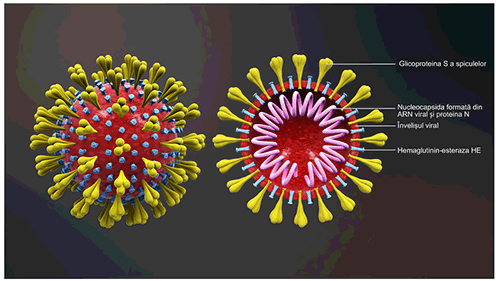
If the virus has a key to get into our cells, this is like making millions of decoy locks that stick to the keys and thus disable them.
What if we could coat our lungs with tiny particles that work like PPE against coronavirus? The aim here is that one nasal spray a day might stop the virus getting entry into our cells. At the moment, one team have this working in the lab already. They’ve created a kind of cut down mini antibody, and at this stage it sticks like glue to the viral spikes. It still needs to be tested in humans, and might yet fall in a hole. But it’s another example of the potential contained in molecular engineering on a scale like we’ve never done before. And we know something like this works in Camels, Alpacas and Llamas, because that’s where the inspiration came from — so it’s not entirely crazy.
Perhaps we’ll just “spray up” for holidays and parties?
The numbers involved in just this one research project are boggling. The team at UCSF started out with two billion different nanobodies and screened them down to nine that stick to the hot-money part of the Covid spikes — the key that opens a lock on the outside of your cells (called the ACE2 receptor). The idea is that any Sars Cov-2 viruses rolling around in your lungs will get coated with these little molecules and thus spin on uselessly for days afterwards, unable to use their keys to get in to your cells. The coated virus will get broken down eventually, as all viruses do when they can’t engage and use host machinery.
In short, if this works in people without any nasty side effects, it could change everything.
The process relies on finding a shape that is exactly right — that will only stick to the virus and then not let go. The research team added a clever modification. Because the virus spikes have three repeated “keys’ at the end of the spike, the team repeated and joined three nanobodies together in formation. When one binds, they all bind and it locks the spike up.
The abstract even refers to pico, nano and even a femto units.
And when they drew on the results of both modifications, linking three of the powerful mutated nanobodies together, the results were “off the charts,” said Walter. “It was so effective that it exceeded our ability to measure its potency.”
Back in 1989 researchers realized camel antibodies were like nothing they’d ever seen — much smaller, and that makes them much more stable, and easier to mass produce. We can genetically insert the right code into bacteria and use the microbial world as mass factories to generate billions of Aeronabs.
Derek Lowe writes about the discovery of these long ago, and how they blew away so many theories:
And with that, we shall now abruptly veer off into talking about camels, llamas, alpacas and their kin, because they have their own variety of antibody. No one knew that they had a different system going until 1989, when a student-run project at the Vrije Universiteit Brussel was trying to come up with a diagnostic test to check camels for trypanosome infection. They discovered that camel antibodies were. . .weird. Some of them were just like the ones above, but about 75% of the camel antibodies (and up to 50% in the New World species like llamas) have no light chains at all. They just have the variable parts of the heavy chain stuck directly onto the “base” constant region. Sharks and their relatives, as it turns out, have something similar going on with a different sort of base region, in what are clearly two different evolutionary events: at least 220 million years ago for the cartilaginous fish and 25 million years ago for the camelids. Both sets of animals seem to work just fine with their proprietary systems – before these discoveries, most immunologists would have said that that such modifications would be likely to cripple the antibody response, but not so.
Vaccine testing is very slow in comparison. It aims to train a whole army — and then we have to check the results. This is vastly simpler, now we have the tools…
After WWII medical science conquered the world of bacteria with antibiotics. This then could be the start of the age of the Antivirals?
This video shows how complicated just the spike is, with the separate arms opening to activate the key. The new Aeronabs can join the three units at the top and stop them getting “armed and ready”.
Story sources:
Good news for Donald Trump. Overconfidence meant Bill Shorten lost the unloseable election in Australia last year. Joe Biden is following in his footsteps — spending $2T on a war against cheap energy in a bid for nicer weather that no one believes will happen in their lifetime.
… Joe Biden — armed with a commanding lead in the polls ahead of November’s US presidential election — now promises a root-and-branch overhaul of the American energy system that will put climate change at its heart and which one worried industry adviser describes as “a Tet offensive” on the fossil fuels industry. The plan, which will be aired again at the Democratic party convention this week, earmarks $2tn in spending over the next four years to use climate policy to drag the economy out of its pandemic-era recession.
In Australia they called it “a climate election” and the people voted “No”. The result was surprise and a bitter disappointment to left leaning commentariat. US polls on climate change showed only a few days ago that the voters rank climate second to last. More windmills will not save the US economy from a rogue virus. Either Biden hasn’t done his research or he is overconfident enough to toss in burdensome gambit policies so he can claim a “mandate” afterwards.
Three important findings from three different studies:
1. That people who survive Covid have more antibodies against Covid virus spikes than the nucleocapsid shell.
2. Monoclonal antibodies against the spike are already being developed and are progressing apace.
3. But many antibody tests are looking for the wrong antibodies.
A new study found a different pattern of antibody responses in people who recovered from Covid compared to those who died. Survivors had a antibodies predominantly against the viral spike (S), whereas early in the infection those who would not recover had more antibodies against the outer shell, known as the nucleocapsid (N). This has implications — in vaccines, testing, treatment and possibly figuring out why some people don’t even get sick at all.
Atyeo et al is a small study. But one tantalizing line suggests the pattern of antibody responses was even better at predicting who would die than the age of the patient, which was until now the best clue we had. It appears that some patients had a strong immune response but they were making more of the wrong kind of antibodies, and perhaps these would not able to neutralize, or stop the virus spreading within.
Atyeo et al looked at 22 patients to find out the difference between the immune responses of those who died and those who didn’t. Then they tested how well they could predict who would live and die in another group of 40 patients.
Vaccines that elicit a reaction to the spike will be more useful. Vaccines that don’t may even do more harm than good.
On each SARS Cov2 virion there are around 100 copies of the spike but there are 1,000 copies of the nucleocapsid. So viruses may be producing ten times as much N type protein. No wonder then that some people are reacting to the N protein. The researchers wondered if it was sheer viral load that defined who would survive, but say the data suggests that it was the failure to produce S protein antibodies that was more important.
Perhaps it’s bad luck and random chance, but it may turn out that past exposure to particular coronavirus common colds (which leaves some T-cell protection) could either help or hurt the development of the right antibodies. (More T-cells soon, but not today).
Monoclonal antibodies may save the day
Ideally we could just inject the right antibodies into people and give them instant — albeit temporary — protection. But blood plasma from recovered patients is not exactly on tap and may come with “other surprises”. But there are teams working on isolating the “memory B cells” from survivors and then choosing the best so we can clone them up. These are called monoclonal antibodies, and will allow mass production of the right antibodies.
One NIH team have already picked five survivors, and isolated 252 monoclonal antibody potential lines to check. 19 of those turned out to be very useful at neutralizing the virus. Nine directly targeted the hot receptor binding domain on the end of the spike, which is probably the most useful way to stop the virus getting into human cells.
Even if we don’t get a vaccine that worked well, we can always ramp up mass production of these monoclonal antibodies. We can give these to people with weakened immune systems who couldn’t mount their own defense, and unlike a vaccine, we don’t have to wait weeks for them to develop protection. We can also give them to health workers or high risk people to prevent them getting sick in the first place. This protection may last weeks or months.
It’s just one of many tools we now have, and just another reason why I’m so optimistic that we will find a way to beat this virus sooner rather than later. It’s just a question of time.
All the restrictions and quarantines are temporary — and there are hundreds of solutions on the way.
Millions of serology tests may be looking for the wrong antibodies
Antibody tests often look for antibodies targeting the nucleocapsid, but not also the spike. Which means they may overestimate the amount of people with the healthy protective type of antibody.
In the second study (McAndrews et al) used 484 blood samples from before the pandemic, and found about 3% of healthy people who’ve never had Covid have antibodies to the coronavirus nucleocapsid, but they don’t have any antibodies to the Covid virus spike. In samples from Houston in 2020, slightly more, 3.6%, have antibodies to the nucleocapsid, but only about 1.6% have antibodies to the spike.
Abbott and Roche have together shipped over 23 million antibody tests to the US. It appears these confirm only antibodies to the N-protein, with over 200 commercial and hospital laboratory testing facilities currently using these tests. The authors warn that we need better targeted antibody tests to figure out who is immune to Covid. Though the published seroconversion studies are looking for antibodies to the spikes.
To put that in perspective, we already know that a bit under half of the population won’t get a symptomatic reaction to Covid. But we still don’t know why that’s the case or who they are in advance. This research doesn’t change the asymptomatic rate. But people testing positive to the antibody test may not have the protection that they think they have.
Rolling blackouts could affect up to 250,000 homes and businesses in the state
Such a power cut has not been implemented since 2001, when there was a massive electric crisis
San Joaquin Valley will see temperatures of 112 degrees and Los Angeles is expected to reach 96 degrees
So that’s a hot 44.4 C in the San Joaquin Valley, while L.A.’s extreme heatwave is all of 35. degrees C. These are the first set of rolling blackouts since 2001. Obviously the USA is behind Australia in the race to the Unreliable Future.
With temperatures soaring above 100 degrees in many parts of the state, and millions of residents stuck at home amid the coronavirus pandemic, experts feared the high demand for power would overwhelm the grid.
‘A Stage 3 Emergency is declared when demand outpaces available supply. Rotating power interruptions have been initiated to maintain stability of the electric grid,’ the Independent System Operator announced shortly before 6pm.
Despite residents being networked, swamped in twitter, facebook, mobile phones, tablets and spam they were not able to be notified:
Residents were unable to be notified due to the emergency announcement, leaving thousands of vulnerable people suddenly without air-conditioning in the midst of a severe heatwave.
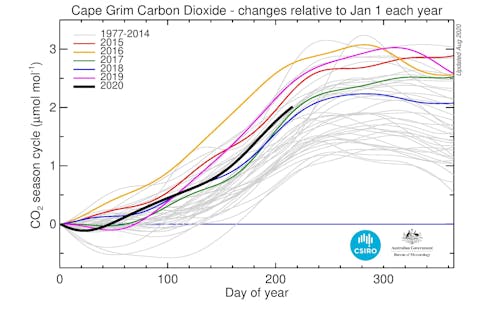
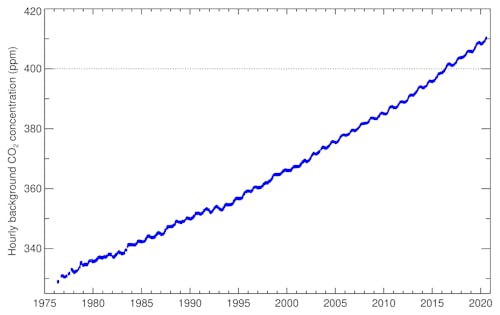
They told us if we stopped driving our cars that global CO2 levels would fall. But after 6 months of the most draconian low carbon diet ever, Cape Grimm Tasmania is still measuring a normal rise in CO2 levels.
Here’s the wild absurdity — Covid restrictions are expected to cut human emissions by 4 – 7% but to reach the Paris Target, we “need” exactly that kind of reduction every single year for the next ten years.
Zoe Loh, Helen Cleaugh, Paul Krummel, Ray Langanfelds, The Conversion
…our measurements show more CO₂ accumulated in the atmosphere between January and July 2020 than during the same period in 2017 or 2018.
Look at the graph (below) of CO2 levels rising on their annual cycle each year.
There was a huge reduction from 2016 to 2017. It’s almost like China built lots of coal power plants, then disassembled them. That, or perhaps CO2 levels are controlled by plankton and have nothing much to do with human activity.
This is terrible news, but it’s helpful terrible news?:
It’s clear COVID-19 has not solved the climate change problem. But this fact helps us understand the magnitude of change required if we’re to stabilise the global climate system
Their excuses are entertaining — Cape Grimm doesn’t show any reduction yet because it’s a long way from the Northern Hemisphere where the biggest reductions were, and the reductions are a “drop in the ocean”.
Spot the effect of coronavirus:
Do the emissions maths
Covid restrictions are expected to cut human emissions by 4 – 7% but the bald truth is that we need a 3 to 7% reduction every single year. And for the next ten years.
Research in May estimated that due to the COVID-19 lockdowns, global annual average emissions for 2020 would be between 4.2% and 7.5% lower than for 2019.
Let’s simplistically assume CO₂ concentration growth reduces by the same amount. There would be 0.08-0.23 ppm less CO₂ in the atmosphere by the end of 2020 than if no pandemic occurred. This variation is well within the natural 1 ppm/year annual variability in CO₂ growth.
To achieve [The Paris Target], global CO₂ emissions must decline by 3% and 7% each year, respectively, until 2030, according to the United Nations Emissions Gap Report.
Previously Tom Quirk found a huge 2.5Gt carbon spike in 1990 (which is 9Gt of CO2) — as if three extra Chinas were suddenly emitting CO2 that year. The best explanation was that changes in wind patterns and ocean currents meant it was a bad year for phytoplankton. When phytoplankton struggle, they don’t draw down the usual CO2, hence the spike.
Donald Trump would be delighted if Biden and Harris make climate change a leading issue.
Climate change is the luxury fear people wear on their sleeves when they can afford it. It’s a piece of fashion. Optional and discarded at a moment’s notice.
Amid COVID-19, Americans don’t care about climate change anymore
Will Johnson, Fortune Magazine
In a survey we at the Harris Poll conducted last December, American adults said climate change was the number one issue facing society. Today, it comes in second to last on a list of a dozen options, ahead of only overpopulation. Among Gen X men, in fact, more than third dismiss climate change as unimportant. COVID-19 and the recession have, of course, reordered priorities around the world.
We asked a panel of U.S. adults a series of questions about today’s most crucial issues, environmental policy options, and their own behavior. In all three categories, I was personally surprised and discouraged to discover that our devotion to the world around us is flagging.
And when the pandemic ends—or at least is suitably controlled—American adults say they’ll behave in ways that would increase their carbon footprint. According to our survey, we’ll drive as much as we did before, take public transportation less, bicycle or walk less, buy more clothes, and have more stuff packaged up and shipped to our homes. And most of us plan to jack up the home AC and heat even more than we already have.
It’s taken two decades of relentless advertising to achieve mass compliance and new habits, but just a few months to be reminded of how convenient some things are. The pandemic gave people permission to break the old rules.
This must be killing the greens.
This is perhaps not as huge a shift as implied. Climate change belief has always been wafer thin, and prone to coming and going at a moments notice. No matter how many “cared” when asked the right question, when they have to rank their concerns “climate change” is always near the bottom.
Just letting readers know that I and the moderation team are trying to find ways to improve the quality of the comments in some threads. In a frustrating, difficult era, we’re especially looking for old fashioned good manners.
Kamala Harris is running to be the next US President. In case anyone hasn’t heard, rumors are that Joe Biden health is iffy and he is the temporary filler to get over the line, and if so, the VP then becomes The P. It’s not just a fringe idea. In a Rasmussen poll, 59% of voters say “it’s likely.”
So, the pocket guide to Kamala Harris for skeptics is that according to Progressive Punch, she’s further left than Bernie Sanders which is quite the feat. Appropriately she has a $10 Trillion dollar plan to get better weather, and “aims to reduce greenhouse gas emissions to zero by 2045” — which would be five years quicker than the famous Green New Deal.
There are various measures for these things, but according to Progressive Punch (“Leading with the Left”), Kamala Harris is the fourth farthest-left of any senator with a score of 96.76 percent out of 100 on “crucial votes,” despite moderating very slightly in the period when she was running for president. Elizabeth Warren is fifth, Kirsten Gillibrand is sixth, and Bernie Sanders is tenth. Here is a portion of the chart.
Put another way, there are 100 Senators in the US Congress and apparently only 3 were more radical.
Kamala Harris was a state attorney general who abused her position to try to silence skeptics.
Harris was a leader in the junta of Democratic state attorneys general that attempted to criminalize dissent in the matter of global warming, using her office’s investigatory powers to target and harass non-profit policy groups while she and her counterpart in New York attempted to shake down Exxon on phony fraud cases.
Until she was stopped by a federal court, Harris was laying subpoenas on organizations such as the Americans for Prosperity Foundation, a conservative-leaning group that is critical of Democratic global-warming proposals. She demanded private information that the organizations were not legally obliged to disclose, including financial information and donor lists, in order to be able to subject the supporters of right-leaning groups to legal and financial harassment. This was, as a federal judge confirmed, an obvious and unquestionable violation of the First Amendment. It was also a serious abuse of power.
Why does any of this matter in far distant Oz? In a world of Sino sabre-rattling the leader of the planet’s largest military force has a certain gravitational pull on policies overseas. Any nation that hopes to share the umbrella will feel reluctant to walk a wildly different path.
Eighty two days to go.
Contradictions abound in the Rasmussen poll. The VP may be President one day, but more than half of the voters don’t care who Biden picks. And more than half the country say they won’t vote for Trump, but aren’t interested in who they will vote for. Welcome to 2020 politics:
… only 45% of all voters say Biden’s choice of a running mate is important to their vote this fall, including 23% who say it’s Very Important. This compares to 76% who say generally speaking that a candidate’s vice presidential nominee is important to their vote, with 34% who feel it’s Very Important.
Lockdowns and border closures mean many diseases have been prevented
It’s peak season for flu here in Australia and there’s almost no sign of it. As Chris Gillham wrote here back in May, we know lockdowns stop viruses, because flu cases are 85% down. Now he shows that this extends to other diseases too, and Chris has used data from the National Notifiable Diseases Surveillance System to calculate that just shy of 200,000 fewer Australians contracted any of the notifiable diseases in the first seven months of 2020 compared to the first seven months of 2019.
Is some of that disease burden just the price of holiday-makers bringing back diseases from overseas each year?
No one wants to stop the planes returning to the skies, but it begs the question — do we have to accept the onslaught of winter germs every year?
The answer may lie with other things we’ve discovered in the Covid pandemic too — that sick people should stay home from work and school, and that we have a lot of anti-viral tools we can use. Perhaps it’s time that travellers considered taking preemptive anti-virals, which might improve their holidays and also reduce the disease burden back at home.
The huge suppression of influenza and other non-COVID diseases also adds a new perspective to the pandemic sick leave funding in Victoria that compensates low-income earners in particular who have run out of annual sick days and are showing up to work despite feeling ill because they fear for their jobs and their earnings. Should such funding always be available nationally to counter the possible long-term suppression of not only COVID-19 but all communicable diseases, some potentially deadly, with resultant public health cost savings?
A reduction in so many diseases is surely a productivity boon to both employers and the population at large. …
Lockdowns have almost wiped out influenza
…
Notably the reduction includes other diseases like syphilis and salmonella which are not respiratory diseases (see the graph below).
Covid restrictions have restricted a lot of other diseases too.
…
Here’s the last four months of influenza from a global perspective — almost 97% down and this is across ten countries, not just Australia, with their most recent updates to the WHO FluNet:
WHO, Graph, Influenza Week 28, 2020.
Near the peak of the flu seasons in the southern hemisphere, the WHO chart below shows all subtypes of influenza have all but disappeared. The 2019 Flu season was a bumper year in Australia, far above the norm. But there has never been a flu season like this one.
WHO, Graph, Influenza Week 28, 2020.
Here’s all the data on all the notifiable diseases.
WHO, Graph, Influenza Week 31, 2020.
Fewer infections could mean lower immunity, but antivirals and biotech can make up for that
We stand on the cusp of a biotech revolution. Like the point computers were at 40 years ago, and medicine was post- WWII with antibiotics and mass vaccines. We have the code for living things. We can do mass arrays, mass testing. People can sequencing their genes “for fun” for a couple of hundred dollars to find ancestors, and risky nucleotides. We are starting to customize and personalize treatment like never before. (What’s your APOE risk?)
UPDATE: To get a taste of the speed of the biotech revolution ponder that in 1990 the Human Genome Project was projected to cost $3 billion and take 15 years, instead it came in faster than expected and far under budget. Today you can get your whole genome sequenced in full for $1,000 and more than a million people have already done it.
Reducing the scourge of disease potentially puts us at a higher risk from novel viruses, but that can be more than offset through the rapidly growing supply of antivirals, CRISPR, monoclonal antibodies, stem cells, RNAi, and new RNA and Recombinant vector vaccines. (Why have antivirals been so ignored for so many years?)
In any case, the threat of newer and darker bioweapons makes the need to beat viruses more urgent than ever. Catching more strains of the flu isn’t going to save us from a Nipah virus or hemorrhagic fever.
We already have major policy programs that reduce infections but increase the future disease risk
Vaccines, so far, can’t elicit the same long term protection that viruses do. Natural influenza infections produce life long immunity to that particular strain of influenza and partial immunity to related strains, but at the price of some deaths, and much morbidity. Vaccines try to mimic the viruses, but protection is often short lived.
Perhaps just using masks when sick, staying home, having antivirals ready and Over-the-counter, along with better handwashing and hygiene will become normal business and social ettiquette and we can spend more of our lives being healthy.
One of the most abrupt climate change events in human existence was the Younger Dryas period about 13,000 years ago, and even though it was so sharp, and so severe, and so recent (geologically speaking) we still don’t know what caused it. A new paper argues that it is likely it was a volcano. But previously researchers have said “asteroid”.
The Earth was warming out of the last ice age, when it suddenly cooled, and stayed cold for twelve centuries, then warmed again, just as abruptly. This is what real climate change looks like, something we mere mortals are unprepared for and apparently have no way of predicting.
Spare a thought for the people alive at the time. They were subject to a fall of three degrees Celsius, apparently in the space of just one year, perhaps triggered by volcanic dust that darkened the sky. What is still far from explained, whether it was by volcano or falling rock, was why the coldness continued so long then so suddenly ended. The snap change wiped out some species, like possibly the last mammoths, and in some locations camels and horses.
The volcanic dust is thought to have fallen out within a few years. Presumably, the spreading reflective snow and ice locked in a cold era that would last 50 generations, but we don’t really know. If only we had scientific climate models that worked?
UPDATE: Coming soon, a better more likely explanation involving the sun. This volcano theory is really an excuse to remind us of what real climate change is like, and how little we know.
When is the next big volcano due, and is anyone prepared for that?
Ancient sediment found in a central Texas cave appears to solve the mystery of why the Earth cooled suddenly about 13,000 years ago, according to a research study co-authored by a Texas A&M University professor.
Some researchers believed the event – which cooled the Earth by about 3 degrees Centigrade, a huge amount – was caused by an extraterrestrial impact with the Earth, such as a meteor collision.
But Waters and the team found that the evidence left in layers of sediment in Hall’s Cave were almost certainly the result of volcanic eruptions.
Something that marks how strange times are, was that in March and April, a group of seismologists found seismic activity fell by 50% at 185 stations around the world (at least in certain high frequency bands from 4 – 14 Hz). For example the three graphs below show seismic activity in Brussels, Barbados and New Zealand. A slight downturn happens at Christmas but the lockdown period fell far below that.
Co-author Dr Stephen Hicks, from Imperial’s Department of Earth Science and Engineering, said: “This quiet period is likely the longest and largest dampening of human-caused seismic noise since we started monitoring the Earth in detail using vast monitoring networks of seismometers.
Who knows what they might figure out now they have a handle on human background “noise”.
(B) Lockdown effects in hiFSAN compared with audible environmental noise and independent mobility data in Brussels, Belgium. (C) Lockdown effect in Barbados compared to noise levels in the last decade (in gray) and correlation with local flight data at the Grantley Adams International Airport (TBPB) (24). (D) Lockdown noise reduction recorded on borehole seismometers in Auckland, New Zealand. (Click to enlarge).
For the record, there will be an array of other frequencies that aren’t listed here because they didn’t change much.
It’s just a bit of Covid trivia, but as an opportunity for experiments, 2020 is surely a researchers dream.
We use cookies to ensure that we give you the best experience on our website. If you continue to use this site we will assume that you are happy with it.


 Follow Jo's Tweets









Recent Comments