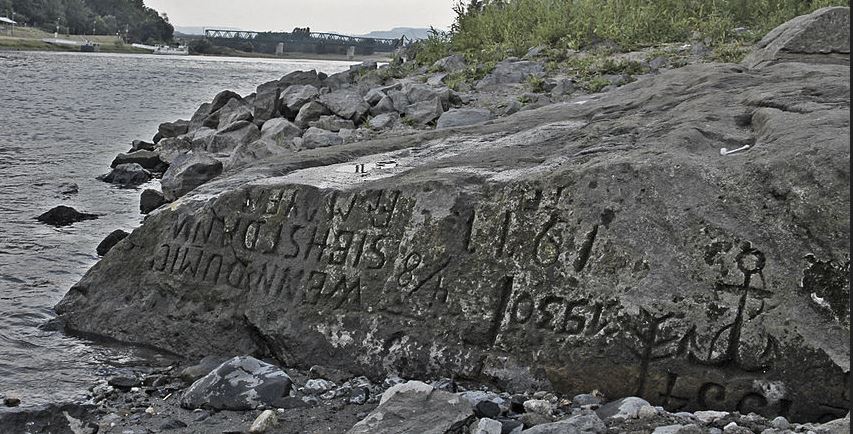
View of the Hunger Stone on the Elbe in Děčín. The stone marks the low water levels of the Elbe with different dates.
By Jo Nova
Using United Nations Science TM — who can deny that the megadrought of 1540 was a man-made creation? Freakish weather was the new norm. The 1530s was described as one of the driest decades of the last 500 years. Bushfires raged, cattle starved, rivers dried up, and people died of dysentery. The hunger stones appeared on the bottom of the Elbe River (again). The Rhine dried up in parts so people could walk across.
In 1535 one drought caused a famine so bad that in Transylvania dead bodies “littered the roads” and men and women wandered the streets, mad with hunger, eating cats, dogs and supposedly even other people.
Religious leaders called it “end times” — other leaders searched for scapegoats. Those in charge started looking for secret symbols of organized arsonists they could blame for the fires. Water was so scare that some towns banned laundering of clothes. Apparently “everything stank”. And all this was in the midst of the Little Ice Age and with no coal plants in sight for another 300 years.
The 1540 event is famous with climate scientists, not that they mention it much, possibly because it was so awful and they can’t blame CO2. At least one expert in The Smithsonian suggests that people may have forgotten the worst drought in 500 years because the weather in the next fifty years got even more horrid as things got colder.
On the plus side, they invented a new Spätlese style of sweet wine in 1540 because the fruit dried on the vine and they waited for more rain before harvesting it. Apparently it was so delicious people drank “like pigs” and lay in the gutters.
The 1540 megadrought brought mass suffering to the continent
The Smithsonian
Occurring during a stretch of unusually warm summers in the midst of Europe’s “Little Ice Age,” a period of global cooling and extreme weather that affected the continent between the 14th and 19th centuries, the 1540 drought’s heat was so extreme that even state-of-the-art climate models could not predict it when fed nearly 1,200 years of climate data.
n a 2014 paper that calls the drought a “worst case,” Pfister and his colleagues showed that rainfall was down by as much as 80 percent in some regions. Rivers like the Rhine, Elbe and Seine dried up to the point that people could wade across them on foot. The Thames was so low that the sea flowed inland and reversed the river’s direction.
Like today, receding waters revealed lost treasures from previous generations. Chroniclers marveled when, on the shores of the shrinking Lake Constance, a woman named Anna Schmid came across 900 silver coins from the time of Emperor Augustus.
Away from the water, there was little silver lining. Farmers’ fields became so dry that giant cracks deep enough to swallow people’s legs appeared in the soil. That dried-up earth reflected even more heat into the atmosphere, feeding an unbearable heatwave that the Protestant reformer Martin Luther interpreted as a sign of the end times. Officials ordered clergy in Germany, Italy and England to beg God for forgiveness and pray for the deliverance of rain.
The extreme heat meant that by the usual harvest time, grapes in Germany and France had dried almost to raisins. The resulting “late harvest,” or Spätlese, wine was deliciously sweet.
Food was in similarly short supply. With nowhere to pasture, cattle died of heat stroke and hunger, decimating Europe’s dairy supply.
As if famine wasn’t enough, Europeans were also chased from their homes by forest and structural fires—the most in any peacetime year since at least 1000 C.E. One blaze reduced the entire German town of Einbeck “to ashes in a matter of hours,” causing as many as 500 deaths, wrote Pfister in 2017.
With tens of thousands left unhoused, unemployed and often diseased, local leaders quickly gave in to paranoia to explain the calamities. Authorities searched for the alleged secret symbols of mordbrenner, or organized arsonists, whom they blamed for setting fires.
Lest we forget… Europe has always had extreme weather.
In 1540, a wave of such heat,
Covering Europe, would unlikely repeat,
Dried rivers without rain,
Which for months did sustain,
Making modern droughts take a backseat.
— Ruairi
Related posts:
- Megadroughts were longer and deeper in the last 2000 years.
- The 1540 Megadrought in Europe: Rhine ran dry, fires burned, and no one blamed coal or beef steak
Photo caption: The oldest legible inscription dates from 1616. Older inscriptions (1417, 1473) were rubbed off over time by ships at anchor. The stone is also inscribed with the saying “Girl, do not cry and do not complain, when it is dry, spray the field”. This saying was probably made in 1938 by the pump manufacturer Frantisek Sigmund. The saying was based on the older saying “If you see me, then cry”. The Deciner Hungerstein is one of the oldest hydrological monuments on the Elbe. The Tyrš Bridge and Shepherd’s Wall can be seen in the background.






.JPG)
July in Europe will be beautiful and very warm.
120
Yep, heat is regenerating.
https://climateimpactcompany.com/ag-market-early-global-weather-climate-alert-worse-case-scenario-for-europe-as-southwest-europe-heat-regenerates-and-pounces-on-france-medium-range-2/
31
The hungerstone carries the text:
wenn du mich siehst dann weine
If you see me, weep
Says it all, methinks.
220
Sadly, all of Europe’s young maidens’ tears wouldn’t be enough to raise the level of the dehydrated river(s). Obviously they were aware of the mediocre-eval prophet, Flim Flam, and his end-of-days pronouncement: Even if it rains, it won’t be enough to fill the Rhine, the Elbe or the Seine … mark my words.
Mark them? OK, F for Fail.
350
Tony Heller posted this newspaper clipping.
Note some of the temperatures are quoted on the Réaumur scale, some with correct (°F), so they are in places actually reporting 43/45°C!
https://x.com/TonyClimate/status/2069390169996980474
We worry about our changing climate from the viewpoint of our own lifetime, but obviously the natural variations are on completely different timescales. There is no ‘normal’.
291
The average state of the climate for the last million years is sea level 50m below present level and land north of 40N covered in thick ice.
So “average” depends on the time horizon.
The “average” for the Holocene is about 1m higher sea level and 2C warmer than present.
The propaganda press push the notion that the average was whatever existed back in 1850.
I asked Copilot to give me two paragraphs on life expectancy and weather in the 1850s to 1900 – when the weather was perfect. Australia is literally spending trillions to get back to those good times:
Life expectancy in the mid‑19th century was typically only around 30–40 years at birth, but this low figure was driven primarily by extremely high infant and child mortality rather than short adult lifespans. In many regions, between 30% and 50% of children died before the age of five, largely due to infectious disease, poor sanitation, and chronic malnutrition. Those who survived early childhood often lived into their 50s or beyond, but overall populations were highly vulnerable to fluctuations in food supply. Malnutrition was widespread, particularly in agrarian societies where harvest failure directly translated into famine, and where limited transport infrastructure prevented redistribution of food from surplus regions. As a result, life expectancy was tightly coupled to environmental stability and agricultural output.
Weather and climate events were therefore far more lethal than today because their effects cascaded through food systems. Droughts, failed monsoons, floods and severe winters frequently triggered famine, disease, and mass mortality rather than only direct storm casualties. In the late 19th century, for example, major climate events such as the 1877–78 El Niño contributed to global famines that killed tens of millions of people, representing several percent of the world’s population at the time. Even outside such extreme episodes, it was common for weather-related crises to cause hundreds of thousands to millions of deaths in single events or prolonged droughts. This reflects not only the variability of the climate system but, more importantly, the high vulnerability of societies before modern agriculture, transport, medicine, and disaster response systems.
The current government is on track to restore Australia to those wonderful days before the demon fossil fuels ruined the climate and CO2 released made agriculture more predictable..
140
Climate Change? Yes.
But NOT Man/Woman made……….
290
Weather is cyclical. Wow, who would have thought.(sic). The idea, humanity’s tiny 2-3% of 0.04% CO2-a colourless, odourless, inert trace gas so rare, it’s almost extinct & exponentially exceeded by water vapour as a ‘GHG’-influences anything, is an infantile disinformation campaign.
390
And foolish community leaders and politicians by the sound of it.
300
And foolish community leaders and politicians by the sound of it.
Unfortunately a pretty common occurrence…..
00
Thank you Jo for raising one of my favourite subjects again: history, in all its vastness.
The first book purchased with my own money as a young fella, earned from after-school part-time jobs, was
https://en.wikipedia.org/wiki/The_Book_of_the_Damned
“A procession of the dammed. By the dammed I mean the excluded. We shall have a procession of data that Science has excluded”.
https://publicdomainreview.org/essay/charles-fort-and-the-book-of-the-dammed/
With such a wide-ranging documentation of odd and inexplicable ‘events’ over the centuries, is it any wonder my scepticism of authority and ‘trusted news sources’ commenced at an early age and, thankfully, has yet to wane.
As Roger Waters of Pink Floyd didn’t write:
Ooh look, Mummy, there’s a fish in the sky!
220
Unauthorised spellchuck –
https://publicdomainreview.org/essay/charles-fort-and-the-book-of-the-damned/
NB. The above link works. Dammed* stoopid 😃
120
Not so long ago there was a severe drought in the UK, I was visiting family at their home in Gloucestershire during summer and it was hot and dry …
The 1976 drought in the UK was one of the most severe on record, lasting from May 1975 to August 1976, with significant impacts including water shortages, crop failures, and the introduction of water rationing. It was marked by prolonged heat, with temperatures exceeding 30°C for many consecutive days, and led to the passing of the Drought Act 1976 to manage the crisis.
210
Dennis co2 levels were only about 330 ppm in 1976 and that’s under Dr Hansen’s so called safe level of 350 ppm as quoted by his dopey pupil Al Gore.
And about 275 ppm in the mega drought in 1540. I wonder are the lights starting to come on for the clueless donkeys and also the con artists and liars? Probably not.
https://www.statista.com/statistics/1091926/atmospheric-concentration-of-co2-historic/
230
Again, we are living in the safest period in Human history today and Dr Pielke Jr has even added up the deaths from all extreme weather events for 2025 to prove it.
But extreme weather event deaths from the 1960s to 2025 have dropped a lot and since 2000.
Never forget that there are 8.2 billion people at risk today and only 1.6 billion in 1900, 2.5 billion in 1950 and yet very few deaths from extreme weather events today in 2025.
Let’s face it most people have lost the ability to THINK today and that’s also the main reason we have a clueless Labor govt in Australia and every chance of a repeat dose in 2028. Unbelievable but true.
220
Here’s the link to Dr Pielke jr’s deaths tally in 2025 of about 0.8 deaths per million people and compared to the terrible numbers in previous decades and centuries.
https://rogerpielkejr.substack.com/p/congratulations-world
90
Here’s the OWI data death rates for all extreme weather events since 1900 and droughts and floods have always been the biggest killers.
This also includes volcanoes and earthquakes and unfortunately not much we can do about these deaths.
https://ourworldindata.org/grapher/natural-disasters-deaths?type=all_stacked×pan=decadal&metric=per_capita
60
And this was with a very stable CO2 of 3/10,000th of the atmosphere
110
It does have a place in our equilibrium temperature. But increasing CO2 by 50% in 250 years has almost zero effect. Physics can prove that even doubling CO2 from this point would increase world temperatures by 0.71C. My point below is that humans have zero effect on CO2 anyway. Emissions are irrelevant. All that matters is ocean temperature as 98% of CO2 is in the ocean. Warm the ocean, as from the Little Ice Age, and you get a little more CO2. But it doesn’t change the weather and we can do nothing about it anyway.
181
TdeF, why do you say physics can prove 1.7C for a doubling, is that a typo? The rate even the believers quote, like James Hansen (1984) is only 1.2C at most — this is the pure effect of CO2 doubling without any of the theoretical (incorrect) water vapor feedback effects the climate models pretend are amplifying the effect of CO2.
Obviously if water vapor feedbacks are negative the effect of CO2 doubling will be less than 1C, which is what the data from the weather balloons suggests. The effect of doubling CO2 may be as low as 0.25-0.5C (close to nothing and all beneficial).
But yes, I agree, it doesn’t appear that humans are the ones controlling CO2 global atmospheric levels anyway.
160
Sorry, typo, 1.7C should have been read 0.71C.
A 1% change in emissivity from doubling CO2 means a (1/4)% of total temperature or 0.71C. This is in another 250 years at the current rate of growth of CO2, less than 1 degree. Explained at 20.00 in the Happer lecture.
As you know I otherwise disagree with Prof Happer about the alleged human source of the 50% increase in atmospheric CO2.
That is dynamic physical chemistry as CO2 is so very soluble that 98% of this gas is in the oceans and swaps out every 5 years in exchanges at the sea/air boundary . Almost all of our ’emissions’ from fossil fuel are in the ocean in 5 years, often within a few months. And as only 2% of CO2 is in the air, 98% of all ’emissions’ stays in the oceans.
Humans have no control over atmospheric CO2 whatsoever. It is the vapour pressure of a dissolved gas. Exactly like water itself. It’s like saying human emissions of equal parts of fossil fuel water vapour from combustion raises the sea level or the humidity. It’s ridiculous. In the context of the TOTAL amount of water, fossil fuel H2O is insignificant.
130
Ok, it is 0.71C not 1.7C for doubling of CO2 from present levels.
I have not even seen that figure justified by any analysis . Maybe Happer just asserts it.
Can anyone come up with something better?
00
Happer partially explains it and I will have to watch that lecture over again. I did actually attend in Melbourne when he gave it.
However I think he leaves a lot out.
00
I gave the link. Happer’s analysis of the total absorption of the spectrum shows that doubling CO2 reduces ’emissivity’ by 1%. As he says, the IPCC has the same figure.
Then he uses physics to translate this into temperature change using established formulae. It’s open and shut.
My view is that is Happer’s specific and lifelong expertise as a tenured professor in the subject at Princeton for half a century. However the essential part missing is the idea that fossil fuel CO2 controls atmospheric CO2 is nonsense. So whether additional CO2 causes warming, man is not responsible for the additional CO2. That has been known science fact for 66 years. And the benefits of additional Co2 are fantastic.
So it’s all a beatup by the UN. Who want $1Tn to fix the problem.
10
“And all this was in the midst of the Little Ice Age”
People think droughts are a result of heat. Quite the reverse.
It’s very simple. The water comes from ocean evaporation driven solely by temperature. What matters to all climates is water surface temperature. And that is determined by direct heating or solar cycles and by ocean currents which are three dimensional as water rises when it hits continents and swirls into gigantic eddies as the planet spins.
Nothing to do with Carbon Dioxide which has apparently risen 50% in 250 years which is 0.2% per annum. And almost a straight line of very low slope in the last 50 years while CO2 ’emissions’ have gone up 3500%.
Which proves they are not at all connected. So CO2 levels are not man made, as we have known conclusively since 1958.
Still the UN wants an urgent $1million million to fix the problem. Of course they do. They invented it.
240
Taking this a little further, to prove that CO2 is irrelevant, it was an Omega block
‘Following a hot, dry spring, the event was triggered by a high-pressure system (an omega block) in the summer, which blocked the Atlantic air currents for several months while cool, showery weather prevailed in western Russia.’ (wiki)
91
Just because Europe has always had extreme weather doesn’t mean that we should wilfully make it more extreme.
141
Still just phoning it in?
140
Is this meant to be ironic?
210
The sub-solar point was on the Tropic of Cancer last Sunday and is still just a tad south of that at 23.18°N. This is the latitude near the center of the Sahara Desert and the home-grown source region for the hot air in Europe. It is only an area of 9,200,000 square kilometres so we could paint it white. That would increase its reflectivity (albedo) and lower its temperature. There is no other way “we” could willfully make it any different than it is.
{Just taking your lead of “we”, because if you and I each painted 10 sq. m there would have to be a bunch of other wes helping.} 🙂
90
But Simon our weather is much less extreme today and we have the numbers to support this claim.
So how have higher levels of co2 today occurred at a time of much lower death rates from extreme weather events?
And the world is greening, crops are more plentiful, calories per person are much higher, GDP per capita is also the highest since the start of the Industrial Revolution.
You should be trying to increase co2 levels because it provides more health and wealth to be distributed around the world.
Average life expectancy was just 28.5 years until the Ind REV, but has since increased to 73 years and projected to be 80+ years by 2100. See UN projections + world bank etc.
And Dr Nordhaus won the Nobel prize for economics by projecting an increase of 3.4 times higher real incomes by 2100. Dr Tol has also had similar projections.
100
What a wonderful idea, we humans control the weather. Do you know how ridiculous that is? But there are thousands of religions and they cannot all be right. One of them is man made weather.
140
‘ … we should wilfully make it more extreme.’
CO2 does not cause global warming.
70
And we do not control CO2. Which is why everyone measures ’emissions’ because actual CO2 hardly changes. Unless someone thinks a constant 0.4% pa growth for the last 50 years is runaway exponential growth. And before that it was much less, 0.2% pa since 1750. If only inflation was that low.
90
Just because you hope modern extreme weather trends will continue upwards and confirm your theory doesn’t mean historical extreme weather events should be wilfully ignored.
30
Of course!
All those hard working horses and they didn’t have our modern medication to reduce flatulence.
80
I didnt mean to thumb you down. during the lock down of covid 2 ala 19, the co2 level continued its unaltered upward trajectory. I thought that to be a wake up call.
100
What is this a response to?
60
Actually the rate of increase slowed.
41
Did it really? That is an odd thing, since the CO2 is a function of Sea surface temperature .
30
A couple of nature papers. One showing that emissions dropped due to industry throttling back and one showing that it was reflected in global measurements
https://www.nature.com/articles/s41561-022-00965-8
https://www.nature.com/articles/s41558-020-0797-x
40
Perhaps the natural Law of Equilibrium. Not enough CO₂ in the atmosphere throws the Carbon Cycle out of gear so lots of bushfires to fix the imbalance. Also, what’s the liklihood that increased vulcanism also contributed heaps of much needed carbon dioxide?
(Geophysical Research Letters: https://agupubs.onlinelibrary.wiley.com/doi/full/10.1029/2011GL050168)
All up: My opinion on climate: Probable cause is Earth’s geologic pendulum whose frequency is governed by thermonuclear activity on our nearest star, the sun.
120
And here is western Canada and western North America, we are experiencing record rainfall.
70
It illustrates that El Nino is on the rise with low pressure developing in western Canada and eastern US.
Besides the rain you might also be experiencing a drop in temperature from the northerly wind flow.
31
Where I am El Nino means dry, cold, cloudless, low wind winters.
While the wind is low and has been for weeks, it has also been wet, mild, and overcast.
So how do the warmenistas explain that?
I can do it quite simply by pointing at that weather is not climate.
00
On weather maps it’s been blowing out of the north for weeks – I’ve been waiting for headlines like
LA Shivers Through Summer Cold Wave
but no, the snow is only falling in the Dakotas and Idaho and, north of the border, British Columbia & Alberta. Oh Canada… snowing in summer thanks to Justine!
31
The sarcasm eluded me on first glance.
100
Last time I looked, “Ice Ages” were DRY TIMES.
Cold enough to reduce evaporation, thus reduced precipitation, failed crops, starving animals, starving people…..
The massive, kilometres-thick Cordilleran and Laurentide ice-sheets that covered all of Canada and a large strip of the current USA did NOT fall from the sky, in situ.
Ice is less dense than water. Thus the ice sheets were shoved out of the oceans and went ‘terrestrial”. All the time dropping “eratics” and gouging serious holes and “trenches” wherever they went. Even as all of this ice was traveling, its own MASS produced a constant and enormous flow of water a la a giant, inverted ice-skate.
To see some of this “handiwork”, check out the “Channeled Scablands” for some idea of the scale.
https://www.youtube.com/watch?v=SIQZOkVSoZE
(Skip to: 19:32
80
No doubt about it, if you’re wealthy you have a much better chance of a lower death rate today from extreme weather events.
Here’s the charts for all 6 continents and Australia plus wealthy compared to poor countries.
BTW Africa has had a much better outcome since the 1960s comparing it from 1900 to 1960s.
Just 227 million at risk in 1950’s Africa and over 1500 million at risk today.
Australia looks almost like a flat line from 1900 to 2020.
https://ourworldindata.org/grapher/natural-disasters-deaths?country=OWID_WRL~OWID_AFR~AUS~OWID_ASI~OWID_EUR~OWID_LIC~OWID_NAM~OWID_SAM~OWID_OCE~OWID_HIC&type=all_stacked×pan=decadal&metric=per_capita
40
In 1540, a wave of such heat,
Covering Europe, would unlikely repeat,
Dried rivers without rain,
Which for months did sustain,
Making modern droughts take a backseat.
150
My article on increasing tropical solar energy on todays thread shows that this drives tropical moisture that results in increasing precipitation at higher latitudes.
So March April and May solar intensity is increasing across the NH that directly increases summer temperature but it is being moderated to some degree by more moisture in the atmosphere. That will see almost a step change around the Med as the monsoon over the Med kicks in earlier as the years roll by. Atmospheric moisture across Europe presently mostly below 30mm needed to support summer storms.
Med now close to the 30+C needed for monsoon to kick in:
https://earth.nullschool.net/#current/ocean/surface/currents/overlay=sea_surface_temp/orthographic=-347.68,39.40,777/loc=12.228,39.619
120
If I’m not mistaken, that’s meteorology, a real science. Nothing to do with Climate Science which is a system of absolute beliefs and taxes and punishments for carbon offences. As you well know, the Climate is nothing to do with the weather.
140
As I keep saying, the Left think the climate is static in a world that never has or never will change, the same view as Aristotle. Modern science knows this is not true but it doesn’t suit the alarmist Leftists agenda of catastrophic “climate change” which requires the woke West to shut down its energy supply. However, not China which is by far the world’s largest CO2 emitter and responsible for twice the emissions of the next biggest contributor, the United States. Not that CO2 matters, but that’s the claim.
And why do you suppose the naturally warm periods of historical times when Civilisation thrived, the climate optima of the Minoan, Egyptian, Roman and Medieval warm periods have been written out of history?
110
Remember, as Steve said in the Tuesday thread:
120
Europe is currently experiencing a few days of cooler weather and rain. The North Atlantic remains cool.
https://i.ibb.co/Z69TnxH7/mimictpw-europe-latest.gif
40
A period of drought teaches us that we must be prepared for a flood. This is due to the disruption of zonal circulation during periods of weaker solar magnetic activity.
40
The temperature at the North Pole will not rise during the summer for the next several hundred years due to the Earth’s position relative to the Sun.
https://ocean.dmi.dk/arctic/meant80n.uk.php
50
Oops 🥶 oh dear, every time it gets close to the mythical zero line, the temperature worm drops and scurries away… tries again to warm ‘up’ then down it goes, scurrying back to below freezing, or ‘below average’ as experts will never say.
Warming twice as fast as nowhere else, brrrrr… won’t somebody think of the polar bear cubs please… and why do so many English & Europeans drown when they finally get a nice summer’s day, can’t they float?
60
I’m sure they believed it was manmade. This was while the Reformation, triggered by Martin Luther in 1517, was spreading. Catholic and protestant would have blamed each other for incurring divine wrath.
At 500 years’ distance, the Reformation is best understood not as protestant vs Catholic but as a key episode in a continuing struggle between free and institutional churches, the latter having links with the civil authorities and claiming all Christians as members. Only free evangelical churches go back to the New Testament in church organisation as well as theology. Such movements were as viciously persecuted by institutional protestant churches as they had been by Catholicism. There were more of them than one might suspect and they did their best to fly under the radar – see Leonard Verduin’s book “The Reformers and their stepchildren”.
40
Dad knew some Danes and Germans in the 1920’s that were none too impressed with national religions – and had to do with why they were here.
I have memories but no details
20
El Niño?
http://tropic.ssec.wisc.edu/real-time/mtpw2/webAnims/tpw_nrl_colors/samer2/mimictpw_samer2_latest.gif
10
FWIW
“‘You’re Next!’: Democrats Discover the Mob has a Mind of its Own”
Below is my column in The Hill on the Democratic establishment struggling to fend off attacks from the far left in their party. After years of fueling the mob, leaders from House Minority Leader Hakeem Jeffries and Senate Minority Leader Chuck Schumer are finding that the mob has its own ideas about revolutionary change that do not include them.”
https://hotair.com/headlines/2026/06/29/deomcrats-discover-the-mob-has-a-mind-of-its-own-n3816431
30
A little more detail on that 1540 wine. It seems that late harvest term ‘spatlese” (sorry can’t do the umlauts) has been applied retrospectively as it was first used in the latter part of the 18th century.
https://vinworld.net/wine-essays/wine-stories/vintage-1540/?lang=en
Collective memory works actively through this blog. It’s significant that a bottle of wine (given the meticulous notes recorded by winemakers from year to year) has provided some context that is seriously lacking, or ignored, today.
10
“I walk around in Summertime sayin’ how about this heat!!
30
You’re an a**hole 😉
20