|
|
Ted Nordhous argues powerfully that Climate Change is simply not the main event anymore, and the climate punters are shellshocked.
by Ted Nordhous, Foreign Policy
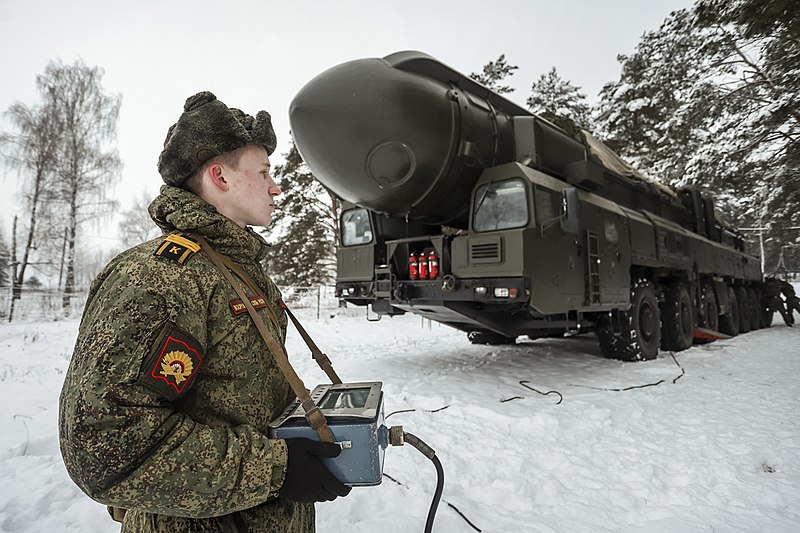
Tactical exercise with the withdrawal of the Topol mobile ground-based missile system in the Serpukhov branch of the Strategic Missile Forces Military Academy
Virtually overnight, the war in Ukraine has brought the post-Cold War era to a close, not just by ending Europe’s long era of peace, but by bringing basic questions of energy access back to the fore.
If recent months have demonstrated anything, it is that war, insecurity, and economic crisis are merciless teachers. Climate advocates and their political allies have often engaged in the policy equivalent of smoking one’s own supply: They have confused the subsidy-driven growth of renewable energy with evidence that the world is ready to rapidly transition off fossil fuels. Hence, they discouraged the production of oil and gas wherever they could and chronically underinvested in other sources of clean energy, such as nuclear power. But while there has been technological progress, the global economy is still very far away from fully replacing fossil fuels.
Climate Change was the filler hob-goblin between the real threats
The issue of climate change burst into the global debate just as the Cold War was coming to an end. As one existential threat seemingly receded, another came into view. For much of the international community, particularly the United Nations and its agencies, climate change also became much more than an environmental issue, offering an opportunity to reshape the post-Cold War order to be more equitable, multilateral, and politically integrated.
And offering the UN a reason to grow, to be bigger, richer, more powerful. There were nice jobs, annual junkets and the feeling they were superheroes.
The political junkies will flex with the times, but the religious zealots won’t:
Much of the climate commentariat—politicians and policymakers, academics and think tank analysts, journalists and activists—appears shellshocked by the violent return of energy geopolitics and fossil fuel shortages.
The 1970s energy crisis left a long term mark:
In response to the energy crises of the 1970s, the United States, rich in both fossil fuel resources and technological capabilities, invested in almost every energy source imaginable. It accelerated the development of coal deposits across the U.S. West, built rail links to bring coal to the Eastern Seaboard, and invested huge resources in the development of unconventional oil and gas production, including shale gas, oil shales, and coal-based synthetic fuels. It also made foundational investments in the commercialization of solar panels, wind turbines, and energy-efficient technologies ranging from LED lighting to combined-cycle gas turbines to fuel-injection engines.
The West hobbled itself in so many ways. Not only by cutting off our own baseload power, but lecturing the developing world, holding them back, and not helping them build the infrastructure they needed. That left the door open to others to fil that role.
Resentment runs deep. For decades, Western environmental and other NGOs, often with the tacit or direct support of governments and international development institutions, have broadly opposed large-scale energy and resource development, from dams to mines to oil and gas extraction.
China and Russia, by contrast, have no such qualms and have leveraged investments in energy, resource extraction, and infrastructure to advance their geopolitical interests. Their intent is to create dependency in ways that advance Moscow’s and Beijing’s economic priorities while creating international leverage. Since the Ukraine invasion, the efficacy of this strategy is now plain for all to see.
The world reduced carbon intensity a lot faster before the UN got involved:
Facts on the ground told a different story. The carbon intensity of the global energy system fell faster in the 30 years before the first major U.N. climate conference than after it—a result of rising energy efficiency, the spread of nuclear power, and the changing composition of the global economy. After 1997, when the Kyoto Protocol was adopted, both total and per capita emissions rose faster than before.
Read it all: https://foreignpolicy.com/2022/06/05/climate-policy-ukraine-russia-energy-security-emissions-cold-war-fossil-fuels/?mc_cid=2f77b4a409
By Ted Nordhaus, the executive director of the Breakthrough Institute.
h/t Benny Pieser and NetZero
Photo mil.ru
10 out of 10 based on 81 ratings
Shh. The Renewable Crash Test Dummy is at work
Another coal fired turbine blew this weekend and will be out for a month, adding to the problems facing the Australian grid, where gas was the main filler-of-gaps in the forced transition but gas now costs a fortune, and we don’t have much else to fall back on. If only we had vast reserves of brown coal that was close to power stations?
If only we looked after those power stations and treated them like our lifestyle depended on them instead of like they were evil Storm Machines Mogambo!
The warnings are growing louder — our aluminium smelters are already going on standby to save us from rolling blackouts and it’s only the first week of winter. Retailers are going broke, asking customers to leave. The market system rides on long term futures contracts which hold the monster prices at bay, and everyone prays a storm doesn’t break an interconnector…
Perry Williams, The Australian
Delta Electricity, which operates NSW’s Vales Point station, said it was concerned by the precarious situation, with fuel costs rising and tight supplies of coal. “There will be consequences of this. There are commercial and industrial customers who just won’t be able to keep going,” Delta chief executive Greg Everett said.
A third of coal units are unavailable in NSW, 27 per cent are out in Queensland and 23 per cent shut in Victoria, according to consultancy WattClarity.
Gas prices are 80 times normal levels:
A rare cap on gas markets of $40 a gigajoule – five times higher than a year earlier – remains in place for Sydney, Melbourne and Brisbane after wholesale prices soared to 80 times normal levels following a cold snap and the demise of Weston.
Not another Government committee solution to a government committee problem…
After spending ten years trying to force old coal plants out of business, now they tell us they need a whole new market system to create incentives to keep the coal plants? These are the same coal plants that are so cheap they outcompeted every other kind of generator for fifty years?
The Energy Security Board, a body created by the nation’s energy ministers to remodel the power system, said it was working on options for a payment mechanism to introduce incentives to stop the early closure of power plants and create long-term signals for investment in dispatchable generation. “We think what we’re seeing with ongoing instances of closing power stations early, it’s critical that we have a market mechanism to get new supply in place when we need it – and to make sure we get the right mix of supply,” the board’s chairman, Anna Collyer, said.
“We can see the economics driving and environmental objectives driving that exit of coal, which just makes it more critical that we’re getting these new investments coming in.
It always fails when someone in the government thinks they know more than “the market” does.
It will take six months until some extra gas arrives:
Santos and its joint venture partner Beach Energy will bring a fifth drilling rig into the gas-rich Cooper Basin to boost supplies, with an extra 15 terajoules a day to flow by the end of 2022. Beach chief executive Morne Engelbrecht said producers increasing volumes was the best industry response.
“Coal shortages and the inability of sufficient renewables to reliably deliver energy security is the main factor driving current higher energy prices,” Mr Engelbrecht will tell a Credit Suisse energy conference on Tuesday.
The turbine that broke is at Liddell:
AGL confirmed on Friday one of three 500 megawatt units at Liddell has been taken out of service for at least a month, with the company blaming a malfunction with a generator transformer.
Can we start up the turbine they shut down at Liddell three months ago?
9.8 out of 10 based on 89 ratings
Australia has no shortage of hot rocks, but it turns out to be harder to capture than people expected:
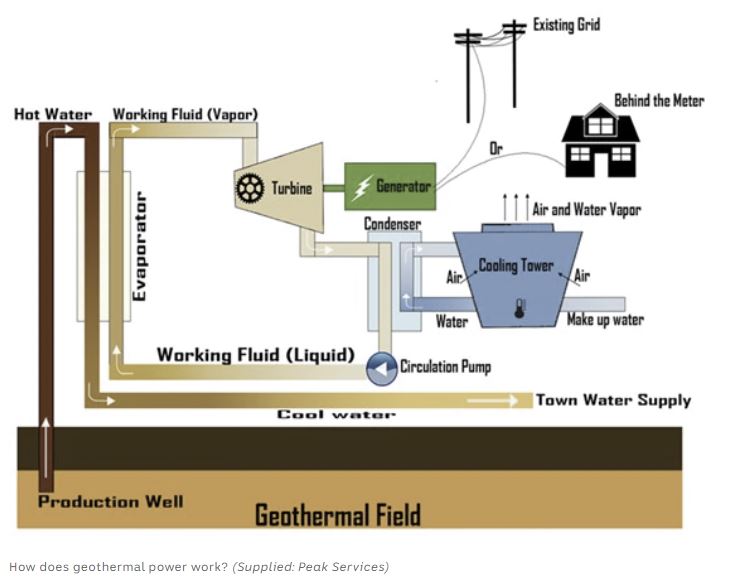
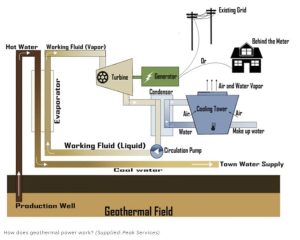 Click to enlarge | ABC Seven years ago everyone was excited in Winton Queensland. The new Geothermal project would only cost $3.5 million but it would save “$15 million” in electricity bills over the next twenty years and “should be operational by the end of 2016”.
Now in 2022:
Council launches legal action over $4m geothermal plant that’s never delivered power
The renewable energy project was set to be the only operating geothermal power plant in the country and was touted as the start of a geothermal windfall in the region. But more than two years since construction finished, it has never delivered power and is not operational.
“It’s bloody disappointing, to put it mildly, for such a great potential for the water that comes into town,” Winton Shire Council Mayor Gavin Baskett said.
What went wrong? “Technical issues”. The ABC doesn’t get to the bottom of this, but the water was just not close enough to boiling.
Martin Pujol, principal hydrogeologist at Rockwater, said at 86C, the Winton project would have been one of the lowest temperatures globally used to produce electricity.
Who did those funding estimates?
In a concept design study, project manager Peak Services — which is owned by the Local Government Association of Queensland (LGAQ)— estimated that the council could save more than $15 million over the first 20 years of operation.
My favourite line from 2016: “We wouldn’t have pulled it on if there were risks.” he said.
The town hopes to salvage something from the town’s white elephant, and no one relishes this failure.
Ultimately, the man-in-the-street needs to know that “free energy” is everywhere but it’s not free to collect. People are being sold a field of dreams and fluffy hope.
h/t Dave in Cooyal.
9.7 out of 10 based on 98 ratings
 The Great Realignment in politics has been coming a long time but it is now starkly lined up as a Class War in most of The Western World, just that quite a lot of voters don’t know it yet, and they are ripe for flipping. The Great Realignment in politics has been coming a long time but it is now starkly lined up as a Class War in most of The Western World, just that quite a lot of voters don’t know it yet, and they are ripe for flipping.
In Australia the tables were turned on a hundred years of history. The poorer half of the country voted for the conservatives, the richer half for the Labor Party, and the Richest of the Rich voted for the Teal-High-Fashion-Parade — the Gucci-Prada of Political Parties — the ones offering the Gold Plated Global Bragging Points!
I have a Platinium Frequent Flyer Card and I’m so Rich I Vote To Save The World!
People in Labor seats earned $8,000 a year more than people in Liberal electorates, but the Green-independents earnt $27,000 more. That’s not something they probably want people to hear.
Reversal of fortune: Labor electorates earn more than Coalition seats
Aaron Patrick Senior correspondent, Australian Financial Review
Households in Labor electorates now earn $8580 more a year than those in Coalition seats – a shift that could have profound effects on politics.
Labor and the Liberals changed places at the 2022 election. At $118,880 a year, households in Liberal seats now earn 2.6 per cent, or $3140 a year, less than Labor-seat dwellers on $122,020. And residents of Greens and independent-held seats are even wealthier. Their average household income last year was $145,690.
The income data may help explain why both main parties are behaving in ways contrary to their historical allegiances. The Labor Party has promised to subsidise childcare for families earning $500,000, and new Liberal leader Peter Dutton has acknowledged his party’s relationship with big business is breaking down.
“The Liberal Party is becoming Labor and Labor is becoming the Liberal Party,” an investment banker who lives in the Sydney seat of Wentworth said this week. “I’ve voted Liberal most of my life. Now I find myself reconsidering.”
The voting-income effects were seen across the metropolitan sprawls. Today, of the 15 highest-earning electorates, seven are held by independents, five by the Labor Party and three by the Coalition (Bradfield, Berowra and Mitchell.) While six Liberal MPs fell to “teal” independents, three of the poorest five electorates swung right.
Years ago when the free market and competition was a bigger part of the economy the wealthier people voted Right, or Conservative, while the workers voted Left. But now the government is the biggest corporation in the country (in all our countries), so it’s the biggest buyer, biggest employer and it decides all the rules as well. So the wealth and the votes has shifted from the fans of the Free Market to the fans of Big Government.
High Fashion isn’t a foundation for a long lived political force. The conservatives can shatter the illusion if they mark the neo-Greens as the rich social climbers who don’t give a damn about the poor or the environment. Then tag the Labor Party as the Party that serves the Bankers and Big Corporates. Notice where the money is and follow the trail. If the conservatives speak the Truth and for The People they will easily win.
9.8 out of 10 based on 80 ratings
8.8 out of 10 based on 9 ratings
Once, when the West could build things, problems got solved
Back in 2007 at least a few people still remembered that golden era. Here’s Dr Ziggy Switkowski, who at the time was head of the Prime Minister’s nuclear task force:
The French in 15 years went from zero reactors to 59 reactors and 80% of their electricity is nuclear. — ABC
Now we don’t even dream of success. If we had started in 2007, Australia could have had ten plants finished already.
Back in the 1970s and 80’s eh? Wow look at that take off…
The first nuclear plant in France was built by the EDF in 1962. Then the 1972 oil crisis put a rocket under the industry. So Prime Minister Pierre Messmer came up with a plan to build an unbelievable 170 nuclear plants by 2000.
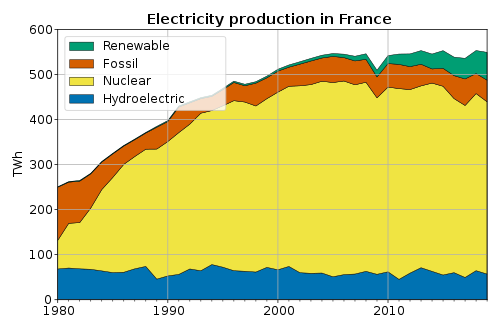 Theanphibian https://commons.wikimedia.org/wiki/File:Electricity_in_France.svg By the mid 1980s it was clear that would not happen, but not for the reasons you might think. The problem was not that they weren’t building plants fast enough, but that they were building them too fast. Demand wasn’t rising fast enough to keep up. The plants are most efficient running at 80-90% but by 1988 there were so many plants the capacity factor of France’s nuclear power stations was only running at 60%. There was too much generation to run them efficiently.
From Wikipedia, there are lessons here on how different the situation was: Three plants were started the same year
The problem of how to solve highly technical decisions is not like this either:
French nuclear power:
The announcement of the Messmer Plan was enacted without public or parliamentary debate.[16][17] Concern over the government’s action spread among the scientific community of France. The lack of consultation outside of political realms regarding the plan led to the formation of the Groupement des scientifiques pour l’information sur l’énergie nucléaire (Association of Scientists for Information on Nuclear Energy). 4,000 scientists signed a petition as a response, known as the Appeal of the 400 after the 400 scientists who initially signed it. [16]
The reason that the Messmer Plan was enacted without public or parliamentary debate, was because that there was no tradition to do that with highly-technological and strategically-important decisions in the governments of France and the parliament did not have a scientific commission with sufficient technical means to handle such scientific and strategic decisions, just like the public does not have such means. France does not have any procedure of public inquiries to allow the assessment of major technological programmes.[18] The plan envisaged the construction of around 80 nuclear plants by 1985 and a total of 170 plants by 2000.[16] Work on the first three plants, at Tricastin, Gravelines, and Dampierre started the same year[7] and France installed 56 reactors over the next 15 years.[19]
However by the mid 1980s it became clear that the Messmer plan had been overambitious. Nuclear power plants achieve their optimum economic value when run flat out, and the projected demand had not materialized. By 1988 France’s nuclear power plants had a capacity factor of only around 60%, whereas other countries that had not invested in nuclear power so heavily were nearer 80-90%.[7]
France’s population is about 3 times Australia’s. So perhaps we could only build, say, 18 reactors by 2040 –Where was that election plan?
At the moment, by 2040 we’ll be lucky to get one nuclear sub to plug into the grid.
*Ziggy says 59 power stations, Wiki says 56.
9.9 out of 10 based on 69 ratings
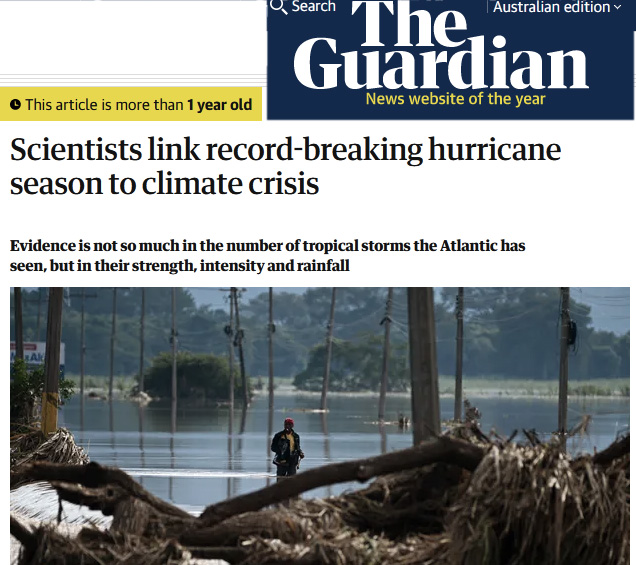
Children won’t know what a cyclone is
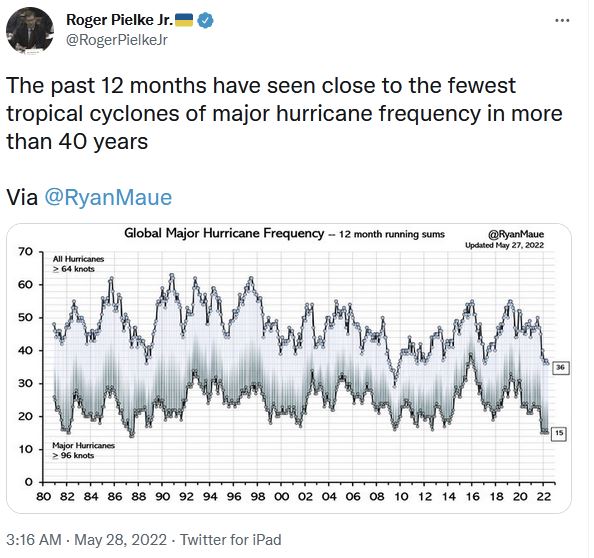
Hurricane activity, after human emissions and CO2 levels reach highest ever recorded, is now close to lowest ever recorded.
Based on a trend starting in 2019 major hurricanes may disappear entirely by 2035. What if Net Zero means “no cyclones”?
h/t ClimateDepot and NotalotofPeopleKnowthat
Spot the effect of Chinese coal plants on global hurricane frequency.
If the situation were flipped, try to imagine that the media would not write headlines like “Hurricanes near highest level ever recorded” and “Signs of Climate change seen in near record hurricane season”, or “Worst Cyclone season for thirty years!
Here’s The Guardian a year ago. But it could have been Forbes, The New York Times, the Washington Post. All of them..
It’s just one more Redpill moment to share with friends.
REFERENCES
9.9 out of 10 based on 41 ratings
…
9.5 out of 10 based on 11 ratings
It’s a cult: Another Woke Dilemma
 Should women in childbirth be warned that their anesthetic might heat the climate a hundred years from now? You know, toss it around, will I or won’t I? On the one hand, there’s hours of what some consider the worst pain they’ll ever feel, or there are other pain-killers which might not be as safe (but it’s only a baby right?). On the other hand, it’s possible that when their baby turns eighty the world might be 0.000 degrees cooler thanks to Mum? You Go Girl! Should women in childbirth be warned that their anesthetic might heat the climate a hundred years from now? You know, toss it around, will I or won’t I? On the one hand, there’s hours of what some consider the worst pain they’ll ever feel, or there are other pain-killers which might not be as safe (but it’s only a baby right?). On the other hand, it’s possible that when their baby turns eighty the world might be 0.000 degrees cooler thanks to Mum? You Go Girl!
Frankly, if they wait to ask this in the labor ward – it’s far too late. Women need to hear this on the phone while booking their first appointment. That way they can run, don’t walk, run and find a real doctor — one that looks at data — not the ones scoring points in a science fashion contest.
Is nitrous oxide a climate risk?
Elios Visontay, The Guardian
A report in Australasian Anaesthesia notes that while nitrous oxide – known as laughing gas when used as an anaesthetic – is an effective method of pain relief during labour, the gas represents 7% of global emissions, according to the World Meteorological Organization. Carbon dioxide and methane account for 66% and 16% respectively.
Using nitrous oxide as pain relief during a four-hour labour creates a carbon footprint equivalent to driving an average car for 1,500km, the report’s authors found, whereas an epidural is equivalent to driving 6km.
None of the numbers made sense anyhow. Nitrous Oxide is 7% of all global emissions? What are they on…?
In the actual report it’s clear almost no one at The Guardian read the numbers (page 185):
The World Meteorological Organization indicates that globally N2O represents 7 per cent of all long-lived
greenhouse gases (LLGHG) which together result in radiative forcing (inward radiative energy to the earth
minus outgoing). This makes N2O the third most important LLGHG following CO2 and methane which account
for 66 per cent and 16 per cent of global warming respectively. More than 1 per cent of worldwide GHG
emissions resulting from N2O are anaesthetic in origin, which is a substantial figure, given that a total of 40
per cent of global N2O is anthropogenic.
Thus 99% of emissions from N2O are not anaesthetic, and who cares? Even nature makes more N20 than we do and 20 times as much CO2. And all the minor gases are nothing compared to water, the most powerful greenhouse gas of all. The whole fixation on “long lived” gases is only so people can ignore short lived ones like water. Do those photons care if the molecule is here today and gone tomorrow, but another one is in its place? This is not angels dancing on pins, but viruses dancing on bacteria dancing on angels. How many of our best and brightest medical staff worked on that paper?
Junk models meets junk research, junk journals, and junk reporting.
Speaking of dilemmas
Don’t look now but two commandments of Pussy-Wokism are in conflict. Should women get what they want even when it means the world might end up 0.0000C degrees hotter in 2100? Which victim scores highest… women or the climate?
See the struggle. Feel the pain:
Isabelle Oderberg, The Guardian
Why this report? Why now? Why did I get all those rolling eye emoji text messages?
When a new report suggested that people who use nitrous oxide when giving birth should be warned about the impacts on climate change, I felt the mild tremor of a collective groan uttered in unison across the country. More than one person sent me headlines accompanied by a rolling eye emoji.
Historians will mark the madness of the era:
Clearly the climate crisis is a pressing mattter of life or death and the future of all humanity. The staggering results of our federal election show that this is an issue about which Australians are deeply concerned. And many medical colleges are considering the effects of climate change on their patients, with the Australian Medical Association even issuing a call to arms.
The real question is why doesn’t the AMA have better things to do, like looking after their patients, giving informed consent, and checking their scientific pronouncements on every topic before they put out a press release. The other real question is why journalists don’t ask medicos more interesting questions about things that might matter today, not in 2100.
Before patients get warned about the effect of nitrous oxide on climate change, they should get warned about B12 deficiency. That’s another story…
Photo by National Cancer Institute on Unsplash
9.9 out of 10 based on 53 ratings
It’s a grid on the edge
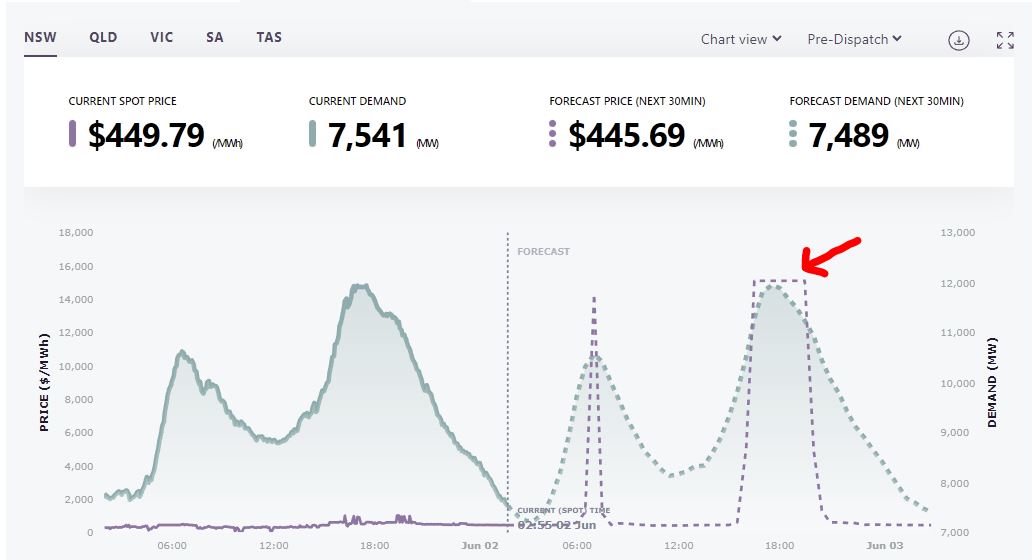
 Like a meteor-shower, the dinner time performance today may or may not be a spectator event. The fun may start at 4:30pm in Qld, NSW, Vic, SA and Tasmania — a full quinfecta at $15,000 per MW/h. The first wave of winter cold is about to wash over the grid, and those solar panels will fail just as people plug in their heaters, ovens, dryers and kettles and there is a four hour spike at $15,000MWh forecast. The graph below is the forecast for NSW, but it is essentially the same tsunami shape and dimension in every single state of the National Energy Market. Right now I presume there are engineers in the control rooms sweating over alternatives and they may well pull it off. These wildly high spikes have a way of resolving at the last minute. But think for a moment what kind of stakes we’re playing with. Hypothetically, if there was a 12,000MW demand for 4 hours in NSW at $15,000, that’s $720 million dollars worth of electricity. A few days like that would pay for a new coal plant, but no one seems to be listening to that price signal… Like a meteor-shower, the dinner time performance today may or may not be a spectator event. The fun may start at 4:30pm in Qld, NSW, Vic, SA and Tasmania — a full quinfecta at $15,000 per MW/h. The first wave of winter cold is about to wash over the grid, and those solar panels will fail just as people plug in their heaters, ovens, dryers and kettles and there is a four hour spike at $15,000MWh forecast. The graph below is the forecast for NSW, but it is essentially the same tsunami shape and dimension in every single state of the National Energy Market. Right now I presume there are engineers in the control rooms sweating over alternatives and they may well pull it off. These wildly high spikes have a way of resolving at the last minute. But think for a moment what kind of stakes we’re playing with. Hypothetically, if there was a 12,000MW demand for 4 hours in NSW at $15,000, that’s $720 million dollars worth of electricity. A few days like that would pay for a new coal plant, but no one seems to be listening to that price signal…
Even if they pull off aerial manouvers tomorrow and save millions of dollars (billions even) what’s clear is that the whole grid is flying seat-of-the-pants. The AEMO issued unprecedented warnings about a gas supply shortfall across Vic SA and Tas that have already been cancelled, but the reserves of generation are razor thin and winter has just begun.
Am I wrong — none of this would be happening if Hazelwood was still running? Brown coal was still winning bids at $24/MWh a few months ago.
But don’t miss the other big signal here. The entire Australian National Energy Market for a “Grid” in a forced subsidized transition needs to be totally redesigned. It might have worked fine with reliable generators but even though we add tweak after tweak, something is going horribly wrong. But redesigning a whole new market is another hidden cost of the junk generators being forced on the grid.
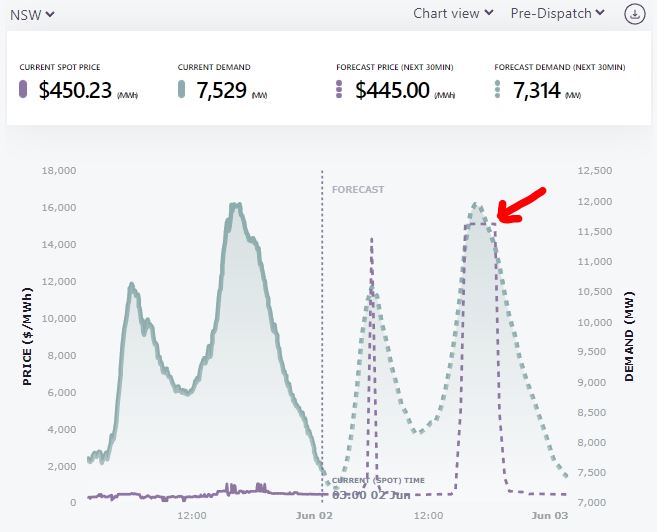 It may not work out this exciting… but that four hour peak is worth millions. | AEMO The total NEM wide demand expected is a bit over 30GW at peak. Not near the peak highs of summer which have hit 35.5GW on Jan 29th, 2009. Somehow in 13 years we’ve increased our network capacity by 25% but something isn’t working….
Yesterday the Instantaneous Reserve Plant Margin across the whole NEM fell below the 15% yellow alert trigger level.
Paul McArdle who lives and breathes the NEM market, says he can never remember seeing a warning like this before:
Keep reading →
9.7 out of 10 based on 55 ratings
Strategically, this seems like it matters.
The French nuclear power plants are the backbone of the EU grid, but this winter, just when Europe is trying to not-buy-Russian-Gas, the French might need to import power instead of export it.
France runs off 70% nuclear power — it’s highest proportion in the world, and the second largest fleet — after the USA. For some reason, known only to international bankers or Renewable Gods, Early in Macron’s reign, he decided to reduce the carbon-free reliable nukes to just 50% by 2035 and fill the gap with short-lived, unreliable generators that cost a lot, need storage, backup, rare metals from China and slave labor from the Congo. Perhaps he was afraid (or whoever it was that helped him get elected) that France would show up all the schmuck-countries going to renewables?
But then the gas crisis started in Europe last October, and like clockwork, in November President Macron muttered the words “energy independence” and belatedly announced that it wasn’t such a bad idea to build some new nuclear plants. As things got more serious, in late February the French nuclear safety authority decided to extend the life of the 32 oldest reactors for another ten years and is now planning to retire them at age 50.
Bu by the end of April 27 nuclear reactors were out of action. Odd cracks had been discovered in five reactors last year due to corrosion and that had expanded to six more plants. A couple of weeks ago another one was taken off-line — so that’s 28 out 56 of EDF’s reactors. And some of these are slow repairs. There are already worries that there won’t be enough back in time for winter to keep the lights on in France without expensive imports during an energy crisis.
Interestingly, the plants that unexpectedly need maintenance are the newer ones with “convoluted pipes”. Prices of electricity are already higher in France. Don’t let anyone tell you the old plants are the cause of the rise!
h/t Notalotofpeopleknowthat
Jesper Starn Bloomberg
Twenty-eight reactors are offline as Electricite de France SA struggles with extended outages after corrosion issues were found at some sites, requiring lengthy checks and repairs. The extra works come on top of already scheduled halts for refueling and regular maintenance, and has brought French nuclear output to the lowest in more than decade for the time of year.
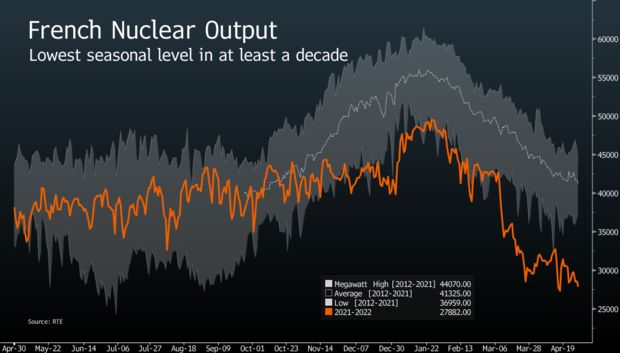 Bloomberg https://www.bloomberg.com/news/articles/2022-04-29/half-of-french-nuclear-fleet-is-shut-for-works-squeezing-supply Western Europe has for decades relied on exports of power from EDF’s nuclear fleet. The cuts are another blow to European energy security just as the region is weaning itself off Russian supplies of everything from natural gas to coal and oil because of the war in Ukraine.
EDF Sees Bigger Earnings Hit as It Cuts Nuclear Outlook
The big test will come when temperatures start to fall toward the end of the year. It won’t take many days of cold weather to jeopardize French power supplies, according to Emeric de Vigan, chief executive officer at French energy analysis firm COR-e.
“Which such poor nuclear availability, if we reach 2 degrees Celsius below normal in the winter for a few days we could be in trouble, it would be really tight,” de Vigan said. Paying customers and factories to lower consumption are steps that likely will need to be taken, he said.
The problem is with the new reactors not the old ones
Perhaps the designers got a bit too tricky?
EDF’s newer reactors seem to be most affected because of the design of some of their piping, which is longer and more convoluted, Clement said. The cracks tend to show up very close to welds at the pipes’ elbows, most likely because of a vortex of hot and cold water, and possibly because of how the welds were done.
Europe’s Biggest Exporter of Power Might Need Imports in Winter
The challenges for the utility are now so great that President Emmanuel Macron has suggested some of its key activities could be nationalized as part of a broader plan to bolster the country’s energy independence.
At least he’s not proposing to give control to the EU or the UN. It could be worse.
9.9 out of 10 based on 83 ratings
8.9 out of 10 based on 13 ratings
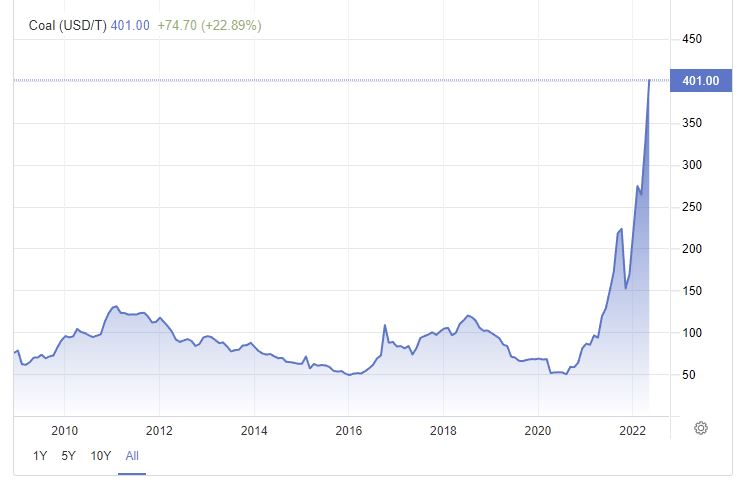
In Australia a Woke tech-billionaire has decided to “keep” the coal assets in AGL in order to destroy them (like that’s the “free market” at work) . But in the rest of the world, coal is $400 a ton and everybody wants it.
Maybe Australians will get so rich selling coal they can afford to use electricity from unreliable generators instead?
LONDON (Reuters) -Some of the British coal-fired power plants slated for closure this year might need to stay open to ensure electricity supply this winter, the government said on Monday.
Countries across Europe are drawing up contingency plans against potential disruption to flows of Russian gas because of the war in Ukraine. Russia typically supplies about 40% of Europe’s gas.
Britain can generate about 50% of its electricity from gas. Although Russia only meets about 4% of Britain’s gas needs, a significant disruption in supply would affect prices in Europe and make it harder for Britain to secure gas from others.
How screwed is that market when they have to “devise” a framework to keep the cheapest reliable generators running?
The government has asked the National Grid Electricity System Operator (ESO) to devise a framework to encourage plant operators to keep the power stations running, according to a letter seen by Reuters from energy minister Kwasi Kwarteng to National Grid ESO.
Is that new “framework” the plastercast that saves the limb which has a plastic pin-and-plate fitted on a bone that didn’t need to be broken?
9.9 out of 10 based on 63 ratings
We can hear the angst and confusion — Another “nasty La Nina?”, “Something weird is going on”, “They (La Ninas) don’t know when to leave”. Oh no!
These are not the words we’d expect to hear from experts who can 97% predict the climate a century from now. The bad news for the modelers is that the climate on Earth seems to be controlled more by the Pacific Oscillation than anything else and they have no idea what drives that pattern, so they can’t predict it more than a few months ahead, and sometimes not even then. And if they can’t predict the Pacific — they can’t predict anything. The hottest of hot years are El Nino, and the coldest years are La Nina and the greatest modelers the world-has-ever-known still get their barbecue summers wrong. The droughts, the floods and the bushfires follow the swinging surface water of the worlds largest ocean. Whenever they happen, the models say “climate change” but the models never tell us which will hit us this time next year.
So here we are with hints that there might be another La Nina, a third in a row, and Oh-the-disappointment! The modelers thought there would be more El Ninos — oh Queen of Global Heating. Instead, in the last 40 years, La Nina’s seem to be getting more common. The models were wrong.
And this failure is of the Grande Mal kind.
Holy Smoke — the Pacific matters
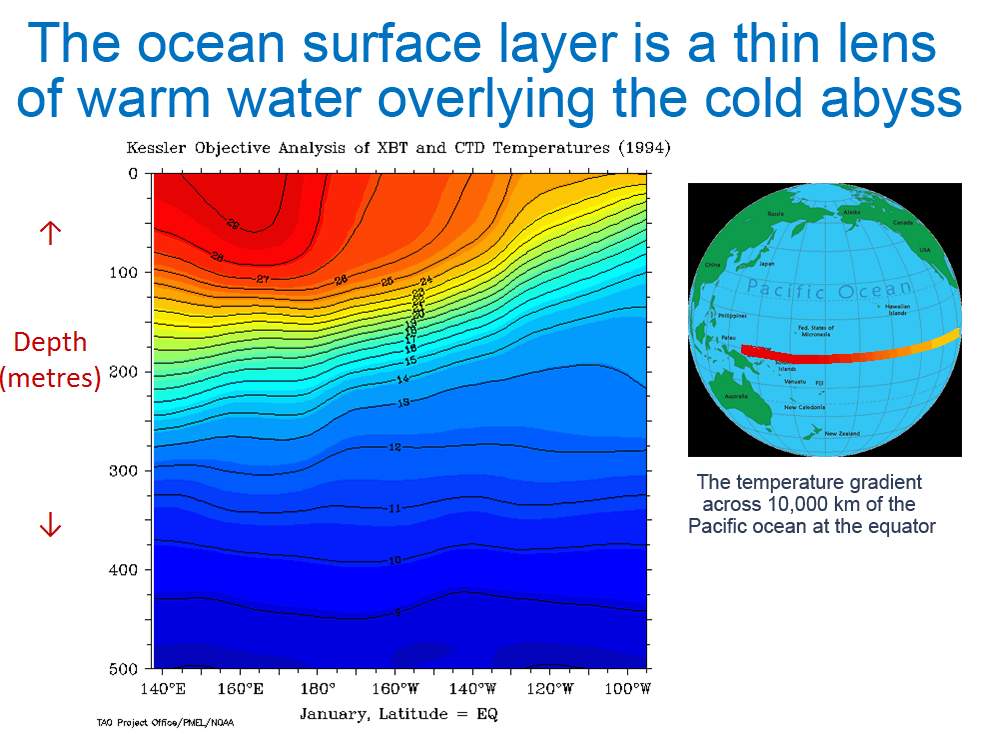
As William Kinninmonth so incisively pointed out — the oceans are 4 kilometers deep and most of the water is only a few degrees above freezing, even under the tropical Pacific. There is a world of cold down there, and the layer of warm water on top is but a thin skin. If that thin skin of warm water rests undisturbed, the air can heat above. But all it takes is a change in dominant currents, or tradewinds, or some new deep sea magma vent to stir up the ocean and the top layers mix. The gargantuan deep blue blob of 3 kilometer thick salty cold water promptly rises up and sucks the warmth out of the sky.
The insipid weak vapor above is no match for the vast energy sink below.
 …. h/t Tallbloke
Something weird is up with La Nina, the natural but potent weather event linked to more drought and wildfires in the western United States and more Atlantic hurricanes. It’s becoming the nation’s unwanted weather guest and meteorologists said the West’s megadrought won’t go away until La Nina does.
The current double-dip La Nina set a record for strength last month and is forecast to likely be around for a rare but not quite unprecedented third straight winter. And it’s not just this one. Scientists are noticing that in the past 25 years the world seems to be getting more La Ninas than it used to and that is just the opposite of what their best computer model simulations say should be happening with human-caused climate change.
“They (La Ninas) don’t know when to leave,” said Michelle L’Heureux, head of the National Oceanic and Atmospheric Administration forecast office for La Nina and its more famous flip side, El Nino.
That sound you hear is the long term forecasts snapping:
An Associated Press statistical analysis of winter La Ninas show that they used to happen about 28% of the time from 1950 to 1999, but in the past 25 winters, they’ve been brewing nearly half the time. There’s a small chance that this effect could be random, but if the La Nina sticks around this winter, as forecast, that would push the trend over the statistically significant line, which is key in science, said L’Heureux. Her own analysis shows that La Nina-like conditions are occurring more often in the last 40 years. Other new studies are showing similar patterns.
The real problem is this is just one of many things the models get wrong and unlike smaller things, it can’t be just “tuned to fit”:
What’s bothering many scientists is that their go-to climate simulation models that tend to get conditions right over the rest of the globe predict more El Ninos, not La Ninas, and that’s causing contention in the climate community about what to believe, according to Columbia University climate scientist Richard Seager and MIT hurricane scientist Kerry Emanuel.
A third dry year for Eastern America will be bad in so many ways. Imagine how useful it would be to everyone if the climate models actually worked and could have told dam managers, farmers and foresters in 2019 that the next three years would be dry? This would be worth billions, but instead the “science” of climate change is a politically captured corrupt sect that shuns alternate ideas, exiles heretics and ignores the Sun, the Moon, Space Weather, the ball of magma we stand on, and pretends that the only thing that matters is a gas your car makes.
And they know it. They’re deleting what they knew: NASA hides page saying the Sun was the primary climate driver, and clouds and particles are more important than greenhouse gases
9.9 out of 10 based on 70 ratings
In Germany, praise be to Gaia, it’s Green to knock down a forest that has sat undisturbed for a thousand years to put wind farms in, and then plant saplings in a fake forest somewhere else as a carbon sink.
When will the environmentalists realize they have been taken for a ride by investment bankers and the renewables industry? Let’s help them speed up that “transition”. There’s a Red-pill moment here. File the story of the Reinhardswald, “fairy-tale forest” away for those moments when a teenager turns up to tell you how important it is to save old growth forest. Exactly, you can say… would you like too help stop the latest rapacious attack on rare heritage forest?
Being “Green” is nothing more than a badge people wear to their weekend dinner party.
NoTricksZone has reported on this environmental crime in February 2022 when the access roads started to go in. In the latest news Swiss NZZ Daily has described it as the absurdity of the German energy transition:
In the fall, the Documenta management planted oaks in the fairytale Reinhardswald near Kassel to save the climate. Now the forest is to give way to wind turbines, which will save the climate even better.
Germany’s last scenic spot to get industrial wind turbines
The area is the largest contiguous forested area in Hessen, virtually uninhabited, undisturbed, and therefore a precious natural area in itself. Its beauty is an entertainment field of outstanding importance [1] in the middle of a landscape that is partly classified as cultural – historical and has the highest value. Even according to Environment Minister Hessian Priska Hinz (Greens), this is one of the most scenic regions in Germany. [2]….
Pierre Gosslin is
“it’s all being industrially raped, gangbang-style, by crony, greedy bastards under the guise of environmental virtue. It’s a grand swindle that in normal times would have everyone enraged.
Wind park proponents defend the deforestation of one of Europe’s remaining virgin forests by claiming that only sick areas of the forest are being cleared away and that the turbines will “free Germany from the clinging grip of Russian energy imports”….and save our climate for generations to come.
That’ll be eighteen 240-meter-high wind turbines. Hope the birds, deer and wild cats can get some sleep.
Pierre Gosselin notes the extraordinary irony that to keep tourists coming they are literally building an artificial forest in the Brothers Grimm Square:
“While the real, historically grown fairytale forest outside the city is being cut down, artificial substitutes are being created within the city. For example, Kassel’s civic society has been fighting for months over the redesign of the Brothers Grimm Square, which is conceived in the form of a “fairy tale forest” of pine trees and shrubbery – whereby at best a light miniature forest on a traffic island can emerge.”
Read it all at NoTricksZone.
7.7 out of 10 based on 91 ratings
…
9 out of 10 based on 9 ratings
It’s the usual apocalyptic headline, hyped from a press release smoked out of a Nature paper, which was pumped from a climate model:
An Israeli study published on Thursday found that climate change is already causing a “considerable intensification” of winter storms in the Southern Hemisphere to a level not anticipated until 2080.
It’s bleak I tell you:
In the new study, Chemke and his team compared climate model simulations with current storm observations. Their discovery was bleak: It became clear that storm intensification over recent decades has already reached levels projected to occur in the year 2080.
Yet again we see true mastery of confirmation bias at work: When the climate models underestimate things it means doom is coming faster. When they overestimate things, it means the equipment is faulty. What would 28 million radiosondes know?
There must be 1,000 permutations of climatoid factors that could be measured across regions of the Earth, but Lo — there has been an intensification of Winter Mid-Latitude Storms in the Southern Hemisphere! Not summer storms, spring storms, or Atlantic Storms or Atlantic Tropical Autumn storms, or Pacific Eastern high latitude Westward events (as far as we know) but roll the dice, some of them will turn up snake-eyes too! (Where is my grant?)
As far as I can see, this is a good example of Neolithic tea-reading type science — equivalent to studying the trails of the scribbly-bark beetle and forecasting that the Blinking Star will eat Neptune before the next full moon.
These are short term trends within the noise envelope, but good enough for a Nature paper, and a press release:
What if there was, say, a natural 60 year trend in there? Who would know?
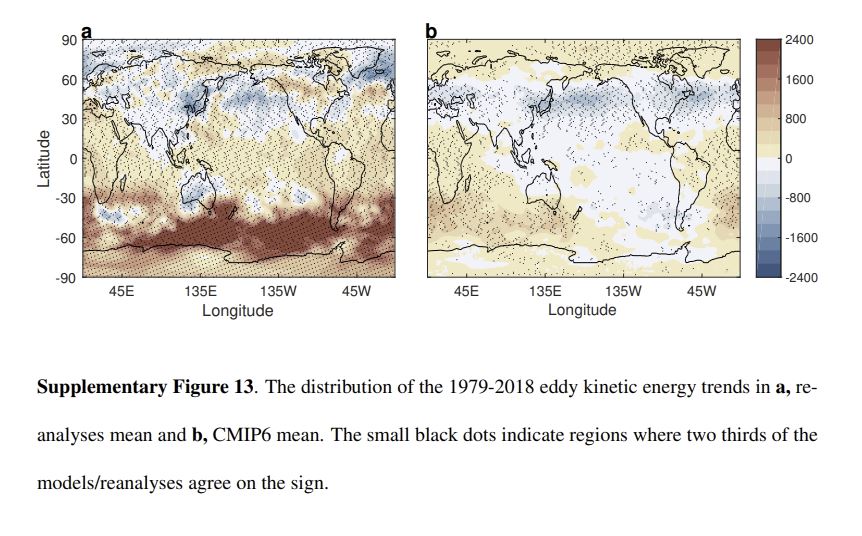
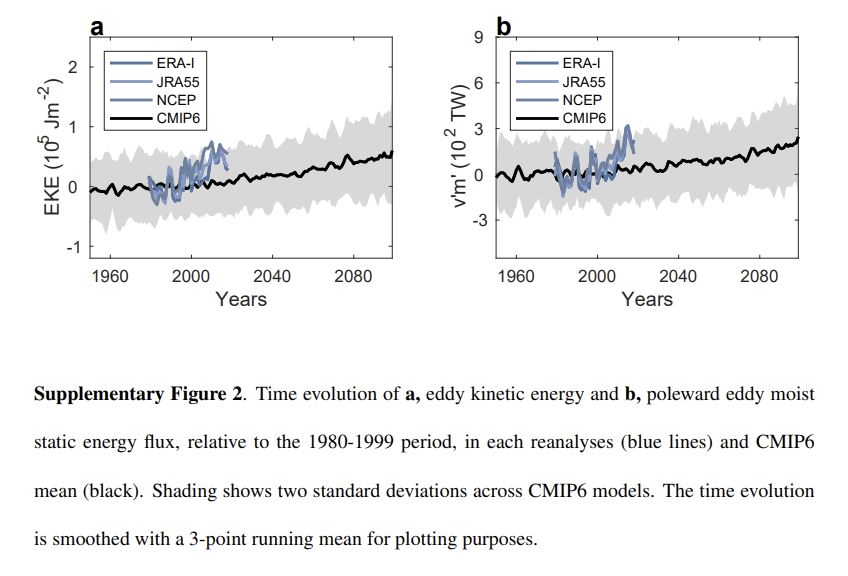 … I notice in the Supplementary section the captivating graph below. Part A, apparently, is the observed trend, and Part B the modeled trend, which don’t look too similar to me. The caption has the immortal words:“The small black dots indicate regions where two thirds of the models/reanalyses agree on the sign.” On The Sign! Unless I’m reading that wrongly, they’re excited about the dot points where two out of three models guessed whether the trend was up or down. It’s that bad. In most of the Pacific apparently nearly 70% of models looked at “climate change” and couldn’t even guess the direction right.
Indeed, the models are so wrong in the Pacific, perhaps it’s significant?
 Click to enlarge. Phys-Org gushes like David Attenborough was let loose in “software biology”:
About 30 massive, intricate computer networks serve the scientists who stand at the forefront of climate change research. Each network runs a software program comprised of millions of lines of code. These programs are computational models that combine the myriads of physical, chemical and biological phenomena that together form the climate of our planet.
What is Truth but “millions of lines of code” eh? What could possibly go wrong (apart from things like the G.F.C.)?
We’re there at 2080 already!
In the new study, Chemke and his team compared climate model simulations with current storm observations. Their discovery was bleak: It became clear that storm intensification over recent decades has already reached levels projected to occur in the year 2080.
Spot the bias anyone? We studied this part of the world because it showed what we wanted to find?
“We chose to focus on the Southern Hemisphere because the intensification registered there has been stronger than in the Northern Hemisphere,” Chemke says. “We didn’t examine the Northern Hemisphere, but it seems that the intensification of storms in this hemisphere is slower compared to that in the Southern Hemisphere.
If any taxpayer funds were harmed in this report, we want them all back. This is non-stop agitprop:
Chemke, Ming and Yuval’s study has two immediate, considerable implications. First, it shows that not only climate projections for the coming decades are graver than previous assessments, but it also suggests that human activity might have a greater impact on the Southern Hemisphere than previously estimated. This means that rapid and decisive intervention is required in order to halt the climate damage in this region. Second, a correction of the bias in climate models is in order, so that these can provide a more accurate climate projection in the future.
It’s new low in scientific spin. Modelers don’t usually just lie straight out like this:
Could the climate models be inaccurately predicting other important phenomena? “The models are doing a very good job at forecasting nearly all the parameters,” Chemke says. “We’ve discovered one parameter for which the sensitivity of the models needs to be adjusted. Changes in temperature, precipitation, sea ice, and summer storm patterns, for example, are all being simulated accurately.”
For what it’s worth, Rei Chemke only finished his BSc in 2012, and his PhD is all “climate science”. It’s more a case of Kool Aid over-exposure for a young guy that has probably never met a skeptic.
Everyone who has met a skeptic knows climate models can’t predict the climate on a local, regional, or continental scale, they don’t know why global warming slowed for years, they get the core assumptions wrong – the hot spot is still missing, (that’s the only fingerprint they said mattered, right up until they couldn’t find it). They can’t explain the pause, the cause or the long term historic climate movements either. Measurements of satellites, cloud cover changes, 3,000 ocean buoys, 6,000 boreholes, a thousand tide gauges, and 28 million weather balloons looking at temperature or humidity can’t find the warming that the models predict. In the oceans, the warming isn’t statistically significant, sea-levels started rising too early, aren’t rising fast enough, aren’t accelerating, nor are warming anywhere near as much as they predicted. Antarctica was supposed to be warming faster than almost anywhere but they were totally wrong. The vast Southern Ocean is cooling not warming. The only part of Antarctica that’s warming sits on top of a volcano chain they prefer not to tell you about.
Some scientists are also behaving very badly: hiding data, declines, history, adjustments and methods. But thousands of other scientists are protesting all over the internet.
REFERENCES
Chemke, et al, (2022) The intensification of winter mid-latitude storm tracks in the Southern Hemisphere, Nature Climate Change (2022)
PDF Preview copy on ResearchGate
Supplementary Information
10 out of 10 based on 59 ratings
We can all use some good news
 Tedros Adhanom In the latest installment of Big Government Badness the WHO is meeting right now to consider some amendments suggested by the US and largely agreed by about 47 rich nations for no real benefit. The US suggested these changes in January and for months almost no politician anywhere said a thing. The changes give broader powers to the head honcho of the WHO — Tedros Adhanhom Ghebreysus. He’s the man who told the world to keep flying in Chinese Bioweapons through their front door in January 2020, while he also told everyone how transparent and wonderful President Xi was: “China is protecting the people in the whole world”! He actually said that. China was stopping all flights out of Wuhan to the rest of China, but not to Italy, Iran, or anywhere else, and they lied about human to human transmission, and said it was preventable and curable, while they harvested up masks and PPE from around the world to profiteer from them later. China lied about the bats in the lab, and WHO helped cover it up.
No one can explain why the rich nations of the world would want to sign rights away to an unelected, unaudited foreign committee that has failed to do the only job it was meant to do, is clearly in the pocket of China’s communists and wants us to pay them to let them boss us around?
Notably China was not signing up
The good news at the moment is that according to The Epoch Times African nations have put the brakes on and they appear to have derailed the process. We might assume that with backroom deals that might amount to some local sweeteners in Africa or maybe just a better job for the Ambassador. However the backroom deals appear to be failing, and the final form of the amendments has now been delayed to September or even November. The battle isn’t over but we have more time to fight back.
The documents we’re talking about are called the WHO International Health Regulations [IHR] — sometimes also referred to as a Pandemic treaty (though there are other Pandemic Treaties too). The original IHR was made in 2005, and you can read the proposed amendments yourself. The IHR already matters. Unvaccinated Australians were banned from leaving Australia because of “this WHO treaty” for nearly two years, it was listed on the Health Ministry website, though apparently almost no other country did the same. Go Figure? Perhaps Australia and Canada were the only ones stupid enough to write it into laws at home?
Joshua Phillips, The Epoch Times
Under the proposed amendments, the director-general could declare a public health emergency in any country regardless of whether local officials agree with the declaration.
Tedros also would be authorized to rely on evidence from sources other than those approved by the affected country as the basis of such a declaration.
But the Biden proposals have sparked a growing furor in the United States among critics who contend the amendments would amount to ceding of some portion of American sovereignty to WHO in the event of another pandemic like the one that has killed more one million Americans and in excess of six million people worldwide.
Rep. Ralph Norman (R-S.C.), the first member of Congress to comment critically on the amendments, told The Epoch Times on May 26 that, “Of course the amendments should be withdrawn, but the bigger issue is how we got to this point in the first place. Why is this administration apparently willing to cede any authority to an international body, particularly the WHO?”
This is not just about pandemics — any “health emergency” will do:
The WHO document was spectacularly vague in all the right places. We don’t even need a moment of monkeypox — this is a “health emergency” treaty and health can be whatever you want. The WHO defines health as anything less than 100% happy, bouncing, bubbly people:
-
-
- Health is a state of complete physical, mental and social well-being and not merely the absence of disease or infirmity.
We all know that Climate Change is an “emergency”, trans-rights is an “emergency”, as are the lack of safe spaces for children oppressed by their parents. It’s only a hop, step and a jump to demand a clean atmosphere is a human right as is having a self-driving electric car with full tracking, carbon credits, and the remote cut-off “safety” circuit too. For your own health!
He spells out the pervasive nature of it all:

The amendments will completely remove all current restrictions on the activities of the WHO Director General and will empower him to declare a suspicion of a “potential” global health emergency in any nation without their cooperation or agreement. Within 48 hours, the Director General will be empowered on the mere suspicion of an ill-defined emergency, and be able to publish his recommendations and regulations to marshal all the agencies of the United Nations and other groups outside the UN to put pressure on dissident nations. Other nations feel empowered by WHO to place suggested restrictions on the targeted nation. The World Bank which is an extreme supporter of empowering WHO, could also put pressure on nations.
The Director General, Tedros, of the WHO will be the sole arbitrator of many health issues and activities, including declaring health emergencies relating to physical health, mental health, environmental health, and social health. This means that if the WHO and Tedros decide that guns are producing an “epidemic” of violence, then gun confiscation can be ordered. Or, if overpopulation is declared to be the cause of food shortages, then WHO could order population control actions, including abortions and euthanasia.
Don’t let anyone tell you it can’t be stopped and it’s not worth trying:
We have heard from Congressional sources that there is a firestorm of concern and attention in Congressional offices about the World Health Organization (WHO) amendments proposed by the U.S. Biden Administration. This concern has been ignited by the phone calls, articles, columns, and media coverage about the WHO power grab. Every citizen who is signing petitions and calling their federal Congressional representatives and Senators is having an enormous impact on U.S. Congress. Our initial report, “ Biden Handing Over U.S. Sovereignty to WHO,” has gone viral in Congress and throughout the world. For reference, here are the 20 nations, plus the European Union, listed by the U.S. as already supporting the amendments before they were even discussed:
Albania, Australia, Canada, Colombia, Costa Rica, Dominican Republic, Guatemala, India, Jamaica, Japan, Monaco, Montenegro, Norway, Peru, Republic of Korea, Switzerland, United Kingdom of Great Britain and Northern Ireland, United States of America, Uruguay, Member States of the European Union (EU) (which means another 27 states).
If only we all had the same kind of democratic protection as Africa. Start contacting your representatives asking them why we needed to rely on African politicians instead of our own ones. Write letters to the editors. Share the news with friends.
Keep reading →
9.8 out of 10 based on 74 ratings
8.8 out of 10 based on 13 ratings
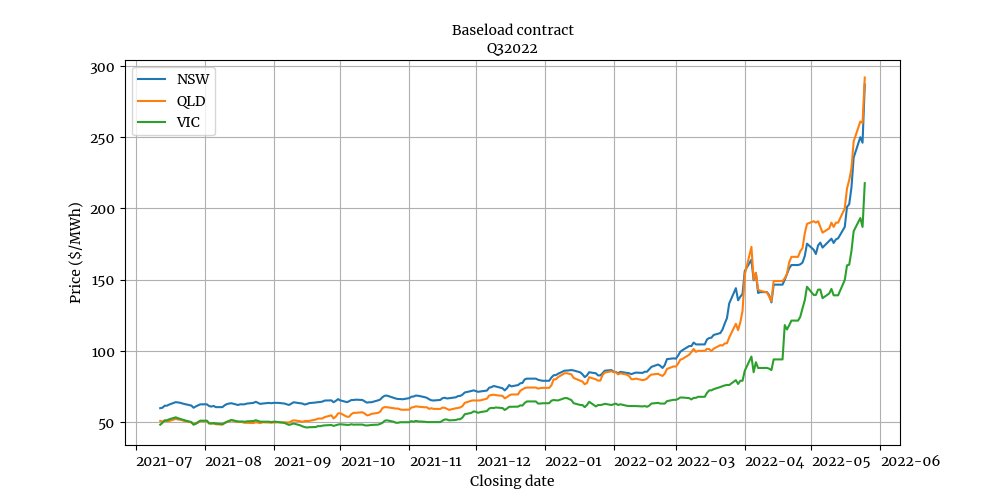
Baseload futures for electricity on the Australian market used to sell for $60 a megawatt hour last year. Now prices are rising by $30 in a single day. Paul McArdle at WattClarity calls it “staggering”. Prices rose from $260/MWh at the end of Tuesday 24th May to $291.20/MWh at the end of Wednesday 25th May 2022.
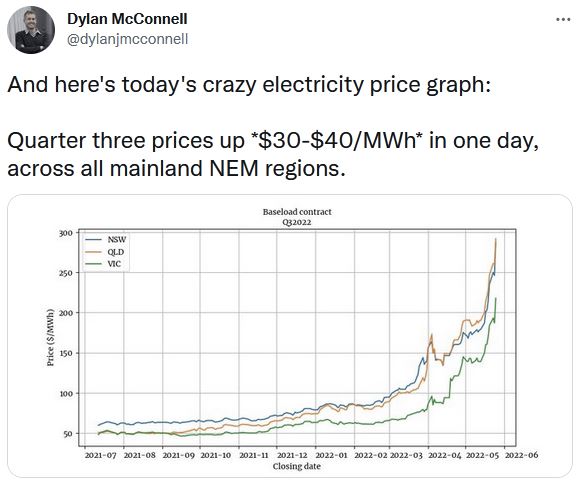 …. Click to enlarge It’s a bloodbath. It appears that no one wants to provide a guarantee they can sell electricity in Quarter 3 for much less than an astonishing, heartbreaking $290/MWh. Unless this situation resolves, the forward prices will soon flow through to the retail prices. At the moment, the number crunchers don’t seem to think it will be fixed soon.
So far, with several coal turbines out of action, and one turbine recently closing (Liddell) it appears to be a network on the brink, with no spare capacity anymore. The situation on the Australian grid isn’t improving. After record April prices, May will also bring in medals of the wrong kind. Current prices of wholesale electricity on the spot market are averaging a blistering $200 — $300 per megawatt every day for all the mainland states of Australia on the national grid.
This was determined — not by a free market — but by the AER (Australian Energy Regulator). Because we need a government agency to dictate that sort of thing. It’s not like we could let people pay a network fee and then choose to do deals with, say, the cheapest generator they can find.
Keep reading →
9.3 out of 10 based on 80 ratings
|
JoNova A science presenter, writer, speaker & former TV host; author of The Skeptic's Handbook (over 200,000 copies distributed & available in 15 languages).

Jo appreciates your support to help her keep doing what she does. This blog is funded by donations. Thanks!


 Follow Jo's Tweets
 To report "lost" comments or defamatory and offensive remarks, email the moderators at: support.jonova AT proton.me
Statistics
The nerds have the numbers on precious metals investments on the ASX
|







Recent Comments