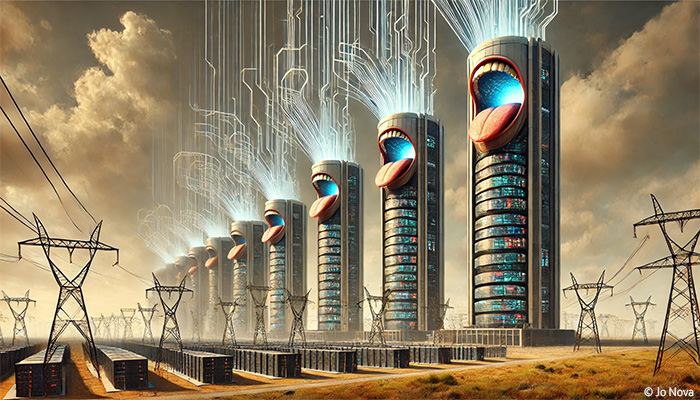
AI eats energy for breakfast.
By Jo Nova
If the grid breaks, remember it’s all AI’s fault!
New data centers in Australia may use as much as 6% of the electricity demand by 2030. (That’s a whole six percent increase in demand four years from now. Call the ambulance, eh!).
But the thing is, our fragile grid already has these odd jiggly voltage and frequency spikes now that we’ve blown up all the spare coal plants, and any one of these jiggles may trigger a cluster of data centers to trip out at the same time to protect themselves. If a large load disappears off the grid simultaneously, it could set off a cascading chain of failures causing a widespread blackout. (A bit like the wind farms did in the Great South Australian Blackout of 2016).
So the manager of our forced fantasy transition is lining up the excuses to cover for his own failures. If there’s a blackout, it’s AI’s fault he says. And if prices rise, it’s AI’s fault too claims Minister Chris Bowen — who says that “Wholesale electricity prices could jump by a quarter in NSW and Victoria if data-centre growth is not matched by new renewable generation and storage…“.(Unlike the 50 years before that where demand grew and prices fell because we just built more coal power).
Then there’s the extortion. If AI want to do business here, they have to install renewables to “strengthen (meaning, weaken) the grid” says Mr Bowen.
Why don’t we just let the AI centers choose the generator themselves Minister, like there was a free market? Is it because we all know they’d build gas or coal plants?
The sad story is his new Capacity Investment Scheme is failing to win over investors, so Chris Bowen has to force the new customers to buy his pet generators, to help him pretend to meet the targets we have no chance of reaching.
Australia’s AI boom fuels data centre threat to national electricity grid
By Perry Williams, The Australian
Australia’s $135bn data-centre industry poses a new risk to the nation’s electricity system, authorities have warned, with sudden dips in voltage potentially causing a mass grid-scale shock and threatening power connections between states.
Energy Minister Chris Bowen has warned that data centres must “do their bit to strengthen” the energy grid, asserting that operators will be required to underwrite new renewable power and fund their own connectivity so the massive spike in energy demand does not become a strain on consumers.
But the grid operator found that by 2030 a single fault near western Sydney could knock out about 1500 megawatts of data-centre power in milliseconds. It cautioned that data centres clustered around Sydney and Melbourne could disconnect across multiple locations as a result of an ordinary voltage dip, raising a new risk for the operation of the grid.
And the lie perpetuates.
Data centre giant Airtrunk estimates that, for every additional gigawatt of data centre demand, Australia will likely need around 3 to 4 gigawatts of new renewable generation capacity to support 24/7 operations.
It doesn’t matter how many renewables anyone installs, it will never support 24/7 electricity without a monster load of storage.
*PS: The internet is out here. I thought I could not write but I managed to rig up a drip feed miracle through a phone, “yay”.






Those data centres will be needed inorder to store and analyses the data of the great Australian public and monitor what you are getting up to.
341
How many Australian jobs will these datacentres provide.?
161
quite a few to build them, but not that many when operating. Certainly not enough jobs to change state or federal employment stats in any noticeable way.
60
Aa per my posts yesterday, not even AI thinks it’s a good idea to run itself on wind or solar.
Gulag AI (fully woke) said:
Grok AI (not so woke) said:
240
Could we turn off all the wind and solar tomorrow? If so, why are we spending a cent on them? To power AI centres so the highest proportion of public servants in the world can do less work from home?
270
Coal provided 77 % of electricity in NSW yesterday.
70
Luckily for them Blackout Bowen knows best..
100
Surely David you can’t seriously suggest that Artificial intelligence can ever really be a match for the natural intelligence of a politician?
20
Romania is considering building SMRs to power their ports and to reduce their emissions. I wonder how they can do both but we cannot. I suspect our union run super funds have a lot of members money invested in unreliables and fear a downturn or maybe a wipeout.
Reference: World Nuclear News.
50
That picture at the top of the article reminded me of the Anglo saxon poem The Ruin.
It is about the gradual decay and collapse of Roman Bath and how the skills of the ancients are beyond the skills of those who followed them.
What will people of 300 years hence think when these data centres lay in ruin, perhaps impoverished and living simply due to lack of energy sustaining the high civilisation we currently enjoy
“The Ruin
These wall-stones are wondrous —
calamities crumpled them, these city-sites crashed, the work of giants
corrupted. The roofs have rushed to earth, towers in ruins.
Ice at the joints has unroofed the barred-gates, sheared
the scarred storm-walls have disappeared—
the years have gnawed them from beneath. A grave-grip holds
the master-crafters, decrepit and departed, in the ground’s harsh
grasp, until one hundred generations of human-nations have
trod past. Subsequently this wall, lichen-grey and rust-stained,
often experiencing one kingdom after another,
standing still under storms, high and wide—
it failed—
The wine-halls moulder still, hewn as if by weapons,
penetrated [XXXXXXXXXXXXXXXXXXX] savagely pulverized [XXXXXXXXXXXXXX] [XXXX] shined [XXXXXXXXXX] [XXXX] adroit ancient edifice [XXXXX] [XXXXXXX] bowed with crusted-mud —
The strong-purposed mind was urged to a keen-minded desire
in concentric circles; the stout-hearted bound
wall-roots wondrously together with wire. The halls of the city
once were bright: there were many bath-houses,
a lofty treasury of peaked roofs, many troop-roads, many mead-halls
filled with human-joys until that terrible chance changed all that.”
232
Or how about Epitaph for a Lost Civilisation by Paul Martin Freeman.
https://www.classicalpoets.org/epitaph-for-a-lost-civilisation-a-poem-by-paul-martin-freeman/
130
Good poem. To it we can add Ozymandius and the curse of akkad.
We appear willing to destroy our civilisation not through war or drought but for lack of energy at a sensible price and stupidity by our ruling classes.
201
We are doing nothing. Labor in Australia, the UK and Democrats in the US are destroying our civilization. Intentionally. On behal of of our enemies, one in particular. And the Libs/Tories/RINOs fully approve. For exactly the same reasons. Which is why everyone is voting Reform, One Nation, MAGA.
340
https://www.liberal.org.au/wp-content/uploads/2025/11/The-Oppositions-Plan-for-Energy_Nov2025-web.pdf
00
At this point in time there’s really no point in AI or any other business to set up business in Australia because it’s no longer an attractive place to do business due to high taxes and regulations, feral unions, high energy prices, high property prices etc.. The only reason to set up businesses is to harvest taxpayer-funded subsidies or harvest other government taxpayer-funded largesse like useless public works projects such as Naarmistan train tunnels or Snowy Hydro 2.
Government will certainly want AI for itself as an aid to tracing, tracking and controlling those who express unapproved thoughts like saying there are only two genders or who are critical of anthropogenic global warming propaganda. They will probably have a dedicated power station for that.
Subsidies for grifters to harvest for AI include:
And here is a list of Australian Government “expectations”.
They just don’t have a clue. AI data centres are hugely energy intensive by their very nature.
Landauer’s principle (1961) is the fundamental physical principle tying computation to energy use and heat dissipation. It establishes a lower theoretical limit on the energy cost of irreversible information processing and arises from the second law of thermodynamics.
A single modern server CPU or GPU performs trillions of operations per second. Hyperscale data centers run millions of such devices 24/7 for AI training/inference, data processing, storage and networking. So even with a tiny per-bit cost of bit-manipulation in a computer operation, the total system energy cost multiplies enormously.
Plus real hardware operates many orders of magnitude above the Landauer limit, typically millions of times more energy per operation due to voltage swings, resistive losses (Joule heating), leakage currents, and charging/discharging capacitances. Most electrical energy ultimately becomes waste heat.
So… due to all that waste heat you have a massive cooling overhead. The heat from computation must be removed to keep hardware reliable. Cooling (air or liquid) often accounts for 30–40%+ of total data centre energy use. Higher-density AI workloads using GPUs generate even more heat than standard server CPUs.
So huge amounts of inexpensive, reliable energy are required to do this. What’s needed is coal, gas, nuclear or real hydro power (not SH2). Solar and wind are entirely unsuitable for the task.
And in Australia high level science and engineering decisions are being made by politicians who are barely literate or numerate and likely avoided any science, or reason-based subjects at “school”.
360
“So… due to all that waste heat you have a massive cooling overhead. The heat from computation must be removed to keep hardware reliable. Cooling (air or liquid) often accounts for 30–40%+ of total data centre energy use. Higher-density AI workloads using GPUs generate even more heat than standard server CPUs.”
Perhaps the Australians should build put their data centres somewhere where the weather is certain to be cold. The nearest suitable place would probably be Antarctica.
30
Don’t they do a lot of Bitcoin mining in Iceland?
30
“So… due to all that waste heat you have a massive cooling overhead. The heat from computation must be removed to keep hardware reliable. Cooling (air or liquid) often accounts for 30–40%+ of total data centre energy use. Higher-density AI workloads using GPUs generate even more heat than standard server CPUs.”
Perhaps the Australians should build put their data centres somewhere where the weather is certain to be cold. The nearest suitable place would probably be Antarctica!
10
Black-Out Bowen, The NO ENERGY Minister.
Fixed.
190
If you are a prospective data centre owner or developer wouldn’t you just pit each state against each other in order to get the best electricity and water deal.
In Victoria you might actually bypass the government altogether and go straight to ENGIE or owners of the other coal generators.
In Victoria we have both the Newport and Laverton gas generator sitting mostly idle, maybe used occasionally for “peaking”, whatever that means. Basically they’e sitting there gathering dust. What a shameful waste. Worse still when the state has oodles of gas. Newport is owned by EnergyAustralia (Hong Kong-based CLP Group) so the boys in Honkers would probably love to make a buck. All you need is to put a bit of heat on the government and bureacrats and anything is possible.
The whole climate change scare is a house of cards. Pull one of the cards out, the whole lot comes crashing down.
230
Very few talk about it, but Disruption is required, properly. Many feel it, and One Nation may be the Vehicle. I hope they soundly thrash their way to Victory in Victoria, because if they don’t they won’t change things quickly enough and the left compliant Media will white ant them out of the joint and things will continue down the plug hole. I suspect things just aren’t bad enough yet to properly burn the hands that vote.
290
I’d reply TW, but it would be off topic. Jo’s having a hard enough time already.
20
Fair enough, BlackRock, Nvidia and Microsoft should be forced to build their data centres in the Simpson Desert, powered by SMR, coal, gas or renewables. New cities would develop, connected by very fast rail to somewhere else.
One Nation should put this on their platform, its a vote catcher.
110
I just donated $200 to One Nation’s Fire the Liar campaign. I couldn’t imagine me doing this 25 years ago, but when the political corruption and incompetency is so rife in your zeitgeist, one needs to try and send a message to the incumbent clowns by any means necessary.
I saw the campaign on ch 7 news, the funds raised were around $800K at that time. When l contributed, the money raised was well over $1 million.
Albo reacted today, he’s started saying ON’s values will disunite Australia. He’s in denial that his government’s poor economic decisions and inept energy policies have created a groundswell of discontent amongst the common people. Rhetoric won’t explain away the cost of living and diminishing energy security- at some point people will wake up to the truth.
30
If AI data centres have to take the blame for abandoning renewable energy in favour of more coal, gas or nuclear, then I’m okay with that. Whatever works, at this point in time.
160
The pro-renewables crowd are having conniptions at the moment. On one hand they want to use AI to solve climate problems (see Jeff Bezos yesterday) but they can’t wrap their head around the idea that of the massive power demands of the data centres needed to run the technology.
They fail to notice that in countries like the USA all the big tech companies are setting up the data centres right next to nuclear reactors.
110
They are very selective about what they choose to notice.
140
Again, here’s world co2 emissions, NON OECD (China, India etc) co2 emissions, OECD co2 emissions and Australia’s near horizontal co2 emissions graph.
Now tell us how we can run EXTRA AI data centres on toxic, unreliable W & S and with replacements every 15 to 20 years?
And what difference would it make to temperature, weather or climate in 50 years or 100 years or 1000 thousand years?
https://ourworldindata.org/grapher/annual-co2-emissions-per-country?country=OWID_WRL~OECD+%28GCP%29~Non-OECD+%28GCP%29~AUS
90
Nev, you probably know, but just in case. The Cape Grim weather site info on Co2 is not Cape Grim it’s “Kennaook / Cape Grim Baseline Air Pollution Station
Discover the critical role of this station in understanding our atmosphere and monitoring key drivers of climate change”. I can’t get the italics to work.
Now if our brilliant pollies and brains trust see the cultural connection they may reason Australia is already a Co2 sink from the thousands of years of experience.
30
Bowen has to go. He, and the Labor party are the most damaging political party I can recall. They are making Whitlam look fiscally responsible.
280
On the current trajectory we should have a One Nation/Lib/Nat coalition government after the next election.
Bowen and Labor should be gone.
70
I like to see them more than gone, I want to see Albanese, Bowen and every other implementor of Australia’s degradation bankrupted, impoverished and destitute, begging in the streets. Being gaoled for treason is too good for them were they would get three meals and a bed, unlike the many thousands on Australians that are on the streets now directly due to Labor’s policies and actions.
120
I hope so Peter C, but a word of caution, is it wise for One Nation to join with their “uniparty” political enemies?
sarc
42
Data centre giant Airtrunk estimates that, for every additional gigawatt of data centre demand, Australia will likely need around 3 to 4 gigawatts of new renewable generation capacity to support 24/7 operations.
It doesn’t matter how many renewables anyone installs, it will never support 24/7 electricity without a monster load of storage.
Indeed.
The suddenly emerging political issues in servicing, who-could-possibly-have-forecast-that, demand for bulk, 100% ‘always on’ power shines a useful light into the Bowen future.
Rough as guts, using the 2026 CSIRO GenCost assumptions and working on the basis of 1GW units of demand, a big hyperscale AI data centre (or several smaller ones) would require:
– 4GW solar: 25% cf, sending out 1GWh for six hours and 3GW during the same 6h period charging something up for 18 hours of no sun operation): $5.6 billion;
– 18GWh storage: assuming current industry-standard ‘big’ 4MWh batteries (4,500 of them): $7.2 billion;
– 1GW of fast start large-scale o/c gas turbine backup generators for cloudy days: $1.9 billion.
Add in EPC, site acquisition, provisioning, and the CFMEU/ETU major project tithe and you’re looking at $17 billion+ for 1GW of constantly dispatchable electricity. A supply standard that should be generally available in a first world industrial economy.
As opposed to lower risk options without massive storage requirements:
– HELE coal $7billion;
– Conventional nuclear $12 billion.
Interestingly, CSIRO appears to be waking up to the stupidly unrealistic call on battery storage that underpins NetZero. Not that the authors acknowledge the tragic economics of firming renewables with storage, instead GenCost blithely tells us that:
Storage capital costs in $/kW increase as storage duration increases because additional storage duration adds costs without adding any additional power capacity to the project (Figure 2-4).
Additional storage duration is most costly for batteries. These trends are one of the reasons why batteries tend to be deployed in low storage duration applications, while PHES is deployed in high duration applications.
https://www.csiro.au/-/media/Energy/GenCost-2025-26-Draft/GenCost2025-26ConsultDraft_20251216-FINAL.pdf
Deployed? Almost as if PHES projects are rolling out the door on a daily basis.
[Cough: Snowy 2.0]
Top Men.
90
Only a few days ago Jo published the story of the Germans throwing money at “renewable” capacity and getting nothing in return.
https://joannenova.com.au/2026/06/the-wind-power-puzzle-add-more-wind-turbines-and-get-the-same-output/
Contrast with these DC “experts” telling us how much extra “renewable” capacity we should install to power the new world.
Bowen has an exit ramp. Does he have the brains to take it? Unlikely.
80
Then today, in his new prestigious role at the UN, Bowen is talking about “electrifying” the world. So, proposing that the world moves away completely from FF to electricity to drive everything. The guy is clueless.
100
I saw a meme the other day and it depicted Sarah O ‘ Connor standing on a hill overlooking a data centre being constructed. So Terminator themes when the machines took over the world. Funny how fiction starts to resemble fact eventually.
71
All very interesting in the light of my next door neighbour who does a lot of contract work in the construction/engineering field and has been working on a data-centre project at Eastern Creek. He tells me that the intention is to run it entirely on diesel.
100
Smart business.
They have no faith in the Australian grid in its vurrent state being able to supply reliable power 24/7.
And rightly so.
50
If I have my history right, here in America basic infrastructure was a government led thing.*
Dams, highways, schools, space exploration.
Looks like now we’re waiting for Musk and Bezos to do space.
And government can’t deliver infrastructure anymore due to incompetence.
Industry is reduced to buying decommissioned nuke plants.
Government is now focused on completely and only on self perpetuation.
The industry of government is fundraising through manipulated moral panic.
Let’s take DC and the Northern Virginia, Southern Maryland SubExurbia.
Generations have been sliding into bureaucratic public service, where pay and benefits began to surpass the private.
DC has become a self perpetuating City State.
I lived there for a dozen years.
The general populace of the area looks on the rest of the country with contempt.
One of the prime causes of Trump Derangement Syndrome.
The Orange One is perceived as a threat to the cushy system.
*LBJ famously procured a hydro-electric dam project for a small road paving company in his district called Brown and Root.
Which became KBR, prime builder of military infrastructure in Viet Nam* and around the world.
*Once JFK was out of the way the of crusade against Communism.
So that we could raise children to be Communist in the 21st century.
40
Exactly right.
There’s a political ad by a Dem who got kicked out last round, proudly proclaiming he voted to impeach Trump and that he would do it again. He say’s because Trump is dismantling “Our Democracy.”
But what exactly is Our Democracy? It is certainly not the system of governance set by the Founders and the Framers of the Constitution.
Answer: It is the system of the Admistrative State set up by FDR. (FDR is also responsible for the UN.) The New Deal has been renewed about every decade, because the Admistrative State System starts running out of other people’s money. State and Local Gov needs baled out. State retirement funds go broke. A next class of university grads need new government jobs.
Right after JFK’s removal came LBJ’s great society. After Reagan came the Bushes and the Clintons, then the Obama three terms.
20
https://www.kbr.com/en
00
In Bonn, Chris Bowen (predident of negotiations for COP) “backs gGlobal 35pc electrification target in first presidential outing”. Which is an amazing recognition that much more than 2/3 of the world’s energy needs have nothing to do with electricity. So blowing up power stations or getting windmills to power Data centres is just playing around. And we are paying hundreds of millions for Bowen to play around.
120
If “fire the liar” did a ministerial reshuffle and made Murray Watt the Climate Change And Energy minister, how much better would a 1 watt grid be than a 0 watt/witless grid?
50
Both as bad as each other, same with the entire Labor cabinet, all useless, delusional, lying, self serving, tough feeding grubs.
60
No one is so stupid. He doesn’t give a damn. Like all the third rate people elected to parliament, whatever it takes is the motto. And whoever pays the most.
I have lost faith in the Liberals and Labor is the party of government because they keep hiring more and more Labor voters. Full voting rights are a new thing. Until the 20th century women didn’t vote and even in the UK, you could only vote if you owned property. We need to wind it back to say that people who take government jobs cannot vote as it leads to a cycle of corruption. That especially applies to the ABC and the people of Canberra and the other public service states like SA, NT and Tasmania. True in Washington too where 98.4% of voters in Washington DC voted for Hillary Clinton. Regardless.
The same with immigration. No instant citizenship. You have to earn the right and promise to fit in, as you would in any place which offered you shelter or opportunity. But what we have is mass migration regardles, more and more voters for more and more free stuff.
Then the liars would be out of a job. We need to tighten up too on sponsorships, so billionaires cannot buy political control.
130
Average Immigration Intake Per Year
2000-2007 125,800 Liberal National
2007-2013 259,000 Labor
2013-2022 Liberal National 168,700
2022-2025 Labor 424,300
10
“The same with immigration. No instant citizenship. You have to earn the right and promise to fit in.”
I agree, ten years wait for citizenship and a review of behaviour before citizenship application.
20
Western Australia’s coal fleet of 5 generation units was at full throttle for a while this morning generating 1174MW, its at 1143MW as I type this. It’s been a while since all units were needed or available at the one time. Very little wind and overcast skies means Thermal generation to the rescue again.
https://explore.openelectricity.org.au/energy/wem/?range=1d&interval=5m&view=discrete-time&group=Simplified
130
And not long ago the Queensland LNP Government overturned the earlier Labor Government schedules for closure of still state owned coal fired power stations and ordered extended operating years ahead.
The youngest are HELE technology and I understand they have a couple of decades left before originally scheduled retirement and replacement
110
I see Swanbank’E’ is cranking out 368Mw today, solar must be having a rest.
It is a 385 MW CCGT station, usually only runs when there are problems.
80
And massively draws down the pressure in the Roma-Brisbane gas pipeline when it does run.
50
It largely depends on the Uninterruptible Power Supply and line conditioning configuration.
Data Centres typically have whopping great double conversion UPS with a ginormous bank of batteries.
The incoming AC charges the batteries, and the batteries drive the inverters. If input line voltage drops or spikes, they don’t disconnect because it only affects the battery charging.
The Data Centre we used could run for about an hour on the batteries, but the bank of diesel gensets was set to fire up after 15 minutes or so. The diesel motors had warm water and oil circulating continuously so thay could kick in on full load immediately on startup.
Some nervous times can be had waiting for them to fire up…
80
Hang on a minute! The government wants us to replace gas appliances with electrical alternatives. Then, it wants us to switch from internal-combustion-engined vehicles to EVs. And now, it wants to power data centres! When the wind turbines and solar panels are inoperative, due to small inconveniences like wind droughts, and cloud cover, rain and/or snowstorms, meaning that the batteries are flat, will that mean we will have to recruit more public servants to operate treadmills, because we seem to be a bit lite-on for hamsters and gerbils! Perhaps the front bench ministers, and their staffs, could be rostered for treadmill duty for a few hours a day, especially those “working” from home!
110
Yep and every prison could be fitted with a few treadmills as well.
10