Tony Thomas has been reading academic papers so you don’t have to. Dr Blanche Verlie at the Uni of Sydney
explores “the affective geographies of eco-anxiety” and seems to help create victims to study at the same time. A good business model maybe, but at the expense of mental health.
The more young people suffer, the more useful they are as political activists:
Verlie correctly concedes that “climate anxiety can intersect with and contribute to clinically diagnosable mental illness” born of “hopelessness, disillusionment or apathy”. But she explains helpfully (if I might paraphrase) that the more kids suffer the better chance they’ll become green activists. In her own words,
climate anxiety is not an illness or disorder, but an appropriate and even valuable source of discomfort that can provide an important lens to help people re-evaluate what is important to them and find meaningful ways to inhabit the world. Education’s remit for cultivating critical thinking and empowerment thus makes it an exciting realm for supporting young people to contribute to what Verlie (2019a) [she is speaking of herself in the third person] terms ‘bearing worlds’: engaging with the pain that the status quo offers in order to transform it.”
She surveyed “educators” and found them feeding the fear:
Verlie found (surprise!) that kids felt overwhelmed, hopeless, anxious, angry, sad and frustrated. Their teachers, having blighted the kids’ joi de vivre with climate doom, then set about “encouraging students to engage with their emotions, validating those emotions, supporting students to navigate and respond to those emotions, and empowering them to take climate action.”
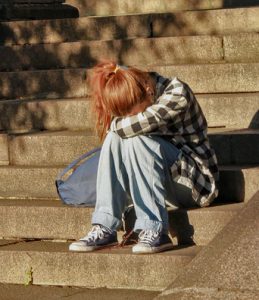
And what a fear it is. This week’s news is just how disabling climate anxiety can be:
Dr Verlie provides dramatic quotes from her undergrad students [at RMIT].
Photo by Zhivko Minkov
♦ I’ve been crying myself to sleep a lot lately. And crying at random times too. It’s not as though I watch a video about climate change, and I cry during it. I mean sometimes that happens. It’s more like, something little happens, like my toast burns, and I have an existential breakdown because I think it’s a metaphor for how the world is burning because we aren’t paying attention.
♦ I found myself dry retching in the shower for over an hour one evening. The contractions of my stomach muscles, sense of my throat exploding, and my whole body convulsing, felt like I was trying to spew up some kind of demon, a wretchedness, a loneliness and desperation, a sense of loss for all that could have been but probably won’t, for that which is but will no longer be.
♦ I feel bitter towards individuals and systems and fail to understand why people are not being charged for climate crimes.
♦ I was thinking of the dark, foreboding nature of climate change, its creeping horror masked by invisibility in the here-and-now of hyperconsumptive capitalism. Sometimes I see climate change as a chasm opening up before me, and I stand on a precipice overlooking the deep ravine, teetering on the edge.
At least students don’t feel alone as long as they live in Monoversity World:
♦ I’m so glad I changed into this class – it’s more of a climate change therapy group than a university subject.[3]
Imagine the mental health gains if students were taught critical reasoning instead?
As far as academia goes it’s in the national interest to shut them all down. Turn off the tap. Cut public funding to any institution that doesn’t uphold free speech and teach why Argument from Authority and Ad Hominem reasoning are fallacies in the first term of the first year of every subject.
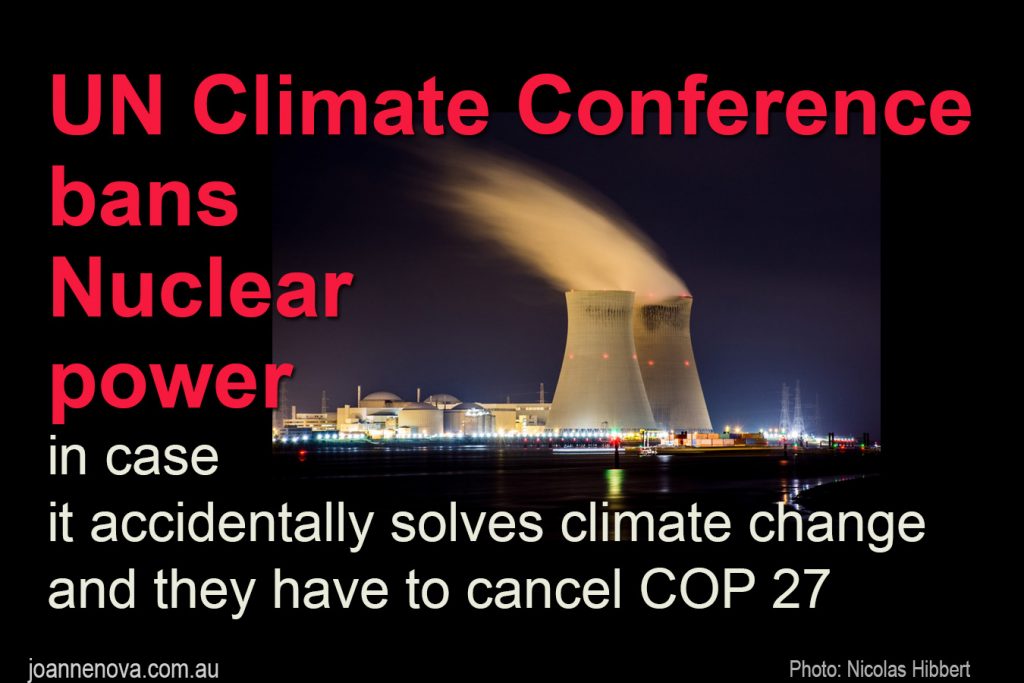
The global nuclear industry has put in fifteen applications to display exhibits at the up-and-coming UN Climate COP26 event in Glasgow. But all fifteen have been rejected in preference for exhibits from industries that appear to solve climate problems but have little effect on actual emissions.
Nuclear power poses an existential threat to the Climate Porn and Fear Industry, potentially causing mass job losses by providing thousands of years of reliable electricity as well as grid scale spinning inertia, FCAS, and reserve capacity too.
President Xi could not be contacted, but has in the past encouraged the rest of the world to keep trying to cut emissions in the most expensive way possible.
…
Imagine what the world would look like if the UNFCCC wanted to solve the climate crisis? (And if there was one?)
Up to 15 applications from nuclear-related bodies are understood to have been rejected by Mr Sharma’s COP26 Unit in the Cabinet Office.
They included an application involving the World Nuclear Association, which represents the global nuclear industry, to put on an exhibition featuring a life-size model of a nuclear reactor.
The trade body will still send delegates to attend events in the blue zone, after their applications were approved by the UN. But in an open letter to Mr Sharma, Sama Bilbao y León, director of the World Nuclear Association, said: “We are deeply concerned about the news that every application on nuclear energy for the Green Zone at the upcoming COP26 conference has been rejected.
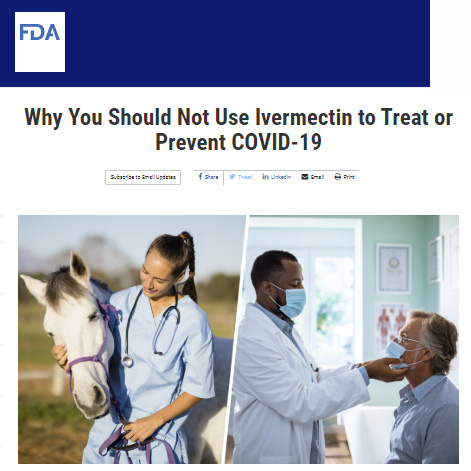
The FDA has launched a marketing program to rebrand the Wonder Drug from Japan as just a horse paste and thus bury the 3.8 billion doses given to very non-horsey humans, many of whom were in Subsaharan Africa. On another day this would be a hideously racist. When do 200 million Africans count for nothing?
The FDA may hope to save people from self-medication accidents, but will regret telling a half-truth-soup and burning up more of what’s left in their trust-bucket. After all, they want the public to trust them with their lives, but it only takes one eye opening conversation to undo years of propaganda. If the FDA are not mentioning that something like 200 million humans use Ivermectin each and every year — what else are they hiding? That it won a Nobel Prize and costs $1 a day?
The FDA and the Guardian and co, are training readers to mock anyone who even asks about Ivermectin. It’s the old Argumentum By Derision again. The tool of bullies, not scientists.
Ahead of full US authorisation of the Pfizer coronavirus vaccine, the federal Food and Drug Administration (FDA) had a simple message for Americans contemplating using ivermectin, a medicine used to deworm livestock, instead of getting a Covid shot.
“You are not a horse,” it said. “You are not a cow. Seriously, y’all. Stop it.”
Indeed, Lordy! No cool person will take cow medicine ever again. But say, don’t vets use penicillin ..?
The reasoning that animal-medicine can’t be a human-medicine doesn’t wash: a lot of drugs for farm animals are drugs for humans too. Like Aspirin. Valium. Prednisone. Propofol. Tramadol. Dexamethazone. doxycyclineAmoxicillin. Benazepril. etc etc etc.
….
The FDA is going Double or Nothing — not to save American lives, but to save their own reputation. Word is getting out that Ivermectin seems to help a lot of people, and how would it look if the US FDA was not as advanced as India, Peru and Mexico?
The FDA’s job is to carefully evaluate the scientific data on a drug to be sure that it is both safe and effective for a particular use, and then to decide whether or not to approve it. Using any treatment for COVID-19 that’s not approved or authorized by the FDA, unless part of a clinical trial, can cause serious harm.
Given their job is to evaluate scientific data, the FDA doesn’t give any of the sort of reasons we’d expect it might do. They don’t say ivermectin is ineffective, doesn’t work, or that it binds to the wrong part of the virus, stops antibody production, or doesn’t reach the tissues it needs too, or anything like that.
They can’t say that, because apparently they haven’t looked:
“The FDA has not reviewed data to support use of ivermectin in COVID-19 patients to treat or to prevent COVID-19; however, some initial research is underway.”
How good do we feel about that? 644,000 Americans have died so far, but the FDA hasn’t found the time in the worst pandemic of the last 100 years to even organise the research?
If it’s that cheap and low risk, why has it taken the FDA 16 months to start reviewing it?
Aren’t preapproved drugs the fastest and cheapest to test because they’ve already passed most of the safety checks and are in full production? If so, what program does the FDA have for screening pre-approved drugs to repurpose them. If the FDA doesn’t do this, who should, and why hasn’t the FDA called for that?
“Due to its extensive record of safe use, medical professionals can feel confident about
prescribing Ivermectin,” said Dr. Pierre Kory, president and chief medical officer of the FLCCC. “In the 40 years since it was first approved for use, more than 3.8 billion people have been treated
For more information about the FLCCC Alliance, the I-Mask+ Prophylaxis & Early Outpatient Treatment Protocol for COVID-19 and the MATH+ Hospital Treatment Protocol for COVID-19, please visit www.flccc.net with an average of only 160 adverse events reported per year. This is a better safety record than several vitamins.”
The FDA won’t quote their critics, but their critics are not afraid of what the FDA says (even if it is boring). Here they are:
Here’s What You Need to Know about Ivermectin
FDA has not approved ivermectin for use in treating or preventing COVID-19 in humans. Ivermectin tablets are approved at very specific doses for some parasitic worms, and there are topical (on the skin) formulations for head lice and skin conditions like rosacea. Ivermectin is not an anti-viral (a drug for treating viruses).
Taking large doses of this drug is dangerous and can cause serious harm.
If you have a prescription for ivermectin for an FDA-approved use, get it from a legitimate source and take it exactly as prescribed.
Never use medications intended for animals on yourself. Ivermectin preparations for animals are very different from those approved for humans.
Medicine delayed is medicine denied. It doesn’t have to be this way.
GB News has only been running for 10 weeks in the UK but it has already been targeted by a campaign to boycott the advertisers.
However the boycott was twice as likely to get people to tune in.
This is how it works. Once the Virtue Signallers have overdone the bullying and the crowd knows it — the bullying itself works like a signpost.. By definition, the forbidden material will always be the most interesting. The politically incorrect shows are the most entertaining.
GB News joy as campaign to boycott advertisers has actually BOOSTED channel
Express.co.uk
While those wishing to boycott GB News may take brands removing their adverts as a win – a recent survey found it may have actually given the channel a boost.
A poll of 1,000 people conducted by CT Group, commissioned by GB News, gave the statement “consumer goods brands should not adopt overt political views”.
Of those polled, 57 percent agreed that brands shouldn’t take on “overt political beliefs”. And only 15 percent disagreed with the statement. When those surveyed were asked if an advertiser boycott made people more likely to tune into the news network, 29 percent confirmed it would.
The Minister for Media and Data has reported a “decline in willingness to pay the licence fee” of the BBC. Mr Whittingdale continued: “The second is in the longer term the decline in willingness to pay the BBC’s licence fee. “So I think this debate about how we sustain public service broadcasting is only just beginning.”
This is both good and bad. It’s good that the BBC is feeling the squeeze, but ultimately it’s bad that the price signals are knocking on the door, and no one is listening. People wouldn’t be tuning out if the BBC was not such a humorless preaching bore.
In a normal world, the BBC ought to care that people are leaving and want to give them what they want to get them back. Instead the BBC will no doubt beg the government for more money while it beats them over the head for not being leftist enough, and the government will give it cash. In the process the Deep State gatekeepers will become more entrenched.
Meanwhile: In Australia, people might want to know about this petition calling for an ombudsman for the ABC. I’d rather sell it myself, but it’s good to see any kind of protest.
We subsidized weather-controlling generators in the hope that our electrical infrastructure could not only provide electricity but would also stop storms, floods and The Taliban. However the weather-controlling-generators were also weather-dependent, and it was costing quite a lot to add storage, stability, transmission lines and synchronous condensors. Who knew changing global weather would cost so much?
Once upon a time Australia had a full complete electricity grid that was cheap and efficient. Then we added inefficient things to it until we had two whole grids, one that changed the weather (in theory) and a spare one that filled in for all the other grids failures. For some reason it was not cheaper to run two whole grids rather than just one.
The subsidies were needed to drive out the cheapest player (coal power), but having succeeded, we then needed different subsidies to keep the coal power in.
What a tangled web we weave when first we lie to ourselves.
Special payments will be needed to keep ageing coal-fired and gas power stations in business to avoid future spikes in electricity prices, under a national plan to shore up the energy grid.
A new capacity mechanism recommended by the Energy Security Board will put incentives in place to stop the early closure of power plants and create long-term signals for investment in dispatchable generation.
NSW is nearly running out of electricity every 4 days.
The Australian understands the Australian Energy Market Operator has issued a record number of warnings about a lack of supply in NSW this year, at a rate of almost one every four days. The notices are issued when AEMO considers there is not enough capacity available in the system.
Once upon a time Australians got “capacity” for free, now we have to pay for it.
Most of Australia is living with freedom, not the virus. “Living with the virus” means long lockdowns in NSW. Who wants that?
The Australian Federal government wants to “open up the nation” when we reach 70 or 80% vaccinated, like it’s The Sign of Bethlehem, or something, but the No-Covid States are rebelling and it’s no wonder. Being free of Chinese Bioweapons means being free to dance, sing, work and send the kids to school — and the voters rather like that. No virus means no lockdown. The States with zero covid know that if they let the virus in even at 80% “vaxed” they’ll have less freedom. They might get to fly to London but they’ll have to give up Big Weddings, Parties, and possibly Grandpa too.
The key value is and always was hospital beds. The hospitalization rates mean even at the magical 80% double-vaccinated mark hospitals will be overwhelmed, forcing states to flatten the curve for months and stand in the street banging tin pots at 9pm each night to say thanks to strung out health workers. We don’t need modeling to know this, it happened already in places like the UK, Spain and Italy. It only took a few percent of the population to get infected and hospitals were overwhelmed.
It’s just maths. There are 12,000 active cases in Sydney now — so a mere 0.15% of the NSW population is infected, but hospitals are already running out of beds. Cancer surgery is being rescheduled.
Photo by Hakan Nural on Unsplash
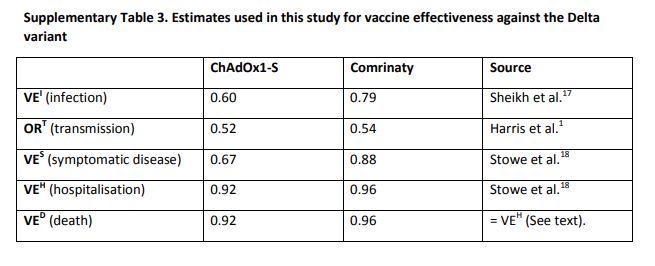
These first generation vaccines are not remotely good enough. Even most of the pro-vax modelers admit we have to vaccinate more 90% of the whole population (really 95%, they say) and in that scenario, there are still thousands of deaths and ongoing restrictions. If the vaccines stopped transmission it might be different. But the leaky sort only halve it (see Table 3 below). Even the 100% vaccinated cruise ship still spread the virus.
If States-with-Freedom open borders to States-with-lockdowns, the lockdowns will spread, not the freedom.
Before we open up we need a better plan than purist vaccination.
The solution is profoundly right wing: it’s hard borders, state rights, free speech and free choice — the right to pick the treatment we want with our doctor. But bizarrely, at the moment, the conservative party in Australia has become the best friend of Big Pharma and Big Bureaucrats while The Labor Premiers are fighting for hard borders and state rights.
Relying on first generation vaxes without antivirals is a train-wreck.
It’s almost like Scott Morrison and Gladys Berejiklian like lockdowns. Judge them by the outcomes, not their words. How many billions of dollars lost, deaths, and broken businesses will it take for them to investigate the bargain vitamin and out-of-patent drugs that have saved thousands in the third world? Instead, they’re trying to sell us on a scheme that might have been written by Big Pharma itself.
Morrison must be frazzled, calling West Australians and Queenslanders “cave dwellers,” because they have not ram-vaccinated as many people as disaster-land-NSW. With insults and a totally Sydney-centric perspective, he may have just handed the next national election to Labor. Were the Liberals hoping to win any seats in WA? Did the Liberals learn nothing from their humiliating WA state election loss?
There is a battle of models going on as well, as various Governments in Australia try to figure out what to do next. All of these models start from the one-eyed Vaccines-Will-Save-Us-Kemosabe! point of view. But it’s eye opening to follow the calculations which mostly show that infecting the nation at 70 or 80% vaxed is reckless. The only model that doesn’t is the Doherty institute’s, and it’s a fantasy model. But that’s the one Scott Morrison is betting the house on. All the models assume there is no other treatment and no one does anything to raise Vitamin D or Zn levels. So all the models are flawed, but we can still learn something from them.
The Grafton ANU modelling concludes that the toll from playing games with novel viruses could be quite high:
“And assuming 80 per cent vaccination coverage for only those over 16, as per the National Plan, there could be approximately 25,000 fatalities and some 270,000 cases of long COVID.
Buried quietly is modelling from The Burnet Institute, which suggests that fully 45% of these deaths will be among the vaccinated population. There are three million Australians older than 70. Even if we vaccinate 95% of them, and even if the Pfizer vaccine protects 96% of that group, there are still potentially a lot of dead bodies in that age group in the wake of the virus. (And the AZ vaccine only stops 92% of deaths.)
No one wants to copy the pain that the people of NSW are going through. Who can blame the smaller states? We almost suspect that what Berejiklian and Morrison are most afraid of is that clean states will show how wrong and incompetent the NSW approach is.
What if the ACT, Victoria, or New Zealand get back to zero? Won’t that make the “gold standard” state look like chumps.
Image: Scientific Animations
The Doherty team models a different virus in an imaginary world
In a fantasy simulation the Doherty group pretend we start with only 30 cases, which is about 900 cases lower than NSW already has. They assume we can manage to track and trace them, which has already failed in NSW (test results are slow, and tracers are not even phoning infected people for a couple of days!). The Doherty model pretends that children don’t spread the virus much, and only runs the simulation for the first six months. It’s like they set out to show the nation can open at 70-80%, and made up the assumptions to achieve that.
In the fine print the Doherty group also assumes the Ro (rate of spread) is reduced from an awesome 6.3 down to 3.6. That means they also assume many ongoing restrictions are in place to halve the rate of spread. Presumably that means Australia can kiss goodbye to football finals, concerts, festivals, big weddings and funerals, and “live with” ongoing masks and lots of distancing. This is a Big-Pharma version of freedom, where we live with death and the last 20-30% of the population are put under major pressure to get vaxed or to hide from public life. How much fun can you have? Booster shots, baby! Big Pharma know that if the nation opens up at 80% the headlines will be full of stories of loss and deaths and reasons to push the last 20% towards an injection.
The Grafton modelling estimates hospitalization and deaths
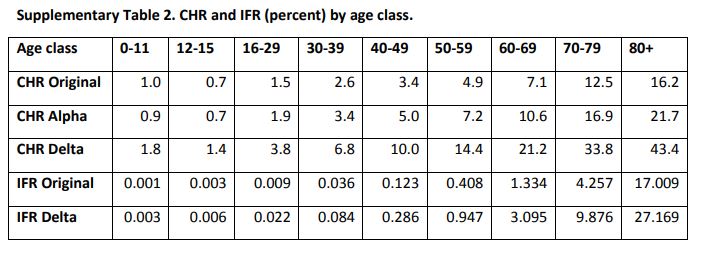
Here’s a table we rarely see. There are a lot of caveats –see below.
CHR – Case Hospitalization rate. IFR – Infection fatality rate.
Deaths may be higher because…
They don’t include deaths related to long covid, or an “overshoot of herd immunity” which I think means a surge that overwhelms hospitals where death rates rapidly rise. They don’t include deaths due to non-Covid causes, such as suicides, undiagnosed cancers, or people avoiding hospitals because they are afraid of catching Covid.
These estimates only consider immediate acute Covid deaths. But in the first wave of the UK epidemic, people who survived and left hospital were subsequently four times as likely to be readmitted to hospital and eight times as likely to die than a matched control group. [14] In other words, deaths can lag illness by a long time.
The next mutation escapes the current vaccines.
Deaths may be lower if…
Australians have higher levels of Vitamin D, maybe lower levels of comorbidities or high risk genes, or they might get scripts to use antivirals. These are not even mentioned in the paper.
The death rate due to Delta is lower than estimated here. The death rates are estimated from Canadian data which estimates that Delta is 2.3 times as deadly as the original Wuflu [11]. The hospitalization rate is likely be to be twice as much as the Alpha strain, which was already 1.5 times higher than the original, based on English and Scottish data [8] [9]). The hospitalization rate for Delta is thus three times higher than the original Wuhan Flu. It’s bad. The Delta variant pumps up the viral load faster, so it swamps immune systems faster and spreads more easily. That explains the higher hospitalization rate, and it’s hard to believe it won’t also increase the death rate — but it may not increase it by the same ratio. The deaths are more about vascular clotting and an overactive immune system, which doctors might be still able to treat.
Vaccines assumed to stop half of transmission:
Though if the Israel data applies to all cohorts, after 6 months, VE of infection is 0.16 and presumably OR (Transmission) must be less too.
The ChADOx means Astrazenica, and Comrinaty means Pfizer vax.
Professor Quentin Grafton from The Australian National University, Dr Zoë Hyde from the University of Western Australia and Professor Tom Kompas from the University of Melbourne examined the Australian Government’s National Plan to reduce restrictions once enough adults are vaccinated.
Under the National Plan, once more than 80 per cent of adults receive two doses of COVID-19 vaccines, equivalent to approximately 65 per cent of the total population, the nation will “manage COVID-19 consistent with public health management of other infectious diseases”.
Professor Grafton said the new modelling showed “we simply can’t afford to do that, both in terms of lives and long-term illness from COVID”.
“We found substantial morbidity and mortality is likely to occur if the Australian Government sticks to the National Plan,” he said.
“Our modelling shows if 70 per cent of Australians over 16 years of age are fully vaccinated, with a 95 per cent vaccination level for those aged 60 years and over, there could eventually be some 6.9 million symptomatic COVID-19 cases, 154,000 hospitalisations, and 29,000 fatalities.
“And assuming 80 per cent vaccination coverage for only those over 16, as per the National Plan, there could be approximately 25,000 fatalities and some 270,000 cases of long COVID.
“In contrast, and if children are also fully vaccinated, national fatalities for all age groups would be reduced to 19,000 with 80 per cent adult vaccination coverage. This would fall to 10,000 at a 90 per cent adult vaccination coverage.
“Children also directly benefit from vaccination. If we could achieve 75 cent vaccination coverage among children and adolescents, we could prevent 12,000 hospitalisations in these age groups.”
Grafton conclusions are to Triple vax the over 60s and vax all the kids?
The Grafton team are essentially saying we need to vaccinate at least 90% of all Australians including children to consider opening with a lower death rate. They assume that 95% of the over 60s are vaccinated, and even consider doing this with two doses of AZ plus the Pfizer booster shot to maximize protection. But even with all that vaccination, the death rates are still too high unless children are vaccinated too. Even under this scenario, with “only” 70% of Australians vaccinated and the over 60’s “triple vaxed,” they estimate there will still be nearly 30,000 deaths and nearly 300,000 with long Covid.
Nearly half of the deaths will be in the vaccinated.
Readers may well disagree with the conclusions, but the modeling and assumptions and references are all there to discuss. (See the links below).
Nearly 7 million Australians will get symptomatic infection — which still means some significant productivity hit to workers and students, even if “it’s like the Flu”. We can bear that, but do we have to?
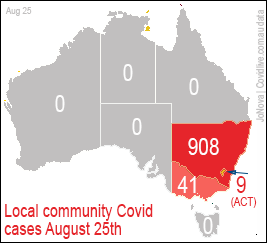
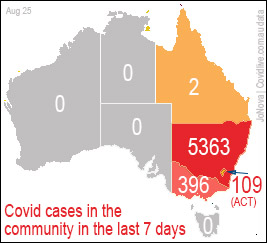
Locally acquired cases in each Australian state for the last seven days.*
Is it worth it?
All these deaths, the sickness, and the experimental vaccines is to allow us visit friends overseas, and let in tourists to help our tourism industry. It also means Qantas can make more money, and we can accept mass immigration that most Australian don’t want (and which pushes down blue collar wages, and pushes up house prices). It also means we can take in Chinese paying students to universities. “Yay”.
Obviously the West has totally failed to stop the Chinese Bioweapon. It is now a given that we’ll all get it or one of its descendants eventually. But there is a huge difference between getting this mutation now — without any respectable approved treatments and with 30,000 deaths — and getting a different mutation a year from now — with a suite of antivirals and / or the second generation of vaccines (which might be so much safer). Monoclonal antibodies may make travel possible without a vaccine. So may a combination of antivirals, like the way we treat AIDS. The next mutation may get nicer like Spanish Flu did, or it might not.
What they are trying to do is distract Australians from the real debate, which is about borders and antivirals.
The modelling from Professor Grafton, Dr Hyde and Professor Kompas is available online as a pre-print publication. Read an analysis article by the three researchers about their findings and proposed four-step national COVID-19 response at Policy Forum.
PS: Before commenters say it, this modelling is not “like climate change”. That doesn’t make it right, but it’s 20 pages not 2000, it’s all published, the assumptions are spelled out and it isn’t trying to predict waves of infections on a regional basis using a bottom up grid system with error bars wider than the trends. Nor is it trying to predict mutations and death rates 100 years in the future.
The point is not the exact number of deaths, but that using purely vaccines and ignoring all the other solutions is a bad strategy.
SA is the pioneer wind state and the first to experience the rapid increase in power prices that hastened the demise of the local car industry. They literally blew up the last of their coal-fired power stations although they still have gas which is just as well because during wind droughts they live on gas and coal power from Victoria.
RE enthusiasts laud SA as an RE powerhouse, the wonder of the world and the shape of things to come across Australia. That is true but not in the way that they mean. Look at the situation in SA in the recent week from August 12 to Wed 18.
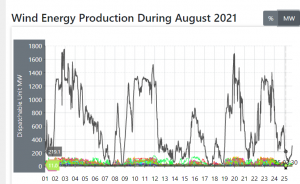
The chart below shows the amount of wind power generated in South Australia hour by hour through August to date. The dotted line across the chart at 219MW is close to 10% of the installed capacity of 2,100MW and it marks the upper level of supply that I regard as a “wind drought”.
From the 12th to the 18th the supply was mostly under the line and consequently they were importing power every day of that week at breakfast and dinnertime. They were importing at lunchtime on weekdays as well during that period and this is unusual due to the amount of solar they have.
South Australia may be a net exporter over 12 months but that it practically beside the point because they depend on imports whenever they are in drought. When other states, led by Victoria, get rid of more coal power they will not have spare power during wind droughts to prop up SA.
That is just about the end of the RE story until there is feasible and affordable grid-scale storage because there is no way to deny the reality of wind droughts. They are clearly visible in the AEMO records and Tony from Oz has been monitoring the situation for years. It is about time for more people to pay attention. See here for the introduction to his comprehensive wind generation series.
Mike O’Ceirin has an interactive site based on those records and this link takes you to a list of periods when the whole of the NEM was in drought (under 10% of installed capacity) during 2020. On 18 occasions the duration of the drought was ten hours or more and in June the drought on the 5th and 6th lasted for 33 hours. Other droughts in June lasted for 18, 16, 14 and 9 hours.
For more instructions on wind watching check out the addendum to this post from the Energy Realists of Australia. But remember that wind watching can be time-consuming and habit forming so please watch responsibly. A Windwatchers Anonymous group has been established to support people who recognize a need for help with wind-watching dependence.
Pay attention to the low points instead of the high points!
RE boosters are excited by the high points of RE supply, but think about a flood protection levee or wall. You need to check the low parts where the water will penetrate and you you will not be impressed to see the high parts getting twice as high while there are still gaps in the wall. Windless nights are the gaps in the RE wall and there is no point in wasting more resources in RE capacity until the storage issue is resolved.
THURSDAY MORNING UPDATE – LOW WIND AT BREAKFAST TIME
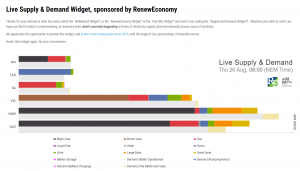
Access the widget in real time here. Western Australia is not connected to the eastern states that are all connected to form the NEM the National Energy Market.
Across the NEM at 8am the windmills are delivering 16% of capacity and 5% of the power in the grid. Queensland and Tasmania are the bookends of the system and the other three states are all in deficit. The lakes in Tasmania (the battery of the nation) are being drained so the ungrateful South Australians (croweaters) can have hot coffee on the way to work.
Urge your friends and relations to check this display at breakfast and dinnertime to see how much or how little green is visible on the bars to signal how much more wind capacity is required to dispense with the black, brown and red bits. Think about moving to Tasmania or getting a home generator!
Google and Youtube are to some extent the Police of our National Conversations. Somehow they are allowed to invest privately and simultaneously put people in jail according to rules they made up themselves. What could possibly go wrong?
Consider the ownership of vaccine makers. Alphabet owns YouTube and Google. Alphabet owns 12 per cent of Vaccitech, which created the AstraZeneca vaccine. YouTube bans videos mentioning ivermectin as a COVID treatment. Aren’t these conflicts of interest? If ivermectin was approved for COVID, what would happen to big pharma’s hundreds of billions of dollars in profits? These profits are a transfer of wealth from taxpayers to big pharma.
New business model? What if one hot drug created a market for other drugs:
Consider the vaccine maker Pfizer’s profits. It’s second quarter 2021 revenue was $19 billion, up 89 per cent. In three months, it made $4 billion profit. The European Medicines Agency discovered a definite link between Pfizer’s vaccine causing myocarditis. In September 2020, our TGA approved Pfizer’s Vyndamax drug to treat myocarditis. Our health department confirmed the AstraZeneca vaccine’s links with blood clots. Pfizer’s Eliquis drug treats blood clotting. Last quarter its sales were up 13 per cent. So are those blood clots rare? Really? In 2019 Pfizer’s Zavicefta drug was approved to ICU patients on ventilators. Is Pfizer making profits making people sick and more profit treating the sickness it caused?
Alphabet, Google’s parent company, is a tech giant with a $1.4 trillion market cap, making it the 5th most valuable company by market cap in the world.
What if public policy was controlled by people who are afraid of being put in the naughty corner by Google and Youtube?
Malcolm Roberts and Craig Kelly are fighting the good fight in Australia in Parliament. In the next election they are going to need all the help they can get.
h/t David B and a few others (I’m trying to find their names).
PS: From Jo. Rafe Champion has been posting at the lost Catallaxy site for years so I offered him a home to try to fill the vacuum on Australian blogs for discussion on energy issues.
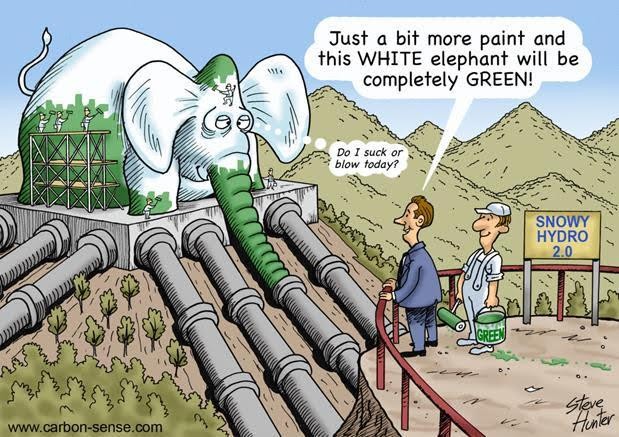
The dilemma Australia faces is that if we keep stuffing subsidized unreliable energy into the system we will force stable fuels out, and be carbon free, but we will also be free of 50Hz cycles, 24 hour power, aluminium plants, and manufacturing jobs. Policy-dreamers are using magical words like “battery” and “pumped hydro” as if Australia is a scaled up Mechano Truck run on Monopoly-money and we can expect reliable rain for the first time in 2 billion years.
by Steve Hunter
The Energy Security Board, chaired by Kerry Schott, has at last delivered a report to the Federal Government with proposals for market reforms to resolve a looming crisis in the national power supply or at least the NEM, the National Energy Market that covers the south-eastern states, excluding WA. The crisis is twofold – increasing grid instability and the threat of supply if coal plants are forced out of business prematurely. Both of those issues arise from the rapid escalation of intermittent inputs of wind and solar power because Australia has the gold medal for the rate of increase in installed RE capacity.
Kerry Schott, the chair of the ESB, has signalled that the ‘simple’ plan to move towards net zero emissions is to get in as much renewable energy and hydro as we can and back it up with pumped hydro and batteries.
The fundamental problem is the gap in RE supply on windless nights when the supply is zero. No amount of installed capacity is helpful in the absence of wind and sun, in the way that a chain is only as strong as the weakest link and a flood protection wall is only as good as the lowest point regardless of the high parts or the average height.
How much can we expect from pumped hydro and batteries?
The Snowy 2.0 project will probably cost north of $10 Billion and it will take years to complete. It is expected to deliver as much power as a big coal power station like Bayswater for about six months. So to replicate Bayswater we need a second Snowy 2.0 but where can that be located? And even then, the two Snowys (and associated wind farms) only replace 2GW out of some 20GW of coal capacity that we have at present.
Moving on to batteries. Some people in the industry will tell you they are not supposed to deal with wind droughts, they just deliver instantaneous inputs of power to stabilize the grid in the face of fluctuations of wind and solar input. But still there is talk about putting batteries at Liddell and Yallourn to cover the gap when they close. The problem is the difference in scale between the power that you can get from the battery (after it is charged) compared with the power delivered by the coal plant. The pathetic scale of big batteries is explained here.
Many of the problems in the green energy transition are covered in the briefing papers from the Energy Realists and you can see them all here.
Even CNN, MSNBC, and The New York Times have stopped defending him.
These are the same teams that hid the Hunter-Biden Laptop from hell, the “10% for the Big Guy” scandal and that the FBI had possession for a whole year and did nothing.
ABC (America) News said: ” when you listen to the President, he is saying things that simply do not comport with the reality.”
In the last week Joe Biden’s own Defense Secretary, and the Pentagon Spokesman both flatly contradicted him in the media. Tucker Carlson says that’s something that never ever happens.
The Afghanistan debacle was so complete, it’s like it was planned. Could someone merely incompetent achieve a perfect fail?
The New York Times has turned against Joe Biden on Afghanistan. For the last two days, it has covered for him. With only brief, passing mentions, the Times has suppressed the issue of American citizens trapped in Afghanistan.
Today, that is all changed. Not only is the issue of getting Americans out mentioned, the headline article in the print edition is: “Despair in Kabul Undercuts Biden on Rescue Effort: President Goes on Defensive as Criticism of U.S. Evacuation Grows Louder.”
It’s clear if you watch closely that things are changing very fast in Washington. The people around Biden are moving away from him, in ways that are not subtle.
Why is this happening now? Was it always the plan? Did the party that hates white guys finally realize it was being led by one? Again, we don’t know the answer. But the signs are everywhere, and they’re strikingly obvious.
Some of Biden’s most senior appointees are contradicting him in public. If you cover politics, it’s shocking to see that. This is a violation of the first and most ruthlessly enforced rule in any White House: Don’t diminish the boss.
But suddenly they’re doing just that, and they’re doing it openly. Just hours after Joe Biden assured us that things were fine in Afghanistan, for example, Lloyd Austin, his defense secretary, described the situation there as a disaster. And then Austin repeated it, for emphasis. Others are doing the same thing. Biden this afternoon told us that American citizens are having no trouble getting to the airport in Kabul … But just an hour later, the Pentagon spokesman told us that’s not true. Actually, Americans are being beaten in Kabul …
Afghanistan is hardly Biden’s first disaster. As of tonight, our southern border has collapsed, the murder rate is spiking in our cities, the Covid vaccines do not work, inflation’s out of control, and the country’s entire population of school children hasn’t been educated in more than a year. All of that’s been going on. None of that seemed to bother CNN in the slightest. In fact, they reserved their energy to attack anyone who noticed those trends. But now, suddenly their anchors are weeping on the air because Americans are trapped in Afghanistan. They don’t notice the 70,000 who die every year from drug overdoses. But this has sent them into a self-righteous rage. Call us cynical, but we don’t buy it. Something else is going on here.
The legacy media move as a herd. Once a shift comes at the top, the rest will follow. Who will fight for him?The man who got 80 million votes (theoretically) may become one of the shortest serving Presidents in history.
Apparently the Taliban were not waiting for a US President to gift them with helicopters and guns and then run away. What they really needed was climate change:
Rural Afghanistan has been rocked by climate change. The past three decades have brought floods and drought that have destroyed crops and left people hungry. And the Taliban — likely without knowing climate change was the cause — has taken advantage of that pain.
According to the CBS News article, titled “How climate change helped strengthen the Taliban,” “Rural Afghanistan has been rocked by climate change. The past three decades have brought floods and drought that have destroyed crops and left people hungry. And the Taliban — likely without knowing climate change was the cause — has taken advantage of that pain.”
Wake up to the new reality that Solar Panels can stop the Taliban. When you see the crying children in Kabul, feel guilty because you eat meat, drive cars, and heat the world! Then go make yourself a Fairtrade Organic cup of Cocoa and know that you’re helping.
According to CBS News, the farmers were destitute, abandoning their children to extremist influences. They didn’t have enough food to eat or enough water to put on their crops, so they turned to farming poppy seeds for opium. Not that they’ve ever done that before…
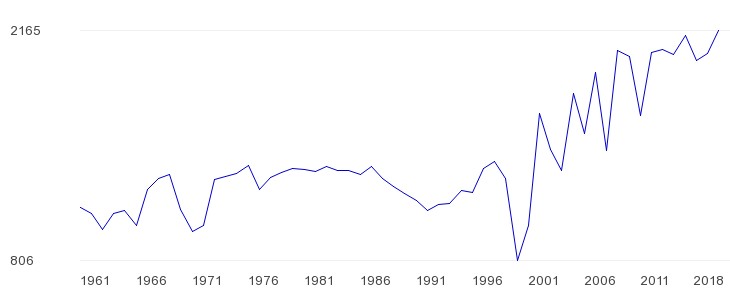
Thanks to James Taylor of Hearthland for finding a graph of just how much crop yields have fallen lately.
Crop yields Afghanistan.
Clearly Climate Change causes better crops…
Or maybe climate change is irrelevant, and well, “follow the money”.
Logan explained that the Taliban’s main base is not Afghanistan but Pakistan … She said the U.S. helps fund a good portion if not all of the Pakistani defense budget in terms of military and intelligence services, like the ISI.
“For example, you could stop the money. You could stop the remittances of Pakistanis living in the United States. You could put on sanctions. You could have visas [withdrawn], you know,” Logan said of one potential action the U.S. government could take quickly to counteract the catastrophe in Kabul.
The three Taliban “Shura,” or councils, she added, are all in Pakistan – the Quetta, Peshawar and Miramshah. The Shura all benefit from the “warm embrace of the ISI”, she added.
“The United States has known this from day one.”
This disaster appears to be exactly what the US Swamp wants — they could stop it, yet they don’t.
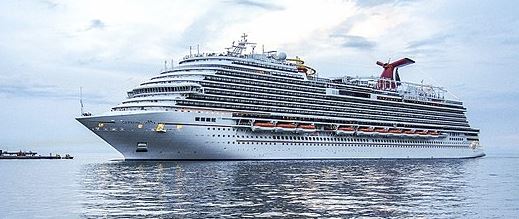
Carnival Vista | Photo by antonio from Trieste, Italy
by J.D.Rucker:
…according to The Liberty Daily, every staff member and every guest on the ship was vaccinated.
“Somewhere near Cozumel in the Caribbean Sea, there’s a cruise ship that had zero unvaccinated people aboard but that still suffered an outbreak of Covid-19,” the report said. “This goes against the narrative that the reason for ‘breakthrough cases’ is due to too many unvaccinated people mingling with those who have taken the experimental injections.” It continued, “The Carnival Vista, which departed from Galveston, Texas, on July 31, has issued strict face mask protocols and ordered infected people aboard into isolation.
Shipping lines would probably do better by giving passengers free Vitamin D and prescribing anti-virals.
The tale of the contagious cruise ship also implies that States demanding all visitors must be vaccinated might not be achieving much at all. If vaccinated travellers are not quarantined in similar arrangements to the unvaccinated, it’s just a matter of days before they bring in Covid.
According to ANI, now, vaccine certificates or negative COVID-19 tests are also required to enter synagogues, mosques, or churches where there are more than 50 people. The capacity of shops, malls, and industrial parks is also limited to one person per seven square meters. It is worth noting that more than 78 percent of Israel’s approximately nine million people received two doses of the Pfizer/BioNTech coronavirus vaccine.
Israel was one of the first nations to load up the vaccines, but the latest figures were suggesting that protection from infection was rapidly waning. People vaccinated in January still had protection from severe disease six months later (mostly) but only 16% protection against being infected. So infections are rapidly rising, and even though hospitalization and death is a lot lower, the hospitals are still struggling. So the new push policy is to get that third shot of Pfizer now:
Israeli PM Naftali Bennett released an audio message urging seniors to get the booster dose on Sunday. In the recorded message, the leader warned that in the next two to three weeks anyone who is over the age of 60 and has not yet received their third vaccine is six times more likely to become seriously ill from the coronavirus, compared to those who are five days past their third shot.
We use cookies to ensure that we give you the best experience on our website. If you continue to use this site we will assume that you are happy with it.

 GB News has only been running for 10 weeks in the UK but it has already been targeted by a campaign to boycott the advertisers.
 This is both good and bad. It’s good that the BBC is feeling the squeeze, but ultimately it’s bad that the price signals are knocking on the door, and no one is listening. People wouldn’t be tuning out if the BBC was not such a humorless preaching bore.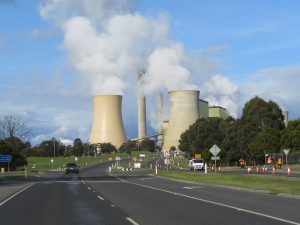

 Even CNN, MSNBC, and The New York Times have stopped defending him.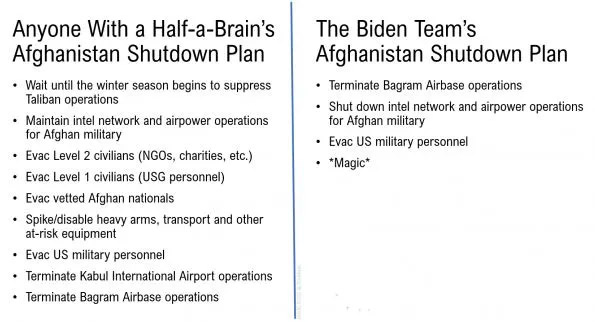






Recent Comments