|
|
Simon Campbell speaks at the Pennsbury School Board meeting serves it up to the Board President he calls “Mussolini”. (h/t commenter Lance for details)
From the Supreme Court case of New York Times versus Sullivan, 1964
US constitutional case law says:
This nation is founded on the profound national principle that debate on public issues shall be uninhibited, robust, and wide open and it may include vehement, caustic, and sometimes unpleasantly sharp attacks on Government and public officials.
Watch the video, not just for the content but for the force with which he delivers it. He will not be deterred, bullied or silenced. He wades right through the intimidation. He knows what his rights are, he has come prepared, and he will not submit.
Most of the snowflake generation need to hear this quote to counter the false power of the cancel culture bullies who cry injury — racism, sexism, and hurty-pronounism. Free Speech may offend people, especially public officials.
h/t Also to Tom Nelson
9.8 out of 10 based on 85 ratings
Don’t wait for your government Newspeak channel to tell you
On Twitter #Netherlands, massive protests are underway. Farmers have been told to shut farms to reduce nitrogen emissions and they’ve taken to the streets. (It’s not clear if this is purely about fertilizer runoff, or climate change as well.) The word is that supermarket shelves are emptying fast, roads are blocked, but that 75% of the public generally support the farmers and are joining in on foot in some places. Farmers are dumping hay bales in the streets and spraying manure on government offices. There are claims (with footage) that the Dutch government has brought in armored vehicles and is using tear gas. Some video allegedly shows masked police zero in on single peaceful protestors and pull them out.
Express.UK
FARMERS in the Netherlands have staged a huge protest with thousands of tractors lining up to block the German/Netherlands border in campaign against the government’s controversial nitrogen policy.
Protestors demonstrated in front of several public buildings with manure and slurry after politicians voted on proposals to slash emissions of damaging pollutants, a plan which could force farmers to cut their livestock herds or stop working altogether. Prime Minister Mark Rutte’s Government says the emissions of nitrogen oxide and ammonia, which livestock produce, must be drastically cut back close to nature areas, which are part of a network of protected habitats for endangered plants and wildlife stretching across the EU.
Dutch farmers turned out in their thousands to speak out against the World Economic Forum (WEF) climate change policies of their government.
 Dutch Netherlands Farmers Protest There’s a food crisis brewing, but you wouldn’t know it with the way the European bureaucracy is behaving.
Dutch farmers – who sit as the second-largest agricultural exporter in the world and largest meat exporter in Europe – have brought the Netherlands to a standstill, protesting against Climate Change regulations.
The newly elected government has set up a 55-60 per cent emissions goal by 2030, 70 per cent by 2035, and 80 per cent at 2040. To meet these arbitrary climate targets, they have created a self-inflicted disaster that will see the government drag its agricultural sector up the temple stairs, tear it to bits, and let whatever bloody stumps are left to tumble down the steps for the pleasure of the United Nations climate gods.
Farms which have been feeding the world for hundreds of years are going to be unceremoniously shut and their owners ruined because a couple of bureaucrats decided they didn’t like the nitrogen and ammonia emissions produced by growing food.
The press have attempted to demonise farmers for defying the EU’s virtuous green push – but the Dutch people aren’t listening, with support for farmers still over 75 per cent.
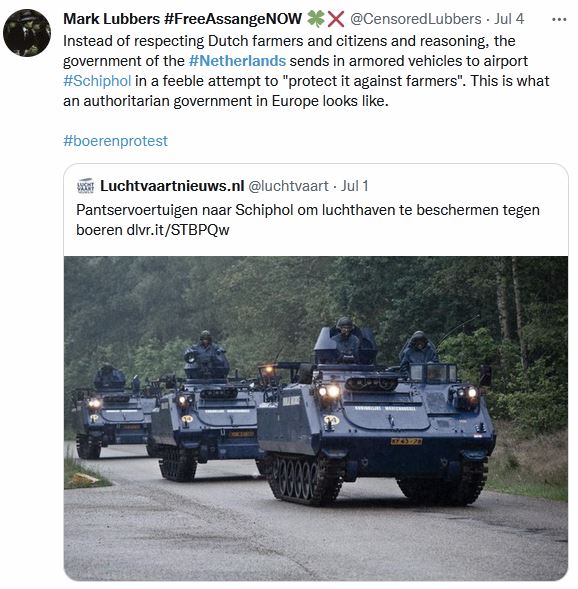 ….
h/t Tonyb, another Ian.
10 out of 10 based on 101 ratings
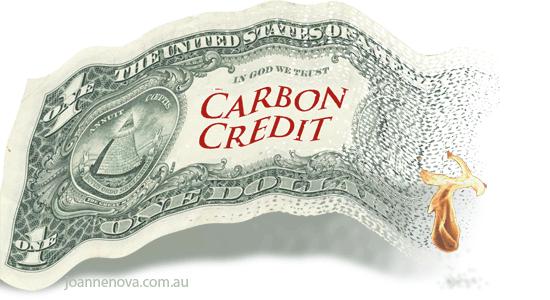 The idea that we could make “a carbon credit” work as an international currency and fix our weather at the same time, is the stuff of Econo-alchemy. The idea that we could make “a carbon credit” work as an international currency and fix our weather at the same time, is the stuff of Econo-alchemy.
It’s where a scientific quagmire marries an economic fairy. Instead of salvation we get the swamp to end all swamps. It doesn’t give power to the people or produce an honest mode of exchange or stop the storms either. A carbon currency just feeds corruption and centralized unaccountable unelected committees who play power-brokers and Kingmakers, deciding what is and what isn’t a real “right” and who or what should pay. It serves global bankers who broker the transactions. It is the paper currency from hell.
Where do we start? A bar of carbon “rights” is not a bar of gold
How do we weigh a “carbon right”? Every nation on Earth knows what a gram of gold is, and with 2,500 years of trading history, everyone knows that come the apocalypse, they can still swap gold for goods.
What sort of security is backed by the right to emit one unit of carbon dioxide, a right that all life on Earth and most of the rocks and water already has? The largest consumer of carbon rights is the Pacific Ocean on a warm day. Should we set up an account for it in Geneva? Do the territorial seas around a nation produce or consume carbon rights? What about the coral reefs, the trees, the bark, the bacteria? Says who? We cannot measure it, so it’s all modeling. May the biggest cheats win and UN Gatekeepers rule the world.
The problem with using a ubiquitous molecule as an exchange of value is manifold — either every molecule is in the market or the new Global Emperor decides what is and what isn’t and everyone bows, grovels or bribes Zir or Zat Ruler to get what they want. There’s no intrinsic way to know if the molecules being counted are “in” the market or out; the biggest players in the market can’t play, and perverse incentives are everywhere like spaghetti.
A global carbon currency would be instantly prone to massive rorting, corruption, and political whimsy.
Are all carbon rights equal, and if not, who decides?
Does a freezing Inuit have the same right to emit carbon as someone living in the tropics? Do countries with high population growth earn more rights to emit? Would that incentivize baby-production in a world where some argue that more people means more pollution? Or do we go the other route, where humans don’t count per se, but it’s the right of a nation compared to past emissions, which disincentivizes and punishes nations that grow their population or allow mass immigration. Should we rate the “right” based on distance from global population centers, population density, latitude, rating for “development” proclaimed by some quasimodo UN Index, rorted up the kazoo by nations that earn votes via Belt-N-Road bribes or leverage, or should we just auction the rights to the biggest bribers? What could possibly go wrong? And whose is this magical “we” who decides?
Gold, on the other hand, is the ultimate anti-cheating device
Governments can’t print it, fake it, change the definition of it, or argue over whether it exists. Logically, without gold backing, our paper currencies are simply legalized counterfeiting. Any global fiat carbon market would be only as secure as its weakest link — think Zimbabwe. At least some paper currencies are backed by the tax-raising power of democracies, which slows the descent of paper currencies to their true long-term value — zero. (Look up MMT).
Make no mistake — the Carbon market is a fiat currency, not a commodity
Despite the name sounding exactly like an element of the periodic table, the carbon market isn’t counting carbon, or even carbon dioxide. It’s merely some fractional subpart, a few percent thereof, as defined by a committee of bureaucrats who would control billions of dollars on a whim — and be bought for mere millions or promises of a glorious golden ambassadorships to New York or Beijing. The carbon market wouldn’t just invite loopholes, it would be one. Real CO2 makes the world go round, produced or consumed by every living thing on Earth. It’s only a small player in the global climate controller — vastly outdone by the Sun, by clouds, ocean cycles and who knows what. Carbon (as CO2) is the only “commodity” on Earth that no human can tell whether the container ship is full or empty. Is that certificate real? Will that CO2 stayed stored in the trees or under the sea? Sure, if you say so, but I need a cut of what you’re getting or I will go public…
There are major obstacles to enter the market
In an efficient market, there should be no obstacle to entry or exit. Yet the largest players in a global carbon market can’t play because they have no brain. Which of these sources or sinks do nations own with sovereign control, and which do they not? The UN power-games over the definition of the parts of nature that could be included will be the International Monetary Bunfight of the Century, and it will never end. We are carbon life forms. Shall we charge fat people more for their right to breathe? Well, obviously.
Is that a market managed by God I see?
What happens when a fire wipes out a forest? Was that an Act of God, or arson, or just an investment? Was it warfare? Foreign actors might find all kinds of ways to destroy a national account. Currency management might be a cigarette butt thrown out a window on a summer’s day. In another country — that sounds like a job for the CIA.
The efficient market hypothesis suggests buyers and sellers act on all available information. But when humans make only 4% of total global emissions, and 96% of this market is controlled by the Sun, or phytoplankton, or cosmic rays, who the heck knows?
Perverse incentives are everywhere
In Australia the Kyoto agreement probably led to the theft of farmland from farmers. Coincidentally, all Australian states brought in legislation to protect native regrowth (often also known as weeds). Suddenly farmers that didn’t clear every year couldn’t clear at all. The new “carbon” was credited towards our national Kyoto commitment, as measured by satellite cameras with no compensation for farmers. Thus the perverse incentive was to stop farmers from allowing regrowth, or to steal the farm accidentally off them if they made the mistake of allowing trees to fill paddocks. (Read the sorry saga of Peter Spencer, who lost his life’s work through no fault of his own).
Most past carbon markets ended up including credits for atmospheric nullities that may or may not have been real, and are always unknowable. Was the forest saved from being razed? Would you have built that hydro dam anyway? Does that carbon credit really exist — was that factory closed, purely to claim the credits, or did it create more pollution in the first place so it could earn more from being closed than it did while running? These environmental frauds have already happened — see HFC-23 and ask President Xi.
And then there is the awful state of carbon accounting. In 2015 the world found 2.6 trillion undiscovered trees. Despite satellites, 83% of the Earth’s trees were not counted nor known. Suddenly, the whole world owed carbon credits to the rest of the world. It’s a bad joke. Every year new carbon account “oopsies” turn up. Lakes one year, microbes the next. As soon as there is money in carbon accounting, the grants to discover carbon will bloom and flow. The market will shake every year and for decades to come as the dollar gets furiously revalued with a thousand new peer-reviewed papers.
Let’s have a free market in science before we mandate an un-Free market in carbon
We need to understand the science before we can even start thinking about the market. The abject endless climate model failure, and the scientific sickness underlying the core value of “a unit of emissions” neutralizes the entire economic argument. We can’t predict what CO2 will do to the climate a year from now, but we do know that carbon emissions increase crop growth, help arid zone plants grow, and green the world. Is that not beneficial? Who should pay who? Cold countries benefit from warming. Twenty times as many people die in the cold than die in the heat. Nothing kills as many people as moderate cold. Global warming saves 166,000 lives a year. Based on the only scientific facts we are sure of, carbon feeds the masses, helps the poor, and saves lives. Reducing carbon will kill people. Who will pay for that?
A theory of carbon currency
Abstract
We propose a new international monetary system based on carbon currency (the carbon standard) to tackle two pressing externalities in today’s global economic and political context: the dangerous and irreversible effects caused by unconstrained green-house gas emissions and the cost to the rest of the world as a result of the U.S. dollar being the dominated global currency and the U.S. Federal Reserve increasingly implementing monetary policies not aligned with the global common interest. We define carbon currency as standardized carbon-related securities backed up by the right of one unit of carbon emissions. It can be used as a new global reserve currency and functions as an international unit of account. Through the trading of carbon currency, efficient carbon prices are established. By incorporating the cost of carbon emissions into decision making, carbon pricing provides incentives for countries to pursue low-carbon growth, which helps achieve the net zero emissions global goal set under the 2015 Paris Agreement. Under the carbon standard, the external shocks to the international financial system would come from variations of carbon emissions rather than the U.S. monetary policies. As such, monetary authorities’ commitment to maintaining stable exchange rates comes together with monetary policies aiming at pursuing low-carbon growth. The new system potentially poses a plausible solution to the classical Mundellian Trilemma because the objectives of maintaining fixed exchange rate and implementing monetary policy become one. Although several hurdles are constraining the launch of carbon currency immediately, the carbon standard poses a feasible international monetary system as the world-wide campaign to achieve carbon neutrality progresses.
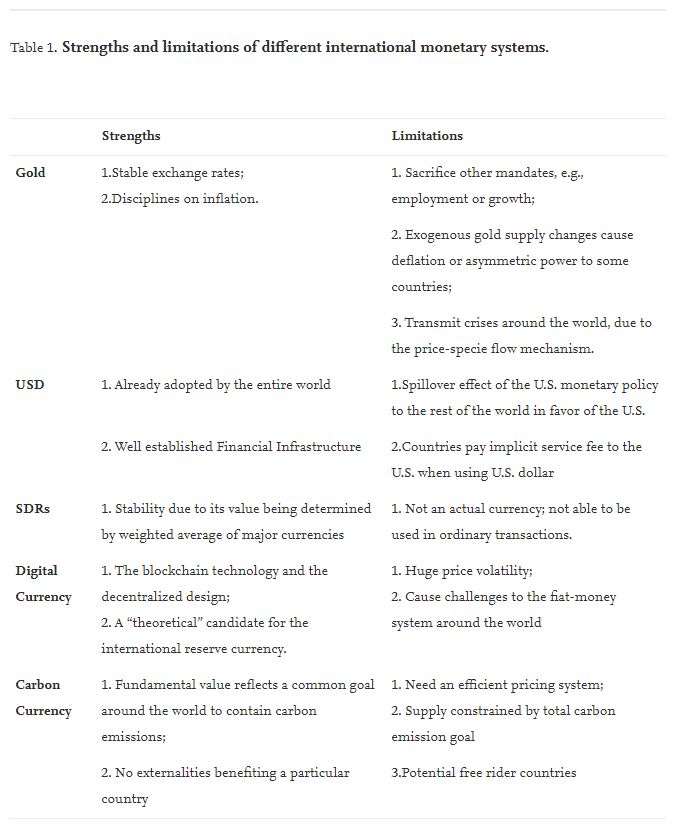 ….
Let’s use a medium of exchange which is not meant to be a medium of exchange, it’s “meant” to control the weather?
3.4. Other benefits: carbon currency as a medium of exchange and a store of value
As discussed earlier, we do not emphasize much the function of carbon currency as a medium of exchange because it is not the main motivation of introducing carbon currency into the international monetary system. As invoicing currency have been shown to be important, we argue that carbon currency could also be used in international trade. The current trade system has U.S. dollar as the dominant invoicing currency, and both theoretical and empirical studies [2] have shown that an appreciation of U.S. dollar would lead the trade volume of the rest of the world to decline.
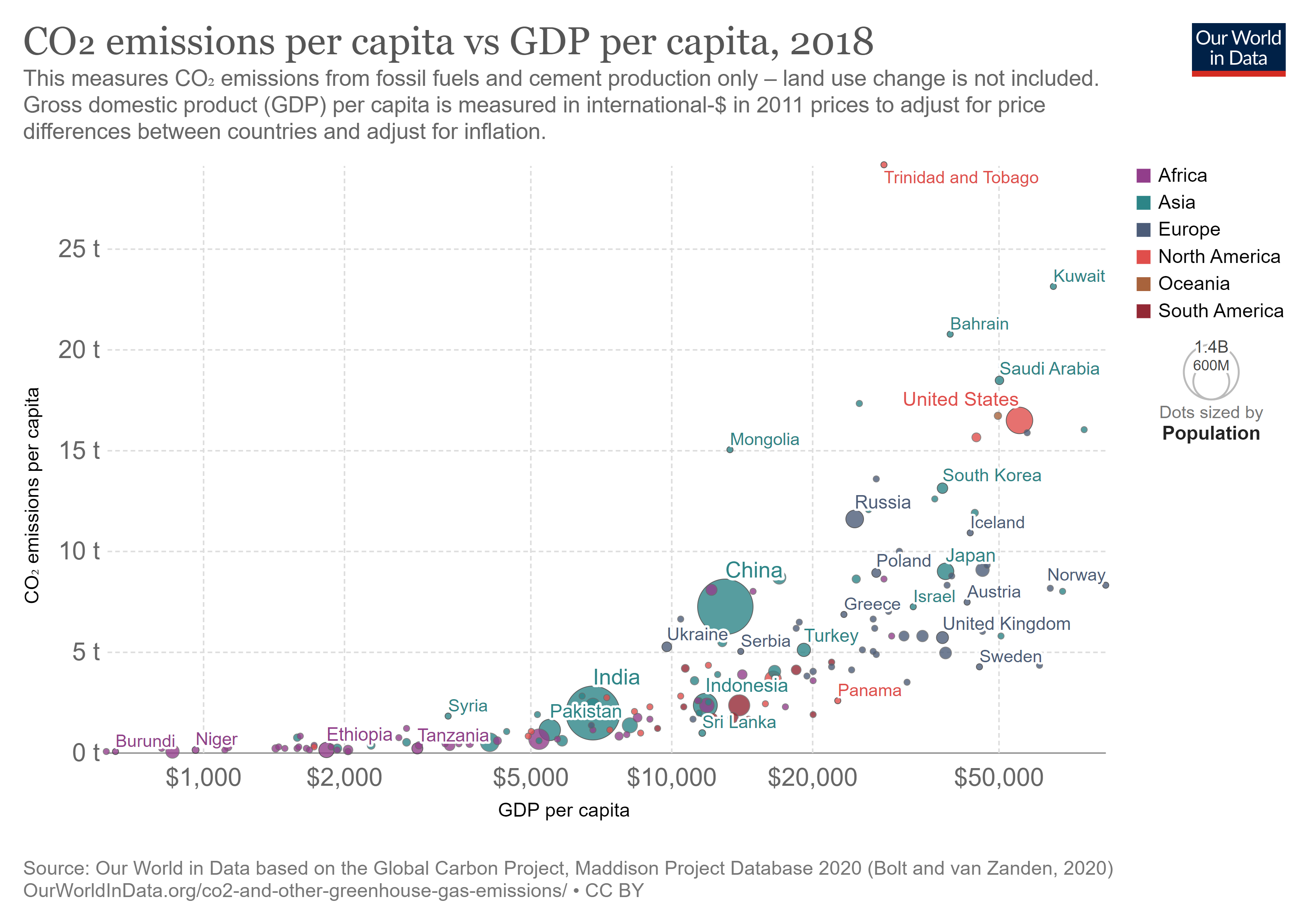
And by definition the appreciation of the carbon credit “dollar” would lead to a trade volume decline in every nation on Earth. Carbon dioxide emissions are linked to GDP. The more nations emit, the richer they are.
Nothing about a carbon currency makes sense except to global bankers and bureaucrats. Certain parties are going to grow rich and powerful by using a carbon currency, but they don’t include us.
h/t Willie Soon and Joe Bast at Heartland
REFERENCE
Liu et al (2022) A theory of carbon currency, https://doi.org/10.1016/j.fmre.2022.02.007
https://www.sciencedirect.com/science/article/pii/S2667325822001182
10 out of 10 based on 52 ratings
8.4 out of 10 based on 14 ratings
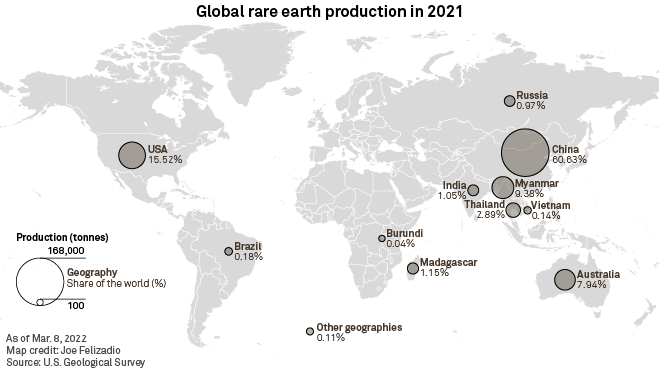
Given the advantage of controlling essential strategic resources, China would be crazy if they weren’t:
Raghav Bikhchandani, ThePrint
A report released Tuesday by Mandiant says a pro-China group named Dragonbridge has been using “nuanced tactics” against firms like Lynas, Appia, and USA Rare Earth. These included posing as local residents online to drum up protests against the construction of a Lynas rare-earths processing facility in Texas. The facility’s development is the result of an agreement signed between the US Department of Defense and Lynas to boost America’s rare-earths domestic industry.
“The accounts claimed that by placing the Lynas plant in Texas, the Biden administration would expose the area to irreversible environmental damage and the local population to radioactive contamination and adverse health effects such as cancer risks, gene mutation, and deformities in newborns,” the Mandiant report said.
‘Tactics to manipulate public discourse’
Elaborating on its claims, Mandiant also shared several screenshots of purported sockpuppet Twitter and Facebook accounts dating from April and May that called for a boycott and shared concerns over Lynas and its rare-earths plant. Mandiant also found other “newly identified” social media accounts that were criticising Appia and USA Rare Earth, and which posted memes or links that were “known Dragonbridge content”.
“Many of the usernames consisted of English-language names followed by seemingly random numeric strings.”
“The private sector is now the victim of attacks by Chinese information operations which is growing increasingly aggressive,” John Hultquist, the Vice President of Mandiant Intelligence said.
” Information operations are typically a problem for civil society, governments, and platforms. They rarely target the private sector so directly and aggressively. This is a well-resourced campaign that’s grown significantly in size and scope compared to its recent activity in Ukraine.”
Among the Australian companies hit was ASX-listed Lynas Rare Earths Ltd, the world’s largest rare earths mining and processing company.
The effect of these particular protests doesn’t appear to be significant yet, but it suggests that China places great importance on controlling the supply of rare earths, that it doesn’t play fair, and that it’s quite likely that this goes on in other industries and public debates.
The US Dept of Defence has acknowledged the disinformation campaign and appreciates the diligence of Mandiant.
So how much of this goes on in the Climate debate?
h/t NetZero
10 out of 10 based on 56 ratings
More strange puzzling numbers coming out of life insurance
Deaths per capita are usually tightly predictable, but it appears something serious is going on in terms of unexplained excess deaths in people aged from 18 to 64. These are people in the prime-of-their lives. If Departments of Heath and Professors of Medicine were working for taxpayers, we surely wouldn’t be trying to guesstimate how many people have died from looking at insurance company payments. But here we are. Someone official has all the morbidity and mortality data. Someone knows.
In January we heard that the chief of OneAmerica Life Insurance was astonished that there was an “unheard” of rise in deaths in working adults of ages 18 – 64 in the last two quarters of 2021. Deaths in this working age group were up by an amazing 40% above the historical norms.
“We are seeing, right now, the highest death rates we have seen in the history of this business – not just at OneAmerica,” the company’s CEO Scott Davison said during an online news conference… “The data is consistent across every player in that business.”
“Just to give you an idea of how bad that is, a three-sigma or a one-in-200-year catastrophe would be 10% increase over pre-pandemic,” he said. “So 40% is just unheard of.”
These extra deaths did not seem to be from people who died of Covid but were untested. It was unlikely they were unrecognised Covid cases. Official case counts of Covid were lower than the year before, and test positivity was down too. The timing of the mysterious excess deaths fitted better with a widespread experimental medical program that was rolled out en masse in the last two quarters of 2021.
There has been little news since then, which is probably not surprising given the high stakes, intense media un-interest, and also that it’s probably not something the insurance companies want to share widely, since it could affect earnings. Which is exactly the next point. If there was a sudden rise in excess deaths we would expect to see it in insurance companies financial reporting. Which appears to be happening in reporting from Lincoln National — the fifth largest life insurance company in America. Indeed their numbers may be worse than the ones discussed in January.
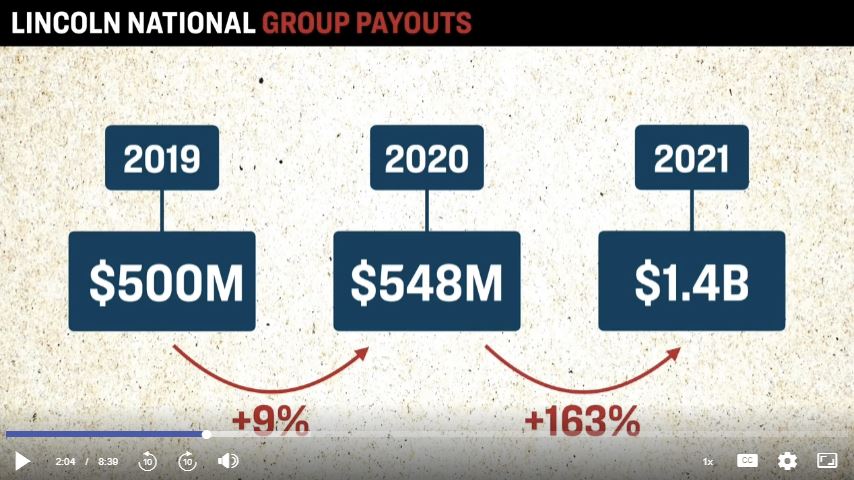
Lincoln National, reported a 163% increase in death benefits paid out under its group life insurance policies in 2021.
This is according to the annual statements filed with state insurance departments — statements that were provided exclusively to Crossroads Report in response to public records requests.
The annual statements for Lincoln National Life Insurance Company show that the company paid out in death benefits under group life insurance polices a little over $500 million in 2019, about $548 million in 2020, and a stunning $1.4 billion in 2021.
It’s not clear how many extra deaths there were, this is just the payouts. Crossroads do some average estimates of normal payouts of around one year’s salary and guesstimate that Lincoln National paid out for around 20,000 deaths in the 18 -64 age group, which is about twice as many deaths as normal.
There have been a million deaths ascribed to Covid in the US during the pandemic and there are normally three million deaths a year, so these numbers may not look that large, but if healthy working age people are dying 30% more often or 100% more often, then something dreadful is going on.
Payouts for individual life policies were up 30%
The statements for the three years also show a sizable increase in ordinary death benefits — those not paid out under group policies, but under individual life insurance policies.
In 2019, the baseline year, that number was $3.7 billion. In 2020, the year of the Covid-19 pandemic, it went up to $4 billion, but in 2021, the year in which the vaccine was administered to almost 260 million Americans, it went up to $5.3 billion.
Increases show up in other company reports but may not be as bad as Lincoln.
Annual statements for other insurance companies are still being compiled and reviewed. So far, Lincoln National shows the sharpest increases in death benefits paid out in 2021, though Prudential and Northwestern Mutual also show significant increases — increases much larger in 2021 than in 2020, indicating that the cure was worse than the disease — much worse.
Shares in Lincoln National are down 3.6% in the month since the earnings report was released.
h/t David Archibald
The SEC has a copy of the May 4th Press Release.
SEC Lincoln National Financial Group First Quarter 2022 Results
Keep reading →
9.8 out of 10 based on 64 ratings
This is Fall of Rome type stuff — everything is coming undone

National rolling blackouts have been occurring for days in South Africa and are forecast to continue for another week at least. One engineer warns they are just a step away from a total blackout and says it will be very difficult to reawaken the entire system. Traffic lights are failing, trains are stopping, and mobiles phones, ATMs and fuel pumps may not work. With unemployment at a shocking 35% already, the million dollar losses from blackouts make for a dark feedback loop.
The immediate cause is strikes for wage claims and terrible maintenance leading to major power outages lasting as long as nine hours. But Green targets and activism only makes it worse because there’s no interest in maintaining plants properly which are planned for closure. South Africa runs mostly on old coal plants, and one of the largest plants is closing (supposedly) as soon as September. And the wind and solar power they have often isn’t helping with the peak loads either.
There is vandalism from every direction. At the bottom end, apparently up to half the people in Soweto are not even paying for electricity — maybe because they don’t have jobs — but they jerry-rig connections to bypass the meters, and the illegal tampering causes more problems. The rolling blackouts cause some breakages and explosions as power comes back on. People who are connected may not pay their bills. Thieves are stealing copper wires, and the blackouts only make it easier for them because they don’t have to worry about being electrocuted.
Eskom has also been hit with major corruption scandals. Some during the Zuma era, led to delays in completing new power plants. Then there is the Chinese Belt and Road program too: In 2018 Eskom took a secretive 33b Rand debt from the Chinese Government (worth about $2b USD). There was word of another 25b Rand debt to China too, which apparently won’t be repaid “due to irregularities and corruption” involved in issuing it.
At the top end of town, the globalists are trying to force an expensive fashionable green transition on a country that can’t afford it. South Africa’s Integrated Resource Plan of 2019 – seeks to expand the share of renewables in the energy mix to 25% by 2030. The UK has offered a billion dollar loan for the transition to unreliable power when what South Africa really needs at the moment is dependable cheap energy.
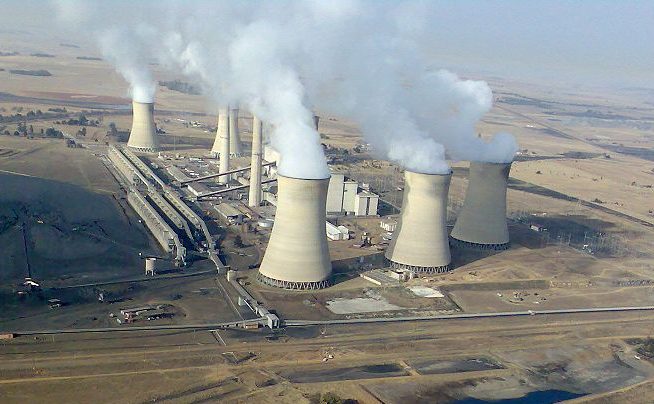 Arnot Coal Power Station in South Africa was built in four years and finished in 1975. (2230MW)
Ominously, Eskom has apparently already lost 6GW of demand in the last year “…because many non-paying customers have been disconnected and several large clients, among them industrial users like mines, are now generating their own power.” So much for the efficiency of mass production eh? It’s every mine for itself, diesel gens to the left, and higher prices to the right… And so much for poor consumers cooking by candlelight.
The first power stations were built in South Africa in the 1920s but now, here we are 100 years later and wondering if South Africa can maintain them?
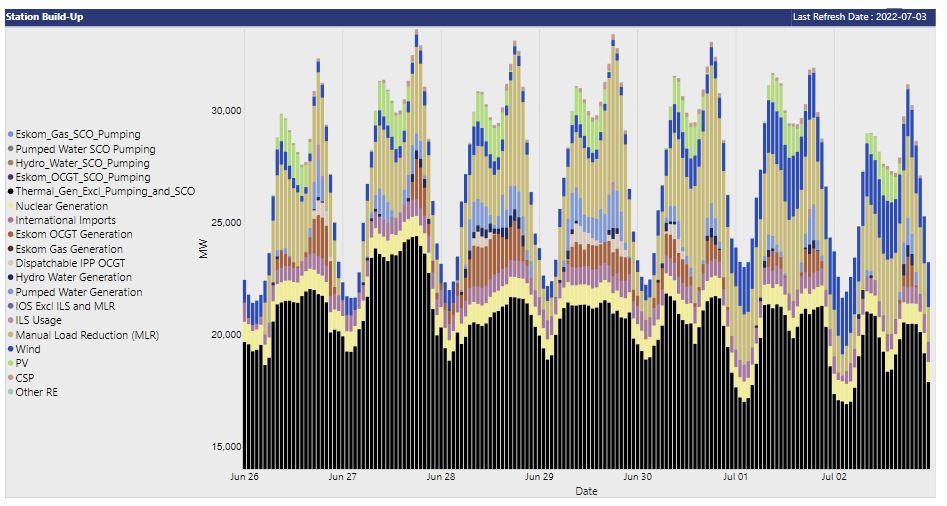
Eskom is the state power utility which generates over 90% of the country’s electricity which is roughly a 20GW-30GW daily operation. In theory it has 44GW of generation but 2,766 megawatts is offline due to planned maintenance, and another 17,395 megawatts is out due to breakdowns. There are about 6GW of unreliable renewables. Apparently as many as 90% of employees at three power stations had not returned to their posts on Friday, making it difficult to fix anything that is broken. Experts say this will take years to fix. Economists at the Bureau of Economic Research predict the load shedding to continue for at least three years.
It’s all rather sad to see for our South African friends, and a rather sobering message of just how many things have to go right to run a modern civilization. A bit of corruption here, a few bad decisions there, a bit of pressure from foreigners, rinse, repeat and recycle and before you know it, a perfectly good civilization is going to waste.
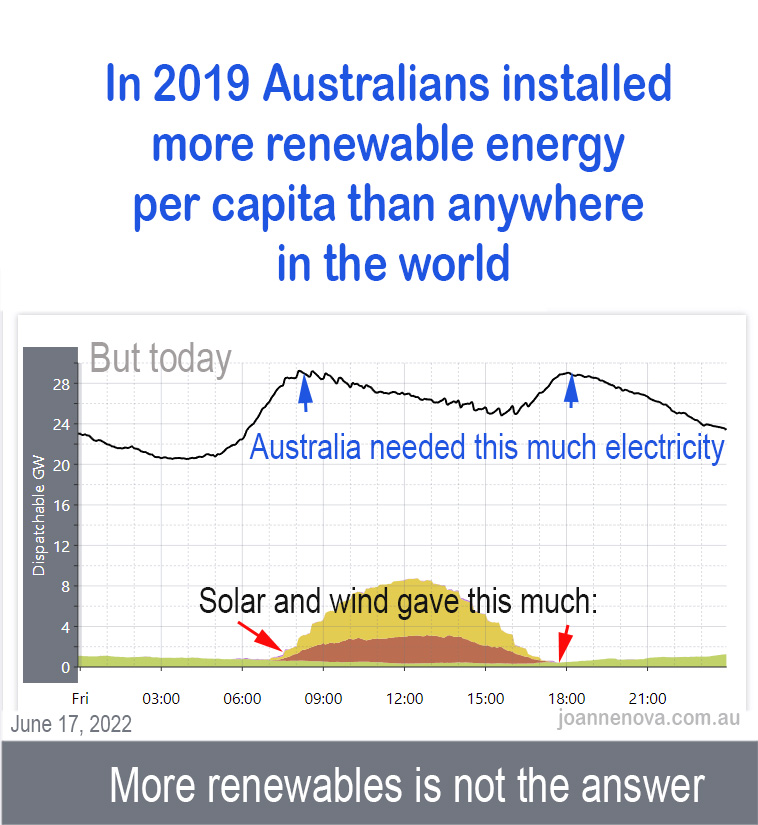
Just as in Australia the demand for electricity peaks at dinner time and wind and solar are more useful at nearly every other hour. The Integrated plan to add 18GW of wind and 8GW of solar won’t solve anything.
The Economist
Forget the weather forecast. South Africans these days are more interested in the outlook for rolling blackouts. One of the country’s most-downloaded apps provides alerts and schedules for power outages. Eskom, the state power monopoly, cannot generate enough electricity to meet demand, and is deploying a byzantine system of rotating outages known as “load-shedding”, so as to avoid the collapse of the entire grid. Last year saw the most blackouts in South African history, overtaking 2020; and this year is set to beat the record again. On June 28th, for only the second time, “stage 6” load-shedding was implemented, which would mean several outages over a 24-hour period.
Many businesses have bought generators or solar-power systems; others close during outages. In big cities, there is chaos at rush hour as traffic lights go dark. The blackouts suit copper-cable thieves, who can steal without fear of electrocution. And when the electricity is switched back on, substations sometimes explode, resulting in secondary outages.
Pandemonium:
Corruption is so bad that Eskom claims 50% of customers in Soweto are illegally connected to the grid and paying nothing.
Qithi said Eskom was dealing with an exponentially high number of failed mini-substations and transformers in Soweto.
This was due to the network becoming overloaded due to illegal connections; meter bypasses and tampering; unauthorised operations on the electricity network; vandalism and theft of electrical equipment; purchasing electricity tokens from ghost vendors; and non-payment of electricity, Qithi said.
“In most areas where customers are experiencing prolonged outages relating to failed or exploded electricity infrastructure, this is due to their resistance to the repair or replacement process.”
Qithi said in some instances communities would violently chase Eskom technicians from areas when they attempted to implement the replacement process as part of their operations.
A total System Blackout is possible:
We wonder how many other countries feel like they are being held to ransom by their national electricity provider? The situation at Eskom remains dire, after the utility plunged SA into Stage 6 load shedding on Tuesday. However, one senior expert now thinks a ‘total blackout’ is coming.
Sampson Mamphweli spoke to eNCA about the matter….
“It’s not looking good. The strike has come at the worst possible time. If you look at our coal fleet, it is not performing how it should. We are moving towards a total blackout. Essentially, Stage 6 is one step away from total blackout.”
“Once we get to that level, it’s going to be very difficult for us to reawaken the entire system we are sitting in a difficult situation as things stand. I feel sorry for the current leadership, because they are grappling with historic negligence.”
The Green international push is on, though workers at the coal plants call talk of a just energy transition is “a big ruse.”
As of September, 2022 Komati power station – one of South Africa’s oldest coal fired-power plants – is due for decommissioning as the first major milestone towards Eskom’s energy transition plans.
Born from agreements at an international level which recognise the urgency of mitigating the drivers of climate change, South Africa has set course to shift to a low-carbon economy.
However, for workers in Komati, talk of a just energy transition is a big ruse. What is actually at play is a neoliberal structural adjustment pacified by rhetoric of a green agenda.
With weeks to go until plant closure at the Komati coal-fired power plant in September, 2022 workers lament that they are yet to be consulted about Eskom’s transitional plans. This has emerged through workshops held with workers by the Institute for Economic Justice in collaboration with the NUM Komati branch.
See also: UK Weighs $1 Billion Guarantee for S. Africa Shift From Coal and South Africa to expand clean energy capacity to meet demand.
An engineering nightmare of rushed emergency temporary repairs
Data presented to the paper showed that half of Eskom’s power stations break down again within nine months of being repaired, and some of the worst-performing stations are offline between 50% and 70% of the time.
This deterioration of the fleet was most apparent this past week when Eskom had to implement stage 6 load shedding for the longest time in its history to prevent a total blackout. While the group targets an energy availability factor (EAF) of 74%, it hit a low of 60% this week.
The deficit between supply and demand was between 5,000 and 6,000MW, necessitating the higher load shedding stages.
Energy experts told the Sunday Times that the repair work being done by Eskom is not enough – or even not correct. The group is repairing units to get them back into operation as quickly as possible, instead of addressing long-term problems that lead to their failure, they said.
The power utility is also putting its focus on new energy projects – many of which will not be online for several years. This means that things are unlikely to improve in the near-to-mid term, which will have a significant impact on the economy.
This is life with random electricity:
Generally, Eskom has stated it anticipates that load shedding should decrease in severity to Stage 2 by the weekend of 9-10 July. However, the schedule is subject to change at short notice, dependent on several factors.
Temporary commercial and communications disruptions are possible while load shedding and unscheduled disruptions are taking place; cellular and mobile services could be affected. Traffic disruptions and longer driving times are possible during these periods due to malfunctioning traffic signals. Trains may also experience delays if outages impact signaling devices or overhead wires. Power outages could also result in the temporary unavailability of essential services such as ATMs and filling stations. There is an increased security threat during power outages. Blackouts could adversely affect security protocols, including alarm systems and electronic fences; opportunistic criminal activity could increase during electricity outages.
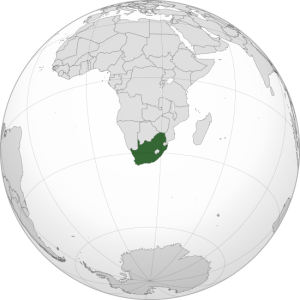
Ezkom data portal
Flag Fredrick Brownall | Map by M.Bitton
9.7 out of 10 based on 80 ratings
While Western cultural warriors are bravely destroying statues of dead colonialists, one kind of modern colonialist gets a free pass.
China gets away with nearly everything: climate crimes, bioweapons accidents, IP theft, and slave labor camps. Maybe spending $100,000 a month on New York Times ads is all it takes to bury unfavourable stories in Western media outlets. But then there are also friends like Mitch McConnell in the US Senate, two million communist party members spread throughout the West, all the universities dependent on Chinese students, and Western academics with jobs for China on-the-side. The West might be quite cheap to buy off really.
Tucker Carlson:
Here in the United States, we’ve been so deeply engrossed in our own debates over whether men should be allowed to compete on girls swim teams or whether it’s immoral to carry our groceries in plastic bags that we’ve missed the fact that the government of China has been busy with its own agenda — taking over the world.
In the space of just 15 years, for example, the Chinese have succeeded in re-colonizing the entire continent of Africa. Didn’t think that could happen? Well, it is happening. In Africa, China now calls the shots and takes the natural resources for itself. Period. As of tonight, there is only one remaining African country that dares to recognize Taiwan, and it happens to be among the smallest countries in Africa, Swaziland. Everyone else on the continent obeys Beijing.
But wait a second. How can this be happening? Isn’t colonialism racist and bad? Yes, it is and no one’s worse and more racist than the Chinese. Go on Chinese social media sometime and see how they describe the Africans they’ve subjugated. It’s horrifying. So, why isn’t the New York Times writing stories about any of this? You know why – because the New York Times is on China’s side. That’s why they all but ignore the brutal Chinese colonization of Latin America, which is also in full swing right now.
Colonialism violates everything the New York Times once claimed to believe in, but that’s okay, because they never really believed any of it anyway. It was always about power. …
Bolsonaro!
One person who is emphatically not in favor of it is the president of Brazil, Jair Bolsonaro. So, of course, the American media hate him. … These are people whose research consists of three minutes on Wikipedia on the way to the studio. “He’s a racist. Of course, he is.” He “doesn’t want lockdowns.” There’s your proof.
But it is the last clip from plagiarist Fareed Zakaria that explains why they’re so mad at Bolsonaro. Bolsonaro … represents a “growing global threat to the ideas of liberalism” –– liberalism, meaning neoliberalism, meaning globalism.
And in fact, that is true. Bolsonaro is no Justin Trudeau. He’s not a low-IQ fascist who would be working as an Instagram influencer if he didn’t have his own army. He’s not the president of Ukraine who shuts down television stations that dare to criticize him and outlaws opposition parties and arms Nazis.
In conventional terms, Bolsonaro is, in fact, liberal. He has done nothing to stop civil liberties in Brazil. But at the same time, he is a nationalist. He cares about his country. He resists China. Therefore, he must be stopped. George Soros hates him and so does Joe Biden. He’s not with the program.
So naturally, we wanted to meet him. Yesterday we did. We sat with Bolsonaro for more than an hour and the first thing we learn is that the left in Brazil hates him very much. They tried to kill him when he first ran for president four years ago. With very little money in the backing of no party, he came out of nowhere to get 57 million votes.
But he almost didn’t survive to be elected. He was stabbed by a leftist almost to death at a rally, at which point the left funded lawyers to come in and rescue his attempted murderer — an amazing story that hasn’t gotten a ton of coverage in the United States.
Another bit of news the ABC, BBC, CBC etc forgot to mention.
hat-tip Stephen Neil
Related posts
EDIT: Headline changed from “controls” to “exploits”as a better description.
9.9 out of 10 based on 74 ratings
Winning: The new Supreme Court decision is much bigger than the climate wars
 Over the last 50 years the Deep State Bureaucrats had become Rulers-defacto and finally the Supreme Court has put the hand-brake on. Instead of unelected agencies deciding national policy, the Supreme Court said, rather radically, that Congress should make decisions of great political significance. Sounds awfully like “Democracy”. Over the last 50 years the Deep State Bureaucrats had become Rulers-defacto and finally the Supreme Court has put the hand-brake on. Instead of unelected agencies deciding national policy, the Supreme Court said, rather radically, that Congress should make decisions of great political significance. Sounds awfully like “Democracy”.
But as far as the Environmental Protection Agency sees it, if the voters are too stupid to elect the correct people, then Congress can’t make the right laws, so it’s up to the EPA to save the people anyway.
It’s what you do when you are Omniscient.
Or as another Ian says: they are only doing “what God would have done if he had truly understood the situation”.
The Supreme Court Restores a Constitutional Climate
The Editorial Board, Wall Street Journal
This has been an historic Supreme Court term, and the Justices kept it going to the end with a major 6-3 decision Thursday (West Virginia v. EPA) reining in the administrative state. The subject was climate regulation but the message should echo across the federal bureaucracy.
The question was whether the Environmental Protection Agency could invoke an obscure statutory provision to re-engineer the nation’s electric grid. Prior to the 2015 Obama rule, the EPA had used the provision only a handful of times to regulate pollutants from discrete sources. The rule would have effectively required coal and gas-fired generators to subsidize renewables.
The Major Questions doctrine sounds like “the big picture”:
Writing for the majority, Chief Justice John Roberts relies on the Court’s “major questions” doctrine. This requires courts to look with skepticism when agencies claim “‘in a long-extant statute an unheralded power’ representing a ‘transformative expansion” in its power. That’s what the Obama EPA did.
Apparently it’s not OK to play legal word games with old subclauses in order to make your agency more powerful, rich, and likely to get grants and Nobel Prizes.
The Court is now placing guardrails on Chevron to prevent lower courts from going off the constitutional road. Justice Neil Gorsuch’s concurrence, joined by Samuel Alito, is especially helpful in lighting the way for lower courts grappling with when and how to apply the major questions doctrine.
First, he writes, the doctrine applies when “an agency claims the power to resolve a matter of great ‘political significance.’” Second, an agency “must point to clear congressional authorization when it seeks to regulate ‘“a significant portion of the American economy.”’” Third, it may apply when an agency seeks to intrude “into an area that is the particular domain of state law.”
Contrary to their critics, the Justices aren’t blocking climate regulation. They are merely saying that the decision on whether and how to do it rests with Congress.
The EPA Gods are very annoyed
Everything about this response shows that Michael S. Regan, EPA chief, *knows* what is best, and democracy be damned — he will save those voters whether they like it or not.
Today, in response to the Supreme Court ruling in West Virginia v. Environmental Protection Agency, EPA Administrator Michael S. Regan issued the following statement:
“As a public health agency, EPA’s number one responsibility is to protect people’s health, especially those who are on the front lines of environmental pollution. Make no mistake: we will never waver from that responsibility.
While I am deeply disappointed by the Supreme Court’s decision, we are committed to using the full scope of EPA’s authorities to protect communities and reduce the pollution that is driving climate change.
True believers:
At this moment, when the impacts of the climate crisis are becoming ever more disruptive, costing billions of dollars every year from floods, wildfires, droughts and sea level rise, and jeopardizing the safety of millions of Americans, the Court’s ruling is disheartening.
For tens of thousands of years, rain-dancing shamen said similar things. It was along the lines of Give me women and goats or there will be terrible storms. Now we have to chop down 120 million trees, or kill 200,000 bats, give up roast beef and then the WeatherMasters will give us nice weather.
The EPA just wants power over the national economy, energy systems, land, air and water. They already sound like they are a political party:
Ambitious climate action presents a singular opportunity to ensure U.S. global competitiveness, create jobs, lower costs for families, and protect people’s health and wellbeing, especially those who’ve long suffered the burden of inaction. EPA will move forward with lawfully setting and implementing environmental standards that meet our obligation to protect all people and all communities from environmental harm.”
Since when was the Environmental Protection Agency meant to create jobs, lower costs, and ensure US competitiveness, and if they can do that, who needs Congress?
Judging by the reactions this looks like a big win for voters. The Guardian, Nancy Pelosi, and Ginger Cassady of the Rainforest Action Network really don’t like it. Nancy Pelosi says the Court has “bowed to polluters who seek to poison the air our children breathe…“.
Meanwhile the Rainforest lady said it “condemns everyone alive today and generations to come”.
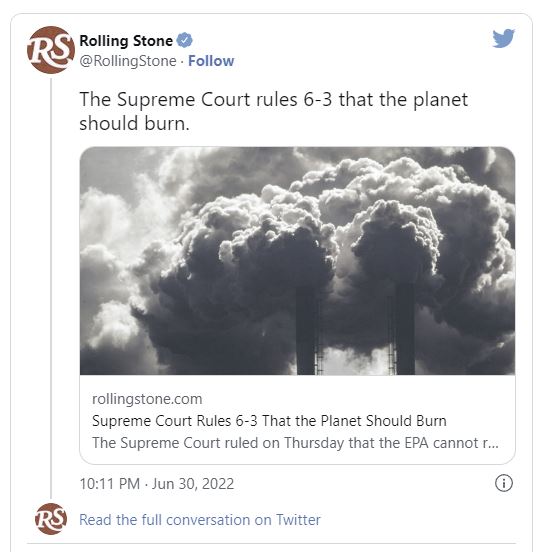
And Rolling Stone said everyone will go to hell, or something a lot like that….
h/t Lance, Dave B, Timo Soren, El Gordo, Robert Rosicka, Mark, Ross, Beth the Serf.
9.7 out of 10 based on 111 ratings
8.7 out of 10 based on 7 ratings
Effectively — the AEMO (the Australian Energy Market Operator) is the taxpayer funded advertising agency for the Renewables Industry. The point of the latest AEMO super-report, apparently, is to get Australian taxpayers or consumers to foot the bill for the high voltage lines that the unreliable industry desperately needs but can’t pay for itself.
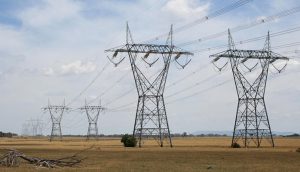
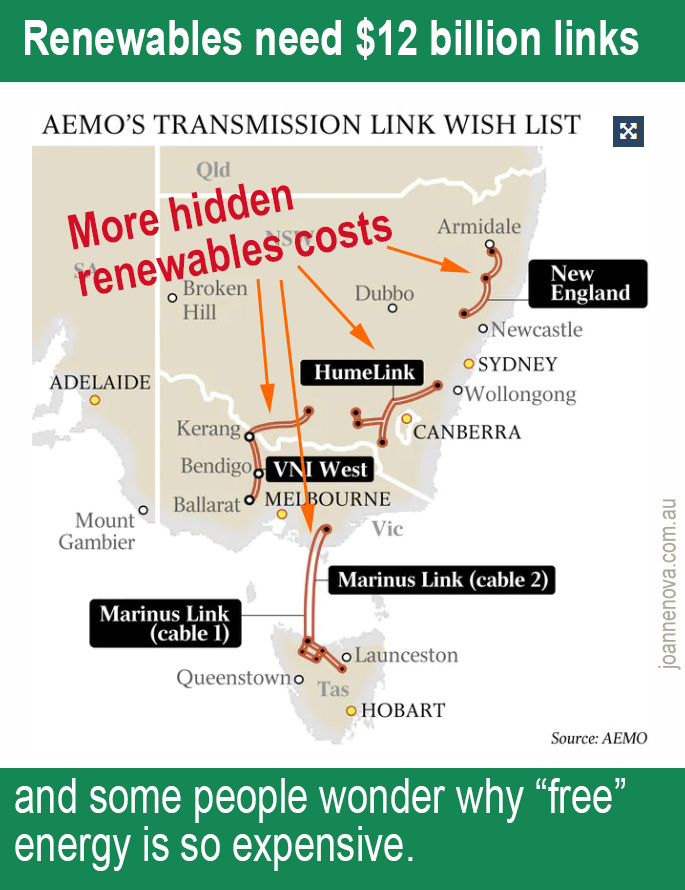
The AEMO has declared we need to rush to cough up $12.7 billion to build new interconnectors in Australia. That’s $500 from every man woman and child and let’s call it what it is, a Gift Card for the Renewables Industry. The net benefit of all that money will be to allow wind and solar industrial plants to connect their unreliable product to the grid we already have, and to the storage products that we still have to pay for, and all so that their green electrons will make the weather 0.0 degrees cooler in a hundred years. Australians alive today will pay now and basically get nothing but views of more criss-crossy-steel-wires and spires, and more wind towers too. Sing Hallelujah.
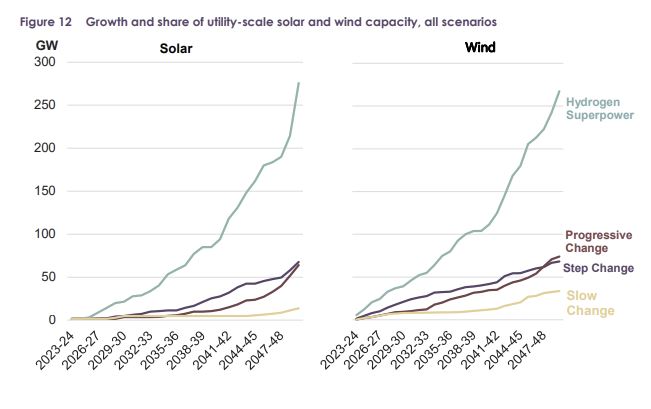
The 104 page Blueprint imagines all kinds of scenarios except for an actual free market, true competition, consumer choice, or whether it makes any sense to use our national grid as a global climatic weather controller. It’s a fantasy document which includes four flavours of future electrical icecream: “Slow”, “Progressive”, “Step” or “Hydrogen Superpower”. Will that be a double-scoop with Spiderman topping? Yes indeedy — and with $28 billion dollars of imaginary savings to go. The word blackout appears no times. Nor is there a scenario for a “Cost effective” electrical grid. (Remember them?)
The Hydrogen Superpower fantasy comes straight out of Marvel comic. Wait til you see Figure 12 — the Hulk Strikes the Australian grid, or at least scrawls wild lines on a graph. Is that a 500 gigawatt 100% renewable grid by 2050 or just Hopium I see…
It’s rare to see this much abject nonsense in a single story. Perry Williams at The Australian just took the junk prospectus and ran it:
Australia must accelerate a move away from coal to renewables and storage and urgently sanction more than $10bn of transmission projects to escape the ongoing threat of blackouts and high power prices amid a national energy crisis.
Follow the logic: if having a bit less coal causes a crisis, then how exactly, will having no coal solve it?
The Australian Energy Market Operator, which runs the national electricity network, said the country was undergoing a “complex, rapid and irreversible” change to its energy system…
Is this the same “irreversible change” that is currently reversing all over Europe? The one where Germany, France, the UK, Austria and Poland are all using more coal.
And isn’t the follow up just a tiny scary?
an irreversible” … that would need a nine-fold increase in wind and solar capacity by 2050 to meet the nation’s net-zero emissions targets.
Apparently this kind of “rapid” irreversible transition is only 11% of the way out of the starting gate, but already falling over, costing a bomb, and we have to do this nine times more.
But wait. Renewables will not only make floods nicer, and fish happier, it make us safer from enemies?
“One source of energy that no geopolitical situation can interrupt in relation to our supply chains and that’s the sun to our land-mass and the wind on and off our shores. That’s good energy security and storing that is a matter of national security,” Mr Bowen told the National Press Club.
What if the enemy just attacks at night and when there is no wind? Except probably they won’t have to attack at all. As we go broke, they can just buy the nation out from under us.
There they go again: The AEMO calls coal and gas volatile, and renewables cheap
The energy supply crunch that forced the suspension of the country’s power market for the first time this month underscored the need for the Australian electricity grid to curb its exposure to the volatile commodities of coal and gas and fast-track cheap renewables backed up by storage, the AEMO said.
The price of coal and gas isn’t volatile, it’s not going up and down, it’s gone up and stayed up — because it’s so essential, everyone has to have it and they want more than they can get. And the true price of renewables isn’t cheap, it’s just hidden — like this giant report pretends to hide that twelve billion dollars worth of interconnectors are entirely frivolous parts of a good grid powered by centralized reliable power. We don’t need them: the Renewables Industry does.
It’s like a grab-bag of energy-platitudes
“I think recent events in Australia and overseas have really just underscored the need for urgent investment in renewables, firming and transmission so that we can de-link ourselves from these international factors and provide Australian homes and businesses with the most affordable, secure and reliable energy,” AEMO chief executive Daniel Westerman told The Australian.
Since when was coal and gas an “international factor” for a nation which is the worlds largest exporter of coal and third largest for gas?
The costs of these renewable-interconnectors are staggering
Just throw money:
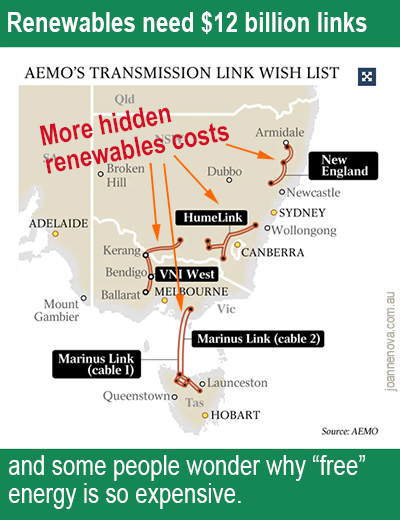
The Marinus Link across the Bass Strait will cost at least $3.8 billion and generate zero watts of electricity. Theoretically it will allow 1.5 GW of electricity to slip through, but for the same price, we could build a whole new advanced coal plant instead. Various iterations of governments here have already spent $200 million just on the feasibility study. Ten years ago they could nearly build a whole gas plant for that, one that wouldn’t be essentially useless for five months in a row if a shark chewed on it.
The VNI link will cost $2 – $3 billion and make it possible for groups of renewable investors to make profits they otherwise couldn’t have. Humelink will be some kind of nightmare of $3b – $5 billion.
The unreliables are dead without these new transmission lines:
To put it in perspective a very annoyed high honcho at Snowy Hydro was not happy with the draft version of this document a few months ago and complained that the AEMO wasn’t pushing hard enough for faster “investment” in the VNI line which, ahem, just happens to be nearer to the Snowy Scheme, and which they wanted a lot more than the link to their competitors in Tasmania. In that complaint he quietly gave away that these transmission lines are essential in a life and death kind of way for renewables.
[Snowy Hydro] has previously warned the lack of transmission could kill the transition to renewables – with a string of major players weighing into the debate – and singled out concerns over infrastructure as a major issue that needs to be confronted to ensure supplies can flow to users.
Renewable developers and network operators are worried a pipeline of power generation and clean energy supplies faces delays or gridlock unless major electricity transmission projects are delivered across the national power system.
–The Australian Feb 9th 2022
REFERENCE
AEMO 2022 Integrated System Plan (ISP), Press release
9.8 out of 10 based on 85 ratings
…
8.4 out of 10 based on 13 ratings
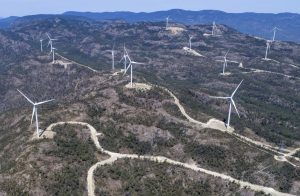
The people making wonder wind turbines are having a tough time. They thought they were picking the hottest new industry, saving the world, and expecting to make great money. Instead supply chains are in crisis, competition is fierce, and profit margins are razor tight. They know that the solar panel industry has largely gone to China, and worry that wind turbine manufacturing will do the same.
What they don’t seem to realize is that the reason the factories went to China is that the country isn’t powered by wind turbines. No country powered by unreliable power is also a growing manufacturing base. And as well as having cheap coal power, China also has the advantage of cheap slave labor, few environmental rules, no ethics and hardly any red tape. It’s a red-light flasher. About now, a wise investor might be wondering about the the odd disconnect in the idea of building devices to save the world while imprisoning people and polluting lakes. What if the environmental movement is a hollow geostrategic trojan fantasy serving Russians, Chicomms, socialists and investment banker cartels?
For Ben Hunt, the light-bulb moment isn’t there yet. These are the guys trying to make ends meet with real products for real consumers. But they haven’t done quite enough homework. Ben Hunt thinks carbon dioxide controls the climate and the world needs wind towers. He thinks “the message isn’t hitting home hard enough” as if showing people more climate-porn-storms will make their industry grow when they’re already at 130% saturation and have been for decades.
Windpower Monthly
27 June 2022
by Ben Hunt
Former Siemens Gamesa insider says turbine manufacturers are in dire need of the bright future they were promised
Ben Hunt wrote to colleagues to say “it will get worse before it gets better”
One of the first responses I received was very instructive: “When I joined more than 15 years ago, I was told that I was joining the sector with the brightest and most promising future. The problem is that it is a future that seems never to come.”
The Wind Turbine OEM’s (Original Equipment Manufacturer) are struggling to turn a profit, and worry that they can’t compete with China:
It is fair to say that that sums up much of the prevailing mood in the wind turbine OEM sector right now with all the major western OEMs struggling to turn a profit. It is not unusual to hear senior industry figures raising the spectre of the fate of the European solar manufacturing industry, long ago lost to the east.
While everything should be going gangbusters for the highly fashionable, saintly industry, reality is no fun:
Instead the news is full of stories of lay-offs, factory closures and eye-watering financial losses. And the resources required for the necessary investments are in jeopardy.
The fantasy is alive and well even if the wheels are falling off:
Wind is a cost effective, inexhaustible and clean provider of secure energy that isn’t going to further poison the planet.
Somehow, however, that message isn’t hitting home anything like hard enough. At Davos late last month, the discourse turned back towards nuclear, shale and more large-scale fossil to overcome the energy crunch.
Many in the industry believed these arguments long since won, but the fight is ongoing, and I’m really not sure we are winning.
After 30 years of the media doing nothing but glowing soft agitprop for the wind industry, blaming fossil fuels just doesn’t cut it.
..it is time to take the gloves off in the lobbying area. The fossil industry is more established, better resourced and more aggressive. The case for wind and renewables needs to be more forceful and more focused. We have been guilty of being too polite and too naïve, perhaps believing the overwhelming weight of argument is enough. It clearly isn’t.
What part of BP being Beyond Petroleum, and Royal Dutch Shell lobbying the World Bank against coal doesn’t make sense? The gas industry has been trying to demonize coal and CO2 just as much as the renewables industries have. And so have the bankers — the Goldman Sachs, JP Morgan, BNP Paribas, Deutsche Bank, HSBC, Barclays, Morgan Stanley –they’re all fans of wind farms. But in the end, the world is paying $400 a ton for coal.
h/t Rafe Champion
Wind turbine photo
9.9 out of 10 based on 87 ratings
 Last month UK Ministers were warned that six million households could enjoy blackouts for dinner this winter. To try to stave off disaster, the UK Business Secretary has already written to the owners of the last three remaining coal fired power plants to ask them to stay running through winter. This is despite them being set to close in September. Last month UK Ministers were warned that six million households could enjoy blackouts for dinner this winter. To try to stave off disaster, the UK Business Secretary has already written to the owners of the last three remaining coal fired power plants to ask them to stay running through winter. This is despite them being set to close in September.
Given the dire shortage of cheap energy, another plan is to pay British households up to £6 for each kilowatt-hour they don’t use at peak time. While a normal kilowatt-hour would cost 28p, the blistering premium price shows how desperate the National Grid planners must be. The last thing they want is everyone to come home, turn on the oven and washing machine and plug in their scooters and EV’s at 6pm.
So now possibly in a grand experiment, as well as trying to control the weather with windmills, millions of families may try to reschedule body clocks somehow, eating later, doing laundry later, watching the melatonin-destroying blue-screens-of-insomnia after 10pm and running the drier while they sleep. Maybe it won’t be so bad, or maybe people will be more sleep deprived and less productive, fatter, or crash their cars on the A6 as they drive right over 200 trillion cubic feet of gas in Lancashire that could have easily kept the lights on. Hopefully the drier won’t catch fire at night.
Sometime 20 years from now, people at Oxford will get a nice grant to study what happened to the lifespan and health of the working class and the poor during the winter of the Energy Crisis. They may not find a conclusive link with house fires, car accidents, falls or school performance, but that’s OK, there’s always another grant for that.
Daily Mail
Families are struggling with energy bills that have jumped by 54 per cent (an average of £693) this year.
It [National Grid ESO] is believed to have written to suppliers last week asking them to assess how much less energy their customers could be persuaded to use at peak times.
Ultimately everyone who uses electricity at dinnertime will pay more so other people can have less.
The cost of the scheme would be added onto energy bills but the National Grid is said to believe the additional charge would be less than the cost of paying power plants to increase supply.
Look at that evening Peak of maximum power consumption, and last night that was at 6.05PM. Incidentally, it’s at that same time year round day in day out, 365 days a year, and has been at that same time forever. In Summer it might be somewhat hidden by HVAC (air conditioning) power consumption, which is so much higher, but the evening Peak has always been at that time, you know the time the power retailers charge the most for, telling the gullible gulls people that they can avoid the peak cost by moving their power consumption to cheaper times, you know come home from school and work some other time. Have your main evening family meal at some other time, watch TV etc at some other time. Live without lighting till some other time. Tell you children to do their homework some other time. Charge your phones at some other time. Move the habits of everyone of many many many lifetimes to ….. some other time.
So let’s utilise that known for Centuries time of day and change the cost to a higher rate, eh!
9.9 out of 10 based on 97 ratings
9.4 out of 10 based on 7 ratings
Tell the children: Energy is Power
And show them this graph. For twenty years the West has been giving up power.
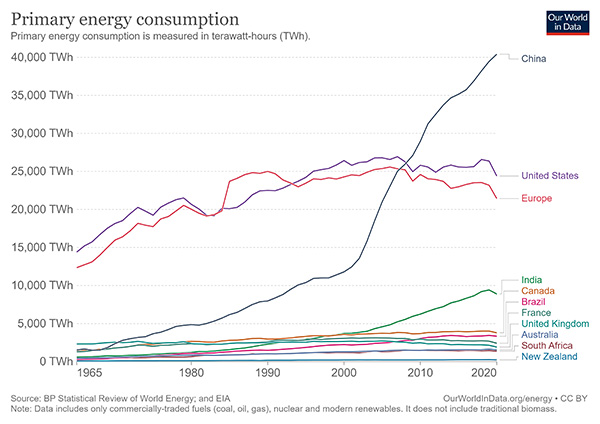
OWID Click to enlarge
A warning from John Constable and Debra Lieberman, Special to Financial Post
Countries where energy consumption is plummeting don’t feel much pain … yet. And there is a good reason for that. One country is increasing its energy use, propping up Western consumption with exports and giving us a false sense of well-being. That country is, of course, China.
Since the West began its energy starvation diet, Chinese energy consumption has increased by over 50 per cent and its electricity consumption has increased by 200 per cent, overtaking the U.S. by a large margin. China, unlike the EU, U.K. and U.S., is still 90 per cent reliant on fossil fuels and nuclear. What’s more, only some of the immense wealth these fuels are generating is being exported. What is China doing with the rest? Time will tell.
But right now, as a matter of urgency, we must reverse the decline in Western energy quality and consumption by ending impoverishing renewable subsidies and clearing the path for fossil fuels and nuclear. Toying with low-density, thermodynamically incompetent renewables is an indulgence we cannot afford. With the Chinese economy on an energetically sound footing and those in the West not, the world has turned upside down. The economic consequences of this reversal are serious, the security implications terrifying. Our energy blindness is both costly and dangerous.
Energy Starvation costs a lot
Energy demand is falling because of environmental policies, including subsidies to modern renewables such as wind and solar. As distasteful as this might sound, it is nonetheless true. So far, both the U.S. and Canada are relatively minor players, the U.S. having spent a mere US$125 billion between 2008-2018, and while Canadian national totals are lower, the province of Ontario alone is reported to have spent about US$30 billion in the period 2006 to 2014. But the EU, where the biggest energy collapse is observed, has spent a staggering US$800 billion since 2008, a total that has been increasing at $US70 billion a year. And the U.K., a country of 65 million people, is shelling out well over US$10 billion every year.
The intention of these subsidies was to reduce costs, but the gamble has not paid off — nor will it so long as Mother Nature and her laws of physics are at the table. Wind and solar remain stubbornly expensive for consumers in spite of a blizzard of misinformation and propaganda claiming otherwise.
Some sources of energy are disordered from the start — doomed by entropy
Moreover, energy varies in quality, not just quantity. To support complex society a fuel must be of high quality, that is, structured so that it has the potential to do a lot of work. In thermodynamics, this is referred to as a fuel’s degree of “disorder” or “entropy.” Greater disorder equals greater entropy equals less work. But our “energy-blindness,” the inability to easily grasp thermodynamic principles, means that we must rely on physics to see — and what it reveals is that fossil fuels and uranium are highly ordered and rich in their potential to do work, making them cheap, while wind and solar are the reverse.
Read it all at the Financial Post
John Constable is energy director of the Global Warming Policy Foundation in London and author of its forthcoming study Europe’s Green Experiment: A costly failure in unilateral climate policy. Debra Lieberman is a professor of psychology at the University of Miami and author of Objection: Disgust, Morality, and the Law (OUP, 2018).
9.9 out of 10 based on 80 ratings
…
8.6 out of 10 based on 14 ratings
h/t GWPF NetZeroWatch
The Greens must be having apoplexy. In Glasgow last year everyone was signing climate agreements with no idea that by June they would be signing 15 year new deals for gas with the U.S., the Middle East and Africa. Germany is pouring $3b into floating LNG import platforms. The Germans are also suggesting that the G7 now allow funding for fossil fuel projects, presumably to allow new gas or even coal projects to solve the energy crisis. Meanwhile Boris Johnson is cutting net-zero targets and suggests maybe in the face of food shortages we should feed food to people instead of cars. Starving people to save the world was never going to sell well. Especially when the UK was getting 20% of the ethanol for the biofuel program from Ukraine.
The squeeze is everywhere. Hydrogen targets are being reconsidered or adjusted down, while still other commitments may become “voluntary”, and some start dates are being pushed back by a year. It was only March when Germany agreed to phase out the sale of new fossil fuel cars by 2035. Now in June, Germany has rejected the EU ban because suddenly there are niches where combustion engines are useful.
Some of these changes, like the gas contracts and national security issues, are going to leave a mark for years, but back-flipping again on things like biofuels and combustion engines will be done in a flash if they can get away with it. The pushback is coming.
Germany pushes for G7 reversal on fossil fuel funding
Bloomberg, 25 June 2022
Germany is pushing for Group of Seven nations to walk back a commitment that would halt the financing of overseas fossil fuel projects by the end of the year, according to people familiar with the matter. That would be a major reversal on tackling climate change as Russia’s war in Ukraine upends access to energy supplies.
A draft text shared with Bloomberg would see the G-7 “acknowledge that publicly supported investment in the gas sector is necessary as a temporary response to the current energy crisis.”
The whole world wants coal now but there is no spare capacity anymore, so coal shortages are not going away
The price is record high for coal but investors don’t have faith that there will still be a market in five years time, so there is little investment. Meanwhile in South Africa people have stolen and vandalized the rail lines so it’s hard to move coal. Australia has had flooding which has slowed production, Colombia has elected an anti fossil fuel leader, and India and China are both digging as much out of the ground as they can already.
Climate pledges abandoned as Putin sparks global coal crunch
The Daily Telegraph, 25 June 2022
The long-term pressure to move away from coal also means there is limited spare capacity, and investors are unlikely to try and pump cash into alleviating what may only be a short-term demand surge.
“Coal markets have been burned so many times [..] and you’ve still got a very drastic retirement schedule in Europe,” says Natalie Biggs, global head of thermal coal markets research at Wood Mackenzie. “What’s the purpose of opening new mines and rushing out into the market when that market disappears in the next five years?
Europe is scrambling to set up gas infrastructure to replace the Russia piped supplies, but these new capital project come with long term contracts that are making the greens very nervous:
Keep reading →
9.6 out of 10 based on 93 ratings
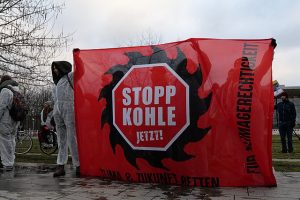 Leonhard Lenz Suddenly the warning lights flashing in Germany. The message is to go easy on the gas, but ultimately even if the national storage tanks were completely full, the largest economy in the EU would only have ten weeks of gas without supplies from Russia. It’s summer and they’ve already hit stage 2 of the 3 stage emergency plan.
It was all totally avoidable. A wholly Green-made crisis. They could have gone nuclear, kept using coal, and explored for more gas and then they could have laughed at GazProm. Instead talk of rationing has already started, and the event horizon now includes the possibility of mass industrial shutdowns and recession.

Germany has been so suddenly crippled it’s almost as if an enemy force had infiltrated the activist soul and culture of the nation and duped it with a magic spell.
As long ago as 2014 a former NATO Secretary General was warning that Russia was funding the anti-frakking mobs. It later came out Russia was also sending money through shell companies to Green protestors in Eastern Europe, and in the US too. Putin could hardly have believed how easy it was to turn young schmucks against their own civilization.
Teenagers without training are gift for enemies. If only our universities had taught them things that mattered?
Germany says that its citizens may have to ration the use of natural gas this winter as the country faces an energy “crisis” due to Russia reducing its supplies last week.
First the energy goes, then the economy:
Kurt Zindulka, Breitbart News
Germany is facing a “Lehman Brothers” collapse in its energy market that could spark a domino effect leading to a severe recession should the gas-addicted economic powerhouse of the European Union be fully cut off from Russian energy supplies.
Economy Minister and Vice-Chancellor Robert Habeck said on Friday that Europe’s largest economy could be forced to shut down certain industries should gas supplies run think by the winter.
“Companies would have to stop production, lay off their workers, supply chains would collapse, people would go into debt to pay their heating bills, that people would become poorer,” he said according to DW.
The Green Party politician warned that there could be “a kind of Lehman-Brothers effect in the energy market,” spreading through municipal utilities, industrial and commercial companies, “And then you have a domino effect that would lead to a severe recession.”
Müller predicted on Thursday that the country could only live off reserves for less than three months without Russian gas over the Winter, saying: “If the storage facilities in Germany were mathematically 100% full… we could do without Russian gas completely… for just about two-and-a-half months and then the storage tanks will be empty.”
Russia eagle: Росгвардия
9.9 out of 10 based on 82 ratings
Tucker Carlson savages the UniParty and talks about the disarray in voters, the sea change sweeping parts of the US in political alliances. The Great Replacement and influx of new democrat voters has run out of steam.
The old coalitions are crumbling before our eyes. Suddenly we’re seeing Hispanic voters, African and Middle Eastern immigrants, as well as huge numbers of American-born young men, all running at remarkable speed from Joe Biden and the anti-human corporate neoliberalism he represents. …
Joe Biden’s support among Hispanics has dropped to a stunning 24%. That’s the lowest among any ethnic group in America. …
…
At the very moment that Joe Biden is at his weakest, months before a pivotal midterm election, Republicans are propping him up. They are saving Biden from himself.
Since the day Biden was elected, Republicans in Washington have taken Biden’s side on virtually every significant item in his policy agenda. That would include: COVID restrictions, vaccine mandates, transgender ideology in school, sanctions against China, the January 6 charade, free speech, civil liberties, spying by the Intel agencies, preserving the big tech monopolies, the anti-White race politics of CRT and Juneteenth, border enforcement and energy policy, and above all, the administration’s signature issue: its lunatic and reckless support for the war on Ukraine. Republicans are all-in.
Mitch McConnell and Chuck Schumer are united in their fear of populism and in their gut-level loathing of the American public and they’re not alone. What Washington fears most is democracy — that is letting voters have what they want. That’s not allowed. Republicans and Democrats have formed a uniparty specifically to prevent it. You see this everywhere, but you see it most clearly in the gun control legislation that’s in the Senate right now. …
Just in case anyone can’t think of 25 million reasons why Mitch McConnell might feel inclined to serve other agendas than his voters, read what I wrote in January last year describing Mitch McConnell’s very strange rich connection with China. The corruption is not even hidden…
McConnell’s wife is a Chinese-American and also happens to be The Transportation Secretary of the US Government (!). Since Elaine Chao took up that job four years ago, her fathers company has expanded rapidly and has added 40 percent more ships. Her father, James Chao, is a shipping magnate that gave his daughter and her husband McConnell a gift of at least $5 million in 2008. That’s the conservative estimate — it might have been worth as much as $25 million dollars. (Nice in-laws if you can get them.) The largess was legally disclosed. The net worth of the political couple went from $3m in 2004 to something between $9 and $36m by 2018.
The Chinese Ship building company is called CSSC Holdings. McConnell’s wife’s family is so close to it that both her father and her sister sit on the Board of the financial arm of this Chinese company they buy boats from. It’s odd, stacked on weird, wrapped up in long explanations. CSSC is not just a boat building company, it’s the Chinese government’s military contractor. Indeed, the letters CSSC stand for the China State Shipbuilding Corporation. Get it?
Speaking of signs of decay: Who IS in Charge?
President Biden on Thursday inadvertently held up a comically detailed cheat sheet prepared by his staff instructing the gaffe-prone leader of the free world to “take YOUR seat” and to limit his remarks to “2 minutes.” — New York Post
 YOU take YOUR seat’: Very specific cheat sheet reminds Biden how to act. By Steven Nelson. Who writes these notes for the Leader of the Free World?
h/t Old Ozzie, Scott of the Pacific, Bill who moved from AZ.
9.7 out of 10 based on 83 ratings
|
JoNova A science presenter, writer, speaker & former TV host; author of The Skeptic's Handbook (over 200,000 copies distributed & available in 15 languages).

Jo appreciates your support to help her keep doing what she does. This blog is funded by donations. Thanks!


 Follow Jo's Tweets
 To report "lost" comments or defamatory and offensive remarks, email the moderators at: support.jonova AT proton.me
Statistics
The nerds have the numbers on precious metals investments on the ASX
|



.svg)





Recent Comments