I have been expecting a shakeout in the RE industry for some time because in Australia more and more providers are feeding into a static market. In recent years the demand in the grid has possibly even declined due to the flight of power-intensive industries although the demand for power is projected to increase a great deal in future due to population growth and the anticipated explosion of numbers of electric vehicles (not to be confused with the explosion of the EVs themselves.)
I think the inflated projections of the rise of EVs are rubbish but that is another story.
RE developers in Australia are frustrated by delays in connection due to inadequate infrastructure (poles and wires) and they want the taxpayers to kick in $20 billion of capital expenditure to get them out of trouble. According to our planners in AEMO and associated lobby groups this will pay for itself many times over in a decade or two. In their dreams. Long before that the industry will implode when the impossibility of the transition becomes impossible to conceal when Liddell and Eraring go off line.
The big news about the travails of the wind industry overseas is the increase in construction costs which could be as much as 30% over the last year. At first, it was a supply chain problem due to the pandemic, now the supply chain issues are aggravated by the war and worse is to come as the inflation rate in the economy at large flows into the wind industry. Worse again is the pinch on lithium and other rare earths that will also get a great deal worse.
Even before the latest round of inflation the offshore wind industry in Britain was in trouble. Inspection of the books of the leading wind providers found that the costs of deep-water construction and maintenance were much larger than expected.
All in all it is a fascinating time to watch the end game of the RE fantasy playing out although it has some way to run due to the amount of capital that the woke finance industry and people like Twiggy Forrest are prepared to commit – with some help from the taxpayers of course.
We are approaching a tipping point in the electricity system where there will not be enough dispatchable power available to get through windless nights. When solar and wind power are both out of action at the same time, clearly the lights will go out unless there is 100% backup from conventional power. Forget about grid-scale storage, there is none in sight for the foreseeable future that is feasible or affordable.
The RE enthusiasts get excited every time they record more penetration of wind and solar into the grid. They don’t appear to notice that the same AEMO data that record increasing penetration, also show zero penetration on windless nights. That is especially clear in South Australia where there is always a deficit when the wind is low overnight. They depend on brown coal power from Victoria to keep the lights on, and no amount of additional RE capacity will help.
Those periods of zero penetration are like the holes in the wall of a dam, or gaps in the fence around a paddock of sheep or cattle, or gaps in a flood protection levee. If the dam has a gap in the wall it ceases to function as a dam, the holes in the fence allow the stock to get out and gaps in a flood protection levee eliminate the protective effect.
Building more installed capacity of RE does not help on windless nights because when next to no power is being generated, increasing the installed capacity of the generators by a factor of five, ten or twenty still delivers next to nothing.
To see what that looks like in practice, see the chart from a paper by Paul McArdle who has been studying the low wind problem for many years. Jo Nova reproduced the chart in a recent post.
Bribery is no way to build an empire. Putin’s intelligence and military bureaucrats didn’t believe in the Russian Empire, and they kept the cash they were supposed to use for bribes in Ukraine. Then lied about the bribes and ultimately left Putin in a precarious position. But they too are vulnerable. Indeed Ukrainians are suffering. Russians are suffering. There are few winners and many losers.
Great civilizations are built on trust. Millions of people work most efficiently when they all know the rules, and everyone has a voice. We used to have that.
Comments here by David Evans on the article by Daniel Hannan
The details are only now emerging, and they help explain why Russia is losing in Ukraine and, indeed, why autocracies are often terrible at fighting wars.
By annexing Crimea and taking Donbass, in 2014 Putin tipped Ukraine into becoming majority western-oriented:
Until 2014, Ukraine was fairly evenly split between, to borrow 19th century Russian terminology, Westernizers and Slavophiles. Some Ukrainians wanted to join the institutions of the free world, including NATO. Others preferred, if not a merger with Russia, at least a special relationship with what they saw as the sister nations to their east and north. When Putin annexed Crimea and effectively detached parts of the Donbas region, he removed millions of Russophile voters and thereby gave Ukraine a solidly pro-Western majority.
Putin had thus unwittingly created what was, from his perspective, an intolerable situation. The last thing he wanted was a kindred population on Russia’s border, speaking a cognate language but moving toward liberal multiparty democracy. So he began to prepare for a further and more decisive military intervention.
Bribery was supposed to make a takeover easy, but the bribery bureaucrats took the money for themselves:
From at least 2015, the FSB’s [Russia’s Federal Security Service] Fifth Service was charged with preparing the ground. Large sums were set aside to suborn Ukrainian civil and military leaders. The idea was that when the moment came, senior Ukrainians, such as mayors, regional governors, generals, and police chiefs, would switch sides, opening the gates to their paymasters.
But the FSB’s bosses never believed an invasion would happen. And so, Russia being Russia, they siphoned the cash off into yachts in Cyprus and numbered Swiss accounts.
Imagine the scene when, toward the end of 2021, Putin called his spy chiefs in and asked them to confirm the bribes had been disbursed and that key Ukrainian institutions would throw in their lot with the Russian invader. The terrified FSB leaders assured him that, yes, all was well while desperately trying to find a way out of the hole they had dug for themselves.
Running away was not an option. Their former colleague Alexander Litvinenko had fled to London … [but] was assassinated with polonium in 2006. Another former agent, Sergei Skripal, had moved to the sleepy English town of Salisbury, but he was poisoned with Novichok in 2018 by two GRU operatives.
So the bureaucrats tried to torpedo the invasion by leaking the plans to the US:
It looks as if they did the only possible thing in their position. They sought to prevent the invasion from happening so that their embezzlement should not come to light. The way they appear to have done so is to have told their Western counterparts what was being planned, hoping that, once Putin knew that his plot had been uncovered, he would drop it. Hence the detailed knowledge that Britain and the United States had about what was coming — knowledge that their governments made public and that Putin lamely denied.
Corruption hobbled the military too:
It soon emerged that much of the money set aside for the modernization of the Russian military had also been diverted into private bank accounts. Tanks lacked basic spare parts. Weapons systems failed. But, again, no one wanted to be the bearer of bad news.
Why autocracies fail but democracies succeed — freer speech:
This brings us to a counterintuitive truth. Democracies, supposedly soft, decadent, and convulsed in culture wars, often turn out to be better at fighting than brutal dictatorships. This is not because their people are braver or more virtuous — it’s because they have systems in place that allow for greater transparency and speedier error correction.
Fascinating. It all fits, and explains much. Probably true.
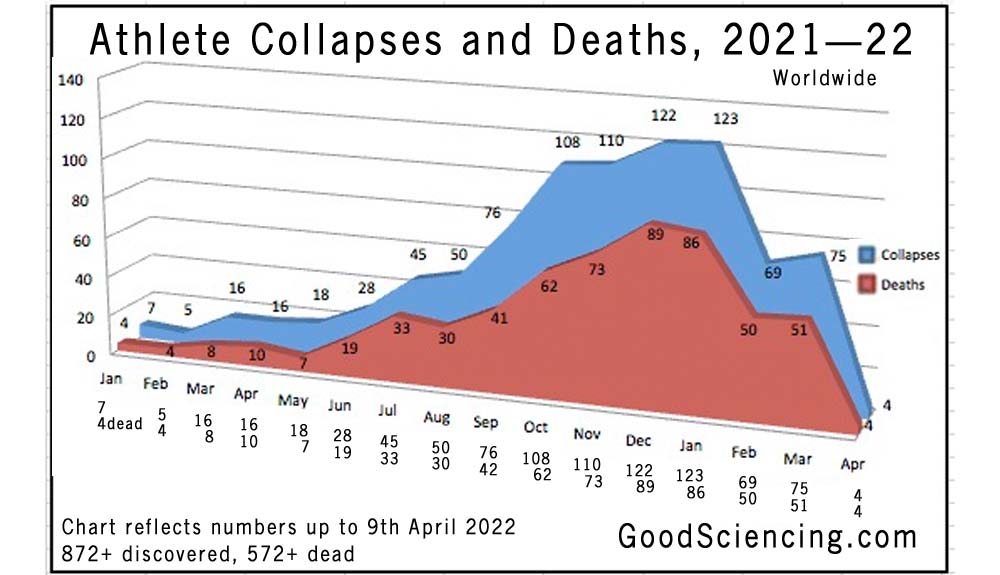
There are people tracking all the reports of athletes suddenly collapsing and dying in their prime, or heartbreakingly, even in their teens. This isn’t a definitive study, but where are the answers and why don’t we know them? There are a hundred million reasons to supply data that shows vaccines are “safe and effective”. If our health really did matter, and the incidence of sudden deaths in athletes was the same as every other year, where are those studies? Why aren’t we discussing this on the news?
Some of the collapses and deaths listed here may have nothing to do with vaccines, the anonymous researchers admit and declare that. They want the full data, we all want the data. But it’s nowhere to be found. The medico’s and football clubs, and the Department of Health have gone from bragging about getting their boosters on Twitter to saying nothing. They are not so keen anymore to report or declare vaccination status.
The rise in mid 2021 start at the same time a massive experimental medical program starts. It might be coincidence, but if it’s normal, they would be saying so, with open statistics and data, not shutting down the conversation, and sacking football managers.
The mainstream media still are not reporting most, but sports news cannot ignore the fact that soccer players and other stars collapse in the middle of a game due to a sudden cardiac arrest. Many of those die – more than 50%.
There has been a rise in reports of athlete sudden collapses and deaths since July last year. | Goodsciencing.com
What’s a normal year?
A review of sudden cardiac deaths in sport found about 29 a year mentioned in medical literature. A different study of the US found about 70 annual deaths across 38 different sports. There are more deaths listed in the peak months in that graph above than usually occurred in an entire year.
The International Olympic Committee in Lausanne, Switzerland, studied documents from international data banks from 1966 to 2004. Those documents indicate 1,101 sudden deaths in athletes under 35 years of age, an average of 29 athletes per year, the sports with the highest incidence being soccer and basketball. (NIH Document)
A study by Maron on sudden death in US athletes, from 1980 to 2006 in thirty-eight sports identified 1,866 deaths of athletes with cardiac disease, with a prevalence of hypertrophic cardiomyopathy.
More people are writing to tell us that in many cases, we didn’t mention a person’s vaccination status. There is a good reason for that. None of the clubs want to reveal this information. None of their sponsors want to reveal it. The players have been told not to reveal it. Most of their relatives will not mention it. None of the media are asking this question. So what should we do? Stop this now? No, we will collect as much information as we can, while it is still available, because eventually, more information will come out, and we will be here to put it together. Will it mean anything? We don’t know. What we do know is that there is a concerted world-wide effort to make this information go away, so that fact alone tells us it must be collected, investigated and saved so other researchers can look at it to see if there are any useful patterns.
Clubs Hide Vaccination Information Now
Here is a demonstration of how sports clubs do not want the injuries of deaths of their players to be associated with the COVID vaccines. It tells the story of why they will not report which of their players has been vaccinated and when. Sunderland FC manager Lee Johnson suggested that the COVID vaccines may have caused the heart issues for his goalkeeper, Lee Burge. The club then sacked the manager.
As a director of The Australian Environment Foundation I am delighted we were able to bring Benny Peiser out from the UK.
Bookings need to be done in the next few days!
Australian Environment Foundation
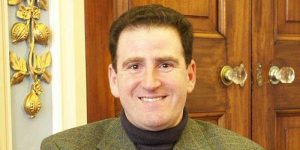
Dr Benny Peiser who heads up the London based The Global Warming Policy Foundation, is visiting Australia and speaking at three major events in Sydney 26 April, Brisbane 27 April and Melbourne 28 April.
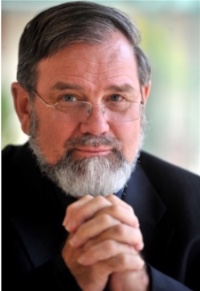
Benny Peiser
Dr Peiser has written extensively on domestic and international climate policy and has appeared on numerous media outlets to contest global warming alarmism and demonstrate the cost of policies being proposed to address it.
His visit is especially timely given the European – indeed global – energy crisis and the key issues of energy and the environment that are prominent in the Australian federal election campaign.
What can the UK tell us about renewable electricity? Benny Peiser points the way ahead on renewables based on the UK and world experience. He is a climate change expert and a complete Renaissance Man who brings a contemporary and historical social perspective to the issue, as well as deep knowledge of the science and policy solutions.
As an example of his breadth of interests his name is literally written in the sky with a minor planet bearing his name, in honour of his work on “near earth objects and impact hazzards”. He is a former member of the German Greens, holds a PhD in Cultural Studies for a thesis examining the history, archaeology and natural history of Greek problems at the time of the ancient Olympic Games.
Nigel Lawson, Margaret Thatcher’s Chancellor of the Exchequer founded the GWPF in 2009, and under Peiser’s direction it has become a major source of climate realist policy in the UK.
The event includes lunch and drinks so prices vary from $135 ($100 for students) or more. See the link for options. Book a table of ten and get a discount!
The AEF has invited Benny Peiser to visit Australia to deliver the Bob Carter Commemorative Lecture for 2022. Dr Peiser will speak on “The Global Energy Crisis, Net Zero Emission Targets and the War in Ukraine” at the Hawthorn Arts Centre, starting at 6:30 pm.
Sadly, not for Western Australians, Tasmanians, the NT, South Australia or New Zealand this time. Perhaps it’s time to arrange some other events for skeptics?
Welcome to Your Green Dystopia. The wind turbines at ESI Energy killed 150 eagles in the last ten years and last week the company was fined $8 million dollars “or $53,300 per carcass”. Which sounds someone cares about these birds. But don’t think the The Fisheries and Wildlife Service (FWS) are outraged at the deaths of eagles. The real problem was not the slaughter, but that ESI didn’t fill out the paperwork first. If they had only got their permits to kill, it would have been fine.
As Gregory Whitestone says: The government is funding this knowing the birds are dying in the name of Clean Energy
The DOJ press release further stated: “ESI and its affiliates received hundreds of millions of dollars in federal tax credits for generating electricity from wind power at facilities that it operated, knowing that multiple eagles would be killed and wounded without legal authorization.”
The legalized slaughter of eagles and other large birds of prey was legitimized under the Obama administration and continues today. At the time, it was estimated that nearly 600,000 birds of all types were killed by the much smaller wind footprint at that time, including 83,000 hunting birds such as hawks, falcons and eagles.
Unknown to most citizens is the fact that the FWS has established a “take limit” for wind energy companies to kill bald eagles. This would be similar to a bag limit for a hunter. However, hunters dare not as they are not of the protected class and would be subject to a maximum fine of $250,000 or two years of imprisonment for a felony conviction. FWS regularly imposes fines on oil companies and electric transmission firms for inadvertent deaths of bald eagles, all the while giving its seal of approval to green-induced eagle carnage of a grand scale from turbines.
The FWS bald eagle take limits were revised February 2022 to allow a more than four-fold increase in the legalized slaughter.
File this story away next time you meet someone who thinks wind farms are good for the environment. Also handy for children in schools where they need to explain the pros and cons of renewables.
What’s remarkable is that a conversation had by so many on the internet has finally made it, for a moment, onto television. No surprise it happened on a footy show. It certainly wasn’t going to happen on The 7:30 Report, Four Corners, or 60 minutes.
A star Australian football player had a “scary” incident with nausea, dizziness, and heart irregularities and missed a lot of the game this weekend. The hosts of the show casually asked if it was the booster shot — saying “that’s obviously the word going around.” Possibly they were relaxed about discussing it because one of the shows hosts even has Bells Palsy, and they had discussed it off camera with him. So they let down their guard:
“Exactly, heart issues and Bell’s palsy has gone through the roof since the boosters and Covid issues,” Lloyd said.”
“We had (sports journalist) Michelangelo Rucci on (3AW) on Friday night and he said that there’s a ward in Adelaide filled with people with similar symptoms to Ollie Wines – nausea, heart issues – so there has to be something more to it.”
This is the biggest news story on the planet. Mainstream Media football show hosts openly talking about adverse reactions sweeping the world after #OllieWines was hospitalised with an irregular heartbeat. pic.twitter.com/9azM3eFTz1
Wines spoke for the first time on Monday. “I’m 100 per cent back to normal, thanks to the Calvary staff the doctors and nurses there,” he said. “They really looked after me, and now I’m 100 per cent fine. There were a few little issues but they have been rectified now.” He said his heart issue is not related his Covid vaccination or vaccine complications, including myocarditis.
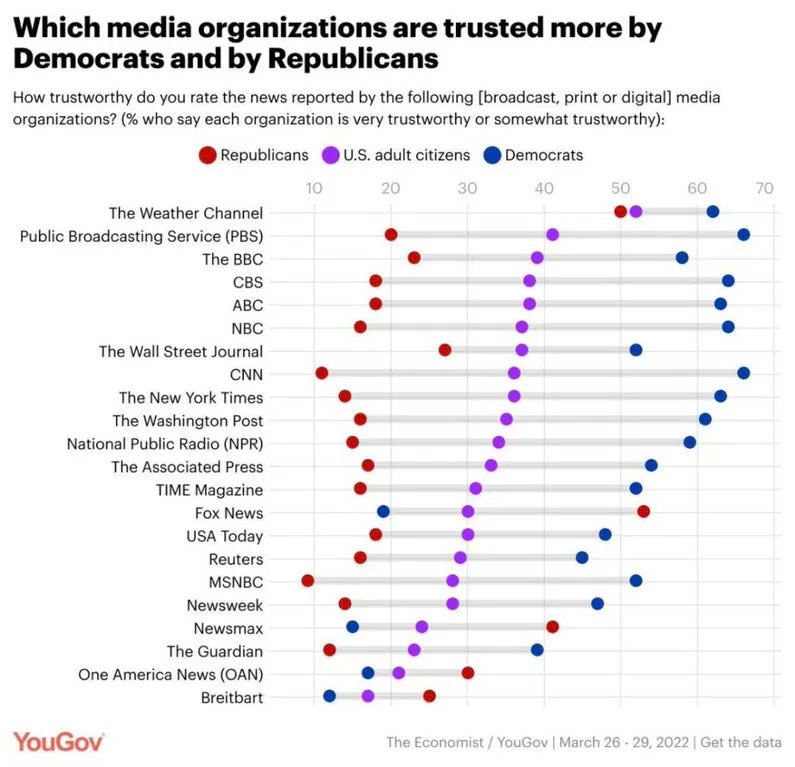
Having sold their souls not-covering Biden-family corruption, election scandals, Pharmaceutical malfeasance, and rackets running through politics and science, it’s no surprise that barely 1 in 6 Republicans trust most media outlets. Mass lies will do that.
Look at the vast partisan gulf in the poll below which asked “how trustworthy do you rate the news media…“. Can anyone look at this graph and argue that the media is not dominated by left-leaning views? Fully 18 of 22 media outlets appeal to, and are trusted by around three times as many left leaning voters.
It’s no surprise that the most polarized and divisive news source in America is CNN followed by The New York Times and Jeff Bezos’ Washington Post.
The Republicans (red) are more skeptical than Democrats (blue) of nearly every media outlet.
The least polarising of the mainstream news outlets is the Wall Street Journal.
The only media outlet arguably that serves both political views is The Weather Channel, but even there half of Republicans and 40% of Democrats don’t “trust” it. There is no common Town Square media left where both sides of the political spectrum can hear each others views.
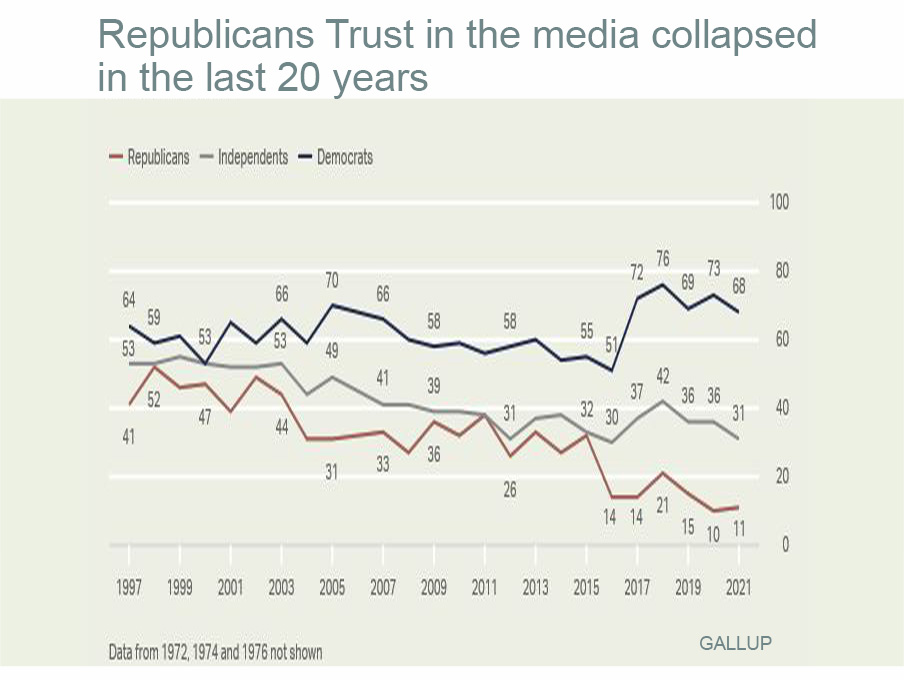
How things have changed since the year 2000
Republicans were always less likely to trust the media than Democrats were, but in the last twenty years that trust has evaporated.
The Daily Examiner in New Zealand seems perplexed that government funding might be a bad thing. Almost like they and the academics at the AUT research centre for Journalism, Media and Democracy, who did the study, have never once thought about the Government as a vested interest.
While in 2020, 62% of New Zealanders trusted the news they consumed, in 2022 the figure was 52%. Additionally, general trust in the news continues to decline.
Paradoxically, one of the main reasons for distrust in news media appears to be the Government’s funding of it. A large number of respondents now perceive media as an extension of the Government, hence it is seen untrustworthy, says Myllylahti.
This year, journalists have been increasingly under attack when reporting on the Covid crisis, vaccinations, vaccine mandates, protests and so on. In its role as disseminator of vital information in a crisis, the media has perhaps been seen as the Government mouthpiece. In one sense, it has quite rightly been, says Dr Greg Treadwell, co-author of the report.
Funny how telling the public to obey the government, without any questions or alterative views, makes the media look like a wing of the bureaucrats because that’s exactly what it was.
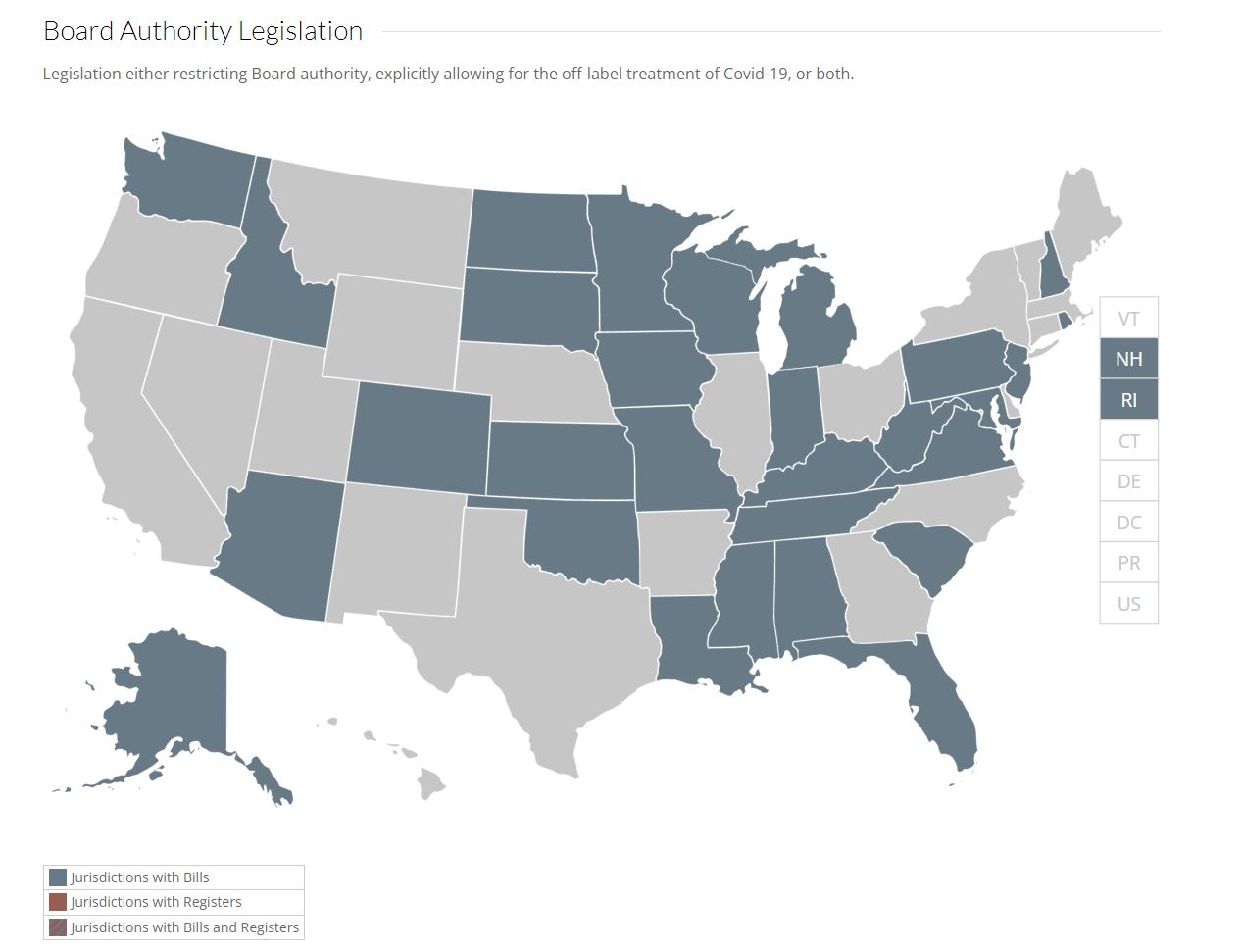
It’s a shock. More than half the states in the US are considering legislation to allow doctors and sometimes even nurses and pharmacists too, to prescribe early treatment drugs “off label”.
Let’s not forget that doctors were able to do that for decades and it’s largely the medical boards who have become the defacto Praetorian Guards of Big-Pharma — taking away the rights of doctors via threats to destroy their career if they step out of line.
Many of the proposed bills simply aim to stop medical boards from evicting doctors who use drugs like ivermectin and hydroxychloroquine. North Dakota, Kansas, Oklahoma, and Tennessee appear to have largely succeeded. The rest are working on it. In Tennessee, people may even be able to buy a drug that’s been given to a billion other humans, right over-the-counter. Golly, that’s almost as free as El Salvador?!
Meanwhile people in America are providing the drug “off-label” and “off-prescription” anyway, sneaking it into hospitals and handing it out at churches. It would be better for everyone if they could ask their doctors. But this response from state legislators in the US seems remarkable to this Australian — almost like Democracy still has a chance.
North Dakota was the first state to pass legislation last November:
The new laws “Prohibit the Boards of Medicine, Nursing and Pharmacy from disciplining a licensee solely on their dispensing of ivermectin for off-label treatments such as Covid-19.” The main aim apparently was to stop some doctors and pharmacists from using the excuse that the medical boards will punish them if they prescribe or supply ivermectin. But presumably some professionals were genuinely afraid of being punished.
In Kansas the legislation was approved on March 23:
Senator Mark Steffen championed the bill and also happens to be an anesthesiologist who has prescribed ivermectin.
“Thousands of Kansans and hundreds of thousands of Americans have died because of this propaganda that shut down early treatment,” said Sen. Mark Steffen, R-Hutchinson. “I fully believe that this passage of this bill through the Senate will gain national attention and help be a very important part of getting the care to the people who need it.”
The bill would allow doctors to prescribe ivermectin, hydroxychloroquine and any other FDA-approved drug that isn’t a controlled substance for an off-label use to prevent or treat COVID-19.
“Studies overwhelmingly show that ivermectin has up to an 85% chance of reducing hospitalizations and death when given early for COVID,” he said in caucus. “This is about decreasing suffering and death of the individual patient.”
“To a large degree, [ivermectin’s] been driven underground,” he said. “In my Reno County area, I have an 80-year-old Mennonite pastor and his wife, who is a retired nurse, they’re doling it out behind the scenes to all their church members. I have other people who have gone to the veterinary for ivermectin and dole that out to their friends. They know what they’re doing and they do a great job with it.”
Senator Steffen went on to write to 250 hospitals in Kansas to point out that they may face legal action if they don’t pay attention to early treatment:
In consultation with the legal community, indications are that “failure to treat” will now be considered “wanton disregard”.
Oklahoma found a different way — the Attorney General simply said there’s no legal reason to punish doctors:
Oklahoma Attorney General John O’Connor says his office does not plan to discipline doctors for prescribing certain medications, including ivermectin and hydroxychloroquine, to treat covid.
O’Connor said in a news release that his office finds no legal basis for a state medical licensure board to discipline a licensed physician for prescribing a drug for the off-label purpose of treating a patient with COVID-19.
The Oklahoma attorney general said he stands behind doctors who believe ivermectin is in their patients’ best interest.
“I stand behind doctors who believe it is in their patients’ best interests to receive ivermectin and hydroxychloroquine,” O’Connor said in a statement. “Our health care professionals should have every tool available to combat COVID-19. Public safety demands this. Physicians who prescribe medications and follow the law should not fear disciplinary action for prescribing such drugs.”
The bill HB2746/SB2188 has just passed the Senate and is headed for the Governors desk. The original bill aimed to make ivermectin available over the counter, like aspirin. But the amended bill requires a bit of paperwork of some sort: “a non-patient-specific prescriptive order, developed and executed by one or more authorized prescribers.” But some still argue that it is effectively now an Over-the-Counter (OTC) medicine in Tennessee now.
The source of the problem was that the Tennessee Medical Board put up a warning on their website last year that doctors risked their medical licenses if they spread misinformation about the COVID-19 vaccine. Many doctors naturally assumed that even mentioning that there was an early treatment alternative would be classed as misinformation.
Incredibly, that sparked a debate about free speech (hallelujah.) It all looks so sensible.
“I had several doctors contact me last summer and into the fall about what they were seeing and hearing from the Board of Medical Examiners, that would potentially punish them for prescribing treatment for COVID that they felt was in the best interest of their patients,” Tennessee Republican state Rep. Chris Todd told Stateline. “That hit me, because they have a perfectly valid license and have practiced for years, and there’s no reason to issue a statement carte blanche.”
The medical boards were intimidating doctors. A bit like saying “Nice Practice you have there…”
Tennessee lawmakers say doctors complained to them about receiving emailed warnings. At its meeting in September, the board discussed sending a warning to all physicians in the state. But Bill Christian, spokesperson for the Tennessee Health Department, which oversees the medical board, said in an email that if doctors received any emails, they came from professional organizations, not the board.
In any case, the board in December deleted the warning from its website, although Christian said that the policy behind it remains in effect.
Rep Chris Todd blamed a “CDC that’s gone beserk”. Nicely said.
Politicoreported Feb. 1 that medical boards have penalized eight physicians in one year for furthering COVID-19, vaccine and therapeutic misinformation.
Fact checkers at AAP examined that claim and found that since July 2019, 61 medical practitioners had been disqualified by the Australian Health Practitioner Regulation Agency (AHPRA) for any reason — not just related to COVID-19 vaccination.
Naturally, other doctors have struck themselves off, seeing what was coming. And so have young candidates for medical school. How demoralizing for the whole profession to find they are nothing but robots performing for an unaudited committee.
Eight doctors struck off in the US is still eight doctors too many. But Australia has about 8% of the population of the US, so it’s “far ahead” in Communist Medicine. Damn.
There’s an electromagnetic ball of fire that is 1.3 million times the size of Earth and just 8 minutes away by photon, and we really don’t know what’s going on there.
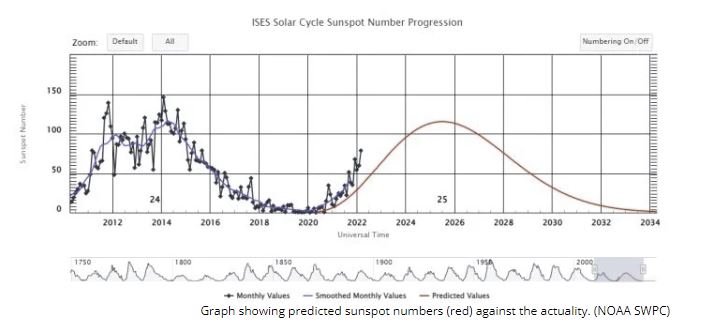
Historians will mock us for trying to predict Earth’s climate when we are in the baby days of Space Weather knowledge. Solar Cycle 24 (the last one) was a shorter cycle, just under 10 years. Right now the big question is whether Solar Cycle 25 will be bigger and more active which seems to happen after a short cycle. But it’s too early to tell. This top graph overstates the effect.
The Solar Cycle Prediction Panel predicted that the 25th cycle since record-keeping began would be similarly quiet, with a peak of 115 sunspots. By contrast, the number of sunspots for the last 18 months has been consistently higher than predictions. At time of writing, the Sun has 61 sunspots, and we’re still over three years from solar maximum.
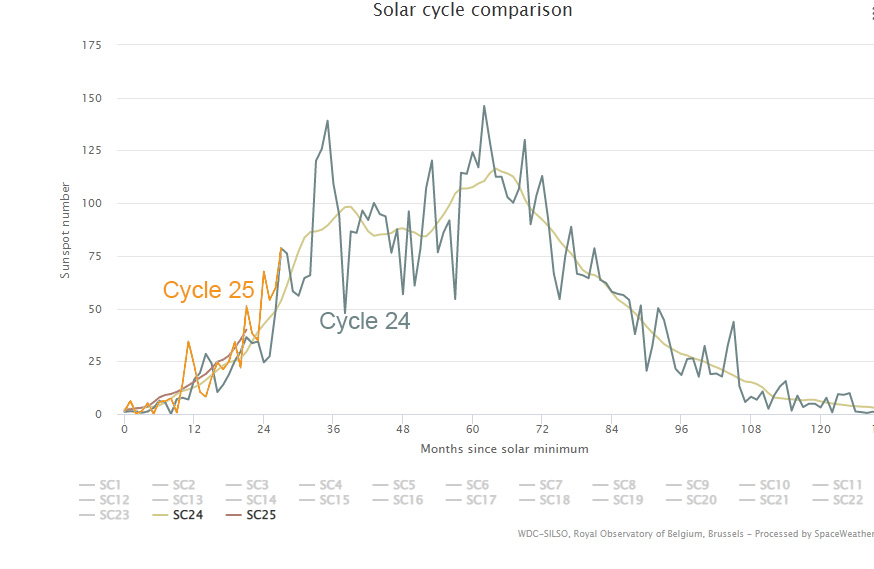
Solar Cycle 25, bigger than expected.
Cycle 25 has been consistently higher than Cycle 24, but it is all within the margins of noise.
It certainly doesn’t look like it will be “the highest on record”. h/t Eben.
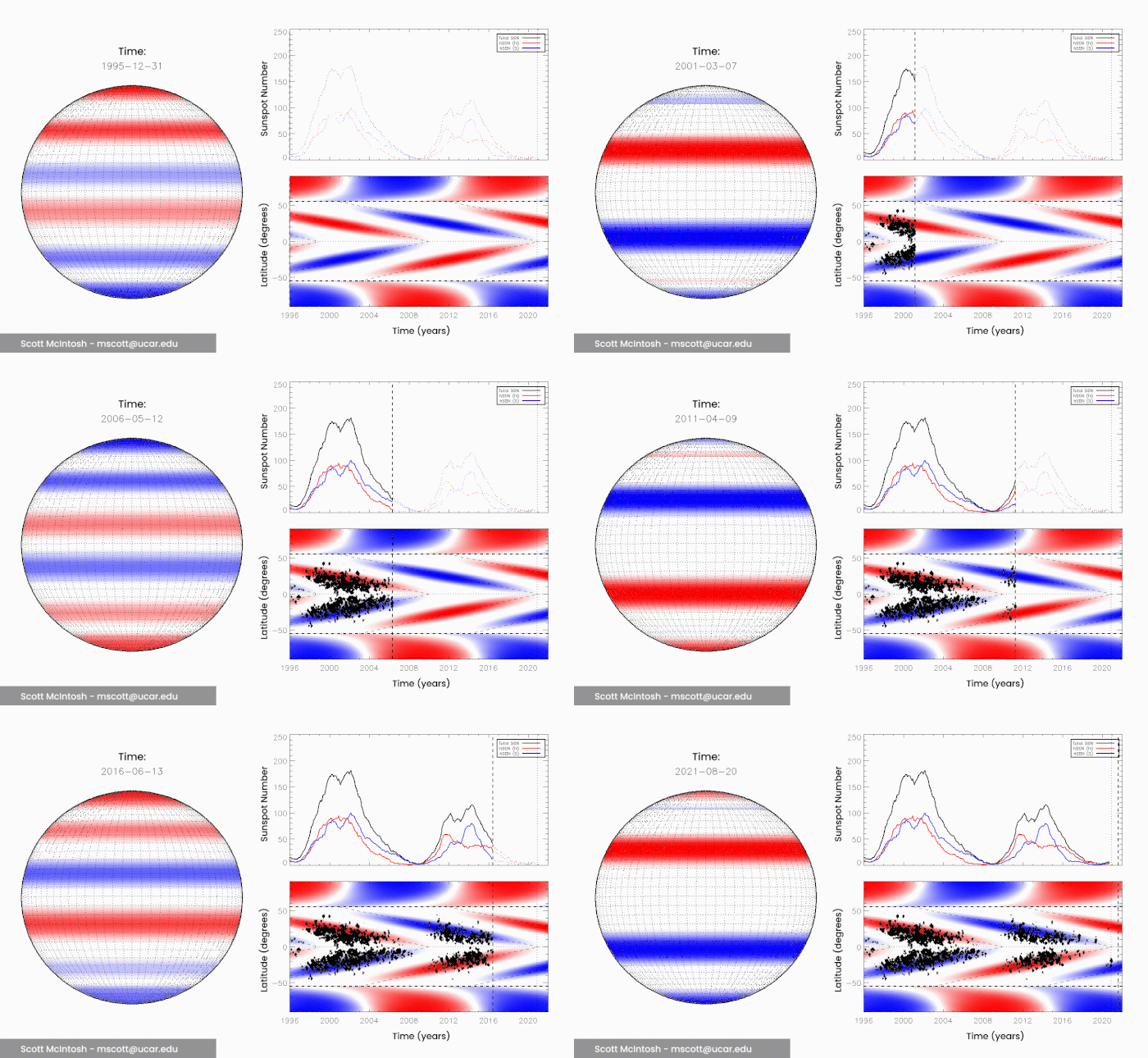
So there are battles over predictions but they are all guessing, including the author of this press release, and the top graph, Scott McIntosh, who admits as much:
A solar cycle following a longer cycle, they noticed, was likely to be on the weaker side. But a cycle following a shorter cycle was likely to be stronger. Solar Cycle 23 was long, which is consistent with the weakness of Solar Cycle 24. But Solar Cycle 24 was also short, coming in at just under 10 years.
This, McIntosh and his colleagues predicted in 2020, meant that Solar Cycle 25 was likely to be stronger – perhaps among the strongest on record. And the climbing sunspot numbers would suggest they may have been onto something.
“Scientists have struggled to predict both the length and the strength of sunspot cycles because we lack a fundamental understanding of the mechanism that drives the cycle,” McIntosh said at the time.
If he’s right and extreme UV marks the magnetic fields moving in waves, it’s just one more factor that’s missing in the models. Climate modelers think the Sun is just a ball of light, and fill all the gaps in their understanding with the hypothetical effect of “CO2”.
In 2014, he and his colleagues published a paper describing their observations of the Sun on a 22-year cycle.
This has long been considered the full solar cycle, when the poles return to their starting positions, but McIntosh noticed something interesting. Over the course of about 20 years or so, flickers of extreme ultraviolet light called coronal bright points seem to move from the poles towards the equator, meeting in the middle.
The movement of these bright points across the mid-latitudes seems to coincide with sunspot activity.
It’s really more of a 22 year cycle on the sun before the North pole gets back to where it started.
These bright points, McIntosh believes, are linked with bands of magnetic fields that wrap around the Sun, propagating from the poles to the equator every 11 years or so.
Because they have opposite polarity, when they meet in the middle, they cancel each other out – what the researchers call a “terminator”. These terminator events mark the end of a solar magnetic cycle, and the start of the next.
But they don’t always take exactly the same amount of time. Sometimes these bands slow down as they reach mid-latitudes, which means that the length of time between terminator events varies. And the team noticed that there’s a correlation between the length of time between terminators and the intensity of the following solar maximum.
“When we look back over the 270-year long observational record of terminator events, we see that the longer the time between terminators, the weaker the next cycle,” said astronomer Bob Leamon of the University of Maryland Baltimore County.
“And, conversely, the shorter the time between terminators, the stronger the next solar cycle is.”
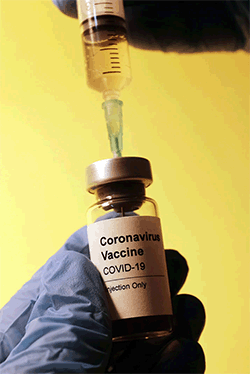
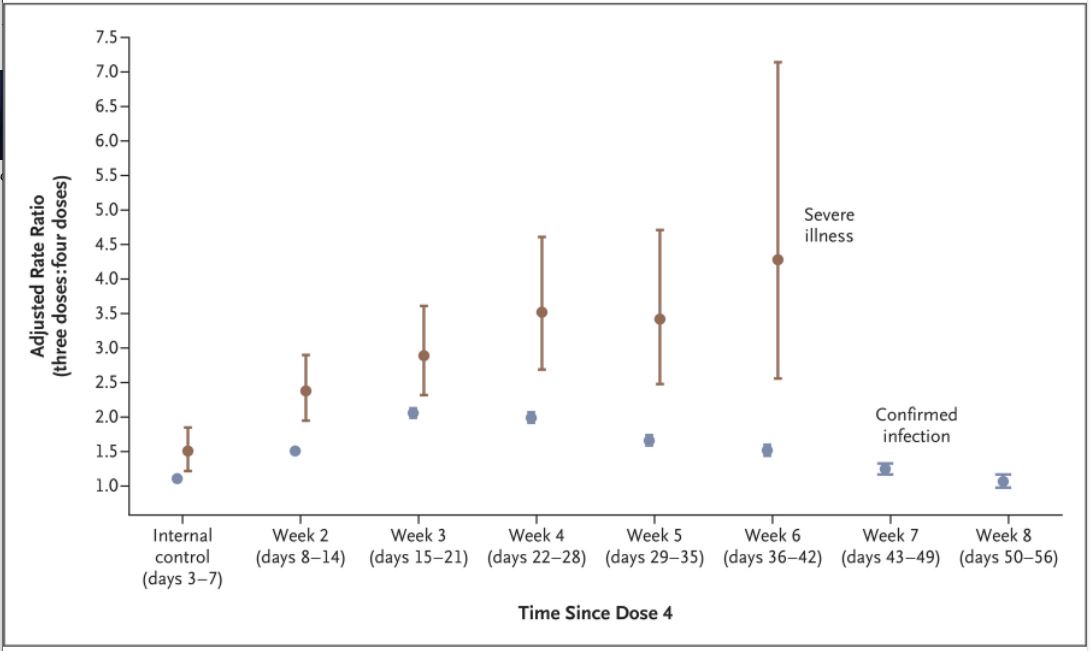
A new Israeli study sliced through the medical records of 1.2 million people. They compared people who had three doses with people who went on to have four. By three or four weeks after the 4th shot, people had half as many symptomatic infections. It’s “nice” but it’s only 50% efficacy, and that’s as good as it gets. So much for the glory days of “95% efficacy” — things are so unimpressive, no one talks in percentages anymore. By eight weeks after the fourth dose there was pretty much no extra protection against infection left.
On the plus side, the fourth dose did seem to prevent people getting a nasty disease, with 3.5 times as many 3-dose people getting a severe infection compared to the 4th-dosers. On the down side, those patients were only followed for six weeks. The honeymoon-from-hospitalization may fade quickly too. It lasts a few months with the 3rd dose.
So the fourth dose isn’t going to last through the winter — the meaningful honeymoon period is just a few weeks — from Week 2 to Week 6 to be precise, and that’s only 30-50% “protection”. If damage from Wuhan spikes is cumulative, the short honeymoon may be a bum deal, to say the least.
So when it comes to people getting on planes, if it’s not safe for the unvaccinated to fly because they might spread more disease, then it’s not safe for the multi-vaccinated most of the time either.
Higher dots on this graph mean more protection
8 weeks after the fourth dose there was no difference between people who had three or four doses. They probably still have some protection against Severe infection, but for how long?
Here’s a surprise for all you Australians trapped in Australia because you chose not to take part in a medical experiment. The reason you can’t leave is not for your own health. It’s not for the health of fellow Australians. It’s because we are “protecting the rest of the world”. This is a world where where fully vaccinated travellers have already spread Covid to every country on Earth and at least 72 countries are happy for you to turn up on their door with your tourist dollars and without a vaccine.
As Senator Rennick says: “I cannot for the life of me see the health risks in an unvaccinated person leaving the country.”
Paul Kelly, Australia’s Chief Medical Officer explained that it was due to Australia’s International Health Obligations. That’s an international treaty we signed because we’re a member of the WHO. As far as a quick search turns up, Australia, Canada and the UAE may be the only nations still banning their own citizens from leaving. In Canada, things are so inexplicable, the vaccinated don’t even need to do a test anymore. So people infected with Covid are free to fly in or out of Canada shedding virus everywhere. But healthy unvaccinated people “will need to be tested at the airport and again eight days after arrival, and isolate for 14 days.” Righto.
The Australian PM Scott Morrison keeps telling us he opposes mandates, yet he hasn’t said “boo” about this international treaty. Indeed, if the Australian government was set up as a subsidiary wing of Pfizer and Moderna, they could hardly have done more to lift profits
Below Senator Rennick asks Paul Kelly, Australia’s Chief Medical Officer, at the Senate Community Affairs Legislation Committee why unvaccinated Australians can’t leave the country. It may take two repeat-viewings to get the message, there is no sunset clause on locking in the refuseniks.
The Good news is that finally the two year Pandemic Emergency Biosecurity powers are about to end.
The Bad news is the government plans to make other rules that will still stop unvaxxed Australians from leaving.
Australian citizens who wish to travel without getting injections will still need to swim, paddle, ride crocodiles, or renounce their citizenship. Perhaps Prof Kelly is hoping to use this as a “booster” bonus carrot? Will they ban the two-jabbed?
Welcome to Prison Australia where unvaccinated citizens are not able to leave. (And Canadians thought they were the only ones). If your best friend is getting married in Madagascar, the Africans will let you fly in, but you can’t go because Australia won’t let you out.
Australians who are unvaccinated or not-jabbed-enough can apply for permission to leave. But unless you need foreign medical care, live or work overseas, or are flying in the “national interest” (meaning you’re a politician) you may not qualify. Trips need to be “longer than three months” for no good reason I can think of, except that it stops most holidayers. Which is obviously the point.
People may get an exemption if they need to work overseas. Which is fine if your boss wants to send you to conventions in the Greek Islands but you can’t take the wife and kids unless she owns the company, and the kids are your employees. Otherwise, there’s no pleasure cruises for the unjabbed peasants from Oz.
Unvaccinated Australians who want to leave pretty much have to escape
We can always drive to Broome. We might find an Indonesian fishing boat and get a lift back the other way, in a kind of reverse boat-people maneuver. With luck, Australian-boat-people might be able to apply for political asylum in Bali. But will Indonesia accept them? Otherwise it’s only 150 kilometers from the top end of Queensland to Papua New Guinea. It’s possible to swim or paddle across the Torres Strait, it’s just that the crocodiles may appreciate your trip more than you do.
The ban doesn’t apply to unvaccinated foreigners in Australia, (luckily for Novak, eh, or he might still be here?). Non-Australians are free to leave, so dual nationals could always renounce their citizenship but the rest of us just have to go stateless.
Right now, there are about 70 countries which allow unvaccinated travelers in. Places like France, Spain, Greece and the UK, as well as Norway, Israel, Denmark, and those bastions of freedom: Cuba, Russia and parts of Africa and central America.
When nations with medical systems as good as Haiti aren’t afraid to welcome the Unvaxxed, it seems a tad odd that Australia is afraid to send them.
As it is, the Australian made vaccine is not on the approved list in Australia, so unvaccinated Australians aren’t able to fly out of Australia to go to Iran where they could get an Australian vaccine. It’s almost like we’re owned by Pfizer.
Set Australia Free Scott Morrison…
If it all sounds a bit hard to believe, ponder that it’s been the law since the Human Biosecurity Emergency was announced two years ago:
“From 25 March 2020, all Australian citizens and permanent residents must not travel outside Australia unless exempt… “
Long after Covid became tame enough to let in, and evolved into omicron, the Pandemic Emergency was extended again and again, even in February this year until 17 April 2022. Will they extend it again? I’ll have more to say tomorrow…
From the Australian Government Health website — here it is in black and white:
Restrictions on outbound international travel for unvaccinated Australians
If you do not meet Australia’s definition of fully vaccinated for international travel purposes, you need to apply for a travel exemption to leave Australia. For more information and how to apply see Travel exemption process to leave Australia.
are travelling as part of the response to the COVID-19 outbreak, including the provision of aid
need urgent medical treatment that is not available in Australia
are travelling for a compelling reason and for three months or longer
your travel is in the national interest
you are ordinarily resident in a country other than Australia.
are travelling for your business or employer
providing critical skills or working in a critical sector.
Would you like hoops to jump through?
When to apply
You need to apply for a travel exemption at least two weeks, but not more than two months, before your planned travel.
If you are travelling due to the death or critical illness of a close family member, you can apply inside this timeframe. We will prioritise your application.
At the moment, two jabs is enough, and people can do them barely two weeks apart and then fly seven days later, which doesn’t sound like anyone in the Health department is too concerned about the travellers actually being protected. If we want to know the efficacy we have to wait two or three weeks after the last injection before we even count them. But if we are only worried about them getting on planes full of viruses, who cares?
It’s not about health is it?
In February more than 400 Australians applied but were told they couldn’t fly out of the country. Some 390 people applied to leave on compassionate grounds, but 168 of those were knocked back. About half the people who said they lived overseas were not allowed to leave either. All told during the last two years the Australian Government has declared that 147,000 Australians didn’t have permission to leave the country. Who knows how many thousands more never bothered to apply in the first place.
As the grapevines bud for the season in France, a mild spring followed by a savage frost is bad news for farmers.
There have been three bad frosts in recent years. The young fashionable expert tells us that frost means it’s climate change. But people didn’t realize...” it’s a form of denial” she says with a straight face.
The change in weather pattern is also pushing up his insurance coverage for loss of harvest, he added. In Yonne, two-thirds of the harvest was destroyed as a result of the frost last year, according to the farm ministry.
Winemakers were starting to join forces to invest in new tools, such as heating cables, to help mitigate the effects of such frosts, she said. However, many in the industry are still reluctant to face up to the fact that the impact of climate change could be long-lasting, Civet said.
Météo-France, the country’s meteorological service, said the night of April 3 was the coldest night on a national scale since the creation of the national thermal indicator in 1947, with an average temperature of 29.3 degrees Fahrenheit (1.5 degrees below zero Celsius). This indicator averages the temperature of weather observation sites across France.
The late winter snap also hit Germany with a new record low temperature of minus 12.7 (9.1F) set at Bad Berleburg-Hemschlar.
We use cookies to ensure that we give you the best experience on our website. If you continue to use this site we will assume that you are happy with it.










.jpg)

Recent Comments