The city kids don’t know the first thing about the sky
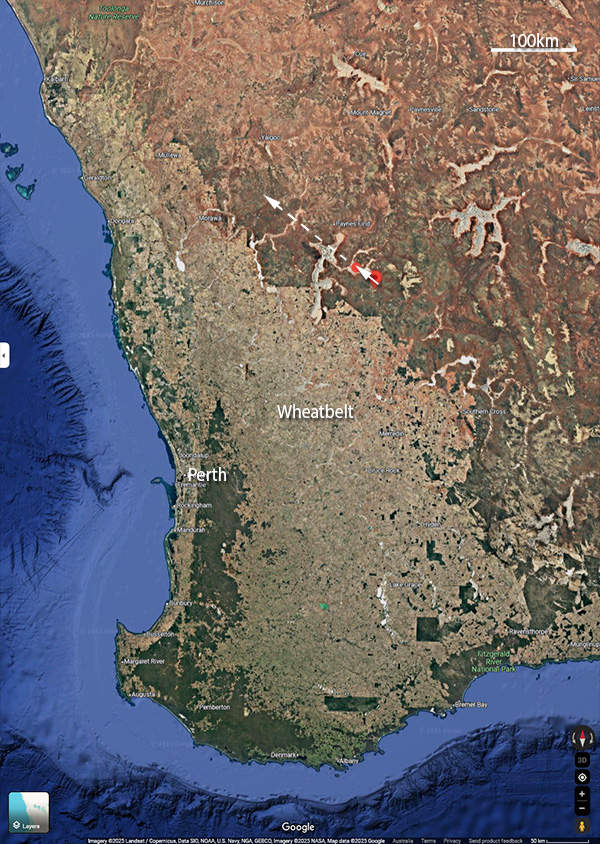
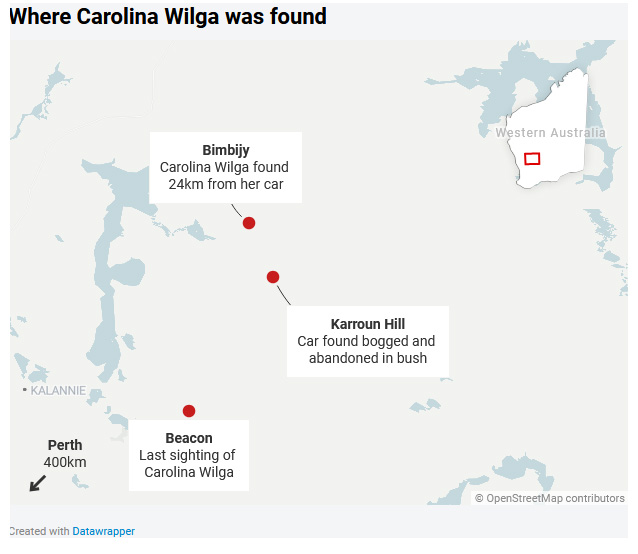
Despite the media frenzy here, no one seems to have noticed that the lost tourist, Carolina Wilga, was walking for 11 days in the wrong direction. She said she “followed” the sun, and thought she was going west, but she was actually going north-west, away from help. See the map below to appreciate what a terrible mistake she was making (among a list). At this time of year, the sun is setting almost as far north as it ever sets. Somehow she was missing the entire Wheat Belt of Western Australia.
Primitive hunter gatherers knew the cycles of the sun and the movement of stars we can’t even see. It’s the most ancient science and we seem to have lost it. Not just Ms Wilga, but all the commentators too. Neolithic Brits built Stonehenge 4,000 years ago to mark the solstice and modern phone bunnies with silicon chips have lost it. Heck, even Bogong moths can navigate by the stars.
Carolina Wilga, 26
The 26 year old German backpacker drove 35 km off the beaten track into no-mans land and had an incident where the car slid, and she hit her head and got bogged. After giving up on the car, she waited a day, then walked “west”. She drank water from puddles and bee-hives. At night, temperatures drop to around zero (32F). No surprisingly, she was convinced she would die. It would have been gruelling and very very scary. On the 12th day, somehow, through extraordinary luck, or a divine act, the one sole station owner for 50 kilometers happened to see her on a dirt track that the owner doesn’t travel on much. Tania Henley (the rescuer) called it a miracle, which I thought was the usual hype, until I saw the map. Out in the border-land surrounding the vast desert center of Australia there are thousands of empty square kilometers.
The direction Carolina was headed in was almost doomed — running parallel to the northern edge of the wheat and barley fields in a largely uninhabited semi-arid zone.
What the bland mass media map doesn’t show is where civilization is, and how she was headed in the wrong direction
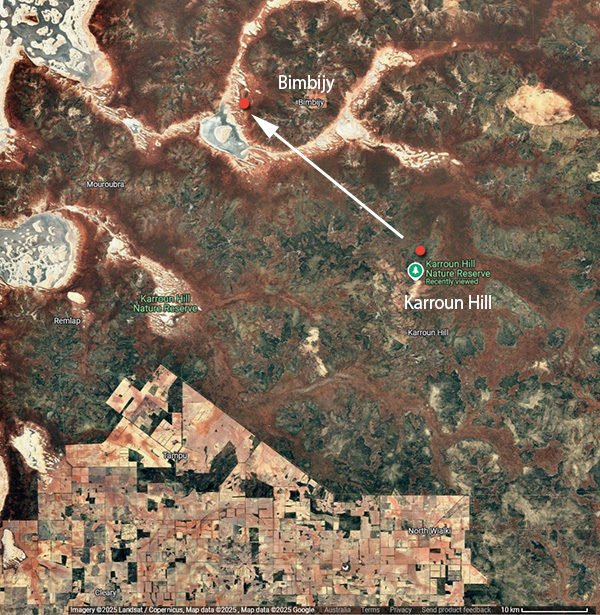
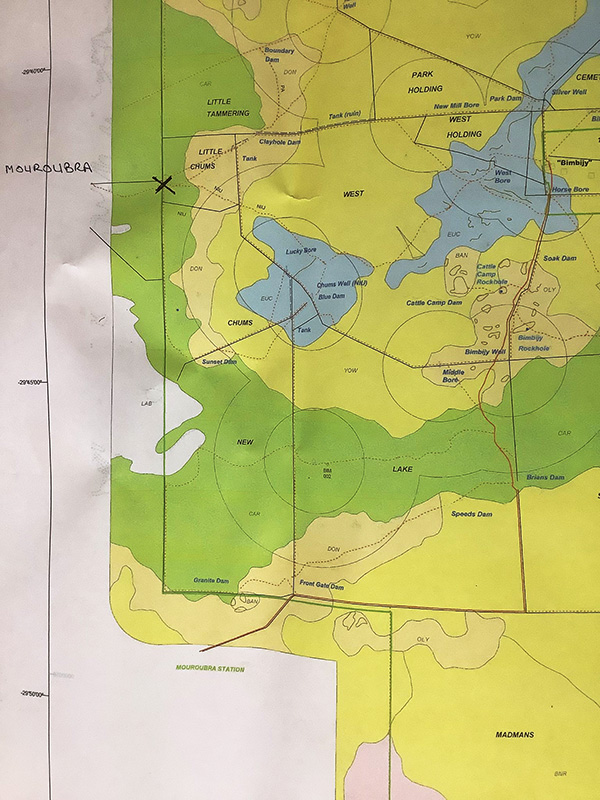
In the satellite photo below we can see the wheat and barley farms to the south, where she had come from, and would have found safety and people. To the north and north-west is Bimbijy — which is one of the vast remote stations in Western Australia. (The red dots marking her start and end points are only approximate. The car was stuck in “Karroun Hill Reserve” which no one has ever heard of, but is 3,097 square kilometers in size. She apparently covered 24 kilometers on foot and was found west of Bimbijy, and her car was left 35km from “any established track”.)
Never mind the brown snakes, the deadliest thing out there is the lack of water. Rainfall in this area is less than 300mm or 12 inches a year and all the lakes are salt-pans. Luckily June and July are the rainiest time of year. One 73 year old gold prospector went missing in the same area last December, and sadly, has still not been found.
Headed NW to follow the Sun.
Ponder that the one cleared pale square under the word “Bimbijy” above is the station homestead and airstrip. The only one out there.
Tania Henley (the rescuer) said:
“It was meant to be because no one goes up and down that road. “I don’t go to Beacon very often…”
We can zoom out and see that by following the sun Carolina’s direction was one long miss. (Along the dotted white line). In midwinter at 29°S the sun is setting 23° north of west. Though obviously, she should have been going south west, not west in any case. (Don’t leave home without a paper map, eh?)
The only “need” for Green Steel on earth is because it’s a fashion accessory at UN events, or because some people believe it can change the weather. There is no intrinsic benefit, it’s not shinier or stronger, it just has more social scoring points, or bragability if you go to inner-city upmarket arts parties. Technically, according to the experts, owning green steel will confer benefits like extending winter for a few more days a year (theoretically). I can’t see that catching on.
This is a market that the bottom could fall out of any day
In May, only 13% of UK Voters said Net Zero goals were more important than their cost of living. So 87% of the market is already not interested in buying Green Steel instead of normal steel. And that 13% “peak” is only maintained with bullying, censorship and non-stop propaganda by the legacy media. Imagine how fast that niche group would shrink if word spreads that Net Zero policies are killing birds and whales and hurting the poor? Or that thousands of scientists are skeptics — including men who walked on the moon and won Nobel Prizes (Vale Ivar Gievar!).
Half of Australia doesn’t want to pay a single cent on Net Zero targets. The IPA research showed barely 7% of the population are willing to spend anything meaningful. So 93% of Australians don’t want “green steel”. The 7% figure who might hypothetically pay more for “weather changing steel” can only shrink from here.
The only market for Green Steel in China is the one we make, sorry, we fake here at home, with government decrees, forced carbon markets, subsidies, and Soviet rules.
In the EU there is a small premium paid for green steel, but they have a carbon market and targets. In the US where people are now more free to choose their favourite steel, the green steel market is “stagnant”.
Devastatingly, Fastmarketreports that the differential paid for green steel was “$0” per short ton (per long ton too!).
That’s how much people in the US are willing to pay voluntarily for green steel. Nothing.
There may come a time soon, when it will be negative. Don’t give me that…
If Australia tries to make wind-solar-battery-power “Green Steel” five minutes later, China will start nuclear power green steel, and wipe out our market
If the gormless West taxes and subsidizes the population into paying more for green steel, China will be only too happy to profit from selling niche fashionista pointless items to the West. If we delude ourselves that it is a market with “hundreds of thousands of jobs” — a moment later, China will process green steel with electric arcs powered by “low emission” nuclear plants.
It’s so unfair, the wind is free, but who could have known we’d need metals, boats, cables, and magnets?
Governments waved their magic wands to declare the renewable transition would “bling” into existence, but they didn’t bother doing the sums on whether we could mine the vast resources in time, and what would happen to the prices of everything, if every other stupid fashion-obsessed western nation tried to do the same thing at the same time.
At the academic safe-space known as “The Conversion” Thomas York explains to baffled renewables fans why wind farm developers are mysteriously pulling out at the last minute. He doesn’t spell out the baby-nature of the economic reality, but we can read between the lines. The ship called The Infrastructure-Bill has arrived and it’s killing them: the price of steel, copper and aluminium has doubled and tripled; we can’t make the right boats fast enough to build the towers out at sea; everyone wants high-voltage cabling at the same time, and they all need the rare metals for the magnets, which are well, rare. Then, the delays in arranging all this mean the developers fall over their contract agreements timelines, so they start to lose subsidies.
Ultimately developers have raised their prices to cover the true costs, but then the customers aren’t happy. As the University of Leicester researcher says so poignantly when faced with the brutal reality of the market: “it [wind power] is simply not profitable enough”. He even admits “renewable energy still cannot compete with oil and gas.” Sacre bleu!
The UK government magic wand says it can generate 95% of energy from renewable sources by 2030. York, master of understatement, says the “target is now in jeopardy.”
The UK government’s strategy for tackling climate change received a major blow in May when Danish developer Ørsted announced that adverse economic developments had halted its 2.4 gigawatt (GW) Hornsea 4 wind farm in the North Sea.
Supply, meet demand: When everyone wants the same thing at the same time, prices rise
Building a wind turbine requires significant amounts of steel, copper and aluminium, all of which doubled or tripled in price between 2020 and 2023. Turbine manufacturers have raised prices in an effort to recover recent losses…
Impending national and international net zero targets also mean that developers globally are having to make earlier investments in transmission infrastructure. An exponential increase in demand for scarce high-voltage cabling has already led to high-profile cancellations of offshore wind farms in the US.
… Rising demand for rare earth metals used to make magnets in turbine generators has also been snared by geopolitical issues.
There are just not enough boats:
Ørsted ceased work on its 2.2GW Ocean Wind development zone off the coast of New Jersey in 2023, citing a vessel delay in its decision to cancel the project.
According to the advocacy group WindEurope, demand for vessels capable of installing foundations and turbines and laying cables will outstrip availability within the next five years. The gap between the two is forecast to skyrocket between 2028 and 2030….
Delays caused by these issues can result in a problem known as “contract erosion”. In their contracts, developers have a commissioning window within which turbines have to start generating. If they are not operational within this time, they lose their subsidies on a day-by-day basis.
Ultimately, the market hath spoken:
Rising costs mean that even one of the world’s biggest wind farms, Dogger Bank in the North Sea, will not be profitable for its developer, Equinor. As a prospect for generating financial returns, renewable energy still cannot compete with oil and gas.
This is the key argument of economic geographer Brett Christophers in his recent book The Price is Wrong. Christophers argues that, if national governments continue to rely so heavily on private sector investment to build renewable energy, decarbonisation is unlikely to proceed as fast as it needs to. It is simply not profitable enough.
If the government had got out of the way and let the market speak twenty years ago without hiding the truth under a bonanza-fog of subsidies, we wouldn’t have wasted twenty years and trillions of dollars to find out it was not going to work.
Burn more oil and coal, save lives and never ever apologize
It’s been a hot ten days in Europe and the Blob-Propaganda Machine is running full tilt. A rapid “analysis” invented a number of excess deaths faster than junk science has ever been done before. So teeth can be gnashed appropriately, never mind about peer-review, who needs that? Thus, extreme heat was said to have killed 2,305 people across 12 cities — 2,305! And with Coupled Voodoo Models we can “show” two thirds of those deaths were because of fossil fuels and “Climate ChangeTM“! This study, note, has not even been published, it can’t be using real data from the event “seven days prior” (June 23 to July 2, 2025) because that won’t be published for weeks or months. It’s all guesstimated from past deaths in other years.
One *handy* thing about rapid analysis like this is that it’s also “too fast” to see if the excess deaths were followed by a lower death rebound, which often happens after heat-waves. A few hot days in a row generally take those who are about to die in the next six weeks anyway, so after the peak, comes the drop. It’s rather darkly known as harvesting future deaths. Good studies use at least a 21 day lag, but crass publicity-science-stunts don’t even wait 21 days to hit the news stands. Maybe they “guessed” that too in the assumptions? Who can tell? Maybe they’ll add it in and adjust the numbers later — after the media hype?
Of course, if the sole purpose of junk-science-academia is to promote government tax and spending plans, then we wouldn’t want to do a careful analysis and find that 1,500 people weren’t really excess deaths we could blame on fossil fuel induced warming, or that by the same reasoning probably 15,000 Europeans were saved last winter. Shh!
The complete sell out of university and legacy-media is there for all to see. All it takes is for one professor, or one journalist to do five minutes of research (or a read a blogger for free) and show what we all know — that if global warming kills anyone in summer, by the same reasoning it would save ten every winter. Around the world Global warming saves 166,000 lives a year. (Zhao et al). Where are the headlines for the people the Greens don’t care if they kill in winter each year?
Climate Change saves ten times as many lives every winter
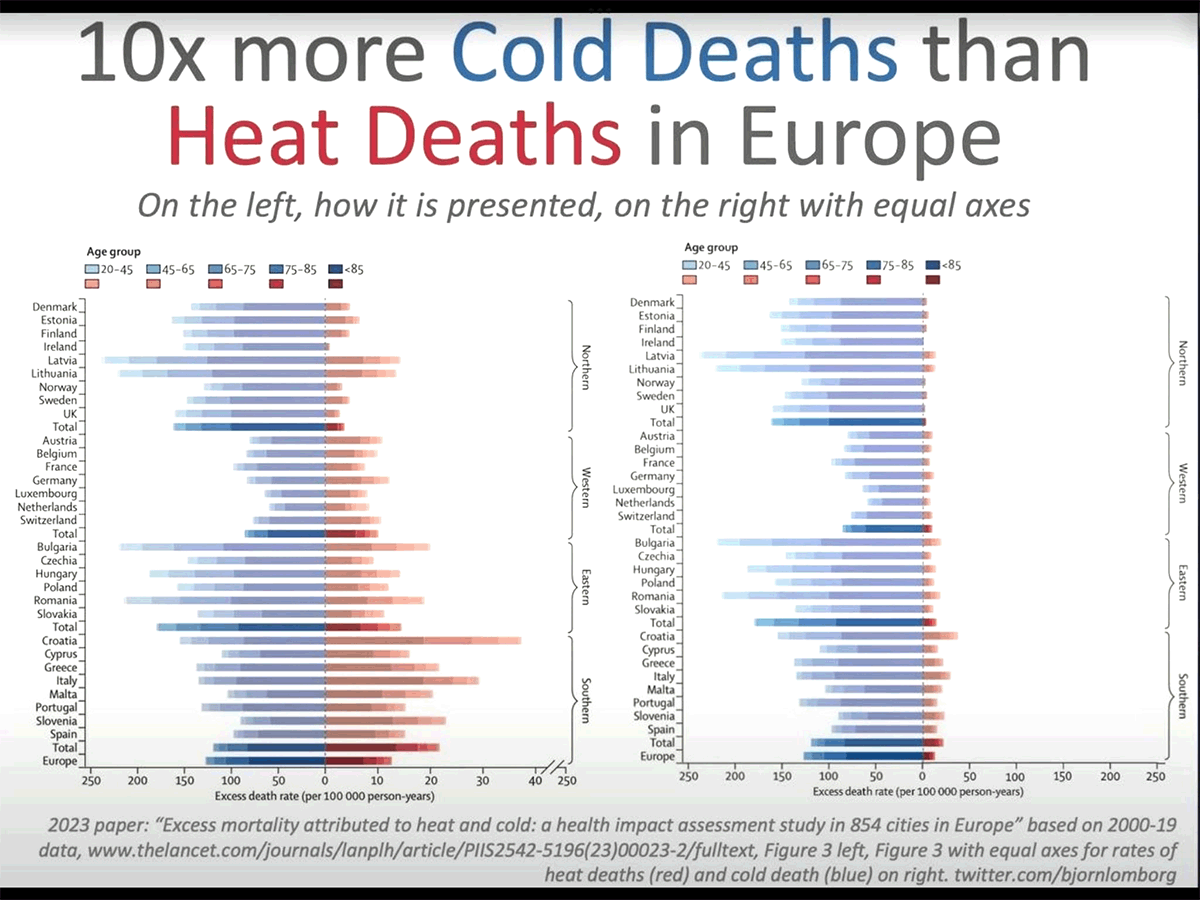
It’s rare in medical science to have unequivocal research. But this is one of those moments. Studies of 74 million people show the same pattern everywhere; in terms of the climate nothing is more deadly to humans than winter. (See Gasparrini et al). For every summer heat wave death, at least 6, 10 or even 20 people die due to cold weather in winter. The largest study across 13 countries found cold deaths were twenty times more common than heat deaths. Look at the scary blue bars below, it’s moderate cold coming to get you!
In richer European cities, with gas stoves and coal fired power stations *only* ten times as many people will die of the cold. (Mazzelot et al) Even in warm sunny Brisbane, Australia, six times as many people die in mild cold weather as in the heat of summer. (Cheng et al).
Remember this graph? The one on the left made it through peer-review and expanded deaths on the “warm” side. The graph on the right is the real proportion of cold deaths to warm ones. And the Lancet published the big 74 million deaths study in 2015. They knew. They knew!
Thanks to Patrick Moore https://twitter.com/EcoSenseNow
The benefits we can derive,
From warming, helps keep us alive,
While our true foe is cold,
Killing both young and old,
Who with warming would otherwise thrive.
– Ruairi
REFERENCES
The World Weather Attribution study (unpublished) … ?
Masselot et al (2023) Excess mortality attributed to heat and cold: a health impact assessment study in 854 cities in Europe, The Lancet, DOI:https://doi.org/10.1016/S2542-5196(23)00023-2
Don’t panic, but the unleashed fossil spirits from The Ford 150 are about to plague us with volcanoes
If only you bought your oranges locally, instead of flying them in from California, the lava would have behaved.
If ever you have doubts that we are merely 3 genes away* from being mammoth hunting tribes of prophets and bone pointing shamen, look no further than modern captive science. These nice geochemists haven’t even published a paper yet, but five minutes after giving a speech at a conference, it’s already click-bait headlines and advertising for The Blob. Not that the captive researchers seem to mind (more’s the pity).
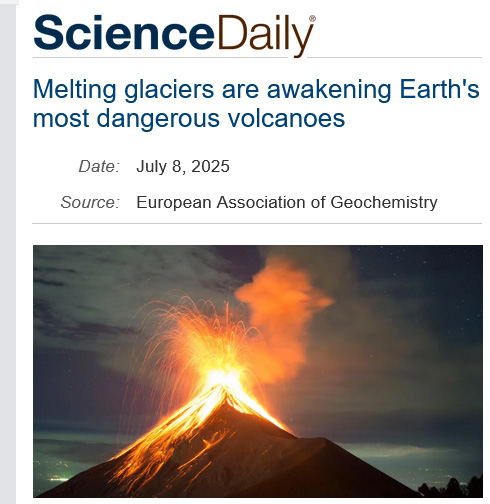
We are about to enter the doom loop where climate change melts glaciers which trigger volcanoes, which melts more glaciers. The press release even says “explosive time bombs”.
Except, of course, this is really about the Great Ice Sheets melting from the last ice age, not about humans raising global temperatures by a thousandth of a degree. And we’ve known about this since 1992 when Sivaldason et al reported that a kilometer thick block of ice slowed down volcanic eruptions in Iceland during the depths of the ice cold climate. The new team have just shown this happened in Chile too.
Scientists have discovered that melting glaciers could unleash powerful volcanic eruptions by removing the weight that keeps magma trapped deep underground. Antarctica may hold hundreds of these explosive time bombs. Melting glaciers may be silently setting the stage for more explosive and frequent volcanic eruptions in the future, according to research on six volcanoes in the Chilean Andes.
After the Patagonian ice sheets melted 12,000 years ago, volcanoes increased two to six fold they say…. as if increasing atmospheric CO2 by 0.01% somehow compares to removing a block of ice that was 1.5 to 2 km thick and weighed 540 trillion metric tons:
“A recent review by scientists found there had been relatively little study on how the climate crisis had been affecting volcanic activity. They said more research was “critically important” in order to be better prepared for the damage caused by volcanic eruptions to people and their livelihoods and for possible climate-volcano feedback loops that could amplify the climate crisis. For example, more extreme rainfall is also expected to increase violent explosive eruptions.”
Should we toss darts at Voodoo dolls?
The witchdoctors of modern science are one-variable thinkers, and every answer is “climate change”.
We don’t even know how many volcanoes there are on Earth. Most volcanoes are underwater and a couple of years ago we found another 19,000 of them that the experts didn’t know about. Sometimes we only find new seamounts when we run into them in a nuclear sub, like the USS San Francisco did in 2005.
We also don’t even know when underwater volcanoes erupt today, let alone whether they were more or less active in 21,000BC. It’s hard to believe, but we can see a volcano explode on Io, easier than we can see one in a deep sea trench. Eruptions under two kilometers of water can be somewhat muted.
The feedback doom loops suggested here are vicarious guesses. Who knows — when the great ice sheets squashed down volcanoes on land, the magma might just have been squeezed out of undersea trenches instead. And underwater eruptions rewrite all the rules. Sudden heating of water might divert ocean currents, it might unleash nutrients that feed vast phytoplankton blooms which in turn emit benzene and toluene aerosols that rise up and increase cloud cover, cooling the world.
*No disrespect intended. There probably weren’t many dumb mammoth hunters in the northern Tundra in an ice age.
Foiled — Coal plants are closing (in theory) in Australia, but all the cheap, free, wind and solar power needs hideously expensive high voltage towers, which aren’t going to be built in time, or maybe ever. Last week the AEMO officially announced there would be a two year delay, throwing a spanner in the transition timeline. Coal plants like Yallourn, are supposed to be closing in 2028, but the Victoria-NSW-Interconnector (VNI) won’t be ready until 2030 now.
It doesn’t matter how much wind or sun falls on outback plains if there is no cable to connect them. The renewables-unreliable industry is worthless without these large pieces of infrastructure, which the farmers detest, and the industry can’t possibly afford to pay for itself.
The organization of the farmers in Victoria is just inspirational — all the paddocks marked in red are the areas farmers have refused access to the VNI project. Give these people a medal.
And now, as the Victorian government presses ahead with legislation to force access onto private property and penalise defiant farmers, the stakes have been raised even higher.
“We’re united on this and we’ll fight them at the farm gate, if that’s what it comes to,’’ said merino breeder Ben Duxson, a sixth-generation farmer from Marnoo in the Wimmera region.
“We’re prepared and we’re organised and, to be honest, there are people out here quite prepared to go to jail for this. They will not be getting access to our land.’’
The Australian has the whole story, and things are starting to get desperate and dark. The farmers on these lands describe the area as intergenerational farms on the best farmland in Australia, and say they can not be bought off. Though rumors are that a desperate Victorian government may offer as much as $460,000 per kilometer for a 100m wide easement. And if that doesn’t work, landholders barring entry may face fines of $12,000 each.
Developers are so desperate they are also offering “near neighbors” up to $40,000 just to smooth things over. Wind turbines are so unpopular, even people next door need some compensation too. No wonder costs are blowing out.
The Victorian government works like the Magic Faraway Tree (but it’s not as much fun). The latest fantasy land has seven “renewable” zones with as many as 5.2 million solar panels, and 1000 wind towers. It would cover as much as 7% of the whole state, though, VicGrid says that’s not so bad because cows and sheep can wander among the towers, or something like that. Presumably they can eat the grass between the solar panels, and sleep under the thump-thump-thump of the blades, not that anyone knows if that affects meat-quality, fertility, or is inherently cruel. It’s just another pointless experiment in a pagan quest to prevent droughts and bad storms in 80 years time.
The proposed transmission lines are totally superfluous. We could use the money to build new coal, gas or nuclear plants near the current transmission lines instead.
Ultimately it’s our money the government and subsidized-renewables-industry is throwing away. We all stand to lose. These farmers are saving Australians vast sums of money and deserve help, beer and postcards. If anyone knows key players, or social media links, please share in the comments.
Scrib Nibit stood on the Centre Bridge in Texas [downstream from Kerrville]. In a condensed footage of a 35 minute period, the first surge arrives. Minutes later the river is a torrent, carrying trees, logs, and finally rising to the bridge level, a house (apparently with a cat). Somehow cars are still crossing as the logs pile up against the railings. They don’t say what happens to the cat. The area is known as Flash Flood alley.
This video of the Guadalupe was shot in Kerrville, Tx from the Center Bridge. Watch how fast these flood waters were traveling & washing everything in front of it out.
It goes from low & barely flowing to over the top of the bridge in around 35 minutes.
I sped the video up to… pic.twitter.com/NcQe4UAQBa
The Blob makes another move to expand their empire
A group of unelected officials in something called the Inter-American Court of Human Rights (IACHR) has decided that humans have the “right” to a stable climate and thus, you have the right to pay for it. The court that nobody has heard of says “states have legal obligations to protect people alive today and future generations from the impacts of climate breakdown.”
This includes the obligation to cut emissions, and to guard against the threat of climate disinformation. (Yes, they know they are lying.)
Personally I’d prefer to have the right to free speech, real science, and laws written in simple English:
There is a human right to a stable climate and states have a duty to protect it, a top court has ruled.
“Top court”, my foot.
Like pagan sorcery, the government is expected to stop storms, floods and droughts. Even though this is an impossible fantasy the mere attempt at managing the illusion of it will employ tens of thousands of lawyers, accountants, technicians, diplomats and representatives who will all get travel allowance and hardship funding for flights to Tahiti. And that’s the whole point isn’t it?
Announcing the publication of a crucial advisory opinion on climate change on Thursday, Nancy Hernández López, president of the inter-American court of human rights (IACHR), said climate change carries “extraordinary risks” that are felt particularly keenly by people who are already vulnerable.
This is a form of meta-lawfare — to get around the problem of a “science debate” they can’t win, some random court makes a ruling that simply assumes that governments can control the weather, and that speaking against it is going to harm “the vulnerable” (which really means it will hurt lifelong career grifters.) This toothless unaccountable court is a legal theatre that generates headlines, pressure, and ammunition for lawyers in more important courts to try to glue this kind of parasite into proper court rulings. They will cite this absurd legalese fantasy to baffle anyone who gets in their way, and to wind up teenage girls and journalists in The Guardian:
In the strongly worded and wide-ranging 300-page document setting out its perspective on the climate emergency and human rights, the court says states have legal obligations to protect people alive today and future generations from the impacts of climate breakdown. That includes taking “urgent and effective” actions to cut greenhouse gas emissions based on the best available science, to adapt, to cooperate internationally, and to guard against the threat of climate disinformation.
The IACHR’s founding purpose is to interpret and apply the American convention on human rights, a treaty ratified by members of the Organization of American States (OAS). But its newly published opinion takes into account a broad range of national, regional and international laws and principles. And it affirms that the findings not just apply only to signatories of the convention but to all 35 members of the OAS, which includes the US and Canada.
So who funds these unaccountable Judges?
This human rights court is a part of the Organization of American States or OAS — it’s a kind of American continent mini-UN. There are 35 states signed up to it, whatever that means, but traditionally the US pays 60% of the regular funds (stop me if you’ve heard this before). Lately, other extra funding is volunteered from a Who’s Who of Globalist Blob entities like the UN, EU, World Bank and George Soros’s Open Society. Every part of the Blob loves every other part…
Presumably Donald Trump is busy with other things, but he has called for a review of the $60 odd million in funding the US government sends towards this rusted on Blobocracy which was created in 1948. This is $60 million in “free” fundraising money for the One World Government Blob. Let’s just say “No”.
If the climate really faces a crisis, more than anything else, we have the right to real science with real debate; not petty namecalling like “climate denier”, or censorious laws about “climate disinformation”.
Citizens have a right to be protected from The Blob.
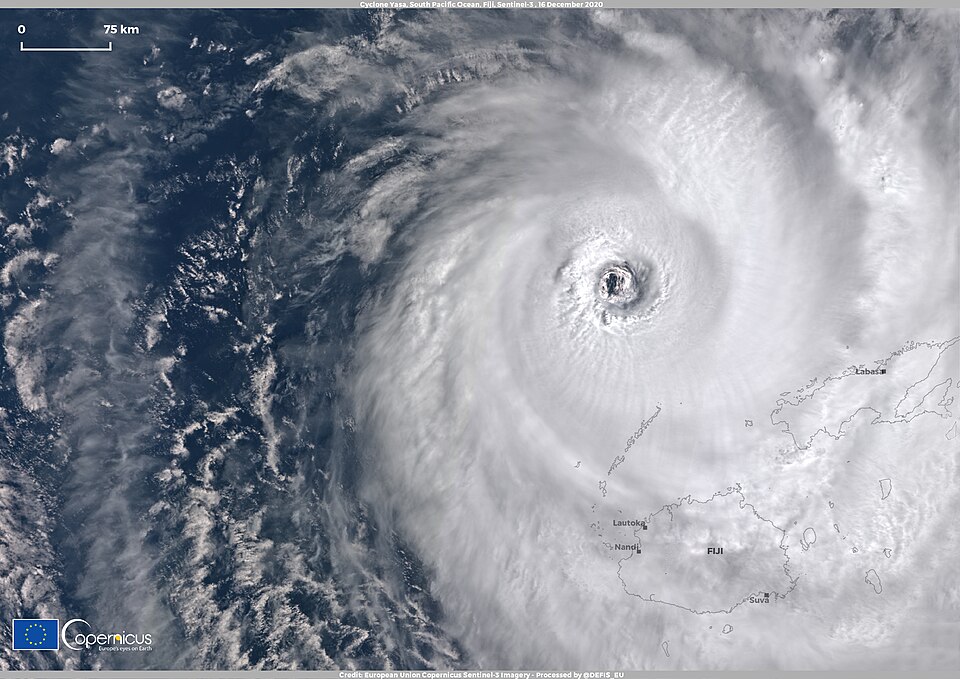
Cyclone Yasa, Fiji | Photo from Copernicus Sentinel-3 imagery
By Jo Nova
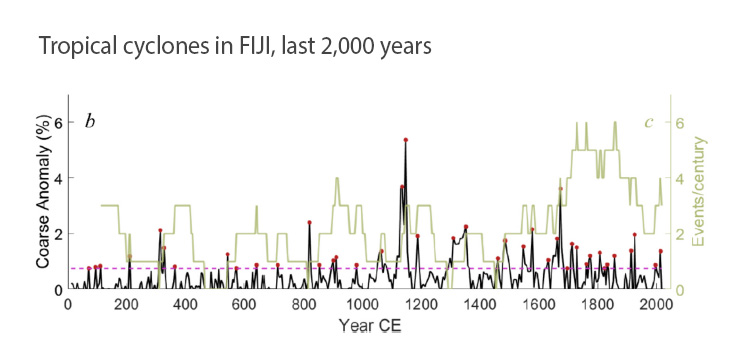
The worst 53 cyclones that hit Fiji in the last 2,000 years were more common in the coldest times, not the warmest ones.
We are told cyclones and extreme storms will be more intense in a warmer world, will have stronger wind speeds, may retain their strength longer and do more damage, our homes will be uninsurable, and this is the new normal. But the evidence continues to grow that warm times are wonderful, and the last thing we want is a colder climate.
There aren’t many long records of cyclones in the South Pacific, which hasn’t stopped climate experts blaming cars and burgers for horrible storms. But even though life on Earth depends upon understanding our climate, it’s only now, after 40 years of panic, that finally that researchers have studied things like pebble layers, shell fragments, and coral rubble in Fiji to find out what has happened there in the past. Yanan Li and others drilled cores to find debris pushed 120m into the mangroves by the worst of the worst tropical cyclones. Handily, they also had two bad storms recorded in the last century to calibrate what they found.
Awkwardly, the big storms were more common in the Little Ice Age. Basically, if we want fewer storms we should pay people to burn oil and gas, or at least give them a taxable discount for saving the world.*
All those layers of rocks and shells and whatnot have been sitting there in the mud flats the whole time that the UN has been trying to save the world from “climate change”:
Fig 3: The course anomaly (%) means the percentage of coarse particles in that layer that are > 63 micrometer. The sediment core they dug is in protected mudflats in mangroves that are 120m above the current high tide line. Storms surges rarely go that far. “Events” means only major Cat 4-5 strength cyclones/hurricanes per century. Obviously only the biggest storms (and presumably near direct hits) would leave sediments there. Some of the particles they found were > 1cm. Fiji gets a few named cyclones every year. But these won’t have the energy to overtop the reef, break through mangroves, and carry sand and shells 120m inland.
Instead of cyclones being driven by one kindergarten variable like sea-surface temperatures (or more stupidly, global temperatures), it turns out that wind shear, humidity, local weather patterns, and things like La Nina conditions are probably a lot more important. If climate modelers had even the faintest clue of what drives the Pacific Decadal Oscillation, we could pretend to reduce storms by reducing La Nina conditions.
Until then, any journalist claiming that extreme storms are the new-normal should be roasted for promoting misinformation, or just being a gormless mouthpiece for bankers, bureaucrats and The Blob.
In this paper, we present a sedimentary record from a coastal karst basin in Bay of Islands, Vanua Balavu, Fiji to provide insight into the regional intense TC activity over the past two millennia. A total of 53 intense storm events captured by this site are identified using coarse fraction (>63 μm) anomalies in sediment core retrieved from the basin, yielding an overall average event frequency of 2.6 events/century. Multiple centennial-scale quiescent periods (from 200 to 300 CE and 1000 to 1150 CE) and active periods (namely from 350 to 750 CE, 900 to 1000 CE, 1150 to 1250 CE, 1400 to 1500 CE, and 1650 to 2017 CE) are found in the reconstruction, and the most active interval spans from 1650 to 1800 CE at 4.5 events/century.
Big storms appear to be less frequent in the medieval warm period too.
A comparison between existing paleostorm records and climate forcing indices suggests that the southward displacement of the South Pacific Convergence Zone (SPCZ) during the Little Ice Age with more La Niña events is responsible for the basin-wide increasing of tropical cyclone activity in the South Pacific. Decline of TC occurrence in the western SP during the Medieval Climate Anomaly is attributed to the northward movement of SPCZ.
*Obviously, we wouldn’t pay people much to emit CO2 because it wouldn’t save us from the next Little Ice Age anyhow, but it will make plants grow, and that’s worth something.
REFERENCES
Yanan Li et al (2025) Intense tropical cyclone activity over the past 2000 years at Bay of Islands, Fiji, Palaeogeography, Palaeoclimatology, Palaeoecology, Volume 675, 1 October 2025, 113090, https://doi.org/10.1016/j.palaeo.2025.113090
Haig, J., Nott, J. and Reichart, G. (2014) Australian tropical cyclone activity lower than at any time over the past 550–1,500 years, Nature 505, 667–671 doi:10.1038/nature12882 [Abstract]
Roose, S., Ajayamohan, R.S., Ray, P. et al. Pacific decadal oscillation causes fewer near-equatorial cyclones in the North Indian Ocean. Nat Commun14, 5099 (2023). https://doi.org/10.1038/s41467-023-40642-x
We use cookies to ensure that we give you the best experience on our website. If you continue to use this site we will assume that you are happy with it.















Recent Comments