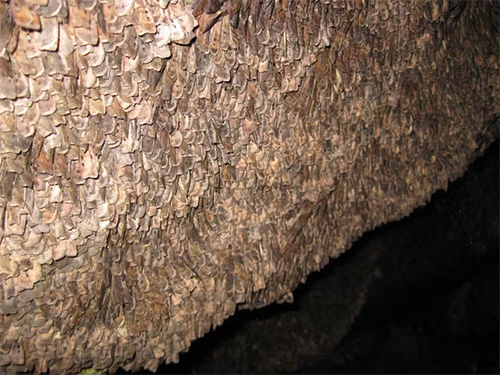
Bogong moths resting in caves in the Snowy Mountains. Photo by Eric Warrant. The Conversation.
By Jo Nova
First insects to use the stars to navigate?
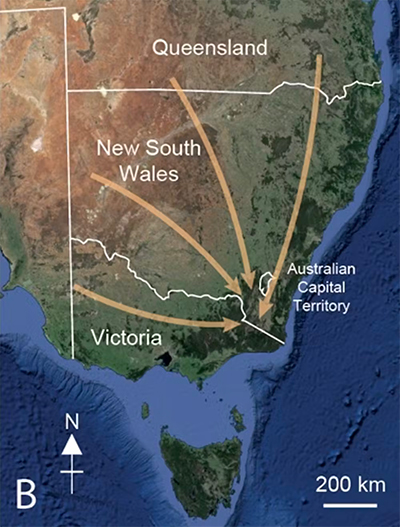
Flight paths of Bobong moths. | The Conversation.
Each year thousands of Bogong moths hatch all over Eastern Australia. Somehow they fly 1,000 kilometers to caves in the Snowy Mountains that they have never seen. Once inside, they hang around and do an insect form of hibernation in the cool Alpine caves through the heat of summer. When autumn comes, they fly 1,000 kilometers back to where they came from so they can breed, and keel over. Next year their children make the exact same trip.
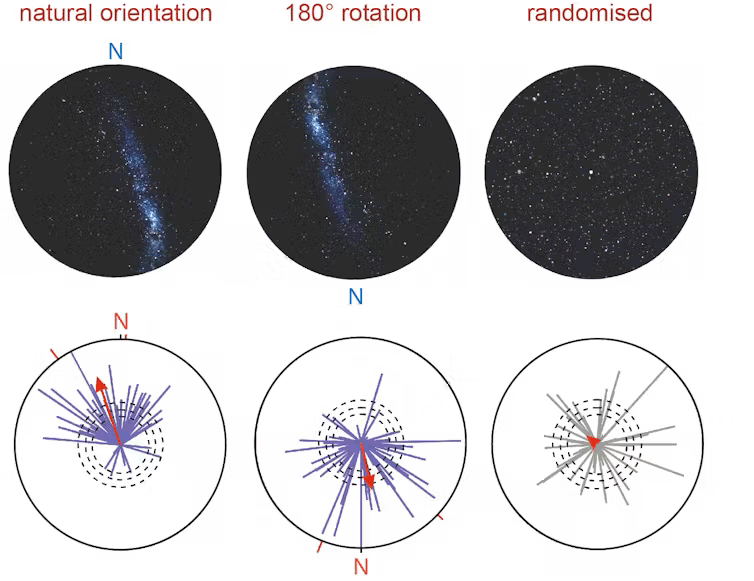
Researchers managed to catch some moths and put them in flight simulators (for real) where Earths magnetic field was neutralized, so they could figure out if the moths could navigate without it. Somehow they “tethered” the moths, and showed them night sky and lo’, behold, the moths still tried to fly in the right direction. When the sky was flipped, the moths reversed course, and when the stars were randomized, the moths were confused.
Ponder that the stars revolve through the night, the moon comes and goes, and the constellations change with the seasons. Somehow an insect with a brain a tenth of the size of a-grain-of-rice was able to fly straight through the night as the night stars revolved around them. They were not fooled by the moon. And, they weren’t following other moths that knew the way. Months later they could reverse that path and fly back through different seasonal star patterns to get to where they started. Freaky weird stuff.
Somehow they were born knowing how to find caves 1,000 kilometers away. The trip was, apparently, hard-coded in their genes. It’s pretty wild…
Which raises tricky questions about what other complex behaviours might be hard-coded in our own genes that we don’t know about?
Eric Warrant. The Conversation. https://theconversation.com/
Migrating bogong moths use the stars and Earth’s magnetic field to find ancestral summer caves each year
Eric Warrant, The Conversation
First we light-trapped bogong moths that were either migrating towards the Alps in spring or away again in autumn. We next placed them in a special flight arena inside the lab, and finely controlled Earth’s magnetic field (with magnetic coils around the arena) and the starry night sky (by projecting a highly realistic starry night sky on the roof of the arena).
Because we already knew bogong moths have a magnetic sense, we used the coils to completely remove, or null, the magnetic field in the arena.
What we found next astounded us. Using only the local Australian starry night sky projected above them, bogong moths flying in our arena were able to discern and follow their inherited migratory direction – both in spring and in autumn.
If we turned this projected sky by 180°, the moths turned and flew in exactly the opposite direction. If we then took all of the stars in this projected natural sky and randomly distributed them across the roof of the arena, the moths became completely confused and lost their ability to migrate in their inherited migratory direction.
The moths can also use the Earth’s magnetic field, so when nights are cloudy they can still navigate. The thinking is that moths have to escape the heat of summer in the outback, so they must find those caves. Presumably, they started, eons ago, living in the mountains near the caves and then gradually expanded their territory to the north and west until they were flying 1,000 kilometers away to breed.
It goes without saying that having survived five or ten million years of ice-ages, droughts, and asteroids, the Bogong Moth is now *threatened* by man-made CO2 (of course). Like all good university research projects are.
h/t Willie Soon.
REFERENCE
Dreyer, D., Adden, A., Chen, H. et al. Bogong moths use a stellar compass for long-distance navigation at night. Nature (2025). https://doi.org/10.1038/s41586-025-09135-3






Absolutely amazing.
Each year, here on the coast we can see the wonderful spectacle of whale “migration”: alternately moving away from the cold waters of the south and later returning to their summer home.
The logic there is easy to follow, but bogongs, this story is on another level entirely.
Worth researching.
310
Imagine the microminimization of their little sextants!
10
With so much science that’s settled, we’re very lucky when we get some new science.
300
Yet without the threat of ‘extinction by carbon’ [sic] this project would have been mothballed before it even took wing.
😃
260
And we all know what you have if you’re holding a mothball in one hand and a mothball in the other, don’t we?
50
A very large, angry moth?
30
Is it though? New science?
We’ve been told for some time that the indigenous are our first scientists. Could it be they followed the bogon moth and the whale migrations as an indicator of seasonal change?
We already know that the indigenous, when doing their own migrating, set fire to the bush so it would regenerate food plants for the following year.
34
Real science, not climate “science”.
Unfortunately it’s hard to fund real science.
230
Hard to fund. Certainly hard to find.
00
The eels in our dam are born somewhere in the Pacific Ocean around Nauru then swim to the Hopkins River near Warrnambool then up two tributary creeks. In the places where there is no water they wriggle overland to the next waterhole. They grow then return to where they were born to breed.
300
Are they short finned or long finned Eels?
50
And something even more remarkable than that is how certain parasites completely alter the behaviour of their host.
For example, toxiplasma gondii which reduces a rodent’s fear of cats with unknown effects in humans.
Ophiocordyceps unilateralis fungus which causes ants to climb blades of grass and clamp down with their mandibles to fix themselves there while the parasite grows.
Horsehair worms which make grasshoppers and crickets jump into water after which the worm exits the host. There are some stomach-churning videos of this on YouTube. The worms are huge compared to the size of the host.
Rabies which makes the host become aggressive and salivate and bite others to spread the virus.
The trematode which infects eye stalks of snails and which moves in a pulsating manner making the snail and parasite attractive to be eaten by birds.
Being infected by intestinal parasites was the norm in humans. Interestingly, now that humans in Western countries are mostly parasite-free, it’s thought there are more autoimmune diseases. Some people are even buying parasite eggs online and ingesting them in order to moderate their immune systems to treat such diseases.
290
Are you intimidating that politicians who advocate Net Zero are creatures with tiny brains infected by parasites?
Does make me wonder.
250
No. No. No. Yes.
180
Gotta love the Vicar of Dibley.
110
Here is a study of the Bogong moth brain:
90
Brain studies and starlight, a funding application.
I have a theory, in a darkened room, if you shine a low wattage bulb into the ear of a green/labor voter, a star pattern will be projected from the other ear, this pattern can be projected and an image formed. If you align that star pattern against the night sky you can find out if the elector is slightly left leaning or full on.
When the pattern is unclear, you can replace the light source with a 10W laser, this typically results in a pole star pattern which shows up near the rooms horizon. An interesting, although limiting phenomenon.
Do I get a grant now?
340
Do you mean something like this.
https://4.bp.blogspot.com/_Vk2ir6UMOjY/TGVSiT1OF_I/AAAAAAAAB6M/IJ_xktBZubs/s640/funny-ads-dogfood-1.jpg
130
More likely the moths numbers reduced due to being sliced up by wind turbine blades. Or blinded by solar panels. Perhaps even mashed on the windscreen of a Tesla, because they are quieter than ICE vehicles. My theories are just as scientifically sound as this one.
220
They’re also likely deafened as well by the incessant wailing & gnashing of teeth, ie. a most horrible noise, emitted by Wokerati Groupthink Inc.
Save Moths From Greenies NOW!
(do furry lil moths even have ears?).
110
They are named as “Bogongs” because of the sound emitted when hitting a 4WD vehicle or truck.
60
The bogong moth has an essentially N-S (and S-N) migratory pattern to alternate between seasons, as it is a cold climate invertebrate. The experiment described in the description here is interesting. Provides good empirical evidence (not for the CO2 bilge).
During actual migrations, occasional “out-of-season” westerly winds sweep the moth packs easterly off course. This results in Sydney and environs being inundated with these insects. Thousands hanging around street lights at night and so on …
Amongst many other migratory insect species, this happens to winged termite species as well. Many thousands becoming entombed in our air conditioners in summer …
Contemplating the opportunism of the uncountable number of evolutionary processes, random but so effective, is as close as I come to awe. Not religious, but the awe of deep time. If you dwell on it, well as my then young daughter said when I first outlined this to her: “My head hurts”.
100
An instinct is an inherited body of expert knowledge. Having done a lot of research I have about 30,000 words on this thesis here:
“Horse Cognition (and other critters)”
https://horsecognition.blogspot.com/
To my knowledge there is no research on how bodies of expert knowledge can be inherited. A new science?
102
My research approach is to consider what capabilities an AI robot would have to have in order to successfully emulate the critter’s behavior. Lots of examples.
61
Moths are smarter than your average Labor Polly.
160
First, a quibble:
They’re born? “Hatch”, maybe; or “emerge from the cocoon”?
More importantly, we shouldn’t discuss how smart moths are without reviewing Max Headroom’s take on moths.
40
Fair point. Changed to “hatch”. Thanks.
20
Isn’t a female moth called a “myth”?
130
What will they think of Next?
I took a look at the flight path diagrams and they did not seem very precise. Although there was a sort of mean line going North, most of the moths were way off track. So I thought I might take a look at the original article in The Conversation, and there, horror of horrors, and right in my face was a promotional message from the Editor, Misha Ketchell, asking for money!
That is very cheeky of Misha, given the misinformation he has published about Climate Change and Vaccines. It would be nice to think that they really can’t do without me and that by keeping my purse tightly closed I could bring The Conversation to an end, but sadly I think they will barely notice.
160
It’s a bit rude of them asking for money when the Australian taxpayer has already been extremely generous.
From Goolag AI:
And Grok says:
So a lot of taxpayer funding is not disclosed as it comes from Universities or other taxpayer-funded institutions.
Tell Misha to go fly a kite.
200
I know this is breaking world news since the work was published in Nature, but there were also other reports of this in earlier phases of the work.
50
Hilarious.
30
Pleasing to see no one shouting, “what a waste of money, who is this going to help”.
A nice multinational collaboration. There are animal behaviour, evol and devo biology international collaborative projects (on-going or in planning) in Australia now that are either on hold, cancelled or being renegotiated with European and Asian partners due to the whims of a patriotic ideology.
017
Edit. Title makes us think this is the first invertebrate to do this rather than the first study showing it.
[Yeah. Fair point. I added the word “found”. Thanks. — Jo]
21
I’m curious. Why would you say “Pleasing to see no one shouting, “what a waste of money, who is this going to help”.”
Is it because after nearly 14 years and 13,000 comments you still don’t understand skeptics? That’s kinda embarrassing.
Here’s your beginners kit: we want to stop corruption and fraud in science, and see the data. You call that “patriotic ideology” (it’s pretty absurd, eh?), does it make you feel better about being on the same side as the grift and graft?
150
Was that really Gee Ayes’ very first comment in the blog? And 13000 more since then.
13000 comments would be a notable contribution if the comments were informative, but that has rarely been the case.
[This might be Gee Aye’s first. Can’t be 100% certain. https://joannenova.com.au/2011/07/climate-change-suspect-must-be-given-a-fair-trial/#comment-415068
Comment #429 – Raquel ]
[It is indeed the first mention of Gee Aye on the blog. August 2011. It’s a long time. – Jo]
20
Does Gee Aye get paid by his university to write his comments here?
40
A real science project like this reminds us of the staggering waste and misdirection of scientific resources which are being spent on the climate change scam and not on more purely academic projects like this one or on practical projects to improve humankind.
It’s easy to get funded for “climate” projects since they’re not about science but politics but try and get funding for purely academic or applied science or indeed anything not in conformity with the Official Narrative on climate or covid and you will have trouble. And if not in conformity with the Official Narrative you might also find it impossible to get published or you might even be sacked/fired.
I think the researchers of this purely scholarly project have done well getting funding for it since it’s not woke and doesn’t involve climate or covid.
90
you don’t know much about science funding do you?
014
Unfortunately, most of us Do.
That’s why I drink.
100
I recall, when involved in the development of a new landscape design course at a certain Victorian looniversity, that it was suggested at a meeting that we should include the word ‘sustainable’ in the course title. This, I was told , would help ensure funding. Surprise, surprise.
150
WHAT A WASTE OF MONEY, WHO IS THIS GOING TO HELP. Happy now? ( meant to be reply to #16
60
Many years ago wasn’t there a website with a title something like “800 Things Caused by Global Warming”? It listed references to papers which linked all sorts of phenomena with global warming most of which probably had little or nothing to do with it. The authors seemed to be scientists carrying out normal research in their own fields but who had to mention global warming because they had mentioned it in their grant applications. Unfortunately I could not find that website on the Way Back machine.
30
Peter C,
That same Misha Ketchell from The Conversation bestowed on me the honour of being the first scientist in the world to have his/her account blocked permanently. Misha even resorted to that time-worn tactic of writing to me that “No further communication with be entered into”. (A journal controller using a misplaced proposition? Bad grammar. Quel horreur!).
Now, The Conversation received taxpayer funding money. Possibly it continues to receive such funds. Mischa’s act is an example of a non-elected person censoring some use of public money. That is illegal.
However, the overall effect of my permanent ban has been a benefit because it saves me the effort of reading The Con. I have therefore directed my creative juices to publications of higher demonstrated quality. Geoff S
140
Geoff, sorry, I went soft because this looks like real science, and actually used the brand-name “the Conversation” for the first time in six years.
Since they kicked off skeptics in 2019 I have only called them “The Conversion”. But that seemed a bit petty given the extraordinary topic…
60
How long before we get the wonderous beauty of Bogon moths tainted by the climate change religion?
20
It’s quite possible, especially in the exceptionally clear skies of Australia and the brightness of the milky way rather than one star. I wonder exactly how they recreate the environment of the flying moth.
And I wonder also that the researchers are analysing from a very human perspective, emphasising sight alone, a human trait. The great sense which other animals and insects have which can be 1000x as strong as with humans is smell. Especially at night. Each area has a unique smell and this can relate to water, plants, rotting, minerals. Plants adaptions attract with emphasis on both colour or sight and smell.
It may be that each moth pathway is also a scent trail which can be travelled in both directions and might explain why they go where they do. Which would minimize the need for extraordinary inherited memory and complex calculation logic. A path can also coincide with seasonal food, the great impetus behind all migrations. And with seasons. It can also be coincident with reproduction cycles as solitary animals, insects and birds have an essential need to congregate, reproduce and share genes.
But this soft of study is really good fun. It confirms Darwin’s basic premise of evolution that selection over millions of generations can produce extraordinary abilities and adaptions. And also explains why most species on earth have vanished as genes adapt along with changes including ice ages. And makes a mockery of current human attempt to stop all changes. Especially the government endorsed megalomania called Climate Change, a massively expensive plan to stop human evolution at the year 2005.
110
Are they following the ” brightness of the milky way rather than one star.”
They discussed that in the paper, but pointed out that the moon — as a single point of brightness — would overwhelm a simple system like that.
But yes, I presume the moths only moved a few hundred meters to find the caves a few million years ago, then some adventurous moths found rich niches a kilometer away, and the ones that went further and found their way back to the caves kept being selected over the ones that got lost…
It’s just so remarkable what a neural net can do after 5 million experiments with a billion moths each year.
This is what chills me when we set up AI to do billions of experiments. The computing power is so vastly, enormously big compared to a moth brain.
60
My idea was, inspired by your photo, that brightness itself is not the point. And the moon is not in any image. But the milky way actually gives an arrow, a line, maybe real direction at any time where a point does not and it is stationary in the firmament, like all stars. I remember studying astronomy from a rooftop in Melbourne with a big refracting telescope. It was near useless. But in the country even 100km away, you have a different crystal clear sky. We lack a near stationary star at the pole, unlike the Northern Hemisphere. And the moon while close to the ecliptic and very clear is highly variable as a guide. But without cloud cover, the stars are more useful and the moon is missing half the time.
As for AI, it is happening. And makes nonsense of intelligence tests. But we are not even close to original thinking yet. I know AI is already an accomplished liar, even creating fake references and tells you what you want to hear. The real question is at what scary point does it start to have a mind? And will it become malicious? Or more exactly, when?
40
TdeF, living on the Australian south coast (more or less) what is this “without cloud cover” you write about. Other than in summer daytime perhaps.
10
Jo
I have just finished reading
Forrest M. Mims III “”Maverick Scientist: my adventures as an amateur scientist”
And interestingly, in his section “The Compass in the Sky”
“After sunset one evening during my visitto Fairbanks, AlAska I hiked to a nearby lake and watched geese taking off for their fall migration. I pot on apair of polarised sunglasses andsaw that the geese were flying perfectly parallel with the compass in the sky. The sun had set at 237 degrees south west, which meant the sky compass was pointed at the western US”.
20
That’s it. Physical prompts, the idea of genetic programming is a bit far out.
10
Yes, but knowing to do so is genetic.
10
I think some birds that navigate at night by the stars were using the point it rotated around.
So they need a set of neurons that map the rotation and keep track of that point. Then they need another set of neurons that aim for that point at a certain angle in their vision to keep them pointed in the right line.
Apparently moth eyes are very small and not that good, which makes it all the more improbable.
10
More on “The compass in the sky” – of which I’d never heard.
“Following the Light of the Sky”
https://www.polarization.com/compass/compass.html
Used by bees
https://www.polarization.com/bees/bees.html
20
Meanwhile the average politician’s brain weighs 1.4kg, can’t understand the path to net zero ends at a cliff, the direction always follows the money, doesn’t know how to reverse course, and seeks to do its work in the dark, unseen by all.
Truthful jokes aside, nature is truly weird and wonderful and we understand so little.
/black monolith 😎
As for celestial body derived navigation, possibly.
Magnetic fields, the angle of the sun, moonlight orientation, internal clocks (humans have one), scent trails that can cover thousands of km, polarised light, infrasound, landmark memory, ocean currents, salinity, pheromone markers, temperature & light patterns. They’re ones we know of.
We’re at the beginning of our journey of knowledge and the laws of physics still can’t explain a lot, so maybe navigation by still more methods is possible.
Quantum effect navigation anyone?
130
That’s got it JC.
00
Saw a doco many years ago about a desert spider that goes out at night and wanders many metres from its home, in all sorts of directions. When it decides it wants to go home it makes a straight line back to its house.
I think one of the claims was that it can travel as far as a kilometre and still bee-line home.
But even if it’s only 100m, how does a little creature know its base so precisely it can derive the straight vector home after all its wandering, without retracing its steps. Across all sorts of uneven terrain.
A quick google and maybe this is it.
Dancing White Lady Spider.
https://www.researchgate.net/publication/201998213_Long-distance_wandering_and_mating_by_the_Dancing_White_Lady_Spider_Leucorchestris_arenicola_Araneae_Sparassidae_across_Namib_dunes
20
More mud slinging at science without evidence, the mo of the amateur.
Keep it up Jo, it entrenches you in blogsville.
020
A gurgle from the evidence free sewer.
150
You’re the ones making incredible assertions against the global scientific community .
The burden lies with you.
015
More like a belch of noxious sewer gas from liberal mummy’s basement.
But it’s amusing to look down from above on their kind. It does give one a sense of broad spectrum superiority, while we wait for captain sewer fart to present a single fact.
100
JC
For a lot of facts just look at any scientific institution, try the CSIRO for a start.
But you would, of course, declare it all corrupt, woke, conspiratorial, etc, all without evidence.
So what would you replace the scientific method with?, the Jo method ?, who would review Jo ?.
06
>scientific institution
>scientific method
Pick one.
10
I had 3 “interactions” with the CSIRO in my working life. Let me say I wasn’t impressed.
The NEW Production method for resins was setup in our laboratory and worked for less than 20 seconds when it stopped working. Obviously they had never tried running it in their laboratory.
And a long gone colleague got a temporary job as a cleaner in the CSIRO Laboratories. After hours for more money.
He came back wondering “how they got away with it”. As a fully qualified (and experienced) chemist he was shown a “running experiment’ by one of their patronising PhDs who pointed out that the stuff sturring in the flask changed colour when something was added to it. This was the experiment shown to politicians and bureaucrats on a visit. (think water with a dash of phenolphthalein as some sodium hydroxide solution was added)..
50
Wow, anecdotal experience trumps science, the norm for what skeptics use for evidence.
At least the standards are consistent.
05
So, you are completely unable to do what you ask others to do? Provide data from “any scientific institution”?
Why is that?
Just one will do.
What about the facts that have been presented from “any scientific institution” places backing post claims?
How are they suddenly invalid when they meet your criteria?
Run along kid.
Adults are talking.
10
JC
I just directed you to the CSIRO , please read.
Cherry picked posts are the antithesis of science.
This is why Jo can’t publish anything.
The burden is heavily on you.
04
Come on guys. Someone left the gate open and he’s got out again. You must be more careful.
130
Esra, Miasma presumably doesn’t realize how they help the site with this kind of inane, random, bingo-card type insult.
I mean, if this is the best that money can buy, it really says something about how pathetically weak their case is.
Shh. Don’t tell them.
110
Hi Jo, well the posts are a good lesson in how to be inanely obtuse.
20
Obtuse is OK Esra, but whatever you do, don’t go backwards.
10
don’t go backwards.
But heating my house by burning my own firewood is cheaper than paying the WA government for the equivalent heating powered by electricity?
20
I agree derfzo.
30
“Which raises tricky questions about what other complex behaviours might be hard-coded in our own genes that we don’t know about?”
This could explain the illogical climate alarmist behaviour in our human populations, caused by a defect in these hard coded genes. If only these people had wings, then they would all fly south to Antarctica in a Darwinian exercise of genetic cleansing.
80
Sorry. I did forget the reference:
Dreyer, D., Adden, A., Chen, H. et al.Bogong moths use a stellar compass for long-distance navigation at night. Nature (2025). https://doi.org/10.1038/s41586-025-09135-3
50
Asking why you can’t provide evidence to the scientific community isn’t random, it’s what scientists have to do.
But because you have a biology degree ( irrelevant authority alert ), you know better and is why you hide in the shadows .
06
No doubt we can expect “The Wisdom of M” will be applied to #20.1.2 then?
20
Miasma, who is hiding on a public blog with public comments? (Mr Anon?)
I did not realize I was able to vaporize NASA data and peer reviewed references just by talking about them. Can everyone with molecular biology degree do that, or is it just me?
10
Maybe the disappearance of Lake Bogong under 80’s SE Qld flood plain residential development is part of the story – the only trace I can find is a Lake Bogong Ct in Logan:
https://maps.app.goo.gl/WnykwPCe4Ai4m4n67
20
I was on google maps looking for a park in Logan that has a statue of a Bogong in it (a modern art interpretation, all curves, not realistic) – I saw it about 20 years ago, but cannot for the life of me remember which park we were in.
All I can remember is that I found it funny as we all know that the Bogans come from Logan…
20
FWIW – for the covid record
“FORMER VACCINE COMMITTEE DID NOT FOLLOW THE RULES”
https://richardsonpost.com/james-lyons-weiler/39962/former-vaccine-committee-did-not-follow-the-rules/
20