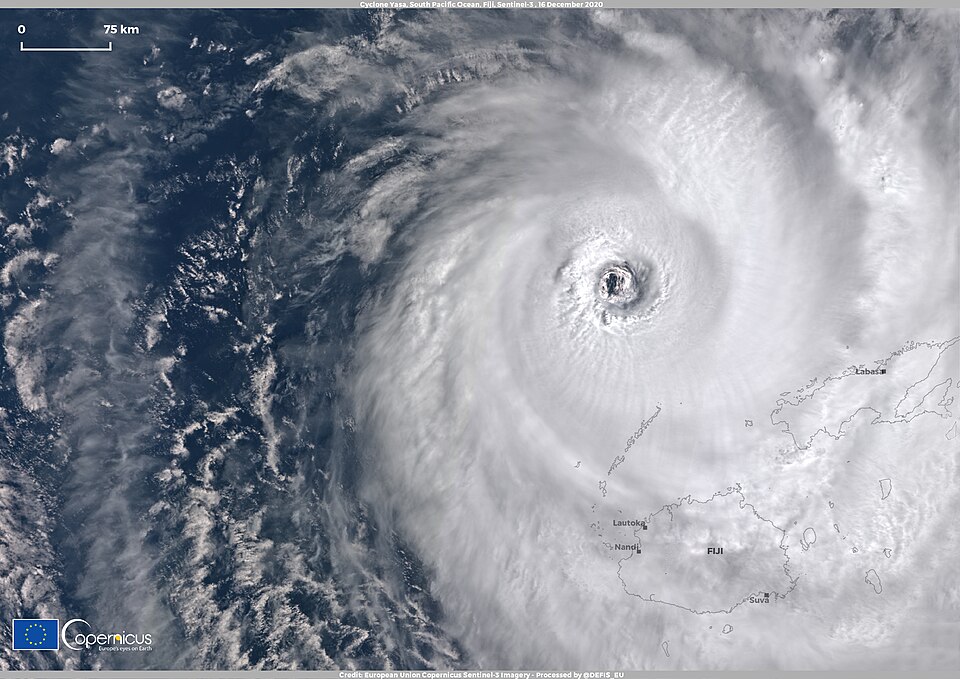
Cyclone Yasa, Fiji | Photo from Copernicus Sentinel-3 imagery
By Jo Nova
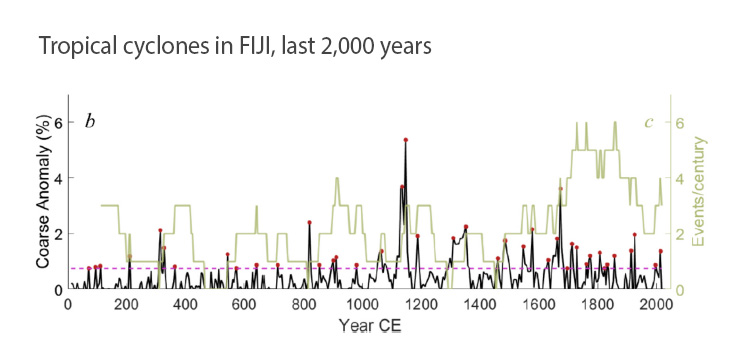
The worst 53 cyclones that hit Fiji in the last 2,000 years were more common in the coldest times, not the warmest ones.
We are told cyclones and extreme storms will be more intense in a warmer world, will have stronger wind speeds, may retain their strength longer and do more damage, our homes will be uninsurable, and this is the new normal. But the evidence continues to grow that warm times are wonderful, and the last thing we want is a colder climate.
There aren’t many long records of cyclones in the South Pacific, which hasn’t stopped climate experts blaming cars and burgers for horrible storms. But even though life on Earth depends upon understanding our climate, it’s only now, after 40 years of panic, that finally that researchers have studied things like pebble layers, shell fragments, and coral rubble in Fiji to find out what has happened there in the past. Yanan Li and others drilled cores to find debris pushed 120m into the mangroves by the worst of the worst tropical cyclones. Handily, they also had two bad storms recorded in the last century to calibrate what they found.
Awkwardly, the big storms were more common in the Little Ice Age. Basically, if we want fewer storms we should pay people to burn oil and gas, or at least give them a taxable discount for saving the world.*
All those layers of rocks and shells and whatnot have been sitting there in the mud flats the whole time that the UN has been trying to save the world from “climate change”:
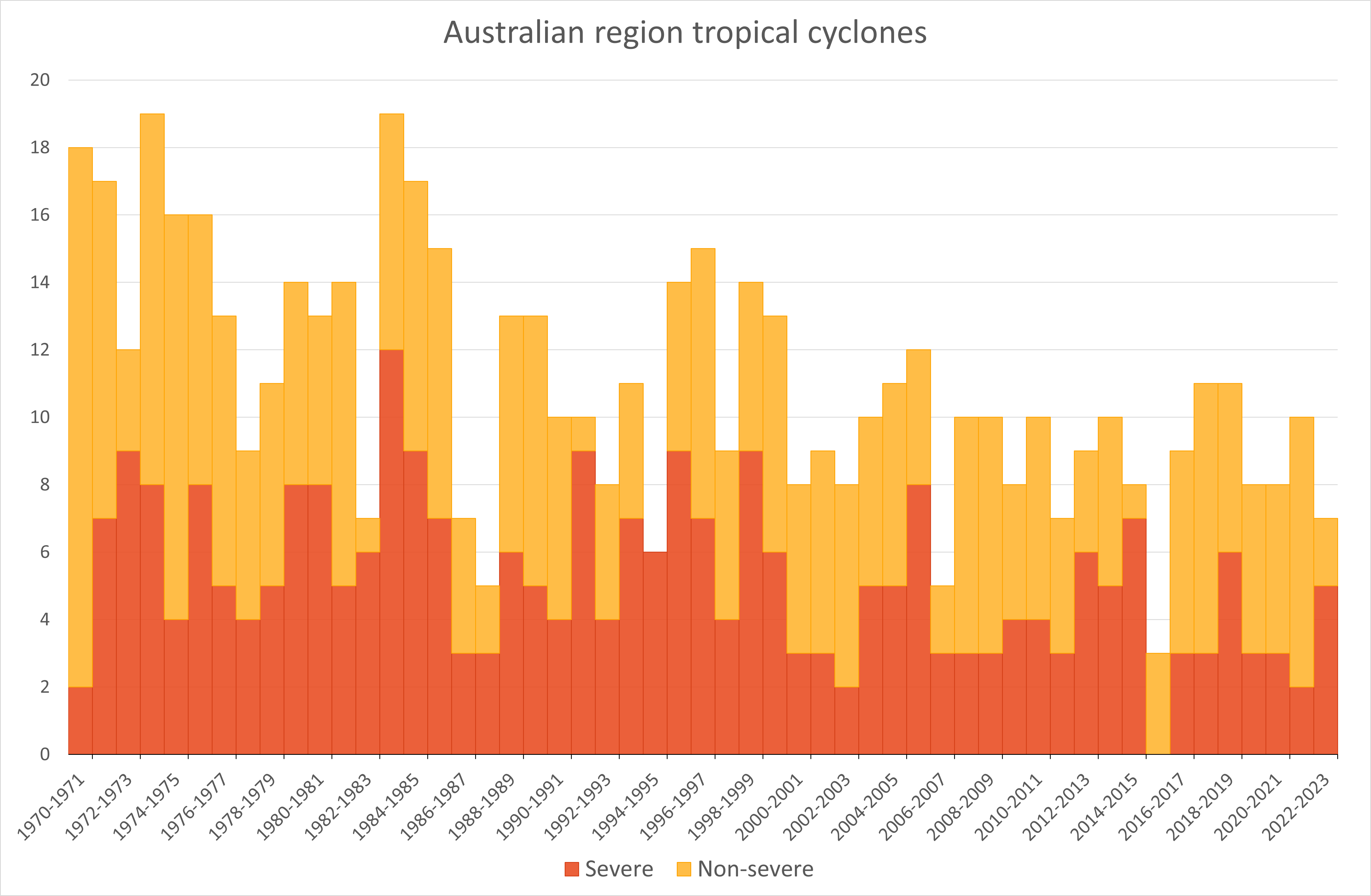
These results also match what researchers in Australian found (Haig, Nott and Reichart). Likewise other researchers, looking at the Indian Ocean found cyclones have been decreasing as the world warmed in the last 70 years, which is also true in Australia since 1970.
Instead of cyclones being driven by one kindergarten variable like sea-surface temperatures (or more stupidly, global temperatures), it turns out that wind shear, humidity, local weather patterns, and things like La Nina conditions are probably a lot more important. If climate modelers had even the faintest clue of what drives the Pacific Decadal Oscillation, we could pretend to reduce storms by reducing La Nina conditions.
Until then, any journalist claiming that extreme storms are the new-normal should be roasted for promoting misinformation, or just being a gormless mouthpiece for bankers, bureaucrats and The Blob.
Intense tropical cyclone activity over the past 2000 years at Bay of Islands, Fiji
Yanan Li et al…
*Obviously, we wouldn’t pay people much to emit CO2 because it wouldn’t save us from the next Little Ice Age anyhow, but it will make plants grow, and that’s worth something.
REFERENCES
Yanan Li et al (2025) Intense tropical cyclone activity over the past 2000 years at Bay of Islands, Fiji, Palaeogeography, Palaeoclimatology, Palaeoecology, Volume 675, 1 October 2025, 113090, https://doi.org/10.1016/j.palaeo.2025.113090
Haig, J., Nott, J. and Reichart, G. (2014) Australian tropical cyclone activity lower than at any time over the past 550–1,500 years, Nature 505, 667–671 doi:10.1038/nature12882 [Abstract]
Roose, S., Ajayamohan, R.S., Ray, P. et al. Pacific decadal oscillation causes fewer near-equatorial cyclones in the North Indian Ocean. Nat Commun 14, 5099 (2023). https://doi.org/10.1038/s41467-023-40642-x