Poor McCartney tries to write a rebel saviour song. Instead he captures the blind mystification of a protected class living in a bubble who have no idea that millions of people are rebelling against the bully thought police and their demands for hero-status and money. Half the population of the West see through the modern witchdoctors who get every prediction wrong.
McCartney’s genius solution? “Lock him up”
Spot the irony, apparently Trump should have listened to “the will of the people”? What exactly does McCartney think 60 million people voted for?
The captains crazy but he doesn’t let them know it.
He’ll take us with him if we don’t do something to slow it. How can we stop him Grab the keys and lock him up
Below decks, the engineer cries
The captain’s gonna leave us when the temperatures rise
The needle’s going up, the engine’s gonna blow
And we are gonna be left down below
Down below
Despite repeated warnings
Of dangers up ahead
Well, the captain wasn’t listening
To what was said
Now the ropes that have bound him (What can we do?)
Prove that he should have listened (What can we do?)
To the will of the people
It’s the will of the people
It’s the will of the people
The song captures the frustration of the people who have no idea and no clue on how to get an idea either. “What can we do?” he asks over and over. How about trying to understand why people voted for Trump by reading what they read instead of just having the BBC-on-a-drip?
Legendary Beatle Paul McCartney has revealed he had climate-change deniers such as President Donald Trump in mind when writing one particular song on his new solo album, “Egypt Station.” The track, titled “Despite Repeated Warnings,” contains lyrics such as “despite repeated warnings of dangers up ahead, the captain won’t be listening to what’s been said,” and “those who shout the loudest, may not always be the smartest.”
McCartney told BBC Music’s Mark Savage in an interview published online Thursday that denying climate change was “the most stupid thing ever.” “So I just wanted to make a song that would basically say, you know, occasionally, we’ve got a mad captain sailing this boat we’re all on and he is just going to take us to the iceberg,” he added.
Asked if the “mad captain” was “anyone in particular,” McCartney responded: “Well I mean, obviously it’s Trump but I don’t get too involved because there’s plenty of them about. He’s not the only one.”
h/t Mark M
As EricWorrall says: “People like McCartney in my opinion epitomise the kind of out of touch “Champagne socialists” who look down on the deplorables…”
“It’s important to note that the two individuals in the background are walking on concrete, and Mike Seidel is trying to maintain his footing on wet grass, after reporting on-air until 1:00 a.m. ET this morning and is undoubtedly exhausted,” a spokesperson wrote.
Australia’s new PM, when pushed, is a mini-Turnbull. The RET is the toxic renewable energy target, the guaranteed gift to unreliable, uneconomic performers. It’s the cancer on the system that makes the cheap generators die. At it’s best, the RET is theft through electricity bills to support industries in China in the hope that storms will be nicer in 2100.
Scott Morrison has assured key crossbenchers he will not dump renewable energy targets as he hedges against the possibility of the Coalition losing the Wentworth by-election and finding itself in minority government.
Morrison’s hand is forced thanks to Malcolm Turnbull, because of the Wentworth byelection to be held October 20th. Turnbull didn’t have to resign in a one-seat majority government, but he did. When you look at how well his resignation works for the Labor Party and the green-freeloaders, how could he say “No”? Thanks to Turnbull being such a bad choice as PM, he lost so many seats he could barely form government, so every byelection now means the entire government is up for grabs. His “safe” seat is no longer safe. Labor are well ahead in the polls there on Wednesday. Ponder that this was a blue-ribbon seat, won with a 62% primary vote in 2016.
For a party “turning right,” the inner city Wentworth seat is a risky one to toss in the air. From this fragile position, Morrison had only two dark choices: 1/ pander and capitulate to stay in government for a short time, or 2/ be brave, speak the truth, and pull the Federal election trigger, a tough call when the party is so behind in the polls. He chose “to pander”.
Turnbull has handed Morrison a poisoned chalice
Without calling for a Federal election, Morrison has to capitulate to the left in both the Wentworth seat and to the independent crossbenchers who might theoretically keep him in government even if the Libs lose the byelection.
If it [The Liberals] lost the seat, the government’s numbers in the House of Representatives would fall to 75, forcing it to rely on the support of two independents to fend off confidence motions if Speaker Tony Smith remained in the chair.
So Morrison has to throw away the best election winning strategy of the Libs in order just to stay in government for a pitiful ‘nother six to nine months until the next federal election. Therefore he will go into it as a Turnbull-lite version, without the base support, the donors, and any strong argument, and the Libs will likely lose.
The winning easy option for any conservatives around the world is the Abbott-Trump-Dean plan. Morrison can’t play that on climate now thanks to Turnbull’s parting gift, or he looks like a liar. Presumably the cross-benchers will play their immigration chips next and bolt that topic down too. The spineless Liberals cannot point out the stupidity of using our generators to control the weather. They can’t explain how stupid and sacrificial Paris is, nor how badly the RET drives our prices up. They can’t point out that every country with renewables pays more for electricity. They can only say the Labor party are right, but they’ve taken it a bit too far. You can’t Axe a Tax that you want to half do yourself.
Turnbull’s resignation is a win for the Labor party-globalists any which way
Either Labor wins the seat and threatens a vote of no-confidence that could bring down the government, or the Libs win but lose the conservative base in doing so.
Turnbull is not even bothering to hide his true lefty colors. He is doing everything possible to destroy the real conservative base — tweeting to put pressure on Dutton who almost beat Morrison and sits in a very marginal seat. It’s hard to believe he was PM of a conservative government merely weeks ago. Takes a true Narcissist-in-chief to so shamelessly bomb his own party.
Why are the Libs in dire straits? They believed the ABC
The Libs romped home in 2013, but find themselves in this pathetic position because in 2015 weak willed and gullible MP’s in a strong 90 seat government tossed aside the landslide winner and instead installed the ABC’s favored candidate.
Conservatives and libertarians, anyone who fears the slide to the gimme-dat side of politics, better get organized. Time to write letters to editors and ministers, to study the pre-selection rules, pick the decent candidates, get email lists running and send donations to people who work to keep the nation free.
Someone leaked an in-house Google video to Breitbart. A couple of days after Donald Trump won the 2016 election the impartial and analytical monopoly team was doing group hugs, almost in tears, and doing psychoanalysis of how Trump and the fascist extremists won. In their expert opinion voters are irrational, and motivated by xenophobic fear or conversely boredom (which is a lot like fear, except for being the opposite. The Google team clearly have a good grip on the topic.).
It’s a message of hate and ignorance. In Google-land half the US population are like extremists, have things in common with terrorists, and definitely didn’t have any legitimate concerns. Amazing how these brains had more access to search keywords and websites of Trump supporters than almost anyone on the planet, yet have not apparently read any.
Google has come out saying this was just some employees and executives expressing personal opinion. So let’s just clarify that this was only the Chief Executive Officer, the Chief Financial Officer, two Vice Presidents and the two men who founded Google. Not the whole of Corporate Management then, and there might be one secret Trump voter in the Maths and Algorithms Department. Though they would have to stay in hiding lest they suffer the same fate as James Damore.
With 88,000 employees Google is bound to employ a few Trump voters, but those deplorables just can’t say so at the office. Eileen Noughton, VP of People Operations, even acknowledges that conservative employees don’t feel comfortable revealing themselves.
Google also insists that nothing they said suggests any political bias in their products. The CFO tears up and talks about the moment she realized the election was “going the wrong way”, the first moment she realized “WE were going to lose”. It was like a “ton of bricks”. Later the co-founder, Brin, asks what they can do to ensure a “better quality of governance and decision-making.” He doesn’t appear to be talking about better governance of Google…
See the comments from Walker and the CEO Pichai below.
Sergey Brin, co-founder of one of the most influential companies in the world:
““As an immigrant and a refugee, I certainly find this election deeply offensive, and I know many of you do too.”
Walker says that Google should fight to ensure the populist movement – not just in the U.S. but around the world – is merely a “blip” and a “hiccup” in a historical arc that “bends toward progress.”
CEO Sundar Pichai states that the company will develop machine learning and A.I. to combat what an employee described as “misinformation” shared by “low-information voters.”
John Hindraker watched the whole 1 hour and 3 minutes:
All of the speakers express grief over Donald Trump’s election. All of the speakers assume that every Google employee is a Democrat and is stunned and horrified that Hillary Clinton–the worst and most corrupt presidential candidate in modern history–lost. There is much discussion about what Google can do to reverse the benighted world-wide tide exemplified by Brexit and Trump’s election. The insane doctrine of “white privilege” rears its head.
You really have to see it to believe it. Having suffered through the hour-long cri de cœur–OK, to be fair, there is a huge element of schadenfreude, too, and you will relish much of it–you probably will have several reactions: 1) These people may have certain valuable technical skills, but they aren’t very bright and are unusually lacking in self-awareness. 2) It is remarkable that they can achieve such an extraordinary monoculture in an organization with thousands of employees. It must require vigorous enforcement of right-think. 3) It is easy to see how these uniformly left-wing robots/people seamlessly transitioned into Resisting the duly elected Trump administration.
These are the people in charge of your search results:
Tyler Durden at ZeroHedge has lots of quotes (for those who don’t feel like watching the Google execs struggle themselves, or those who just want to pin point the most fun moments — all times are listed there).
Brin says he is “deeply offen[ded]” by the election of Trump, and that the election “conflicts with many of [Google’s] values.” (00:01:12)
Whatever Google’s values are, they are not the same as US voters.
Trying to explain the motivations of Trump supporters, Senior VP for Global Affairs, Kent Walker concludes: “fear, not just in the United States, but around the world is fueling concerns, xenophobia, hatred, and a desire for answers that may or may not be there.” (00:01:12)
CFO Ruth Porat appears to break down in tears when discussing the election result. 00:13:10)
Sergey Brin praises an audience member’s suggestion of increasing matched Google employee donations to progressive groups. (00:27:30)
Brin compares Trump voters to “extremists,” arguing for a correlation between the economic background of Trump supporters and the kinds of voters who back extremist movements. Brin says that “voting is not a rational act” and that not all of Trump’s support can be attributed to “income disparity.” He suggests that Trump voters might have been motivated by boredom rather than legitimate concerns. (00:34:40)
Walker says Google must ensure the rise of populism doesn’t turn into “a world war or something catastrophic … and instead is a blip, a hiccup.” 56:12
A Google employee urges employees to “discuss the issues you are passionate about during Thanksgiving dinner and don’t back down and laugh it off when you hear the voice of oppression speak through metaphors.” Every executive on stage – the CEO, CFO, two VPs and the two Co-founders – applaud the employee.
Go for it — fight the oppression sayeth the people running the most visited website in the world.
Not the best timing for Google to show its real face.
After being fined billions of dollars for anti-competitive conduct in Europe, Google is facing an international revolt by mainstream media seeking a regulatory crackdown and possible break-up of its business empire.
These moves have been triggered by persistent complaints by publishers in Europe, the US and Australia that the tech giants, and Google in particular, are abusing their market power to stifle threats to their dominance over the online distribution and monetisation of news.
News Corp has Google in their sights — pushing for structural interventions that may mean the break up of Google, Facebook and other tech giants. They want more transparency in the algorithms:
In the lead-up to those hearings, the European Publishers Council has told the FTC the tech giants’ algorithms were exposing online readers to “echo chambers” filled with opinions that confirm and do not challenge their existing views and values. The News Media Alliance, representing 2000 publishers in the US, has urged the FTC to use its antitrust and consumer protection powers against Google and the other tech giants because of the “dire consequences the further erosion of quality news will have for society.
“When platforms are accused of manipulation or bias, their most common response is that they rely on objective, neutral algorithms,” the submission says. “The problem is that no one — not the victims of the alleged manipulation or bias, not regulators, not the public, not even the advertisers who purchase the products generated by the algorithms — has any insight into how those algorithms work.
“The algorithms are ‘black boxes’ and many platforms expect the public simply to accept the output,” says the News submission.
Time to pay for subscriptions for real journalists (and donate to independent commentators, hint hint 🙂 ).
A British observer [in 1975 or so] noted “Any fool can bugger up Britain but it takes real genius to bugger up Australia.”
Australian politicians are again showing real genius.
Now, we have incredible tri-partisan plans to cover the continent with a spider-web of transmission lines connecting wind/solar “farms” sending piddling amounts of intermittent power to distant consumers and to expensive battery and hydro backups – all funded by electricity consumers, tax-assisted speculators and foreign debt.
We are the world’s biggest coal exporter but have not built a big coal-fired power station for 11 years. We have massive deposits of uranium but 100% of this energy is either exported, or sterilised by the Giant Rainbow Serpent, or blocked by the Green-anti’s.
Australia suffers recurrent droughts but has not built a major water supply dam for about 40 years. And when the floods do come, desperate farmers watch as years of rain water rush past to irrigate distant oceans.
Once, Australia was a world leader in exploration and drilling – it is now a world leader in legalism, red tape and environmental obstructionism.
Once, Canberra and the states encouraged oil and gas exploration with geological mapping and research – now they restrict land access and limit exports.
Once, Australia was a world leader in refining metals and petroleum – now our expensive unreliable electricity and green tape are driving these industries and their jobs overseas.
Once, Australia’s CSIRO was respected for research that supported industry and for doing useful things like controlling rabbits and prickly pear and developing better crops and pastures. Now CSIRO panders to global warming hysteria and promotes the fairy story that carbon taxes and emissions targets can change the world’s climate.
Once, young Australians excelled in maths, science and engineering. Now, they are brain-washed in gender studies, green energy non-science and environmental activism.
Once, the opening of a railway or the discovery of oil, coal, nickel or uranium made headlines. Today’s Aussies harass explorers and developers, and queue at the release of the latest IPad.
As Australia’s first people discovered, if today’s Australians lack the will or the knowledge to use our great natural resources, more energetic people will take them off us.
“Paris” is rock solid and on the brink simultaneously
In a kind of Schrodinger’s-Agreement Paris means everything and nothing all at once. The Grand Emissions-Mouth says every country on Earth has signed up except the US. The Giant Money-Mouth says it’s unravelling, an emergency and on the brink.
How can that be? Spot the pea. This strange superposition can exist because the emissions agreement is vaporware: 200 countries signed up but almost none of them are going to meet their agreement and no one cares. On the money side though, almost no one is going to give or get what they expected, and it’s a complete bunfight down to the last comma.
Environment groups have claimed the Paris deal was “on the brink” after an emergency meeting in Bangkok at the weekend failed to reach consensus on crucial details on how the agreement would be managed.
The body established to distribute the limited funding that had been raised to date has been gripped by turmoil. A meeting of the GCF in July disintegrated into acrimony over who should control the money, leading to the resignation of Australian chairman Howard Bamsey.
The cash cows want to issue loans they can get back or use for power games. They want transparency and control. The cash-cowees want freedom to spend their free money, and want it to be more-more-more than just rebadged foreign aid. Who wouldn’t?
Negotiators said a key issue had been whether loans could be counted as part of the $US100 billion a year financing promise.
The Bankok bunfight was meant to settle the rules on money before the next two-week COP junket in Poland in December when thousands of activists and activist-scientists are rewarded for their faith and creative interpretation of raw data.
Announcing the advent of the disappeared scientific paper:
Three days later, however, the paper had vanished. And a few days after that, a completely different paper by different authors appeared at exactly the same page of the same volume (NYJM Volume 23, p 1641+) where mine had once been.
What topic is too hot to discuss? In this case, hotter than climate — variability of intelligence. Obviously, it is an irrelevant construct, so irrelevant it must be outlawed. This debate got so ugly, half the board members of the second journal threatened not just to resign but to harass their own journal til “it died”. It’s that bad.
These institutions are sitting ducks — staffed with nice busy people who avoid conflict and who are not equipped to handle the missiles coming. Empiricism and rational debate is being replaced with bullying and censorship. See his plea at the end. To fight back against the bullies, spread the word, buy Ted Hill’s book, or subscribe to Quillette.
In the highly controversial area of human intelligence, the ‘Greater Male Variability Hypothesis’ (GMVH) asserts that there are more idiots and more geniuses among men than among women. Darwin’s research on evolution in the nineteenth century found that, although there are many exceptions for specific traits and species, there is generally more variability in males than in females of the same species throughout the animal kingdom.
Evidence for this hypothesis is fairly robust and has been reported in species ranging from adders and sockeye salmon to wasps and orangutans, as well as humans. Multiple studies have found that boys and men are over-represented at both the high and low ends of the distributions in categories ranging from birth weight and brain structures and 60-meter dash times to reading and mathematics test scores. There are significantly more men than women, for example, among Nobel laureates, music composers, and chess champions—and also among homeless people, suicide victims, and federal prison inmates.
Darwin wondered why males might have evolved to be more variable than females, but could not settle on an answer, so Ted P. Hill took up the search…
My aim was not to prove or disprove that the hypothesis applies to human intelligence or to any other specific traits or species, but simply to discover a logical reason…
I came up with a simple intuitive mathematical argument based on biological and evolutionary principles and enlisted Sergei Tabachnikov, a Professor of Mathematics at Pennsylvania State University, to help me flesh out the model.
He got great feedback, the preprint was published, the paper reviewed, typeset, accepted and scheduled. But at about the same time James Damore was triggering international strife at Google for suggesting that differences in gender variability might explain gender disparities in careers in Silicon Valley.
The accepted article was published as a preprint and then the trouble began: A representative of the Women In Mathematics (WIM) chapter in his department at Penn State warned that “the paper might be damaging to the aspirations of impressionable young women.” She worried that some will see maths being used to “support a very controversial, and potentially sexist, set of ideas…”
Is the maths sexist, or is reality?
For weeks the department at Penn State was embroiled in debate and private lectures:
… the Department Head had explained that sometimes values such as academic freedom and free speech come into conflict with other values to which Penn State was committed. A female colleague had then instructed Sergei that he needed to admit and fight bias, adding that the belief that “women have a lesser chance to succeed in mathematics at the very top end is bias.” Sergei said he had spent “endless hours” talking to people who explained that the paper was “bad and harmful”…
Ted Hill wrote to the organisers at Penn State (Women in Maths) offering to go there, discuss their concerns, and even edit the paper if necessary. They didn’t reply. Instead the NSF (National Science Foundation) suddenly asked to be removed from the papers acknowledgements as a source of funding, which was unheard of. (Turns out the Women in Maths crew had been lobbying the NSF). Worse, the journals editor rescinded the offer to publish. Suddenly the accepted paper was unaccepted. Not because of scientific errors but because the bullies won:
“Several colleagues,” she wrote, had warned her that publication would provoke “extremely strong reactions” and there existed a “very real possibility that the right-wing media may pick this up and hype it internationally.””
The people warning of the strong reactions were also the ones providing the strong reactions
Amie Wilkinson, a senior professor of mathematics at the University of Chicago had become involved. Read the original longer version to find out how she used relatives, facebook, and social media in order to stop this paper being published and then punish the journal and authors.
At this point it was too much for his co-author Sergi who was facing departmental action, fury of collegues, the diversity committee as well as putting out the NSF. He asked for his name to be removed even though he’d done the simulations.
Ted Hill was the last man standing:
Fortunately for me, I am now retired and rather less easily intimidated—one of the benefits of being a Vietnam combat veteran and former U.S. Army Ranger, I guess. So, I continued to revise the paper, and finally posted it on the online mathematics archives.
The paper was quickly picked up and then published by the New York Journal of Mathematics on November 6th last year, but not for long:
Three days later, however, the paper had vanished. And a few days after that, a completely different paper by different authors appeared at exactly the same page of the same volume (NYJM Volume 23, p 1641+) where mine had once been.
The paper should be deleted said the political activist because it was “political” and the editor was a horrible man too:
As it turned out, Amie Wilkinson is married to Benson Farb, a member of the NYJM editorial board. Upon discovering that the journal had published my paper, Professor Farb had written a furious email to Steinberger [the Editor in Chief] demanding that it be deleted at once. “Rivin,” [the editor who published it] he complained, “is well-known as a person with extremist views who likes to pick fights with people via inflammatory statements.” Farb’s “father-in law…a famous statistician,” he went on, had “already poked many holes in the ridiculous paper.” My paper was “politically charged” and “pseudoscience” and “a piece of crap” and, by encouraging the NYJM to accept it, Rivin had “violat[ed] a scientific duty for purely political ends.”
Half the board of the NYJM had threatened to resign and “harrass” the journal “until it died” unless the article was deleted. So the editor in chief had capitulated lest the journal he founded 25 years before ceased to exist.
Professor Wilkinson, having “won” the day, is apparently continuing to tar and blacken the names of all people and journals involved. It’s a warning to other journals to toe the line.
Sitting ducks — How can a journal survive that?
It will end up that only retired scientists can freely speak on contentious topics, and where will they publish? Small institutions are soft targets unless they are extremely well funded. To thwart the bullies the board would need to be vetted, trained and prepared to deal with the escalation (and who needs it?) It would help if they had lucrative positions or rewards that were worth defending. But our current system relies more on a code of honour. Only an implacable belief in the importance of science, plus serious training, and funding would carry a team through.
The last word from Ted Hill — Who will be next?
… I understand the importance of the causes that equal opportunity activists and progressive academics are ostensibly championing. But pursuit of greater fairness and equality cannot be allowed to interfere with dispassionate academic study. No matter how unwelcome the implications of a logical argument may be, it must be allowed to stand or fall on its merits not its desirability or political utility. First Harvard, then Google, and now the editors-in-chief of two esteemed scientific journals, the National Science Foundation, and the international publisher Springer have all surrendered to demands from the radical academic Left to suppress a controversial idea. Who will be the next, and for what perceived transgression? If bullying and censorship are now to be re-described as ‘advocacy’ and ‘academic freedom,’ as the Chicago administrators would have it, they will simply replace empiricism and rational discourse as the academic instruments of choice.
Wrapped under all this is that politically incorrect fact about the different spreads on the bell curves…
If the IPCC are wrong, the BBC will be the last place to say so
Lets all bow to the IPCC — a modern God that shalt not be questioned. The Holy Sacred Climate Cow!
The IPCC is an unaudited and unaccountable foreign committee. Not only are no scientists paid to check its findings, now the publicly mandated BBC is making sure none of their journalists will check its findings either.
In April, the UK regulator, Ofcom, found the BBC was guilty of not sufficiently challenging Lord Lawson, a skeptic. So in response the BBC now promises they will never sufficiently challenge the IPCC. That’s “false balance” for you.
The BBC issues a guidance to journalists
What’s the BBC’s position?
Man-made climate change exists: If the science proves it we should report it. The BBC accepts that the best science on the issue is the IPCC’s position, set out above.
If only BBC baby-scientist-rulers knew what “proves” means in science. The IPCC can never be “proven” right, though it has been proven wrong, and many times.
Be aware of ‘false balance’: As climate change is accepted as happening, you do not need a ‘denier’ to balance the debate.
These guys are supposed to be master communicators — I defy anyone to explain their definition in 25 words or less:
Although there are those who disagree with the IPCC’s position, very few of them now go so far as to deny that climate change is happening. To achieve impartiality, you do not need to include outright deniers of climate change in BBC coverage, in the same way you would not have someone denying that Manchester United won 2-0 last Saturday^. The referee has spoken.
The climate is a soccer game? Geniuses. This could be the tritest reduction of a complex multivariate chaotic system ever. Is climate sensitivity 1, 2 or 4 degrees C? Score 1-nil. The BBC appoints themselves as ultimate umpire in a science debate with only Yes-No answers.
^UPDATE: GWPF point out thatActually we do deny [the Manchester claim.] And so should the BBC. The match was played last Sunday. Such is the arrogance of the BBC. They claim to be “referees” of the truth, but don’t even bother to get their own facts right. h/t Hot under the collar
Having called skeptics filthy names and made it clear the IPCC is God, the BBC then plays a safe “get out of free-speech-jail card” knowing that virtually no journalist will want to risk a trip in this minefield:
However, the BBC does not exclude any shade of opinion from its output, and with appropriate challenge from a knowledgeable interviewer, there may be occasions to hear from a denier.
There are occasions where contrarians and sceptics should be included within climate change and sustainability debates. These may include, for instance, debating the speed and intensity of what will happen in the future, or what policies government should adopt. Again, journalists need to be aware of the guest’s viewpoint and how to challenge it effectively. As with all topics, we must make clear to the audience which organisation the speaker represents, potentially how that group is funded and whether they are speaking with authority from a scientific perspective – in short, making their affiliations and previously expressed opinions clear.
If the BBC must report “group funding” will it also warn the audience that government funded climate scientists will lose funding and status if the climate turns out to be controlled by the sun and not your car?
Helpfully, the BBC is offering training for journalists so that they can learn to spot goals:
…we are offering all editorial staff new training for reporting on climate change. The one hour course covers the latest science, policy, research, and misconceptions to challenge, giving you confidence to cover the topic accurately and knowledgeably.
After the extensive one hour program, BBC journalists will be qualified to dismiss PhD holding skeptics and ignore nobel prize winning scientists.
The document concludes with a list of “common misconceptions” produced by the Science Media Centre (SMC). The list appears to be an adapted update of a document (pdf) published by the SMC in 2012.
There are no surprises here. All publicly legislated media outlets end up being mouthpieces for Big-Legislators.
The Brits are paying for propaganda. Will they protest?
No link between droughts and climate change in Australia
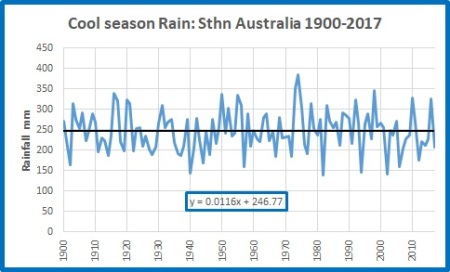
Ken Stewart finds that rainfall may have fallen in the last 30 years over Southern Australia but it has stayed remarkably constant in the long run.
Fig. 2: Cool season rainfall, Southern Australia, 1900-2017
Oops! Rainfall has in fact increased over southern Australia.
Stewart has also looked at the number of consecutive dry months across Australia. Looking at both 12 month periods and at 36 month periods it’s clear that we had more severe droughts more often from 1900-1970. The only exceptions are in SW WA (which is having a good year for rain this year) and small parts of Victoria and Tasmania.
Fig. 4: Number of consecutive months per calendar year of 12 months severe rain deficiency: Australia
Don’t forget to pop in at Kens Kingdom and say thanks for all the work he does.
Ken Stewart is not paid but can create these graphs. The Australian BoM gets a million dollars a day, and Ken used their definition of a drought, but there are no press releases about this from the BoM.
The ABC gets $3 million dollars a day. If we paid them $4 million a day would they stop parroting the CSIRO, BOM and renewables industry and start investigating? The evidence says “not”. Apparently, the better the funding, the better they spin. To get the ABC to serve the taxpayer instead of Big-Gov, we need to cut the funds to “zero”.
Fig. 5: Periods of 36 months serious rain deficiency: Australia
As Ken says — droughts were more common in all but a few areas:
Old coal plants don’t have to die, they just need to be fixed
Vales Point, Power Station, NSW, Australia
The Vales Point Coal plant (Part B) was built in 1978. It was sold for $1 million in 2015 by the NSW government. It’s now making a bumper profit. If it gets a $750 million renovation it could keep running til 2049 when it will be 70 years old. Vales has a nameplate capacity of 1,320 MW.
The Vales Point power station near Lake Macquarie, which supplies about 4 per cent of power for the national grid, could receive a $750m injection to ensure it runs until 2049, making it the nation’s last standing coal station, with the country’s other facilities due to be shuttered over the next 30 years.
The closure of Hazelwood improved profits for every surviving generator in the NEM (National Electricity Market).
Vales Point had a bumper 2018 financial year, according to documents lodged with the corporate regulator and obtained by The Australian, with the asset making a strong $113m net profit from $505m revenue, compared with a $35m net loss from $382m revenue last year.
The story of how Big-Gov can turn $500 million into “One”
The bumper profit comes less than three years after the rich-list duo paid the NSW government only $1m for the ageing asset on Lake Macquarie on the state’s central coast, which after a revaluation is now worth $555m. Sunset Power’s balance sheet is carrying $339m in net assets, including $36m in cash.
At the time of the sale, then NSW treasurer Gladys Berejiklian said the $1m price was “above its retention value”.
Australia now has 200 years of frackable gas to add to the 300 years of coal
And yet we are still buying Chinese solar panels. The big question is how much of our our gas and coal can we use before nuclear energy makes them irrelevant? h/t GWPF
The Northern Territory holds enough natural gas to supply Australia for 200 years-plus and is comparable to the shale resources that have revolutionised the US energy sector, Resources and Northern Australia Minister Matt Canavan says.
Senator Canavan described Beetaloo, located southeast of Katherine, as “a world class shale resource rich in liquids that is comparable to US shale resources which have been so critical in turning around the US energy market and manufacturing sector”.
“The refinement of hydraulic fracturing (fracking) has turned the US from the world’s largest net energy importer just over a decade ago to becoming a net energy exporter in recent years,” he said.
Green genius: Pay $1400 a year to not stop any storms
Finally some veteran engineers checked the Labor Party 50% renewable plan and the AEMO “65% scenarios”. Unlike others, their study that did not involve magical assumptions that the cost of renewables would dramatically fall. Instead they used “actual costs” and found the price of electricity will rise “84%” and cheap coal power will be forced out of business (just like what we also found here). The engineers include Barry Murphy, former managing director and chairman of Caltex. Robert Barr, an electrical engineer and academic at University of Wollongong. If only Kevin Rudd had asked them in 2007.
Electricity bills will soar and gas and coal-fired power stations will close if the share of wind and solar generation increases dramatically, engineers have warned after analysing the nation’s energy supply.
It found bills were likely to soar 84 per cent, or about $1400 a year, for the typical household, if wind and solar power supplied 55 per cent of the national electricity market.
A quarter of Australian rooftops have solar, and we need 40 times the current solar?
The AEMO forecast would require more than a 40-fold increase in the solar capacity and around a tripling of the number of wind turbines.
Not only is this pointless but it’s 25 times more expensive than it has to be
The Abbott “Direct Action” auctions cost taxpayers about $12-14 per ton of CO2 reduction. Yet Labor-Green-and-Turnbull continuously pick the wildly inefficient and expensive pro-renewables option. So does the climate-change activist Audrey Zibelman who manages our AEMO. They all say they want to reduce CO2, yet they all chose to enrich the renewables vested interests instead.
Stupid or suspicious?
The AEMO scenario of 65 per cent renewable energy by 2040 would reduce emissions at a cost of $365 a tonne of carbon dioxide, the study estimated. Replacing coal-fired power generation with nuclear power would reduce emissions by a far greater amount at an abatement cost of $27.50 a tonne. The Gillard government’s ill-fated carbon tax envisaged a tax of $29 a tonne. [Jo notes that the Gillard Labor carbon price ended up being $5310 per ton. ]
Follow the money.
Also this week: the PM, Scott Morrison, noted that Texans were allowed to explore for gas, unlike people in NSW and Victoria, and electricity prices were a “third lower” there.
UPDATE Thanks to Pat: Report linked here from August 2018 at bottom of the 4 pages:
Electric Power Consulting: National Electricity Market (NEM) Model
Reliable and Affordable Electric Power Generation Booklet
This report is based on modelling undertaken with the EPC NEM generation mix model. Download a copy of the 4 page “Reliable and Affordable Electric Power Generation” booklet here: Booklet (LINK)
Contributing Authors:
Dr Robert Barr AM BE(Hons) ME PhD FIE(Aust) CPEng , Director Electric Power Consulting Pty Ltd
Barry Murphy BScApp, BE(Chem) CSci MBA FIChemE FTSE FAICD, Former Chairman & CEO Caltex Australia
Dr Mark Ho PhD, President Australian Nuclear Association
Martin H Thomas AM FTSE HonFIEAust HonFAIE
Barrie Hill BE MiMechE MIPENZ FIE(Aust), Managing Director SMR Nuclear Technology Pty Ltd
After 20 years of subsidies, intermittent renewables account for just 3.6% of total energy generation. That’s the tiny purple sliver in the graph. Global power means not just electricity, but also fuel used in transport. And this is where wind and solar power are respectively old and slow, or modern but useless.
Someday solar powered planes might make their first round world trip in 48 hours but at the moment they need 16 months. There’s a a bit of hitch in the global energy transition.
Hello fossil wonder fuels:
Global Primary Energy, Graph, 1965-2018
Intermittent renewables are pretty useless everywhere:
Oil remains the world’s dominant fuel, making up just over a third of all energy consumed. In 2017 oil’s market share declined slightly, following two years of growth. Coal’s market share fell to 27.6%, the lowest level since 2004. Natural gas accounted for a record 23.4% of global primary energy consumption, while renewable power hit a new high of 3.6%.
— Spencer Dale, Group Chief Economist, BP
It took billions of dollars to get renewables up to 3.6% of total global energy. See the orange slice at the bottom of this graph (colored solid to make it easier to notice). This graph shows the changes (or stability) of global energy use since 1965.
A national army of knitters is in desperate need of more volunteers to help them meet the growing demand for winter woollies.
Victoria returns to the Victorian era
Knitters can not keep up with demand
“Some people say it has been a colder winter — I actually don’t think so,” Ms Rogers said. I think it’s been milder than what we’ve had, it’s just the need that’s so much greater unfortunately.
“Even if people have got heating, they can’t afford to run it, so they need the warm clothes or the blankets.”
Can you knit to keep a poor Victorian warm?
UPDATE from Beowulf:
I hear Audrey Zibelman, boss of AEMO, is a dab hand with a set of needles. Here’s her favourite pattern ladies: plain one, pearl one, skip 10, repeat.
It makes a jumper full of holes that must be plugged with other materials, but it saves heaps on the cost of wool and we don’t need to breed any more sheep to make our jumpers. Fabulous.
PS:I’m still travelling. Apologies for very delayed replies to email.
Perhaps somewhat surprisingly I have a degree of sympathy for members of the public who are climate change deniers. I have this sympathy because I was once one of them. …doing my level best to deny it was happening. Because it scared the bejeezus out of me.
… so I understand why people choose to believe those who say climate change is not the issue, that the issue is power prices and thus we need to fire up the coal furnaces.
Denial is a very easy way out of guilt that your lifestyle is leaving your children and grandchildren an awful legacy. Denial is a good way to throw away concerns that you might have to actually wear a cost – either through lifestyle changes or monetary loss.
It is a scary thing to hear talk of the impacts of climate change and the suggestions that it might be too late to do anything.
So deniers are selfish cowards, but Saint Greg has some pity for these poor inadequate sods. He is so magnanimous! One day he may deign to meet one.
It is so much easier to live in denial…
Sure. It’s easy to be sacked, exiled, univited, and treated like a … selfish coward. And it’s so much harder to follow the greased road of groupthink, laid out by unaudited foreign committees, lit by billion dollar LED’s, and endorsed by journalists who don’t bother to do one minute of original research.
Greg Jericho accuses the government of being “bereft of reason” then goes on to be … bereft of reason.
His whole scientific case:
According to NASA, of the 1,663 months since January 1880, the top 100 for temperature anomaly have all occurred since 1990, and every month since December 2014 is in the top 100.
It is real, it is happening, it is getting worse…
So the last 0.1% of human history is hotter than the 0.1% just before it. Therefore coal plants cause floods?
This paragraph is, Ouch:
…this week Taylor gave a speech that made zero mention of wind power – the main renewable energy in Australia – and in which he declared he wasn’t sceptical of climate change, just of subsidies for renewable energy, the Gillard government’s emissions trading scheme and of “excessive renewable energy targets.” This is despite that fact that renewable energy not only reduces our emissions, it also provides cheaper electricity.
So renewables are cheaper, but despite this the dumb Minister wants to reduce subsidies?
Psychologist Susie Burke tells the story of a woman who came to her for counselling after having her first child. Not because she was suffering from post-natal depression, but because she was “struggling with the enormity of what she had done.” She felt she had brought her child into a “world she knew was going to be a lot harsher and a lot less safe,” Burke told DW.
“She came to me when she was overwhelmed by this distress; questioning whether she had done the right thing. The fear she had for his future was really huge.”
Look out for the new hotline (Can someone find this number?)
Burke is an Australian psychologist and academic who specializes in eco-psychology. She treats people suffering mental illness as a result of climate change, and also recently set up a free hotline called the “Climate Change Psychological Support Network,” where Australians can call a qualified psychologist to talk through their feelings about environmental change.
Engaging in more serious conversations with climate dissenters, deniers, doubters, or the disengaged, is also very valuable, for those who are willing to take this on.
The book has advice like “use fear”, “be emotive”:
FOOD FOR THOUGHT: Fear Appeals
When climate change is framed as an encroaching disaster that can only be addressed by loss, cost and sacrifice, it creates a wish to avoid the topic….
Use vivid and emotive stories
Build emotional arousal… Use vivid imagery…
… move beyond ‘what’s in it for me?’ to ‘what’s best for humanity?’
The book advises that “Action is the best antidote to despair and helplessness….”. Mature adults, on the other hand, know that pointless action is the best path to hell.
To cure panicky snowflakes, instead, they could try talking to people who are not panicking — like skeptics.
We’d be happy to help. Instead of talking about feelings and framing their pain, we’d suggest they look at some proxies, feel the history, gaze at graphs and learn some logic and reason. It’s a long term solution. Never again will they fall for gullible voodoo, fake science and make-work rent-seeking propaganda.
We use cookies to ensure that we give you the best experience on our website. If you continue to use this site we will assume that you are happy with it.










Recent Comments