|
|
…
8.8 out of 10 based on 9 ratings
Wow. Australia may dump the RET — the renewable energy target — and stop trying to use our national grid to make global weather nicer for our great grandchildren? This would be legendary.
“Lowering prices will be more important than lowering emissions”
Don’t break out the Moët yet. Note two caveats.
1. The Daily Telegraph “understands” this to be true. Not definitively announced. Not passed through cabinet. Is this just testing the water to see how hot it is?
2. Australia will still try to meet our pointless Paris agreement some other way. Sure.
Will those big complex winner-picking, market fiddling schemes go?
Daily Telegraph
RENEWABLE energy subsidies and emission-reduction targets will be replaced with a focus on lowering electricity prices under the Morrison government.
New Energy Minister Angus Taylor said the federal energy policy has been “a mess” and says the fact prices have soared while blackouts persist means something has “gone terribly wrong”
The complex schemes Mr Taylor refers to are understood to be the Large-scale Renewable Energy Target (LRET), which subsidises the development of renewable energy.
The Daily Telegraph understands emission-reduction will also play no future role in energy policy. h/t GWPF
As Andrew Bolt says: …he finally gives us the truth: we have global warming schemes that drive your power bills through the roof without cutting the temperature.
Scott Morrison has split the Energy and Environment portfolio. Nice but symbolic. But, but, but, the nation is still aiming to reduce emissions by an obscene 26%. How will that happen — Like the Germans, who aim big, but don’t get there?
Scott Morrison says the role of ensuring Australia meets its emissions reduction targets will be taken out of the hands of Energy Minister Angus Taylor and be given to Environment Minister Melissa Price.
The Prime Minister said Ms Price would be tasked with coming up with policies to hit the government’s Paris targets of 26 per cent reduction of 2005 emission levels by 2030.
“It’s her job to continue to pursue our policies in relation to climate and to pursue the policies we have to address our emissions commitment that was given under the Abbott government,” Mr Morrison said this morning
“Angus Taylor’s job is to be the Minister for getting electricity prices down.”
Guardian: Angus Taylor: ‘I am not sceptical about climate science’
In a speech in Sydney, new energy minister Angus Taylor denies being a climate change sceptic. But he adds that ‘I am deeply sceptical of the economics of so many of the emissions-reduction programs dreamed up by politicians, vested interests, technocrats and politicians around the world’ VIDEO: 1min36secs: 30 Aug
How do our friends at Reneweconomy feel?
Not happy. He is a “Bjorn Lomborg type” who won’t help renewables, which is “crazy” because renewables are cheap, (which is why we can’t stop the subsidy schemes, right)? Got that?
Renewables are only cheap if you ignore all the hidden costs.
Bottom line: This is a step in the right direction. Keep sending those messages to your Liberal members, friends and donors. Make sure they know your opinion. Right now they will be hearing from the rent seekers who may wake up tomorrow incensed.
h/t Pat, GWPF, Dave B.
9.6 out of 10 based on 63 ratings
The alarmist case is so strong they will Not Discuss It.
Right now, the world is going to hell and expert scientists need to convince the doubting masses that they face a dire threat. They have rock solid evidence. Do they:
- Patiently answer questions with graphs and data. or
- Shout “fire” and ask for 89 trillion dollars, then tar those who disagree as pedophile-nazi-loving-idiots, throw a tanty and refuse to answer questions.
Obviously, expert scientists make mistakes.
Michael Bastasch | The Daily Caller
Climate Alarmists refuse to debate skeptics: “We are no longer willing to lend our credibility to debates over whether or not climate change is real. It is real. We need to act now or the consequences will be catastrophic,” reads the letter signed by 60 self-described “campaigners.”
Beware — balanced articles can kill people, cause floods! Run, Run…
From the letter:
In the interests of “balance”, the media often feels the need to include those who outright deny the reality of human-triggered climate change.
Balance implies equal weight. But this then creates a false equivalence between an overwhelming scientific consensus and a lobby, heavily funded by vested interests, that exists simply to sow doubt to serve those interests.
The readers of newspapers and viewers of news are too stupid to see that climate scientists are the smartest people in the room.
———–
Running chicken from debate, while declaring that the debate is over, must be the oldest trick in the grade-school Handbook for Con Artists. What’s really amazing is the cowards at The Guardian (BBC, ABC, CBC etc) can’t see it.
Hat tip to Marc Morano who has flown to debates to find his debater has run chicken.
In another instance, Hollywood producer James Cameron cancelled a debate with Climate Depot publisher Marc Morano in 2010, Morano told The Daily Caller News Foundation in 2014.
“In 2010, I was set to debate Hollywood producer James Cameron after weeks of negotiations, only to have the debate cancelled at the last moment when my plane landed in Colorado for the debate,” said Morano, a prominent global warming skeptic.
But it was the smartest thing Cameron could do at that point (apart from becoming a skeptic). Morano would have rolled him.
See the Daily Caller link for more.
9.8 out of 10 based on 72 ratings
…
8.5 out of 10 based on 15 ratings
Good news. Children who don’t know what snow is can now ski in summer.
Matt Wiseman, Mountainwatch
Heavy snow fell above 1500 metres across the European Alps this weekend with a number of destinations reporting over 40cm of the fluffy white stuff.
While it is still summer in Europe, temperatures dropped over 15 degrees and dipped into the negatives in less than 24hrs
Debbie White, Mail Online
There’s been a dramatic plunge in temperature across parts of Europe where searing heat has suddenly given way to heavy snowfall of up to 40cm – despite it still being summer.
About 25cm of snow was dumped on Germany‘s highest peak, the Zugspitze, where temperatures reached a decidedly chilly 19.4F (-7C) yesterday.
A ski resort in northern Italy was coated with 10cm of snow on Sunday as temperatures plunged to -8C.
Locals are a bit surprised:
Monday, August 27, 2018, 9:59 AM – We know it’s Monday, so we won’t blame you for doing a double or even triple take of this August snow in Alberta. That’s right we said SNOW.
No doubt, climate change will be blamed for this freak weather.
Soon, children won’t know what science is.
PS: I see Anthony Watts has seen snow in other places as well.
h/t Pat
9.9 out of 10 based on 68 ratings
Last Saturday at 1pm both Queensland and South Australia were cut off from the national grid. In Sydney 45,000 homes lost power for a couple of hours. Shops had to close. Trains were stopped. Passengers were stranded. Traffic signals were not working on major roads. Chaos. Industrial users shut down in a mass of 725MW of load shedding.
Apparently this was due to lightning.
Once upon a time, Australian states were self sufficient, now interconnectors allow us to share problems:
Two vital interstate power interconnectors blew without warning at the weekend, causing blackouts and critical industrial incidents and isolating two states from the national electricity grid, in a dramatic reminder to Scott Morrison just days into his prime ministership of the nation’s energy policy paralysis.
Queensland and South Australia were exporting power across the interconnectors when they were simultaneously tripped on Saturday, forcing power to be cut to big industrial users and retail customers in NSW and Victoria.
The nation’s biggest single-site power user, the Tomago aluminium smelter in the NSW Hunter Valley, lost power without warning, halting two pot lines for up to an hour. Alcoa’s Portland smelter in Victoria was also affected, losing power for about 50 minutes.
It would have been worse on a weekday.
Ausgrid working to restore power to thousands after mass Sydney blackout
TRAFFIC is at a standstill, trains are delayed and almost 40,000 homes were left without power thanks to a huge power outage. — news.com.
“Consistent” with a lightning strike:
A spokesman for NSW transmission line operator TransGrid said the interconnector appeared to have tripped during a storm passing through northern NSW and Queensland. “The way the system alarmed was consistent with a lightning strike,” a spokesman for TransGrid said.
Before the advent of interconnectors, a lightning strike could not have blacked out customers in three states simultaneously.
Predictably renewables fans are calling for more interconnectors. Other people just want each state to have reliable baseload generation like we used to have.
9.7 out of 10 based on 93 ratings
Gotta love a long unbroken proxy.
Scientists looked at 44 pines sites across the Scottish Highlands and used their tree rings to create a continuous temperature series for the last 810 years. Showing admirable restraint, they did not paste on adjusted thermometer records to create a hockey stick effect. Instead we can see that Scottish summers were just as warm in the 1300s, the 1280s and around 1500 as well.
The rate of warming is not unprecedented. The temperature is not unusual. But thermometers don’t tell the same story as the tree rings in the last 50 years. They both can’t be right. Either the tree rings are always unreliable thermometers or the thermometers are placed near ice cream trucks and adjusted up-the-kazoo?
Rydval et al. extended “the previously published Scottish dendroclimatic record (Hughes et al., 1984) by nearly 500 years,” in order to create an 810-year-long proxy over the period AD 1200-2010. The reconstruction was derived from a network of 44 Scots pine (Pinus Sylvestris) sites across the Scottish Highlands from both living and subfossil samples that correlated well with summer (July-August) temperatures.
In placing the most recent warming of the instrumental period in context, Rydval et al. write that it “is likely not unique when compared to multi-decadal warm periods observed in the 1300s, 1500s and 1730s.”
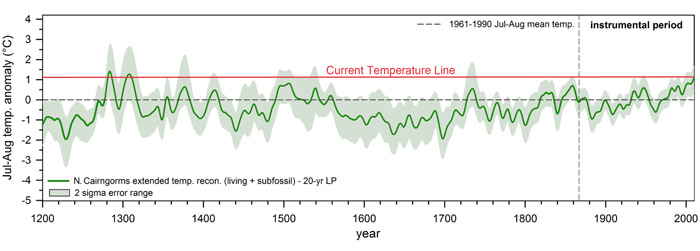
Looking at Scottish summer temperatures what we see is 800 years of ignorance
 ….
REFERENCE
Rydval, M., Loader, N.J., Gunnarson, B.E., Druckenbrod, D.L., Linderholm, H.W., Moreton, S.G., Wood, C.V. and Wilson, R. 2017. Reconstructing 800 years of summer temperatures in Scotland from tree rings. Climate Dynamics 49: 2951-2974.
9.6 out of 10 based on 90 ratings
In Victoria, 40C used to be known as “A Hot Day”, but now thanks to climate change it’s called an “extreme condition” (wasn’t it meant to become a common event?) Nevermind.
The AEMO (Australian Energy Market Operator) has pretty much warned us the Victorian electrical grid can no longer cope with “a hot day”.
[The AEMO] predicts a one-in-three chance of load shedding under extreme conditions this summer unless additional action is taken.
“Specifically, temperatures of 40C or more in Victoria could be the catalyst for extreme, one-in-10-year electricity demand conditions.
“Particularly when these temperatures are experienced towards the end of the day when business demand is still relatively high, residential demand is increasing, and rooftop PV’s contribution is declining.”
So since solar PV is useless in this situation, the Victorian government is spending one billion dollars installing Solar PV. One billion dollars of generation that is guaranteed not to work when we need it.
Will the new PM, Scott Morrison, be able to solve this problem? Thousands of engineers can.
Once upon a time even the brainless inanimate free market did.
h/t Dave B, Pat
PS: Still travelling.
9.5 out of 10 based on 93 ratings
…
10 out of 10 based on 10 ratings
UPDATE: Scott Morrison won 45 to Dutton 40.
Hours from now the Liberal Party members will decide whether Peter Dutton, Scott Morrison or Julie Bishop will be PM. Dutton is aligned with Tony Abbott, but Morrison seemingly and Bishop definitely, with Turnbull. I doubt Bishop has a chance. Morrison has not pinned his colors to the mast on climate change but the ABC is pushing for him according to Andrew Bolt — so we know who threatens the most sacred cows. Go Dutton.
Likewise, Fairfax are telling readers not to vote for Dutton: “In sunny Kooyong, Liberals find the thought of PM Dutton ‘appalling’“. So they managed to find a few people who don’t like him and turn that into a story.
Malcolm Turnbull is, as usual, being statesmanlike, thinking only of the Party:
He’s promised to resign and force a byelection in his seat. Tossing bombs as he leaves. On the plus side: no more Malcolm in Australian politics. Not unless the member for Goldman Sachs joins the Labor Party.
Will the new leader of the Liberals take the easy and obvious winning path of Abbott, Trump Dean, serve the people and stand up to the namecallers? Send a message to your local Liberal Party MP. Ask them today.
Apologies for minimal posting. I’m currently out of the office. Posting from a car in the dark parked by a road where I can get at least one bar of internet access.
I’ll leave it up to more informed commenters for the moment…
Commenter TdeF on Duttons eligibility and what the allegations tell us about Turnbull– :
Keep reading →
8.9 out of 10 based on 85 ratings
…
9 out of 10 based on 24 ratings
Abbott is an incredibly powerful man. From the backbench he’s creating disunity, stopping legislation, ruining careers, and bringing down Prime Ministers, all just for the fun of it.
This has nothing to do with the 54% of Australians who are skeptics.
Turnbull has lost control of government. He cannot get legislation through the lower house. But hey, if only Abbott wasn’t there, Australians would be happy to buy expensive electricity.
Peter Hartcher, The Sydney Morning Herald
“Turnbull thinks people will fall on their knees and say hallelujah!
Turnbull’s supporters are angry and frustrated at Abbott. But among many in the conservative faction of the Liberal Party, there is glee. Turnbull has been humiliated. And, to the conservatives’ great satisfaction, he has been humiliated over what they consider his pet fetish – climate change and carbon emissions.
“Turnbull is obsessed with this issue,” says a leading conservative MP. He thinks it’s a “‘greatest moral challenge of our time’ type of initiative”, a reference to the Kevin Rudd description of climate change. It was a challenge that Rudd failed because of an internal insurrection and now Turnbull has been forced to abandon too.
Contemptuously, he adds: “Turnbull thinks people will fall on their knees and say hallelujah! We’re back to the innovation message”, Turnbull’s campaign theme that fell flat at the 2016 election and which he has since abandoned. “He’s blind to the politics because he’s obsessed with the issue.”
But the defeat is about much more than climate change. It’s an ideological and identity marker. And it has exposed Turnbull’s jugular. “You can’t have a government,” says a Dutton advocate, “that can’t rely on the House on a key piece of legislation.”
The Coalition’s primary vote fell to 33% in the latest IPSOS–Fairfax poll. This is Abbott’s fault.
This may be”Turnbull thinks people will fall on their knees and say hallelujah!unfair. It’s Abbott and other conservatives who have revolted against Turnbull, yet Turnbull is being judged responsible. Disunity is death – Abbott delivers the disunity, Turnbull gets the death. But that’s politics.
Yeah. Only a “handful” of conservative MP’s have thwarted Turnbull yet again.
Simon Benson, The Australian
In a counter-move by moderates, The Australian understands that, if Mr Dutton won a second ballot, leading moderates including Julie Bishop, have threatened to resign from parliament, stripping the government of its slim majority and triggering a general election.
If Turnbull had just won 90 seats at the last election, a handful of MP’s couldn’t play these games.
Just bad luck.
h/t Dave B
9.5 out of 10 based on 69 ratings
Good news for people who like political drama. Turnbull lives on, as does the lack of unity, purpose and meaning of The Australian Liberals.
The Australian
Malcolm Turnbull has won a leadership ballot against Peter Dutton in the Liberal partyroom by 48 votes to 35 and Peter Dutton has resigned to the back bench.
Dennis Shanahan:
Malcolm Turnbull’s victory in the leadership ballot has solved little for the Liberal Party.
It has also shortened the odds of an election before Christmas and confirmed the rebellion against the Prime Minister is far wider than just a few malcontents.
9.9 out of 10 based on 58 ratings
Simon Benson, Geoff Chambers, The Australian
Malcolm Turnbull has lost the confidence of half of his Liberal Party cabinet colleagues as the Prime Minister’s backers admit they are bracing for a leadership challenge from Home Affairs Minister and leading Queensland conservative Peter Dutton.
As the leadership crisis engulfs the government, sources close to the Prime Minister were yesterday briefing that they were expecting a leadership challenge as early as today. Liberal MPs last night claimed that Mr Turnbull had begun calling colleagues to shore up support.
Mr Dutton’s camp believed that it could get to the required 43 votes to roll Mr Turnbull…
Peter Dutton may be ineligible to sit in Parliament. His lawyers say clearly no. Other lawyers say “Maybe”.
Anne Twomey, The Conversation
Section 44(v) says that any person who “has any direct or indirect pecuniary interest in any agreement with the Public Service of the Commonwealth” is disqualified from sitting as a member of parliament.
Dutton, as recorded in the parliamentary register of interests, is the beneficiary of a discretionary family trust. This trust, through its trustee, apparently owns two childcare centres in Queensland. The allegation is that since July 2, 2018, the trust, through its childcare centres, has agreements with the public service to provide childcare services in exchange for childcare subsidies.
The Liberal Party meet again today. The path is not obvious. Legal technicalities have run like a virus through parliament lately.
Would you like 90 seats with that?
The hate media portray the man who won by the largest electoral margin in 20 years as a loser.
Chris Kenny: The Australian
All of this will make many voters wonder why the Liberals wouldn’t, instead, go back to Tony Abbott. Like Kevin Rudd before him, he would be reclaiming the job that was cruelly ripped away from him. While he has never been popular, he is a known quantity and the public would understand the natural justice in his return. Voters gave him a landslide victory in 2013 and he is revered by friend and foe alike as an effective campaigner. Abbott would also bring enormous experience to the job.
To my mind, it has always made most sense that if Turnbull imploded or resigned, the party would return to Abbott. No other contenders have imposed themselves on the party or the public. Yet even Abbott now scoffs at the suggestion.
Abbott says, rightly, it should be about policies not politicians
Pat Griffiths, The Australian:
“It’s not about personalities. It’s not about him, it’s not about me,” Mr Abbott told reporters in Canberra on Monday.
Ending subsidies for renewable energy, stopping price gouging by energy retailers and locking in new baseload power were next on his list.
Among other missteps, the government should withdraw from the Paris agreement on climate change.
“The only way we can win the next election is to have a contest over policy not personalities,” Mr Abbott said.
Dutton hasn’t shown he can take on the Global Bullies yet in the national arena.
Few are true leaders, speaking out unapologetically as a skeptic.
9.6 out of 10 based on 45 ratings
An imminent train wreck that has been coming a long time…
by Simon Benson, Dennis Shanahan, Joe Kelly, The Australian
The leadership crisis engulfing Malcolm Turnbull has deepened, with cabinet ministers privately accusing the Prime Minister of cobbling together his plan to cap retail power prices in a last-minute bid to save his leadership.
The Australian is aware that a number of MPs called Home Affairs Minister and leading Queensland conservative Peter Dutton at the weekend to pledge support should he seek to challenge Mr Turnbull.
Former prime minister Tony Abbott told a Tasmanian Young Liberals meeting at the weekend he was looking forward to serving under a “Dutton government”.
Simon Benson, National Affairs Editor, The Australian, says the word is that the challenge is “inevitable”.
Malcolm Turnbull is in full capitulation mode. In the face of a possible and increasingly likely challenge, he has buckled to rebel MPs, and in the process surrendered the future of his leadership to the demands of a few.
It’s not the demands of a few, it’s the preference of about 4.8 million voters. Let’s do a plebescite?
A defining moment has arrived for a decision between two competing ideas. Does the Liberal Party return to the conservative values that have provided the ballast for its most successful periods in government, aligned with a centre-right orthodoxy, or does it continue with the moderate, centrist experiment? At the heart of it are two interpretations of the Menzies era. Turnbull has argued that the founder of the modern Liberal Party was a moderate. Conservatives violently disagree. They are forced to this crossroad largely through human folly.
What centrist? Since when was mass taxation to change the weather a centrist experiment? Since when did centrists control almost every aspect of the market, supply, demand, the product, the price, and call it “free”?
Four prime ministers look set to be taken down in their first term. The real problem is that the nation is bullied into not discussing big ideas, like the plan to stop storms with our electricity generators (and there are other sacred cows too). Politicians are trying to foist a fantasy plan on the masses. The masses are not happy.
Get your popcorn. The ABC and Fairfax (or what’s left of it) will be slapped by reality again.
The ABC tonight has the insipid: “Turnbull plans more energy policy changes amid internal pressure‘
While The Australian was talking to key players, the ABC are quoting twitter and interviewing the opposition and the Greens.
Along with that non-event, at the top of the ABC-politics page is the classic Lara Tingle Analysis “Abbott’s Influence waning within Coalition”.
 …
9.8 out of 10 based on 79 ratings
….
9 out of 10 based on 22 ratings
Too little, too late, not enough
Turnbull has to go.
Faced with a possible and imminent challenge from Peter Dutton, a limping Malcolm Turnbull has done the barest minimum just to stay in power. He has capitulated, and won’t try to mandate the Paris agreement through law, but he still wants the nation to meet the Paris agreement. If he had pushed it through Parliament he would have faced a leadership challenge for sure, and pundits are saying it’s still likely. How long will Liberal lemmings allow him to lead and give up the easiest, well trodden and winning election strategy?
Tony Abbott is leading the nation from the back bench.
When will the Liberals grow a spine and dump the Paris agreement completely?
Most of the party is too afraid to even talk about how much warming humans may be causing lest they be called a “denier” for doubting that it is not exactly the same as an unaudited, unelected and unaccountable foreign committee says. The nation can’t even have a sensible public discussion on climate change.
As Andrew Bolt says Turnbull’s leadership is now terminal. His clumsy gambit to present the NEG as a done deal too early shows how non-consultative he is, how bad his judgement is, and makes those that defended it look like fools.
The new “Ministerial Agreement” arrangement may be worse because it probably suits the Deep State even better. Decisions about whether to proceed will be done by a Minister advised by unelected committees using models based on a bunch of assumptions about “the cost”. Turnbull has led the party for three years while electricity costs have jumped seismically and now he just wants to keep prices at this obscene level?
The Australian:
Instead [of being legislated in the NEG] the 2015 climate change commitment will be mandated through Ministerial order and only after advice from the competition regulator that it wouldn’t increase power prices.
A condition of the order would be that the advice would have to be tabled in Parliament.
ABC viewers blind-sided by reality again
On Tuesday The ABC news audience heard what an unqualified success it was for Turnbull to get the NEG through the party meeting. It turns out this was a complete bluff — most of the party didn’t even know what was in the plan (the Labor Party got a copy before them). The ABC didn’t point out the obvious — that speaking up against it, or threatening to cross the floor was a major risk, so Turnbull’s gambit was that he might get the illusion of support and unity by railroading it past the party in a high stakes situation. Instead it took other journalists at The Australian and on radio — Ray Hadley — to ask the right questions and expose how deep the resentment was and how fragile was the “unity”. So fragile that three days after his big win Turnbull’s head was almost on the block. We pay a billion dollars for blind propaganda.
The NEG was not about electricity costs, it was (is) primarily about emissions:
The purpose of the NEG was first and foremost to lock in emissions reductions. Fines for failure to cut emissions are ten one hundred times higher than fines for failing to provide electricity.
Daniel Wild, IPA:
The NEG is functional equivalent to the Renewable Energy Target, an Emissions Trading Scheme, an Emissions Intensity Scheme, and a carbon tax. It uses government regulation to support weather-dependent energy generators, such as wind and solar, at the expense of coal.
“Under the NEG, energy retailers could face a $100 million fine for not meeting their emissions reductions requirements, but just as little as a $1 million fine for not meeting their reliability requirements. This means the government is favouring emissions reductions over reliability by a factor of 100-to-one.”
“The goals of reducing electricity prices and carbon emissions at the same time are contradictory. The emissions reduction component will mean that energy retailers will be forced to acquire energy from higher-cost sources than what would otherwise be the case,” said Mr Wild.
Download the IPA Parliamentary Research Brief recommending that the Australian government dump the Paris Agreement and the NEG.
See Pat at comment #2:
Sky News: Turnbull’s NEG changes could make matters worse: Craig Kelly
Prominent conservative backbencher Craig Kelly says Malcolm Turnbull’s reported changes to the National Energy Guarantee could pave the way for a higher emissions reduction target under a future Labor government…
Reportedly, the 26 per cent renewable energy target will not be regulated and not legislated. Mr Kelly has told Sky News this change could ‘make the situation worse,’ as it would allow Labor to easily change the target should it win office.
https://www.skynews.com.au/details/_5823292272001 12mins 33secs: 17 Aug:
Facebook: Peta Credlin
h/t Beowulf, Graeme Campbell. Pat.
9.7 out of 10 based on 84 ratings
Normally a governing party, especially with a margin of “one”, would consult with its own members before it consulted with the opposition. Turnbull’s gambit appeared to depend on sneaking the plan past the conservatives and libertarian skeptics.
Simon Benson, Joe Kelly, The Australian
It emerged last night that Labor had been given a copy of the NEG legislation, another move that has angered Coalition MPs who are yet to see it. A Liberal rebel told The Australian it was “disgusting” that Labor had the legislation but they were being asked to sign off on it sight unseen.
To forestall a revolt, Turnbull is said to be giving ground on all kinds of things, like ways to stop the big retailers gaming the market, but not “Paris”?
However, senior ministers have told The Australian this would not be enough to prevent Coalition MPs crossing the floor if the 26 per cent Paris emissions reduction target was not dumped or “decoupled” from the NEG.
The move to cauterise the growing threat of internal revolt came as the Prime Minister’s most senior conservative minister, Peter Dutton, suggested there could be a time when he resigned from cabinet over policy – which would trigger a leadership crisis.
There is also growing discontent with Turnbull’s political leadership as ministers are caught in a crossfire of demands that they resign or stay and head off a leadership crisis.
But the focus remains on the energy legislation, which went from being “ready to go” to a “moveable feast” and threatens to end up looking like a dog’s breakfast as every man and his dog offer up ideas and proposals from price control to “decoupling” from the Paris emissions target.
Not enough time was spent earlier to address the concerns of the Coalition partyroom and so avoid what is now a sizeable revolt…
All roads lead to Paris?
Turnbull, apparently is “wedded” to his plan to be the only nation on Earth to legislate and mandate the Paris target. He knows carbon taxes and emissions trading schemes are widely unpopular or he wouldn’t have buried the “success” of his achievement getting a secret emissions trading scheme through Parliament. (One the World Bank is very pleased about). He’s not glued to Paris for the votes. Nor is he doing it for the environment, surely, since all these international schemes achieve notoriously little except for funding some banker yachts. Turnbull is a smart guy, if he was serious about reducing carbon, he’d be talking about nuclear power, and the cheapest ways to reduce CO2, like supercritical coal, Abbott’s auctions, and anything-other-than-solar. Why the fixation with foreign committee dictats?
Senior Liberal Eric Abetz says Coalition MPs should put cheaper power prices ahead of political unity … MPs should not consider the short-term political consequences for Malcolm Turnbull of defeat of the NEG.
“I don’t think the next generation will thank us for putting unity, in inverted commas, before doing the right thing by the nation,” he said.
9.6 out of 10 based on 85 ratings
The advantage of communist autocrats is that they can create government havoc so much more efficiently.
The Chinese solar boom was so big it became the world’s largest solar market. It was so big it pushed up global “clean energy” investment to a record high. China became the veritable show pony of the solar spruikers: “leading the world in clean energy investment”. Mashable tells us it was so big “the solar boom could be seen from space“.
But the star advertisement for renewable glory was all based on subsidies:
 The Chinese solar boom was “pretty significant” A couple of months ago the Chinese government admitted they were cutting the subsidies to make electricity cheaper again for consumers. That hit the stock market. Now projects are being cancelled and orders are drying up for the hapless manufacturers.
The free market might be telling us something
“Without subsidies there’s no return on investment for over a decade, so investors and property owners aren’t interested in distributed solar. With subsidies it only takes seven years to recoup the investment,” he adds.
China’s solar manufacturers are unhappy with recent government policy changes that have put a brake on the sector.
“We’ve already halted work on 11 megawatts of industrial and commercial distributed solar PV projects,” says the marketing director for one solar photovoltaic (PV) module manufacturer in Guangdong province.
Looks like sustainable power is not sustainable:
China has led the world in new solar installations in each of the past five years, helped by guaranteed electricity prices. But the cost of subsidies has been growing unsustainably, and as manufacturers have expanded rapidly to meet demand the risk of overcapacity has grown.
What the government giveth, it can axeth, nevermind about consultation, standing committees and white papers:
The new policy, which came into effect immediately, has no target for the construction of solar farms, and orders local governments not to approve solar farms that need subsidising.
Shame about the human toll.
The blind free market is so much kinder and more predictable.
hat tip to the GWPF
9.4 out of 10 based on 42 ratings
The climate circus is back in Australia
Election 2019 is coming and Turnbull just lit a fire under the conservative base. The Deplorables are angry. Phones are running hot today. The DefCons awaken. In the last election defiant non-left voters were the “most influential group” — the swingers who ultimately decide the winner. This was the same group the journalists completely missed, like Brexit and Trump voters.
The Australian government, despite the polls showing Australians don’t want to pay more for renewables, has agreed to try to legislate a 26% reduction in emissions, setting a target in stone that almost no other country has done. (Have any?) Most countries have committed to nothing, or rather, they’ve committed to building nearly 300 coal plants. They’re planning 400 more.
A 26% mandatory target means so much more than just higher electricity bills, we’ll have to carve up our cattle and sheep, transport, waste and the rest of the economy too. What are they thinking?
We could lead the world in agriculture or medicine but we picked hara kiri?
We are the largest coal exporter in the world and it’s our largest export earner, we have a lower population density, bigger distances, higher transport needs, and 300 years worth of coal. We already pay some of the highest electricity rates in the world. We have faster population growth than practically any other first-world nation (so we’re offering to ignore that completely and cut our total emissions, not our emissions per capita? Master negotiators, not.)
This is industrial and economic suicide, but on the upside we will look fashionable in UN cafe-latte circles right until the lights go out. Good work Malcolm.
Sadly, the main opposition party’s aim is to destroy jobs and lifestyle even faster. Why go out on a limb when you can launch yourself with a canon? The “conservatives” want a 26% reduction, Labor thinks a 45% cut will stop storms and make electricity cheaper. (So why not do 100%?)
This is a big risk the party did not have to take
Just like 2009 — Turnbull fell on his sword over climate change and was tossed out as opposition leader, he’s doing it again. He runs a one seat majority government, up to ten MPs have such great reservations they say they might cross the floor (and vote against it). Turnbull has to get the Labor party and states to back this. If he fails, the word is it will cost him his leadership. That gives the Labor party huge leverage over the policy details.
They may say “No” because the policy is not suicidal enough and they are scared of losing the Green voters. Or because they want to troll the Libs, watch them immolate and pick a new leader, in which case, the joke’s on them. If somehow Turnbull pulls it off, the Liberal base will desert the party, he’ll have to put in two million dollars of his own money this election to replace the lost donors, and he’ll likely lose anyway. What drives this man?
Foreign readers can get some idea of the schism in Australian politics — the last Prime Minister of the very same party writes of the dissent in the ranks at the party meeting on the NEG: ” there were lots of pleas for unity, but as one MP said, we’ve got to be loyal to our electorates and to party members too, and not show the “unity of lemmings”. On Abbott’s Facebook page there are over 600 commenters, most of whom are congratulating him and pleading for cheaper electricity.
What they [Liberals] have done, to put it in the most simple terms, is back a policy that will now be filtered and modified by the demands of state premiers to whom Turnbull will be obliged to defer if he hopes ever to go before the cameras and claim with that patented supercilious grin that his NEG has carried the day. It won’t be his NEG by that stage. What sort of a “conservative” leader places his destiny in the hands of Laborites?
For people looking to understand the political ramifications, read all of Peter O’Brien’s piece at Quadrant.
These men need our support
It’s a high risk play to talk about crossing the floor in a government that rules by one seat.
 There are still some men in Parliament who stand for something. Image: The Australian. Only a few politicians are brave enough to stand up to the namecalling and media intimidation, and say what most Australians think. Send them your thanks, and let them know how much you appreciate their effort.
The Australian has named and interviewed these key men:
Some just want a price guarantee which Turnbull may be able to (in theory) add to the NEG but the wisest MP’s won’t settle for anything less than pulling out of Paris:
Mr Turnbull and Energy Minister Josh Frydenberg yesterday claimed the partyroom meeting as a victory for the NEG with majority support for the policy, and dismissed questions about MPs threatening to cross the floor. However, it is understood that, privately, there were concerns within the leadership group about the fate of the policy. The Australian has confirmed Barnaby Joyce told the partyroom he couldn’t support the bill. He was joined by South Australian MP Tony Pasin, the LNP’s George Christensen, Victorian Kevin Andrews, outspoken NSW Liberal Craig Kelly and NSW Nationals MP Andrew Gee. All cited price guarantees as a minimum requirement for support.
West Australian Liberal Andrew Hastie, Tasmanian senator Eric Abetz and Mr Abbott claimed they would not support the bill on principle because its only purpose was to legislate the Paris target of reducing emissions by 26 per cent on 2005 levels. LNP senator Barry O’Sullivan has also indicated he could cross the floor in the Senate.
…. But it is understood it will fail to win the support of Mr Abbott and Mr Hastie, whose opposition to the NEG is based solely on the Paris target.
Then CC your messages to your local MP — whoever they are. And if you have the energy, CC it to the editors of the major daily papers.
Can a reader (or two) please do an email list of current politicians? (Here’s the 2015 list).
Australians go early to bed,
To reduce power bills which they dread,
Due to blind dumb ambitions,
To cut ‘carbon’ emissions,
By their leaders who serve Paris instead.
–Ruairi
9.3 out of 10 based on 72 ratings
|
JoNova A science presenter, writer, speaker & former TV host; author of The Skeptic's Handbook (over 200,000 copies distributed & available in 15 languages).

Jo appreciates your support to help her keep doing what she does. This blog is funded by donations. Thanks!


 Follow Jo's Tweets
 To report "lost" comments or defamatory and offensive remarks, email the moderators at: support.jonova AT proton.me
Statistics
The nerds have the numbers on precious metals investments on the ASX
|
 Print This Post | |






Recent Comments