In March I was invited to present the FESAus Christmas function in December this year. They’re the Formation Evaluation Society of Australia, a non-for-profit volunteer organisation for Petrophysicists and Well Log Analysts. A niche technical club of experts. It was unpaid, but I was happy to help make it a fun and push some buttons. “Hot” graphs, cartoons and all.
But in June, suddenly it became controversial to make jokes about climate change. Committee members started resigning, and dummy-spit declarations were made that “a discussion about climate was stupid”. People were shaken. The chips were on the table, the members said “yes” but the committee was split. When decision time came, the key committee meeting was hijacked by an outsider from Woodside who turned up by surprise and darkly threatened that all funding or support for the professional organisation and all future speakers from Woodside would be withdrawn if that climate denier, Jo Nova, was allowed to speak.
It was Woodside or me…
So my presentation was cancelled, and by Woodside no less. What’s astonishing is the effort someone inside this 4 billion dollar revenue giant went to — to stop an unpaid blogger from speaking to a low profile, small technical organisation, with little, as in, almost zero, media influence. Seriously? As if a group of experienced geos were at risk of being badly influenced by yours truly — there are people who analyze seismic logs and signatures of key stratigraphic surfaces for fun. Does Woodside think they need “protection”? Or is Woodside just running chicken itself? Scared of the Western Australian EPA, which is currently calling for submissions, and promising draconian guidelines that threaten to kill off the industry? Woodside need the EPA to approve all their new projects. Petrophysicists might be almost all skeptical, but some either work for Woodside or hope too. Woodside are the largest operator of oil and gas production in Australia.
When asked to put their objections in writing the Woodside representative refused. When put the test, they weakly said they objected to all climate change discussions. But of course, there were, and are, other discussions mentioning climate on the agenda and they’re not being threatened.
And the fallout hasn’t finished yet — more resignations may take place if threats from Woodside prevent an esteemed member of FesAus from speaking in my place and about climate change. I hear he is skeptical too. That decision is due soon.
Soft power character assassination
Good enough for Munich, Oslo, London, New York, Sydney and Washington. Not so much, Perth.
Via emails, which I’ve seen, I was referred to as a climate denier, just a blogger, and whose husband was a holocaust denier. It was the full character assassination. We’ve heard it all before. Here’s our reply to one hapless media outlet that posted the anti-semitic allegations about Dr David Evans and then issued a complete apology. I still remember being impressed that the original article was deleted within the hour, late on a Friday night, and our explanation posted immediately. Despite that action, the baseless slurs persist. And what’s my husband got to do with me giving a presentation anyhow? (Where is a feminist when you need one?)
Evans, by the way is PhD, M.S. (E.E.), M.S. (Stats) [Stanford Uni] and a few more degrees, a medal, OK, I’m just showing off. But it doesn’t matter how many prizes you’ve won if the rumor mill circulates lies and innuendo and no one stands against it. Which is why I’m so glad that several people are pushing back. It takes courage when industry heavyweights turn up… especially when jobs are at risk.
One big unspoken implication is that if Woodside won’t let a skeptic speak at an outside event, why would they hire one? Many younger geologists and engineers — who are largely skeptics — are becoming afraid to speak up…
(Lordy B! Pray for Woodside if it hires believer-engineers.)
For what it’s worth, as things got hot I decided to turn up to a FesAus technical meeting myself and listen to a presentation. I handed out Skeptics Handbooks all round. As expected, almost all of the members are friendly and already skeptical (see Lefsrud et al). Geologists and Engineers are the most high-grade skeptics around. They know too much about the history of Earth, and the fickleness of models.
Why this heat? Perhaps there is a religious zealot in middle management at Woodside, it’s hard to believe anyone in upper management would have made such a cackhanded PR move and over-reached this badly.
Otherwise this is the dark hand of soft power — the Administration State has a billion reasons to silence independent thought. When the government gets too big there doesn’t need to be an edict to quash dissent. People silence themselves.
Not us.
Alarmists get into a sweat,
Overcome with fear, fright and fret,
That a climate-change joke,
Might dissension provoke,
Which they see as a terrible threat.
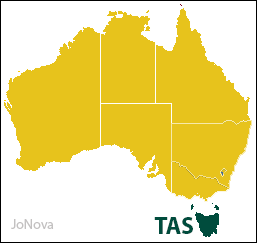
After the dramatic loss in Tasmania at the May election the local state Labor party has realized they went too far Green left. They are scrambling to distance themselves from the Greens — saying that working with the Greens was a mistake. They are even talking about working people again as if they matter. It is a 180 shift from trying to win votes from the Greens by adopting their policies to openly isolating the Greens and pointing out their flaws.
Far from trying to fight “a climate election” they are even trying to fight on economic issues — ground that usually suits the Liberal (conservative) party. The problem for the Tasmanian branch is that they said something like this in 2010, then reneged when push came to shove and did a deal. Unless they get serious about pointing out why Greens policies are so toxic, the voters won’t believe them. The added advantage of scrutinizing the Greens (finally) would be that the Labor party might win votes from both the left and the right.
Rebecca White is the leader of the Labor Opposition in Tasmania.
Ms White will rise to her feet on Sunday to spruik Labor’s commitment to the working class, and to raise concerns about a “jobs emergency” in Tasmania.
She will use her speech to distance Labor from the Tasmanian Greens.
After working with the Greens earlier this year to pass transgender reforms through state parliament, Labor now seems intent on avoiding the appearance of being too cosy with the minor party.
Ms White’s speech will criticise the Greens’ positions on energy policy, tourism, and planning.
“As bad as the Liberal Government is on jobs — the Greens are just as bad,” Ms White’s speech reads.
“I am tired of the Greens standing in the way of Tasmanian jobs.
“They leave people behind. Working people. Our people.
In 2007 Ken Rudd ran his campaign on a promise of being great economic managers. The Australian Labor party won and did what they usually do –they blew away the surplus, raked up debt, built $800,000 tin-sheds for schools that needed libraries, and created a bubble in pink batts. It’s very risky for any Labor Party to run a campaign on “the economy” — but finally they appear to realize the empty shell of the climate election — where everyone says “they believe” and “they care” but no one wants to pay, and every other issue rates higher. The votes just aren’t there.
The party appears to have decided the key to future electoral success lies in convincing voters it would be a stronger economic manager than the Liberals, both at a state level and federally.
“The Morrison Government is in denial about the economy. A soft economy has been their blind spot, and it’s becoming their weak spot.”
White admitted past alliances with the Greens, most recently from 2010-14, had been a mistake. She painted Labor’s former power-sharing partners as arrogant, anti-everything, job-destroying naysayers.
Her quest to distance herself from the tree-huggers went as far as endorsing roo shooting as a pastime.
Her problem is that Tasmanians have heard this song before. Former premier David Bartlett promised never to do a “deal with the (Greens) devil” in 2010, shortly before doing exactly that to cling to power. Many still recall the similar Faustian pact between Julia Gillard and Bob Brown in the same year.
In preferences, Scott Morrison put Labor ahead of One Nation. What are the odds the Labor party would put the Liberals ahead of the Greens? Close to nothing.
Huge sums would have to be transferred from richer to poorer countries and regions to allow them to take the strain. Even then unemployment and mass migration across now open frontiers would follow. And a full-fledged Single currency would allow no escape hatch.
The political consequences can already be glimpsed: the growth of extremist parties, battening on fears about mass immigration and unemployment, offering a real — if thoroughly unwelcome — alternative to the Euro-centrist political establishment.
Given the timeframe, this is a draft post — just to flag this and start a discussion. Suggestions welcome. More coming Monday.
In March the WA EPA astonished the state by suddenly declaring that all new projects would need to “demonstrate how they would offset all emissions from their developments.” After an outcry these were withdrawn, but the EPA still wants them and are calling for submissions.
The requirements were so drastic they would affect the whole country just because of the size and the revenue lost from the WA projects. Not to mention that if the WA EPA gets away with this scientifically empty power grab, other EPA’s will follow…
The new regulations will affect planned projects such as Woodside Petroleum’s $US11 billion ($15.6bn) Scarborough gas project and its $US20.5bn Browse development, as well as existing projects such as the $US34bn Wheatstone LNG plant and the $US54bn Gorgon LNG plant. — Paul Garvey, The Australian.
The EPA is made up of five members appointed by the minister. It’s a QANGO, paid by the government, dependent on the government, but supposedly independent of it. It makes recommendations regarding the approval of new projects in the state but the government can choose to do something different. The problem is though, that companies need to jump through the hoops (which costs money and time), and it’s harder for a government to say “Yes” if the EPA says “No”. Plus it’s another PR win for the religion of climate change. More paid press releases.
How do we predict or assess the “environmental benefits”: The EPA are only supposed to be considering the environment, not the economy, and they’re only supposed to be considering Western Australia, not the world. It seems to me that the hardest point for them to justify is how cutting emissions in a state of 2.6 million people or 0.3% of the worlds population will have any measurable outcome on the West Australian environment.
Their entire assessment of “likely harm”comes from generic quotes and Argument from Authority from the CSIRO, BOM and the unaudited foreign committee. Who is responsible for checking these?
The EPA needs to define what a “reasonable” measure is. If the rest of the world is doing almost nothing, is it reasonable for West Australian companies to pay exorbitant fees to allay emissions which will drive them out of business? And emissions that will just be emitted elsewhere and which will have no measurable effect to the fourth decimal place on the temperature of WA?
The EPA document is poorly researched — it argues that “It is rapidly becoming standard international practice for greenhouse gas emissions to be considered by regulatory agencies”. Obviously the EPA is unaware that of what is happening in Russia, China, Indonesia, India, Africa, Brazil or the USA. Do they realize Donald Trump won?
On that basis the EPA are calling for submissions and promising to publish them and their responses. (That way they can say they consulted, even if they ignore everything that’s too hard). Nonetheless, it’s still worth putting in a submission Monday. Which I will. This post is here to remind others that’s it due, ask for suggestions, and offer to help.
Right now a very rare southern SSW (Sudden Stratospheric Warming) is taking place, possibly peaking today or this weekend over Antarctica. In the Northern Hemisphere SSW’s happen more often and in the month afterwards, wild polar blasts like the “Beast from the East” can peel off. So somewhere way up at 10hPa or 30 – 50 km, there is an area that’s warmed from -60C to close to zero. The warming up high throws a spanner in the normal jet streams and weeks later, down at the surface, blobs of cold air from the poles may end up wandering far from “home”.
We (as in Africa, Australia, Argentina, or New Zealand) may get bumper snow and severe frosts, or we may not. Some researchers are getting excited and are using the word “historic”.
…
These are rare over the Southern Hemisphere — due to Antarctica being shaped like a circular cheesecake right over the pole and surrounded by water. The geography is cleaner and simpler than at the north pole, and that generates a strong circumpolar jetstream. The strong pattern normally stops these sudden warmings up high which occur with wandering jetstreams.
In the Southern Hemisphere there have only been two officially recorded SSW’s in the last 50 years, one in 2002 and a more minor one in 2010. Though I’d venture to guess that we haven’t got much data on temperatures 30km above Antarctica in 1922 (or whenever). In the northern Hemisphere, some are already discussing the odds of another one for this winter,#PolarVortex.
“… this plot gives a sense of how large planetary-scale atmospheric wave propagation is in the mid-stratosphere (in the SH, the biggest values are more negative). These waves can break (think waves breaking on a beach) and rapidly slow the normal circulation there.”
While those with crystal balls and CMIP5 models may blame any freak weather on CO2, none of the models can predict this. Indeed, the modelers are still trying to define SSW’s Is it a wind reversal, or a temperature gradient change? (Junsu Kim 2017). The best meteorologists can only predict a Sudden Stratospheric Warming a whole week in advance.
Time to arm up on ways to explain to the superstitious that any cold snaps that may come are not another spooky sign of A CO2 Effect.
The unstoppable Tony Thomas has collected the tears of climate scientists the world over as they wallow in their self-inflicted heartache. For anyone who hasn’t come face to face with the raw emotional PR power of a crying scientist, check out Quadrant.
In particular, this new study:
The $2.5 million dollar study of The Emotional Labor of Climate Scientists
.. let’s get back to the psyches of Australia’s top warming spruikers. Geographers Professor Lesley Head (Melbourne University) and Dr Theresa Harada (Wollongong University) have published a breakthrough paper in the peer reviewed journal Emotion Space and Society. It’s called “Keeping the heart a long way from the brain: The emotional labour of climate scientists”.[4] This includes insights about climate-panic people’s “emotional labour” from “feminist perspectives” in which the scientists combat “a strong climate denialist influence”. The authors, straight-faced, found that our climate scientists use emotional denial to suppress the consequences of climate change. Guilt-free, they can then continue “extensive use of long-distance airplane trips throughout a scientific career”.
The authors accept, no questions asked, that 33-50 per cent of the world’s petroleum and over 80 per cent of coal should be left in the ground. Even so, they fret we’re set for maybe 6 degC warming and transformation of society. From this bland starting point, they sample four female and nine male Australian climate scientists — half of a group of 26 rated “the nation’s leaders in this field”. Tragically, the names of this band of bedwetters are withheld. The 13 interviews are wrapped with references to nearly 70 prior academic papers.
The study took at least three years. The scientists were surveyed from mid-2014 . The paper was submitted in May 2015 and re-submitted after revisions in July 2017. It was funded from part of an ARC research grant of $2,467,256 [you read that right: nearly $2.5m] for “cultural dimensions of environmental sustainability and human-environment interactions, including climate change.”
The interviewees’ particular terror was the “strong climate denialist movement [that] was a source of pressure and a cause of anxiety”. Into the bargain the denialist discourses were “seen to undermine the legitimacy of science authority”. The authors seem unaware that Australia’s leading “denialist” is Joanne Nova, one-time professional science educator and now a housewife in outer suburban Perth with a global reputation. Her only resource is her intellect and her only income is from her blog’s tip jar. No $2.5m taxpayer grants for Joanne…
As Thomas says — “note the elistism”. I would add — “note the narcissism”. Could Dr Ailie Gallant be the only homo sapiens that cares?
# Dr Ailie Gallant, Monash: “I often feel like shouting… but would that really help? I feel like they don’t listen anyway. After all, we’ve been shouting for years. How can anyone not feel an overwhelming sense of care and responsibility when those so dear to us are so desperately ill? Perhaps I’m the odd one out, the anomaly of the human race. The one who cares enough, who has the compassion, to want to help make her better. Time is ticking, and we need to act now.”
Or could it be she cares so little about the rest of her species she can’t be bothered even listening to them? And she has so little interest in saving the world she won’t even seek to find out why skeptics are skeptical?
Tony Thomas’s new book, The West: An insider’s tale – A romping reporter in Perth’s innocent ’60s is available from Boffins Books, Perth, the Royal WA Historical Society (Nedlands) and on-line here
The Basslink cable has gone down again, and is expected to be out of action til mid-October. Luckily for Tasmania, the dams are at 45% full. However in Victoria, which sits on one of the largest brown coal reserves in the world, currently prices are hitting $300/MWh every morning and every evening at peak time. This graph below shows 5 minute prices for the last two days in Victoria. Every dollar Victoria saves at lunchtime from solar generation is lost a few hours later, and then some. Though it’s wrong to use the word “saves” at any time of day. The wholesale price of brown coal power for years was $30/MWh, and this below is a wholesale price graph. Even the lunchtime “low prices” are twice as expensive as brown coal which can supply all day, every day and for hundreds of years to come and doesn’t cause voltage surges, frequency instability, or house fires, and doesn’t need backup batteries, demand management schemes, free movie tickets, or dark hospitals.
The AEMO must be counting their lucky stars that this happened at probably the “best” time of year when demand is lower.
….
The effect of the Basslink outage is presumably obvious above the noise of the monthly graph of 30 minute prices in Victoria (see the last three days of thick red spikes). However, the biggest bonfire of money on the Victorian grid is the forced energy transition “every day”. Just look at the prices from 2015 (blue) when Hazelwood coal was still running and compare them with prices this year (red). That’s what the renewables revolution does.
Victorian prices, AEMO, August 2015, August 2019.
At lunchtime even with all those Victorian solar panels working, SA and QLD were keeping the lights on in Victoria.
Winning: The ABC news implied the G7 didn’t achieve much and was a bit of a flop with leaders “unable to overcome their differences…” and signing only a one page form. But for the rest of the world, the G7 was a big success — there were no long pledges to lead the world in weather changing voodoo. Climate was sidelined.
“No matter what you read and hear from the media, this G-7 was all about Trump re-aligning the world — reshaping the world economy with America’s interests first and foremost,” said Varney on Fox Nation’s “My Take.”
“Trade was the headline issue … A deal with Japan — they will import a lot more of our agricultural product. Britain gets a major trade deal after Brexit, and there’s dialogue with Germany on car tariffs as well, but the most important — China,” stressed Varney.
After President Trump’s news conference, at the conclusion of the summit on Monday, CNN’s Jim Acosta said, “I think perhaps one of the biggest headlines coming out of this press conference that we just witnessed here in France is that the President would not be pinned down on this question of climate change.”
TWEET: Peter Baker, Chief White House Correspondent for The New York Times and MSNBC analyst.
With all the differences with Trump, the G7 leaders ended up releasing a largely general one-page statement that added up to 264 words. The last joint statement under Obama in 2016 was 14,263 words
China is selling cheap labor which is available in so many other places:
China is not selling the world anything the world does not have or cannot make. What China is selling is a safe haven to avoid the labor, tax and environmental laws that exist in the West.
U.S. imports from China totaled $539.5 billion in 2018. U.S. exports were $179.3 billion. … the U.S. market is about 5% of the Chinese economy, assuming the fake Chinese economic numbers are even close to reality, which is surely not the case. The Chinese market is less than one percent of the U.S. economy in 2018.
All groupthink-minded, obedient journalists have been advised to find a climate crisis to report on in Sept 16th which is the week before the next UN climate summit on Sept 23. How many will obey, conveniently serving the UN, big government activists with “free advertising”?
The best things skeptics can do is expose how artificially crafted and politically timed this “reporting” is. Spread the word that it’s coming to help neutralize the effect.
Let’s ask our favourite ABC/BBC/Guardian/NY Times journalists in advance if they plan to obey this directive. Perhaps we could score each journalist with a Climate Patsy mark as the week unfolds and they hit their prescribed targets? They score extra points for saying “12 years to go”, “all scientists agree” and using the terms “climate crisis”, and “climate emergency”. Triple points go to photos of weather porn: Eg melting asphalt, “rain bombs”, freak clouds, and 20 year old photos of the Amazon burning.
We’re writing from Covering Climate Now, a new project of the Columbia Journalism Review and The Nation aimed at dramatically improving journalism’s coverage of climate change. We invite you to join us.
The science is beyond clear: humanity faces an emergency situation. Rising sea levels and record heat waves, wildfires, and floods are unleashing devastation worldwide, and much more is in the pipeline. We have 12 years to radically change course, UN scientists warned last October, or face catastrophe.
As journalists, we have a professional responsibility to report on the urgency of this moment. Despite good coverage by some news outlets, climate silence still reigns in much of the media. For example, only 27 percent of Americans knew in election year 2016 that virtually all scientists agreed that climate change is human-caused, happening now and very dangerous.
The good news is that 63% of the public recognized that the statement “virtually all scientists” agree is a PR and advertising line. No one has surveyed “all scientists”. And the few fields that have been polled show that climate scientists are failing to convince all the professional fields of scientists around them. Surveys show 50% of meteorologists don’t believe the doctrine (Maibach et al 2017), 66% of engineers and geologists are skeptical (Lefsrud et al 2012). Even most certified climate scientists don’t agree with the full 95% certainty that the IPCC claims (Strengers et al 2015).
The Columbia Journalism Review could be sued for false advertising — pretending to be journalists, pretending to be concerned about “facts” and then promoting fake facts.
Previous reasons for underplaying the climate story—fears of alienating audiences, losing money, or appearing partisan—no longer hold. Most people under age 40 care intensely about climate change, irrespective of their political outlook—even Republicans and independents want action, while Democrats call it their number one concern. That may help explain why The Guardian, our first partner at Covering Climate Now, has found that its extensive climate and environment coverage is making, not losing, money.
Instead of most people under 40 “caring intensely” — most people rank climate change as one of their lowest environmental concerns. Here are just a few surveys. Young people universally score higher in belief, but they grow out of it as they grow up.
We describe our plans for Covering Climate Now in this FAQ, which links to the April 30 conference at the Columbia Journalism School that launched this project and where iconic TV newsman Bill Moyers announced a $1 million pledge from the Schumann Media Center to fund the first year of our work.
Because all good journalists should time their articles to help the UN political agenda?
Our ask of you is simple: commit to a week of focused climate coverage this September. We are organizing news outlets across the US and abroad—online and print, TV and audio, large and small—to run seven days of climate stories from September 16 through the climate summit UN Secretary General Antonio Guterres hosts in New York September 23. The stories you run are up to you, though we can offer ideas and background information and connect outlets looking for content with content providers looking for outlets.
Global Fire Data shows this year is unequivocally a low fire season in the Amazon. But social media tears and outrage is running at 1000% driven by old photos and fake facts of the Amazon producing “20% of our planet’s oxygen”.
And the media experts reported the house was on fire in the lungs of the world, or something to that effect. They didn’t check the data, didn’t ask hard questions.
Based on hyperbolic twitter pics French leader Macron is threatening to cancel a foreign trade deal. The hype serves the purpose of attacking the right wing Brazilian leader Jair Bolsonaro in the lead up to a G7 summit this week…
The tally of fire counts here is up to data for August 22, 2019. Emissions are preliminary estimates based on fire counts, but the graph shows just how ordinary, normal and boring 2019 is expected to be when the final numbers are done.
Amazon fires, emissions, graph, record years. (Click to enlarge) | Source: globalfiredata.org
The actual fire counts for the whole Amazon Region as listed up to Aug 22nd:
The monthly fire count total. (Click to enlarge) | Source: globalfiredata.org
Spot the coincidence
The twitter firestorm is amplified just when the UN and big-government fans could use a negotiation weapon.
What is the outside world doing?
The UN secretary general and many world leaders and celebrities have expressed concern. The Amazon will be high on the agenda for G7 leadersat a summit in France this weekend. They are likely to make a strong statement condemning the recent increase in deforestation and urge Brazil to restore the Amazon protections that previously made the country a global environmental leader.
Where was the mainstream media?
Some journalists appear to be running off the twitter feed. But others seem to be carefully crafting their stories to highlight irrelevant, cherry-picked half truths. Notice how many tell us that this year in XXX (sub part of the Amazon) things are “twice as bad as last year” as if history starts in 2018, and as if the low fire statistics from the rest of Amazon don’t matter? Which news outlets are telling the whole truth and nothing but…
International leaders are transparently exploiting the hype:
“France and Ireland say they will not ratify a huge trade deal with South American nations unless Brazil does more to fight fires in the Amazon. French leader Emmanuel Macron said President Jair Bolsonaro had lied to him about his stance on climate change.” — BBC News, 6 hours ago.
Right at the end of one BBC news article the last line hints that the whole event is unwarranted. Why is this just an “add on”?
Remember when it comes to climate change, NASA are the definitive last word, but when it comes to Amazon fires, they’re just a casual addendum. “No comment”.
Jonathon Watts at The Guardian carefully words the panic. It’s almost as if he is aware of what is going on but not happy to make it too clear. With headlines like these, anyone would think the readers of The Guardian are 14 year old girls.
Does this happen every year?
Yes, but some areas have suffered far more than usual. In the worst-affected Brazilian state of Amazonas, the peak day this month was 700% higher than the average for the same date over the past 15 years. In other states, the amount of ash and other particulates in August has hit the highest level since 2010.
Is the entire forest ablaze?
No. Satellite monitoring experts say the images of an entire forest ablaze are exaggerated. A great deal of misinformation has been spread by social media, including the use of striking images from previous years’ burning seasons.
The Amazon makes 20% 6% of the worlds oxygen:
The hype is so over the top even Michael Mann is watering it down. This might be the first time Michael Mann is on the same side as skeptics?
Do we need to worry about oxygen?
No. Although some reports have claimed the Amazon produces 20% of the world’s oxygen, it is not clear where this figure originated. The true figure is likely to be no more than 6%, according to climate scientists such asMichael Mann and Jonathan Foley. Even if it were accurate, the crops being planted in the cleared forest areas would also produce oxygen – quite likely at higher levels. So although the burning of the rainforest is worrying for many reasons, there is no need to worry about an oxygen shortage.
Right wing leaders might cause fires, left wing leaders go unnamed
Buried in a Guardian story is the admission that there are also huge fires in Bolivia which has a “leftwing populist president.” The Guardian writer uses that to claim this is not a political witchhunt, yet with no one hounding the Bolivian leader, this appears to be exactly what it is.
Let’s play sea level bingo with the latest advertising from the Merchants of Sea-level Scares.
Hitting the media outlets tonight — the latest “Prepare to Die” news stories claim we must plan now for evacuees, refugees, inundation and homeless koalas. All the usual features of marketing are there — firstly all the images they use are from mocked up futuristic sea level rise. Secondly, it’s not a continuation of current trends, it a sudden acceleration — in this case from 1mm to year to 9mm a year, effectively starting tomorrow.
1 tiny millimeter
From 1969 – 2013 the seas have not changed the beaches around these Tuamotu atolls — or almost any other atoll you can name.
By every method known to man, seas are rising around 1mm a year:
1,000 tide gauges,
hundreds of studies of beaches,
satellites measuring sea levels, and
satellites measuring beaches.
All anyone needs to know about sea levels is that for the last 50 years sea levels have been rising at 1mm a year as shown by a thousand tide gauges all over the world. There was no acceleration. (Beenstock et al). Some of those gauges were rising, some falling, but when averaged out, it’s almost a wash at 1mm. Nils-Axel Morner took the opposite approach and studied 50 beaches around Scandinavia intensely, figured out which beach was at the centre of the turning crust and calculated that the seas were only rising at 0.9mm a year and for the last 125 years. (Morner, 2014).
Satellites are now tracking every 20m rolling sandspit above the seas — and if seas were rising the beaches would surely be shrinking. Instead of 709 islands in the Pacific and Indian oceans 89% either stayed the same or got bigger. (Duvat, 2018). Not one island large enough to have human inhabitants was getting smaller. Not one.
Most of man made warming is made by adjustments
We don’t need sea walls to stop the rise, just an independent science audit.
Before adjustments:
A lot of the rise here is just the El Nino effect of 1998 in any case.
Figure 5. Annual mean sea-level changes observed by TOPEX/POSEIDON in 2000, after technical “corrections” were applied (from Menard, 2000). A slow, long-term rising trend of 1.0 mm/year was identified, but this linear trend may have been largely an artefact of the naturally-occurring El Niño Southern Oscillation event in cycles 175-200.
After adjustments:
Figure 7. Sea-level changes after “calibration” in 2003. The satellite altimetry record from the TOPEX/POSEIDON satellites, followed by the JASON satellites. As presented by Aviso (2003), the record suddenly has a new trend representing an inferred sea-level rise of 2.3 ±0.1 mm/year. This means that the original records presented in Figs. 5-6, which showed little or no sea-level rise, must have been tilted to show a rise of as much as 2.3 mm/year. We must now ask: what is the justification for this tilting of the record?
As far as the eye can see, it has nothing to do with CO2. Fully 85% or more of all our human emissions of CO2 have been produced since World War II and nothing changed.
[Graphed by Jo Nova based on data from Jevrejura et al located at this site PMSML]
There are large natural forces in here that are not well understood — look at the way the rate of change of sea level has rolled in cycles in the last 200 years.
Source: Jevrejeva 2008
Scream and run soon say the ABC
As usual, Nik Kilvert of the ABC doesn’t do any research or ask any hard questions. He’s just a distant part of the Science propaganda unit. The gloom and doom is based on highly adjusted data being fed into junk models and extrapolated beyond the error bars, but don’t expect Nik to report that. Truly terrible science needs truly terrible journalism to live on long enough to get the next grant.
From Bangladesh to the Philippines and the low-lying islands of the South Pacific, the impacts of climate change for many people around the world are going to get much worse, very soon.
Some people will become stateless, and will need to find homes in new countries, while others will need to relocate within their own borders.
Researchers writing in Science today argue that it’s time to begin preparing the retreat of people living in regions that will become uninhabitable due to climate change.
Average global sea level will rise by up to 77 centimetres by the end of the century if warming is kept to 1.5 degrees Celsius, according to IPCC predictions.
Extreme weather events, saltwater incursion and bushfires are also expected to displace people in the near future.
etc, etc, etc
Trust the ABC to throw a bushfire scare into a sea level story.
Ruairi
Small changes in sea-level rise,
Should not come as any surprise,
But a reading adjusted,
Can’t really be trusted,
As it’s not what the reading implies.
Past changes were larger in the Maldives (Mörner, 2007); In Connecticut (van de Plassche, 2000),; SW Sweden – Kattegatt Sea region (Mörner, 1971, 1980); In the Kattegatt and the Baltic (Åse, 1970; Mörner, 1980, 1999; Ambrosiani, 1984; Hansen et al., 2012). Other sites (e.g. Pirazzoli, 1991). [See the link above for the full references].
Michael Beenstock, Daniel Felsenstein,*Eyal Frank & Yaniv Reingewertz, (2014) Tide gauge location and the measurement of global sea level rise, Environmental and Ecological Statistics, May 2014 [Abstract]
Morner. N.A. (2004) Estimating future sea level changes from past records, Global and Planetary Change 40 49–54 doi:10.1016/S0921-8181(03)00097-3 [PDF]
Nils‐Axel Mörner (2014) Deriving the Eustatic Sea Level Component in the Kattaegatt Sea, Global Perspectives on Geography (GPG). American Society of Science and Engineering, Volume 2, 2014, www.as‐se.org/gpg
Jevrejeva, S., A. Grinsted, J. C. Moore, and S. Holgate (2006), Nonlinear trends and multiyear cycles in sea level records, J. Geophys. Res., 111,
Jevrejeva, S., J. C. Moore, A. Grinsted, and P. L. Woodworth (2008), Recent global sea level acceleration started over 200 years ago?, Geophys. Res. Lett., 35, L08715, doi:10.1029/2008GL033611. [PDF]
The Science and Technology Select Committee says technology alone cannot solve the problem of greenhouse gas emissions from transport.
In its report, the committee said: “In the long-term, widespread personal vehicle ownership does not appear to be compatible with significant decarbonisation.”
Naturally, after suggesting a preposterously large, transformative impossibility — the report then just says the government should spend more on more of the same: buses, trains, bikes and ride shares. See the segue? What starts as a huge mission to change the world morphs into an excuse to boost pet projects. The ridiculous gambit claims pave the way to make another round of “more, more, more” look reasonable.
Let’s join the dots that they won’t. How many storms exactly will 1,000 extra buses prevent?
Next, how not to do journalism by Roger Harrabin:
The MP’s go on to say that the big problem is that the punters keep buying big polluting cars because “financial incentives to buy cleaner cars are insufficient.” Which is another way of saying people want big cars and if we don’t punish them enough with punitive taxes they won’t settle for something less. Being a paid PR agent for the government, Harrabin knows which way of phrasing things sounds better for the rulers and he chooses that.
This next line says so much — mostly by what it doesn’t say:
Ministers have held down fuel duty increases in recent years following lobbying from motoring groups.
Obviously, if it weren’t for motoring groups the whole nation would be asking for a higher fuel tax. To a BBC journalist, “the people” might as well not exist.
But the MPs say they should ensure that the annual increase in fuel duty is never lower than the average increase in rail or bus fares.
Give Harrabin a point for mentioning there was a conflict of interest:
The MPs backed many of the recommendations of the government’s official advisory body, the Committee on Climate Change.
But they complained that its chair, Lord Deben, should have declared the interest of his consultancy firm in Drax power station, the largest recipient of renewable energy subsidies in the country, and Johnson Matthey, which is about to make a huge investment in electric vehicles.
Give Harrabin no points for describing this comically absurd conflict of interest as merely “a complaint”. Here’s the Logo of Debens committee:
See especially, Strategic policy 3: “Conduct independent analysis into climate change science, economics and policy.”
Thus it’s essentially an industry lobby group. Other industries have to set up their own and don’t get to call themselves “independent”. The big mystery to me is that Lord Deben’s conflicts have been known for years (thanks to David Rose and Christopher Booker), yet Deben’s still in charge?
Could anyone imagine the CCC employing one skeptical scientist?
Photo from the legal paper. Also known as a “money printer” according to Elon.
Walmart installed Tesla solar panels on 240 stores across the US. There have been 7 incidences of fire which Walmart claim has cost them $8.2m and were caused by negligence on Tesla’s behalf. After a spate of fires in 2018 Walmart de-energized all the panels. Then one more caught fire. Now it not only wants damages paid, it wants Tesla to remove all of the panels.
It’s not that there is something wrong with solar power, just that it’s complex, unnecessary, unaffordable and the companies that install panels can’t afford to train staff or pay guys who know what they are doing:
One of them in 2012, one in 2016, another in 2017, and then three of the fires happened in the first half of 2018 and it eventually led Tesla to de-energize all 240 solar power systems at Walmart stores:
“Fearing for the safety of its customers, its employees, and the general public, and wishing to avoid further damages and store closures, Walmart demanded on May 31, 2018 that Tesla “de-energize” (i.e., disconnect) all of the solar panel systems that Tesla had installed at Walmart sites. Tesla complied, conceding that de-energization of all the sites was “prudent” and recognizing that it could provide no assurances that the deficiencies causing its systems to catch fire were confined to particular sites or particular components.”
However, Walmart says that there was one more fire even after Tesla de-energized the systems.
Elecktrek have a full copy of the lawsuit at their site.
Reuters claim Walmart gave Tesla 30 days to fix the situation in July. By August 15th, nothing had happened, except for Musk relaunching his solar business and saying ““It’s like having a money printer on your roof.”
The lawsuit accuses Tesla of having untrained workers putting up shoddy installations and showing “utter incompetence or callousness, or both,” court papers said.
The lawsuit is the latest blow to Tesla’s struggling solar business, which it acquired through its $2.6 billion purchase of SolarCity in 2016. Quarterly installations have plummeted more than 85 percent since the deal, as Tesla has cut its solar panel sales force and ended a distribution deal with Home Depot Inc .
“If Walmart were included in the Greenhouse 100 Polluters Index,” the report said, “a list that is limited to heavy industrial firms, such as oil companies and power plants, the retailer would take the 33rd spot, just a hair behind Chevron, America’s second largest oil company.”
In related news, in 2014 there was this story:
How Walmart Became A Green Energy Giant, Using Other People’s Money
Christopher Helman, Forbes
Last year President Barack Obama stopped by here to give a speech about his energy plan. Standing before shelves filled with discount lightbulbs, Obama held up Wal-Mart as an exemplar of corporate responsibility.
…And it’s great p.r. for a company that has been lambasted for a range of corporate sins, …
[But] … the retailer has off-loaded the capital investment–and all the risk–onto partners, like SolarCity, that minimize their exposure by taking full advantage of the federal government’s generous subsidies for investing in alternative energy.
Wal-Mart has installed 105 megawatts of solar panels–enough to power about 20,000 houses–on the roofs of 327 stores and distribution centers (about 6% of all their locations). That’s enough to make Wal-Mart the single biggest commercial solar generator in the country. And it intends to double its number of arrays by 2020.
Add another billion to the cost of the Renewable Energy Target?
In the last few days Bluescope Steel (formerly BHP) has confirmed it will spend US$700m (AU$1b) to expand it’s North Star steel mill in Ohio. So there are multiple headlines. But back in February CEO Mark Vassella explained exactly why they were thinking of it, and his first reason was “energy prices”. Last week, high energy prices were even “a tragedy” for Australian manufacturing. This week however, he’s clarified his position by muddying it up. Now there other reasons and the solution is to fix our gas prices. He’s backpedaling and tossing quotes that happen to help the renewables industry.
Perhaps he’s been heavied by his PR and strategy team? Now he’s saying that energy costs matter, but labor costs do too and “we weren’t ever going to put another steel mill in Australia”. He’s even saying energy costs “did not play a role” — the complete opposite. These will become the quotes the renewable energy fans rely on. Apparently, now what he really wants is cheaper gas — which requires a socialist government-driven solution to fix gas prices, and it’s safe for anyone to mention anything that requires bigger government. It’s not so safe for him to say “get the government out of our electricity market”, “axe the RET”, or “Australia has too much red tape, and too many regulations.” And he doesn’t say that.
Nor does he point out that if we burned more coal, we wouldn’t need to use much expensive gas to make electricity, we’d have cheaper electricity and we could sell more profit-making gas overseas. (But Jo does and you can quote me.)
Which world does Australia get richer in: Burn more coal or fix gas prices?
Feb 25 2019, Simon Evans, Australian Financial Review
The chief executive of Australia’s largest steelmaker, BlueScope, says much cheaper energy in the United States is a major driver of the company’s preparedness to invest in a $1 billion expansion of its star performer, the North Star steel mill in Ohio.
North America was providing far more growth opportunities than Australia, Mr Vassella said.
He said energy prices in the US were only a third of those in Australia and New Zealand,and that was a big plus, along with North Star’s proximity to customers and the strong market for steel products, which has benefited from trade sanctions that favour US steelmakers in supplying automotive companies and building products.
“It’s part of the package of a competitive business model,” he said. “We’re still paying too much for energy in Australia.”
Aug 16 2019, Simon Evans, Australian Financial Review
BlueScope chief executive Mr Vassella said the $1 billion expansion of the North Star mill, to be fully up and running by 2023, was the largest capital investment the steelmaker would likely ever make…
Mr Vassella lamented the state of Australian manufacturing as the sector battled high energy prices and said one of the main drivers of the North Star expansion, which will increase capacity by 40 per cent, was that energy costs in the United States were substantially lower.
“That’s a tragedy quite frankly for Australian manufacturing,” Mr Vassella said.
BlueScope also operates the Port Kembla steelworks in New South Wales, which underwent major cost-cutting and restructuring in 2015. Mr Vassella said he worried a lot about manufacturers in Australia who were BlueScope’s customers and were facing ”demand destruction” because their energy costs were too high.
As Trump would say …”Winning!”
As ScoMo won’t say: “Losing!”
See his latest muddy quotes below where he contradicts himself:
Guess which state, big business will be headed to next?
Brilliant! Let’s talk about a Quexit of the NEM. Nationals MP, Keith Pitt is suggesting that Queenslanders could cut their power bills if Queensland stands alone and disconnects from the rest of the Australian National Grid. There are concerns from experts within the energy sector that this could result in blackouts in other states… (is there an “e” in electricity?).
Keith Pitt says these are Queensland assets paid by the Queensland people, owned by the Queensland people, but we can’t continue to prop up states that make silly decisions. He’s driven by one motivator, and that’s price for consumers.
Check out the AEMO data dashboard. On any given minute Queensland is probably sending electricity to most of the NEM.
this is _the_ dumbest idea i’ve heard @keithjpittb since gina’s dad suggested using nuclear bombs for earthmoving. while you’re there, you may as well blow up the highways in and out of queensland — the oversupply of bananas would drive the costs down. for a time.
The Nationals haven’t decided if they will back this at the next state election. Send them a message.
Just asking the question changes the game
In the long run, it would be silly for Queensland to own large assets that could turn a profit but say “no thanks” and just blow off the excess. But if they seriously threatened to leave, suddenly contracts would be up for negotiation. Perhaps more importantly, an excess wouldn’t last for long if big business from NSW and Victoria moved to Qld to use that excess power. It could work out well for a lot of people.
For decades each state managed its own grid just fine. As I say in my speeches, to truly wreck a grid, it needs to be nationalized. Only a big groupthinky grid can be mismanaged by one sole mismanager. Not mentioning any names, Audrey Zibelman.
But let’s not forget, Queenslanders still need to cut off the RET next.
Wind and solar power are the intermittent freeloaders on the electricity grid. They are treated as if they’re generators, adding power to the grid, but instead they provide something the grid doesn’t need — power that can’t be guaranteed.
Random gigawatts has the illusion of looking useful, but it’s the gift of a spare holiday house you don’t know if you can use til the day before. It’s the spare fridge in the garage that overheats in hot weather, the extra turkey for thanksgiving that might not arrive til the day after. The bills, the storage, the clutter, the chaos.
As I keep saying in RenewablesWorld fuel bills go down, but the land-maintenance-staff-insurance-FCAS-storage-and-capital costs all go up.
RenewablesWorld is a place where a lot more people and machines sit around and watch cat videos on youtube.
If you wish to sell power into the grid, the NEM or National Energy Market, you will have to guarantee a minimum level of supply and guarantee that minimum level of supply 24/7.
And critically, that minimum level can be no lower than 80 per cent of the maximum amount of energy you will be permitted to sell into the grid.
He gives the example of the 1,000MW wind farm that either has to promise 800MW or more like 200MW. If it’s 800 — which means the team has to buy a gas plant out the back (or a fixed deal with a group that owns one), and if you own that gas plant, you’d just run it, who needs the wind turbines? If it’s 200MW, then you the owner can only profit on sales up to 250MW max.
In the simplest example, you would have to build an (at least) 800MW gas power station next to your wind farm, which you would only use intermittently, on the whim of the weather. Suddenly, wind would not look so cheap; it would be exposed as certainly not being “free”.
Critically, you would not be allowed to sell up to that 1800MW into the grid, using both the gas and the wind turbines when the wind did blow.
And if they did generate 1800MW, the same group would need to blow away the 800MW, or pay for the battery or dam to store it.
Which leads to the obvious question:
Why would I build two so-called power stations, the real gas one and the fake wind one? Why wouldn’t I just build the one, the gas one?
Ur, yes. But in a really rational world you’d just build the one coal-fired station…
But the problem with what McCrann is suggesting is that it only works in that old anachronistic thing called a free market. The RET’s got to go. No renewable energy target to force the transition we don’t need to transit to.
The good thing about McCrann’s idea is that we could finally find out what wind and solar cost.
Two years after the world’s first solar road — the Normandy road in France — was set up, it’s turned out to be a colossal failure, according to a report by Le Monde.
The road has deteriorated to a terrible state, it isn’t producing anywhere near the amount of energy it had previously pledged to, and the traffic it has brought with it is causing noise problems.
The original aim was to produce 790 kWh each day, a quantity that could illuminate a population of between 3,000 and 5,000 inhabitants. But the rate produced stands at only about 50% of the original predicted estimates.
Even rotting leaves and thunderstorms appear to pose a risk in terms of damage to the surface of the road. What’s more, the road is very noisy, which is why the traffic limit had to be lowered to 70 kmh.
Despite costing up to roughly $6.1 million, the solar road became operational in 2016.
Leaves fall on the road, then cars grind the leaves on the beautiful polymer surface. The road isn’t angled towards the sun, gets brutally hot, and both reduce efficiency. If the top polymer layer were thicker and tougher, less solar energy would get through. Planting trees beside the road would cool it, but the shade…
We use cookies to ensure that we give you the best experience on our website. If you continue to use this site we will assume that you are happy with it.





 The unstoppable Tony Thomas has collected the tears of climate scientists the world over as they wallow in their self-inflicted heartache. For anyone who hasn’t come face to face with the raw emotional PR power of a crying scientist, check out Quadrant.


 In the last few days






Recent Comments