….
|
|
||||
|
$18 billion for technologies we don’t need The Coalition plan is an investment in five low emission technologies that private investors have mostly already looked at and don’t like:
Since emissions don’t change the weather in a measurable way, no one in the world “needs” low emission steel or aluminum. It doesn’t solve any problem, apart from giving guilt-free passes to Ecoworriers to help them feel better about buying a new car. We-the-people are investing in a fashion empire dedicated to a niche market, so they can brag at dinner parties. Of the five technologies, the only useful outcome is richer soil. Batteries are handy, but if we burnt coal for power we get all the storage and stability we need and at half the price. The renewables industry needs batteries. The Australian people need cheap electricity. The roadmap allows Ministers to say they are reducing carbon faster than the opposition. It’s a bland defensive chess move for a group of people who feel constantly harangued to reduce the sacred carbon. Effectively this $18 billion dollars buys government ministers some comfortable answers to hold off the hostile activist-press. That’s expensive insurance. UPDATE: To expand on this: This $18b buys a cone of protection from media hate. The voters have never voted for climate action. Surely our PM knows that by now. What no PM wants is to be targeted by the green machine like Tony Abbott was. Winning 90 seats in a landslide isn’t attractive to any pollie if they think the Green Blob will force them out of power in two years. What do we call this money? Extortion? As a fuel, hydrogen has some big shortcomingsAs far as hydrogen goes, as David Archibald said Great civilizations are built on Coal Gas and Nukes, not Hydrogen: Hydrogen has low energy density, so a big, high-pressure tank of the stuff doesn’t take you far. It has an explosive range in air of 18% to 60%. It causes embrittlement of steel. There is a plot at the moment to add hydrogen to the natural gas distribution system — which then might start leaking like a sieve. It has a colourless flame, so leaks that have caught fire can’t be seen. In the days before infrared cameras, workers at a rocket fuel factory in Texas used to detect hydrogen leaks by walking with a straw broom in front of them. When the broom caught fire they had found the leak. Chasing the Carbon Capture and Storage rainbowDespite relentless failure and ominous laws of physics, the government is hoping to use Carbon Capture and Storage to stuff a valuable fertilizer in a hole in the ground. If they succeed it will be a net loss to the nation. As I’ve said: With CCS, the hard part is deciding which obstacle is the most stupidly unachievable. One ton of solid coal generates nearly three tons of CO2 in a puffy, fluffy, expanded gas form. It doesn’t take a genius to know it won’t fit back into the same hole. And even if you get it down there, it may not stay there. The gas has to be compressed, or refrigerated (or both). Underground holes are hot. Not surprisingly, this takes a lot of energy, so that to build a coal plant with the capability to “store CO2″ we must spend 60% more dollars, and then throw away 40% of the electricity as well. We already know how this experiment turns out. The EU has tried CCS and it blew £520 million on carbon capture project that stored no carbon. The UK government blew £168m on Carbon Capture Projects that were cancelled. The US likewise has tossed millions and achieved nothing. Wind and solar are so competitive “they don’t need subsidies anymore”.There are minor wins: The roadmap holds the renewables industry to their own propaganda. It’s “mature” now and doesn’t need subsidies. So Minister Angus Taylor has redirected the ARENA green machine. This is the renewables QANGO set up by Julia Gillard with about $3 billion to help, cheerlead and market for the Renewables Industry. Now it will still waste money but not on wind and solar. It could have been axed. Missed opportunities — throwing away great electoral advantagesThe Liberal party (the conservatives in Australia) are still playing the role of a mini-Labor-Green Party. There’s still the slavish acceptance of the fantasy that human carbon dioxide emissions control the weather in a meaningful way, or that even if they had some effect, it was worth spending ten cents to achieve an unmeasurable cooling effect in one hundred years, even though the models all fail, warming will save lives, CO2 feeds plants, and China and India are doing nothing. The Liberals can’t poke fun at the Labor party for grandiose fantasies to stop storms when they are positioning themselves as just being better at the same grandiose fantasies. The new roadmap echoes the Tony Abbott strategy of finding ways to reduce carbon emissions without feeding the crocodile. Abbott put in an auction system, and let the market find the cheapest solution (at $14/ton), which Morrison keeps, but Morrison also tries to pick some winners. The plan will, no doubt, be able to reduce carbon emissions at a lower cost than Labor’s $5,310 per ton carbon tax. It will also be “more effective” than the gold-plated windmills and solar panels plan, which are spectacularly useless at cutting carbon emissions. But none of the Greens care about that anyway. Morrison will still be called a climate denier by people who use namecalling to set public policy, even though the Coalition will achieve more useless carbon reduction than the Labor-Green party. It’s a roadmap for expensive electricityIf I’m not mistaken, the government is aiming for wholesale electricity that only costs 230% more than that sold by the 53 year old Hazelwood Coal Plant in it’s last month of operation in 2017. The new “stretch goal” (whatever that means) for batteries, is apparently “consistent with an average wholesale electricity price under $70/MWh”. The average price for most of the last 20 years was $30/MWh. Now, apparently, it’s going to cost a fortune more just to get prices down to twice what we used to pay. The new normal in electricity prices is far higher The usual wholesale electricity price was around $30MWh from 1999 – 2015 | Source: AER The small upsideMalcolm Turnbull doesn’t like it. This is the closest thing to a ringing endorsement of the Technology Roadmap that I’ve seen: Malcolm Turnbull says Government’s energy plans are ‘crazy’ and ‘a fantasy’Mr Turnbull said Mr Morrison’s reluctance to commit to the 2050 target was at odds with the Paris agreement, which aims for climate neutrality. “The idea that you crash the economy by cutting your emissions is just again, that’s ideology taking the place of what should be sound environmental and economic policy,” he said. “There is a reason just about every other developed country in the world apart from [Donald] Trump’s America is taking a very different approach.” The ABC let Turnbull take a free swipe at Donald Trump and imply that Australia is somehow backwards in carbon reduction. They didn’t mention that Australians are the renewables superstars who have installed more renewables per capita than anywhere in the world, and pay the highest prices too. The things they don’t mention matter so much more than the things they do. REFERENCETechnology Investment Roadmap: First Low Emissions Technology Statement 2020, Australian Government, Department of Industry. AEMO Quarterly Report, 2019, Q4.
As I predicted, Victoria is doing better than the models estimated. Many people focus on the “daily new cases” but the “unknown source cases” is a better, more forward looking tool. In Newspoll today we find — also as I predicted from the outset of the pandemic — that health is priority one for most voters. It’s an awkward fact of democracy. As drastic as the restrictions are in Victoria, more than half the voters are happy to give up some freedom temporarily in order to save lives, hardship and unknown health effects, and the burden on healthworkers. Right-leaning small business owners and entrepreneurs are often not at all happy about giving up freedom. They’re much more comfortable taking risks, but most of the population are not. It’s a personality type thing. It’s not going to change. (What’s obscene though, is that those comfortable taking risks are bearing more of the costs while public servants like Dan Andrews are getting fat pay rises. ) Despite the strict restrictions, fully 71% of Victorians view the restrictions as “about right” or “too lenient”. One quarter say they are “too strict”. The biggest fear at the moment, of 56% of Victorians, is relaxing restrictions too soon. Though 39% are worried things are moving too slowly. Given the poor modeling, it’s easy to understand the latter point of view. It’s virtually certain now that Victoria will emerge from the restrictions faster than the tough plan of a few weeks ago. The two groups are not as far apart as you might think. Fears of “relaxing too soon” are basically fears of a third lockdown, and nobody wants that. Unknown source cases: the most important graph for forecastingOn Sept 8th, I said that the Victorian cases would come down faster than expected purely because the cases with unknown sources were already under control by then. Incredibly, the model used to predict how long it would take to bring cases down did not even consider whether the cases were “unknown” source or known local transmission. It makes all the difference in the world whether the clusters are trackable or not. Here’s an update of that graph showing that for the last two weeks Victoria has been running a negative count on “unknown” source cases as finally got a grip on this epidemic and stitched together the mysterious clusters to figure out how the virus spread.
Victoria has done a lot better than NSW in the last two weeks (on unknown sources)Victoria has 101 fewer “unknown source cases” in the last two weeks. NSW has 85 more cases. As we’d expect — given the much stricter restrictions in Victoria — the spread of mystery infections is slowing in Victoria but continuing at a constant low rate in NSW. Based on this limited net daily data (from Covidlive) we can say that since Sept 8, Victoria has reported 8 unknown source cases but identified the source of 111 cases, whereas NSW has discovered 86 people with infections that it can’t explain. These are only “net daily figures”, but the latest press release from Vic Health shows that only 3 cases are unknown among the current 657 that are active. Though sewage tests hint that there may be an unknown outbreak in Apollo Bay. Following the mystery cases down, the total daily new cases in Victoria have fallen: 39, 32, 27, 42, 22, 8, 9 and 28. This has prompted the Chief Medical Officer to admit Victoria would likely reconsider the roadmap. Queensland, meanwhile, has had three unknown-source cases in the last eight weeks and found the cause of one. Two of those were three weeks ago, so if they haven’t spread, it’s happy days for Queenslanders. So far, I count ten days in a row with no mystery cases. We shouldn’t count chickens and all, but theoretically, in two and a half weeks Queensland might reach the 28 days with community transmission. Elimination. Arguably the largest public policy failure in Australian historyThe second wave was so much worse. Look at how fast that infection spread. All that second wave came from just two hotel breaches: the Rydges on Swanson and the Stamford Plaza. All of the billions of dollars lost, the restrictions, the pain, and 740+ deaths could have been avoided with a strong border. Without those breaches NSW and Qld would have no cases now too (if only they had not let the virus in). All states of Australia would have been flying freely right now. No internal borders needed. Despite the extraordinary grand failure in Victoria, remarkably, somehow, 62% of voters are satisfied with Dan Andrews performance, which seems hard to believe. It’s risen 5% since July. While many Victorians feel the lockdown has been draconian, the majority support it.  Victoria, covid infection, graph, new daily cases, Sept 2020.
Arguably the biggest policy failure of all though could be the denial of benefits from so many other potential treatments, the lack of Vitamin D3 use, the political opposition to HCQ, Ivermectin, Bromhexine (cough syrup), and the many antiviral options. The lack of Vitamin D3 is an ongoing scandal, and a travesty causing an increase in mortality from many infectious diseases, as well as likely cancer and many other causes. It’s one of the few vitamins associated with a reduction in all cause mortality. Vaccines for the Flu have been pushed and promoted for years, but where was the campaign to make sure everyone had enough of the safe and cheap and essential nutrient? Vitamin D reduced the rate of ICU admission from 50% to 2%. Do black lives matter? 10%: The hospital burden is too much for any nationThe state of Victoria:
The hospitalization rate is around 10%, and that’s with one of the highest testing regimes in the world where test positivity was 1% a month ago, but is as low as 0.2% now. Even if we ignore mortality, the hospital burden of Covid-19 is significant, and some restrictions are inevitable and necessary just to keep hospitals functioning. The toll on healthworkers has been significant too and nurses have had to be flown in from WA, SA and Qld. Clearly if all the states of Australia were dealing with major outbreaks like this one, it breaks the hospital system. And we know in other nations, death rates climb rapidly once hospitals have to turn people away. REFERENCESJust in time for the US election. Climate Hustle 2 is almost a Who’s Who of the climate skeptic world. It’s a documentary of the power games, dirty tricks and brazen hypocrisy behind the push for a global governance through the excuse of carbon dioxide. It’s about the way children are used as pawns, trained in schools to “become a whole generation of obedient voters”. It’s Eisenhower’s warning, and Nineteen Eighty Four. It’s the Rise of the Climate Monarchy. Marc Morano and CFACT have circled the world, interviewing everyone from Richard Lindzen, to the late great Bob Carter, to Vauclav Klaus and Patrick Moore, the man Greenpeace erased. There’s Christopher Monckton, Will Happer, Roger Pielke, Tim Ball, Don Easterbrook, Senator Malcolm Roberts, Anthony Watts… too many to name, even briefly, Jo Nova. This is aimed at a wider audience than the skeptics who will be familiar with the battles of the last ten years. But even for the die-hards, there’s something good about putting faces to so many names. Worldwide, the online premiere is set to take place on September 24th at 8 p.m. (in every time zone around the world … including yours in Australia!). For those who can’t be there at 8pm, the replay of both Climate Hustle 1 & 2 broadcasts will remain viewable through September 27th. 1 hr 35 mins. Tim Ball: “Until you push back at Big Government you have no idea how nasty it can get.” There have only been a few professional documentaries that share the skeptical message. So support CFACT, Climate Depot, and the team that put it together. Skeptics need to reach a wider crowd. There must have been hundreds of hours of footage to condense.
It is an online stream but can, through google chrome cast or Apple TV or just linked up to your computer be watched on your regular television. One ticket will be enough for you and your family and friends to all watch together.
________________________ We all benefit from getting past the censors — so put on your “hats” and think about ways to use this opportunity. Suggest avenues in comments. And it would be ideal if you happen to have a few like minded friends over on Thursday night (great excuse just to see friends) and if you do, take a photo, add it on Twitter (I’ll add the right # here) and show the world that there are lot of skeptics out there, who won’t be silenced by the cowards and parasites of facebook, youtube, google, our education sector and the mainstream media.
—————————————— Buy a ticket to support the skeptics who put in all the work to make this.
 Click to get tickets. September 22nd, 2020 | Tags: CFACT, YouTube | Category: Global Warming, Media-matters |  Print This Post | | Print This Post | | Australians used to have an electricity grid that gave them the freedom to work from homeFor years they told us to work at home to help the environment. But thanks to a decentralized unreliable grid, Australians are now being warned that it will be a “disaster” for the grid if they stay home and work with their air conditioner on in summer. Now we better drive to work so the solar-windy-grid doesn’t fall over: Why working from home could be a disaster for Australia’s electricity grid this summerEmma Elsworthy, ABC Air conditioners could send Australia’s power grid into meltdown this summer, as roughly one third of the workforce do their jobs from home, experts have warned. According to research company Roy Morgan, more than 4.3 million Australians are working from home… But warmer weather has come with a warning that increased use of air-conditioning in homes could lead to more blackouts and higher electricity bills. “Air-conditioning is what drives our maximum demand in Australia,” said Peter Dobney, the former founding chairman of the Energy Users Association of Australia. “We can expect higher prices, in fact, I think that’s a certainty.” After installing solar panels on one in four houses we apparently don’t want people to stay home and use them to power their air conditioners. Instead we want them to get into their cars and drive in to large office blocks which we can still afford to keep cool. Nearly 70% of Australians drive to work, and 30% spend almost an hour getting there. The freedom to spend nearly two hours a day not sitting in traffic is surprisingly popular. But now, just as people discover how good that can be, comes the bad news that our electricity grid doesn’t offer the freedom to turn on your air conditioner whenever you like anymore. The hours spent stuck in cars is just another kind of renewable tax. No one saw this comingWho would have thought that an electricity grid which is designed to make the weather nicer in 2100 would not work as well as an electricity grid designed to make cheap electricity now? Where were the university academics who were paid fat cheques to forecast our renewables future? The grand irony is that as our power becomes less centralized and less efficient, our offices have to be more efficient. Thus decentralized power means centralized lives. Just another price of saving the Earth. Evil coal fired power gives us freedom, but who wants that? It’s 118 years since the first air conditioner was invented. They save 20,000 lives each year in the USA, and probably 2,000 a year in hot Australia. If only we could still afford to run them. If global warming is really going to happen, cheap air conditioning and electricity would be even more important than ever. Do old lives matter? September 21st, 2020 | Tags: Electricity Grids, Renewable Energy | Category: Big-Government, Grids, Renewable | Print This Post | | … The Snowy 2.0 Scheme is a $10 billion bandaid to make up for Wind and Solar’s unreliability. Hydro storage is an anti-generator that destroys 20-30% of the electricity fed into it. It turns out it also destroys three quarters of the money fed into it, and some of the environment as well. What’s not to like?  by Steve Hunter. h/t StopTheseThings Today a Who’s Who of Australian engineering are scathing about Snowy 2.0 in The AustralianThe mammoth pumped Hydro scheme is a $10 billion dollar disaster that will never pay for itself, is already being superceded by battery technology, and will scar the land, infect pristine alpine lakes, risk critically endangered species, damage fishing grounds, and breach the Biosecurity Act in a National park. (Where are the environmentalists, Tim Flannery? Does anyone care?) Pumped Hydro doesn’t even work on a small scale. Projects like it are being junked around the country before they get built and there has been only one other pumped hydro project “committed” in the last 20 years. On the revenue side, the output of Snowy 2.0 from 2025 to 2042 is now forecast to be less than half the business case estimate, according to the Australian Energy Market Operator. AEMO forecasts Snowy 2.0 to be largely idle before 2033, as the existing 1800 megawatt Tumut 3 pumped hydro station can provide most of the forecast output from both stations until then. Also, AEMO forecasts Snowy 2.0 would never attain the maximum annual output estimate in the business case. Not only has output been over-estimated by 100 per cent, Snowy 2.0 is not urgent or critical for the transition to renewable energy, nor itself “renewable”. On the cost side, the business case estimate of $3.8bn to $4.5bn is understated, also by about 100 per cent. … Once all costs are added, including the associated transmission lines, we predict the total to be in the vicinity of $10bn. It is now clear that Snowy 2.0 will never pay for itself. Analysis by the Victoria Energy Policy Centre finds that even Snowy Hydro’s inflated revenue projection will cover only a quarter of the capital cost. Origin Energy was planning to spend $250 million building a extra 235MW of pumped hydro in Kangaroo Valley. But costs have risen to $600 million and just a few weeks ago they pulled the pin unable to justify the investment. Origin notes that the capital costs were 15-20 times the forescast annual revenue. The AEMO estimates we will need up to 19 vast gigawatts of reliable back up in the next 20 years. But government policies have made reliable energy uncompetitive — to the point where no one can justify spending money to build it as a part-time second fiddle to the green hallowed random electrons produced by the sacred weather-changing unreliables.  Tantangara is the high pristine reservoir. Talbingo is the lower, infected, pest laden water which by definition must be pumped up into the top reservoir. Batteries may be cheaper than Snowy 2.0 but Unreliables-plus-batteries are not as cheap as good old coal: Everyone is missing the point in the debate about batteries versus pumped hydro: AEMO recently revised its modelling costs, increasing pumped hydro costs by 50 per cent and decreasing battery costs by 30 to 40 per cent, with a further 50 per cent decrease in battery costs by the end of this decade. Those old brown coal reliables in Victoria settled their market bids at bargain basement prices like $10 – $20 per megawatt hour in 2017. But Murray Hydro settlement costs were $44 – $122 per megawatt hour. So even hydro that runs with the help of totally free water pumping thanks to rain and Mother Nature is not remotely competitive against brown coal. How’s that supposed to work if they have to buy electricity to push water uphill, and pay for the tunnels and transmission lines as well? Let’s destroy the environment to save itThe financial and technical flaws of Snowy 2.0 are reason enough to halt the project. An equally compelling reason is the recently revealed magnitude of damage to Kosciuszko National Park. The bulldozed moonscape scar along 5km of the Yarrangobilly River at the Lobs Hole construction site is already visible on satellite images. Much more is to be destroyed across 35km of the park. Most of the 20 million tonnes of excavated spoil is now to be dumped on parkland rather than in the reservoirs. Your governments have conceded the inevitability of pest fish and pathogens being transferred from Talbingo Reservoir to Tantangara Reservoir and then throughout the Snowy Mountains and downstream rivers (Murrumbidgee, Murray, Snowy, Tumut). Native fish and recreational fishing will be devastated. A critically endangered species, stocky galaxias, will become extinct. … it is now evident that the NSW government has no option but to grant exemptions to its own biosecurity protections to “legitimise” the spreading of declared noxious pests, throughout a national park no less, and beyond — this will be unprecedented. The Snowy Hydro 2.0 proposal has “money” written all over it.  Snowy Hydro Diagram h/t Euan Mearns Some of the names on this letter:
But even the renewables fan club hate Snowy 2.0 as well:
What’s interesting is the number of die-hard renewables advocates who think this is a bridge too far.
Who loves it? Malcolm Turnbull, the Member for Goldman Sachs, and the Snowy Mountain Hydro corporation, who turned into an instant renewables cheer squad the moment the first unreliable generators needed hydro back up.
In 2003 Tim Flannery called the original Snow Hydro Scheme a “lie … that did untold damage to our river system for the sake of white immigration.”. Where is he on Snowy 2.0? Crickets. The cost of “storage” and frequency stability was zero in our old pre-renewables grid. The new hydro battery scheme costing $10,000 million is entirely a renewable energy charge. Wind and solar drive up the price of everything around them. When will we start adding that cost to the estimates of adding new solar and wind power? Even this white elephant isn’t big enough for a 100% renewables future:
Roger Andrews at Energy Matters details the pitiful contribution Snowy 2.0 would make to shore up the unreliable nightmare of our renewables future.
To support a 100% renewable electricity sector Australia will need approximately 10 terawatt-hours of long-term energy storage. The multi-billion-dollar Snowy 2.0 pumped hydro project will supply only 0.35 terawatt-hours, a small fraction of this, and conventional pumped hydro potential elsewhere in Australia, including Tasmania, will not fill the gap.
The only world Pumped Hydro makes sense in, is one where we all pay the rorted high prices that South Australia does while we pray to the God of CO2 to stop the storms and put out the fires of unmanaged forests.
September 18th, 2020 | Tags: Hydroelectricity, Hydropower, Renewable Energy | Category: Electricity, Energy, Renewable, Storage | Print This Post | | What happens when the Glorious Coal Free Future meets summer: How a ‘coal-free’ UK has returned to coalTerry McCrann, The Herald Sun Back in June, they separately sprung tweet-style to deliriously hail the ‘end of coal’ in the UK. [Former PM, Kevin] Rudd tweeted: “For anyone who thinks it cannot be done: the UK has not produced any electricity from coal for the last two months — the longest period since the Industrial Revolution. Let that sink in,” he concluded with all the deadening portentousness he could muster. But then it got warm, calm, and everyone wanted to use the air con: ..not only did the Brits go back to coal to keep the lights on – and, as they baked in a mid-20s ‘heatwave’, the aircons as well – they really shovelled some coal. At its peak this week, the UK was getting nearly 3000MW from coal, well more than three times the 800MW or so coming from all the wind turbines, both those that despoil the British landscape and those parked equally hideously offshore. Where are the headlines: Victorious coal saves the day? …. Dr Li-Meng Yan worked in the WHO Coronavirus Reference Lab in Hong Kong. She has just published a detailed paper claiming that the SARS-2 coronavirus was artificially made in a laboratory and appeared on Tucker Carlson’s show today. She also claims it was deliberately spread (though this was slightly ambiguous– listen closely). We already had enough evidence to know that SARS-Cov2 is a likely bioweapon. (The virus it supposedly evolved from appears to be fake.) This is largely what her paper covers. Chinese defector virologist Dr Li-Meng Yan publishes report claiming COVID-19 was made in a labPhoebe Looms, News.com Dr Yan had been working at Hong Kong University’s public health laboratory sciences division, a World Health Organisation infectious diseases research centre, when her boss was asked to investigate the outbreak in Wuhan. Dr Yan claimed her and her team’s scientific findings were suppressed, and they were told only to report cases linked to the Huanan seafood market. After becoming fearful of her safety, she fled China on a flight bound for Los Angeles in late April. Others in her lab said: “ Dr. Yan’s statement does not accord with the key facts as we understand them.”
“It’s like its a cow has deer’s head, rabbits ear and monkey’s hand.” “I work in the WHO Reference lab, the top lab in the world on coronavirus “ It was intentionally created, and spread to the world to make such damage. Her twitter account has been suspended. An act of war?The claim that this was spread to inflect damage is new, though she offered no specifics and promised more evidence would come. The deliberate release of a weapon that has already killed a million people would be an act of war. Her short speech raises more questions than answers. It’s easier to believe it was a malicious creation, but not necessarily deliberately released. It could have been an incompetent leak, by staff selling ex-lab animals to wet markets, followed by a deliberate and rushed cover up after-the-fact. There is a big difference between leaks and lies, with post hoc malicious intent, and a full premeditated hostile attack. Even in a leaked situation, there was undoubtedly willful negligence in the coverup. The CCP and minions at the WHO played down the threat, said it was the flu, and harvested masks and PPE for the benefit of the CCP. Traffic out of Wuhan was only partly blocked — the CCP prevented people from spreading the virus to the rest of China, but not the rest of the world. If it was a deliberate and hostile act, why was the virus released so close to the only P4 class lab in China? With careful planning, the virus could have been released practically anywhere in the world. And if it was pre planned, why did Dr. Shi Zhengli the “Batwoman of the Wuhan Institute of virology” not register the RaTG13 virus code — supposedly the nearest relative of SARS-Cov-2, until January 23rd? She had apparently discovered it 6 years earlier, and it had obvious potential to target humans — which would make it a hot research item. And why did she forget to add in the non-coding mutations as well as the coding ones. Why did the order go out to destroy and delete the data and other viruses at the Wuhan lab on Jan 2nd? If a pandemic was planned from the get-go the trail of cover-ups didn’t have to be so loud, so late and so obvious. Though it’s possible that the “leak” may have been facilitated by a sub faction within the Chinese military or political eschelons, catching others off guard. Hypothetically — if the virus had to be released on home ground first, the CCP would want the cover of “an accident” to justify it to their own people. It’s easy to imagine the effect on the citizens of China if they thought they had been used as cannon fodder in a bioweapon war. It might be easy to release the virus in Ethiopia or Brazil, but releasing the virus on home turf has the added benefit that the CDC and all foreign inspectors can be kept away for a while, and the CCP can control the message about the virus (it’s mostly mild and treatable and came from a wet-market — that sort of thing). This is all mere conjecture at this point. Incompetence with coverup still seems a very appealing theory. The cover up seems to be so brazenly obvious it’s hard to believe it was planned to look that way. Though Plausible Deniability is the Chinese CCP way — where naked political threats are often thinly disguised as tariff battles. Where, ships held up in port are subject to vague environmental restrictions at inconvenient times, and where there are arrests which look so obviously like a hostage gambit. The CCP might be happy to project an image of conquering natural foes at home, while it also projects ambiguously dark and coded threats to foreign powers. If this were a deliberate release it may backfire badly — as far as bioweapons go, SARS-2 could have been a lot nastier, and the world will be so much better prepared for the next pandemic. The element of surprise is over.. Meanwhile the West is shifting manufacturing back to domestic factories and sorting out the supply lines for essential drugs and fuel. That can’t be good for China. The whole world has skated dangerously close to “ganging up” against China, and no one wants to be dependent on China if they don’t have to be. That would have to be the last thing China would want. As a weapon currently, SARS-2 is quite an effective Goldilocks mix to hobble competitors — it’s not so nasty that the world stopped the flights and stamped it out. Nor is it so nice that politicians can ignore it. But China knows the virus better than anyone, and it keeps doing everything in its power to stop the virus from spreading. What does the CCP know? Bottom line: The artificial nature of Covid is hard to argue against. The details around its emergence may never be known. If I were betting I’d put money on incompetence and cover-ups. But there are serious questions to be asked about Gain of Function research, and why the West was funding it in China. ____________ Previous postsEvidence grows that Coronavirus was man-made: the bat virus it “evolved” from appears to be faked h/t Scott of the Pacific, Orson REFERENCELimen Yan (2020) Unusual Features of the SARS-CoV-2 Genome Suggesting Sophisticated Laboratory Modification Rather Than Natural Evolution and Delineation of Its Probable Synthetic Route, September 2020, DOI: 10.5281/zenodo.4028829, Project: COVID-19
September 17th, 2020 | Tags: Bioweapon, China, Coronavirus, Virology | Category: China, Genetics, Microbiology, Science | Print This Post | | Losing unloseable climate change elections has some effect:In the 2019 election the Labor emissions reduction target was a 45 per cent cut from 2005 levels by 2030: New Labor manifesto drops emissions targets for 2030Greg Brown, The Australian Anthony Albanese has been given the green light to go to the next election without specific climate change targets for 2030, under an ALP draft policy platform that outlines plans to turn Australia into a “renewable energy superpower”. The party’s preliminary draft platform — obtained by The Australian — was backed by shadow cabinet this month. The document, a third of the size of the 2018 national platform, makes no mention of a 2030 or 2035 emissions reduction or renewable energy targets. The Labor leader is facing an internal push to drop medium-term targets and focus on a policy of net-zero emissions by 2050. “Labor will ensure that Australia becomes a renewable energy superpower, harnessing our natural advantages in clean energy to become energy independent from the world, while lowering power prices, reaching zero net emissions by 2050,” the document says. Labor’s overall direction hasn’t changed, they are still captive to the vested interests and co-dependents of the renewable world. This is still an economy-killing idea based on the fantasy that “renewables are cheap”, but it kills the economy a bit slower than the 2019 plan. The Libs meanwhile make gas and energy priority oneGovernment policies to change the weather have, like witchcraft, destroyed a once brilliant honed energy market delivering the cheapest energy in the world. The market is so rigged that the valuable infrastructure called Liddell Coal Plant, built and paid for by a generation of hard work, was given away for free by the NSW state government in 2014, like a McHappy meal, bundled in with Bayswater, and valued at zero dollars in an AGL investor presentation. AGL also own a mass portfolio of other electricity generators, and the market is so screwed, it’s now in AGL’s interest to turn down billion dollar offers to buy Liddell, and to trash the asset in 2022. Nothing gives cheaper electricity than a 30 year old coal plant. Thus one of the cheapest electricity makers in NSW is better off destroyed than selling cheap electricity. That says everything you need to know about how stupid the government policies are. Given what happened after Hazelwood closed down, with the predictable sudden leap of electricity prices by 85%, the Commonwealth government is now forced to build a reliable power plant that the private market won’t to solve a problem that it created with stupid energy policies to hold back the tide and stop droughts. NSW can’t keep coal plants, or aluminium smelters running, and electricity prices are spiking to $14,000MW/hr, which suits a seller of golden electrons like AGL just fine. Scott Morrison move to energise industrySimon Benson, The Australian Scott Morrison has elevated energy policy to the primary issue that will underpin key planks of the economic recovery. And he will use the urgency of the pandemic to end a debate that has seen Australia’s competitive advantage of cheap energy of the past lost to rampant ideology. The market has had plenty of warning, particularly AGL, which is about to see its indolence over the Liddell coal-fired power plant lead to the government building a 700-megawatt gas plant smack in the back yard of Labor member for Hunter Joel Fitzgibbon. What Morrison is proposing is nothing short of a complete transformation of the sclerotic east coast gas market, which has failed to invest in any new dispatchable power for the past decade. Given the AEMO rewards unreliable power at the expense of “despatchable” (controllable, reliable) power, it is entirely predictable that companies won’t build base load in Australia. This move by the Liberal government won’t solve that. But it might reduce the disaster coming. As I wrote about Liddell in 2018, it was worth more dead than alive to AGL:AGL is the largest coal-fired producer in Australia, but it’s also the largest generator in toto and the largest investor in renewable energy on the Australian Stock Exchange. Spot the conflict of interest? The company controls 30% of the generation in our two largest states, and 40% in South Australia. The man in charge of AGL – Andy Vesey – formerly of New York, earns $6.9 million a year, and can probably afford to pay his own electricity bill. But as Tony Cox points out, he has surrounded himself with Gore-trainees and Get-Up and ALP staffers. Not a great combination for a man controlling something like a fifth (more?) of our generating power. Not surprisingly, after the NSW government practically gave the old coal plant away for free to AGL in 2014, it appears the company has been running Liddell into the ground. Rather than being incompetent, this is no doubt part of the plan, and an advantage for shareholders in the new tribal world of Good-Lectrons:Bad-Lectrons. After a few more years of AGL management, it won’t be worth taking over. Bankers explains AGL won’t sell Liddell because then electricity will get cheaper:But research from analysts at JPMorgan yesterday said it was unlikely the deal would ever eventuate due to a number of market and logistical reasons. Selling the power station to Alinta would hurt the wholesale prices that AGL can charge for energy from its other assets, the analysts said, while also helping a rival that is determined to eat into AGL’s market share. Operationally, Liddell and AGL’s nearby Bayswater power station are supplied with coal from a single coal loader and are subject to a number of contracts that would need to be unwound. The climate bullies are still running the national debateLiberals still rarely have the backbone to risk being called names like “climate deniers”. Amazing how effective that kindergarten technique is. Even though Labors shock loss in 2019 was a surprise, we should keep in mind that the Liberals only won by two seats. There was no excitement in the base on the conservative side, except for the “excitement” that the thought of a Labor win provided. The nation still sits in a ridiculous preventable crisis. Most of the world loves coal. China is secretly building plants despite its so called Paris commitment. The only countries dumping coal are those which don’t have much. The Global Patsy-Land of Australia is the largest coal exporter in world — and still has 300 years of coal left. This problem is so easy to solve. The sacrificial lambs in Australian pay $1300 in hidden climate bills each year in the hope of stopping droughts and bushfires. Who stands for them? Malcolm Roberts, Queensland Senator for One Nation. But not Liberal or Labor MP’s (apart from a few brave ones, thank you Craig Kelly).
… All around the world are dawning headlines wondering if we have founds signs of life on Venus.Despite the hunt for life on star systems that are lightyears from Earth, it turns out there may be something on the Planet-next-door. “May” being the operative word. A team found phosphine in the atmosphere of Venus and can’t think of any other way it could have got there. Phosphine is considered to be a biomarker. And microbes on Earth would have no trouble making it, though none of them could easily survive on Venus where the Scientists find gas linked to life in atmosphere of VenusIan Sample, The Guardian Sara Seager, a planetary scientist on the study at MIT in the US, called the finding “mind-boggling”. She hypothesises a lifecycle for Venusian microbes that rain down, dry out and are swept back up to more temperate altitudes by currents in the atmosphere. For 2bn years, Venus was temperate and harboured an ocean. But today, a dense carbon dioxide atmosphere blankets a near-waterless surface where temperatures top 450C. The clouds in the sky are hardly inviting, containing droplets of 90% sulphuric acid. “It’s completely startling to say life could survive surrounded by so much sulphuric acid,” said Prof Jane Greaves, an astronomer at Cardiff University, leader of the team who made the discovery. “But all the geological and photochemical routes we can think of are far too There are still a lot of ducks that need to line up before we could say we’ve found life on Venus (if it exists). It’s a competition of disbelief — we can’t believe lightning or volcanoes could have made that much phosphine and we can’t believe microbes can live in near pure sulphuric acid either. Still, it’s interesting to wonder whether life could have evolved on Venus during that two billions years of oceans and this is all that’s left? If there were once fish on Venus, how would we know on a 450 degree C planet, and from 200 million years in the future and from Earth? Scientists Find a Possible Sign of Life on Venusby Maria Korean, The Atlantic Venus is a notoriously inhospitable planet, where surface temperatures hover around 860 degrees Fahrenheit (460 Celsius). Travel high into the atmosphere, where it’s cooler, and you’ll find more bearable, even comfortable, temperatures, closer to what we experience on Earth. This is where the telescopes detected the signature of phosphine. But Venus’s atmosphere is so acidic, with clouds made of droplets of sulfuric acid, that any phosphine would be quickly zapped. For the gas to stick around, something must replenish the supply. Yes, there’s a climate simulation involved and we all know what that means. Until now, phosphine has been detected only on three other worlds in the solar system. On Earth, it is found in swamps and marshlands, and in the intestines of some animals. On Jupiter and Saturn, the gas is forged within the planets’ violent storms, under extreme conditions that aren’t known to exist anywhere else. Sousa-Silva and the other researchers mimicked similar processes on Venus using computer simulations. They sent jolts of lightning coursing through the atmosphere and meteorites crashing through the clouds. They simulated the scraping of crust against crust, even though Venus doesn’t have plate tectonics, because they couldn’t think of anything else that could produce enough energy to force phosphine into existence. It’s easy to pooh-pooh the evidence, but having studied microbiology, it’s hard to imagine a whole planet being sterile. The phosphine clue might be a fizzer, but it won’t surprise me if there is some microbial life there. And if there is, I want to see what it uses for DNA. But to get that we need a titanium rocket, or something. *Edited: Thanks to Bob Fernley-Jones for pointing out that I meant to say clouds and rain specifically are sulphuric acid. The atmosphere is mostly CO2 (of course). September 15th, 2020 | Tags: Venus | Category: Astronomy, Biology, Microbiology | Print This Post | | … Given that people with dark skin are more likely to be deficient in Vitamin D, wouldn’t studies like these be the best way to show that black lives actually matter? Would you like training in cultural sensitivity or to avoid the intensive care unit?  A free antiviral shining down on you? In the Castillo study in Spain, 76 patients were randomly assorted into Calciferol treatment ( 0.532 mg Vitamin D ). Of the 26 who didn’t get it, 13 were admitted to the ICU. Of the 50 who got Vitamin D doses on days 1, 3, and 7 — only one ended up in the ICU. It’s worth noting that all patients got HCQ as well, and azithromycin too. A second study tested 500 people to find out if they were deficient and followed them to see if they caught Covid. Why has it taken 6 months of pandemic to do these small studies? Before the pandemic came there was already ample evidence suggesting that it mattered. Vitamin D influences over 200 genes. Its levels also correlate with lower rates of cancer, diabetes, high blood pressure, asthma, heart disease, dental caries, preeclampsia, autoimmune disease, depression, anxiety, and sleep disorders. One recent long German study showed half the people who died of respiratory illnesses might not have died if they had enough Vitamin D. Even Indonesia managed to do a study and publish results by May 1. The West spends billions looking for vaccines and new antivirals, but hasn’t even done the basic studies on cheap and easily available nutrients? First Castillo et al: Effect of Calcifediol Treatment on Patients Hospitalized for COVID-19: A Pilot Randomized Clinical study”Conclusion Our pilot study demonstrated that administration of a high dose of Calcifediol or 25-hydroxyvitamin D, a main metabolite of vitamin D endocrine system, significantly reduced the need for ICU treatment of patients requiring hospitalization due to proven COVID-19. Calcifediol seems to be able to reduce severity of the disease, but larger trials with groups properly matched will be required to show a definitive answer. People who were seriously deficient in Vitamin D were nearly twice as likely to get sick Could Boosting Vitamin D Cut COVID-19 Risk?Molly Walker, Medpage One Vitamin D trial shows that people with very low vitamin D levels are 80% more likely to catch Covid. The message here is that it’s wise to get tested, and make sure you are in the healthy range. (Don’t forget to get Vitamin K as well if you take large doses of D). Among nearly 500 patients, the relative risk for infection was 1.77 (95% CI 1.12-2.81, P=0.02) in those judged to be vitamin D-deficient (below 20 ng/mL or 18 pg/mL, respectively) compared with patients believed to have sufficient vitamin D, reported David Meltzer, MD, PhD, of the University of Chicago, and colleagues writing in JAMA Network Open. It’s an observational study, not a randomized one. Cause and effect is not guaranteed: The authors acknowledged one major caveat, however: vitamin D deficiency may be associated with many other COVID-19 risk factors, including age, obesity, diabetes, and chronic illness. Their statistical analysis included adjustments for many of these, but potential remained for residual confounding. Meltzer and colleagues suggested that interventions to reduce vitamin D deficiency, as a means to reduce COVID-19 risk, be tested in randomized trials. Such research would be especially pertinent since both African-American and Hispanic populations not only have disproportionate morbidity and mortality from COVID-19, but also high rates of vitamin D deficiency. It’s possible that SARS-2 could strip out Vitamin D, or that the co-morbidities could, in which case it may be coincidental to some degree. Then again, it could be that a lack of Vitamin D contributes to those comorbidities in the first place. Keep reading → … The sitation in California is just like the one in Australia Tim Ingalsbee has been fighting fires or trying to prevent them since 1980. He founded Firefighters United for Safety, Ethics, and Ecology. They know how to prevent megafiresElizabeth Weil, ProRepublica So what’s it like? “It’s just … well … it’s horrible. Horrible to see this happening when the science is so clear and has been clear for years. I suffer from Cassandra syndrome,” Ingalsbee said. “Every year I warn people: Disaster’s coming. We got to change. And no one listens. And then it happens.” The pattern is a form of insanity: We keep doing overzealous fire suppression across California landscapes where the fire poses little risk to people and structures. As a result, wildland fuels keep building up. This week we’ve seen both the second- and third-largest fires in California history. “The fire community, the progressives, are almost in a state of panic,” Ingalsbee said. There’s only one solution, the one we know yet still avoid. “We need to get good fire on the ground and whittle down some of that fuel load.” Modern Californians are burning 0.1% of what indigenous California’s used to do:Academics believe that between 4.4 million and 11.8 million acres burned each year in prehistoric California. Between 1982 and 1998, California’s agency land managers burned, on average, about 30,000 acres a year. Between 1999 and 2017, that number dropped to an annual 13,000 acres. The state passed a few new laws in 2018 designed to facilitate more intentional burning. But few are optimistic this, alone, will lead to significant change. We live with a deathly backlog. In February 2020, Nature Sustainability published this terrifying conclusion: California would need to burn 20 million acres — an area about the size of Maine — to restabilize in terms of fire. ..is there is any meaningful scientific dissent about controlled burns? \ “None that I know of.” The incentives are all wrong. There is a risk in doing cool burns, but no immediate risk in foregoing them. And among other things, fires are big business. Cal Fire may spend $1 billion this year. Full time Firefighters earn $148,000 a year. A lot of the money though, goes on late afternoon planes dumping fire retardant to save a few wild trees: Keep reading → It appears people who wear masks are much less likely to get severe infectionsThis will make some heads spin.  Child Wearing a a Mask. Author vperemen.com Not only do masks reduce the odds of getting infected, but if people do get infected while wearing a mask — the severity of Covid is so much milder. With masks on, the odds of getting an asymptomatic infection improve. Masks don’t stop all viral particles but they stop the large droplet clusters, and thus reduce the viral load. If asymptomatic people get some protection (and we still don’t know for sure) it could solve so much. Consider the two cruise ships where the asymptomatic rate varied from 18 to 81%: One used masks and one didn’t: In February, one of the first outbreaks of COVID-19 outside of China occurred on the Diamond Princess cruise ship docked in Yokohama, Japan. Of the 634 people on board who tested positive, about 18 percent of infections were asymptomatic. In March, an Argentinian cruise ship found itself in a similar predicament, but of the 128 people on board who eventually tested positive, 81 percent were asymptomatic— Ghandi et al. Nations that use masks have lower death rates: In countries where mask wearing was already commonplace, such as Japan, Taiwan, Thailand, South Korea, and Singapore, and in countries where mask wearing was quickly embraced, such as the Czech Republic, rates of severe illness and death have remained comparatively low. — Nina Bai, UCSF In food plants up to 95% got an asymptomatic infection: In two recent outbreaks in U.S. food-processing plants, where all workers were issued masks each day and were required to wear them, the proportion of asymptomatic infections among the more than 500 people who became infected was 95%, with only 5% in each outbreak experiencing mild-to-moderate symptoms.3  Image: by Felipe Esquivel Reed The initial dose of virus appears to be likely to be a key driver of severity. Those who get a small dose to start with, get extra hours to get their immune system activated. Those who breathe in a large dose, perhaps don’t have time to react before they are overwhelmed. The idea of viral load being important has been around for a long time. Before vaccines, people would sometimes try to protect themselves from smallpox by inoculating themselves with tiny doses of the real deal. It was called Variolation, and must have been a dangerous game to play. (And we think we are hard done by). There is at least a new study on Covid (Pujadas et al ) which shows that viral load at diagnosis is an independent predictor of mortality. Though this doesn’t tell us necessarily about viral loads at the time of infection. Mask wearing explains some of the paradoxes of Covid-19. All around the world, there are big variations of both the death rates and the estimates of how many people are asymptomatic. Case Fatality rates range from 2% to 14%, and countries which wear masks or mandated masks tend to have a lower death rate. There are hints that the first wave iun some places was much more deadly than the second, but little evidence that this was due to mutations. Could it be due to mask wearing (as well as Vitamin D in summer, and a younger demographic)? There are not many studies in humans, because of ethical questions but there are animal studies: A study published in May by scientists at Public Health England’s National Infection Service at Porton Down, Salisbury, gave ferrets varying doses of Sars-Cov-2 and found a clear difference in outcomes. Animals given high and medium doses contracted the virus and suffered many of the same ailments as humans. But a low dose “appeared to result in infection of only one ferret”. It also escaped the worst effects of the disease, with no scarring of its lungs or fatigue reported. — Paul Nuki, The Telegraph. And we know it matters for the Flu: A major 2010 study of influenza A concluded that there was a clear relationship between the infectious dose of that virus and patient outcomes. …. one retrospective study of the 1918 Spanish Flu finds the much higher fatalities seen in its second and third waves can be explained entirely by people being exposed to a larger infectious dose rather than a mutation in the virus, as has previously been assumed. — Paul Nuki, The Telegraph. In 2015, researchers tested this concept in human volunteers using a nonlethal flu virus and found the same result. The higher the flu virus dose given to the volunteers, the sicker they became. At this point we need to know whether low dose exposure and an asymptomatic infection also helps us avoid the silent heart damage and other potentially longer term problems. Then we need to know whether an asymptomatic infection gives long term protection, or even a reduction in symptoms the next time around. Masks are so cheap compared to all the other options. It seems crazy not to use them while we wait to get past the Medical Swamp and get cheaper treatments approved. The more masks we use, the less excuse there is for all the other pandemic control measures. h/t to useful tips and discussion over the months from Slithers, Rudi K, Meglort, Bulldust, Heber Rizzo, TdeF, cedarhill, A C Osborn, Sunni Bakchat, Orson, DOC, Konrad, Annie, ren, PTR, bobl, Stephen Wilde, David A, Rud Istvan. Other posts on masks:
REFERENCESGhandi et al (2020) Masks Do More Than Protect Others During COVID-19: Reducing the Inoculum of SARS-CoV-2 to Protect the Wearer, Journal of General Internal Medicine. https://link.springer.com/article/10.1007/s11606-020-06067-8 Pujadas E, Chaudhry F, McBride R, et al. SARS-CoV-2 viral load predicts COVID-19 mortality. Lancet Respir Med 2020; published online Aug 6. http://dx.doi.org/10.1016/S2213-2600(20)30354-4 September 10th, 2020 | Tags: Coronavirus, Masks | Category: Health, Microbiology | Print This Post | | The UK parliament has decided to phase out fossil fueled cars entirely by 2040 or even 2035, but right now only 4% of the UK public are even planning to buy an EV, which makes it a very forced transition. Forty four percent say they won’t even be ready in fifteen years time, and a quarter effectively say “over my dead body”. Half of Britons say a 2035 deadline to switch to an electric car is too soon!Rob Hull and Grace Gausden, ThisIsMoney.co.uk But despite the growing availability and wider selection of motors to choose from, a survey commissioned by the SMMT found that almost half of drivers are not only unprepared to make a transition to zero-emission motoring now but don’t think they will be in 2035 – five years ahead of the existing deadline for the sale of new petrol, diesel and hybrid cars to be banished. A quarter (24 per cent) of the 2,185 drivers interviewed claimed they don’t foresee themselves ever buying an electric car in their lifetimes, despite the impeding ban in 2040. 96% say they are not even thinking of buying one at the momentHardly anyone wants to buy an Electric Car in the UKPeter Campbell Financial Times The number of people in the UK planning to purchase an electric vehicle has collapsed as the pandemic squeezed finances for potential car buyers, according to a leading online automotive portal. A survey by Auto Trader of 2,300 consumers in January found 16 per cent were planning to buy a battery-only car. But in an August survey of 2,700 people, just 4 per cent were considering a pure electric car. The two big reasons cited are the lack of charging points and the cost — even though the government effectively does a £3,000 cashback deal to help sell them. Government subsidies for electric cars were cut in March from £3,500 to £3,000, although the benefit does not apply for used vehicles. In tight pandemic times, EV’s are so unpopular people don’t even want a second hand EV. The average selling prices for second hand EV’s fell 5% in August. Since the tiny number of electric vehicles we have in Australia are already causing the odd blackout, UK Grid managers must be slightly relieved. The UK Minister for the Environment, not so much.  Building the future one log at a time. Thanks to climate activists, coal deposits underground are safe but Europe’s old forests are being converted to industrial plantations and wood pelletsPierre Gosselin of NoTricksZone thinks the media, which raged over Brazil’s Amazonian forest fires may be finally noticing their own man-made disaster. The ARD’s “Das Erste” reports how satellite images show deforestation has risen 49% since 2016 in Sweden, Finland and the Baltic countries. The reason: “Because of the CO2 targets. Who needs massive hardwoods anyway? For “CO2-neutral” wood pellets Where once massive hardwoods once stood now grows tiny fir trees. The harvested trees, the report says, were used for wood pellets – a form of renewable green energy. The trees, the pellet industry says, will grow back. Not only are the forests taking a hit, but so is the wildlife that once inhabited in them. According to Ms. Steinberg, bird life has fallen some 25%. “It’s wasted. Now we have to start all over again.” The problem is particularly severe in Estonia where one sixth of the forest has been razed since just 2001 to feed the worlds second largest pellet company. Estonia is beginning to see the cost of wood pellets. Is North Carolina next?Elizabeth Ouzts, Energy News Network“The main driver of the pellet industry in Estonia is the renewable energy subsidies by the European Union,” said Asko Lõhmus, lead research fellow of conservation biology at the University of Tartu. “They are making the richest people in Estonia out of European taxpayers’ money.” Carbon accounting tricks kill forests: Under an international accounting framework, wood pellet emissions are tracked in the land use sector (where trees and plants soak up and store carbon) rather than in the energy sector (where burning fossil fuels emit carbon.) Countries that burn wood pellets for electricity count their emissions as zero and heavily subsidize the fuel. Estonia lost 15% of its forest cover since 2001, with only a fraction getting replaced with new tree canopy. Data from the Ministry of Environment show more and more land is clear cut or cut to leave only middle-aged trees that can produce seeds. That trend has cut against Estonian’s official appeal to tourists… |
Jo appreciates your support to help her keep doing what she does. This blog is funded by donations. Thanks!
 Follow Jo's Tweets
   
 
|
|||
|
Copyright © 2026 JoNova - All Rights Reserved |
||||

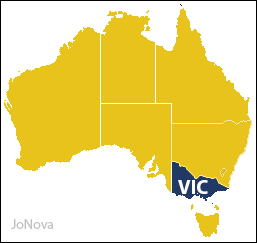 The good news: Lockdowns will end sooner than expected. Not soon enough for some desperate businesses, but sooner than Dan Andrew’s modelers thought.






Recent Comments