Instrument errors, noise, may account for a quarter to one half of our national warming trend in the last century.
When the newspapers run a headline with Sydney hits, say, 44.4 degrees and that number gets engraved in history, who realizes that the extreme heat may have only lasted one second? You might think the maximum temperatures were above 44 for at least ten minutes, but the BOM will write it into the record books even if that heat lasts one second, and if the temperature a minute before was more than a whole degree cooler. We’re writing puffs of jet emissions, car exhaust, or random packets of hot (or cold) air into history books, and comparing these new records with old ones done in slow reacting liquid in glass thermometers. No wonder we are setting records!
In the last twenty years, electronic sensors have replaced most of the old fashioned thermometers. It’s for exactly this reason that we need the side-by-side comparison data that Bill Johnston asked for and which the BOM can’t supply because it is deleting the data – as a matter of routine practice.
Back in 1910, or even 1990, thermometers were not able to record a spike of heat (or cold) that lasted for such a short time. Liquid-in-glass thermometers just can’t react that fast (who remembers waiting with a thermometer under their tongue as a child?)
This is not just about headline grabbing records, but about temperatures recorded every day and used to calculate long term trends. The effect of bringing in newer more sensitive thermometers in the mid nineties could cause a “step up” in maximum temperatures.
Any politician who cares about the climate would order one immediately.
Meteorologists debate whether it should be 5 minute or 7 minute averaging, not 1 second
A paper by Lin & Hubbard in 2008, argued that, even 5 minute averaging was not long enough to avoid some warming bias in maximums (and cooling biases in minima). We don’t have to ask what they would think of one-second “averaging” or sampling rates:
“Commonly-used 5 min average was not sufficient for the fast-response thermometers in surface climate networks while the WMO standard thermometer (20 s time constant) should have a 7-min running average for reporting daily maximum and minimum temperatures. The surface temperature sensors with smaller time constant than the standard LIG [Liquid in glass] thermometers must implement a follow-up running average algorithm.”
The story of strange temperature mismatches appearing
A few months ago, Ken Stewart and others in the independent BOM Audit team (like Lance, Phill, Ian, Chris, Bill, Geoff, Bob and Tony) were watching the various BOM data channels when they noticed strange mismatches. The live update BOM observations page records temperatures every 30 minutes at hundreds of sites across Australia. Sometimes though, the daily maximum temperature would lie far above any of the 30-minute observations. Stewart wrote to the BOM to find out why, and was shocked to hear that the 30 minute data was not the average of the last 10 minutes, or even the last single minute. It was just a random sample of the data the second before.
So Ken asked for the detailed data (and paid for it) so he could graph and see how long the temperature spikes were lasting. But what he found was that readings would sometimes erratically rise and fall, chopping up, down and up, and the spikes — were often outliers, far beyond normal variation. And there was no apparent mechanism to remove these noisy errors either (at least, not on the high side). And normally noise is not so important – it cancels out when numbers are averaged — but when only the highest moment (or the lowest) is recorded, there is no averaging among the Maxes, and nor the Mins — though the cooler extremes are less affected by the spikes and rapid changes that are going on in the hottest part of the day.
Sometimes a temperature two whole degrees above the rest of the readings was being recorded for posterity as the the daily max, which may theoretically be also recorded as the hottest day ever… See these graphs below and be prepared to change the way you think about “record temperatures”.
To find out how often these spikes occur, Ken graphed how fast temperatures changed within one minute of the daily maximum temperature being reached — and fully 44% of all the readings he looked at, the temperature fell more than 0.3C within one minute. In theory these electronic thermometers are supposed accurate to 0.2C, so swings this fast could be due to pockets of warm air coming and going (like a jet turbine) or they could be errors (or both). In 200 cases Ken found five situations where the one minute drop after the peak temperature was reached was 0.6C – 1.5C!
More importantly — the entire 20th century warming trend — as Ken points out — is only 0.9C. If these thermometers are picking up noise spikes as big as two degrees, it’s no wonder the BOM doesn’t put error bars on the century long trends.
There have been no studies published of automatic electronic thermometer probes and the old fashioned liquid in glass thermometers side by side.
Record temperatures, maximum and minimum temperatures, and monthly, seasonal, and annual analyses are based not on daily values but on ONE SECOND VALUES.
The Bureau reports daily maximum and minimum temperatures at Climate Data Online, but also gives a daily summary for each site in more detail on the State summary observations page , and a continuous 72 hour record of 30 minute observations (examples below), issued every 30 minutes, with the page automatically refreshed every 10 minutes, also handily graphed.
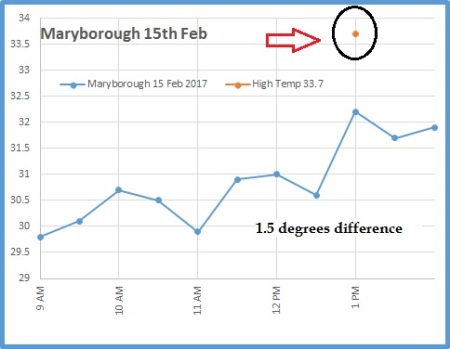
In Maryborough on the fifteenth of February this year the daily maximum was recorded as 1.5C above the highest 30 minute data point.
At Harvey Bay, the temperature was 2.1 C below the reading at 6am.
I sent a query to the Bureau about Hervey Bay, and the explanation from the Bureau’s officer was enlightening:
Firstly, we receive AWS data every minute. There are 3 temperature values:
1. Most recent one second measurement
2. Highest one second measurement (for the previous 60 secs)
3. Lowest one second measurement (for the previous 60 secs)
In Stewart’s words:
The temperature reported each half hour on the station Latest Observations page is the instantaneous temperature at that exact second, in this case 06:00:00, and the High Temp or Low Temp for the day is the highest or lowest one second temperature out of every minute for the whole day so far. There is no filtering or averaging.
The BOM tries to explain why:
The explanation for the large discrepancy was that “Sometimes the initial heating from the sun causes cooler air closer to the ground to mix up to the temperature probe (1.2m above ground).”
However… it can be seen that the wind was south east at 17 km/hr, gusting to 26 km/hr, and had been like that all night, over flat ground at the airport, so an unmixed cooler surface layer mixing up to the probe seems very unlikely.
You will also note that the temperatures in the final second of every half hour period from 12.30 to 6.30 ranged from 25C to 25.5C, yet in some second in the final minute before 6.00 a.m. it was at 23.2C.
How to spot natural versus unnatural temperature changes
In Part 2, How Temperature is “Measured” in Australia Stewart describes what the differences are between natural and unnatural temperature fluctuations, and looks at the noise levels on minima compared to noise levels on maxima.
Not all quick changes are unnatural.
Temperatures can change quite rapidly in a natural setting — for example, as the sun rises over an inland spot (like Urandangi) temperature rise 5.1C in 24 minutes. So that’s a sustained rapid rise of 0.2C a minute. Fast! But we wouldn’t expect to find rises that are faster than that in coastal situations, or ones that happen during the middle of the day. We also wouldn’t expect to find cool changes that come and go in a minute – flip flopping from warm to cold to warm. We know that cold fronts and other changes can come through and drop temperatures rapidly (as Ken describes, like a 1.2C fall over 1 minute in Rockhampton) — but these are step up or step down changes that are sustained after the shift.
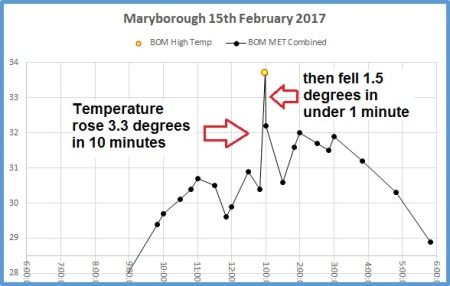
What’s not natural are spikes like this in Maryborough where temperatures rise 3 degrees in ten minutes then fall 1.5 degrees in just one minute straight afterwards.
” …rogue outliers are being captured as maxima and minima.”
Doesn’t noise just cancel out and won’t this make minima cooler too?
The errors don’t cancel out — high spikes are recorded as the max of the day. The noise that trends downwards (and is cooler) during the hot part of the day is not recorded in the long term climate records. (As is hot noise during the coolest part of the day). As Stewart points out during the warm part of the day “only the highest upwards spike, with or without positive error, is reported. Negative error can never balance any positive error.”
Stewart analyzed both the hot and cold parts of the day and found that there is a lot more variation during the hot part of the day. As well, the Bureau was caught clipping low side “noise” (and even low side real measurements) at Goulburn and Thredbo a couple of months ago. They have not answered questions about when this clipping started, and which stations it applies to. They are doing an inhouse review instead.
Ironically, because there will be a smaller cooling effect, as well as the larger warming one, it will mean the DTR (Diurnal Temperature Range) will be increased. This is not what the CO2 modelers are looking for. They expect CO2 to shrink that diurnal range by keeping the heat in at night and bringing up the minima.
Instrument errors may account for a quarter to one half of our national warming trend in the last century:
There is some ambiguity about the error margins of the electronic AWS sensors, is it +/- 0.2 or +/- 0.5? In 2011, the BOM mentioned that 10% of electronic thermometers are functioning outside the +/- 0.2 range that is more than 50 probes in the network.
Stewart concludes that because these one-minute differences are so common he thinks it’s likely nearly half of the high temperatures recorded may be 0.2C too high, saying that “Instrument error may account for between 22% and 55% of the national trend for maxima.”
Stewart has a wish list of things that need fixing which include replacing automatic electronic sensors at at least 50 sites. Obviously the Australian BOM should not be using one-second samples but something more like ten minute averaging. He wants the BOM to show error bars on all it’s long term trend calculations. He wants the BOM to redo their filters so they can identify their spurious spikes.
I naively thought that the ‘raw data’ was mostly good data. But now I am even sceptical of this.
As someone who values data above most else – this is a stomach-churning revelation.
Indeed, it could be that the last 20-years of temperature recordings by the Bureau will be found not fit for purpose, and will eventually need to be discarded.
Just yesterday I wrote a rather long letter to Craig Kelly MP detailing these and other concerns. That letter can be downloaded here: TMinIssues-JenMarohasy-20170831
Corals first appeared 540 million years ago, but having made it through supervolcanoes, mass extinctions, and an asteroid impact equivalent to 10 billion Hiroshima A-bombs, it’s now likely they will be wiped out because a trace gas has risen from 20% up to 25% of levels common for half of the last 300 million years.
Source: www.geocraft, Scotese and Berner 2001
Having made it through the volatile last 65 million years, and multiple ice ages where the oceans rose and fell by as much as 125m repeatedly, it will be tragic if the current man-made warming phase wipes them out. According to one thousand tide gauges the worlds oceans are relentlessly rising by 1mm every year. While corals coped with the last 125,000mm of sea level rise, it’s not clear they will still be around if it rises another 20mm.
Current climate change marked in
The team of 22 researchers admit “there is still a lot to understand about corals,” and “there are major knowledge gaps”. But despite not knowing much, the experts on marine ecosystems advise that “our only real chance for their survival” is to control the global climate.
While they don’t actually predict the exact year the world will be coral-free, they do say “The time to act is now, as the window of opportunity to save coral reefs is rapidly closing…”
Looks like that’s it for 542 million years of the evolution of corals. Pfft. A world without coral?
The cost of Going Green, The Australian, Cover, September 1, 2017.
The Australian calculates the total bill will be in the order of $60b for green electricity.
It’s not like we could have done something better with that.
Read it all (if you can), then write to your MP and Senator. Ask why — if they are serious about helping reduce CO2 — we don’t have a USC coal plant like so many other countries, and why we don’t have nuclear power. Then ask why, if they are concerned about the poor, about health, about education, we are wasting $60b dollars to try to change the weather in 2100 that we could be spending on these critical areas right now?
Taxpayers will have paid more than $60 billion through federal renewable energy subsidies by 2030, about twice what the crumbling car industry received over 15 years and enough to build about 10 large nuclear reactors.
The government’s large and small-scale renewable energy targets, which will compel energy retailers to buy 33 terawatt hours of wind, solar and hydro energy by 2030, will deliver about $45bn of subsidies to renewable energy producers over 20 years, according to analysis by The Australian.
If it’s improving and getting cheap, whatever you do, don’t buy it yet:
It’s hard to argue with ACIL Allen Consulting chief executive Paul Hyslop:
“Solar costs have probably fallen 75 to 80 per cent in the last six or seven years,” Mr Hyslop told the energy and environment committee. “If we had not done anything seven years ago and today we then did all those things, we could have … two to three times as much solar (energy generation) in roofs for the same amount of investment over that period.
“If you think that the cost of renewables and low-emission technology is falling rapidly, absolutely put it off for as long as possible.”
Economist Geoffrey Carmody, a founder of Deloitte Access Economics:
“If we sweep nuclear energy off the table in favour of renewables, achieving these three conflicting objectives with one instrument — renewable energy — is numerical nonsense,” Mr Carmody said.
Australia is the only G20 country to have banned nuclear power.
Read it all….
PS: USC = Ultra super critical coal. Hot burning generators are so much more efficient. They cut emissions but without the pain of intermittent unreliable generators. Japan, China, India have lots of them.
If we started planning one now we might catch up in the advanced technology stakes with Indonesia.
Malcolm Turnbull cannot afford to fiddle around any longer before tackling Australia’s energy crisis. Handled well, the issue would be an election winner for the Coalition…
That [the $60b] is twice what our crumbling car industry received in the 15 years to 2012. It would build 10 large nuclear reactors, an option long dismissed by politicians as too expensive. Present policies provide an exorbitant taxpayer-funded windfall for renewable energy producers for little if any public benefit. However inefficient, car industry subsidies protected about 40,000 jobs. By comparison, 39 renewable energy projects under construction or being completed this year have created 4400 jobs, according to the Clean Energy Council.
We allowed a free market in gas, but didn’t allow one in coal generation.
If we had true free markets, we wouldn’t worry about high gas prices. We’d just profit from the high priced gas sales, and get cheap electricity from coal. We wouldn’t need so much gas if we didn’t have so many intermittent wind generators.
Malcolm Turnbull has seized on energy spokesman Mark Butler’s admission that Labor was warned that customers would be hit with higher energy prices from the gas exports it authorised in government five years ago, blaming the Gillard government for the spike in gas prices which has seen energy bills rise dramatically.
Mr Turnbull said the Gillard government had made a “reckless” decision in allowing gas to be exported from the east coast of Australia without putting in any protection for Australian families, households and businesses.
The coalition is taking the wrong tack. Real free markets produce better cheaper outcomes. The problem is the regulations in the electricity market.
How many people have died prematurely because they swapped their fats for carbohydrates?
More fat meant less death (left). More carbs (right) meant the opposite (at least above 60%). (Click to see the full table of Figure 1 results).
New research published in the Lancet shows that low fat diets could increase your risk of death.
Specifically, those who are in the top fifth of carbohydrate-eaters are also about 28% more likely to die than the fifth eating the lowest amount. This is a correlation (only), but the PURE* study was tracking the thing that matters most — all-cause mortality — and they followed the diets of 135,000 people in 18 countries for 5 – 9 years. Loosely, if people avoided high carbohydrate diets, they were less likely to die.
The graph flattens off below “60% carbs” (that’s a percentage of total calories). However, the mortality numbers keep improving for the highest fat intakes which rather skewers 40 years of headlines. I’m guessing that some people who kept carbs below 60% ate more protein instead, which, judging by the “fat” graph, wasn’t as useful.
The McMaster University team announced this quiet bomb, slightly obscured, in a press release about three papers at once under a tame headline, “Moderate consumption of fats, carbohydrates best for health, international study shows.”
Read carefully:
…higher fat consumption was associated with lower mortality; this was seen for all major types of fats (saturated fats, polyunsaturated fats and mono unsaturated fats), with saturated fats being associated with lower stroke risk.
So saturated fats might reduce strokes?
Total fat and individual types of fat were not associated with risk of heart attacks or death due to cardiovascular disease.
This is not the dietary approach that 97% of experts and officials recommend.
The current government consensus, backed by thousands of scientists and doctors, and running for decades, tells people to limit fat and eat a high grain diet (which means carbohydrates). See the US Dietary Guidelines.
The message has generally been to “limit fat”, be careful with protein, and fill up all the empty spaces with carbs.
The current US Food guidelines puts a big emphasis on grains (carbs).
Guideline 2 recommends “Milk, yoghurt, cheese and/or their alternatives, mostly reduced fat“. Guideline 3 tells us to Limit intake of foods containing saturated fat,…
Australian experts remark that “Low fat diets are not suitable for children under the age of 2 years.” They don’t say that low fat diets may increase the risk of death in people over 2.
Grains make up the largest part of the food plate in Australian Government Recommendations. | Click to enlarge
The news that fat is no demon, will come as no surprise to people who have been looking at medical papers, internet forums, and some popular diet books for the last twenty years. (Though notably, the percentages assessed in the PURE study are not remotely “keto” levels of low carb which are in the 5% carb range and 75% fat as per the Atkins, or Keto-style diets.)
Presumably the mainstream consensus and recommendations will shift in the next 5 – 10 years to soften up on the anti-fat dogma, and start to warn people that just making your bread wholemeal doesn’t neutralize the carbs and turn it into a superfood. When will food pyramids and guiding-plates drop the non-essential “essential grains” meme?
In the meantime, the people who obediently follow the official experts can be sure that “consensus” is self correcting eventually — but the process can still be deadly.
For those who want the gritty details, the lowest quintile of carbohydrate intake ate about 46% or less of their calories from carbohydrates. The highest quintile — 77% or more. So most people won’t have a clue, (or an inclination) but if you do, there is good software available online to estimate these numbers (and a lot more). It’s easier than you think.
On saturated fats, the researchers write that things are complicated, but we appear to need some small base level:
Collectively, the available data do not support the recommendation to limit saturated fatty acids to less than 10% of intake and that a very low intake (ie, below about 7% of energy) might even be harmful.
Sat-fats might not be so bad, but at 10% of daily intake we are only talking of 20 grams a day in a 2000 calorie diet. It’s still not a lot.
On monounsaturated fats, the finding is consistent across many big studies:
We found an inverse association between monounsaturated fatty acid intake and total mortality. Consistent with our findings, two large cohort studies of the Health Professionals Follow up and the Nurses’ Health Study showed lower total mortality by higher monounsaturated fatty acid intake.46
Monounsaturated fats means olives, avocados and some nuts.
And of course things can be confounded by the fact that carbs are cheap, cheap, cheap, and maybe some people who are eating lots of carbs just don’t have the money to afford the more expensive fats and especially proteins. (Though they did adjust for income, education, wealth, etc to try to consider that).
Finally, at least they do recommend that the consensus shifts, and it’s worth mentioning that they refer to other enormous separate studies (Health Professionals Follow up and the Nurses’ Health Study) as well as some randomized trials:
Global dietary guidelines should be reconsidered in light of the consistency of findings from the present study, with the conclusions from meta-analyses of other observational studies and the results of recent randomised controlled trials.
This is a good sign. Fifteen Ivy league professors have offered advice and a warning to students everywhere –to recapture the spirit of truthseeking and free debate. The message might just catch on, because although the young strive to conform to fashionable norms, approximately none of them want to be seen doing so. Who wants to be a the weak minded conformist?
The real bigots are those who fear open-minded enquiry…
It’s sad that it needs to be said, but we don’t train children to question fashionable truths and always look at both sides.
Our advice can be distilled to three words:
Think for yourself.
Now, that might sound easy. But you will find—as you may have discovered already in high school—that thinking for yourself can be a challenge. It always demands self-discipline and these days can require courage.
In today’s climate, it’s all-too-easy to allow your views and outlook to be shaped by dominant opinion on your campus or in the broader academic culture. The danger any student—or faculty member—faces today is falling into the vice of conformism, yielding to groupthink.
It is great to see them stepping into the fray:
Thinking for yourself means questioning dominant ideas even when others insist on their being treated as unquestionable. It means deciding what one believes not by conforming to fashionable opinions, but by taking the trouble to learn and honestly consider the strongest arguments to be advanced on both or all sides of questions—including arguments for positions that others revile and want to stigmatize and against positions others seek to immunize from critical scrutiny.
The love of truth and the desire to attain it should motivate you to think for yourself.
They are calling out the namecallers who have distorted the meaning of the word “bigot” and use it to shut down questions:
Merriam-Webster’s first definition of the word “bigot” is a person “who is obstinately or intolerantly devoted to his or her own opinions and prejudices.” The only people who need fear open-minded inquiry and robust debate are the actual bigots,…
“These views should probably come with a trigger warning on Ivy League campuses, but are likely to be celebrated by parental check-writers from sea to shining sea.”
It’s a very well written article: Bonackers vs. Big Wind by Robert Bryce. h/t Andrew. The good news is that opponents of wind power are having a lot of success onshore. The bad news is that the renewables industry is pushing offshore instead, but fishermen don’t want them either, and families that have been fishing the same areas for 300 years are up in arms.
“The South Fork fishermen are fighting to preserve their access to some of the most productive fisheries in the world.”
Some eye-opening numbers:
Obama set a target of 10GW of offshore wind power by 2020. But right now there is only 30 MW. It’s 9,970MW short. The offshore push is on.
To replace a single nuclear generator will take 45 offshore wind plants.
Offshore generation costs as much as three times what gas power costs per KWh.
They face big money renewables proponents — not just rich beachfront homeowners, but large corporations who want tax credits worth millions, and groups like Norwegian oil giant Statoil ASA, plus the Sierra Club and Natural Resources Defense Council (NRDC). Governor Andrew Cuomo has a goal of “producing 50 percent of the state’s electricity from renewables by 2030.” But to do it, bills will go up for the poor.
The backlash on land:
“The backlash against Big Wind is evident in the numbers: since 2015, about 160 government entities, from Maine to California, have rejected or restricted wind projects. One recent example: on May 2, voters in three Michigan counties went to the polls to vote on wind-related ballot initiatives. Big Wind lost on every initiative.
An analysis of media stories shows that, over the past decade or so, about 40 New York communities have shot down or curbed wind projects.”
Onshore wind is becoming unviable due to opposition. So New York Governor wants it offshore. But fishermen don’t want wind power either.
“Alex. Beckwith traces his family’s roots in the region back more than 300 years. “I’m totally opposed” to the wind project, he said. “It’s going to be a hazard to navigation.”
Expanding offshore wind to the 2.4 gigawatts that Cuomo has pledged will require covering about 300 square miles of offshore territory with turbines.
… fishermen are facing “permanent denial” of their labor in the areas in and around the proposed projects. “We can’t go anywhere else,” she tells me. Asked about the politics of offshore wind, Paul Farnham, who owns the Montauk Fish Dock, which packs fish for shipment and sale (on consignment) to the New Fulton Fish Market at Hunts Point in the Bronx, replies: “I’ll guarantee you, 90 percent or more of all these fishermen voted for Trump. It wasn’t because they liked him. It was because they wanted less regulation.”
Professor Peter Ridd has made the mistake of putting scientific standards ahead of collegial comfort. What was he thinking? He seems to feel he should serve the people of the Queensland instead of helping the careers of co-workers and admin staff.
Ridd is being accused of “Not acting in a collegial way” (or something like that, no one is allowed to say for sure) and is now under investigation for serious misconduct.
The federal government is set to spend more than $1 billion on the Great Barrier Reef in the next few years to mitigate the effects of climate change, based largely on research that is claimed not to have been subjected to proper scrutiny.
James Cook University physics professor Peter Ridd writes in a new book that the credibility of key research papers driving investments in the reef rest on “a total reliance on the demonstrably inadequate peer-review process’’.
Professor Ridd argues for the establishment of a properly funded group of scientists whose sole job is to find fault in the science “upon which we are basing expensive public policy decisions regarding the Great Barrier Reef’’.
Ridd wants to get the Barrier Reef science (and policy) right:
“It’s [the Great Barrier Reef policy] affecting the sugar industry, the cattle industry, the mining industry, the tourism industry…”
“there is a certain duty of care on scientists to make sure they get it right. I don’t think they are..”
…in other areas of science when they do proper checking about half of it is wrong, so why aren’t they trying to check it.
They want to shoot the messenger…”
Peer review is a cursory look at the science, they don’t review the data, but if you are going to spend a billion dollars…
As Jennifer Marohasy says:
Rather than James Cook University sacking Peter Ridd for having the courage to speak out, it would be good if they would get behind him, and his calls for urgent reform.
The question is whether JCU care about getting the answers right?
Peter Ridd writes a lot more in his chapter in the new book Climate Change: The Facts 2017. Co-authors include yours truly, Clive James, Matt Ridley, Willie Soon, Roy Spencer, and Anthony Watts. Pre-order your copy now, the first edition, released last week, has sold out.
h/t Jennifer M
Of professors, there are only a few,
Who dare challenge or doubt peer-review,
Of all topics climatic,
Which is so problematic,
For alarmists who think it taboo.
Remember the Electrical Eclipse-Fear? For months, people were coached to use less electricity during the eclipse for fear that the grid might fall over as marvelous new-revolution-solar stopped working. The media were selling the message that we might not cope without solar. I figured this would be as big a threat as a cloudy day (but easier to prepare for.).
So after all the spin, what happened? Electricity was massively oversupplied, and spot prices went negative.
Apparently people went outside to watch the sky. (At least that’s Southwest Power’s excuse.)
Most of the groups that hyped the fear don’t seem to have mentioned the failure so much:
Grid operators and traders thought they were totally prepped for the historic U.S. solar eclipse. There was just this one thing they didn’t completely factor in: “irregular human-behavior patterns.”
That’s the technical definition, from the folks who manage the electricity network at the Southwest Power Pool, for the conduct of millions of Americans who were outdoors ogling the moon shadowing the sun instead of cranking up the A/C in homes and offices.
This was a bummer for traders who’d bet prices would jump as a whole load of solar-produced megawatts faded to black.
Spot power in California fell to negative levels as the eclipse wiped out and restarted thousands of megawatts of solar power, and they also dipped from Texas to New York.
Then at 11:50 a.m. local time — as the sun started to reappear from behind the moon — the ramp-up in solar power sent prices to a low of minus $15.97.
…the next total eclipse in the U.S.: April 8, 2024.
The normal unpredictable variation of solar and wind power is far harder to deal with than the predictable dips from a solar eclipse.
Justin Gillis, writer for The New York Times used the recent eclipse to sell something I’d call Sciencemagic. Essentially, if some Scientists™ can calculate orbital mechanics to a fine art, it follows, ipso nonfacto, that all people who use the same job title are also always right.
Thanks to the work of scientists, people will know exactly what time to expect the eclipse. In less entertaining but more important ways, we respond to scientific predictions all the time, even though we have no independent capacity to verify the calculations. We tend to trust scientists.
If Scientists™ say that solar panels will stop malaria, then buy some! Save lives in Ghana. (What are you waiting for?)
The implications stretch far. Clearly, we can chuck out the whole research thing (labs, who needs em?) Why test predictions, if Scientists™ are 100% accurate? We’ve been wasting money. We don’t need more large hadron colliders, we just need to survey more particle physicists.
This idea that job titles have a kind of truth-telling power is not much different to astrology where truth comes from birthdates.
Preacher-Gillis struggles with cause and effect:
So what predictions has climate science made, and have they come true?
The earliest, made by a Swede named Svante Arrhenius in 1897, was simply that the Earth would heat up in response to emissions. That has been proved: The global average temperature has risen more than 1 degree Celsius, or almost 2 degrees Fahrenheit, a substantial change for a whole planet.
It’s the most tritely obvious thing that any cause of warming would cause… warming. Was it CO2, or solar spectral changes, solar magnetic effects, or solar particle flows? Gillis seems to think that warming itself is evidence that CO2 is the problem. It’s magical short-term thinking. But turning points, dammit, tell another story. If CO2 was the major driver there wouldn’t be major turning points that we can’t explain. For half the decades since Arrhenius made that prediction, global temperatures have been not-behaving as Arrhenius predicted – CO2 was on the rise, and global temperatures weren’t.
Hadley Global Temperature Graph with Phil Jones trends annotated on top.
Gillis provides a cherry picked random-hits list (Not only are these signs of any warming but if you make forty predictions — some will work out, it’s quite difficult to fail on all forty):
The scientists told us that the Arctic would warm especially fast. They told us to expect heavier rainstorms. They told us heat waves would soar. They told us that the oceans would rise. All of those things have come to pass.
Considering this most basic test of a scientific theory, the test of prediction, climate science has established its validity.
The globe has two poles, and the Arctic warmed but the Antarctic did the opposite. On a yes-no question, a 50% success rate is not “success” but random luck.
As evidence, Gillis links to model predictions of “heatwaves” that haven’t even happened yet. For “heavier rain” he links to a story from 2014 that he wrote that is almost cut n paste identical to the current story — same cause and effect problem. Hello Justin — what kind of warming will not cause water to evaporate from the ocean leading to more rain? (What goes up must come down). If the solar dynamo was warming Earth, we’d see these exact same events. The only difference is that solar theories explain more of the turning points, and far more of the history.
Then there is the old warming-troposphere-cooling-stratosphere fingerprint which shows that CO2 is increasing (which we already knew from measurements) but not that CO2 causes global warming:
By the 1960s and ’70s, climate scientists were making more detailed predictions. They said that as the surface of the Earth warmed, the temperature in the highest reaches of the atmosphere would fall. That is exactly what happened.
Applying exact tests, inexactly:
If the science were brand new, that might make sense, but climate scientists have been making predictions since the end of the 19th century. This is the acid test of any scientific theory: Does it make predictions that ultimately come true?
What kind of “acid test” is not an acid test? The Gillis kind:
Considering this most basic test of a scientific theory, the test of prediction, climate science has established its validity.
That does not mean it is perfect, nor that every single prediction is correct. While climate scientists have forecast the long-term rise of global temperatures pretty accurately, they have not been as good — yet — about predicting the short-term jitters.
In other fields, we do not demand absolute certainty from our scientists, because that is an impossible standard.
The acid test used to separate gold from base metals, it gave a definitive answer, but in Gillis-world copper is gold is nickel. Who cares? This is sloppy language — so sloppy it’s meaningless. If a salesman spoke like this we’d call it deceptive marketing.
There are no Gods of Science
Lots of eminent and otherwise sensible scientists still say things that are wrong:
Gillis would protest that I miss the point. Individual scientists can be wrong, but this is a C.o.n.s.e.n.s.u.s. as if group thinking crosses some magical line into truth. Despite all the evidence that experts get things wrong and for decades, Gillis helps to propagate those mistakes by being an apologist for B-grade thinking, asking no hard questions, doing no investigation and pandering to unscientific excuses.
The Andrews government this morning unveiled a new renewable energy target with a commitment to power up to 25 per cent of the state from renewables by 2020 and 40 per cent by 2025.
The government has backed the construction of two large scale solar farms in regional Victoria which will provide another 140MW to the state’s supply, and has set up a reverse energy auction system to bring forward an additional 650MW to the state’s supply.
Victorian households will allegedly each save around $30 annually on power bills under the new plan, while medium sized businesses have been projected to save up to $2400 a year under the legislation which will be introduced to parliament today.
It’s almost like Victoria plans to make electricity from legislation (hey, it’s renewable, and will never run out). By making electricity shockingly expensive, Government ministers can talk of “savings”, even though prices will be far higher than the average price of electricity for the last twenty years.
Do the maths. A few months ago, a major Victorian coal generator shut down. Hazelwood provided 1,600 megawatts, 22% of the state’s electricity at $30/MWhr. South Australia just signed a deal for solar power averaging a price of $70-plus-per-megawatt-hour (plus RET scheme, government loans, and who knows what other subsidies).
This is Soviet-style electricity management:
The plan would deliver an increase to the state’s energy supply because it gives investors the certainty they need commit to large-scale renewable energy projects, according to Energy and Climate Change Minister Lily D’Ambrosio.
The word certainty is code for guaranteed profits from forced customers who are not permitted to buy the cheaper alternative.
Strangely coal investors don’t seem to need “certainty” from legislation (governments and investors are building 1600 new plants in 62 countries, but not one in Australia.) Coal power investors get certainty by selling a product that they know freely consenting adults will always want to buy. One version of certainty is driven by the free market, the other by government dictat.
There was no Medieval Warm Period in China. No little ice age either. Not warm in Roman times either.
Obviously CO2 controls this climate.
(Click to enlarge)
Quansheng et al show that weather is lumpy, that modern warming is a lot like past warming. They go so far as to say that there are regular cycles and hint that sun might have something to do with it, and volcanoes.
“…centenial variation is significantly correlated with long-term changes in solar radiation—especially cold periods, which correspond approximately to sunspot minima, as well as the frequency of large volcanic eruptions.”
They go on to say that rate of warming was about half a degree per century lately. It may have been the fastest rate, but then again, it may not. It was hard to tell with the error bars being so wide. It was all done with proxies and has a ten year resolution. Obviously it is in need of having homogenadjustoided thermometer data added after 1960 as is the custom in climate science.
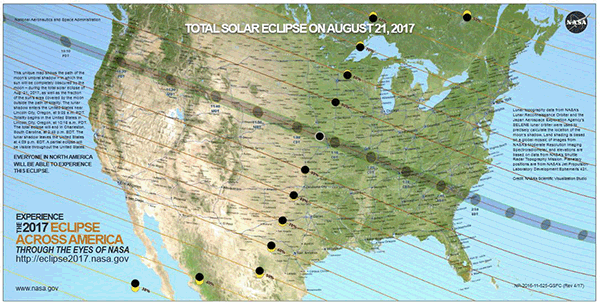
Grid operators, utilities and electricity generators are bracing for more than 12,000 megawatts of solar power to start falling offline as the moon blocks out the sun across a 70-mile-wide (113-kilometer) corridor stretching from Oregon to South Carolina.
This is the first major test of the power grid since America started bringing large amounts of intermittent solar and wind resources onto the system. It comes just as the grid is undergoing an unprecedented transformation whereby flexible resources such as battery storage will complement growing supplies of solar and wind.
Reader Andrew writes: “The path of totality is trivially narrow although the partial eclipse is quite wide. But they mustn’t have clouds in the US.”
Indeed.
Looks like it is being marketed as some kind of dummy run to “prove” intermittent energy will not hurt the grid when it “takes over”?
The celestial event provides an opportunity to test plants, software and markets refined in recent years in anticipation of the day when renewable energy becomes the dominant source of power.
Or perhaps it’s just the faithful reassuring themselves that the eclipse won’t end up being another disastrous blackout other people can blame on renewables. Look at how much trouble they have to go to:
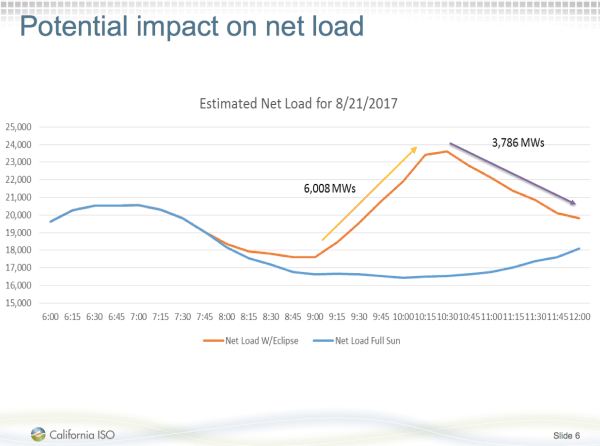
California, home to more solar power than any other state, will tap into its network of hydropower generators and gas plants that can ramp up quickly to fill a 6,000-megawatt gap in solar energy. The state also embarked upon a public relations campaign to convince residents to conserve energy to minimize greenhouse-gas emissions while solar plants are down.
These stories of fear of a grid breakdown or “whiplash” have been going on for months:
The Australian National grid deals with about 3,500MW of wind power coming and going all the time and without 3 months to plan for it. Surely California can cope with 6,000?
I predict happy stories tomorrow of how the-solar-grid survived the test.
Wind-farms and solar thermal plants will prey,
On birds of every size who fly their way.
The public, to pay less per kilowatt hour,
Must vote to drive the zealot Greens from power.
Australia’s constitution has a flaw,
When politicians wish to change the law,
By referendum, have the flaw corrected,
That very flaw will rule their wish rejected.
Bad-tempered glass can have a snap eruption,
Like children’s tantrums cause a quick disruption.
This used to be black glass, now it’s a sinkless, shattered crazed basin and bench.
Who knew tempered glass could suddenly fracture and in some cases explosively?
We have a bathroom basin and countertop of moulded thick black glass. For about five years it was happy, then late one night this week, for no reason, it shattered — the sink fractured into 100 pieces and fell into the towels below. The countertop crazed from end to end even tossing a few cubes of cracked glass up to two meters away. Luckily no one was in the room. The new white dusty look was created by the crazing pattern, which slowly continued for the next few hours. We could hear the odd crackling noise every now and again as the last of the tempered tension in the glass ebbed away. Even far corners — away from the sink — broke off. It turns out this is a natural, rare phenomenon.
Exploding shower-screens, shelves, sinks, car windows, and patio tables?
One four year old needed hospital care after a shower screen shattered, though luckily, people rarely get hurt, but it is disconcerting, and it’s easy to imagine how this could end very badly, especially in glass towers far above the ground.
Many people report that it sounds like a gunshot or car backfiring. So some people thought their house was being invaded (rather terrifying, I would think), others feared someone shot at them, or they were victims of a stray bullet. Some hunt for spent bullets, and a quite a few other poor sods got very spooked, wondering if their house was being occupied by angry spirits. Think poltergeists and ghosts. The most common words posted were “I’m so glad I found this thread.”
Tempered glass and the rare Nickel Sulphide intrusion
The best explanation is that a manufacturing defect leaves tiny traces of nickel-sulfide as an intrusion. The problem has been known about since the 1940s. The flaw can trigger any time without warning, though most events occur in the earlier years. There is an excellent discussion at The Achilles heel of toughened glass by Dr John Barry:
Ross Clark, journalist, met Al Gore to interview him about his favourite topic. But Ross broke the rules; he did some research. Clark even talked to a professor about the scenes of Florida being flooded. The prof explained that it’s not so much that the seas were rising fast, but that the land under Miami is sinking — and by an amazing 16-24cm in the last 80 years. (No wonder some residents are seeing water inundate new areas.)
When I put all this to Al Gore and ask him whether his film would be stronger if it acknowledged the complexities of sea level rise — why it is rising in some places and not in others — I am expecting him to bat it away, saying that it doesn’t counter his central point and that there is a limit to what you can put into a film pitched at a mass audience, but his reaction surprises me. As soon as I mention Professor Wdowinski’s name, he counters: ‘Never heard of him — is he a denier?’ Then, as I continue to make the point, he starts to answer before directing it at me: ‘Are you a denier?’ When I say I am sure that climate change is a problem, but how big a one I don’t know, he jumps in: ‘You are a denier.’
That is a strange interpretation of the word ‘deny’, I try to say. But his PR team moves in and declares ‘Time’s up’, and I am left feeling like the guy in Monty Python who paid for a five-minute argument and was allowed only 30 seconds. On the way out, a frosty PR woman says to me: ‘Can I have a word with you?’ I wasn’t supposed to ask difficult questions, she says, because ‘this is a film junket, to promote the film’.
Surely if you are going to make a film claiming climate change to be a grave threat to the world, you ought to be prepared to answer detailed questions about it. — The Spectator
Perhaps he just needs more time? Give him another 20 years and Gore may get the hang of the scientific points.
Exposure to climate-denial, “shocking”
It was the same thing a few weeks ago when Nigel Lawson talked about climate change at the BBC. Gore was practically speechless (certainly he ran out of words):
Mr Gore told LBC: “It’s shocking how the BBC is engaged in climate denial, isn’t it?
“I had a personal experience with it this morning. It’s really shocking.”
The way climate denial is referred to — it is almost like the BBC was spreading anthrax or engaged in child abuse. And that’s the message, not that Gore can debate Lawson’s points, just that anyone who asks those questions is such a toxic evil person, so beyond the pale, that even if they were Chancellor of the Exchequer of one of the worlds top economies they don’t deserve to be interviewed. (If only Lawson had come second in a US presidential race.)
Gore is trying to scare listeners who found Lawson interesting. His message is both to BBC journalists (how dare you) and to people listening who might be tempted to go to work or dinners and talk about the Lawson interview. Gore wants to keep “climate denial” in the taboo camp by pouring indignant scorn and outrage at the mere idea of a conversation– but he can’t do this forever.
When people lose their fear of asking what their friends think about Lawson (or any skeptic) the infection will spread rampantly.
For foreign readers, the Australian Parliament is undergoing the most extraordinary spectacle at the moment. Politicians have resigned after discovering that they were dual citizens of Australia and some other country — such as Britain, Canada, or New Zealand — which is a clear breach of the constitution. But this is going far beyond people who held two passports. The constitutional affliction is spreading, as more and more politicians get caught up in what will now become High Court cases. Some renounced citizenship in writing before the election but their unwanted sovereign-alternate nation didn’t necessarily acknowledge that for months (that was Malcolm Roberts case). Others never knew their mother applied for them to become a dual citizen. Some claim ignorance or inheritance may be no excuse.
Bizarrely, this could theoretically escalate to involve pretty much the entire parliamentary body.
The stakes are pretty high, given that our current government holds power by just one seat. Already the endangered list includes some ministers. People are resigning from the Senate and being replaced. In the House, no one has left yet but their continued stay will depend on the High Court. By-elections may have to be called, and government may change hands to the Labor Party.
Section 44(i) of the nation’s founding document disqualifies someone from office if that person:
…is under any acknowledgment of allegiance, obedience, or adherence to a foreign power, or is a subject or a citizen or entitled to the rights or privileges of a subject or a citizen of a foreign power…
How to remove every politician in Australia
Last week, David Evans (my other half) pointed out a simple method for a foreign power to get rid of any Australian politician they didn’t like. What if Kim Jong Un, say, granted selected politicians citizenship, or voting rights, or “free health care,” or the rights to some benefits in North Korea? Non-rescindable. Nothing the Australian politicians can do about it. Wouldn’t this disqualify every politician to whom this was granted? The blackmail potential is excellent, obviously.
But it gets worse. Apparently New Zealand has already neutralized the Australian Parliament. Now the only people who can run for Parliament are Australian citizens who are not Australian citizens. Figure that…
Much closer to home, under recent and little-noticed changes to New Zealand law, Australian citizens now don’t need a visa to live, study or work in the Land of the Long White Cloud. That’s right: Any Australian citizen is entitled to live, study and work there.
That means we’re ALL entitled to the rights and privileges of a subject of New Zealand — not a citizen, with the attached rights and privileges such as voting — but to be a subject of that country, living there, subject to New Zealand law, working or studying. And there’s no doubt that New Zealand is a “foreign power” — you only have to watch the All Blacks do the haka to realise that.
What does this mean?
New Zealand law has made every Australian citizen incapable of being elected to, or serving in, the Australian Parliament. It’s not just Barnaby Joyce: It’s everyone!
UPDATE: Seems this is not likely at all. From Tim Andrews (Australian Taxpayers Alliance)
The High Court dealt with this in Sykes v Cleary and in fact in his concurrent judgement Barwick called it “absurd” :
“To take an extreme example, if a foreign power were mischievously to confer its nationality on members of the Parliament so as to disqualify them all, it would be absurd to recognize the foreign law conferring foreign nationality. “
It appears to be a bit of a historical anomaly — one Queen, many countries, that sort of thing.
At the time the constitution was enacted, only Senator Canavan’s Italian citizenship would have triggered the disqualification in section 44(i). Being born in Britain, Canada or New Zealand would have simply made a person a subject of Queen Victoria and therefore not a citizen of a foreign power.
The High Court decided in 1999, however, that at least since 1986, Britain is a foreign power for the purposes of section 44. Canada and New Zealand fall into the same category.
The constitution can only be changed by a referendum, but a referendum can only be initiated by legislation passed by the Australian Parliament. If the New Zealand angle is correct, then all our current politicians are ineligible to be in Parliament and therefore cannot pass the legislation needed to initiate the referendum. No new politicians can be elected without a change to the constitution by a referendum. Checkmate, Australian Government.
South Australian households are paying the highest prices in the world at 47.13¢ per kilowatt hour, more than Germany, Denmark and Italy which heavily tax energy, after the huge increases on July 1, Carbon + Energy Markets’ MarkIntell data service says.
When the eastern states’ National Electricity Market was formed in the late 1990s, Australia had the lowest retail prices in the world along with the United States and Canada, CME director Bruce Mountain said.
The Markintell report graph:
…
Hmm — odd coincidence of Price with Wind Energy Penetration:
Wind energy is “free” but countries with the most wind power are also the most likely to get to the top of the Prize Pool for exorbitant electricity. Wind energy penetration is highest in Denmark (1st), Portugul (8th), Ireland (6th), Spain (11th), Germany (3rd). Conversely, renewable energy penetration is low in places at the tail end of the price curve like Luxemburg 6%, Estonia 15%, Hungary 7%, Lithuania 15.5%. In the low mid price range is France with 80% nuclear generation, and Finland which is 47% Nukes and Hydro.
Could be a message there?
If South Australia were on the graph of wind penetration below it would be equal second at 30%.
…
The end cost of electricity is not just decided by the amount of wind power as a percentage of the grid. Australia as a whole is a stand out – despite having wildly expensive electricity, it only has (as a whole) 5% wind. using 83% fossil fuel sources, it In NSW, Victoria and Queensland, most electricity is generated from fossil fuels. Nor is the cost of electricity due to “renewables” alone, because hydropower is low cost. Countries with a lot of hydropower like Norway have high renewables but low prices. What we can’t find though is a single country with high wind and solar generation that also has cheap electricity.
The Nobel Peace Prize leads to the Nobel Price Price.
Read on to find out (some) of why Australia is such an odd fish.
It’s not just renewables in Australia, the National Electricity Market is a bureaucratic nightmare
The NEM operates one of the world’s longest interconnected power system. It covers a total distance of about 5000km from Port Douglas in Queensland to Port Lincoln in South Australia, with 40,000km of transmission lines.
But herein lies one of the NEM’s weaknesses: it is a very long, weakly connected system which does not provide the ideal underlying conditions for the efficient and transparent operation of the market for electricity. The penetration of renewables, as well as their preferential access to the NEM, has made this weakness even more apparent.
The NEM is not a free market, it’s so over-regulated with state and federal layers and counter committees to undo or outdo each other that any normal price signal is lost.
If we look at the operation of the NEM, one standout feature is the proliferation of regulatory agencies. There is the Australian Energy Market Commission, the Australian Energy Regulator, the Australian Energy Market Operator and the Clean Energy Regulator. And just because we don’t have an enough empire building in the electricity space, the government will add yet another agency: the Energy Security Board, one of the many unfounded recommendations of the Finkel review of the security of the electricity system.
The market used to have a reliable supply with intermittent demand, now both sides of that equation are volatile. The forced uptake of intermittent renewables must surely make the whole system a much more complex beast, and the generators are gaming that volatility. In this case, even the Queensland government is in on the act:
The Queensland government is also attempting to destroy the NEM by instructing one of its generators, but not the other, to bid low at peak times. Mind you, that government has been more than happy to reap the excessive dividends produced by the gaming of the system by these generators.
The customers get screwed by everyone in this:
Some of the bigger [private] players are behaving in duplicitous and self-serving ways, the most egregious example being AGL. All that marketing tosh about being committed to renewables while coal and gas make up 93 per cent of its output of electricity.
The other problem is complexity and customers being unwilling to shift
“…big retailers are content to let customers slip off the deep discounts they attracted them with after a year or two, and onto a costly standing offer or a much smaller discount.
Australian Competition and Consumer Commission chairman Rod Sims said last week he wanted to help consumers find better offers and lower barriers to new entrants to curtail the market power of AGL, Origin Energy, EnergyAustralia and Queensland’s state owned power duopoly.”
Mr Mountain said power bills are constructed in such a complex way that ordinary customers without sophisticated spreadsheet and analytical skills have little hope of analysing competing offers to work out which offers them the best deal.
Private comparison websites do not include all market offers and charge retailers for switching customers, while the websites offered by the Australian Energy Regulator and the Victorian government do not provide the tools customers need to discriminate among offers.
There is no free market for electricity in Australia. If a group just built a coal fired plant and lined up free and consenting customers willing to pay for 100% fossil fuel based electrons, it would be breaking the law. If customers can buy “clean energy” why can’t they choose “fertilizing energy”?
BACKGROUND: As a whole the EU uses about 50% thermal, 25% nuclear, 12% hydro, 10% wind, and 4% “others”. The breakdown by generation source is graphed (awkwardly) here.
Crescent Dunes, Solar Thermal Plant, USA. | Wikimedia Author, Amble.
A company called SolarReserve is planning to build the new Aurora 150MW solar thermal plant at Port Augusta, which is apparently a copy of their Crescent Dunes plant in the US. But that project has been offline for most of the time since last October. The whole SA government is meant to be running 24/7 off “solar power”, which allegedly only has about 8 hours of energy stored up (as heat in the molten salt block). So an 8 month break will be a bit of problem for the SA government (except of course, we all know that the real baseload backup here at 4 or 5am everyday, and most of the day in winter, is ultimately the very fossilized gas and coal.) Since the project only began working in Sept 2015 it managed to operate for all of one year and one month before it went offline for 8 months due to a leak. The SA State Energy Minister is not concerned saying it was a construction issue and SolarReserve “have learnt from that”.
The 150MW myth: most of the time it will be less, a lot less
Here’s an ominous number: Crescent Dunes has worked at an average capacity factor of only 16%. That would mean an average generation of just 24MW of power from the 150MW plant. Theoretically, they are aiming for a capacity factor of 51.9%. (Yes, according to Wikipedia, it is not 51.8%, or 52%, but 51.9%. Very specific spin then?) — Thanks to Graeme No 3 and AndrewWA in comments for their help. And from TonyfromOz who says: “Everything about this SouthAus plant is the hyped to the max best case scenario that NO plant on Planet Earth has achieved yet…”
Should they close their Solar-Parliament each winter?
The South Australian government might want to switch their summer holidays to winter, because Crescent Dunes production in summer was three times as high as their best winter month. (30GWh in Sept 2016 compared to 9GWh in February 2016). SA may well be better off if Parliament has to shut down for winter, but how do you run hospitals and schools on one-third of the power?
Not low-cost:
State Energy Minister Tom Koutsantonis is not a man you want negotiating your deals:
“This deal is an incredible outcome for South Australians. It locks in low-cost power for our schools, hospitals and trams while also boosting supply to the broader market in order to reduce power bills for households and businesses.”
This genius deal is so good, Premier Jay Weatherill is going to waste $2.6 million to sell it to South Australians.
Premier Jay Weatherill has defended allocating $2.6 million to an advertising budget to spruik the plan.
He argued the advertising was necessary to “ensure” investors understood that SA has “a secure energy future” and to protect the state’s reputation against people “seeking to essentially characterise South Australia as having an insecure and unstable energy system”.
Given the likely capacity factor, and the governments use, how many megawatts exactly will be left to spare?
Jay Weatherill has promised a $50 cut to the average household power bill when a $650 million solar thermal power plant is running, even as experts warn that the technology is in its infancy and largely untested anywhere.
The South Australian Premier yesterday visited the proposed site of the world’s largest solar thermal project, 30km north of Port Augusta, hailing the new 150-megawatt plant as a “game-changer … (that) signals the death knell for coal-fired power stations in this nation”.
Coal is dead sayth Mr Weatherill
Being anti-coal is a religious badge of honor. Here’s a line history will not be kind to:
Mr Weatherill said no form of coal-fired electricity generation, which includes new high-efficiency, low-emission options, were considered during the tender process.
“There’s going to be no more coal-fired generation,” he said. “Coal is dead”
The solar thermal plant, to be built by US company SolarReserve in the state’s mid-north, was “by far the lowest-cost option of the shortlisted bids”, he said.
“The government will pay no more than $78MWh for our power. By way of comparison, you can’t build a coal-fired power station for less than $100MWh,” Mr Weatherill said, hailing the technology as “the future for the world”.
Weatherill knows coal is more expensive even though he didn’t consider it. All the other world leaders building 1600 coal plants in 62 countries must be kicking themselves.
As for $100MWh coal power — Weatherill could have paid $30m to keep the 520MW coal plant going.
Possibly people can come watch birds fry in the sky:
Birds combust in mid-air at Ivanpah, Solar Thermal Plant, USA. | (Click to watch the video – how much fun can you have?).
h/t David Maddison for the youtube link.
Not the largest solar thermal project
Being the biggest in a new immature and rarely used field is not that exciting, but Aurora is not the biggest bar perhaps in a minor technical sense. Everything about this is hyped — spot the weasel words “of its kind”:
We use cookies to ensure that we give you the best experience on our website. If you continue to use this site we will assume that you are happy with it.








-F3.png)

Recent Comments