OK. Bit late. Sorry about that.
|
|
||||
|
Stone Island is the reef that put Peter Ridd’s career on the road to the high court. Last week Jennifer Marohasy released a mini documentary showing corals around Stone Island that weren’t supposed to be there. It was a bad look for Dr Tara Clark, the expert who had said the corals were gone. This week Graham Readfearn hit back with “Scientists say rightwing think tank misrepresented her Great Barrier Reef study”. Apparently Marohasy must have used a right wing camera or something. (Those corals you saw are not really corals). If only Readfearn had not used a left wing keyboard, where the only truths it could tell were projections of his own flaws onto everything else. Dr Clark apparently now denies she said the corals were all dead. Saying “We never claimed that there were no Acropora corals present in 2012.” Poor Guardian readers, as usual, get spoon-fed thin slices of technicalities and weasel words, never the whole truth.  This picture was taken with Jen Marohasy’s drone, Skido, looking south east towards the edge of Pink Plate Reef Are you now or have you ever been an Acropora coral?In reply Jennifer Marohasy just quotes the same Dr Clarke in her own papers:
It’s clear Dr Clark said the reef was similar to a report from “1994” when there were “no living Acropora” and the “substrate was almost completely devoid of living corals.” So that’s all right then, Clark only said it was “like” there were no live corals. It’s not “like” that is misleading.  Acropora sp and Turbinaria mesenterina, both hard corals, on 27th August 2019, at an inshore reef fringing Stone Island. Jen Marohasy’s study was too small says Mr Readfearn, but Tara Clark’s was even smaller…Jen Marohasy says: According to the nonsense article by Mr Readfearn, quoting academic Dr Tara Clark, I should not draw conclusions about the state of corals at Stone Island from just the 25 or so hectares (250,000 square metres) of near 100 per cent healthy hard coral cover filmed at Beige Reef on 27 August 2019. Beige Reef fringes the north-facing bay at Stone Island. But Tara Clark… “based this conclusion on just two 20-metre long transects that avoided the live section of healthy corals seaward of the reef crest.” The whole Great Barrier Reef covers 348,000 km2. Rather than just a couple of transects, Jen Marohasy surveys more and also describes a bigger better study that the whole media “forgot”: A study published by Reef Check Australia, undertaken between 2001 to 2014 – where citizen scientists followed an agreed methodology at 77 sites on 22 reefs encompassing some of the Great Barrier Reef’s most popular dive sites – concluded that 43 sites showed no net change in hard coral cover, 23 sites showed an increase by more than 10 per cent (10–41 per cent, net change), and 17 sites showed a decrease by more than 10 per cent (10–63 per cent, net change) Queensland sea levels have been falling for 5,000 years (see Lewis et al). Sea levels also fall with El Nino’s. This puts the highest part of the reef at the most risk: It is uncontroversial in the technical scientific literature that there has been sea-level fall of about 1.5 metres at the Great Barrier Reef since a period known as the Holocene High Stand thousands of years ago. It is also uncontroversial that sea levels fall with the El Niño events that occur regularly along the east coast of Australia most recently during the summer of 2015–2016. As a consequence, the reef crest at many such inshore fringing reefs may end up above the height of mean low spring sea level. This is too high for healthy coral growth; because of sea-level fall, corals in this section of these reefs are often referred to as ‘stranded’ and will be dead. Dr Clark studied the reef crests which are the high parts of the reef. Join those dots and the parts Clark studied were probably the most likely to have stranded, dead corals. Dr Clark and colleagues clearly state that they began their transects at Stone Island at the reef crest, which they also acknowledge is at ‘the upper limit of open water coral growth’. It could reasonably be concluded that Dr Clark’s study set out to sample the section of this reef that could be referred to as stranded. Jen Marohasy’s full reply at her blog: Why Deny the Beautiful Coral Reefs Fringing Stone Island? Why indeed. Possibly there are more grants in finding dead corals than live ones?
November 22nd, 2019 | Tags: Corals, Great Barrier Reef, Marohasy (Jennifer) | Category: Global Warming |  Print This Post | | Print This Post | |
Watch this. There’s no electricity involved, and also no smart government operatives. The US and Canadian military couldn’t see much potential. The inventors tried to keep it secret and give the military a heads-up but they’re only getting replies now that it is on youtube. Another case of incompetence rising to the top in Western bureaucracy. If the West survives it will be despite our governments… UK Express: Invisibility breakthrough: It’s cheap and it’s thin, and it would foil heat-seeking cameras as well. Yaron Steinbuch, New York Post: ‘Invisibility cloak’ straight out of Harry Potter is now a thingHyperStealth Biotechnology Corp. has announced four patent applications for “Quantum Stealth,” its own version of the fantasy cloak that could be used to make things appear to be invisible. “It can hide a person, a vehicle, a ship, spacecraft and buildings,” the British Columbia-based company said in a statement. “There is no power source. It is paper-thin and inexpensive.” … It works just by bending light. An optical illusion. “It bends light like a glass of water does where a spoon or straw looks bent except I figured out how to do it without the water or volume (thickness) of material,” he told the news outlet. … “The light comes from the sides and comes out the middle,” CTV’s science and technology specialist Dan Riskin said. “You think, intuitively, that the light comes straight through the middle and comes and hits your eye, but the light that’s coming out the middle has bent there from around (the sides). It’s the bending of light that makes it look like it’s not there at all,” he added. … There are many less obvious applications, Ciaran McGrath, UK Express “Hiding shadows in the solar industry can potentially solve the problem of the newly MIT developed 3D Solar Towers from achieving their potential of 1 Terawatt solar power generation.” “With the laser splitting, apart from the many military and commercial LIDAR type applications, I can foresee quantum computers utilising this as it solves two of their big requirements: millions of lasers and room temperature quantum computing. “Currently quantum computers need to be industrial cooled and just a little, they need very cold temperatures to operate, whereas I demonstrate the splitting at room temperature.” No actual clothes yet due to the distance required around an object. — h/t David E The West is weak to the point of collapse. A major hotel chain has canceled a 200 person conference mere days beforehand because 20 activists yelled at them. Where are the police? These people are a public nuisance. EIKE has hosted regular scientific conferences for 12 years without incident, they are regular clients, the conference is worth thousands, but a small group of shouty people overrules a long working relationship instantly? Thomas, D Williams, Breitbart: NH Group cancels Climate ConferenceThe hotel group cited “security” concerns for its cancellation of the event after activists from the “Anti-Capitalist Climate Society,” whose motto is “system change, not climate change,” staged a protest of the conference including the formation of a flash mob in the hotel lobby, causing a disturbance and distributing flyers to hotel guests. “The safety and well-being of our guests and staff is always our top priority,” hotel management declared in its cancellation letter. “Due to the polarizing effect of the EIKE association we could not guarantee this security for our hotel guests or for the participants of the event. For this reason, our responsibility as hosts requires you to cancel this booking.” I spoke at the European Institute for Climate and Energy (EIKE) 12th conference last year, I would have recommended the NH Hotel group myself til this morning when I discovered the management wilt like teenage girls under the merest hint of pressure. The EIKE Conference is a fabulous event. Last year I had a wonderful time, especially meeting “dangerous” people like Nir Shaviv, Henrik Svensmark, Nils Axel Morner, Thomas Wysmuller, and James Taylor. All of them apparently, a threat to democracy so terrible that the Munich police will not remove 20 teenage loudmouths and allow them to discuss science. I know the organisers are determined to find a venue for the event which starts tomorrow. Professor Peter Ridd is probably on the plane headed there as I write. Mob wins – How activists hinder a scientific congressBurkhard Müller-Ullrich (Google translation). …on November 11 at a Munich hotel and conference center. Not to book rooms there or to announce a conference, but: “We cordially ask you not to provide any premises for the EIKE conference, as this organization spreads dangerous propaganda and opposes our basic democratic values.” EIKE , the European Institute for Climate and Energy, is also a non-profit association. The “dangerous propaganda” consists in scientifically justified doubts about the media narrative of the Klimatsatstrophe, of the imminent end of the world by CO2 and of the only possible rescue by jumping panic children. To hold a conference in a hotel, no airport staffing, no traffic, but a completely non-violent conference, in which facts are analyzed and ratings are exchanged, is in the opinion of the letter writer Dr. med. Hauke Doerk “contrary to our democratic values”. The EIKE Congress is scheduled to take place on 22 and 23 November, but the hotel has since terminated the contract “for security reasons”. This decision was probably helped by the fact that last Saturday a flash mob of 15 to 20 people with megaphone and leaflets penetrated into the building and distributed an imprintless leaflet, which said: “We do not want this conference to take place undisturbed. Therefore, we meet on Friday, November 22, at 7:30 clock at the S-Bahn station München-Riem! “How it stands in these circles with the understanding of democratic values, shows a particularly bad reproach, which is also raised in said leaflet : “Parts of the CDU, for example in Thuringia, also rely on publications by EIKE.” The mindless activists will be emboldened at their ability to vandalize months of work and customer relations as well as free speech all with so little effort, planning or funds. EIKE organiser, Wolfgang Muller tells me that other hotels are afraid of the activists too: The original hotel cancelled the venue 10 days before our event was supposed to take place. Other hotels that I have contacted and had capacity and which sent me specific offers have also since pulled out once they understood that the other hotel cancelled the contract because of “security reasons“ and that the event was not liked by the eco-establishment. In the end, I did not even get quotes from many hotels.
The great thing is, that 200 people are signed up to attend.
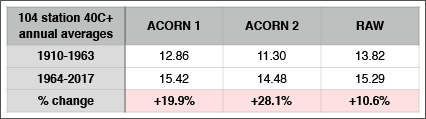
The complete failure of the police to respond appropriately, and hotels to cave so pathetically will mean this kind of intolerant protest will spread around the world. The mob wins, free speech is not free, and bullies rule. I think I shall have to return to EIKE next year! They are “over the target”. (And it was an excellent event!) The way we skeptics win is to make this event twice as large next year and use the protests as a way to get more publicity — the Streisand effect. If you can get to Germany next year, put it in your calendar. Pretty soon, skeptics may only be able to hold events at a Trump tower. Does anyone know if he owns any hotels in Germany? Today it’s an ominous sign, –Ruairi h/t Marvin. Wolfgang. November 20th, 2019 | Tags: Bullying, Coercion, Germany | Category: AGW socio-political, Free Speech, Global Warming, Protests | Print This Post | | … What a bombshell. Despite the non-stop stories of unprecedented heat the original data at 60 of the oldest sites across Australia shows there are no more Very-Hot-Days now than there were early last century. That’s no trend in 40 degree days for 100 years. No change — that is, until the Bureau of Meteorology adjusts the data… After we were shocked at the latest ACORN changes to our Very Hot Days data, I asked Chris Gillham if we could see the effect of Bureau of Meteorology changes to the original raw data – and he replied it would be too time-consuming writing the code to calculate 40C+ days among the millions of daily temperatures from 112 weather stations across Australia since 1910. Then he did it anyway. Wow. In 2011, the BoM’s ACORN 1 adjustments wiped out some of the “very hot days” recorded at weather stations in the early 1900s. These were records that had stood for a whole century. Then, quietly six years later, the ACORN 2 readjustments turned the statistical air conditioner on again and cooled people from 100 years in the future. It’s all especially miraculous given that even the old World War I data was recorded in official BoM-approved Stevenson screens. The BoM won’t consider pre 1910 data because it wasn’t standardized, but even when it is, they still have to “fix” it. And in the intervening years after 1910, the Urban Heat Islands have grown and electronic equipment that can record one-second-records have been introduced across the nation. With the old equipment, 40C+ extremes were harder to get than with today’s micro-minute spikes caused by gusts of hot air rolling off carparks and tarmacs. What we see in the 60 longest running ACORN sites, all open in 1910, is that the raw temperature data had just as many “very hot days” in the World War I era as it does now. Oh boy. No wonder the BOM was keen to move the “Very Hot Days” graphics and data and tuck them away in a remote page on their website.
 History changing before your eyes. Here’s a PDF copy of these three animated graphs side by side. Chris also analyzed larger pools of sites (see below) but these include new stations that have opened since 1910, many of which are in hot arid locations that skew the averages as the proportion of “hot region” thermometers grows. The addition of new “hot” stations probably makes an upward trend all by itself. The 60 long-term stations then, are more useful because they’re the originals, even though many of them have shifted down the road from post offices to airports and got new electronic gizmos. None of them are ideal, but at least they are in the same locality. Presumably with a million-dollars-a-day the Australian BoM might have been able to do this graph themselves. But somehow we need unpaid volunteers to tell Australians basic things about the trends across the country. With billion dollar decisions about how to change the global weather, you might think a responsible bureau would want to let Australians know that the original temperatures recorded show there are no more 40C+ days now than there used to be? — Jo ______________________________________________________ No more extreme hot days in Australia than 100 years agoGuest Post by Chris Gillham, who maintains waclimate.net Despite a community belief that global warming is creating a climate of extremes with more very hot days in Australia than ever before, analysis of the Bureau of Meteorology’s 112 ACORN weather stations shows nothing much has changed since 1910. The BoM defines a very hot day as having a maximum of 40C or greater, and the bureau’s own official data show that the recently released but virtually unknown ACORN 2 dataset has significantly increased the frequency of very hot days compared to its predecessor, ACORN 1, mostly by decreasing 40C+ days in the first half of the 1900s (see blog post). Analysis of the annual 40C+ average numbers and temperatures at the 112 stations allows a comparison between original RAW daily observations and the homogenised ACORN 1 and ACORN 2 datasets. The following analysis is from 1910 to 2017 as this is the final full year of ACORN 1 daily temperatures. The first analysis compares the three datasets at the 104 non-urban ACORN stations used by the bureau to calculate national and regional average temperatures …
 Australian Very Hot Days, Graph, Bureau of Meteorology, Chris Gillham.
It’s clear that ACORN 1 reduced the number of RAW very hot days in the early 1900s, and ACORN 2 has created a staircase. However, the animation nevertheless suggests a RAW increase in the annual number of very hot days in Australia, although the observable step changes coincide with 1972 metrication and the introduction of automatic weather stations in the mid to late 1990s that are believed to increase maxima because of their instant electronic response to warmth compared to the slower responsiveness of liquid thermometers. The very hot day increase in the new millennium also coincides with the introduction of smaller Stevenson screens that decreased their internal space by almost 74%. The trend and dataset differences in the 104 non-urban stations are similar among all 112 ACORN stations … Keep reading → November 20th, 2019 | Tags: BOM, Extreme weather, Gillham (Chris) | Category: Global Warming, Meteorology | Print This Post | | It’s a nervous wait til summer. The Australian grid appears to be in slightly better shape than a couple of months ago, but it’s still so shaky manufacturers admit they are developing contingency plans to move operations interstate if a blackout hits, or they get attacked by a bout of high prices: Something that doesn’t happen in competent countries with reliable electricity: Victorian manufacturers prepare for power crunchAngela McDonald-Smith and Mark Ludlow, AFR Manufacturers are drawing up contingency plans to shift operations out of Victoria this summer as fears of blackouts and sky-high electricity prices for the March quarter keep nerves on edge. While worries about blackouts in Victoria have eased in the past three months, Coca-Cola chief executive Alison Watkins said on Friday the company was prepared to beef up manufacturing in other states should the worst-case scenario eventuate in Victoria and generation fall short of demand. Just another burden and inefficiency on business. As power gets more expensive and unreliable the Victorian government is blaming coal:
Victoria’s Energy Minister, Lily D’Ambrosio, reiterated her concern that the increasing failure of ageing privately owned coal power generators was the biggest threat to Victoria’s power supply. She noted the work by AEMO “to secure the back-up power we need to compensate for this unreliability”. The definition of incompetence is having a 430-billion tonne brown coal reserve but not enough electricity to operate the manufacturers that haven’t already left. In any case, old coal plants don’t have to die, we could just keep fixing them. But the land of incompetence not only seems to have forgotten how, but it’s forgetting that it ever could. Running the behemoths in an increasingly peaky grid, with more volatile demand, higher voltage swings, and more outages, while on shrinking profit margins and in a culture of doom is hardly conducive to good corporate maintenance. South Australia, with more renewables than anywhere, seems rather desperate to get gas power: AGL this month switched on its new $295 million Barker Inlet gas plant outside Adelaide and has won approval to defer the mothballing of units at its Torrens Island plant until at least March. South Australia rushing to add another lean green jet engine to the fleet by summer: The new generator, an Aeroderivative Open Cycle Gas Turbine, is a variation of a jet plane engine and has the capacity to reach full load within five minutes from start. The new turbine is more environmentally friendly, using half the amount of fuel of other generators on site. The Hallett power station at Canowie, around 210 kilometres north of Adelaide, currently has 12 operating turbines with total generation capacity of 203 MW, enough to power over 60,000 South Australian homes. — Energy Australia In this case the money comes from hapless customers who have to pay more because the law says they can’t choose to buy electricity from cheaper generators. After adding more renewables per capita than anywhere on Earth strangely electricity is not cheaper yet, and not forecast to ever get cheaper than what it used to be before we got all those renewables. Forward prices for wholesale power reflect the concerns, with Victoria’s March quarter price now at $147/MWh, having risen early in the winter and only marginally softened. The plant outages, combined with the drought, drove Victoria’s average spot power price to $98/MWh in the September quarter, the fifth highest quarter on record, AEMO said. Victoria’s March quarter price is now almost 45 per cent above that in NSW, which has also risen north of $100/MWh.
Bring out your wallet. November 19th, 2019 | Tags: SA (South Australia), Victoria | Category: Global Warming | Print This Post | | In NSW fires continue to burn, and with more hot weather is forecast. Some farmers are burning off for themselves, not waiting to be saved by a bucket of rain from a plane. There’s a total fire ban in NSW, so this is very much illegal, highly risky, and 5 months (or 5 years) too late. Desperate and dangerous. A dire situation. As a signpost on the Road to Madness, its time the whole nation heard of Maxwell SculzHere in Westernistan Australia, in 2011 Szulc cleared a firebreak on his own land, and the government put him in jail. He didn’t start any fires, or put anyone at risk — he cleared a 20 wide break through scrubby regrowth on his own land, and they sent him to jail for 15 months. No heritage trees were destroyed, no rare orchids went extinct. It had all been cleared back in 1983 and regrown. His property was next to state land and he wanted to reduce the fire risk. He’d been ordered in court to fill in forms and ask permission. But it was his land, he felt that was wrong, so he cleared it. His action was both as a farmer and as a protest — an act of civil disobedience. For that, he earned a short mention on an ABC page once, was not nominated for a Nobel or an Oscar, and the UN didn’t ask him to dinner. Meanwhile in NSW this week: ‘Locked up and forgotten’: Farmers taking fire management into their own hands Peter Hannam, Sydney Morning Herald
Desperate farmers are doing their own back-burning to protect their land from bushfires, prompting the Shooters, Fishers and Farmers Party to draft laws to allow farmers to do controlled burns in national parks. Shooters’ MLC Robert Borsak will introduce a bill to NSW Parliament next week that would give farmers the power to conduct “small controlled burns” if their property adjoins public lands. The proposed bill comes as the NSW Rural Fire Service (RFS) concedes farmers in bushfire-ravaged parts of the state may have been doing their own back-burning. The most desperate farmers were the ones living next to National-Fuel-Parks, the kind being un-managed by governments: Mr Borsak said farmers living next to state land were desperate to protect their property, with “millions of hectares of national park … locked up and forgotten”. “The national parks are not being properly managed,” he said. “ There’s no chance the government will let farmers back burn public land. … the government, …says hazard reduction is a complex task that requires significant planning. A spokeswoman for Emergency Services Minister David Elliott said: “The NSW Rural Fire Service works in collaboration with partner agencies including NSW Parks and Wildlife on hazard reduction. Adapted from my post on Szulc in 2013: In Australia if you try to clear a firebreak on your land you could go to gaol Maxwell Szulc, Some will say that Maxwell Szulc is technically not in jail for clearing his land, but for contempt of court. He deliberately went against a court injunction that forbid him from clearing more land. The innocent will wonder whether he should have filled in the management plan that the DEC asked him too. But this is the key. Szulc is a conscientious objector, and cleared the land as a protest against laws he sees as completely unjust. He felt it was his duty to protest. Szulc believes that his land is his land, and that he should be able to manage it without asking permission from anyone. Those “management plans” sound innocent, but as other farmers (like Matt and Janet Thompson and Sid Livesey) have found out, the management plan is an insidious form of creeping fascism. Why should a landowner need to get permission to clear firebreaks on his own property? Land clearing is expensive, and top-soil in Western Australia is a precious commodity (we have the poorest and oldest soil in the world, and fertilizer costs money). No land-owner would want to overdo the clearing or lose that thin layer of top-soil. The owner stands to lose the most if the land is badly managed. That is the point of the free market and ownership by individuals. Creeping quietly into fiefdoms where no one can afford to “offend” a bureaucrat…In a western democracy we assume that it’s One Law for Everyone. But what if a government department made every business put in a separate management plan for approval? Isn’t that just fascism by any other name? The government department is then free to approve, deny or delay approval on a case by case basis. This pits individual farmers against the state and each other, and puts them under the direction of the state. Sure they “own” their land, but they have to do what the state says — that’s fascism, where the state allows private ownership but commandeers property at will (under communism you neither control nor “own” property). Corruption can’t be far behind. If the bureaucrat doesn’t like the farmer, they can make life tough. They can selectively enforce the rules. Farmers know that, which is probably why they have been so silent as other individual farmers have either been jailed, or driven to bankruptcy by bureaucrats who don’t have to answer to anyone. Who wants to stick their heads up over this parapet? Who stands up for them? Their ABC — the love media — agrees in spirit with everything the environment department does (unless it’s not “green enough”). The ABC are missing-in-action when it comes to standing up for the farmers who are forced to pay tax to keep the billion dollar big-government propaganda-machine running. Read Maxwell Szulc’s story. — does anyone know where Maxwell is now? There is no winning against the state: Matt and Janet Thompson did the opposite to Szulc, they obeyed every rule, jumped through every hoop, and were still bled dry by bureaucrats, lawyers and banks, and lost their profitable business and life’s work. Szulc pushed back on principle, but spent 15 months in jail. Some choice. Property rights helps to stop fires. It’s the collective-forests that are most at risk, and each decade farms are becoming more collectively managed (by the farmer, the EPA, the ABC, and the RBA? Who knows?) If you doubt that the ABC has some control over our farms, ponder how different it might be now in NSW if the ABC had picked up Szulc’s story (as if he was as important as a 16 year old Swedish schoolgirl) and the nation had discussed property rights instead of advertising for solar panels? h/t Dave B … Jennifer Marohasy dives on Beige Reef near Stone Island with Walter Stark, and Emmy Award winning cinematographer Clint Hempsall. The aim was just to record what was there… don’t believe your lying eyes. Fortunately, this science is not peer reviewed. Jennifer’s blog and the IPA.
November 15th, 2019 | Tags: Corals, Great Barrier Reef, Marohasy (Jennifer), Nature | Category: Global Warming | Print This Post | | The Bureau of Meteorology did what to February?Wow, just wow. Look what the Bureau of Meteorology has covertly done to February? Something like one third of a degree has been added to the average Australian summer maximum anomalies over the past few years according to the “expert” data from the worlds-best-practise equipment. In the BOM Whopper Part 1 we revealed that in the BOM’s latest round of unannounced adjustments there were big increases in the rate of Australian summer warming. It turns out a lot of the summer rise comes from changes to February. Mysteriously, there were large changes to the national average of the last three years. Let that sink in. These changes were incomprehensible because while the averaged “whole nation” got warmer, there were no changes to the data in any of the 104 individual stations. It’s all rather spooky… but what it isn’t, is scientific. The two main points in Bob Fernley Jones’ work:
The BoM needs to explain… Despite urbanisation of modern sites, which would artificially warm them, we see adjustments that work in the opposite direction, effectively warming the modern era recorded in built-up sites, and cooling the past that was recorded with sites in fields and gardens. Jo ————————————————————————————————— Australia’s Bureau of Meteorology has covertly made summer hotter:Guest post by Bob Fernley-Jones
In 2011, the BoM adjusted (homogenised) Australia’s temperature records with the objective of making corrections for the varying measurement conditions back in time. Controversially, they deleted all data before 1910 by ruling them unreliable (especially the inconveniently hotter records) and by adjusting the surviving early 1900’s values generally downwards. Amid the controversy, this program received much official praise and publicity that culminated in a third and final government sponsored report in 2017 declaring it to be among the world’s best practice. Despite that acclaim, in October 2018 they found it necessary to quietly launch a new program that further increased warming rates. The BoM has long had a propensity to issue many media releases and special reports that emphasise hot weather events, and yet strangely, they were silent in this matter. Consequently, the vast majority of Australians are unaware of the big changes to the already modelled data. It was presumably well received by the IPCC in time for their coming sixth assessment report though. The two adjustment programs employ a methodology known as homogenization which is described under the acronyms ACORN-SAT (2011), and then by ACORN-SAT version 2 (hereafter v1 & v2). The discovery of what follows arose from enquiries to the BoM made last year over some already existing concerns with v1 data and the fortuitous archiving of BoM data and graphics that no longer exist on line (but which are easily proven to be genuine). It resulted in citizen researcher awareness of v2 and hence in recent interest to compare outcomes. In monthly terms, the most extreme warming increase in the all-of-Australia summer average was in February, as seen in the following animation. It is derived from a BoM online download archived in early 2018 compared with the replacing v2 copy in 2019:  Australian February summer maximum temperatures, adjusted again? Animation by Chris Gillham at waclimate.net Typically, (as seen elsewhere, regionally and temporally) the greatest adjustments are increasingly negative towards 1910 (cooling) and increasingly positive towards 2019. Typically, they are netting rather flat with minimal change in the centre and over the full range they are in a random magnitude pattern. The v1 data were also archived which has enabled determination of comparative linear trend rates of the modeled data as follows:  Adjustments mean the trend in February maximums has risen (yet again). | Click to enlarge. The v2 over v1 warming rate 1910 – 2018 is increased by 87%! (v1 data not available in 2019). Similar calculations for Summer (DJF) give an increased trend of 57% for 1910 – 2018. Notice that the two trend lines merge and cross close to the centre, which is typical of what was seen in Part 1 (and elsewhere). In effect, this can be called ‘rotating the dataset anti-clockwise,’ with minimal net change around the centre. Strangely, equipment in the middle period as highlighted in the chart has seemingly worked more accurately than modern equipment. The reason behind this paradox is elaborated next. The biggest surprise is seen in the following figure:  Adjustments mean February maximums have cooled in the distant past and risen in recent times. (Yet again). | Click to enlarge.
Of particular interest is that the final three years show increased warming on top of that already existing under “world’s best practice” in v1:
2016 = 0.34 °C 2017 = 0.33 °C 2018 = 0.30 °C Keep reading → November 14th, 2019 | Tags: Australian temperatures, BOM, Fernley-Jones (Bob) | Category: Global Warming, Meteorology, Sites | Print This Post | | Roger Pielke Jnr in Forbes: Everything You Hear About Billion-Dollar Disasters Is WrongFirst NOAA did the billion dollar disaster graph and forgot that it was just a artificially truncated proxy for inflation. Then after they got caught, they adjusted for inflation, but are still forgetting, somehow, that more people live in the US, and GDP has risen, so there are more assets to be destroyed. The storms have a larger target and more chance of “scoring”. Here’s the ominous, grant-raising NOAA Count of U.S. billion-dollar disasters, 1980 to 2016.  Tried to graph disasters, accidentally graphed their own incompetence
Luckily there’s one man left in academia who hasn’t been sacked yet. Roger Pielke is helping NOAA out again and has calculated a meaningful graph instead. Obviously, carbon emissions have gone to hell in a Saturn 4 Rocket, but in the USA it hasn’t made any visible impact in the last third of a century:
 Cost of disasters, floods, storms, Roger, Pielke Jnr. Data: data from the U.S. Office of Management and Budget (GDP) and Arizona State University (hazard losses). Is it just incompetence, or is the NOAA team really succeeding (but as a Public Relations Agency pretending to do science). Pielke puts this as kindly as he has to, to keep his job: To their credit, early on NOAA recognized that there were methodological issues in its approach to collecting and sharing disaster loss data, and commissioned a study of the dataset and methodology, which was peer-reviewed and published in 2013. That study acknowledges that, “the billion-dollar dataset is only adjusted for the CPI [consumer price index, representing inflation] over time, not currently incorporating any changes in exposure (e.g., as reflected by shifts in wealth or population).” NOAA admitted that the lack of such adjustments had implications for the increasing trend in the count of billion-dollar disasters: “The magnitude of such increasing trends is greatly diminished when applied to data normalized for exposure.” So we see the usual official split personality — call it “two faced”. In public “it’s a disaster!”. But NOAA admits the flaws in fine print that no one ever reads and it will never mention unless someone spots a failing. Then it becomes a “get out of jail” card to play. Plausible deniability. Well we did say that. Here’s the NOAA fine-print: Not surprisingly, due to such methodological concerns, the NOAA study concluded: “it is difficult to attribute any part of the trends in losses to climate variations or change, especially in the case of billion-dollar disasters.” Here’s the NOAA public face, where they overcome that difficulty: On its website today NOAA says: “Climate change is also playing a role in the increasing frequency of some types of extreme weather that lead to billion-dollar disasters.” The more money governments spend on science the worse it gets. Science might progress faster if the government just stopped funding it. Fires in Spring? It’s normal for fires to peak in Spring in NSWGreg Mullins is a former Fire and Rescue NSW commissioner and a councillor on the Climate Council, he implies in the Sydney Morning Herald that this is abnormal and that fires are starting earlier: If anyone tells you, “This is part of a normal cycle” or “We’ve had fires like this before”, smile politely and walk away, because they don’t know what they’re talking about. In NSW, our worst fire years were almost always during an El Nino event, and major property losses generally occurred from late November to February. Based on more than a century of weather observations our official fire danger season is legislated from October 1 to March 31. During the 2000s though, major fires have regularly started in August and September, and sometimes go through to April. This year, by the beginning of November, we had already lost about as many homes as during the disastrous 2001-2002 bushfire season. We’ve now eclipsed 1994 fire losses. Mosomoso: The fire season in NSW is spring — this is not early, this is “late season”For those not living in the east and who may be tricked… Spring is the main fire season for NSW. Because of the winter-dry/summer-wet pattern and the spring wind patterns you will get massive burns like now and 2013 and 1951 and 1980 and 1895 etc. There can also be lethal fires in summer when the spring pattern persists with drought and westerlies. Hence 1939, despite La Nina and time of year. This talk of “early season” is a stunt. September is normal peak for fire here and when the rains and storms don’t come in October/Nov…that is “late season”. In the past the severity depended on how much good growth preceded the spring dry (1951 came after the all-time wet of 1950). With the lack of forestry, fire-maintenance etc now….who knows? Bureau of Meteorology – Fire SeasonsThe coastal areas north of Sydney in NSW are listed as a “Spring” peak fire season. Sydney is in the “Spring and Summer fire season” zone.  Fires Seasons of Australia, NSW Spring fires. As Silliggy (Lance Pidgeon) notes far back in 1951 before “climate change” the fire season in Queensland was listed as July – January 30. So these seasons are nothing new. And it was the dry cold that helped the fires. Dry cold helps bushfires, The Courier Mail, Brisbane, 16th May 1951 The dry-cold wave has caused the extension of the bushfire danger season in central and South-West Queensland. Normally the fire season is from July 1 to January 30. It has been extended to June 30. Rural Fires Board inspector (Mr. G. Gentry) said last night that proclamation of the fire danger season meant all burning off had to be brought under the notice of the chief fire warden in each area. Any fires have to be kept strictly to regulation limits. Mr. Gentry said frosts were killing and drying green pastures. Westerly winds were fanning bushfires. Bushfires were still reported over thousands of acres in South-west Queensland. Crops ruined The cold snap had forced down the demand for citrus fruits, he added. The Weather Bureau forecasts further frosts for the next few days in South Queensland. Brisbane’s minimum temperature of 43.2 deg. [fahrenheit] yesterday, war 7.3 below normal, and 3.8 lower than on Monday. And from Bob Fernley-Jones, the worst fire in Queensland was October 1951. BUSH FIRES WORST IN Q’LAND HISTORY BRISBANE, Oct. 2.
Queensland s bushfire outbreak was the worst in the State’s history, said the Rural Fires Board Inspector (Mr. G. Gentry) tonight.He asserted that 98 p.c. of the fires burning now were started deliberately. Under soaring temperatures, fires were burning to day in many parts of the State. A fire near Clermont, in Central Queensland, is reported to be out of control, with the heat so intense that fire-fighters could not approach within 100 yards of the flames. From Injune to Baralaba chains of fires stretch for 150 miles.
The fire between Injune and Baralaba is out of control in dense timber and rolling grasslands. While fighting a fire at Eidsvold. Mr. A. Bramley was overcome by the smoke and had to be dragged from the flames. Airline pilots said to day that smoke enveloped a vast area bounded by Emerald (central Queensland),the Darling Downs and Casino (NSW). Capt. M. Mitchell, of Queensland Airlines, said there were hundreds of fires in this area.  Trove Nov 1951 FRIDAY, NOVEMBER 23, 1951. BUSH FIRES
For the most part Australia’s seasonal reverses are measured by the incidence of flood and drought, both of which are capable of taking a heavy toll; but from time to time there enters into the picture a third hazard, that of the bush fire. Never before has greater devas- tation been wrought amongst pastures, livestock and timber assets than is being exacted by the bush fires that for weeks have devastated large tracts ot country . in New South Wales and Queensland. If anything, they are worse in New South Wales, for there the forest fire menaces the outskirts of cities and towns, even Sydney itself, adding the tragedy of people being burned out of their homes. In Queensland we have es-caped that extremity, but cur- rent losses in stock, pastures and fencing are reputedly! severe enough in all conscience. Nor does it end with the passing of the fire. Stock which’ escaped the flames are faced with starvation on burnt out runs, and owners have the formidable task of restoring fences with inadequate supplies of labour and material. It is safe to say that the evil influences of the bush fires of 1951 will long remain with us.
The severity of the fires this year is accounted for by the lush seasons of the past two years, which provided a luxur- iant crop of herbage and
undergrowth that became tin- der dry from the eight months drought that succeeded the flood rains early in the year.
… In 1946 fires burned in an “almost unbroken chain from Brisbane to Townsville”. They lit up the sky at night, pushed plumes of smoke 3,000 ft in the sky, that looked like “Bikini Atoll”. And this was July… Qld 1946: Now that’s what I call Hazard ReductionBelievers of man-made-weather say that warmer drier conditions and longer fire seasons are preventing hazard reduction burns. Aside from the fact that a warmer world is not a drier world, and rainfall trends have gone up not down, this is a snowflakes excuse. Even if it were true, the answer is to get more serious about burning off when conditions are cooler. Thanks to Siliggy, Lance Pidgeon for the pointer. This is what Queenslanders used to do when they were serious about stopping wildfires. Their view of dry brush was that it was waiting like tinder… Fortunately yesterday, Armageddon didn’t come to the East Coast. But it might have. 800 Miles Of Fires Along the North Coast The Courier Mail, Monday July 29th, 1946
 Trove, National Library of Australia By a Staff Correspondent
TOWNSVILLE, Sunday. — Fires
are burning to-night in an almost
unbroken chain from the edge of
Brisbane to Townsville, 800 miles
distant.
The coastal fires provide air
travellers with a graphic picture
of parched Queensland.
Deeper inland, even greater
areas of dry brush and grass are
burning or waiting, like tinder, for
a careless match or spark.
From Rockhampton to Gor-
donvale, farmers are burning off
cane. Forestry officers in other
areas are burning fire breaks.
Long Smoke Trails
Columns of smoke loom from
hills above some coastal towns, In
the hills north and south of Mac-
kay to-night smoke from two
separate groups of fires stretched
in trails for many miles.
South of Maryborough there is
another group of fires. From some
of these the smoke was rising yes-
terday afternoon to a height of
3000ft.
One air traveller said: ‘They
look like pictures of the Bikini
bomb explosion.’
Some fires are blackening areas
of dry grass on which ‘small and
large graziers depend for fodder
while the drought lasts.
A Forestry Department manage
ment officer (Mr. Pohlman) said
to-night that no fires had been
reported in forestry areas, but
burning off operations were con-
tinuing.
Brisbane Fires
Grass and rubbish fires round
Brisbane increased yesterday after
the light rain on Friday morning.
Fire engines were called to 10 fires
hi the metropolitan area. No dam-
age was done.
November 13th, 2019 | Tags: Fires, History, Queensland (QLD) | Category: Fire, Global Warming, History | Print This Post | | Catastrophic fires are predicted tomorrow across the East Coast of Australia. Around 500 schools will be closed tomorrow. Some 400,000 people have been warned “to be ready. Thousands are evacuated. A state of emergency has been declared. 1,400 interstate fire fighters have gone to NSW to help. For updates about New South Wales, check the NSW RFS website. For Queensland, see the QLD RFS website. MyFireWatch has a live map updated regularly with outbreaks. —————————————————————— How close and thick was that forest?Shots from the ABC news Monday. To appreciate what happened, see the moving scene as people approach these ruins through tiny lanes surrounded by dense forest. (Full ABC segment below).  Bobin, NSW, Fire damage, ABC News  Look at the trees around this house at Rainbow Flat The backlash beginsThe opportunistic greens are already crying “climate change” while firestorms rage and lives are potentially under threat Greens playing politics with fire, say Labor and CoalitionGreg Brown, The Australian Greens leader Richard Di Natale sparked fury from both major parties when he said the nation’s emissions policy had caused the fires that killed three people and injured 100. Greens policies increasing bushfire threat, Barnaby Joyce saysGreg Brown, The Australian “The problems we have got have been created by the Greens,” Mr Joyce told The Australian. “We haven’t had the capacity to easily access (hazard) reduction burns because of all of the paperwork that is part of green policy. “We don’t have access to dams because they have been decommissioned on national parks because of green policy. We have trees that have fallen over vehicles and block roads, so people cannot either get access to fight a fire or to get away from fires. And we can’t knock over the trees because of Greens policy. Deputy Prime Minister Michael McCormack has lashed the “disgraceful, disgusting” behaviour of “raving inner-city lunatics” for linking climate change to the ferocious bushfires burning across Queensland and NSW. Spot the fuelOur hearts go out to those that have lost homes. But in every scene here, tree changers who never thought it would happen to them, were living with their $3000 bicycles in idyllic fire traps. How much were these folk misled by an ABC constantly reporting on climate change, and barely ever discussing fuel loads and almost never interviewing skeptics? Firefighters who recite the permitted “climate change” lines were put on a pedestal. Firefighters with data on fuel loads don’t get called. And why was that ABC journalist wearing brand new fluro fighting gear to interview the victims? But proximity is not the biggest problem.If the fuel loads are too high across the state, there is no firebreak big enough to stop the embers in a Firestorm. Once a fire is generating its own weather and high-speed-wind every house would need a 10km clearing all around. Wytaliba where two died, was badly hit The houses are dotted among a thousand square miles of forest. A great way to live until the firestorm burns the soil, the microflora, macroflora, seeds, old growth, everything. It will take years to recover.  Wytaliba (See GoogleMaps to get close up). Arrows mark houses or shed visible in Google maps. Image: Copyright 2019 CNES / Airbus, Landsat / Copernicus, Maxar Technologies, Map data, Google. The treechange movement has a day of reckoning comingThe forests have changed. Open canopies and scrubby undergrowth have maximized the fuel. Hippies of Nimbin admit bush got too wildGraham Lloyd, The Australian Des Layer has for 30 years ridden his horses through hills now being ravaged by fire. For decades he has watched the structure of the bush change from what he says is poor logging and lax management. Before the area became national park, Mr Layer said, he would get permits to collect firewood from the state forests. Since the national park was declared there had been no permits issued. “It has just been building up,” he said. Poor logging practices have changed the forest’s ability to cope with fire. First the fire-retardant edges were lost and then the high-value canopy trees. With the big trees gone, the humidity of the forest was reduced, the canopy was opened to allow palms to grow and then drop dead fronds into the undergrowth. Extended dry conditions have resulted in a tinderbox of lantana and weeds in an area that has not seen a significant fire for half a century The forecasts for Tuesday: Embers could fall on the Opera HouseWith a situation this bad, it’s hard to believe there is room for hyperbole… Sydney’s ‘ring of fire’: Terrifying map shows suburbs most likely to be ravaged by bushfires tomorrow and why embers could fall on the Opera HouseCharlie More, Daily Mail Australia Every suburb in Sydney must brace for devastating bushfires on Tuesday as 37C temperatures, 10 per cent humidity and 60kmh winds create ‘catastrophic’ conditions, fire chiefs have warned. But fire bosses have warned ‘no area is entirely safe’ as high winds could send dangerous embers capable of sparking secondary fires towards beachside suburbs such as Manly and even the CBD, home to the Opera House. Scenes of Armageddon in New South Wales today and people are calling it a climate emergency on twitter. Ban new coal mines! Blame Tony Abbott! (See #nswbushfires). So far there are three deaths, and 150 houses lost (at least). The latest report tonight from @NSW RFS is that at 12:30am, there were 74 bush fires across NSW, 43 still not under control.
…
Wow. That is a lot of forest being converted into cloud in that satellite image.  … …
Too much fuel causes extreme bush fires, not climate change67 years of hazard reduction in Western Australia shows exactly how to control wildfires. It’s just chemistry. We leave all that fuel lying around then get surprised when it burns? Western Australia fire management burns off about 8% of the forest under management each year — a one in 12 year rotation. Californian management burns once every 500 years. The men with decades of experience, and indigenous practices estimate that a six year rotation is better.  More prescribed burns means less wildfire area burnt. Source: Bushfirefront Western Australia
….  The Red Brigade uniforms are mass produced and the same all over the world. Big finds in Mozambique, Saudi trouble, and the anti coal movement are helping African oil and gas: Why Africa’s Oil & Gas Sector Is ExplodingBy Tsvetana Paraskova – Nov 05, 2019, OilPrice Major oil and gas discoveries and subsequent investments in infrastructure projects are set to help the oil and gas industry in Africa to grow, also helped by improved governance and regulation, PwC said in its newly released Africa oil & gas review 2019. “One of the most dramatic finds in Africa over the past decade is Mozambique’s natural gas estimated at over 180 tcf, which has already unlocked the first three large-scale LNG projects,” according to PwC. These projects and additional exploration could make Mozambique the world’s third-largest LNG producer after Qatar and Australia by 2030, PwC says. So seven XR groupies turn up outside an African oil and gas conference to show just how arrogant they are: Extinction Rebellion calls Africa Oil Week delegates “climate criminals”By Madison Yauger, GroundUp In a media statement, the group said: “Following the protest on Tuesday 5 November, Extinction Rebellion continues to oppose Africa Oil Week being held at the Cape Town International Convention Centre. This conference brings together international corporations, governments, investors and lobbyists, who – despite the global ecological crisis – continue to value profit over both people and the planet. The delegates who attend this conference are climate criminals. “While they make billion-dollar deals, they do not care about global warming caused by their industry, or the floods, droughts, typhoons, pollution, crop failures, refugees and misery that result… These climate criminals are not welcome here!” XR demands the declaration of a “climate emergency” which would legally assist vandals and self-serving protestors with an excuse for the damage and danger they may create: Extinction Rebellion want government to acknowledge and declare a “climate and ecological emergency, reverse all policies inconsistent with addressing climate change, and work alongside the media to communicate this to their citizens”. XR also want to force everyone to do what they want and to subvert democracy because voters are not as smart as 21 year old activists: They also demand a legally binding policy to reduce carbon emissions to net zero by 2025, and for the creation of a national Citizen’s Assembly to oversee these changes. Seriously? Seven people dress up in red outfits, make selfish, immature demands and that’s international news? The African’s have exactly the right response: No apologies: Africans say their need for oil cash outweighs climate concernsLibby George, Reuters Two floors above, the hundreds of delegates at Africa Oil Week were largely unaware – and mostly unmoved – by the display. “Under no circumstances are we going to be apologizing,” said Gabriel Obiang Lima, energy minister of Equatorial Guinea, adding that they need to exploit those resources to create jobs and boost economic development. “Anybody out of the continent saying we should not develop those fields, that is criminal. It is very unfair.” h/t GWPF Image: wikimedia by Gazamp Extinction Rebellion’s ‘Red Brigade’ at the end of Smeaton’s Pier in St Ives, Cornwall August 2019 November 9th, 2019 | Tags: Africa, Big-Oil, Fossil Fuel, XR (Extinction Rebellion) | Category: Energy, Fossil Fuels, Global Warming, Protests | Print This Post | |  Eight full grown trees of carbon in every bottle of Eco-vodka No seriously, yesterday Air Co launched a type of vodka made from air instead of potatoes. One bottle allegedly soaks up “as much CO2 as eight fully grown trees.” At $65 a bottle, this will be a must have for fashionable snowflakes who have too much money and not enough taste buds. This solves the hole in the market for all the people wanting low carbon Bloody Mary’s. The vodka, which costs $65 for a 750 ml bottle, is made from only two ingredients, carbon dioxide (a greenhouse gas) and water. That’s unlike traditional vodka, which is typically made by fermenting grains such as corn, potato and wheat. Producing a typical bottle of vodka could create around 13 pounds of greenhouse gases, according to Fast Company, while Air Co.’s product is carbon negative, removing a pound of carbon from the air with every bottle produced. More efficiently than plants?! The process uses the same principles as photosynthesis in plants but does so more efficiently,” Constantine tells CNBC Make It. Air Co.’s technology splits water into hydrogen and oxygen, then combines the hydrogen with carbon dioxide (collected from factories near its Brooklyn, New York headquarters), which creates alcohol and water, only emitting oxygen into the atmosphere. I like that they collected that carbon dioxide from factories, rather than stealing it from farms or forests. Finally, someone finally found a way to do something useful with solar panels!Air Co. says its patented system works by using (renewable solar) electricity to turn carbon from the air into pure ethanol. Next up, someone can sell conversion kits for home solar to moonshine. (Do it for The Grid!) Air Co. says its vodka is also free of the impurities that can left behind from the grains used in traditional vodka production. Free of impurities for sure, and possibly also any residual flavour. I can’t see this technique threatening the wine industry. Presumably they could have just called this drink “Ethanol” but Vodka is so much more catchy.
|
Jo appreciates your support to help her keep doing what she does. This blog is funded by donations. Thanks!
 Follow Jo's Tweets
   
 
|
|||
|
Copyright © 2026 JoNova - All Rights Reserved |
||||






Recent Comments