|
|

OWID
By Jo Nova
Means, motive, and opportunity. It looks for all the world like China used dirty tactics to corner the rare earth processing plants of the world.
Michael Kern argues that for the last twenty years, every time a Western rare earth mining operation looked like it was about to build its own processing plant, Chinese producers would flood the market and crash the price of the metal. The investment case would evaporate and the company would go out of business.
This kind of predatory capitalism is all very well until the nice guys realize what’s going on and ban your products from their defense contracts, back their own start ups, and those companies develop their own processing techniques, which is what is starting to occur in the US now.
China was treating rare earths as a strategic weapon, while the West assumed the free market was free, and was hooked on the cheaper stuff.
All’s fair in love and war, but dirty tricks have their own price.
By Michael Kern, Oilprice
The West handed its rare earth processing capability to China roughly 40 years ago. The last major U.S. rare earth mine, Mountain Pass in California, closed in 2002, unable to compete with Chinese production costs. By 2010, China controlled approximately 90-95% of global rare earth production and an even larger share of the processing and refining that turns raw material into usable metals and magnets.
China was able to control the price because it not only controlled 90% of global rare earth production, but it also controls the Asian Metal Index (AMI).
Even if the western company survived the price crash, they were often dependent on Chinese technology that only Chinese operators could maintain, and the CCP sometimes withdrew support leaving the western company with something they couldn’t use.
The Crisis That Should Have Changed Everything
The most dramatic chapter of this story came in 2010, when a territorial dispute between China and Japan over the Senkaku Islands triggered what many consider the first open weaponization of rare earth supply.
In September 2010, China unofficially halted rare earth shipments to Japan. Within months, rare earth prices spiked dramatically, with the prices of some oxides increasing more than tenfold. The price of dysprosium oxide alone surged from roughly $90 per kilogram in early 2009 to over $2,300 per kilogram by mid-2011.
What followed was a gold rush.
Then China did what it usually does. After the initial panic subsided and prices peaked, China eased its restrictions and flooded the market with supply. Prices collapsed just as quickly as they had risen. Dysprosium oxide, which had peaked above $2,300, fell back below $200 per kilogram by 2016. One by one, the Western projects that had launched during the boom ran out of money, ran out of investors, or simply couldn’t compete. Molycorp, the company behind the Mountain Pass revival, filed for bankruptcy in 2015.
Read it all. It’s a long article describing how things are changing. On January 1 next year, the US defense procurement rules will ban all Chinese origin rare earth materials. That means price-wars can’t shake out the US suppliers. The US government is also going to financially back key suppliers. One company called REalloy has developed its own processing pathway. It is expected to produce 525 tonnes per year of neodymium-praseodymium metal by early next year.
Dirty tricks may help in the short term, but in the long run, it takes a long time to win back the trust.
9.9 out of 10 based on 88 ratings
9.3 out of 10 based on 14 ratings
By Jo Nova
Look how fast Norway is moving
While Australia and the UK pat themselves on the back, telling themselves that no one is interested in fossil fuels, the market price tells another story. Norway, meanwhile, is going gangbusters on project development.
The EcoWorriers are not happy. These gas and oil fields were closed down in 1998 but there is still twenty years of gas and oil left to dig out. Production is due to start in 2028.
The end of fossil fuels was always a myth The Blob wanted us to believe.
— By Miranda Bryant and Jillian Ambrose, The Guardian
Approval for exploration in 70 new areas prompts fierce backlash from fossil fuel opponents
Amid sharp price rises in oil and gas since the US and Israel’s attack on Iran in February, Oslo has also given its approval for oil and gas companies to explore in 70 new locations in the North Sea, Barents Sea and Norwegian Sea.
The decision by the Labour-run government goes against the advice of the country’s environment agency and has infuriated left-leaning parties.
“We live in troubled times,” the prime minister, Jonas Gahr Støre, said as he announced the decision, which would “create great value for the community, lay the foundation for good jobs throughout the country, ensure our common welfare and contribute to Europe’s energy security and safety”.
There are at least five different projects and areas that are suddenly in action:
Norway’s state oil company, Equinor, hopes to develop the Rosebank oilfield, while Shell is waiting for a government decision on its Jackdaw gas project.
This will of course, help rescue Europe from it’s green fantasy:
— By Jan-Thore Bergsagel –
Equinor has fast-tracked the long-idled Eirin gas field into production, boosting European supply via existing infrastructure at a time when energy security still dominates policy.
That backdrop explains why Eirin, holding expected recoverable resources of about 27.6 million barrels of oil equivalent, mainly gas, suddenly carries strategic weight.
Thanks to Ben Beattie who retweeted @yestiseye — “oh no, the Australia Institute is going to be so upset“
10 out of 10 based on 99 ratings
9.4 out of 10 based on 15 ratings

By Jo Nova
It couldn’t happen to a nicer parasitic committee
This is what happens when you treat your main benefactor like an idiot, and do everything possible to turn them into a vassal state of the Globalist Blob. In return for $800 million a year the UN spreads Chinese bioweapons, and throws giant junkets to reward The Blob loyalists, but nothing for the average American taxpayer.
The US pays 22% of the regular UN budget, yet the UN has no respect for American voters or their choices.
by Antonio Graceffo, Gateway Pundit
Unless collections improve, Guterres warned, the UN will run out of cash by July 2026.
Wide-scale non-payment by member states has accelerated the crisis. In 2025, 42 of 193 member states failed to pay their assessments in full, and by the February 8, 2026 due date, only 55 countries had paid.
The United States is the dominant factor. Historically the UN’s largest contributor at 22 percent of the regular and peacekeeping budgets, roughly $820 million per year, the U.S. paid no dues at all in 2025 and accounts for approximately 95 percent of all unpaid contributions currently owed. The total U.S. debt stands at $2.2 billion to the regular operating budget…
Not to put too fine a point on it, but the UN wants to control your medical data, decide which injections you must get, and dictate whether you can travel when the next pandemic comes, which it can declare any time it suits. The UN (plus Mark Carney) organized the bankers into a $130 trillion cartel to use pension funds against the average American (and western) voter. It dreams of putting a carbon tax on shipping so it can finally raise its own revenue (and be even less accountable than it already is).
What looks act and smells like it’s working to become an unelected Global Government? And what’s the other word for that? — Tyranny.
The United Nations is $1.57 billion in debt — quite an achievement for a group that has an annual budget of $3.5 billion.
We know the EU and patsy countries like ours will keep funding the UN. But Donald Trump has turned off the tap to crime and corruption. Celebrate the win…
POST NOTE: Lest anyone get the wrong idea, the other 78% of UN funding will no doubt continue, as the golden handshake promises of UN roles after politics tempt patsy leaders to chip in their nations wealth to help the poor suffering bureaucrats in Geneva.
There is something to be said for electing billionaires who don’t want or need UN handouts.
Our best hope is that stupid countries who are desperately in need of oil will be forced to pander to the US because it has what they want.
h/t Willie Soon
9.9 out of 10 based on 127 ratings
9.1 out of 10 based on 9 ratings
By Jo Nova
The pagan witchdoctors are out in force —
This time an invisible spooky force called carbon dioxide is stealing away nutrients from food, at least that’s how the Washington Post propaganda team words it. It’s a “surging” culprit causing anemia in pregnant women which can lead to complications and “even death”. Stop the car! Is there no evil this molecule can not do?
This is pure climate-scare porn — carbon dioxide makes plants grow faster, and so it has this “awful” effect where crops bulk up more quickly, and without extra fertilizer, the mineral content and protein levels will be slightly diluted by the extra carbohydrate. And when I say slight, I mean barely measurably — in the last 37 years the levels of zinc in an undisclosed amount of chickpeas has fallen from 22% of our RDA to only 20%!
Let’s be clear: no one in the rich world eats chickpeas to get iron, protein and zinc, not if they can eat steak instead. All these nutrients are far higher in meat, and they are more absorbable too.
So this article is mostly at the concern-troll level. They pretend to care for the poor of Africa, but use their suffering to sell carbon reduction policies. It’s true the world’s poor rely on paltry rice and chickpeas for basic nutrition, but if we want to help them, the answer is to lift them out of poverty and give them a steak, not to change the global climate, cars, and electricity generation in order to get more zinc in their peas.
Weight for weight, beef contains three times the protein, four times the zinc, and twice the iron that chickpeas do. The minerals in beef are easier to absorb and also come with B12, B6, selenium, B3, B5, Vitamin A, E, and D.
At the very least, in the short term, it would be kind of us to help the poor get better fertilizer and richer soils. NPK fertilizer is essential (and that’s a challenge), but the soils are steadily depleted of iron, magnesium, boron, calcium, vanadium, iodine and twenty other trace minerals.
By Naema Ahmed and Sarah Kaplan, The Washington Post
Chickpeas and rice are not the only foods steadily growing less nutritious. Many of humanity’s most important crops — including wheat, potatoes, beans — contain fewer vitamins and minerals than they did a generation ago.
The invisible culprit behind this damaging phenomenon? Carbon dioxide pollution.
Surging concentrations of carbon in the atmosphere, caused largely by burning fossil fuels, have produced potent changes in the way plants grow — from increasing their sugar content to depleting essential nutrients like zinc. Experts fear the degradation of Earth’s food supply will cause an epidemic of hidden hunger, in which even people who consume enough calories won’t get the nutrients they need to thrive.
More spooky associations:
On average, they found, nutrients have already decreased by an average 3.2 percent across all plants since the late 1980s, when the concentration of carbon dioxide in the atmosphere was about 350 parts per million.
Nutrient decline in the last 30 years could just as easily be soil depletion from constant cropping with no replacement of trace minerals. Can poor farmers get seaweed spray in Chad? Can they afford blood and bone fertilizer?
Ultimately, Myers said, the best way to protect human health is for people to stop releasing so much carbon dioxide into the atmosphere, which not only depletes the nutritional value of crops but leads to escalating heat waves, intensifying floods and lengthening droughts that hurt food production around the globe.
How many windmills in Dubbo does it take to stop one case of anemia in Nigeria? Sadly, the answer is infinity-and-another-ARC-Grant.
The diet witchdoctors have done this all before back in 2014. Back then, the fear campaign was about rice losing some iron, and the answer I calculated to compensate for the tiny decline was for the world’s poor to eat one extra chickpea.
REFERENCES
USDA — Chickpeas (canned)
Protein — 7.02g, Zinc — 0.72mg, Iron — 1.04mg
USDA Beef Rump per 100g (NZ)
Protein — 21.6g, Zinc — 3.43mg, Iron — 2.29mg
10 out of 10 based on 88 ratings
9.2 out of 10 based on 17 ratings
8.7 out of 10 based on 27 ratings
9.9 out of 10 based on 22 ratings

By Jo Nova
Trump said he wanted Energy Dominance. And now the oil tankers are heading to fill up at the USA.
Compare the US to Australia. Downunder there is chaos due to fuel shortages, one in four international flights have been cancelled, and inflation figures have leapt, which may lead to higher interest rates. That in turn will likely force some families to sell their homes, and others to go out of business. These are the costs of bad energy planning. Plus, we’re going cap-in-hand to China to beg for fuel. Other Australians are holding off booking holidays in July, for fear that they won’t be able to pay for the petrol to get there, or the regional pump might run dry, which is also hurting the tourism industry. The chaos, it flows.
In response the the crisis, our government has just arranged for an extra 150 million liters of fuel to arrive which should keep us going for … almost another 24 hours.
If only we had explored for oil and kept a few refineries open?
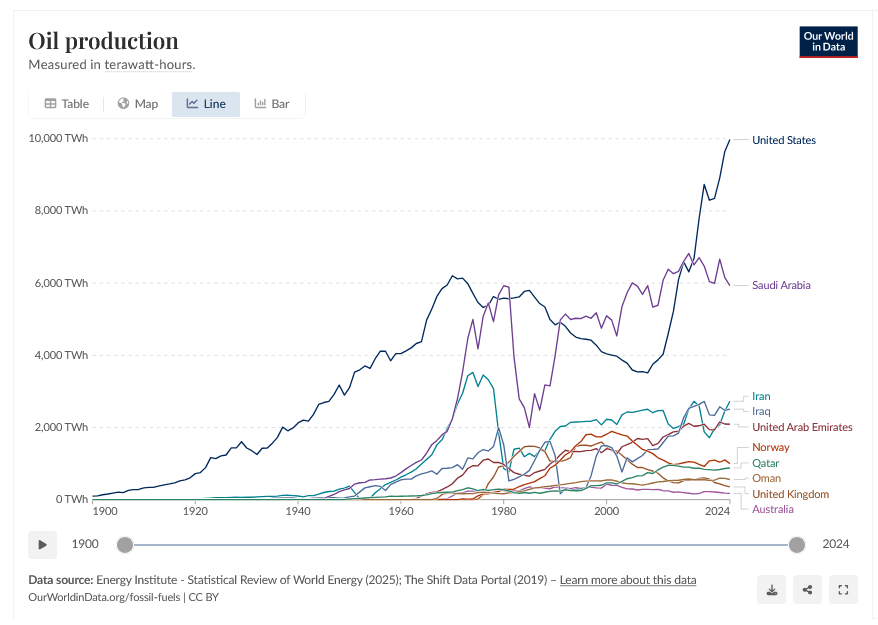
Meanwhile, the USA, run by Orange-man-bad is setting records for the export of crude oil, diesel and gasoline.
By Phil Flynn
In a striking display of America’s energy dominance, the United States has shattered export records for crude oil, diesel, and gasoline—delivering a powerful message on Persian Gulf Day as military options against Iran remain firmly on the table. This landmark achievement underscores the remarkable strength of U.S. production and refining capacity, even amid global tensions. It comes as Iran says we can expect a message from Supreme Leader Mojtaba Khamenei on national Persian Gulf Day.
The US exported jaw-dropping 14,179 barrels a day of all petroleum products. That blew always last week’s record of 12,881 million barrels a day and was above the 10,645 [thousand] million barrels a day we exported a year ago to give perspective. What this means is that US is in a league of its own right now for total energy product exports. No one else is exporting anywhere near 14 mbpd.
This is why Trump can afford to keep Iran waiting — he has options which Europe and Australia don’t. And this works in his negotiations. The more desperate we are for fuel, the more options Trump has.
Most of the shouty commentariat judging the war don’t seem to realize that the oil production tables have turned.
REFERENCE
EIA Short-Term Energy Outlook (STEO)
Australia consumes about 1.15 million barrels per day of oil products or about 160 million litres.
9.8 out of 10 based on 92 ratings
9.2 out of 10 based on 10 ratings
8.6 out of 10 based on 16 ratings
By Jo Nova
Left climate mob admits they might need to be more friendly
We know a movement is on the way down when they start to analyze what is going wrong.
Faced with the Worst Possible Outcome (Trump is still the President), one corner of the climate zealot world is starting to wonder if bundling The Climate Cause in with the Femo-Gay-Lezbian-Gaza-Project as an all or nothing package might be counterproductive. There is even awareness that they are supposed to be the compassionate ones.
Wait til they find out they manipulate, coerce and bully teenage girls and scare toddlers…
To motivate their team, they stoke their worst possible fear, and what’s worse than the climate apocalypse — well, it’s when voters choose a right wing government.
…the two of us share a growing concern about the direction of the climate movement. A project that ought to be broad, open and compassionate has come to be dominated by a narrow set of ideological demands which leave little room for genuine diversity of political perspective. Increasingly, participation in the climate movement has come with an ideological entry fee—where new participants must adhere to specific views beyond climate issues.
Those who want to participate are expected to accept a “package deal” of positions on issues such as race, gender and social justice.
They even call it ideological gatekeeping, and then describe how the cancel culture begins.
“…members were often asked to adopt the slogan “No climate justice without racial justice,” which, in practice, meant aligning with the Black Lives Matter (BLM)
Possibly this article was written by a couple of half-way sensible folk, who were given the job to reach the crazy-flock and pull them back from the puritanical cliff edge.
But they don’t want to demoralize the unwashed masses too much, so they try to roll out some “hope” to end the speech on.
Here’s what Nirvana looks like to people who have never talked to a single climate skeptic. They cling to the fantasy that the average voter (they call them the “hard-right”) will wake up from the non-existent condition they call “climate denial”:
We predict a reversal in the 2030s. As climate denial mostly recedes on the right, hard-right pro-climate movements may emerge. For them, ecological concern could become a vehicle for white nationalism, opposition to democratic institutions and authoritarianism. This would be a bitter irony if it arose because the climate movement failed to engage a broad political spectrum.
Just like the climate modelers — the definitions are inane, the assumptions are delusional, and the predictions are the opposite of reality.
9.9 out of 10 based on 103 ratings
9.4 out of 10 based on 14 ratings

By Jo Nova
It’s a bankers job to manage the Indian Ocean dipole, don’t you know?
People have noticed that coal, oil and gas projects that were legal and looked profitable were still unable to get funding from the Big Bankers. You might think it was the elected government’s role to figure out the complex trade-offs of how to keep the lights on, avoid unemployment and protect the spotted quoll (and the nation). But even if the people vote, and the government approves, the bankers can still say “No”. And they did…
The Commonwealth Bank piously declared in August 2024 that they will no longer provide finance to oil and gas companies that don’t have a “Paris Transition Plan”. The bank was helpfully taking on the role of judge, jury and financial executioner.
Yet, thanks to the Straits of Hormuz, suddenly instead of earning bragging rights for their climate saintliness, they face questions about how they let the country down.
By Sarah Ison and Rosie Lewis, The Australian
Australia’s big banks have defended their financing policies against criticism they fail to support oil, coal and gas projects, as Foreign Minister Penny Wong turns to China to shore up fuel and fertiliser supplies in a high-stakes diplomacy mission that also includes Japan and South Korea.
The trip comes amid concerns from the Coalition that projects that could have delivered oil and fuel had not been offered enough support from not only the government but the banks.
The mindset of the bankers was that coal was unthinkable:
Pembroke Resources founder and ex-chair Barry Tudor laid bare the hurdles [his coal project] faced …
“At one point during the development of Olive Downs, a senior executive at a big four Australian bank told me he really liked our project. He understood it, he believed it would succeed. But he also made something else clear: it simply would not be worth his while explaining to senior management why the bank was financing a new coal project.”
It even extended all the way down to petty cash and loans for a LandCruiser:
As Mr Irving [NAB CEO] and other banking heads rebuffed suggestions there was some kind of explicit “prohibition” on financing carbon-intensive projects, Mr Tudor revealed Pembroke’s house bank had once refused to provide simple financing for a LandCruiser because the vehicle would be used in helping deliver a coal project.
Sometime in the last ten years ago the bankers of the world decided it was their duty to manage the ocean currents and jet streams of Earth, or to at least predict them, and figure out the so-called risks to the economy. Not that they did due diligence on the science, or checked the modelling. They just took the GroupThink and added compound interest.
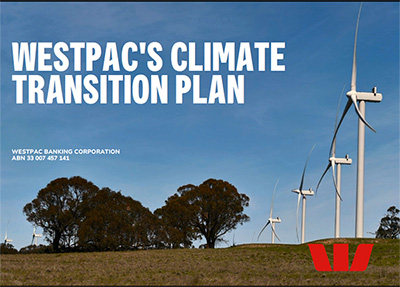 Westpac Bank Transition Plan It took years for the Banker Blob to spread into global weather control
Way back in 2010 the National Australia Bank was a founding member of “Climate Active” and was the first bank downunder to become carbon neutral. But lately all the Australian banks felt the need to have a “Climate Change Commitment”– they just want to save the world, right?. Most of these “commitments” may have been trivially symbolic — like NAB installing 2,000 solar panels, and LED lights in all their branches. Nevertheless, overtly or tacitly, it appears the message got through to the staff at least, who became afraid of upsetting the boss.
The media cheered them on, the politicians said “bravo”, and most Australians had better things to do (or so they thought). But the levers of power and accountability were being taken out of Parliament and being handed to bankers. Most of whom should have been serving their country, rather than serving The Blob, the UN, the WEF, and all the agencies of globalist power. But the bankers are creatures of The Blob, which protects them from competition. They look like private institutions but they only exist at the pleasure of the regulators. And our western democracies make sure it’s hard for new competitors to get a license (we must protect the racket). We wouldn’t want any upstart bankers to get off the ground who’d like to loan to Big Oil and Big Coal and proudly so.
So it is somehow very fitting, if not frighteningly so, that the Bankers became the enforcement arm of laws written in Paris, and not necessarily in Parliament.
Let us not forget the bankers role in our current predicament. Make them squirm…
Thanks to Matt Canavan and the National Party who are trying to do that:
The Nationals are calling for a major shakeup of Australian banks, following revelations that energy-lending policies have been destroying investment in coal, gas, and oil.
Leader Matt Canavan said The Nationals had written to the four major banks, expressing concern that a businessman was denied even a bank account after he tried to build a diesel refinery in Gladstone.
“Now, with the benefit of hindsight and our current oil crisis, I am sure Australia would be a lot better off today, had we provided support for someone who had planned to build a refinery in 2018,” Senator Canavan said. “But we need to dump all of this Environmental, Social and Governance agenda because it is now clear that ESG stands for Extreme Shortages Guaranteed.
9.9 out of 10 based on 116 ratings
9.9 out of 10 based on 13 ratings
9.9 out of 10 based on 18 ratings
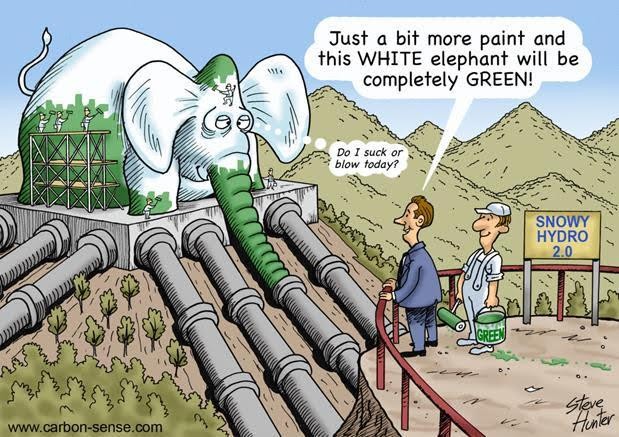 by Steve Hunter By Jo Nova
Snowy 2.0 will stand as a monument to organized crime
Big Government is the ultimate racket. The costs have been hidden, the FOIs denied, the Unions are raking in the cash, and a foreign corporation is soaking in easy money. And in the end, the stored power is likely to be a horrible $200/MWh*, making it 6 times the price of brown coal plant power.
Malcolm Turnbull promised us it would cost $2b and take four years, and here we are, nine years later, with just $40 billion and three more years to go….
There is something in this project for every grifter. The incompetent management delays have added $8b in interest during construction. That will keep the Bankers happy. There are 3,000 extra workers nobody thought we’d need and they earn $250,000 each on average. And there is now $12 billion in interconnector high-voltage line costs. Like all “renewable” projects, the fuel is free but the cost to collect and distribute it burns like a magnesium flare.
By Tansy Harcourt, The Australian
The true cost of Snowy Hydro 2.0 has spiralled to $42bn and should be the subject of a Royal Commission into “one of the biggest disasters” in Australian infrastructure, economist Bruce Mountain and energy executive Ted Woodley said.
Major contractors on Australia’s flagship renewable energy project are simultaneously reaping profits at taxpayers’ expense under arrangements that guarantee payment irrespective of performance, while a series of prime ministers have maintained a wall of secrecy around the project.
The cost is now $1,500 per man, woman and child in the country. It’s like the government demanded every family of four pay $6,000 for something that doesn’t generate electricity, it just stores what wind and solar power make at the wrong time, so we can convert a useless product into something less useless.
This is pure subsidy money to wind and solar power. Each renewable project should be charged the fees to cover this, then see what the hourly charge for unreliable power really is.
Who is making money from Snowy?
Italian construction giant Webuild is in charge of the project and booked €4bn of revenue from Australia last year alone (a figure that included other projects). Australia is now a close-second in terms of revenue for Webuild behind Italy, and is its biggest pipeline going forward.
Webuild operates under a controversial cost-plus margin contract. Based on industry standards, that probably means it gets $1.20 for every $1 it spends, creating a perverse incentive to go big.
“That’s a wonderful business to have, isn’t it?” said a former insider.
One of Webuild’s delays was so that they could get worker accommodation built in Italy and sent to Australia. Because the Australian economy is not built around remote mining camps, right?
From the Herald Sun — Bruce Mountain is renewable fan, and even he hates it:
Dr Mountain argued the project represents a fundamental policy failure that successive governments refuse to acknowledge. “Snowy 2.0 is, and always was, a dreadful idea,” he said, citing its price, environmental damage and a storage system that cannot be quickly recharged like batteries.
It takes months to pump water through a cascade system before the upper reservoir can be refilled, making it unsuitable for the flexible backup role it was designed to fill.
When finished, Snowy Hydro should provide 350GWh of long-duration energy storage, impressive enough to power 3 million homes for a week. Whether it is worth $42bn is another thing entirely.
Or we could have built four nuclear plants, South Korean style, and got 5GW of actual generation, with production of 40TWh a year. That’s 100 times as much energy, available when we need it. The big downside of course is that it’s a horror show for renewable investors and all the daft politicians who said wind and solar were “cheap”.
There are, of course, excellent reasons for secrecy
Responsible Members of Parliament clearly have a duty to keep these obscene costs a secret from taxpayers, adversaries, and anyone with a calculator. This isn’t about dodging accountability —it’s about protecting Australians from the harmful effects of understanding the astronomical numbers. Clearly releasing the truth suddenly would demoralize the nation, increasing rates of depression and suicide if people knew how crooked and inept our government really is. This is secrecy in the interests of public mental health.
Then there is the matter of commercial sensitivity. We don’t want foreign infrastructure firms to know how easy it is to screw absurd amounts of money out of Australia. They will all raise their quotes. If word got out that budgets are flexible, deadlines optional, and overruns practically a revenue stream, every bidder would adjust accordingly. Australia will never get a reasonable tender again.
Naturally national security is also at stake. If adversaries learned how effectively a single project can inflate costs and strain the grid, they might attempt to replicate the model. Why sabotage infrastructure when you can simply commission it?
Though in fairness, it’s hard to imagine how foreign spies could make the situation worse than the Labor party already has.
h/t Jethro Bodeen, David Maddison and David E
*kWh fixed to MWh!
10 out of 10 based on 116 ratings
9 out of 10 based on 21 ratings
|
JoNova A science presenter, writer, speaker & former TV host; author of The Skeptic's Handbook (over 200,000 copies distributed & available in 15 languages).

Jo appreciates your support to help her keep doing what she does. This blog is funded by donations. Thanks!


 Follow Jo's Tweets
 To report "lost" comments or defamatory and offensive remarks, email the moderators at: support.jonova AT proton.me
Statistics
The nerds have the numbers on precious metals investments on the ASX
|







Recent Comments