Recent Posts
-
Sunday
-
One Nation are now the Party of the workers, and Labor the party of wealth and academics
-
Saturday
-
Net Zero anyone? USA bets big on coal and gas — overtakes China in spending.
-
Friday
-
Winning: Trump persuades The World Bank to drop its huge spending target on “climate”
-
Thursday
-
Bafflement?! Germany, a global leader in renewables but has one of the highest EU electricity prices
-
Wednesday
-
Horse-drawn carriages must have caused a Megadrought in Europe in 1540, right?
-
Tuesday
-
Monday
-
Sunday
-
UK facing devastating 36 degree heat — can’t decide whether to use air conditioners or rip them out
-
Saturday
-
Batteries failed on day One: A four day wind drought in South Australia wreaks havoc, high prices
-
Friday
-
The UN wants to be One World Government and it starts with a carbon tax on ships and planes
-
Thursday
-
What if Global Warming was just because something made the clouds go away…
-
Wednesday
-
Snowy 2.0 is the Trillion dollar Black Hole of Australia — sucking in energy, money, land, industrial relations, the dollar, our lifestyle
-
Tuesday
-
Monday
-
Winter Solstice
-
Saturday
-
We were throwing-renewable-energy away at record levels in 2025
-
Friday
-
Pauline Hanson, the centrist, just wants a free market in electricity, and an end to the renewable energy bribery
-
Thursday
-
Blame the Climate Yeti again for making your life more expensive! (It’s a smokescreen)
-
Wednesday
-
The Sunrise Project funneled $343 million from overseas to push net zero
-
Tuesday
-
Monday
-
Sunday
-
The US government has been secretly funding 120 dangerous biolabs around the world
-
Saturday
-
New report shows renewables are a drag on our national productivity
-
Friday
-
Thursday
-
Well, how convenient. AI data centers have arrived to be the fall guy for the Energy Minister
-
Wednesday
-
Billionaires are leaving the room with excuses — Bezos says “AI will solve climate crisis”
-
Tuesday
-
Monday
-
Sunday
-
The Craziest eco laws against Farmers. Let’s check that science…
-
Saturday
-
China cooks the carbon accounting books by 400 million tons
-
Friday
-
The Wind Power Puzzle (add more wind turbines and get the same output)
|
…
8.1 out of 10 based on 33 ratings
Climate Change Business Journal estimates the Climate Change Industry is a $1.5 Trillion dollar escapade, which means four billion dollars a day is spent on our quest to change the climate. That includes everything from carbon markets to carbon consulting, carbon sequestration, renewables, biofuels, green buildings and insipid cars. For comparison global retail sales online are worth around $1.5 trillion. So all the money wasted on the climate is equivalent to all the goods bought online.
The special thing about this industry is that it wouldn’t exist if it weren’t for an assumption about relative humidity that is probably wrong. As such, it’s the only major industry in the world dependent on consumer and voter ignorance. This is not just another vested interest in a political debate; it’s vested-on-steroids, a mere opinion poll away from extinction. You can almost hear the captains of climate industry bellowing: “Keep ’em ignorant and believing, or the money goes away!”.
To state the obvious:
Policy, or the anticipation of new policy, has been one of the biggest drivers of the industry, the report shows.
Most industries this size exist because they produce something the market wants. They worry that competitors might chip into their market share, but they don’t worry that the market might disappear overnight. Normal industries fear that a “bad” political outcome might reduce profits by ten or twenty percent, and sometimes they donate “both ways”. But the climate industry has literally a trillion on the table that depends on big-government policy and election outcomes. They are always one prime-time documentary away from disaster. What if the public saw that thermometers were next to industrial exhaust vents? What if they learned that the climate models are unskilled, broken, and non-functional, or that 28 million weather balloons show carbon reduction is fruitless pursuit? What if they knew historic records are wildly adjusted to make the current weather look warmer than it would?
So while The Guardian worries about the dark and evil influence of the fossil fuels industry they don’t seem at all concerned about the vested-monster-in-the-kitchen, the 1.5 Trillion Climate Industry. Ditto for the intrepid souls at the ABC/BBC/CBC who think they speak truth to power, but miss the most powerful lobby in the climate debate.
By the way, you can buy the 200 page Climate Change Consulting Report for $995, or not.
 …. Insurance Journal
Keep reading →
9 out of 10 based on 185 ratings
 … I used to think there was a consensus among government-funded certified climate scientists, but a better study by Verheggen Strengers, Verheegen, and Vringer shows even that is not true.[1] The “97% consensus” is now 43%.
Finally there is a decent survey on the topic, and it shows that less than half of what we would call “climate scientists” who research the topic and for the most part, publish in the peer reviewed literature, would agree with the IPCC’s main conclusions. Only 43% of climate scientists agree with the IPCC “95%” certainty.
More than 1800 international scientists studying various aspects of climate change (including climate physics, climate impacts, and mitigation) responded to the questionnaire. Some 6550 people were invited to participate in this survey, which took place in March and April 2012. Respondents were picked because they had authored articles with the key words ‘global warming’ and/or ‘global climate change’, covering the 1991–2011 period, via the Web of Science, or were included the climate scientist database assembled by Jim Prall, or just by a survey of peer reviewed climate science articles. Prall’s database includes some 200 names that have criticized mainstream science and about half had only published in “gray literature”. (But hey, the IPCC quoted rather a lot of gray literature itself. Donna LaFramboise found 5,587 non peer reviewed articles in AR4.)
Fabius Maximus deserves credit for finding and analyzing the study. He notes that only 64% agreed that man-made CO2 was the main or dominant driver controlling more than half of the temperature rise. But of this group (1,222 scientists), only 797 said it was “virtually certain” or “extremely likely”. That’s just 43% of climate scientists who fully agree with the IPCC statement. This survey directly asks climate scientists, unlike the clumsy versions by John Cook, William Anderegg, or Naomi Oreskes that do keyword surveys of abstracts in papers and try to “guess”.
Fabius Maximus suggests we exclude the “I don’t knows” which brings up the number to 47%. Since these are “climate scientists” I don’t see why those responses should be excluded. An expert saying “I don’t know” on the certainty question is an emphatic disagreement with the IPCC 95% certainty.
The IPCC AR5 Statement:
“It is extremely likely {95%+ certainty} that more than half of the observed increase in global average surface temperature from 1951 to 2010 was caused by the anthropogenic increase in greenhouse gas concentrations and other anthropogenic forcings together. ”
— Summary for Policymakers of the IPCC’s AR5 Working Group I.
 …  … The researchers acknowledge that skeptics may be slightly over-represented, “it is likely that viewpoints that run counter to the prevailing consensus are somewhat (i.e. by a few percentage points) magnified in our results.” I say, given that skeptics get sacked, rarely get grants to research, and find it harder to get published, they are underrepresented in every way in the “certified” pool of publishing climate scientists. Skeptical scientists, I daresay, would be much less likely to use the keyword phrase “global warming” in the papers they do publish. I imagine it’s easier to get papers published that don’t specifically poke the mainstream buttons.
UPDATE: Curiously this new detailed study builds on a previous study by the PBL Netherlands Climate Assessment Agency, which was issued in 2014 and includes the same authors, as well as John Cook and a few others.[2] Jose Duarte responded to that first version, pointing out that many of the people surveyed worked in mitigation and impacts of climate change, (not climate “science” per se) which artificially inflated the results.[3]
Is there an alternate skeptical theory in climate science?
Keep reading →
8.8 out of 10 based on 131 ratings
How easily it could collapse. What more proof do we need that the climate-crisis facade is maintained by hiding the counter arguments. Evidently the worst possible thing is for the public to be exposed to little pieces of paper with a message that runs against the creed.
The South Australian (SA) government is very very afraid, issuing statements yesterday, designed to intimidate Flinders University into rejecting the Lomborg Consensus Centre. They know that they can’t defend their “wind power” and “climate” policies, and the public will be up in arms when they realize how much money has been burned. (In 2012 Hamish Cumming estimated South Australian windfarms have saved 4% of their rated capacity in fossil fuels at a cost of $1,484 per ton.)
But it’s not about the environment or the economy, it’s about prestige, popularity and status.
If the SA government fails to stop the Lomborg Centre at Flinders University, they know they will be called nasty names by their peers. They admit as much in their bizarre statements, which effectively use political pressure against a university to keep it free of “political pressure”, and admits researchers can be bought to support an agenda. Flinders Uni will look weak if they cave in now.
Are there any universities left in Australia that have academic freedom?
In a series of statements yesterday aimed at the Flinders University Council and the Coalition, the Weatherill government warned Dr Lomborg that he was not welcome in the state as it would damage South Australia’s image among the climate change fraternity.
State Labor also warned Flinders University that its academics would be bought off to peddle an anti-climate change agenda, and likened federal funding for the proposed centre to tactics used by the tobacco lobby.
Federal Education Minister Christopher Pyne said the state’s position was “bizarre” and a “disgraceful intervention” in Flinders’ academic affairs.
The SA Government oppose the Lomborg Centre on “ideological” grounds while declaring that universities should be free of er… “ideological” influence.
He [Ian Hunter, SA Climate Change Minister] said the Flinders University Council should immediately rule out establishing the centre. “It needs to be made abundantly clear that the federal government’s funding carrot to set up the Lomborg centre comes with ideological strings attached.
So university researchers can be bought by governments to “support their agenda”. What does that say about the 97% government funded “consensus”?
“The federal Liberal government’s attitude to climate change is well known — and derided globally — and this funding is designed to buy willing researchers to support their agenda.
The former federal Labor governments attitude to climate change was “well known” too. Did Weatherill protest about the ideological strings then?
Keep reading →
9.2 out of 10 based on 116 ratings
It’s a tax that’s “not a tax” and a “free market” that isn’t free.
Joy. An emission trading scheme (ETS) is on the agenda again in Australia. Here’s why the first priority is to clean up a crooked conversation. If we can just talk straight, the stupid will sort itself out.
The national debate is a straight faced parody — it could be a script from “Yes Minister”, except no one would believe it. Bill Shorten argues that the Labor Party can control the world’s weather with something that exactly fits the definition of a tax, yet he calls it a “free market” because apparently he has no idea what a free market really is. (What union rep would?) It’s like our opposition leader is a wannabe entrepreneur building a Kmart that controls the clouds. Look out Batman, Billman is coming. When is a forced market a free market? When you want to be PM.
The vandals are at the gates of both English and economics, and we can’t even have a straight conversation. The Labor Party is in flat out denial of dictionary definitions — is that because they can’t read dictionaries, or because they don’t want an honest conversation? Let’s ask them. And the idea central to modern economics — free markets — when will the Labor Party learn what one is? It’s only a free market when I’m free to buy nothing.
A carbon market is a forced market. Who wants to buy a certificate for a reduction in carbon dioxide emissions? Only 12% of the population will even spend $2 to offset their flight emissions. How many Australians would choose to spend $500? Why don’t we ask them?! Why — because Bill Shorten knows what the answer would be.
Then, on top of all that, is the hypocrisy — the Labor Party say an ETS is the most efficient way to reduce carbon, but they know it isn’t true, because they also insist we buy 50% of our electricity from renewables. Even with an ETS, no one would choose wind power or solar to reduce CO2. They are that stupid.
But a fake free market will help the Global Financial Houses. Buy a carbon credit and save a Banker!
When will Labor start to speak English?
Definition of “Tax”: noun
1.a sum of money demanded by a government for its support or for specific facilities or services, levied upon incomes, property, sales, etc.
2.a burdensome charge, obligation, duty, or demand.
So let’s call it what it is, the ETS-tax. Confront the Labor Party with their inability to speak honest English. There is deception here, written into their language. As long as they won’t speak English, how can we even discuss their policy?
Can someone tell Labor what a “free market” is?
Real free markets are remarkable tools and very efficient, but we can never have a real free market on a ubiquitous molecule used in all life on Earth. It’s an impossibility.
The Labor Party is simply stealing a good brand name. This fake market in air certificates does not meet even the basic requirements of a true free market. It’s a market with no commodity, no demand, no supply, and no verifiability of goods delivered. You and I are not “free” to choose to buy nothing. Most of the players in this market are not free to play — who pays for yeast, weathering, or ocean cycles?
As I said in The Australian: people who like free markets don’t want a carbon market, and the people who don’t trust capitalism want emissions trading. So why are socialists fighting for a carbon market? Because this “market” is a bureaucrat’s wet dream.
Keep reading →
9.4 out of 10 based on 71 ratings
Did you know CCS (carbon capture and storage) requires an industrial plant almost as large as the coal fired power station it is supposed to clean up? Or that it uses fully 40% of the energy of the entire output of the same station? It turns out to be such an onerous, costly pursuit it could only have been dreamed up by an enemy of coal.
The central problem is that under conditions we humans like to be in, the CO2 molecule emphatically wants to be a huge voluminous gas. To make it more compact and storable back in the small hole it came from, we either have to change it chemically, or forcibly stuff it in under some combination of extreme pressure or extreme cold. And there aren’t many cold sealed rock vaults in Earth’s thin crust, which rests on a 1000 degree C ball of magma. Any form of chemical, temperature or pressure change uses monster amounts of energy, and there is just no getting around it without fiddling with laws of chemistry. The whole idea of CCS is so insanely unfeasible that in order to stuff a beneficial fertilizer underground it appears we must spend 60% more to build every new power station and then throw away 40% of its output as well. You can’t make this stuff up. CCS is the threat that makes new coal stations unaffordable in the West, and building those costs into the plans makes cost comparisons with renewables (and nuclear) so much more “attractive”. Anton goes through some provocative numbers. — Jo
Guest Post: Anton Lang (TonyfromOz)
Here’s why CCS (Carbon Capture and Sequestration, Storage) or “Clean” Coal is impossible
The Big-PR machine makes it sound simple:
 … Credit to Genevieve Young (Univ of Utah) for an image that has been adapted by others.
Billions of investment dollars hinge upon it, but few will correctly explain the whole process and what it entails. If they did, the public would see it for the pie-in-the-sky fairy plan that it is.
CCS is the proverbial Sword Of Damocles, hovering over every proposal for a new large scale coal fired power plant because it might only be approved only if it includes CCS. It’s used in the costings for new plants, making them virtually unaffordable. Making coal fired power enormously expensive means wind-power appears to be “cheaper” than coal. It’s one of the ploys used to artificially raise the costs for coal fired power, so renewable proponents can point and gloat that wind especially is now cheaper than coal fired power.
CCS artificially raises the costs of coal fired power in two ways
Keep reading →
9.8 out of 10 based on 111 ratings
There is only one good reason to buy The Age: cartoonist John Spooner
 … For foreign readers, there are two big headlines in Australia this week that Spooner is teasing us with.
One is about Shorten’s fantasy that Australia can go 50% renewable by 2030. This is an “aspirational ambition”, which, according to opposition leader Shorten, doesn’t need any kind of feasibility or budgeting before being announced as a policy. He plans to wave his magic wand and make aspirations happen, regardless of stuff like “money”, “Watts” and thousands of dead bats.
Keep reading →
9 out of 10 based on 83 ratings
Big Oil knows no bounds. Not only can it derail governments, and thwart the UN, World Bank, and IMF but now it may be sending out climate death squads to assassinate Arctic Ice Experts. These expert hit squads apparently push people down stairs, run them off the road, and strike them down with lightning. Lightning! (That is one mother of aTesla Coil.) James Bond could learn something. Q, where are you?
Prof Wadhams at Cambridge has been the go-to man for Arctic scare stories across the UK (h/t Delingpole). In 2012, Wadhams predicted Arctic Sea Ice was set to collapse in just four years. Last year, after years of a relentlessly surviving Arctic, even some alarmists threw Wadham under the bus, (so to speak) as being too “extremist”. But now he’s topped that.
You see, in January 2013 there were four leading Arctic experts in the UK, now there is one, and he is very very worried.
No, seriously, you can’t make this up. Let’s try to imagine how much more profitable Big Oil would be if every single Arctic climate expert in the World was dead. (Count the zeros…)
The utter futility of it all escapes Wadhams. After a high-risk pogrom against arctic scientists, it would be exactly five minutes before the BBC and Guardian would be reporting their 22-year-old underlings apocalyptic predictions instead. Wadhams has no idea how irrelevant he is, or how little Big-oil cares. If I were advising Big Oil — I’d tell Royal Dutch Shell to hold off with the hit-squad — and just get their PR department to stop the press releases where they beg for more Carbon Trading in the EU. Next on the list: has Shell stopped sponsoring WWF? If Shell want to stop the climate scare campaign, that has to go.
The truth is that Big-Oil want the climate scare — it’s good for business. In the end, everyone wants oil, no one goes to work in a solar car. And Big-oil get bonus government subsidies for biomass and carbon sequestration too. Money for jam. Plus Big Oil also get an excuse to fight their real enemy, Big-Coal.
With such a hot-to-trot conspiracy on the cards, where is Stephan Lewandowsky, John Cook and Mike Marriott? I bet they can’t wait to study conspiracy ideation among actual climate experts, it would be so much more exciting than analysing 10 anonymous internet responses, or getting no responses from “78,000 skeptics” (who didn’t see the survey that was never hosted at John Cook’s site). Imagine a real study subject, an actual person, instead of internet readers who say they are 32,000 years old. The thrill!
The Telegraph
Three scientists investigating melting Arctic ice may have been assassinated, professor claims
Cambridge Professor Peter Wadhams suspects the deaths of the three scientists were more than just an ‘extraordinary’ coincidence
A Cambridge Professor has made the astonishing claim that three scientists investigating the melting of Arctic ice may have been assassinated within the space of a few months.
Professor Peter Wadhams said he feared being labelled a “looney” over his suspicion that the deaths of the scientists were more than just an ‘extraordinary’ coincidence.
But he insisted the trio could have been murdered and hinted that the oil industry or else sinister government forces might be implicated.
The three scientists he identified – Seymour Laxon and Katherine Giles, both climate change scientists at University College London, and Tim Boyd of the Scottish Association for marine Science – all died within the space of a few months in early 2013.
Professor Laxon fell down a flight of stairs at a New year’s Eve party at a house in Essex while Dr Giles died when she was in collision with a lorry when cycling to work in London. Dr Boyd is thought to have been struck by lightning while walking in Scotland.
His suspicions drew outrage on Saturday from Prof Laxon’s partner, who was also a close friend of Dr Giles. When told what Prof Wadhams had said, Fiona Strawbridge, head of e-Learning at UCL, replied: “Good god. All of this is completely outrageous and very distressing.”
Alarmist propaganda has been ranting relentlessly for twenty years about the power of Big Oil. But brainwashing bites, and this is one of those moments. Poor Prof Wadhams is reaping what that bizarre culture has sowed.
Keep reading →
9.5 out of 10 based on 73 ratings
…
7.6 out of 10 based on 11 ratings
 … What’s scarier than an Endless Global Drought? The fear that the public might… hear from a skeptic. Skeptical arguments are so dangerous that even the whiff of one will kill a $4million dollar project stone dead at conception. Be Gone Freak! Guess who has no answer to the questions skeptics ask? How they do advertise the dire state of their intellectual ammo? You might think I’m exaggerating. Bjorn Lomborg believes the IPCC science 100%, and uses the “denier” term to distance himself from the scientific skeptics. It’s like cloaking himself in garlic, except it doesn’t work — true believers still hate him and seek to shut him down. Lomborg wants to stop fossil fuel subsidies, the arch-enemy in the believers world, and that’s not enough. Furthermore he wasn’t going to work at the Australian Consensus Centre and it wasn’t going to discuss the climate, but two steps of purification is not enough. Lomborg commits the unforgivable sin of wanting to spend enviro-gravy in ways that actually help the poor and protect the environment. He wants measurements and accountability. And that makes him “repulsive” — just ask the students of Flinders University. The modern University needs no logical reason, hate-mail is enough:
FLINDERS University students are “repulsed” by the prospect of a new policy centre associated with controversial Danish academic Bjorn Lomborg, who has long been accused of downplaying the dangers posed by global warming.
The university has been in talks with the Federal Government about establishing the Australian Consensus Centre, which would come with $4 million funding and base its work on Lomborg’s methodologies.
The University of Western Australia was to host the think tank, to be aligned with Lomborg’s Copenhagen Consensus Centre and work in areas ranging from food security to social justice, but reversed its decision amid howls of protest from students and staff.
Flinders University Student Association general secretary Grace Hill said students would launch a campaign immediately against having “a climate change denial centre on campus”.
“I’m pretty repulsed by it,” she said.
“At this stage there seems to be no student or staff consultation. It’s right-wing junk. It was excellent to see him booted out of WA so hopefully the same will happen here.
— Flinders Uni Students Vow to Rebel against Bjorn Lomborg policy centre: Daily Telegraph
Only purity of thought will do behind the fortress walls of Australian Universities. The panic caused by the possibility of a skeptical argument is so strong that Global Repulsion is called for, even against believers who dare suggest the IPCC are not Godlike in all their aims and decrees. I think all universities in Australia should be offered the Lomborg Test. Let’s send an offer to host the Consensus Centre at their University, and cancel future government support for all who refuse to allow diversity of opinion and debate on campus. What’s the scariest thing that could happen — the Lomborg Consensus Centre might issue a press release? But the howling at UWA was so successful in cancelling the Lomborg Consensus Centre, that it’s happening again. What chance would a skeptical scientist have of working at an Australian University? Right now the best thing that can happen to Australian Universities is for them to be privatized and a few new institutions set up. Without some serious academic competition here to show them up, the backward behaviour will go on. We need one sensible university to show the others what “Sensible” looks like.
9.4 out of 10 based on 118 ratings
Pope Francis put out his pro-climate encyclical eight weeks ago, getting mass media attention, but the latest Gallop poll shows the people were not so enthused:
WASHINGTON, D.C. — Pope Francis’ favorability rating in the U.S. has returned to where it was when he was elected pope. It is now at 59%, down from 76% in early 2014. The pontiff’s rating is similar to the 58% he received from Americans in April 2013, soon after he was elected pope.
Is this about “climate change” — the encyclical has 245 paragraphs, 16 mentions of “climate”, 7 mentions of “carbon”, and more than 100 mentions of the “environment”. Moreso it reported around the globe as a “coup” on the climate issue by groups who normally think the Pope is wrong, silly and anachronistic. Furthermore, the biggest change has come among Catholics, Protestants, and especially conservatives. But he’s less popular among liberals too.
The drop in the pope’s favorable rating is driven by a decline among Catholics and political conservatives, two groups that have been ardent supporters of the modern papacy. Seventy-one percent of Catholics say they have a favorable image of Francis, down from 89% last year.
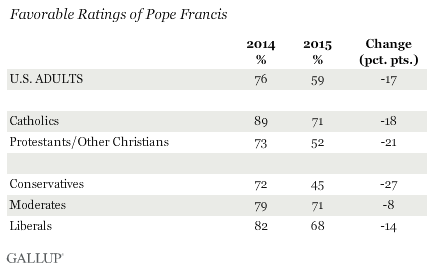
h/t to Heartland who deserve some credit here, having sent a team to the Vatican to draw attention to this issue.
The poll was a random survey of 1,009 people in the US. The margin of sampling error is ±4 percentage points at the 95% confidence level. The question: “Please say if you have a favorable or unfavorable opinion of Pope Francis — or if you have never heard of him”.
Did everyone miss the papal decree against Carbon trading?
During the orgy of papal-enthusiasm I noted that few people mentioned that the Pope was against carbon trading. Not the preferred prophesy?
190. Here too, it should always be kept in mind that “environmental protection cannot be assured solely on the basis of financial calculations of costs and benefits. The environment is one of those goods that cannot be adequately safeguarded or promoted by market forces”.[134] Once more, we need to reject a magical conception of the market, which would suggest that problems can be solved simply by an increase in the profits of companies or individuals. Is it realistic to hope that those who are obsessed with maximizing profits will stop to reflect on the environmental damage which they will leave behind for future generations? Where profits alone count, there can be no thinking about the rhythms of nature, its phases of decay and regeneration, or the complexity of ecosystems which may be gravely upset by human intervention. Moreover, biodiversity is considered at most a deposit of economic resources available for exploitation, with no serious thought for the real value of things, their significance for persons and cultures, or the concerns and needs of the poor.
The Pope was not able to explain why “market forces” were not the answer. He didn’t mention that sometimes free market forces work just fine with environmental problems, but they don’t when it’s a ubiquitous molecule central to life on Earth. In this case a free market is an impossible fantasy because most players can’t play — they are dogs, cats, yeast or the Pacific Ocean. Also it isn’t a real free market, because no one is “free” not to buy and governments control both supply and demand.
Anyhow…
9.3 out of 10 based on 72 ratings
The Coalition in Australia must be thrilled that Bill Shorten wants to make the next election about “climate change”. What a gift from Labor.
Just before the last election Labor had a plan to spend $60,000 dollars per person to try to change the weather by 2050. Labor lost nearly a quarter of their seats. Bill Shorten’s new election vision is to repeat the same mistakes. Like the G7 leaders, he wants symbolic and unachievable promises — only, unlike them, he’s making pie-in-the-sky, uncosted plans for 2030, not 2100. Five of the seven G7 nations are increasing their coal use. Get with the game Bill, other countries are winding schemes back and putting off the promises til long after most people alive today will be gone.
Shorten is pushing a dead dog. The sweet end of the wind and solar power deals have already been done and the numbers get uglier from here. As more and more of the grid is taken over by a massive erratic and unreliable supply, the marginal returns shrink, prices go up. The carbon “savings” falls. Full baseload back up must be maintained regardless, whirring away inefficiently on standby. The Labor Party are making a big miscalculation electorally, fooled by inept surveys that show everyone “likes” the environment and “worries” about climate change. Better studies show almost no votes hinge on this topic, nobody wants to spend much, and pandering to the green religion will hurt things people do care about — electricity prices, manufacturing and employment. US voters rank “climate change” last in environmental polls, and they rank the environment below nearly every thing else. In the UK, polls show 62% don’t believe in a man-made climate disaster. There’s a long list of environmental climate polls showing skeptics are everywhere, and many believers are bored and unmotivated. In the US Tom Steyer threw $74 m at the election on climate change and lost nearly every seat he tried to influence. Fully 92% of Swiss Voters said “No” to a carbon tax.
Just what the country needs?
Green “renewables” schemes push up the price of electricity, make the world 0.0C degrees cooler, and increase unemployment. Every green job created means a loss of 2 – 5 other jobs.
Bill Shorten to unveil 50% renewable energy target at Labor conference –– Sydney Morning Herald
Opposition Leader Bill Shorten is set to unveil a bold climate policy goal requiring half of Australia’s large-scale energy production to be generated using renewable sources within 15 years.
Fairfax Media has learnt that despite Labor’s humiliating 2013 election defeat caused in part by voter contempt for its carbon tax, Mr Shorten will use this weekend’s ALP national conference in Melbourne to announce the even more ambitious goal, dramatically beefing up Labor’s renewable energy target.
The policy shift is designed to recover green support, sharpen the contrast with Prime Minister Tony Abbott over climate change and make global warming the defining battleground of the next federal election
As Andrew Bolt points out, it’s “not costed, not modelled, and not effective”.
Only in Labor economics can we add more expensive suppliers and pretend the prices won’t rise dramatically. It’s “free energy from the sun” after all. It’s like the Labor Party believe the bumper stickers.
 Comparison of costs of electricity generation. | Energy Supply Association of Australia How much global cooling does $100 billion buy?
Australians emit 1.16% of human emissions, which total just 4% of natural ones. Co2 doesn’t appear to have warmed the world in the last 18 years despite rapid rises in human emissions — one third of all human emissions ever since 1998, and no warming. The Australian impact is 0.00064 of nothing.
We need another 10,000 wind turbines?
Adam Creighton, The Australian, on energy prices, and the cost of the Labor 50% renewables plan:
ACIL chief executive Paul Hyslop said: “If this were met by wind power it would require 10,000 to 11,000 additional turbines … with capital costs for the turbines alone of $65 billion.”
He suggested such a move would undermine productivity.
ACIL said the total capital cost would be in the order of $100bn — about three times the cost of the National Broadband Network.
“Basically, we’d be spending another $65bn on turbines to effectively get no more output,” Mr Hyslop said.
Australia will need about 300,000 GWh total in 2030 according to ACIL — We’d need another 92,000 GWh of “renewables”:
The Coalition and Labor agreed in May to trim the RET from 41,000 GWh a year by 2020 to 33,000 GWh, to allow for the fall in electricity demand that was projected to lift the share generated from renewables to 26 per cent by 2020, rather than the 20 per cent envisaged. The new RET is forecast to provide 23.5 per cent.
ACIL estimates a total power demand of 300,000 GWh in 2030, of which half would come from renewable sources under the Labor plan. The firm believes 25,000 GWh would come from rooftop solar systems, with another 16,000 GWh from existing hydro-electric plants, leaving 110,000 GWh to be provided by large-scale renewable projects — or 92,000GWh more than existing capacity.
In terms of carbon emissions, wind turbines are almost the last choice on Earth. They cost $50 – $100 per ton of carbon, seven times more than the Coalition’s Direct Action plan. No one who cares about the environment would want to waste money doing something so inefficient when they could spend the same money and achieve a lot more.
Australian electricity prices are rising much faster than inflation.
The big leap in electricity prices in the graph in 2012/13 below is due to the carbon tax, but some of the rise before that is due in part to other policies to “green” our electricity.
 Electricity prices in Australia. The Carbon Tax was introduced July 2012. Source: Parliamentary Library
The electricity price is rising much faster than inflation. The Rudd Labor government was elected in November 2007.
 …
8.8 out of 10 based on 73 ratings
I’ve discussed the big ComRes/ITV survey before, which showed that 62% of UK citizens are skeptics and are not convinced that humans are changing the weather. This is the same interesting survey which also showed that the highest proportion of skeptics were in the educated upper middle class, and the lowest was in the unskilled workers and pensioners. I didn’t explain then that this survey also split the groups according to age. So here (finally) are those graphs. Fittingly the young are undecided and the wise are more skeptical. But surprisingly there is a peak believer age, and that’s around 35 – 44. Either this generation has been assailed with more propaganda than any other, or something else is going on.
Is this the beginnings of the youthful revolution? Only 20% 34% of 18 – 24 year olds would be called believers?
They quizzed 2047 people from across the UK early last year and I’ve graphed the results according to age, and the “peak believer” band is clearly visible. In all three questions I colored believers red, and skeptics blue. The undecided are grey.
People generally switch from the “don’t know” category when they are young into the skeptic camp as they get older. Some may go via the “believer” group in their 20s and 30s.
The first graph shows results from an unusually specific and accurate question.
 An unusually specific and accurate question.
Keep reading →
9 out of 10 based on 58 ratings
 Fig 3 (Part VI only) Sunspot drawing of by G.D. Cassini in 1671 (Oldenburg, 1671c). What is surprising is just how much data we have on the Sun from 400 years ago.
For some aspects of solar activity we barely have a half a solar cycle. For example, on solar spectral changes: UV and Infrared light swing up and down through the solar cycle, but we only got a good grip on these important changes in the last ten years with the SORCE mission.
But on other aspects of solar activity there is much more long term data than I expected: 400 years ago quite a few people were carefully recording detailed drawings of sun spots (like Cassini in 1671, right). Others were reporting aurorae — up to 150 a year in parish records, newspaper reports, and scientific observations, which tells us something about the strength of the solar wind. There were also observations of the solar corona during eclipses at the time, which suggest the sun was less active as well.
Lately some (Zolotova et al) have said solar activity was not low during the cold Maunder Minimum period from 1645 – 1715. Usoskin and others have responded by amassing a compedium of historic data demonstrating that something very unusual was going on with the sun during that time. They not only look at sun spots, but aurorae, solar corona observations, Beryllium in ice cores, Carbon 14 in tree trunks, and titanium in meteorites.
We know aurorae were rarer or smaller during the Maunder minimum because for 80 years there were virtually no reports of auroras in Great Britain, though keen observers were looking for them, and recording “clear skies” day after day.
There were reports of aurorae from the late 1500’s in the UK, Denmark, and Prague, but then early in the 1600’s activity fell away. The silence was loud. At the end of the Maunder period, across northern Europe on “Tuesday 17th March 1716” people all over Northern Europe reported aurorae, including Edmund Halley in Great Britain, who had never seen one before, yet had read about them, and looked for them. He’d begun to despair he might never see one. One Petter Dass in Norway did miss out, he diligently recorded the night sky from 1645 to 1707 when he died, and though he had read many historic reports of aurorae, he never recorded seeing one himself. His bad luck, to be an astronomer and his whole adult life spent during the quietest period for centuries.
The Usoskin paper is an interesting read for people interested in the history of early science as well as for the history of solar activity.
Total sunlight levels suggest the Sun was very quiet 300 years ago
The world has warmed since 1680, as best as we can tell, and solar activity has increased since then too. This graph of TSI (total solar irradiance) shows that rise — though the absolute change is tiny. TSI changes are small but appear to be another indicator of solar activity.
 Fig. 17. Selected TSI reconstructions since 1600, labeled in the plot are: Sea09 –Steinhilber et al. (2009); DB11 – Delaygue & Bard (2011); Wea05 – Wang et al. (2005); Kea10 – Krivova et al. (2010); Dea14 – Dasi-Espuig et al. (2014); Vea11 – Vieira et al. (2011). The green, blue and red colour tones are used for the reconstructions based on the 10Be, sunspot and 14C data, respectively. The black dotted line marks the TSI value at modern solar activity minimum conditions according to SORCE/TIM measurements. As we keep suggesting, some other factor on the Sun, like the solar-magnetic, spectral changes or solar wind may be responsible for changing the climate on Earth. Correlation is not causation, but neither is it nothing. Yet, the mainstream Climate Models assume all the other solar factors are irrelevant.
That’s record low activity
The Zolotova and Ponyavin paper suggested that solar activity was much higher (red dashes) compared to other reports.
 Fig. 1. Annual group sunspot numbers during and around the Maunder minimum, according to Hoyt & Schatten (1998) – GSN, Zolotova & Ponyavin (2015) – ZP15, and loose and strictly conservative models from Vaquero et al. (2015a) (see Sect. 2.1), as denoted in the legend.
ABSTRACT
Aims. Although the time of the Maunder minimum (1645–1715) is widely known as a period of extremely low solar activity, claims are still debated that solar activity during that period might still have been moderate, even higher than the current solar cycle # 24. We have revisited all the existing pieces of evidence and datasets, both direct and indirect, to assess the level of solar activity during the Maunder minimum. Methods. We discuss the East Asian naked-eye sunspot observations, the telescopic solar observations, the fraction of sunspot active days, the latitudinal extent of sunspot positions, auroral sightings at high latitudes, cosmogenic radionuclide data as well as solar eclipse observations for that period. We also consider peculiar features of the Sun (very strong hemispheric asymmetry of sunspot location, unusual differential rotation and the lack of the K-corona) that imply a special mode of solar activity during the Maunder minimum. Results. The level of solar activity during the Maunder minimum is reassessed on the basis of all available data sets. Conclusions. We conclude that solar activity was indeed at an exceptionally low level during the Maunder minimum. Although the exact level is still unclear, it was definitely below that during the Dalton minimum around 1800 and significantly below that of the current solar cycle # 24. Claims of a moderate-to-high level of solar activity during the Maunder minimum are rejected at a high confidence level.
Look at the detail of this drawing by Cassini, 1671
 Fig. 2. Drawing of a sunspot group observed in August 1671, as published in number 75 of the Philosophical Transactions, corresponding to August 14, 1671. The amount of aurorae data is remarkable
 Fig. 11. Occurrence of auroral reports, 1700-1900. The green line is the number of auroral nights at geomagnetic latitudes below 56◦ from a combination of several catalogues (Nevanlinna, 1995; Fritz, 1873, 1881; Legrand & Simon, 1987). The points show the geomagnetic latitude and time of auroral sightings from the catalogue of V´azquez et al. (2014) (their Figure 9). Black diamonds, red squares and red triangles are, respectively,
for observing sites in Europe and North Africa, North America, and Asia. Blue dashed lines mark the minimum latitude of auroral reports in the last solar cycle of the Maunder minimum (MM) and in the two cycles of the Dalton Minimum (DM). There is a stark dearth of aurorae recorded during the Maunder Minimum:
 Fig. 12. Same as Figure 10 (see caption below graph box), but compiled from 41 different catalogues of auroral observations at magnetic latitudes below 55◦ in Europe, Asia, North Africa, New England and Great Britain. The time series covers both the Maunder and the Dalton minima. [Fig. 10. (a) The grey histogram shows the number of auroral nights, NA, in calendar years for observations in Great Britain collated by E.J. Lowe (1870) with the addition of the observations by Thomas Hughes (Harrison, 2005) and John Dalton (Dalton, 1834). The black line shows the annual group sunspot number of Hoyt & Schatten (1998), with the adoption of recent corrections by Vaquero et al. (2011) and Vaquero & Trigo (2014). Lowes personal copy of his catalogue of natural phenomena (including auroras) was only recently discovered and was compiled completely independently of other catalogues. Yet it shows, like the others, the dearth of sightings during the Maunder minimum, some events in 1707 and 1708 and the return of regular sightings in 1716. (b) Annual variation of NA in the same dataset and of RG.]
Usoskin et al describe the extraordinary sighting of the first aurorae for decades
What is significant about this event is that very few people in the country had seen an aurora before (Fara, 1996). Indeed, Halley’s paper was commissioned by the Royal Society for this very reason. This event was so rare it provoked a similar review under the auspices of l’Acad´emie des Sciences of Paris (by Giacomo Filippo Maraldi, also known as Jacques Philippe Maraldi) and generated interest at the Royal Prussian Academy of Sciences in Berlin (by GottfriedWilhelmLeibnitz).All these reviews found evidence of prior aurorae, but none in the previous half century. Halley himself had observed the 1716 event (and correctly noted that the auroral forms were aligned by themagnetic field) but had never before witnessed the phenomenon. It is worth examining his actual words: “…[of] all the several sorts of meteors of, this [aurora] was the only one I had not as yet seen, and of which I began to despair, since it is certain it hath not happen’d to any remarkable degree in this part of England since I was born [1656]; nor is the like recorded in the English Annals since the Year of our Lord 1574.” This is significant because Halley was an observer of astronomical and atmospheric phenomena who even had an observatory constructed in the roof of his house in New College Lane, Oxford where he lived from 1703 onwards. In his paper to the Royal Society, Halley lists reports
of the phenomenon, both from the UK and abroad, in the years 1560, 1564, 1575, 1580, 1581 (many of which were reported by Brahe in Denmark), 1607 (reported in detail by Kepler in Prague) and 1621 (reported by Galileo in Venice and Gassendi in Aix, France). Strikingly, thereafter Halley found no credible reports until 1707 (Rømer in Copenhagen and Maria and Gottfried Kirch in Berlin) and 1708 (Neve in Ireland).He states “And since then [1621] for above 80 years, we have no account of any such sight either from home or abroad”. This analysis did omit some isolated sightings in 1661 from London (reported in the Leipzig University theses by Starck and Fr¨uauff). In addition to being the major finding of the reviews by Halley, Miraldi and others (in England, France and Germany), a similar re-appearance of aurorae was reported in 1716-1720 in Italy and in New England (Siscoe, 1980).
The absence of auroral sightings in Great Britain during the MM is even more extraordinary when one considers the effects of the secular change in the geomagnetic field. For example, using a spline of the IGRF (InternationalGeomagnetic Reference Field, http://www.ngdc.noaa.gov/IAGA/ vmod/igrf.html) model after 1900 with the gufm1 model (Jackson et al., 2000) before 1900 we find the geomagnetic latitude of Halley’s observatory in Oxford was 60.7◦ in 1703 and Edinburgh was at 63.4◦. Auroral occurrence statistics were taken in Great Britain between 1952 and 1975, and of these years the lowest annual mean sunspot number was 4.4 in 1954. Even during this low solar activity year there were 169 auroral nights observed at the magnetic latitude that Edinburgh had during the MM and 139 at the magnetic latitude that Oxford had during the MM (Paton, 1959). In other words, The British Isles were at the ideal latitudes for observing aurora during the MM and yet the number reported was zero. This is despite some careful and methodical observations revealed by the notebooks of several scientists: for example, Halley’s notebooks regularly and repeatedly use the term “clear skies” which make it inconceivable that he would not have noted an aurora had it been present. Halley’s failure to find auroral sightings in the decades before 1716 is far from unique.
..
REFERENCE
Usoskin et al (2015) The Maunder minimum (1645–1715) was indeed a Grand minimum: A reassessment of multiple datasets, arXiv:1507.05191 [astro-ph.SR]
h/t Willie.
9.5 out of 10 based on 83 ratings
Humans can adapt to live in locations where the monthly average is over 40°C, and as low as -50°C. That’s a 90°C range. The world has warmed by 0.9°C in 100 years (or less, depending on adjustments). This warming was so dangerous that global population only expanded from 1.7 to 7 billion.
Now, if the IPCC are right, we might heat up by another half a degree by 2100 — shifting those extremes from -49°C up to 41°C.
Prof. Andy Pitman, one of Australia’s leading climate scientists, responds to this risk with all the usual careful analysis we’ve come to expect from mainstream climate experts. Here’s another “children won’t know what snow is” type of Global Panic quote:
“I expect by 2050 … people just don’t go outside,”
— Professor Andy Pitman, director of the ARC Centre of Excellence for Climate System Science at UNSW.
So that’s the end of golf, surfing, and picnics then. Somewhat confusingly, he also said (in the same interview) that we won’t necessarily notice that extra warmth: “… because humans acclimatise to heat quite quickly”. This is what 95% certainty looks like in 2015, ladies and gentlemen — abject panic and nothing to see here, both at the same time… journalist Lucy Cormack swallows it all, trained by the Sydney Morning Herald to ignore wild claims and bizarre contradictions.
The hottest inhabited places on Earth
There is a lot of competition for the “hottest” town on Earth.
 Marble Bar, Western Australia Dallol, Ethiopia has an average July monthly high of 45.6°C (114F), so it is usually top of the “hottest inhabited location lists”. But is practically a ghost town so it doesn’t quite count, though miners lived there from 1960-1966 and the 45°C record heat was recorded during these years. The annual average year-long maximum temperature is 41 °C (105 °F). Summer nights in Dallol get down to 32°C (90F).
Marble Bar, West Australia, has an average of 41°C in January for the last 100 years. It holds a world record for having 160 days above 100F from 31 October 1923 to 7 April 1924. About 200 people live there. (See more Marble Bar photos.)
In Kebili, Tunisia, the average July max is 41.7°C and sixty thousand people still live there, so I think it gets the medal for “hottest inhabited town”. Curiously in this warming world, Wikimedia notes that the hottest temperatures (all 50°+C) were recorded from 1888 – 1930, and not since. Presumably those old thermometers needed adjustment.
Humans, apparently, have lived in area’s around Kebili for at least 2,000 years, and maybe, possibly, 200,000 years. (I expect they are probably used to it by now.)
The coldest inhabited places
 Oymykon, Russia Five hundred people live in Oymyakon, Siberia, Russia, almost in the Arctic circle at 63N. The average temperature for January is -50°C. The village is called the coldest permanently inhabited settlement in the world, and there doesn’t seem to be anyone arguing about it. (Though technically, the research station at Vostok, Antarctica has a monthly average of – 68°C, and about a dozen people manage to live there.) In winter in Oymakon, there are only three hours of sun a day, and people have to heat their garages, or run their cars 24/7 to keep them usable.
The coldest ever temperature recorded in Oymyakon was -71.2°C. Read more at Dailymail, and Wired.
The photo (and more glorious ones) was by Amos Chapple.
8.9 out of 10 based on 99 ratings
[Tick tick, only 150 comments to go to 300,000…]
8.1 out of 10 based on 33 ratings
The last time an IPCC chair position was up for grabs was in 2001, when things were not so politicized and aggressive, and there was not so much money and power on the table. Lobbying for this role is running hot and Tony Thomas compares the five men who are standing for this role. The position will be decided by October 8, and the new chairman will presumably be influential, or at least very visible, in Paris at the UNFCCC in early December. In the elections, there is one vote per country, so it is not so much about scientific credibility (and never was, think of Pachauri) but more about the powerful voting blocks that may form with small developing nations. Given that the new chairman will be in the media frequently and soon, this post is about being prepared. No matter who wins, I think the IPCC is unsaveable and needs to be shut down or deprived of funding as soon as possible. — Jo
Guest Post by Tony Thomas
Five candidates have put up their hand to become chair of the Intergovernmental Panel on Climate Change from October 8.
They are Jean-Pascal van Ypersele (Belgium), Hoesung Lee (Korea), Thomas Stocker (Switzerland), Chris Field (USA) and Nebojsa Nakicenovic (Austria).
The elections will be at the meeting of the IPCC in Dubrovnic, Croatia, from October 5-8. Further nominations are unlikely but it is possible that ‘wild card’ candidates could be nominated at the meeting itself, with a vote 24 hours later.
Each of the 195 nation-state members of the IPCC have an equal vote by secret ballot. The vote of Vanuatu (pop 250,000) carries the same clout as the USA’s. This means candidates, and their national backers, will be courting the myriad small states for votes, using hard and soft diplomacy as occurred in 2001.
A win requires a simple majority. If no majority occurs on the first voting round, the top two candidates are put to a run-off vote.
The chair has been vacant since February when Dr Rajenda Pachauri, 75, resigned abruptly after a 29-year-old female analyst at his TERI thinktank in Delhi filed a sexual harassment complaint against him. Pachauri has since been on bail after Delhi police charged him with molestation, stalking, sexual harassment and criminal intimidation. The IPCC then appointed Vice-Chair Ismail Elgizouli (Sudan) as acting chair until October 8.
The IPCC chair position and other top roles carry no salary but give global prominence and status. Leaders’ home governments or institutions pick up the tab.
Van Ypersele and Hoesung Lee are two of the three current vice-chairs (Elgizouli is the third). Stocker is co-chair of Working Group 1 (the science); and Field is co-chair of Working Group 2 (Impacts and Adaptation). If the IPCC operated logically, the showdown would be a contest between the Swiss-backed and US-backed candidates, whose science credentials are overwhelming.
The Candidates
Nebojsa Nakicenovic, Austria, Prof of Energy Economics
Keep reading →
9.1 out of 10 based on 41 ratings
by Jo Nova
If the “leech” doctors circa 1000AD were able to treat superbugs that modern doctors struggle with, I wonder what other knowledge has come and gone and had to be rediscovered?
How many lives have been lost because information was not there when they needed it?
 Image: © The British Library Board (Royal 12 D xvii) Judith Curry posted a link this week to a story about a medieval recipe for an “eyesalve” that rather surprised researchers when it worked against the ghastly MRSA superbug, which is resistant to almost all modern antibiotics.
The book is one of the earliest known medical texts, called Bald’s Leechbook. The recipe called for garlic, onion, wine, and bile from a cow. It was very specific — the mix had to be brewed in brass and then left for nine days. The researchers at the University of Nottingham followed it closely, then it was tested in the lab. Will it work on people, and what are the side-effects?
Keep reading →
9 out of 10 based on 92 ratings
Tony Thomas visited the UK and found old fading National Trust signs using scary photos of flood damage and warning people to “eat local” and change their light globes to stop more floods. He followed that thought to a 2005 web plea from the National Trust, to find them claiming floods are accelerating but using 20 year old photos to scare people with.
Years from now people will study climate propaganda and marvel at how stupid it was. — Jo
Guest Post by Tony Thomas
My wife Marg and I, two Antipodean yokels, wound up at the National Trust’s Bodiam Castle in Kent last month, awed at its 650-year history. After all, our colony’s iconic historical moment was in 1854, when someone broke a hotel lamp in Ballarat, Victoria and precipitated a scuffle between goldminers and police. The ringleader, instead of being quartered like Mel Gibson — sorry, William Wallace — acquired a seat in Parliament next year and eventually died in bed. That’s all you need to know about Australian history, unless you’re into sheep.
Marg and I had lunch and wandered out the back of the Bodiam cafe towards the Rother River. “Hey, come and look at these signs!” she called. I ambled over to the bank that descends steeply to the river.
The first sign said, “The Rother – Where you are standing now will almost certainly be under water in 50 years’ time as a result of climate change. A foretaste of this was given in November 2000 when the river burst its banks and flooded the area.” Below this, the sign had a photo of, sure enough, the water level raised two or three metres to where I was standing. And photos don’t lie.
 …. The next sign read:
“We all have a part to play in tackling climate change and by acting together we can make a big difference. The National Trust is helping by looking at its use of energy, water and waste. You can help too by:
- Buying and eating local food
- Insulating your home
- Changing your light bulbs to low energy
- Using public transport, or cycling.
For more information, look at the National Trust website.”
Keep reading →
8.8 out of 10 based on 91 ratings
 Wind Farm, Wind Park, Wind Sheep, Wind Cows, & Wind-Flowers? This week’s note on mangling English: Since when was an industrial plant a farm? Electricity does not grow, breathe, or look cute in photos. There is nothing biological to sell.
Some will say the term “farm” has broader definitions now. I say we might as well call a coal-fired-plant a “coal farm”, or Fukishima a “nuclear-farm” (that had a “farming accident”)?
The word “farm” has been stolen for its good PR value. Let’s take it back.
Industrial wind turbines are a massive subsidy swamp that produces almost nothing that can’t be provided in cheaper and more efficient ways elsewhere.
Can someone let Wikipedia know that Industrial Wind Turbines are not “Wind Parks” either?
Photo: “Windpark-Wind-Farm” by Philip May – Own work. Licensed under CC BY-SA 3.0 via Wikimedia Commons
9.3 out of 10 based on 106 ratings
|
JoNova A science presenter, writer, speaker & former TV host; author of The Skeptic's Handbook (over 200,000 copies distributed & available in 15 languages).

Jo appreciates your support to help her keep doing what she does. This blog is funded by donations. Thanks!


 Follow Jo's Tweets
 To report "lost" comments or defamatory and offensive remarks, email the moderators at: support.jonova AT proton.me
Statistics
The nerds have the numbers on precious metals investments on the ASX
|






Recent Comments