Recent Posts
-
Friday
-
Vote Left to get expensive electricity
-
Thursday
-
Lucky us, The UN deigns to not list the Great Barrier Reef as ‘in danger’ (yet again)
-
Wednesday
-
Blackouts and maintenance problems hit farmers forced onto solar and batteries in Western Australia
-
Tuesday
-
Monday
-
Sunday
-
One Nation are now the Party of the workers, and Labor the party of wealth and academics
-
Saturday
-
Net Zero anyone? USA bets big on coal and gas — overtakes China in spending.
-
Friday
-
Winning: Trump persuades The World Bank to drop its huge spending target on “climate”
-
Thursday
-
Bafflement?! Germany, a global leader in renewables but has one of the highest EU electricity prices
-
Wednesday
-
Horse-drawn carriages must have caused a Megadrought in Europe in 1540, right?
-
Tuesday
-
Monday
-
Sunday
-
UK facing devastating 36 degree heat — can’t decide whether to use air conditioners or rip them out
-
Saturday
-
Batteries failed on day One: A four day wind drought in South Australia wreaks havoc, high prices
-
Friday
-
The UN wants to be One World Government and it starts with a carbon tax on ships and planes
-
Thursday
-
What if Global Warming was just because something made the clouds go away…
-
Wednesday
-
Snowy 2.0 is the Trillion dollar Black Hole of Australia — sucking in energy, money, land, industrial relations, the dollar, our lifestyle
-
Tuesday
-
Monday
-
Winter Solstice
-
Saturday
-
We were throwing-renewable-energy away at record levels in 2025
-
Friday
-
Pauline Hanson, the centrist, just wants a free market in electricity, and an end to the renewable energy bribery
-
Thursday
-
Blame the Climate Yeti again for making your life more expensive! (It’s a smokescreen)
-
Wednesday
-
The Sunrise Project funneled $343 million from overseas to push net zero
-
Tuesday
-
Monday
-
Sunday
-
The US government has been secretly funding 120 dangerous biolabs around the world
-
Saturday
-
New report shows renewables are a drag on our national productivity
-
Friday
-
Thursday
-
Well, how convenient. AI data centers have arrived to be the fall guy for the Energy Minister
-
Wednesday
-
Billionaires are leaving the room with excuses — Bezos says “AI will solve climate crisis”
|
Our PM’s rapid descent is described as due to the failure of the carbon trading scheme tonight on the 7.30 Report. To make it so much more pointed, on top of that, there’s the suggestion that Rudd is driven by anger, and that his latest attack on the Mining Industry (with the massive new tax scheme) is about beating the same forces that succeeded over him on the Emissions Trading Scheme.
Author and journalist David Marr spoke with the 7.30 Report‘s Kerry O’Brien about the psychological make-up of the Prime Minister and his collapse in public approval.
Apparently it all boils down to the carbon trading scheme that failed.
The point he started to unravel was not the Global Financial Crisis, an ongoing war, or the weak outcome of his feted hospital plan, it was about the carbon scheme:
Keep reading →
9.5 out of 10 based on 2 ratings
Not many people realize just how utterly unprecedented the Global Financial Crisis was.
To see just how singularly anomalous those months were, let’s revisit an article I wrote for 321 Gold in November 2008.
The graphs below are extraordinary, jaw-dropping plots. At the time I was watching them grow week by week, and was amazed that they were not “everywhere”. I still remember the chill I got in mid October when I first saw the ballistic spike. We’re talking about the money supply of the worlds largest economy. The rescue package blew away the scale — the second graph below covers 90 years. It’s not often you see any graph which is a true hockey stick. This was originally published at 321Gold on Nov 25th 2008. Remember this money (your money if you hold US dollars) was “injected” as a temporary fix (in theory), the plan was to neutralize it, or sterilize it, or insert-your-favourite-euphemism-here-for-getting-it-back-to-normal.
So where does the Money Base graph stand now? It’s not back down to $900 billion (where it was in August 2008), it’s not even stable at $1500 billion, it’s $2000 billion. Our markets run on ever increasing injections of new money. The people in the center of these markets–the banking class (many of whom are Wall Street types with big bonuses)–are the same ones who want a carbon trading scheme.
I pointed out that Ben Bernanke’s Helicopter (also known as the US Federal Reserve) was dumping dollars on the bankers. As a corollary, that had to be good for the gold market. At the time gold was selling for around US$700 per ounce. Tonight it’s $1220 (a 75% rise). Not many other market sectors can match that. On another day I’ll explain why gold is the only currency that governments can’t control (in the long run), and why it’s more important than the economic politically-correct litany would suggest. For the moment, ask yourself why the Money Base data is not reported on the front page of newspapers?
By the way, did you get some of the cash stashed in that rescue package?
Ben’s Helicopter Drop is Here
…and it’s Good for Gold
Joanne Nova
Nov 25, 2008
This is a graph to take your breath away.
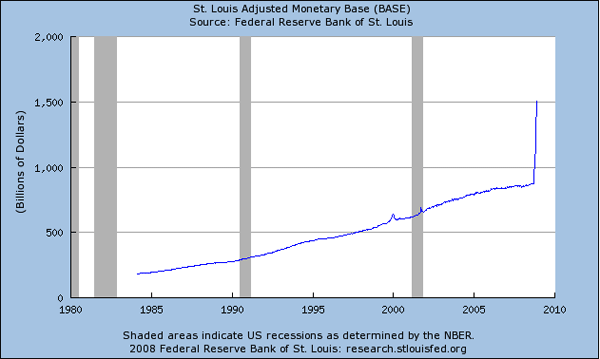
St Louis Adjusted Monetary Base 1984-2008
This is what the start of hyperinflation would look like.
This is the US money base – the total of all currency and reserves of commercial banks in the central bank itself. It’s the narrowest form of monetary aggregate (but getting fatter fast). Banks create loans from base money, so in theory this recent expansion should turn up in broader monetary aggregates in the future.
Keep reading →
10 out of 10 based on 5 ratings
Maybe you are already au fait with the deep flaws in our financial system, or maybe you are like I was ten years ago, too bored to read “economics”–knowing it was all human vagaries and surrounded with jargon. If your eyes glaze at the thought of bonds, yields, debt and GOFO’s–bear with me, I understand. But history books will be written about this year. No one can afford to be not interested in the science of money.
Economics is known as The Dismal Science, and the reason it’s dismal is the same reason that official climate science is — too many dollars at stake. (If we can treat psychology scientifically, why not economics too?)
Those who want to falsely alarm us benefit from confounding issues, confusing statements, argument from authority and bureaucratese
But the unscientific nature of some subjects is no accident. Clear thinking, transparency, and rigorous logic benefit the majority, just as jargon, elitism, gatekeepers and censorship do not. Those who want to falsely alarm us benefit from confounding issues, confusing statements, argument from authority and bureaucratese, and so too do the people who control our money — central bankers, the banking aristocracy, and some politicians. (Though instead of a false alarm, they want false calm…)
Keep reading →
10 out of 10 based on 3 ratings
 Kevin Rudd, 7.30 report May 10, 2010 Kevin Rudd let slip yesterday that he has a vision for bigger-more-malignant ETS than the one he dropped.
“We need to make sure that the Senate becomes, shall I say, positioned in a manner which is able to deliver that change to Australia’s domestic laws,” Mr Rudd said at a news conference with the Maldives president.”
We missed the bullet in December. As a nation we came within a butterfly-wing-flap of sacrificing ourselves to the carbon-Goldman-Sachs-socialist-nightmare. But it could still happen, and it could be worse. The national orbit has swung again slightly, like a pendulum with an elliptical chaotic path. With Rudd destabilized, so are we all collectively far from center.
Australia could be headed for an election where climate change is still a central issue, or worse, it won’t be, and the nasty surprise will spring afterwards.
Keep reading →
9.5 out of 10 based on 2 ratings
The Age — formerly a decent newspaper — never fails to take an opportunity to parrot PR for Team AGW.
Last week they gave a free shot to Will Steffen, Executive Director, ANU Climate Change Institute.

Climate debate ‘almost infantile’
(The Age, ADAM MORTON, May 25, 2010)
A SCIENCE adviser to the federal government has described the debate in the media over the basics of climate change science as ”almost infantile”, equating it to an argument about the existence of gravity.
It takes a tax-payer funded Pro-fessor to equate AGW to gravity. It must have taken years of education to be able to issue pronouncements like this eh? If Australian taxpayers were hoping to get a bit more than just bluster and name-calling from certain public servants, they’re bound to be asking for their money back soon.
Not to put too fine a point on it, but the existence of gravity is proven each day you don’t get flung off the planet when you get out of bed. We can measure gravity to twelve significant digits*, but our value for climate sensitivity to carbon dioxide varies from 0 to 10. Pick a number. We can’t even get one significant digit fixed. Quantifying gravity involves dropping a rock with a clock and a ruler. Quantifying carbon’s effect on climate change involves understanding cloud-formation, ice sheet changes, evaporation, humidity levels in air 8000 m above Singapore, and ocean currents at the bottom of the endless abyss that we can’t even measure.
Speaking at a Melbourne summit on the green economy, Professor Will Steffen criticised the media for treating climate change science as a political issue in which two sides should be given a voice.
Is it political? Heck No. It’s not about managing our economy, assessing risks, choosing between different courses of action… err… it’s pure science. Prof Steffen has modeled our future, there’s no need to involve the economists-consumers-engineers-investors-medical-experts-or those pesky kids we’re supposedly saving-the-planet-for. Managing the country is pure science now; free speech and democracy-babble, who needs it!
Keep reading →
10 out of 10 based on 2 ratings

Mr OAKESHOTT, Federal Independent Member for Lyne, talked about the failure of the Carbon Pollution Reduction Scheme in the Australian Parliament, and wanted to name and shame those responsible:
“I take this opportunity to raise the issue of the smoking guns that I have seen over the last six months. I smelt a rat in the shift that I saw and what looked to be—to their credit—a very well organised and very well-funded campaign from the likes of JoNova and Viv Forbes.”
— Hansard record of Parliament, 27 May 2010
Golly — I’m a smoking gun, a smelly rat, and a paid mercenary of undisclosed groups, and Viv Forbes of Carbon Sense is too!

I’m bowled over by the compliment. Is he really giving me and Viv the joint credit for the sweeping poll changes? (As if). I’ll just ask my PR department (me) to arrange with my cartoonist (me too) to throw together a parody of parliament, which the web-editor (me) can code into a page. All of us are delighted to be described as well organized. (It’s true we communicate like we are all in one head.) **
Keep reading →
10 out of 10 based on 5 ratings
 David Archibalds new book by David Archibald
David will be speaking with the Anthony Watts Tour in Australia. I’ll be buying a copy of his book.
June 1, 2010
This is a shorter version of the Quadrant Online extract.
Edited extract: “Why did so many scientists get it wrong?” from David Archibald’s book – The Past and Future of Climate:
If the data and forecasts in this book are correct, then the Intergovernmental Panel on Climate Change (IPCC), the National Academy of Sciences in the United States, the Royal Society in the United Kingdom, the Bureau of Meteorology and the CSIRO in Australia are all wrong. How can this be? Firstly, there aren’t that many scientists involved in the IPCC deliberations. The inner core is possibly twenty souls. Secondly, they were untroubled by the necessity to concoct fraudulent data to get their desired results. The only unknown question regarding the IPCC scientists is “Did they actually believe in the global warming that they were promoting?”
It turns out that they did, and possibly still do. That is shown by the Climategate emails released on 20th November, 2009. The Climategate emails are a selection of emails amongst members of the inner core plus minor characters. The fact that the IPCC scientists believed in the global warming they were promoting means that their morality at that level was better than expected, but it also means that they are a lot more stupid than expected. Nevertheless, their behaviour in promoting the notion of global warming using fraudulent statistics is reprehensible and hopefully they will be duly punished in this world or the next.
Keep reading →
9.7 out of 10 based on 3 ratings
The debate with Paleoclimatologist Dr Andrew Glikson about the evidence for Climate change has reached a telling point. There is a gaping hole.

Through four rounds of to and fro, I’ve been asking for evidence that the predicted (critical) “hot spot” was there above the equator, and we were drilling down to this point. It’s the weak link in the chain of evidence, and if the climate models are wrong on this element, you can kiss goodbye to the catastrophe. Everything else might be right, but there’s no major warming if there’s no strong amplifying (positive) feedback, and and there is no amplifying feedback from water vapor if there is no hot spot. Indeed, I quoted evidence from three peer reviewed studies that show that we’re headed for a half a measly degree of warming rather than a baking 3 – 6 degrees.
In Round 2 Glikson didn’t mention Lindzen, Spencer or Douglass (the three independent papers which suggest that predicted feedbacks are missing or negative). Instead he suggested “Sherwood 2008” found the hot-spot. I pointed out that Sherwood used wind-gauges instead of thermometers. To believe he is right we need to throw out thousands of thermometer readings and calculate the temperature indirectly from the wind-speed instead.
In Round 3, Glikson didn’t mention Sherwood. But he posted graphs showing the troposphere had warmed. I pointed out that his graphs demonstrated what I had been saying — the upper troposphere had warmed at the same rate as the surface. If the hot spot was there it would have warmed nearly twice as fast.
In Round 4 (in comments after round 3), Glikson didn’t mention the graph. But he pointed to Santer 2008. I replied that Santer didn’t find the hot spot, he just found fog in the data and fog in the models and stretched the error bars so wide that finally the models just overlapped with one set of observations. Santer had no new data. Nine years after the data came in, all he did was to increase the error bars and suggest that maybe our equipment wasn’t good enough to find the hot-spot. It’s rather devastating: if we can’t build weather balloons that get a useful temperature reading, how the heck can we create models that estimate the temperature from 10,000 m below based on dozens of factors that are even harder to measure? The hot-spot should have been at least 0.6°C and radiosondes are individually calibrated to 0.1°C. Somehow we’re supposed to believe that hundreds of radiosondes had missed it?
In round 5, Glikson didn’t mention Santer. It’s as if this devastating point didn’t exist. Andrew Glikson is genuinely trying to come up with other evidence, and he’s not just ducking out completely (as many would), but he is ducking the point that matters, the weak link in the AGW chain. Really, seriously, everything about the Tower of Global Warming was built on the foundation of an increasing column of water vapor. Does he realize that all the other circumstantial evidence is predicated on a guess that the Earth’s climate had net positive feedbacks, when almost all other long-lived natural systems have net negative feedbacks?
All of the other points I’ll briefly sum up here below. I’ve had helpful responses from Michael Hammer with some very original work, and also from William Kinninmonth. I will post these both soon (separately).
Keep reading →
8.7 out of 10 based on 7 ratings
It’s either a seismic shift in power here, or a farce of Grand Proportions. Either way, if you haven’t heard about the Australian Super-Tax, it’s one of those full-moon-moments in Western Democracy when “one plus one equals minus thirteen”, and the guy earnestly telling you this is also running the country. The sheer Spectacle of Stupid is something to behold.
 Guess what the rules will be next year? For the first time, our government has announced a war against a whole Australian industry: mining (the same sector that rescued us from the global financial crisis and produced 37% of our total exports in 2009).
Australian Prime Minister Rudd desperately needs a big win to go to the next election with, and desperate men are dangerous. He was taken in hook, line and stinker by the Big Carbon Scare — bet his reputation on the big bluff, and crashed and burned. He doesn’t want to look like a complete loser (and who does) so he grabbed the easy wedge; attack the rich foreigners, grab the fast cash, pretend to be Robin Hood. Et Voila! The Resource Super Profits Tax*.
This is not so much about climate (sorry) but it is a story about totalitarian trends in government, grand theft, and dismal reasoning. Like the Big Carbon Scare, there is no polite discussion of the pros and cons — the government reduce the commentary to fake black and white choices, name-calling, and “moral positions”. Oh, and the “evidence” is all based on … modeling.
Dodgy logic — It’s the price stupid
Rudd argues piously that underground resources “belong to all of us”, which is true, but a false front to fight on. The companies already pay royalties to the states, but not the Fed). So we Australians are not giving away our minerals for free, and it’s not a question of charging or not-charging for our resources (as Rudd’s Labor government make out) — it’s a question of the price**.
Rudd wants to charge a higher sovereign price, a tax regime on mining that’s higher than anyone else in the world (the Canadians, Brazilians, etc charge much lower prices). Maybe we should charge more for our minerals. But no one is talking about the real issue: whether we should lead the world at raising prices.
The Minerals Council of Australia estimates miners will move from one of the highest rates in the world — 38% total tax — to a world record breaking 58%. Why would the miners, entrepreneurs and mineral consumers of the world pay extra when they can get their minerals elsewhere? Hasta la vista Australia.
Keep reading →
10 out of 10 based on 3 ratings

I wish I could add an insightful quip here. But alas, it’s yet another book I’ve written that I can’t read. 😉
The first Skeptics Handbook is now available in 14 languages and the second handbook in 3. Thanks to volunteer efforts there soon won’t be a corner of the world which doesn’t know just how misleading the UN and western media can be.
Thanks to Maniphone Xayavong and some of her colleagues for the pro bono dedication in translating the Lao version.
Click on the image to download the 1.9Mb PDF.
Steve Hyland helped to connect all the right people and suggests these sites in Laos are useful for people who want to know more.
http://www.kplnet.net/
http://www.vientianetimes.com/Headlines.html
http://www.laostudies.org/
http://www.jhai.org/about.htm
http://www.laoplanet.net/
http://laoconnection.com/
http://www.etllao.com/service/internet.html
Volunteers have translated the first Skeptics Handbook into German, French, Norwegian, Finnish, Swedish, Turkish, Portuguese, Danish, Japanese, Balkan, Spanish, Thai, Czech and Lao. The second Skeptics Handbook is available in French and Turkish. See all posts tagged Translations.
9.7 out of 10 based on 3 ratings
Hate Crime legislation is the last resort of those with no real case. It’s the last resort in the “shut-up” campaign that Team-Carbonari have been running against the free world for two decades. The unverifiable, unknowable crime of intent. (Anyone have one of those Handy-Hate-Meters that reliably measures the dreaded Evil-Score to two decimal places? No? It’s a matter of time…)
A couple of months ago, I wrote a post called Evidence What Evidence? where I dismantled the words of a famous Australian science journalist for parroting bureaucrats and not investigating the evidence. What I wrote is not a recipe for building a better bomb with your Mazda, but Ben E took issue with my pointed discussion in the comments:
“Sad, but scarcely surprising. Sites like this one will eventually be shut down in future updates to hate crime legislation, as they are well on the way to inciting violence and hatred towards scientists and science communicators.”
Willis Eschenbach popped in with a devastating reply that deserved to be repeated.
“Well, let’s review the bidding regarding “violence and hatred” …
Keep reading →
10 out of 10 based on 14 ratings

New Scientist plumbs new lows. The magazine has become its own self-parody. Do they see the irony of inviting a PR expert to accuse groups of committing the crime of, wait for it, … using a PR expert?
…he’s the advertiser being offered free editorial space within the one-sided propaganda that masquerades as journalism
Don’t get me wrong, I don’t hold any elitist ideas that only people with science degrees can write for New Scientist (the magazine and its staff have pretty much proven how useless a science degree can be). My issue with them is that Richard Littlemore (a PR expert) has essentially written a smear-by-association piece, which should have no place in a real scientific magazine. It’s not like Littlemore is just an unhealthy part of a big healthy debate — instead he’s the advertiser being offered free editorial space within the one-sided propaganda that masquerades as journalism.
New Scientist may think climate science is a moral imperative, but they don’t have room for the climate scientists who have published peer reviewed criticisms of their favorite theory. Nor do they have space to tell the extraordinary story of the grassroots independent retiree scientists who’ve busted the biggest scientific scam since the Piltdown Man.
Keep reading →
8.6 out of 10 based on 14 ratings
Round 5 of my debate with Andrew Glikson
Dr Andrew Glikson and I have been debating the evidence first through Quadrant, and then here. Kudos to him for following this up in a polite, diligent manner. This kind of open debate is extremely rare, and I am happy to encourage it. I will post a reply in a few days. For the moment I think the many able commenters here can discuss its merits. The only thing I’ll say now is that in each of my four previous replies I ask for evidence that the models are right on the magnitude of the feedbacks. Is it half a degree or 3.5oC?
Part I: AG / JN; Part II: AG / JN; Part III: AG / Part III & IV: JN (& AG). (Part IV took place in the comments below Part III). Yes, this is the first time I’ve had a guest post from a scientist who disagrees… My reply is here.
— Jo
Guest Post by Andrew Glikson
Earth and Paleoclimate scientist
Australian National University, 18 May, 2010
 Dr Andrew Glikson ANU Unique among the terrestrial planets, occupying an intermediate position between Venus, with its thick blanket of greenhouse gases (93 bar; 96.5%CO2, 3.5%N2, 0.015%SO2, 0.002%H2O) and Mars with its thin atmosphere (<0.01 bar; 95.3%CO2, 2.7%N, 1.6%Ar, 0.13%O, 0.08%CO, 210 ppm H2O), the Earth’s atmosphere (78.08%N2, 20.95%O, 0.93%Ar, 398 ppm CO2) allows presence of liquid water at the surface and thereby existence of life. Modulation of the atmosphere by trace greenhouse gases (H2O, CO2, CH4, N2O, Ozone), exchanged with the hydrosphere and the biosphere, constrains surface temperatures in the approximate range of -89.4oC to +58oC.
Due to long atmospheric residence time on the scale of centuries to many millennia (Eby et al. 2009) [8], CO2 is capable of accumulation and modulating terrestrial climate, as contrasted with a shorter atmospheric residence time of methane (~8.5 years) and a short residence time of H2O vapour in the troposphere (~9-10 days). As identified by a range of CO2 proxy methods, listed in Table 1 and elaborated by Royer (2001, 2010) [21][22], the build-up and decline of atmospheric concentrations of CO2 has played a profound role in the evolution of climate through geological time (Figure 1), corroborated by observation of glacial deposits and the environmental classification of fossil plants and organisms. Abrupt rises in levels of CO2 associated with volcanic eruptions and asteroid impacts constituted an essential factor underlying extinction of species (Ward, 1994, 2007 [29] [30]; Veron, 2008 [27]).
Keep reading →
10 out of 10 based on 2 ratings
 The Australian Department of Climate Change People have asked me if the Rudd Government’s postponement of the ETS means we’ve won, as in game over, time for that beach holiday in Broome? But the end of the game is nowhere in sight while our government still has a Department of Climate Change stacked with high paid executives that soak up $90 million a year. The gullible guys who leapt in with both feet are still top-dogs. The end is not even close while two of our largest daily papers don’t realize they are the real Deniers they disparage, or when the second in charge of our opposition still thinks we need to trade carbon. Joe Hockey (our shadow treasurer) said this week that “a carbon price is inevitable”. He used the same old line: “scientists say blah”, as if a consensus of “scientists” is either (a) faultless and incorruptible, or (b) in control of the weather.
Carbon trading, “inevitable“? How about “inane”? Even better: perilous, fraud-prone, and serpentine. It boils down to forced markets trading fake goods that nobody would willingly buy. It’s not a “carbon” market, it’s a Permit Market. And a permit (especially to something unmeasurable) is not a commodity to be traded. What better recipe to bake a crooked cake, and fan the flames of darker human instincts? Yea verily, let’s feed the dark side and invite the charlatans to our table. Why not give them press secretaries, diplomatic immunity, and an expense account as well?
…
Speaking of dark: the propaganda rolls on (thanks to your money)
Keep reading →
9.5 out of 10 based on 2 ratings
It’s like watching the lights go out over the West. Sinan Unur has mapped the surface stations into a beautiful animation. His is 4 minutes long and spans from 1701-2010. I’ve taken some of his snapshots and strung them into a 10 second animation.
You can see as development spreads across the world that more and more places are reporting temperatures. It’s obvious how well documented temperatures were (once) in the US. The decay of the system in the last 20 years is stark.
For details on just how sinister the vanishing of data records is, see my previous post on Anthony Watts and Joe D’Aleo’s extraordinary summary of Policy Driven Deception.
 The Great Dying of Thermometers LATE POST NOTE
Sinan points out that people might not realize that many thermometers haven’t actually disappeared — they are often still collecting data — it’s just that their records are not being included in the “global” compilations. Though, as Watts and D’Aleo point out, sometimes these forgotten thermometers are still used to calculate the baseline averages.
…
I’m sure one day the chronological spread (and decay) of thermometers will be a useful marker for some socio/economic/historic marker (though it’s hard to put my finger on exactly what). This is not a measure of population growth — some of those dots in Australia 100 years ago are just stations (as in big farms). It’s not just “money” (Europe booms post WWII), it’s not measuring the spread of “English” though English speaking countries are well represented, Japan suddenly comes “online” in about 1880. What was it exactly, that swept countries up with the idea and the wherewithal to measure temperatures and record them?
The full 4 minute animation is (below), it’s a twinkling silent testament to human endeavor. You can also rate it on Youtube, or go to Sinan’s site and leave a comment there to say thanks.
Keep reading →
7.5 out of 10 based on 24 ratings
“Watts up with the climate”
June 13th – July 1st, 2010
 ... In years to come history books will be written about the grassroots scientists with next to no resources except their wits, who blew the whistle on the biggest scientific scandal of the century and changed the course of billions of dollars, and thousands of careers. Anthony Watts is one of those key men. We’ve hit the jackpot here in Australia: we’ve got a chance to hear him speak. His site Watts Up With That gets a whopping 3 million hits a month.
Anthony Watts is a TV weatherman and meteorologist. He started a volunteer movement with over 650 people who’ve inspected and reported on over 1000 of the surface stations in the US Historical climate network (USHCN). This is a network managed by NOAA with a four billion dollar annual budget. The volunteers achieved what big bureaucracy couldn’t or wouldn’t do.
The grave state of the USHCN was exposed with photograph after photograph. The network has impeccable standards on paper, but only manages to meet them 11% of the time.
Keep reading →
9.5 out of 10 based on 35 ratings
Gullible Rudd steps right in it
Rudd let slip a line in his frustration this week that reveals how little he knows about the topic he holds so dear. He has so completely swallowed the PR on climate science, that when poked, he reflexively fires back exaggerated scientific claims that would make even the IPCC blush. In 2007 the IPCC and Gore et al offered Rudd the perfect Election-Wedge-on-a-Platter. They’d primed the audience with propaganda; trained the crowd to recite: Carbon is pollution. It looked like a no-brainer. Yet having based his leadership and campaign on it, it’s obvious he had not done even the most basic of checks (and still apparently hasn’t).
It’s an abject lesson in the importance of doing some homework before rewriting a nation’s economy.
 Toga's don't keep you warm Last week Tony Abbott (the Australian opposition leader) told school children that it was warmer ”at the time of Julius Caesar and Jesus of Nazareth”. This banal line set off a flurry of denial and bluster.
Rudd was incredulous in the Parliamentary Hansard record to the opposition members last week:
…how is it that, in the 21st century, you could support this Leader of the Opposition, who says that the world was hotter in Jesus’ time? How could you actually hold to a belief, in defiance of total science around the world, that somehow in the last 2000 years the world has become cooler, not warmer? How could you stand behind a leader who says that the industrial revolution, in effect, did not happen?
In defiance of “total science”? Or totalitarian science?
It’s true it’s difficult to know the exact temperature of the globe in the year one (it’s difficult to know the exact global temperature in 1975, too), but there are scientists reporting in journals from all over the world that back up Mr Abbott. We know it really must have been warmer in Europe thanks to written historical records and artefacts that pop out of melting glaciers. As William Kinninmonth points out, Hannibal took an army of elephants across the Alps in winter in 200 BC. And we all know that the Romans are not known for wearing fur coats.
Rudd is apoplectic with the non-sequiteur about the industrial revolution: If temperatures were warmer in 10BC, somehow that nullifies the steam engine 1800 years later? In Rudd-land, no one can even imagine the parallel universe where carbon might not control the climate.
A warmer world in Roman times?
A quick tour of peer reviewed research around the globe shows it was also warmer in China, North America, Venezuela, South Africa, and the Sargasso Sea 2000 years ago. And of course, Greenland tells an evocative tale.
Keep reading →
9.9 out of 10 based on 17 ratings
 Czech Cover: Click to download the PDF (680K) The grassroots organized effort of people motivated to volunteer to work against the big-money interests, the disinformation, and the fog of half-truths continues to grow.
Thanks to Mirek Pavlicek for his dedication and skill in translating the first Skeptics Handbook into Czech. According to the great Lubos Motl, he’s done an excellent job (which is an achievement given the irreverent colloquial nature of the booklet). Thanks again to Ralph at Kane TV for his masterful efficient turnaround of the images.
I was honored that Lubos offered to read over the translation to check it. If I’m hunting for a fast condensation of something at the leading (most confusing) edge of the science, his site has at times been the place with the insight–the savvy summary. He is one of a kind. The Reference Frame.
Mir writes that “skepticism is growing to be very cool in the Czech Republic now in spite of the fact that most people cannot cope with long and profound English texts and the Czech literature on the topic is very limited. Your publication addresses a certain gap”.
He added that the Australian debate (Glikson verses yours truly) had been noticed Czech Kosmoklub site, where a regular writer was impressed. (See the discussion thread called “Sun and Climate” at the Kosmoklub web-site.) Shucks, that made my day. I gather it’s a site for well informed cosmonautics enthusiasts. 🙂
Lubos also recommends Klimaskeptik.cz. (And I notice they have already linked to the Czech version Příručka skeptika).
UPDATE May 29th: Mr Kremlik has added an English speaking section to Klimaskeptik.
Click on the cover to download the 680 K version.
There’s also larger 5Mb version for printing.
Keep reading →
9.7 out of 10 based on 3 ratings
 This is too rich. Baa Humbug has found scientific peer reviewed research that skeptics are more attuned to reality and better able to discount misinformation (!) but, oh the irony, which researcher makes this claim? The man with the fairy dust logic, Stephan Lewandowsky. It’s just a shame he wouldn’t know a skeptic if one sat on him. This is too rich. Baa Humbug has found scientific peer reviewed research that skeptics are more attuned to reality and better able to discount misinformation (!) but, oh the irony, which researcher makes this claim? The man with the fairy dust logic, Stephan Lewandowsky. It’s just a shame he wouldn’t know a skeptic if one sat on him.
He presented his research conclusions in Nov 2007 in Online Opinion and The Canberra Times as A Sceptics Guide to Politics. One week later with a completely straight face, he implored everyone to act to save the climate, because it was obvious. Of course.
In his world, if you question officialdom and you’re “right”, you’re a skeptic, but if you question officials and you’re “wrong”, then you’re a denier. Got it? It all makes sense, but only if Lewandowsky is God. Somehow He knows when to trust the news-media and politicians: John Howard and George Bush couldn’t be trusted over Iraq, but obviously Kevin Rudd and Penny Wong are entirely correct on Climate Change. (After all, most of the world’s bankers agree with them.)
I recently conducted research with colleagues abroad in which we investigated how people processed information about Iraq. We identified scepticism as the key variable that predicted whether or not people mistakenly believed that weapons of mass destruction had been found. People who were sceptical about the motives underlying the invasion tended to be more attuned to the reality on the ground than people who were less sceptical.
Similarly, after it was corrected, sceptics were able to discount the misinformation, whereas those who were less sceptical failed to discount the discredited versions of events. Importantly, scepticism did not interfere with people’s ability to remember true events, identifying it as a sharp and incisive tool to differentiate between truth and falsehood.
Get ready, Lewandowsky has written the Guide to being a Skeptic and it has all the value of any guide written by The Gullible.
How to protect yourself from “Misinformation”?
First is confidence – an essential ingredient of scepticism. You cannot doubt a politician’s statement, especially one based on unspecified intelligence, unless you have sufficient confidence to know that you may know better.
Why not take your confidence to an extreme? Gift yourself the power to know without doubt which politicians are telling the Truth (other people call this arrogance). Pour scorn on those who disagree. You are the holy one with the Vision for Truth. (Does Lewandowsky really think the rest of the population are so underconfident that they believe politicians? Hasn’t he seen the polls, people rate the honesty and ethics of politicians just above news-readers, insurance brokers and car salesman, and below most other professions.)
Keep reading →
8.6 out of 10 based on 7 ratings
UPDATED Part IV: Andrew Glikson replies below.
I am impressed that Glikson replied politely, rose above any ad hominem or authority based arguments, and focused on the science and the evidence. This kind of exchange is exceedingly rare, and it made it well worth continuing. Links to Part I and II are at the end. Round 4 was copied from comments up to the post.
Depending on flawed models
by Joanne Nova
May 11, 2010
 For a sentence, I almost think Dr Glikson gets it. Yes, it’s a quantitative question: Will we warm by half a measly degree or 3.5 degrees? It’s not about the direct CO2 effect (all of one paltry degree by itself), it’s the feedbacks—the humidity, clouds, lapse rates and other factors that amplify (or not) the initial minor effect of carbon. For a sentence, I almost think Dr Glikson gets it. Yes, it’s a quantitative question: Will we warm by half a measly degree or 3.5 degrees? It’s not about the direct CO2 effect (all of one paltry degree by itself), it’s the feedbacks—the humidity, clouds, lapse rates and other factors that amplify (or not) the initial minor effect of carbon.
Decades ago, the catastrophe-crowd made guesses about the feedbacks—but they were wrong. Instead of amplifying carbon’s effect two-fold (or more!) the feedbacks dampen it.
Dr Glikson has no reply. He makes no comment at all about Lindzen [1], Spencer[2] or Douglass[3] and their three peer reviewed, independent, empirical papers showing that the climate models are exaggerating the warming by a factor of six. (Six!) He’s probably unaware that the assumptions about positive feedback are wrong, and all the portents of disaster were built upon those guesses. Everything else is just an error cascade flowing from a base assumption that is implicit and essential (and wrong). Don’t expect the IPCC to explain it in an easy-to-read brochure though.
Keep reading →
7 out of 10 based on 3 ratings
|
JoNova A science presenter, writer, speaker & former TV host; author of The Skeptic's Handbook (over 200,000 copies distributed & available in 15 languages).

Jo appreciates your support to help her keep doing what she does. This blog is funded by donations. Thanks!


 Follow Jo's Tweets
 To report "lost" comments or defamatory and offensive remarks, email the moderators at: support.jonova AT proton.me
Statistics
The nerds have the numbers on precious metals investments on the ASX
|





Recent Comments