When personal, ad hominem attacks are launched against a scientist there is no upside for science. People who care about science discuss the science, not the scientist’s-biography. Instead there are five potentially ugly outcomes that the mudslingers are presumably aiming for:
The target scientist may be effectively silenced: spectators tune out. Weaker journalists feel less inclined to cite them for fear of the push-back against themselves.
Another day where the scientific national conversation wallows in the gutter instead of discussing science.
The target scientist feels dissuaded. Who needs this hassle?
The message to thousands of silent skeptical scientists is unmistakable — “don’t speak” or you’re next.
Philanthropists, and corporate donors feel the heat too, and may (if they are not made of strong stuff) figure that their funding does more harm than good. This starves independent science of essential support.
These attacks don’t raise a single scientific argument. Their aim is not “better science”. Let’s turn the pain back on the mudslinger and those who aid and abet. It won’t be so much fun for them if each attack makes us stronger, crystallizes support, and exposes their anti-science intent.
This mud-ball is begging to be turned
We don’t want to play in the stupid-theater of mud, but they picked the fight, and the sooner we win, the sooner they stop. Why wait? With every email to the target and in support of the target, we win. The Smithsonian and its senior management need to hear from the good smart people of this world. Christopher Monckton, David Legates, and Matt Briggs have written a scathing report and letter inviting the Smithsonian to investigate, apologize to Willie Soon, and repair the damage. All you need to do is add your name.
For the sake of the science-donors, the other university deans, the journalists, fence-sitting politicians, and the thousands of silent onlookers, let’s stand up and stand together. Let’s let them know there are thousands of people who will not let them get away with their anti-science pogrom.
To support Willie Soon, this letter and good science, send an email with your full name and your academic qualifications to monckton[-at-]mail.com.
Christopher Monckton, David Legates, and Matt Briggs:
Researchers were sure fatter people would get more dementia, so they studied two million middle-aged people for nearly a decade but were “baffled to find the exact opposite. Their sample included 45,000 cases of dementia and the obese were 30 per cent less likely to be diagnosed with it.
This contradicts previous studies and was not at all what the researchers expected, so they analyzed the data every which way they could think of but can’t explain the results. Need I say “experts” and “consensuses”?
Scientists at the London School of Hygiene and Tropical Medicine said they were baffled by the results as previous studies have shown that being overweight raises the risk. —Telegraph
Risk factors such as alcohol and smoking made little difference to the results, published in The Lancet Diabetes and Endocrinology. — Mirror
Dr Qizilbash said the findings held despite attempts to adjust for other causes of dementia and the tendency of obese people to die earlier. “We did a lot of analysis to see if we could explain it but just seems to persist. We couldn’t get rid of it so we’re left with this apparent protective effect,” he said. — The Australian
It’s in the Lancet (and press everywhere– like the BBC, live science, The Australian). I’m posting it for the curiosity, discussion factor, and the sheer thrill of watching the scientific method at work. (Did your government want to add food labels to tell you what to eat?)
There’s another more subtle message to politicians from the Gallop poll last week. The headline we discussed was that a whole quarter of the US are emphatic skeptics who don’t worry “at all” about climate change. But the other message is that if the politicans want to show they care about the environment, nearly every major environmental issue is more important to voters than “climate change”: 55% of the population worries about water pollution but only 32% feel the same level of concern for global warming.
On environmental concerns, climate change has the highest profile, but is consistently low ranking in the concern-stakes. People are much more worried about clean water, lakes and rivers, and air pollution rather than “climate change”. There is room here for either side of politics to step over the top of the supposedly greenest left wing parties and win voters by tackling real pollution rather than the fantasy kind. Any party that took serious action on rivers and water would earn environmental kudos and swinging votes. They wouldn’t win the die hard green vote, because those votes are not about the environment anyway. But true swingers shift between the major parties, and they are less into tribal politics and more into real outcomes. Their votes count. Wouldn’t it be something if the discussion at dinner parties was not about the “degree of green” as if it were a sliding scale from 1 – 100, but the type of green — practical, achieveable, or grandiose and grand-mal-expensive? The price of making a measurable difference to rivers and lakes is vanishingly small when compared to the cost of changing the global climate.
Most voters won’t change their vote for the environment ahead of the economy or jobs. But elections are won or lost on a few swinging percentage points. At the very least it could change the landscape of the environmental debate. There are pragmatic environmentalists, and there are fairies at the bottom of the garden. As long as all political parties run in the climate changin’ race, as if it were the only enviromental issue, the greens win. Time to change the race. Other finish lines are closer
Here’s an update to the digging through our historic records we discussed a month ago, we can now include nearly twice the stations and the difference between temperatures originally recorded 100 years ago and temperatures today are even smaller.
Chris Gillham has been working with CSIR documents and official Commonwealth Year Books. Last month he used the 1953 Year Book which contained 44 weather station averages for 1911-40 to compare with 2000-14 temperatures, but has since discovered that the 1954 Year Book provides an additional 40 stations with 1911-40 data. The average rise in mean temperatures across all 84 weather stations around Australia over the last 70 years of global warming is about 0.3C. This larger dataset suggests as much as two thirds of the current official trend in Australian warming was due to post hoc adjustments, not heat recorded by thermometers.
These historic temperatures were calculated by the best scientists of the day, using the best equipment of the era (the same Stevenson Screen we use now). Yet again, global warming appears to have a “man-made” contribution. Far more important than CO2 is man-made “pollution” called homogenisation.
When doubling the recorded trend makes “No difference”
Bear in mind – some adjustments are necessary because raw is not automatically right. Stations have moved. But the Australian Met bureau can’t explain why all these adjustments are necessary, and indeed still claims the adjustments make no difference to the trend when clearly they do. Ken Stewart heard Dr Vertussy, the Director of the Bureau of Met (BoM), claim on radio last week that the adjustments make “no difference at all”. We look forward to Dr Vertussy’s reply.
And then there is the bizarreness of the half a degree adjusted cooling that occurs in these historic records when modern screens are much more likely to be near tarmac, bitumen, jumbo jets and 15 storey apartment blocks. The Urban Heat Island effect means that modern temperatures are artificially elevated in city CBDs by as much as 5- 7 C, with tests also showing several degrees of UHI at regional weather stations. So we have the paradox that the old records near dirt roads and horse drawn carriages were apparently reading artificially warm compared to thermometers today near roads with 10,000 internal combustion engines passing daily.
Guest post by Chris Gillham
New historic temperatures suggest even more of Australia’s warming trend is due to adjustments
The earlier analysis of unadjusted temperatures in the 1953 Year Book found a 0.4C increase in mean raw temperatures from 1911-40 to 2000-14 at 44 weather stations across Australia, but it turns out that the 1954 Year Book adds another 40 to create a pretty large network of 84 stations.
These 84 stations suggest Australia’s mean temperature increased 0.3C from 1911-40 to 2000-14.
The Year Book network also suggests that the raw mean minimum has only increased 0.1C nationally and was static or cooled in NSW, Victoria and WA. When capital cities are removed and a comparison made of only regional weather stations, the average nightly minimum is nowadays cooler in those three states than when your grandparents were born – particularly in winter.
Almost exactly 25 years ago Al Gore, a Democrat Senator at the time, warned us of an ecological Kristallnacht in the New York Times. He didn’t use the term “denier” but he was talking up an unmistakable environmental holocaust. Since then CO2 levels have risen 50ppm, and the global population increased by two billion. Yet much of the article could be rerun today and who would know? He could just change the dates.
The 1990’s are the decade of decision. Profound changes are required.
In 1987, carbon dioxide levels in the atmosphere began to surge with record annual increases. Global temperatures are also climbing: 1987 was the second hottest year on record; 1988 was the hottest. Scientists now predict our current course will raise world temperatures five degrees Celsius in our lifetimes.
The holocaust was coming
Here’s the headline and opening paragraphs: March 19 1989
An Ecological Kristallnacht. Listen.
“Humankind has suddenly entered into a brand new relationship with our planet. Unless we quickly and profoundly change the course of our civilization, we face an immediate and grave danger of destroying the worldwide ecological system that sustains life as we know it.”
It is time to confront this danger.
In 1939, as clouds of war gathered over Europe, many refused to recognize what was about to happen. No one could imagine a Holocaust, even after shattered glass had filled the streets on Kristallnacht. World leaders waffled and waited, hoping that Hitler was not what he seemed, that world war could be avoided. Later, when aerial photographs revealed death camps, many pretended not to see. Even now, many fail to acknowledge that our victory was not only over Nazism but also over dark forces deep within us.
In 1989, clouds of a different sort signal an environmental holocaust without precedent. Once again, world leaders waffle, hoping the danger will dissipate. Yet today the evidence is as clear as the sounds of glass shattering in Berlin.
The science was settled 25 years ago
This was “the evidence” according to Al Gore back then in six points. Carbon dioxide was important, but just one of the pack of troubles. (Possibly the potential “value” of carbon trading was unseen):
Ian Dunlop in the Canberra Times, The Age, and The Sydney Morning Herald namecalls away, discusses a mythical creature called a “climate denialist” and shows how little research it takes to get an opinion page in the Fairfax mastheads. (Comments are “open” at these sites).
He thinks that PM Tony Abbott ought follow Margaret Thatcher on climate policy, without realizing that skeptics would say “Bravo — Yes Please” to that. Thatcher was a chemist, and no fool. In 2003 she made it clear, when few people did, that she was absolutely a skeptic.
Ian Dunlop 2015:
It is too much to expect the male-dominated, eminence-grise of the incumbency to rise to the occasion, but women might. There is a precedent. Margaret Thatcher, addressing the United Nations General Assembly in 1989: “We should always remember that free markets are a means to an end. They would defeat their objective if, by their output, they did more damage to the quality of life through pollution than the wellbeing they achieved by the production of goods and services”. Just so. You may not agree with Margaret Thatcher on many things, but on climate change she was spot on, three decades ahead of her male compatriots in Australia. Time for our stateswomen to step forward.
In 2003, towards the end of her last book, Statecraft, in a passage headed “Hot Air and Global Warming”, she issued what amounts to an almost complete recantation of her earlier views.
She voiced precisely the fundamental doubts about the warming scare that have since become familiar to us. Pouring scorn on the “doomsters”, she questioned the main scientific assumptions used to drive the scare, from the conviction that the chief force shaping world climate is CO2, rather than natural factors such as solar activity, to exaggerated claims about rising sea levels. She mocked Al Gore and the futility of “costly and economically damaging” schemes to reduce CO2 emissions. She cited the 2.5C rise in temperatures during the Medieval Warm Period as having had almost entirely beneficial effects. She pointed out that the dangers of a world getting colder are far worse than those of a CO2-enriched world growing warmer. She recognised how distortions of the science had been used to mask an anti-capitalist, Left-wing political agenda which posed a serious threat to the progress and prosperity of mankind.
In other words, long before it became fashionable, Lady Thatcher was converted to the view of those who, on both scientific and political grounds, are profoundly sceptical of the climate change ideology. Alas, what she set in train earlier continues to exercise its baleful influence to this day. But the fact that she became one of the first and most prominent of “climate sceptics” has been almost entirely buried from view.
“The argument that we face some long cold years is pretty convincing.”
The story was that some professors at the largest meteorology center said so — we’d had a couple of really cold winters, temperatures are falling, and the armadillo is moving.
“There’s a theory among climatologists that the last two years of battering by winter mean that an ice age is returning to the Earth and ice ages Glaciers Down to the Mason-Dixon Line.”
“…the headlong retreat of the heat loving armadillo from Nebraska to the southwest and to Mexico…”
Climate scientists have come so far in 40 years. They would never make a fuss over a few freak seasons and an armadillo.
H/t to Tom Nelson (he’s back on twitter @tan123, thanks to skeptics) and Heartland. This is a great video originally reported by Julia Seymour at MRC Business report. See that link for the full commentary.
“Warm periods like ours last only 10,000 years, but ours has already lasted 12,000. So if the rhythm is right, we are over-ready for a return of the ice,” Smith said in his comment on the January 18, 1977, ABC evening newscast.
He cited “experts like Reid Bryson” who based their worries on “cooler temperature readings in the Great Plains” and elsewhere and the “retreat of the heat-loving Armadillo from Nebraska to the southwest and to Mexico.” Bryson argued the return to an ice age had begun in 1945.
Another excuse may be on the rocks. The Arctic ice melt has been a favorite clarion of catastrophists. What will they do if it stops declining? It is early days, but if the missing heat is hiding in the Arctic this pattern is not following the green machine plan.
Examining the sea ice extent data for the past eight years it is obvious that there has not been any statistically significant downward trend, even though there is more noise (interannual variability) in the data. There are interannual variations but they do not form a trend. For the 2002 – 2006 period the annual differences are mostly in the extent of maximum and not minimum ice cover. The period 1990 – 1996 displays much more interannual variability. The main difference between the ice-curves is that in recent years there has been an increase in the gradient around the beginning of June.
Of the general decline and the interannual variability how much is due to external forcing and how much to internal variability? Estimate from climate models give about equal measure to forcing and internal variability, Kay et al (2011), Stroeve et al (2012). That 50% internal variability is almost never illustrated graphically when presenting Arctic ice data.
That the minimal extent of Arctic ice has “paused” is admitted by Swart et al (2015)
“…from 2007–2013 there was a near-zero trend in observed Arctic September sea-ice extent, in large part due to a strong uptick of the ice-pack in 2013, which has continued into 2014.”
Swart et al (2015) maintain that “cherry-picking” such short periods can be “misleading about longer-term changes, when such trends show either rapid or slow ice loss.”
– See more at: http://www.thegwpf.com/arctic-ice-decline-a-new-pause/#sthash.etgq6yJ2.dpuf
Melting Arctic sea ice, a keenly watched measure of global climate change, has “paused”, sharpening debate on whether humans or natural variability are to blame for the earlier decline.
After shrinking 35 per cent over several decades, the low point reached in Arctic ice cover each year appears to have stabilised. This is despite a record low maximum ice extent this winter and new research that shows the annual melt was beginning days earlier each decade.
Scientists who first identified the “hiatus” in global average surface temperatures are claiming a new climate change “pause”.
UPDATE April 4th: Tom Nelson’s account was unsuspended today. Success!
What fantastic publicity. Twitter suspended Steven Goddard’s account last week, then reinstated it after getting inundated with complaints. Now Tom Nelson’s twitter account is gone, also “suspended”, because he used the word “crap” in response to Gavin Schmidt using the word “crap”.
Those two accounts that have made the all new celebrity Twitmo Hall of Fame:
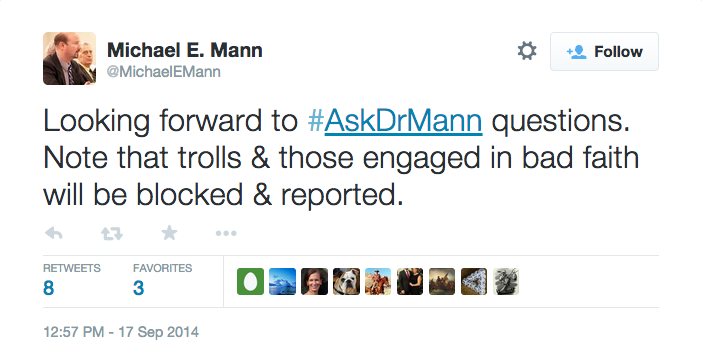
The word is that trolls abuse the “report abuse” link to get skeptics silenced. We note Michael Mann recommends blocking and reporting. What else can you do when you don’t have an answer?
So let’s show them that silencing voices doesn’t work. Follow @SteveSGoddard to show that trying to silence people only makes them stronger. To get Tom Nelson reinstated, send your thoughts on this to @Support.
WattsUp calls it abusive censorship. ✔ @MarkSteynOnline wants to know why @twitter “suspended” another climate dissident, Tom Nelson @tan123. See also @iowahawkblog.
UPDATE: Do you hate twitter? Is it a land you never visit? Read my comment #7.1.
Read the other comments where I make the case that it’s worth bothering to learn the bare essentials so you have a voice. Read my four rules of Twitter below.
Nature 520, 42–43doi:10.1038/520042a Published online
Emerging evidence indicates that dragons can no longer be dismissed as creatures of legend and fantasy, and that anthropogenic effects on the world’s climate may inadvertently be paving the way for the resurgence of these beasts.
Figure 2: The rise and fall and rise again of dragons. The relative frequency of ‘dragons’ in fictional literature (thick red line), as determined as a unigram probability4, with two historical reconstructions of Northern Hemisphere temperature (decadal smoothing) shown in blue5 and purple6. Global temperatures have been measured since 1855 (thick black line5). Temperature anomalies represent deviations from the 1961–90 reference period. The rising incidence of dragons in the literature correlates with rising temperatures, and suggests that these fire-breathing lizards are being sighted more frequently. As a result, the large-scale ‘Third Stir’ is deemed to be imminent.
Ominous signs are there:
Further work has revealed that the early medieval period was a veritable paradise for dragons. This can be attributed to the period’s unusually warm temperatures (Fig. 2) and an abundance of knights, the beasts’ favourite combatant and food. It was also a time when wealth and status were measured in terms of gold and silver — the preferred nesting material for Western dragons.
So dragons forage for knights, and nest in gold and silver. The Nature researchers don’t even mention the rising price of gold and silver nor the volume of trades. Now that’s a hockeystick.
Australia gets the blame again:
Sluggish action on global warming is set to compound the problem, and policies such as the restoration of knighthoods in Australia are likely to exacerbate the predicament yet further by providing a sustained and delicious food supply. It is now only a matter of time before The Third Stir takes place, and this, to borrow a phrase from Godfrey of Exmouth, will be the “bigge one”.
USA Today reports one of the authors is expecting attacks from skeptics:
Some skeptics continue to deride the notion of human-induced climate change, “so we will not at all be surprised that our finding that this climate phenomenon will see a burgeoning of fire-breathing dragons is treated with extreme suspicion, if not contempt, scorn and ridicule,” said Andrew Hamilton, a professor of
entomology and an expert in pest management at the University of Melbourne in Australia.
I would say “Not at all”. There’s far more empirical support here than for man-made global warming. ;- )
During the recent warmest decades on record, Earth suffered under the highest CO2 levels of the last 800,000 years. Life responded to this devastating situation by — flourishing. There are now some 4 billion tons more living matter on the planet than there was in 1993. What a calamity. (And what a lot of carbon credits.)
It has, naturally, got nothing to do with warmth and aerial fertilizer. The researchers tell us it due to that force of nature known as “good luck”. Remember, human CO2 emissions were pollution that was going to afflict life on Earth. After twenty years of predicting the loss of forests and species, it turned out that biology bloomed instead. Notch up another model “success”. The press release headline: Good luck reverses global forest loss. (What else would we expect from UNSW?)
To those who know basic biology — and that almost half the dry weight of plants is carbon, sucked straight out of the air — this is not so much good luck as one entirely foreseeable and foreseen consequence of rising CO2. Acquiring carbon is often a plant’s hardest task. When the sun comes up, a cornfield begins sucking, and by lunch time its already got all it can get, so growth slows til night returns to pump up the CO2 levels again. Pulling out all that plant fertilizer from under Middle Eastern deserts and spreading it around where the plants could get it has a predictable effect on plant life (though it’s fair to ask if our emissions actually contribute very much).
Remember in post-modern climate science, your air-conditioner causes snowstorms, but if CO2 rises and plants grow — that’s “luck”.
Lui et al studied, as they call it, natural radio waves, recorded in satellite data of our land surfaces.[1]
Fig 2: Mean annual change in aboveground biomass carbon between 1993 and 2012.
Global vegetation has increased by the equivalent of 4 billion tonnes of carbon – despite ongoing large-scale deforestation in the tropics.
Analysis of 20 years of satellite data has revealed the total amount of vegetation globally has increased by almost the equivalent of 4 billion tonnes of carbon since 2003. This is despite ongoing large-scale deforestation in the tropics.
What to do with the public broadcasters? ABC BBC CBC (Can anyone explain public media in NZ?)
Big-government fans forcibly take funds from all citizens to support big-government propaganda by journalists who predominantly vote left or very-left (see here or here). The question is not whether or not they should do this but whether to privatize the public broadcasters, or to split them in two. I say, let’s forget the submissive plea to get one conservative commentator among a monoculture of “progressives”. Chop the current one in half and call it what it is: pro big-government. Then set up a new counter half to match — the pro-small-government broadcaster with the same funds but new staff. (Game on — let the best team win that ratings war.) Abbott could keep ABC funding promises. ABC-L plus ABC-R equals current ABC-LL+ funding.
Obviously, true free-market libertarians want public broadcasters 100% sold — their incentives are always going to run counter to unbiased reporting and the hunt for the truth. On the other hand, among the populace, the ground is not remotely laid for a big-sell. Many voters remain blind to the bias, and have no idea how filtered the half-truths are: in 2013 73% said they “trust” the ABC. Though 4% more viewers turned off the boring indoctrination last year, there is a long way to go.
Is a split more realistic, or is it a short term solution but a long term fail? Would a split ABC (or BBC or CBC) finally achieve real public debate to help our civilization achieve the best balance between “Big-Gov and Small-Gov”? I think the independent-minded Small-Gov-half would romp in the ratings as people tuned in to see real debate, real conflict and the funniest smartest shows. Big-G TV can keep the ever-predictable Shaun Micallef, and the group-thinky gags of Clark & Dawes. Edgy comedy is a step ahead of the crowd, it mocks the ruling paradigms rather than repeats them. The most popular BBC show is (or was) Top Gear. Need I say more? Political correctness is just not that funny.
A dark side of a split would be that polarized audiences may end up watching self-reinforcing TV, everyone in their preferred silo. I’m optimistic; I think the competitive side of libertarian-conservative minds would mean the Small-G-TV would be where the real debate happened. The Big-G team currently work by silencing debate, but the independent minds crave it. Perhaps the “progressives” would have to debate their ideas once more? But there is also the danger that, if it wasn’t done well, the big-government lovin’ journalists and their attendant bureaucracy would capture both broadcasters.
So here are two points for today’s blog episode of “sell or split”. One: The Victorian State Liberal Party (now in opposition) formally recognizes the Australian ABC as the enemy, and sends a message to the Abbott government that the ABC should be privatized. Two: Rupert Wyndham eviscerates the BBC for it’s pretentious but vapor thin grip on “ethics”. His letter is a work of art.
The accompanying statement to the motion [passed by the Victorian Liberals], drafted by Bernie Gaynor:
The ABC and the SBS are clear enemies of our party. They wish us ill, do us great harm – while we foolishly maintain them with our taxes. They are not mere political reporters and commentators – they are aggressive political participants. Relentless in their pursuit of left ideological policies and objectives, they have nothing but contempt for our liberal, conservative values.
It is not the role of government to run a huge media empire. The time for public funding of this disgraceful political bastion of the left is over. They must be sold. Let the left pay for them out of their own pockets, and let the tax payers of Australia be saved $1.2 billion per year by their liquidation.
Rupert Wyndham explains what ethics are to the BBC
Wyndham writes to point out real ethical issues the BBC ought to discuss. A few razor sharp points first below, and his full letter with all 32 examples after that. (H/t to Ross, thanks).
“…what are the ethical issues that should, but plainly don’t, exercise … the state broadcaster? Here are a few suggestions.”
So when the BBC:
Routinely ignores its own Editorial Standards (as it happens, legal requirements), that is an ethical issue;
Subverts the accepted meaning of language in order to generate a spurious justification for institutional bias, that is an ethical issue;
Claims that its much vaunted impartiality has been ‘calibrated’ on the advice of a specially convened assembly of experts, that is an ethical issue;
Subsequently spends large quantities of licence fee payers’ money seeking to avoid disclosing the composition of that convocation, that is an ethical issue;
Has, as it later transpires, lied repeatedly about the accreditation of attendees, that is an ethical issue;
Is in possession of information indicating gross malfeasance within the climate change community, which for weeks it deliberately suppresses, that is an ethical issue;
When scientists, or those claiming to be, concoct evidence, that is an ethical issue.
When they refuse to engage in debate with their peers, that is an ethical issue.
When they defame and willfully denigrate the motives of any who have the temerity to question their fraudulent orthodoxy, that is an ethical issue.
When they monopolise finite resources at the expense of vastly more important areas of scientific investigation, that is an ethical issue.
Oops. Who hates “the environment”? Green lobbyists keep revealing how little they care. Friends of the Earth want to categorically rule out one of the most cost effective ways to reduce our carbon emissions. New supercritical hot burning coal plants can reduce emissions by an amazing 15%. But Friends of the Earth and The Guardian hate coal more than they care about CO2.
The green climate fund (GCF) refused an explicit ban on fossil fuel projects at the contentious meeting in Songdo, South Korea, last week.
“It’s like a torture convention that doesn’t forbid torture,” said Karen Orenstein, a campaigner for Friends of the Earth US who was at the meeting. “Honestly it should be a no-brainer at this point.” — The Guardian
Poor old solar and wind power are so useless that the debate is about whether they achieve any reductions at all. Their intermittent power means some kind of back-up base load power source has to run on standby to pick up the pieces when they collapse. The more wind power you have, the less CO2 you save. Solar Power provides “cheaper” electricity to the rich at the expense of everyone else, and potentially destroys thousands of square kilometers of wilderness, as well as zapping birdlife. We can use precious funds to help the environment, or we can waste them…
Apparently what matters most to environmental campaigners is knee-capping independent industry and cheap energy. Judging by what actually happens, the primary aim is increasing the government sector. Every industry dependent on big-government is a friend a socialist can count on.
The EU has burned $100 billion on badly managed renewable subsidies (that’s just the waste, not the total budget). That money ended up in someone’s pocket, and you can bet they have an incentive to donate to Friends of The Earth to keep the junket-gravy flowing.
If the Guardian and Friends of the Earth want us to believe they care about CO2 levels, they need to stop choosing the worst ways to reduce CO2 as their preferred option. Perhaps they are scared that if we actually reduced our CO2 emissions people might realize that it makes no difference to the weather?
The Guardian lobbying rag didn’t ask any hard questions, do an Internet search, or speak to critics. But they did provide a free “Ad” ticker counting the barrels of oil used by the world while we read their unresearched, careless, and innumerate “report”. The oil ticker the most insightful piece on the page. So far 1.5 million barrels of oil have been used while I write this. We are an oil-powered world; 80% of our total electricity comes from fossil fuels. Thank goodness for the independent free market that provides it.
Congrats to Steve McIntyre who surely deserves every bit of his LifeTime Achievement award. I’m delighted to see Paul Homewood (Notalotofpeopleknowthat) win in Best European blog. He was stiff competition in the Topical category given his role in the Christopher Booker series on the scandalous temperature adjustments which made such an impact around the world. Breitbart was also a favourite of mine, largely thanks to James Delingpole.
For the overseas crowd, Larry Pickering is an award winning political cartoonist in Australia who came out of retirement because our last government was so awful. He’s a skeptic to the end.
Thanks to the volunteers who help to moderate and make this site possible.
You’ll be glad to know the BoM problems are all dealt with. Some hand-picked statisticians met with some BoM people yesterday, and they had a robust private chat about secret temperature stuff at the technical advisory forum (that’s the tea-and-cakes one-day-wonder). I’m so relieved to know it was “productive”. (Imagine if the press release had said it was “predictable, boring and unproductive”?) In a few months we will find out a small, filtered version of what they said and possibly something of what the BoM approved statisticians think about the nameless, unlinked, public-submissions.
We do know that the BoM didn’t want public submissions, but in their good grace, they have given them to the select forum members anyway. (Be grateful serfs, you don’t get acknowledgment or answers, but your dedication in listing and referencing known scandalousproblems with our national dataset is worthy of one line in the last paragraph of a press release. Congratulations — maybe. Only one two submissions have been formally acknowledged which means the others, with months of work, might fall off the back of a truck, lost in the mail.*It’s possible. Is it too much to expect officials to send an email receipt with acknowledgment?)
We still don’t know how the BoM defend their ACORN dataset in response to these submissions, or when these errors (which have been reported on blogs and in emails for nearly three years) will be fixed. I predict that we’ll get some answers — but only the week after Graham Lloyd puts a problem in The Australian (eg like last August). National media attention is the only kind of “submission” the BoM seems to respond too. (Not that their responses make a lot of sense.)
Bob FJ notes the press release has a custom tab that suggests the press release was written two days ago. I guess they knew it would be productive and robust. It could be no other way. UPDATE: I added this last line to highlight the artificial nature of the modern press system. I’m sure it would be standard practice for government departments to write press releases before events to get them pre-approved and ready to go. In theory, they would argue that they would change keywords after the event and before they were released if the event went very differently to what was expected. I’d like to break the illusion that press releases are written after the fact, and let everyone know how much the press team are factored into the program these days (at least for those who have a press team). The point of the forum is largely for show, a theater, as far as I can see. The press release is part of that show. If the BoM were genuinely interested in the accuracy of their data they would thank the volunteers who found errors and fix them. Three years of inaction speaks for itself.
We use cookies to ensure that we give you the best experience on our website. If you continue to use this site we will assume that you are happy with it.






Recent Comments