…
|
|
||||
|
Tucker Carlson: Late-night Comedy died during Trump’s Presidency. Adam Carolla: ” You know they’ve got to everybody when they’ve got to comedians. Think about that, Professors, cops and politicans — they caved. Now the fact that comedians have caved means everyone is scared of the Woke Mob. “ UPDATE: Youtubes gone, so Bitchute whole Episode here. Mark Steyn does some parody at 11 mins. The discussion of the Death of Comedy starts at 27 mins. 25 March 2021 But comedy is not complete dead on late night cable: check Mark Steyn — especially on the fawning slavish American Media: Biden said we have to raise every road 3 feet because of climate change, … and they took that, these people, the Court Enuchs went along with it… Mark Steyn on Joe Biden declaring he might run for another term: … I have no idea who the government of the United States is, but if the Deep State can get away with this, they can get away with anything. The Deep State are saying, if we can pull this off, we don’t need anyone in the Oval Office.
Matt Taibbi: The Death of HumorReview of “Killer Cartoons,” edited by David Wallis, and “White,” by Bret Easton Ellis Humor is dying all over, for obvious reasons. All comedy is subversive and authoritarianism is the fashion. Comics exist to keep us from taking ourselves too seriously, and we live in an age when people believe they have a constitutional right to be taken seriously, even if — especially if — they’re idiots, repeating thoughts they only just heard for the first time minutes ago. Because humor deflates stupid ideas, humorists are denounced in all cultures that worship stupid ideas, like Spain under the Inquisition, Afghanistan under the Taliban, or today’s United States. A lot of the anti-Trump cartoons were neither all that creative nor funny — if “He’s gay and has a little dick!” is the best you can do with that politician, you probably need a new line of work … March 27th, 2021 | Tags: Carlson (Tucker), Satire & Parody | Category: Global Warming, Satire & Parody |  Print This Post | | Print This Post | | The latest academic voodoo doll tossed at Fossil Fuels is a study claiming that the industry gets $65 billion in “implicit” subsidies in the US. The authors of the latest paper assume the broken climate models work, and then guesstimate what the cost of all that theoretical warming would be with economic models that aren’t much better. It’s a paywalled paper, but they don’t appear to account for all the net benefits of coal, oil and gas which include, keeping people alive and fertilizing forests and fields around the world for free. These aren’t guesstimates from the future but known good and great gifts from the last century or two. 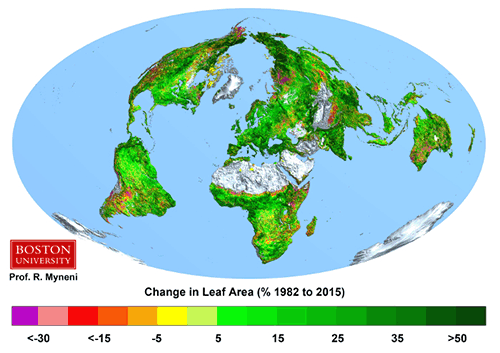 Greening the Earth. Zaichun Zhu, (2016) Send them the bill: the fossil fuel companies are subsidizing taxpayersHow much is a hundred years of free fertilizer worth? If only academic institutions were more than Big Gov advertising agencies they might also have considered that fossil fuel companies are never paid for their part in boosting agricultural yields, nor in greening the forests. Some 18 million square kilometers of Earths surface has more biomass. Arid regions of the world are 11% greener, mostly thanks to CO2 and deserts are shrinking. If CO2 actually caused much warming we might even be overrun with cheap soy and corn and crops could grow another 1,200 kilometers closer to the North Pole. Cold weather kills 20 times more people than heat. If Kotchen can assume CO2 causes warming (despite the lack of evidence for that), it follows then that it must have saved countless lives. How many more senior citizens would die prematurely if they are forced to pay more for electricity and thus can’t afford to turn the heater on in winter? In the UK alone, in one winter there were at least 20,000 more deaths. All over the world, people die more in cooler weather, even in hot Brisbane. Fossil fuels makes farmers richer, food more affordable, keeps people warm, greens the planet, employs thousands, pays taxes, saves forests from being razed for Drax, moves nearly everything that needs to move, and creates more flowers. In a fair world, Yale should give back all government funding until it raises its standards and stops producing politically biased, incompetent studies. The producer benefits of implicit fossil fuel subsidies in the United StatesMatthew J. Kotchen, PNAS There are real and substantial financial implications to fossil fuel producers of policies that seek to correct market failures brought about by climate change, adverse health effects from local pollution, and inefficient transportation. The producer benefits of the existing policy regime in the United States are estimated at $62 billion annually during normal economic conditions. This translates into large amounts for individual companies due to the relatively small number of fossil fuel producers. This paper provides company-specific estimates, and these numbers clarify why many in the fossil fuel industry oppose more efficient regulatory reform; they may also shape the way policymakers view the prospects for additional subsidies going forward. “The financial benefit because of unpriced costs borne by society is comparable to 18% of net income from continuing domestic operations for the median natural gas and oil producer in 2017–2018, and it exceeds net income for the majority of coal producers. “ And yet the companies themselves don’t even try to defend what they do? Why? Kotchen notes that he contacted all of the companies included in his study and found that none of them had anything to say about implicit subsidies. See the chart of how desperate plants are for carbon dioxide. The fertilizer carefully released to the world by the gas oil and coal industries is a gift to farmers and consumers, keeping the price of pumpkins low. REFERENCE Zaichun Zhu, et al (2016) Greening of the Earth and its drivers, Nature Climate Change, Letter, doi:10.1038/nclimate3004 March 26th, 2021 | Tags: Fossil Fuel, Subsidies | Category: Economics, Fossil Fuels, Global Warming, USA | Print This Post | | ,,, The purpose of the hot air balloon adding two whole kilograms of chalk to the atmosphere is a glorious multipurpose marketing exercise. It might as well be a skywriting advert. Building a sunshade for the whole planet radiates cinematic desperation — it’s advertising the terror of climate change — Really, we need to do that? It’ll get everyone talking about climate change for another five minutes, as if it mattered. But make no mistake, it’s such an ambitious Manhattan-scale idea, it’s advertising Bill Gates the billionaire, too. This is meant to raise his global cachet too. Super-Bill to the rescue. Is he God? But it’s also advertising other things, like how stupid the climate models are, how fake the pious planetary-care is, and how daft the whole UN-herd is. Bill Gates plans to launch a bag of chalk into the stratosphere and somehow get useful data out of it about whether we could build an Earthly sunshade to cool ourselves on the same scale as a super volcano. ( To that end, if it looked like he might succeed, watch the Paris agreement dissolve a nanosecond after someone starts to get serious about shading one nation and not some other one.)  Dumping 2kg of advertising into the global media. So straight off some of the Ecoworriers panic that this is a terrifying experiment — not because Bill Gates is recklessly endangering the climate — but because, if this works, it ” will be used by politicians as a justification to postpone reducing greenhouse gas emissions.” Lordy! Imagine the disaster if the planet cooled, and the Green movement got what it wanted without the hair shirts? What really matters to them, reducing CO2 or getting people to stop driving and clogging up their roads? Indeed, not having to bankrupt all the fossil fuel corporations? I mean really!? It’s worse than that– the Deplorables would get hooked on pumping up the white skies, addicted to chalk to cover up for all their sins! ‘It would cool the planet by reflecting solar radiation but once you’re on to that, it’s like taking heroin — you’ve got to carry on doing the drug to keep on having the effect,’ he said. He explained that without tackling pollution first we would have to keep lifting more and more dust into the stratosphere, which would change the daytime sky to white and if it ever stopped there would be a rise in global temperatures again. Recklessly fiddling with the climate to save us from reckless fiddling.Apparently the same models that have all the answers now, are pretty useless at predicting what happens when one aerosol changes. Climatologists are also concerned that such tinkering could unintentionally disrupt the circulation of ocean currents that regulate our weather. This itself could unleash a global outbreak of extreme climatic events that might devastate farmland, wipe out entire species and foster disease epidemics. Which begs the question — some models are happy to say exactly what will happen if we reduce CO2, but those same models apparently don’t work at all on aerosols. Scientists may be able to set the perfect climatic conditions for farmers in America’s vast Midwest, but at the same time this setting might wreak drought havoc across Africa. For it is not possible to change the temperature in one part of the world and not disturb the rest. Everything in the world’s climate is interconnected. Furthermore, any change in global average temperature would in turn change the way in which heat is distributed around the globe, with some places warming more than others. This, in turn, would affect rain levels. Heat drives the water cycle — in which water evaporates, forms clouds and drops as rain. Any heat alteration would cause an accompanying shift in rainfall patterns. But how and where exactly? There is no way of predicting how the world’s long-term weather may respond to having a gigantic chemical sunshade plonked on top of it. No way of predicting long term weather indeed. Someone tell the modelers. Imagine if the world was going to cool in the next 50 years but all the models said it was warming so geniuses put up a sunscreen and made the cooling worse? What if a Krakatoa goes off the week after the dust is released? Someone will have to design a nuclear-powered flying vacuum-cleaner before the next ice age hits. h/t Colin, and Kathleen. March 25th, 2021 | Tags: Aerosols, Gates (Bill), Geoengineering | Category: Global Warming | Print This Post | | So the worlds car manufacturers are lining up: The Volkswagon group and GM are going “full electric” — so they say. Ford Motor Co claims its line-up in Europe will be fully electric by 2030, while Tata Motors unit Jaguar Land Rover said its luxury Jaguar brand will be entirely electric by 2025. But Toyota and Honda are not. At least investors (and consumers) have a choice. Presumably , the US Democrats will want to change that. Toyota Warns (Again) About Electrifying All Autos. Is Anyone Listening?Bryan Preston, PJ Media When Toyota offers an opinion on the car market, it’s probably worth listening to. This week, Toyota reiterated an opinion it has offered before. That opinion is straightforward: The world is not yet ready to support a fully electric auto fleet. Toyota’s head of energy and environmental research Robert Wimmer testified before the Senate this week, and said: “If we are to make dramatic progress in electrification, it will require overcoming tremendous challenges, including refueling infrastructure, battery availability, consumer acceptance, and affordability.” Of those, “Consumer Acceptance” is the easiest thing to change (especially with a law and the right amount of jail time). But last time we looked, a quarter of UK drivers wouldn’t even buy an Electric car “in their lifetimes”. Only 1 in 50 US cars are electric:Toyota warns that the grid and infrastructure simply aren’t there to support the electrification of the private car fleet. A 2017 U.S. government study found that we would need about 8,500 strategically-placed charge stations to support a fleet of just 7 million electric cars. That’s about six times the current number of electric cars but no one is talking about supporting just 7 million cars. We should be talking about powering about 300 million within the next 20 years, if all manufacturers follow GM and stop making ICE cars. The scale of the switch hasn’t even been introduced into the conversation in any systematic way yet. According to FinancesOnline, there are 289.5 million cars just on U.S. roads as of 2021. About 98 percent of them are gas-powered. Toyota’s RAV4 took the top spot for purchases in the U.S. market in 2019, with Honda’s CR-V in second. GM’s top seller, the Chevy Equinox, comes in at #4 behind the Nissan Rogue. This is in the U.S. market, mind. GM only has one entry in the top 15 in the U.S. Toyota and Honda dominate, with a handful each in the top 15. California and Texas don’t have grids big enough to deal with houses…
h/t Marvin W, Jim Simpson,
Bjorn Lomborg was going to present some economic pointers to Duke University last week, but even UN approved estimates were too high-risk for Duke . Evidently the students are so poorly trained they couldn’t be trusted around a different point of view. Lomborg might seed all kinds of wicked ideas about them doing their own research. Though, more likely, it had nothing to do with the students. The real problem with Lomborg was that he threatened their branding. What if Duke lost some big lefty donors? (Or the biggest donor of all, Big Government?) Lomborg shows how fragile the UN-Wall of Science is All he aimed to do was to join together two separate UN economic factoids, but he had to be axed. He even agrees “climate change is a problem”. But agreeing on the science is not enough. When climate alarmism meets cancel cultureBjorn Lomborg, The Australian … One of my [axed] presentation points was highlighting the latest full UN Climate Panel report which estimates the total cost of climate change. They found that unmitigated climate change in half a century will reduce general welfare equivalent to lowering each person’s income by between 0.2 and 2 per cent. Given that the UN expects each person on the planet to be much better off – 363 per cent as wealthy as today – climate might cause us to only be 356 per cent as rich by then. That is a problem, but certainly not the end of the world. Except it’s not a problem, just an error bar. With blind economic models piled on broken climate models, fifty years from now the world might well be cooler, and poorer too. But Lomborg’s point is still potent. The UN are complete hypocrites and troughers. Keep reading → … Carbon dioxide radically lower but floods destroy houses, cover beaches in debris across NSW in 1857Floods are sweeping across NSW and 18,000 people have been evacuated, and rain is forecast to keep coming for til Wednesday. Flooding is described as the worst in 60 years. But that’s the point. There have always been floods right after droughts and fires — and we knew that 150 years ago. The scandal is that in 1865, scientists had a better grip on what caused them. Today “top” climate scientists think your car causes the weather. Top science in 2021: Solar panels and windmills could have stopped the flooding: The multiple natural disasters Australia has experienced over the past 18 months — such as the floods currently ravaging NSW — should be blamed on climate change, say experts from the Climate Council. “The intense rainfall and floods that have devastated NSW communities are taking place in an atmosphere made warmer and wetter by climate change, which is driven by the burning of coal, oil, and gas,” Climate Council spokesperson Will Steffen said in a statement on Monday. “For many communities dealing with floods right now, this is the latest in a line of climate change-exacerbated extreme weather events they have faced, including drought, the Black Summer bushfires, and scorching heatwaves,” he added. The more money we put into government funded science the more it looks like witchcraftDoes CO2 cause floods? It takes 3 minutes in the historic Trove archives to test this theory. In a surprise to Supermodels everywhere, getting CO2 back to 310ppm (even if it were possible) would return Australia to 1950, so we already know how this works out. There were a spate of floods in Eastern Australia in the 1950’s and 1960s when La Nina’s were more common and the world was cooling. For example, in 1949 8 people were killed and 20,000 were left homeless in New South Wales by flooding. The Adelaide Chronicle June 23, 1949 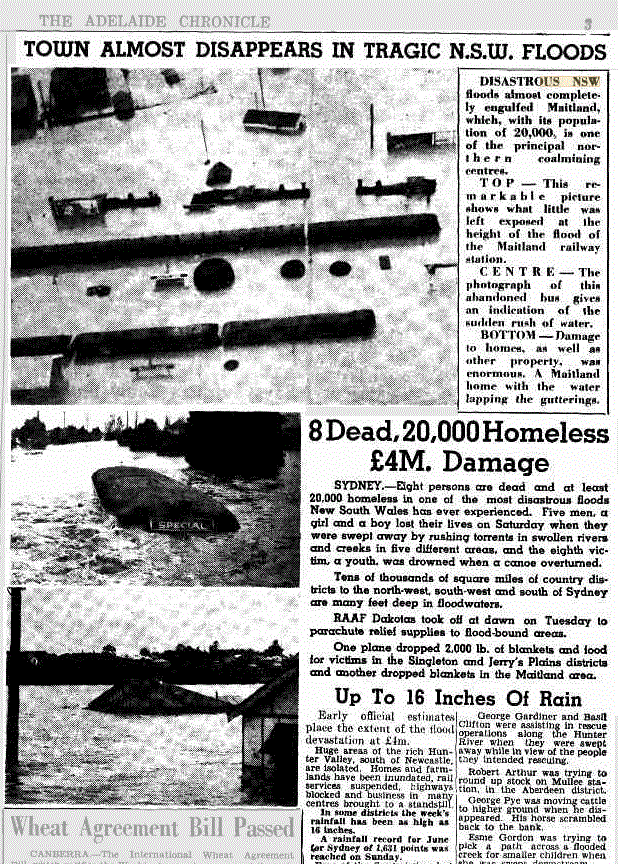 … In Maitland in 1955, 25 people died, 2,000 homes were inundated and 58 homes washed away. This was only three years after the previous floods when The Hume Highway at Camden was under 30 feet of water. NEWSFLASH: There were floods in New South Wales in 1857 even before coal fired power was inventedA quarter century before the first coal power plant was built anywhere in the world, devastating floods washed over New South Wales. There were three separate floods in 1857, “each worse than the one before”. The floods and storms were described as afflicting an area from far north of Taree down to Goulburn.
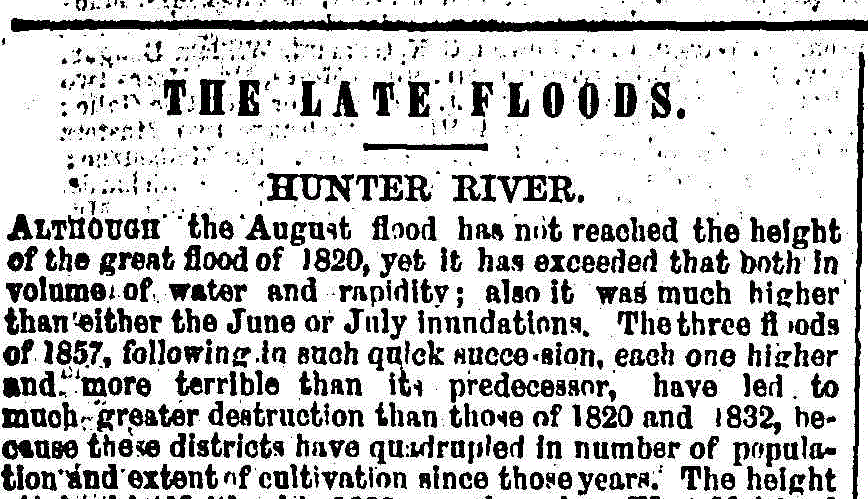 Hunter River Floods, 1857 “Five years of firewood” washed up: What amount of property was destroyed by the flood it is impossible to ascertain. The piles of wood, which of themselves would supply the inhabitants of both East and West Maitland with firewood for the next five years, have buried in, without doubt, some hundreds of pounds’ worth of property. Many families are left entirely destitute of food and raiment. It is impossible to give an accurate description of this desolate scene. On the Hawkesbury “Windsor was almost an island, there was no escape by dry land.” In Mudgee, the “consequences were most disastrous “. .. the rain fell in torrents… ” “Other floods occurred at Penrith, Camden, Gouldburn and Cassilis.” Read the story of boats trapped for days, including one “small trusty craft” that was “driven off course by the violence of the tempest some thousand miles” and out of sight of land for ten days, while the people survived on biscuits. The beaches were covered to “an incredible height with the trophies of some devastating flood…” the debris included the sides and roofs of houses, furniture, cabbages, pumpkins, goats and pigs. Mail was stopped, and at least three boats were seen wrecked.
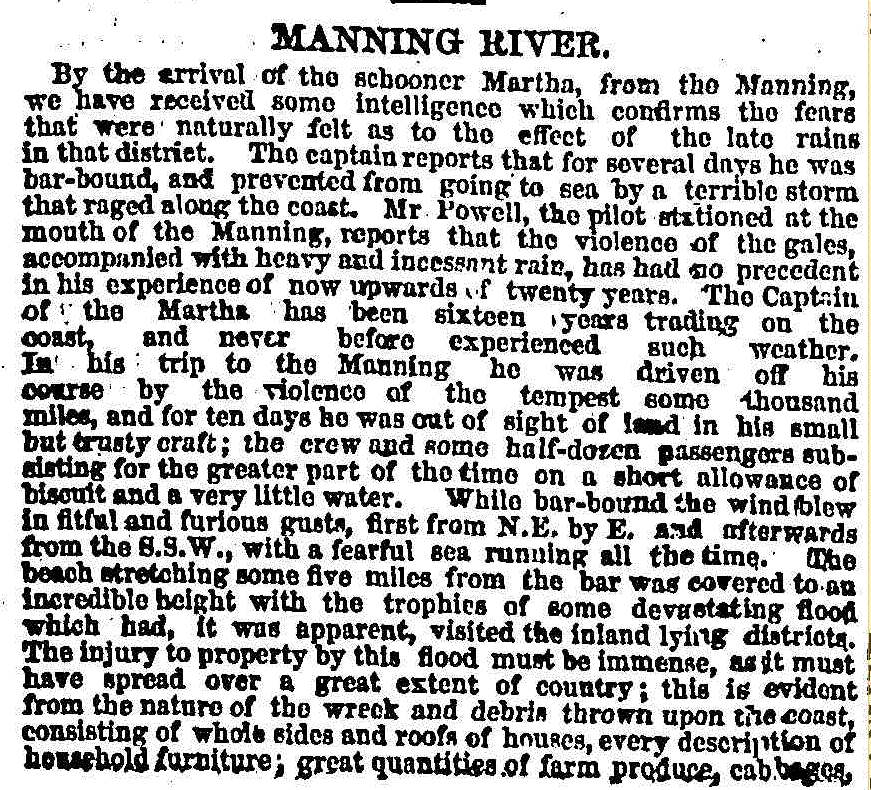 Part a Floods, NSW, September 10th, 1857, Manning River, Trove, NSW. Sydney Morning Herald| Click to enlarge. 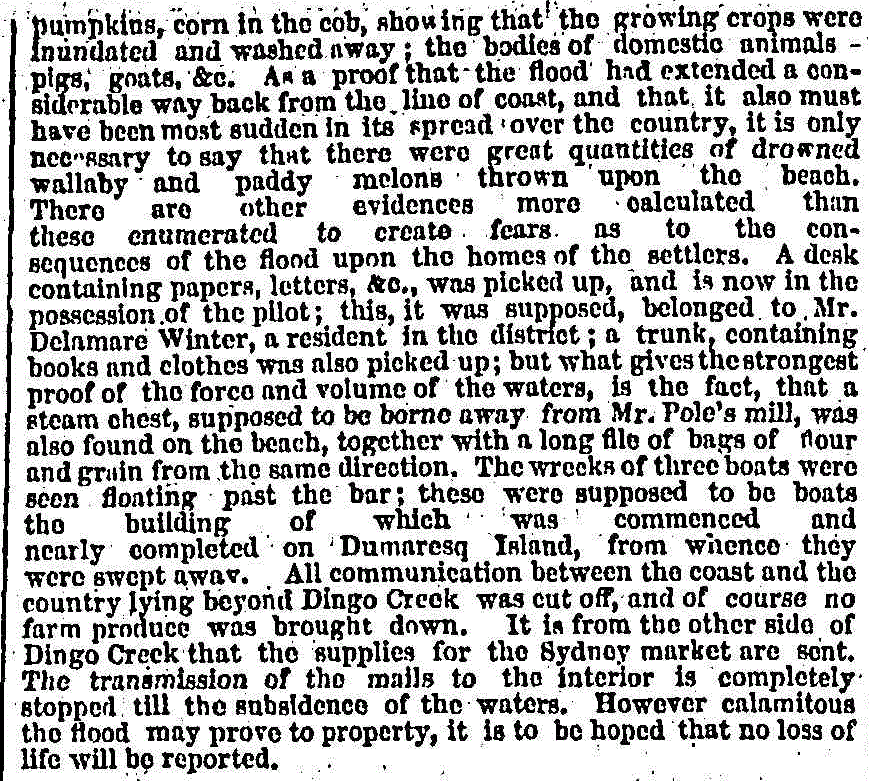 Part b. Floods, NSW, September 10th, 1857, Manning River, Trove, NSW. Sydney Morning Herald| Click to enlarge. In 2021, among other things, cows are even being rescued from the surf on beaches, which probably makes them a lot luckier than the ones that got washed downriver in 1857. Thoughts and best wishes for everyone caught in this natural disaster. March 22nd, 2021 | Tags: Floods, NSW (New South Wales) | Category: Global Warming | Print This Post | | The Chinese government understands the weakness of the West where national self hate has become a spectator sport. When the US Government attacks the CCP for human rights abuses, the CCP just use all the Democrats own talking points right back at them and the Democrats can hardly disagree: Tucker Carlson: Even the Chinese know America won’t survive with ‘woke’ liberals in chargeHere, for starters, is the Chinese government’s assessment of our democracy: YANG JIECHI [TRANSLATION]: Many people within the United States actually have little confidence in the democracy of the United States, and they have various views regarding the government of the United States. Many Americans don’t have confidence in their own democracy, he said. In other words, maybe the last presidential election was fraudulent. Suddenly China’s top diplomat sounded a lot like one of those right-wing White supremacist insurrectionists you’re always hearing about on CNN, the ones the Biden Justice Department has put in prison. Tucker Carlson explains the Mandarin word “Baizuo” means a white liberal (in the wokest possible way): The Chinese know our leaders well. In fact, they have a name for our self-hating professional class. They call them “baizuo.” The rough translation from Mandarin is “White liberal,” and it is definitely not a compliment. Chinese state media describes baizou as people who, “only care about topics such as immigration, minorities, LGBT and the environment, who have no sense of real problems in the real world, who only advocate for peace and equality to satisfy their own feelings of moral superiority, and who are so obsessed with political correctness that they tolerate backward Islamic values for the sake of multiculturalism.“ As Chinese state media notes, “former US [sic] President Obama was considered an advocate of baizuo ideology.” So is “German Chancellor Angela Merkel and her decision to welcome more than one million third-world [sic] immigrants to Europe.” Other observations about baizuo, as reported by Chinese state media, include the fact that they “advocate inclusiveness and anti-discrimination but cannot tolerate different opinions.” Baizuo’s political opinions are “so shallow that they tend to maintain social equality by embracing ideologies that run against the basic concept of equality.” According to one scholar from Peking University, “baizuo are phony and hypocritical and will make the situation in the West go from bad to worse.” And so on. And so, a communist superpower that harvests organs from political prisoners can silence opponents by repeating their own self indulgent attention seeking critics. And the so called “Leaders” of the most powerful nation on Earth can’t even defend themselves. What would Kamala Harris say — “We are the house of horrible haters. You’re so right?” h/t Bill AZ and David. March 21st, 2021 | Tags: China, Political Correctness, USA, Woke | Category: China, Politics, USA, Woke | Print This Post | | …
Yesterdays free advertisement for the Renewables Industry comes from Peter Martin, ANU, and was swallowed whole by The Conversation, and then repeated by The ABC. (If only the ABC had three million dollars a day to spend on checking things before it published them, they might have warned the economist that he doesn’t understand much about the grid or even the energy market.)
This kind of anti-coal PsyOps might work on teenagers:
Yallourn, in the Latrobe Valley, provides up to 20 per cent of Victoria’s power. It has been operating for 47 years. Since late 2017 at least one of its four units has broken down 50 times. Its workforce doubles for three to four months most years to deal with the breakdowns. It pumps out 3 per cent of Australia’s carbon emissions. And here’s Macarthur Wind Power plant, Victoria’s largest at 420-never-attained-MW. It breaks down nearly every single day:
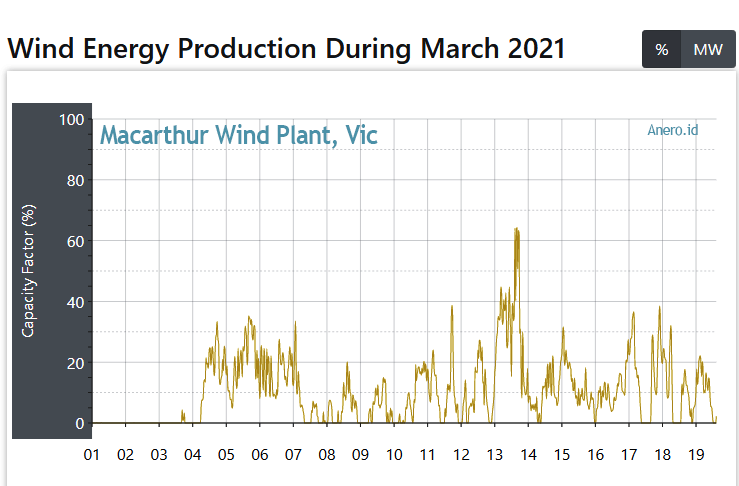 Fig 1: Anero.id Macarthur Wind output Martin goes on in a non-stop infomercial for wind and solarHe must be aiming for 12 year old voters, or perhaps dogs and cats, with genius comments like this:
Nationwide, wind and solar including rooftop solar supplies 20% of our needs. It turns on and off at will.
Even 12 year olds know he can’t turn on the sun and wind. Though the AEMO appear to be happy about this level of national debate, as do The Conversation and the ABC editors. Perhaps it’s worth asking if they even read what they publish?
As for his understanding of maintenance: coal plants can be continuously refurbished. If one turbine at Yallorn isn’t being maintained properly perhaps that’s got something to do with the forced transition to random generators which strips profits from reliable power? Maybe ramping up and down this generational infrastructure “with the wind” costs more to maintain?
The bottom line:After closing two coal plants then spending four years installing renewables at world record levels, for one whole quarter, South Australian retailers have finally paid lower wholesale rates than QLD and NSW. Proving that if you take a jagged line and draw a line to a cherry picked point you can find any kind of trend you want.
Coal-fired plants close, then prices fall
Before Northern closed, South Australia had Australia’s highest price. Five years after the closure of Northern in 2016, and four years after the closure of Hazelwood in 2017, South Australia and Victorian have wholesale prices one-third lower than those in NSW and two-fifths lower than those in Queensland.
Something happened after the closure (largely as a result of the closure) that forced prices down. South Australia became a renewables powerhouse.
“Something happened”? Something indeed. Wholesale rates fell from a crisis peak, while retail prices and other costs rose (like storage, stability, and emergency control). What matters is the total cost and South Australians on average, pay 33 cents per kilowatt hour, nearly 60 percent more than people in Queensland. The closure of coal plants doesn’t cause a renewables boom, only Big Government junk subsidies can do that for junk generators.
And the closure of coal plants doesn’t cause prices to fall either. More coal means cheaper electricity.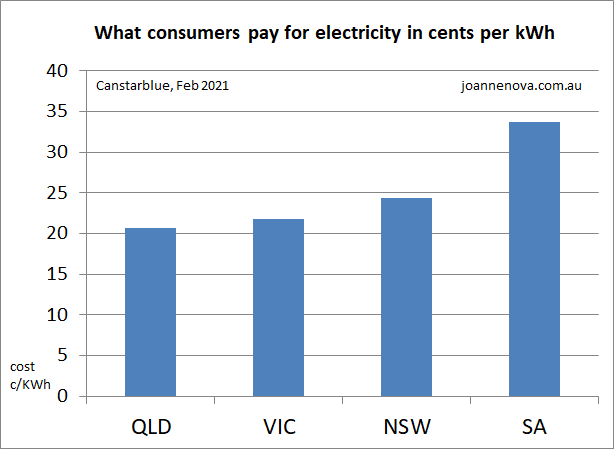 Fig 2. SA consumer still pay more. None of our grid now is as cheap as it was for years before renewables were added to the system
Peter Martin has cherry picked with a surgical scalpel. The last quarter, where South Australia was finally cheaper (on wholesale rates) than NSW and Qld, was the first time this has happened in eight years. For the last four years during the rapid rise of renewables, the cheapest electricity comes from the black coal state of Queensland.
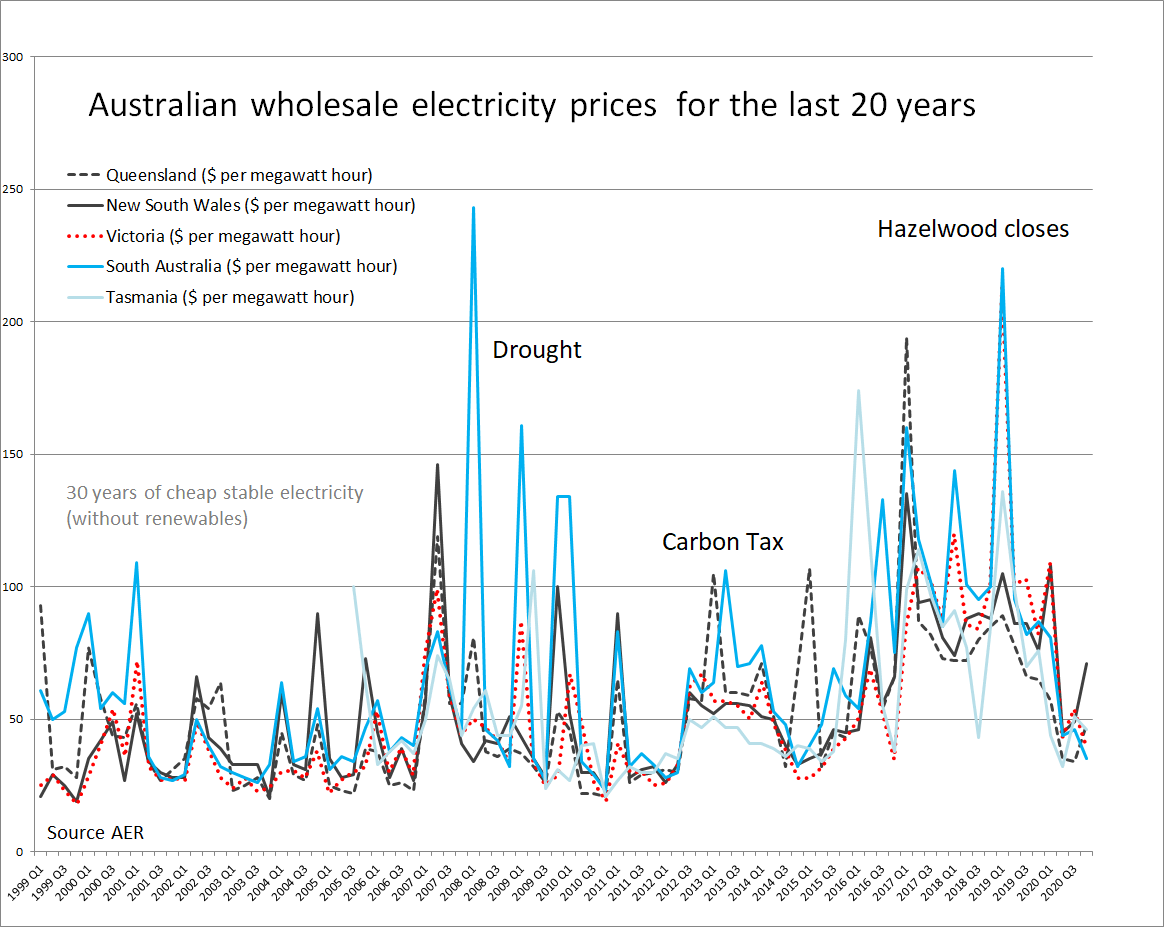 Fig 3: All those renewables, and yet prices are still not as low as what they were when we didn’t have them. South Australia might be a renewables superstar but guess where their cheapest reliable power comes from … black coalThe only thing cheaper than black coal is brown coal. Most of the hours of the day the price in South Australia is not being set by solar or wind power. SA system costs keep rising Another record! South Australia had to spend $15 million last quarter on “system security directions”. The AEMO were very busy ordering the Gas Powered generators (GPG) to stay on. In 2020, total costs for directing South Australian generators for system strength was $49 million (or 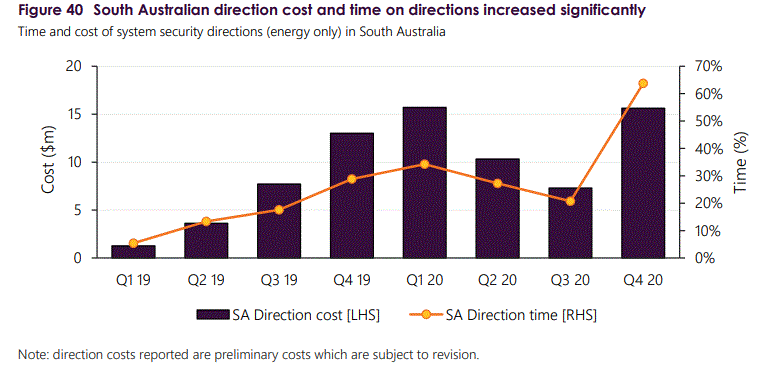 Fig 5: The AEMO has to manage the system, and the costs of keeping back up on standby are rising.
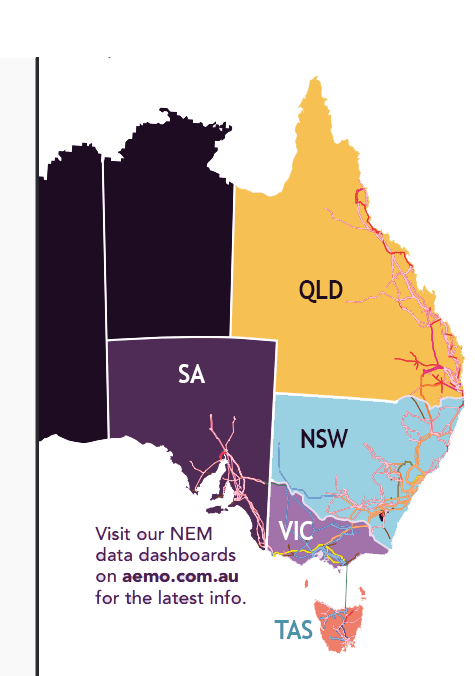
NSW prices spiked because 3,000 MW of coal power was out of action (mostly planned maintenance)The spike in NSW electricity prices that Martin builds his case on, was minor and temporary. According to the AEMO Quarterly report, the wholesale costs went up in NSW last quarter because it was the quietest quarter of the year, and plant managers decided to catch up on maintenance (see figure 6). Up to 3,000 MW of its black coal generators were offline. Thus, it follows, if they had more coal they would have been even cheaper than SA and Vic. Doesn’t fit the narrative…
It also follows that the AEMO knows Peter Martin is wrong. When will they speak up and serve the public that pay them?
Why is that left to unpaid bloggers?
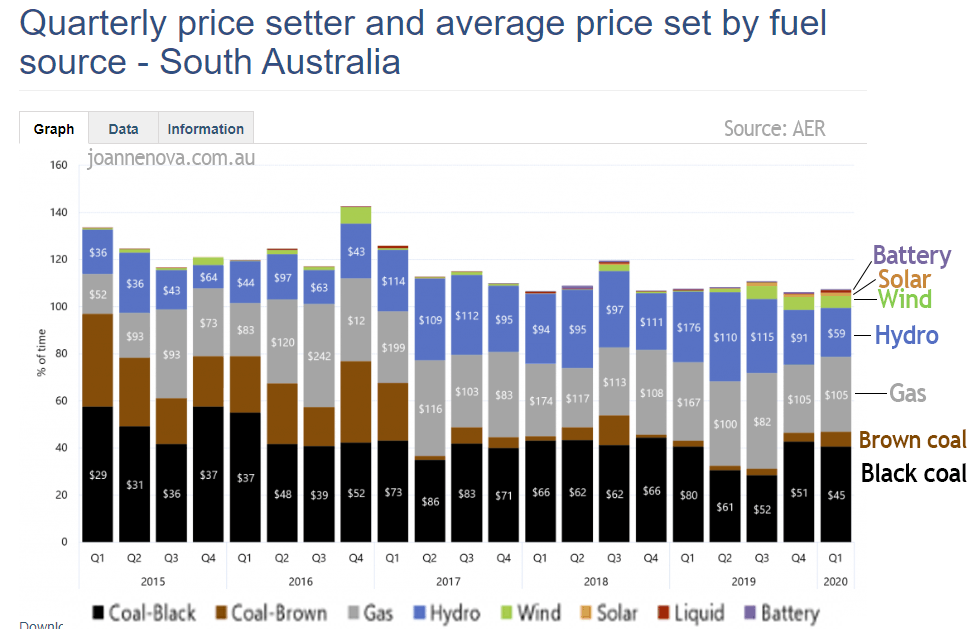
 Figure 6. Look which state turned of it’s cheap black coal supplies last quarter for planned maintenance. More solar PV is the system vandal that makes coal power more expensive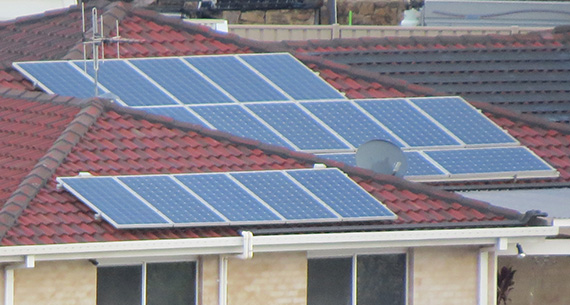 … Critics may argue that Solar PV on rooftops doesn’t bid, but “sets” the price by reducing demand. But renewables and coal are not swappable services. Being cheaper at noon can mean being more expensive at most other hours of the day. Random “free energy”, just steals profits from coal, makes a whole lot of infrastructure and staff sit around doing nothing on a long lunch, and run less efficiently when it tries to fill in for the energy vandal forced on the system. When the sun goes down the whole solar team and capital sit around powering nothing too. Coal plus solar can not possibly be cheaper than coal alone. It takes more people, more capital, more land, more maintenance. In the hours solar runs, all the useful coal infrastructure has to still be there, waiting to step in. The only cost “savings” to the large coal plants is a few truckloads of coal. All the other costs are the same or higher. The solar electrons are simply surplus random supply that “is the part of the jigsaw that doesn’t fit in” (to use Peter Martin’s words). Coal also used to provide all that frequency stability we need for free and on call 24/7 and then feed our crops free fertilizer as an unlisted bonus. How to create market chaos and a price spikeAfter Hazelwood shut in 2017, the cheapest form of electricity (brown coal) suddenly couldn’t supply enough electricity to set the final price of supply very often. That’s why the system price leapt. Hazelwood was in Victoria but the effect can even be seen in South Australia in Figure 3 above, where brown coal stops setting the price as often from Q2 onwards in 2017. That was “the Hazelwood effect”. Brown coal fired generators are still sometimes setting the final winning bids at under $10/MWh. Its unbelievably, unbeatably cheap. No wonder all the junk expensive system vandals want to close brown coal stations. The screwed market — a world of negative pricesThe low quarterly prices in South Australia were partly due to negative prices, which “cut South Australia’s average by $8.7/MWh.” This is a graph below of the main fuels setting wholesale prices in South Australia. The brown coal average winning bids are so low they are hard to see. Gas power and hydropower are obviously setting higher prices. The black coal winning bids have settled now in the new post Hazelwood bountiful world of renewables, at a higher price than they were. Genius. 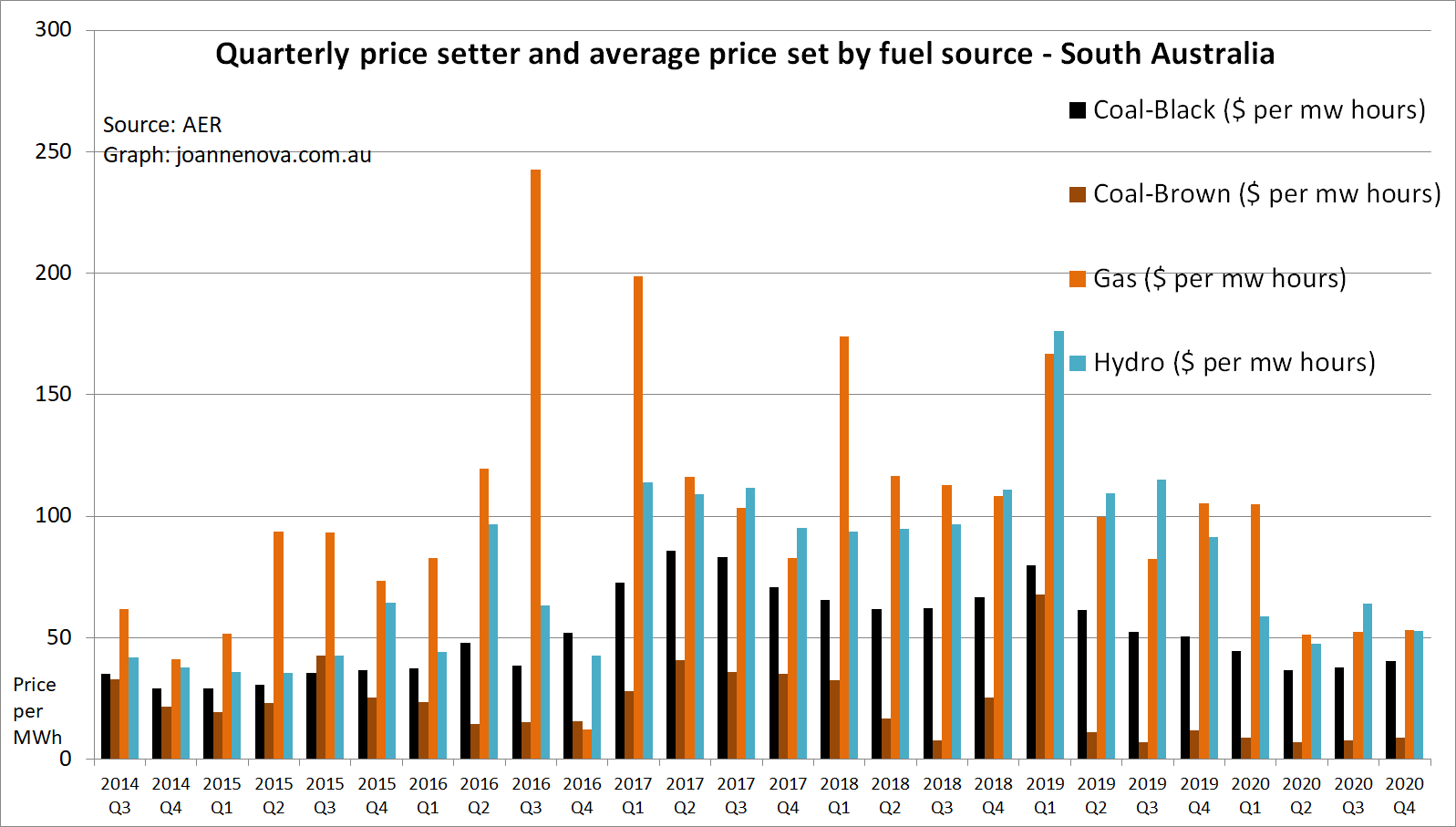 Fig 7: Some fuel sources set the price all the other fuels earn. Lower bars mean cheaper winning bids. Black coal wins bids at higher costs now that cheap brown coal plants closed and renewables have been added. | Click to enlarge. But sometimes solar and wind power win bids too. Have a look at what happens to this same graph when their winning bids are added in (below). The effect of the large deeply negative bids changes the scale of the graph and pretty much defies any sense at all. Why would anyone pay money to provide electricity? In a normal market we only pay people to take away rubbish. Is this craziness entirely a product of the subsidies? Is that what makes it possible to bid so deeply negative and “still make a profit” or are some of the players trying to game the system but losing? 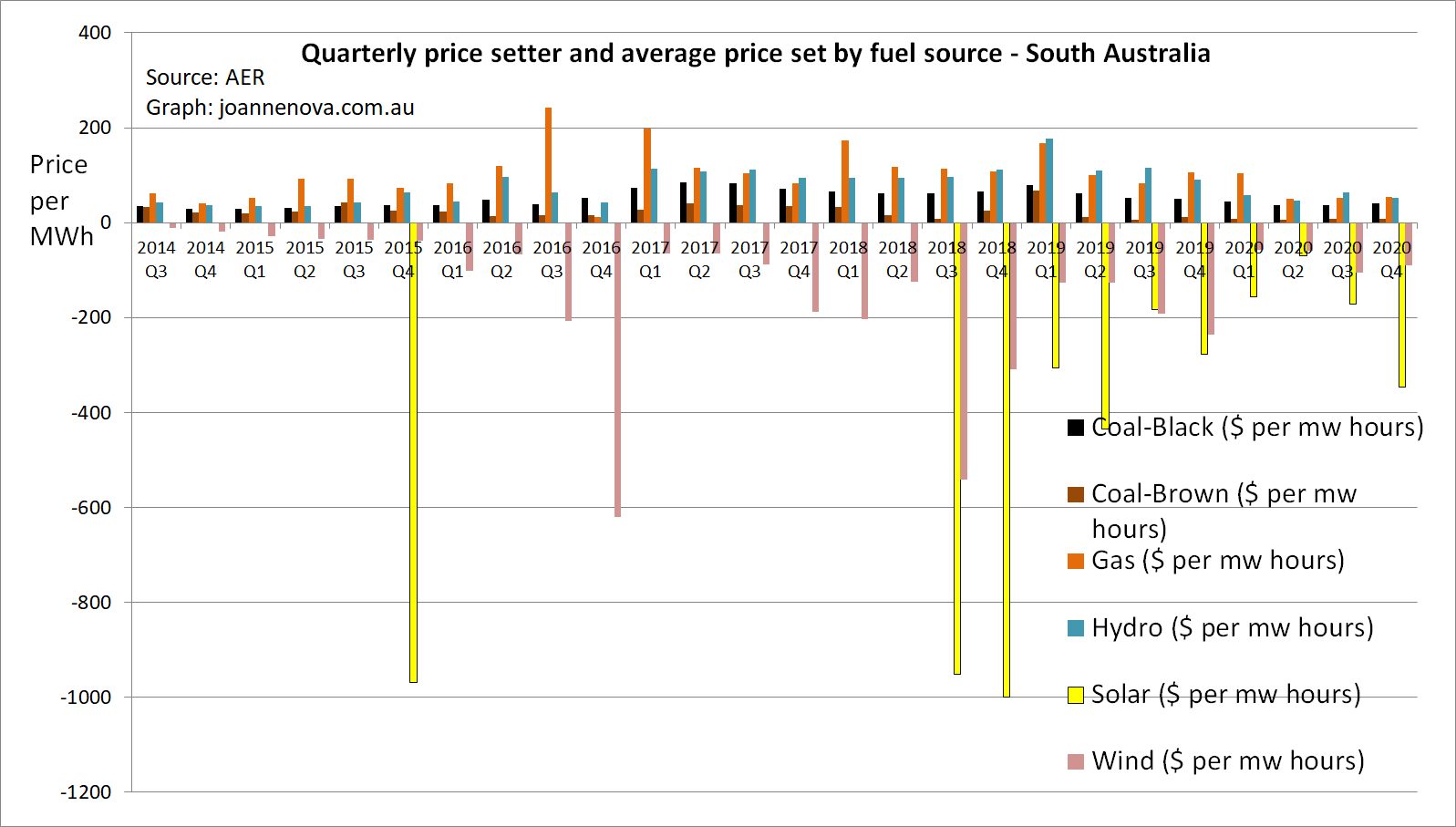 Fig 8: The Negative price bids are all thanks to solar and wind power and are “off the chart”. | Click to wallow in a fake market.
On the NEM, suppliers bid in the hope that someone bidding a lot higher than them wins the last successful ticket in the stack. Then all successful bidders all get paid at that same top winning rate. Obviously, generators don’t want to bid too high, or they earn nothing at all. But the race to the bottom seems kinda odd (to say the least). If they win at minus $1,000/MWhr, then they have to supply the electricity AND pay til it burns for it too. In the end, if the negative bids reduced the wholesale price of electricity by $8/MWh but that’s only due to subsidies, it’s not a savings at all, it’s just a redistribution. Someone else had to pay. It’s false advertising yet again. The AEMO report remarks on the record amount of negative prices in Q4 last year. 1.3.3 Negative wholesale electricity prices Despite the record occurrence of negative spot prices, the impact on the quarterly average prices was limited. Peter Martin — economist of some sort, thinks negative pricing means being paid to “turn off”. His junk commentary is “not even wrong” but for 17 years he was the ABC’s economics correspondent. He is so wrong he was awarded an Member of the Order of Australia (AM). Flinders uni taught him economics. They have a lot to answer for. Peter Martin says: Being even cheaper than the power produced by the old brown-coal-fired power stations, there is at times so much it that it sends prices negative, meaning generators get paid to turn off in order to avoid putting more power into the system than users can take out. It’s one of the reasons coal-fired plants are closing: they are hard to turn off. They are just as hard to turn on, and pretty hard to turn up. He is making mistakes piled on mistakes. Firstly he’s confusing negative prices with something called “Demand management”. Secondly he thinks the new random and volatile grid is progress instead of being an unnatural artificial forced transition that no one needed to have but we were all coerced into paying for. In the new vandalized grid, no one wants to put money into coal maintenance. Plus the companies that own coal own the unreliables. What could possibly go wrong? And who said the ABC doesn’t have advertising? It has the worst kind — the sort dressed up as “reporting” and funded –mostly — through taxpayer dollars. Pace Viv Forbes. Carbon Sense who said this earlier this week.
There are zero comments on this article at The Conversation. And presumably comments will be closed five minutes after I publish this.
Keep reading → March 19th, 2021 | Tags: Corruption (markets), Renewable Energy, Solar Energy (PV), Wind Power | Category: Electricity, Fossil Fuels, Global Warming, Grids, Renewable, Solar Power, Wind Power | Print This Post | | …
The criminal profilers estimate that the crime was so well developed that small runs of fraud must have been already at work, in test runs in past elections, and they want to hunt for that evidence now… And they warn that unless they are caught, the fraudsters will only grow. The good news is that there is already insurance software that can check and catch dead, moved, and out of state voters on-the-spot as they try to vote. But the legislatures and FBI aren’t going to do that unless The People speak loudly and speak now… If these experts can predict where and when the worst future election fraud is most likely to occur, we just hope that somehow someway there predictions can be used to stop it. The Sovereign Crime of Industrial Scale Vote FraudOur team members were the lead builders of one of the world’s most sophisticated criminal profiling systems in use by law enforcement today. We broke the eBay auction fraud rings and deployed a never-before-used technology to end auction fraud as an emerging crime category. We identified numerous Medicaid fraud rings and were hired by most of the top 10 property and casualty insurance firms to solve auto crash rings that eluded the FBI and every fraud technology.
It’s what the government agencies didn’t do that reveals the sovereign involvement. The national government refusing to investigate the most egregious examples of voter fraud like hundreds of thousands of more ballots than voters in several states, that is a pretty good indicator that they are passive participants in industrial level vote fraud. The refusal of the FBI to fully investigate Jesse Morgan’s truck with the hundreds of thousands of ballots going from New York to Pennsylvania – yet dispatching agents to a NASCAR location to investigate a garage pull-down they hoped was a noose – well, that’s a good indicator, too. Pretty clearly, the evidence is piling up that the FBI had zero interest in trucks with ballots crossing state lines, ballots being shredded in Maricopa County, tens of thousands of ballots received before being mailed and all sorts of other clues any competent law enforcement agency would at least investigate. The experts were not interested in the 2020 election though — it was “too obvious”: There was no interest on our profilers’ part in doing investigation of massive voter fraud. They felt it was so obvious and the current work being done by citizens and published on hard-to-find blogs was state-of-the-art and no further investigations would find much more. Their comments were striking because they said the data easily available showed the election fraud patterns had two very alarming characteristics: It was not the first time this was tried, and it will be performed again, at scale, in the next election. Fraud behaviour evolves — which means it doesn’t just come out of nowhere, and future directions can be predicted.The sociology of fraud has a start, test runs, and techniques and teams that grow. Successful sub-branches take over: Fraud rings, when organized, grow. They continue to expand with new entrants, slightly different profiles, corrupting more people with money that dwarfs what one might make honestly. Fraud techniques are like an organic species: what works, thrives; and what fails, dies out. Patterns emerge. Patterns equal prediction and prediction enables eradication. The profiling team were not interested in the 2020 election where the fraud was so obvious. They’d rather hunt through past elections to find the early runs they are now sure must be there: The team, educated in some of the most sophisticated organized fraud tactics, posited that this was not a dry run. Their thesis is that if one were to seriously evaluate the balloting in many states for 2014, 2016 and 2018, one will find traces of what happened in 2020. That project is under discussion. The US Supreme Court inaction invites more fraudWithout any punishment or consequences there is no way this fraud will not be used in 2022 and so on. Fraud perps are greedy and when left to commit fraud, for which there was likely millions of dollars in remuneration either presently or in the future, they are not going to stop. As fraudsters recognize that national law enforcement refuses to investigate and the courts will not look at evidence, they are emboldened. Who wouldn’t be? Our courts and law enforcement are saying “come, commit all the fraud you want, we won’t investigate, and if there is litigation, we will toss it out on procedural grounds.” If anyone protests, the FBI may raid their home with an assault vehicle. Don’t believe me, well, meet Christopher Worrell. A lot of the standard level fraud could be stopped live if only there was the will to do it It’s almost like election officials are going out of their way to avoid catching cheats: We have technologies that can identify dead voters the moment they cast a ballot. We can identify people who are out-of-state, voted twice, are underage, live in a vacant lot or a UPS or FedEx postal box. We can even show a photo of that vacant lot so you can see where your fake neighbor claims to live. Literally, the second their ballot is counted, they can be flagged as a likely fraud. Yes, we can deploy that technology today. We have done it in the insurance industry for decades. Keep reading → March 18th, 2021 | Tags: Election (corruption), US Politics | Category: Corruption, Election security, Politics | Print This Post | |
That’s how much we value our public In a survey of 500 Australians this week, more than half (52%) didn’t want to pay a cent. The situation got worse when they were asked if they would subscribe “like Netflix”? At this point the number of naysayers grew from 52% to 79%. Truth be told, we all deserve a refund, and backdated 30 yearsThe cost to the nation of their ABC is not just a billion dollars a year lost, but their culpable-pro-rata-part in the billions of dollars wasted on policies that were practically pagan witchdraft which the ABC covered up. As leading failures of the fourth estate, the ABC consistently hid the incompetence of universities, professors and institutions like the BoM.
Two out of three people say that it’s biased to the left. Even 60% of Labor voters thought it leaned left. Even, wow, by crikey, 78% of Greens voters felt it “leaned left”. Was that them speaking the unspoken out loud? Are they proud that the national broadcasters uses taxpayer funds to represent just 5% of Australia? This might be a little window to the truth. In future surveys the Greens will learn to say, “the ABC is biased right” and blame Murdoch. All up, most people would pay nothing, and those who might pay were only willing to pay $3 a month — meaning the ABC budget could be cut 75%. The study was funded by the Menzies Research Centre, a right wing think tank. In comments on The Australian about the only response defenders of the ABC have is to accuse the Menzies Research Centre of being aligned with the Liberals. But we all know why the ABC haven’t run surveys exactly like this one. The time to protest The ABC Swamp is coming. Most swipe Left on dear AuntyJames Madden, The Australian The majority of Australians believe that ABC television is not worth paying a single cent for. According to an independent study conducted by True North Strategy, more than half (52.6 per cent) of those interviewed said if they had a choice, they wouldn’t be prepared to pay anything for access to the national broadcaster’s television content in its current form, while the other respondents said they would only be willing to pay (on average) $2.94 per month. Did the ABC publish those “most trusted” survey questions, I’d like to see them if anyone can find them. REFERENCES The ABC Annual Report, Financial statement pages 116 onwards. The ABC Annual Report, “Most Trusted” statistics p18 ABC: Chris Berg and Sinclair Davidson, Against Public Broadcasting: Why and how we should privatise the ABC. h/t Skeptical Sam *Corrected. To be more accurate, there are 13.5 million taxpayers in Australia so the cost is $74/taxpayer. h/t Lawrie …. There are lessons for conservatives from this eclectic election in the most isolated state on Earth. It was historic, epic, and “A complete and utter landslide“. And the message is “borders”. Remember “Build the Wall?” Conservatives all around the world seem to have forgotten the power and appeal of being able to control who and which viridae, come across the border. If the Democrats in the US fortified the wall, they might not have to fortify election results. 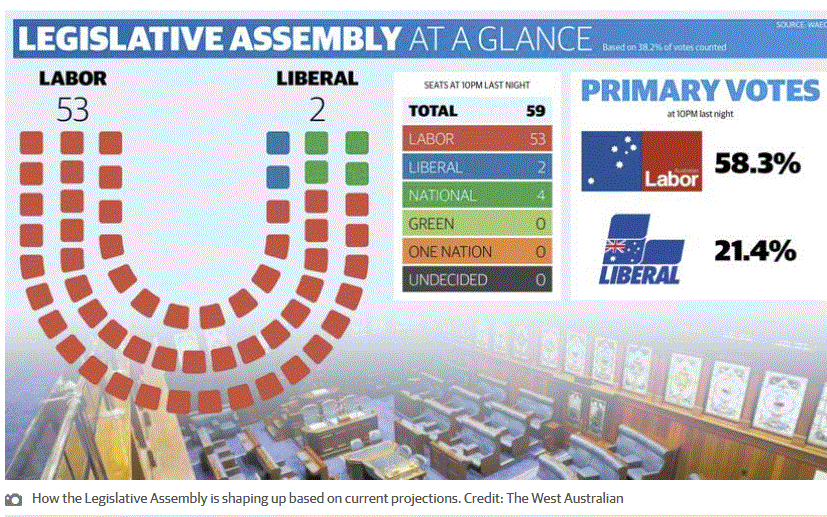 It’s a complete blitz. | The West Australian 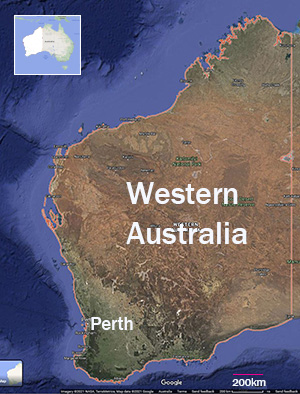 … The election Saturday was a wipeout of legendary proportions among democracies anywhere. Only four years ago, the Liberals (conservatives, theoretically) were the ruling party in Western Australia. Today they hold but two, as in one plus one, seats in the lower house of the WA Parliament, out of 59. They may win 3. The Labor Party took 58% of the first preference votes (that’s almost unheard of). Labor will take the Upper House too. See: WA Election Results. Things are so extreme, the talk now is how the Parliament is not big enough to hold the Labor M.P.’s. The rooms are just not designed for one party having almost all the members. The Labor leader, Mark McGowan, is no Rhodes scholar or Cary Grant. There are no stirring speeches, but he’s wildly popular, by mostly just for standing up for the state. The Labor Party WA is an old fashioned centrist type player. So un-progressively neutrally-woke that when the (ahem, right wing) Liberals recklessly talked about removing all coal power in… f.o.u.r… (4!) years, McGowan said it was too fast, renewables were too unreliable and electricity bills would rise. Did I say centrist? Firstly, secondly and thirdly, it was about bordersMake no mistake, there was only one issue in this election which was a 90 percenter, and that was the two week mandatory quarantine — the hard borders. They worked brilliantly (at least for people on the inside of them). To be fair, Western Australia has a land border which is 1,800 kilometers long — but with a million square kilometers of desert, there are only two bitumen roads across the entire length. If WA couldn’t close the border, who could? So Western Australians have lived the last year like Covid didn’t exist and loved it. (Wishing our friends could too). Closing the borders was hugely successful, wildly popular, and the Liberal (conservative) party opposed it all the way, and they lost the election months ago, and everyone knew it. For months on end, the voters universally sent the message, that they didn’t want Covid, or lockdowns, or any of that. McGowan reached stratospheric popularity — in the order of 90% approval. At one point in polls — as many as 95% of WA voters approved of the border closure. When, in any democracy, on any question do we get such a unanimous decision? Even Apple Pie would struggle. It’s worth noting that this was popular among young voters: despite not being at much risk from the virus, the young wanted the borders closed even more than older voters in WA did — probably because their jobs in the service industries of restaurants and pubs were so at risk from lockdowns. And thus with no virus and no lockdowns, the open economy boomed, the stadiums had crowds of thousands, the nightclubs danced, and the weddings rolled on. We could visit our older folk in aged care homes without a second thought. The only exceptions to the happy list were some tourism operators and the poor sods caught outside the state trying to get back in. A problem that is still a blight. What does it mean to be a citizen if you can’t come home? 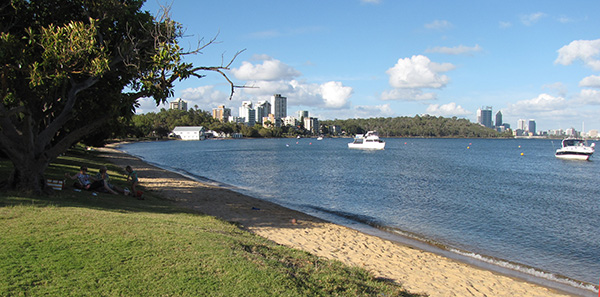 Not a bad river to play on. Matilda Bay, WA. But even many of the hapless tourism operators ended up happy. Western Australians were prolific long distance travellers before Covid, but after Covid, many of them finally toured the distant corners of their own state for the first time, and the roads were packed with caravans. Local flights were busier than before. The Liberal state opposition in WA, and the federal government Liberals in WA too, consistently took the side of other states, including backing Clive Palmer and his High Court case against WA. Go figure. It was like they wanted to lose. And it will hurt them federally too. Which WA Liberal Senator or member spoke for WA? As far as I can tell, they all represented the Liberal Party, not the people. They got what they deserved. … the single biggest factor in the history-making victory was McGowan’s steadfast defence of WA’s right to close its border to keep coronavirus out of the State. He resisted pressure from Prime Minister Scott Morrison, defeated Clive Palmer in the Federal and High courts, waged a war of words with his NSW counterpart and watched the WA Liberals implode spectacularly when they misread public sentiment. — Peter Law, The West Australian Once upon a time, conservative parties were the ones which spoke of sovereign borders, but when it came to the cheapest and most obvious way to stop a potential Sino bioweapon, to prevent debilitating lockdowns and loss of individual liberties, mortality, hospital surges, long term unknowable health problems — most conservative parties missed best chance they’ve ever had to argue for strong borders. And they are still missing it. Western Australia is an extreme example, but this was an extreme result. Border control is a tougher pill when the economy is built on tourism instead of iron ore sales to China (which need to diversify). It’s awful when families are split. It’s tough when there are border towns — but there must be a better way to manage them than a state wall through the middle — why not draft a federal agreement that the twin towns are automatically temporarily moved to the care of the state without an outbreak?). But the next virus is coming. Giving up the trips to Bali was a small price to pay to avoid doing lockdowns and to avoid potential long debilitation. Speaking of which: What’s a lockdown with no border control? At best, inefficient. At worst, sabotage. Clearly the West needs a better Pandemic PlanIt’s a personality thing as well as a medical thing. Right wing entrepreneurs might be happy taking risks, but the democratic masses are clearly not, no matter how hard the risk takers try to convince them. And until widespread anti-viral cocktails make this treatable (which means getting past the gatekeepers), or SARS-2 evolves into something more like the flu, the cheapest easiest way to make both the risk takers and the masses happy (ie. democracy) is to keep unknown epidemics in their country of origin. i.e. All Chinese bioweapons should stay in China. Though, of course, no matter which lab or cave generates the next one, the problem code could pop up anywhere, not necessarily just at a wet market next to a lab. The best time to close borders was January last year when the WHO was telling us to keep them open. Second political black hole — the Green-left climate trapFacing disaster, the WA State Liberals installed a new inexperienced leader in the last few months. He promptly announced a far left climate anti-coal policy and thus drove off any support from the base that still remained. His energy policies were so bad, they didn’t just make it hard for Liberal supporters to vote Liberal, they made it imperative to vote against them. In a complete flip of normal politics — the Liberals sounded like the Greens, and the Labor Party were speaking like climate skeptics. The stupid Green Left Climate election trap is so obvious, it’s amazing any Western politicians still fall for it. The trap is when any centre right politician thinks they can appeal to young lefties in the hope of picking up Green votes. The climate religion has nothing to do with science or reason, or the centre of politics. It’s only a fashion quest for status — so young woke voters cheer the craven centre right for two microseconds (if that), but they don’t change their votes. Appealing to the group that say they care about carbon dioxide emissions is doomed from the get-go. Reducing actual emissions is worthless to them — as has been shown again and again. In every choice between cutting CO2 and advertising their own virtue, they choose the advertising every time. They don’t support nuclear power, they don’t say “no” to flights for frivolous holidays, or advocate online conferences instead of carbon hungry global symposiums, and they keep supporting wind and solar power even though neither of those is a cost effective way to reduce CO2. The Liberals in WA didn’t do their research, didn’t understand the science of virology or climate, nor did they understand the voters they represent. The futurePerhaps it won’t be as awful as it could be. Given that some states are run by The disguised Uniparty anyhow, being run by The Labor Party is at least a known risk, and there is the hope that the Opposition will rise like a phoenix reborn, without so much baggage. There’s also the possibility that with so much power, the Labor Union powerbrokers will lose their control. Maybe no faction will rule the roost, and a bunch of Labor members sitting on seats that are really not Labor seats, will respond to pressure from electorates that could flip back any minute. (To those West Australians, start writing letters now). And maybe a few political leaders will notice that simple policies are winners. Listen to the voters, aim for the centre, toss out all the climate vanity, and control your own borders. Keep reading → March 15th, 2021 | Tags: Australian Politics, Borders, Coronavirus, Elections, Western Australia (WA) | Category: Australia, Big-Government, Global Warming, Grids, Microbiology, Politics | Print This Post | | … After a thousand headlines told us Climate Change would make deserts grow, a new study suggests it won’t. It’s a finding that shocks no one who knew that climate models have no predictive skill with rainfall, and that a warmer world means higher global precipitation. Plus there’s the awkward clue that for the last forty years the arid regions of the world have been getting greener instead of more deserty. Looks a bit different?The top map (below) shows the deserts expanding — but that’s the old predictions which are based only on “atmospheric data” like temperature and rainfall. The bottom map is the new work which uses soil and vegetation data too. Red means growing deserts. Blue means shrinking. Remember, all contradictory conclusions are based on expert opinions using worlds best practice and done by Nobel-Prize-winning people. Shame about all the farmers and investors making decisions based on junk models. 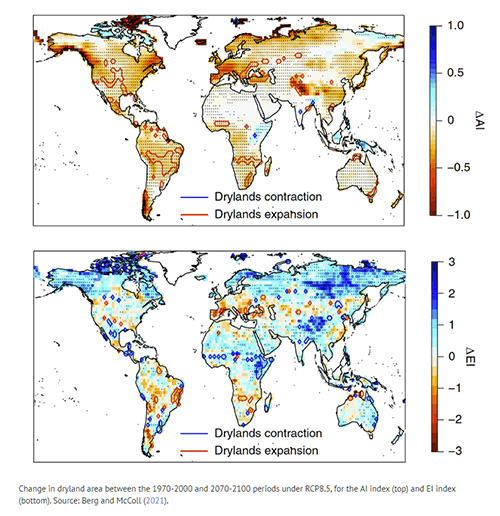 Deserts were expanding until experts got a better model.
The new study is based on modeling too so it is still wrong, but less useless than previous studies. The hugely different forecasts show how vaporously thin the past doom and gloom was, and how so many headlines were generated out of a banal omission from an inadequate model. Cancel the cover shots of cracked Earth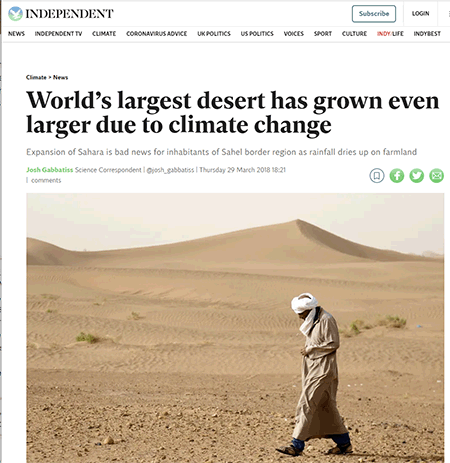 Or not. | The Independent & nearly every other media outlet on Earth. Now they tell us? Now we find that all the past expert predictions were made with models that only used “atmospheric information” like rain and temperature — to predict the condition of plants and soil. You’d think they might have mentioned that. Now that they have some actual soil moisture data and flora involved — things look very different. As all good skeptics know (but apparently not science journalists) increasing CO2 means plants need less water. Thus more carbon dioxide makes plants “drought resistant”. Note the attention getting headline: Climate change may not expand drylandsPrevious studies used atmospheric information, including rainfall and temperature, to make projections about future land conditions. The real picture is more complicated than that, said Kaighin McColl, Assistant Professor of Earth and Planetary Sciences and of Environmental Science and Engineering at SEAS and senior author of the paper. “Historically, we have relatively good records of rainfall and temperature but really poor records of the land surface, things like soil moisture and vegetation,” said McColl. “As a result, previous definitions of drylands are based only on how the atmosphere is behaving, as an approximation of the land surface. But models can now simulate both atmospheric and land conditions. By just looking directly at the land surface in climate models, we find that the models aren’t showing a clear increase of drylands over time and that there is huge uncertainty about the global average state of drylands in the future.” Plants need less water when there is more CO2: Keep reading → March 13th, 2021 | Tags: Climate Models, Desert, Evidence | Category: Evidence, Global Warming | Print This Post | | The EU has given up trying to persuade Australian voters that wind and solar power is “cheap”. Instead, it’s using Upperclass centralized bully-power in an attempt to force Australia to sacrifice cheaper electricity and hobble its generation network to satisfy the EU totalitarians. Australian exporters could face millions of dollars in European tariffs as EU seeks to punish pollutersWritten by someone at Their ABC Australian exporters to Europe are likely to face millions of dollars in new tariffs after the European Parliament voted overnight to move forward with a carbon levy on products from countries lacking serious pollution reduction programs. The vote came after a top parliamentary committee noted concerns about “the lack of cooperation by some of the EU’s trade partners … to reach the objectives of the Paris Agreement”. Australians installed more renewables per capita than any place on Earth in 2018-19, but that isn’t enough. The EU say we need a “target” of net-zero, (which we can point at and ignore, like most of what the EU does): Kathleen van Brempt, a key parliamentary trade coordinator, said an FTA was contingent on “a clear vision [from] Australia by when and how they will become climate neutral and by when and how they will phase out of coal”. Until Australia establishes a new scheme to lower emissions, its exporters to Europe face the prospect of paying additional tariffs under the new Carbon Border Adjustment Mechanism (CBAM), which is expected to come into force in 2023. The mechanism is designed to apply tariffs on imports equivalent to the fees paid under the EU’s Emissions Trading System by local businesses producing the same product. Three solutions: Nukes, fake targets, or a trade war?Being practical, given that the EU is our second largest trading partner, we can either build a few nuclear power plants, fake up a symbolic “carbon target”, or fight back in a trade war. While Australia has more uranium than any place on Earth, we also have 300 years of coal and it’s a lot cheaper. Nothing beats wholesale brown coal at 3c KWh. As for symbolic carbon targets and fake declarations of emergencies, the price is still too high. These careless declarations become potent legal tools to protect extreme protesters, excuse trade wars (like this one), and punish certain politicians and companies. The best choice is to point out how Australia is already a super-achiever with carbon reduction per capita, and the installation of unreliable renewables. When the EU achieves similar per capita “gains” then they can lecture us — especially when we have an energy-dependent economy, live on the lowest population density country on Earth, have bigger distances to cover, and are more remote than any continent bar Antarctica. Until then Australians will just have to drink Australian wine and cheese and drive South Korean and Japanese cars. We’ll sell our gold, shiraz and beef to the UK, Canada, India, and US. Long live The Commonwealth! 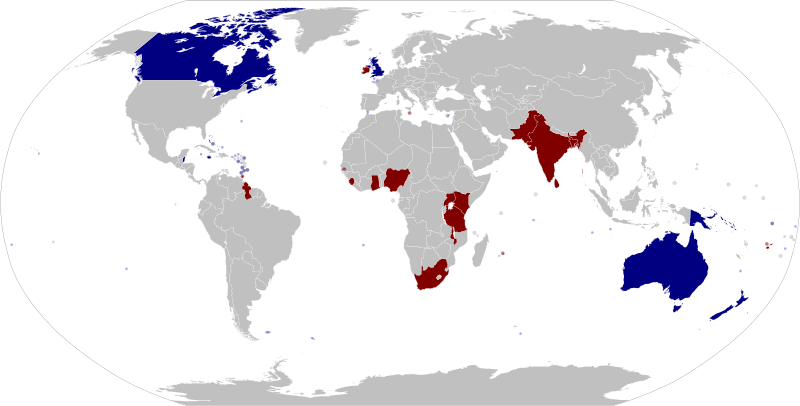 Map of the Commonwealth Time to talk about that lop-sided AU-EU trade imbalanceIn a trade war with the EU, Australia surely holds the upper hand. We export $30 billion dollars worth of goods and services to the EU, but import $80 billion dollars worth of EU goods, none of which we really have to have, and that’s despite the EU already having higher tariffs on Australian goods than we do on EU goods. Could we not just add tariffs to incoming EU goods to recover their charges and distribute them back to subsidize our exporters to the EU? Seems only fair. Yes, yes, obviously we’d prefer no tariffs, but if the EU wants a tariff on our electricity, so be it. If the EU wants to set our electricity prices, Australians could easily choose not to buy EU goods. It’s not that we have anything against the suffering small businesses of the EU (to whom we are rather sympathetic), but if they won’t protest at this bullying behaviour and their own stupidly high electricity prices then we can’t help them. We don’t need German windmills, French wine, Italian cheese or Spanish olives. We can supply our own. We should also cancel our French submarine purchase “in protest” (any excuse will do — the Japanese subs are better in any case).
|
Jo appreciates your support to help her keep doing what she does. This blog is funded by donations. Thanks!
 Follow Jo's Tweets
   
 
|
|||
|
Copyright © 2026 JoNova - All Rights Reserved |
||||










Recent Comments