|
|
||||
|
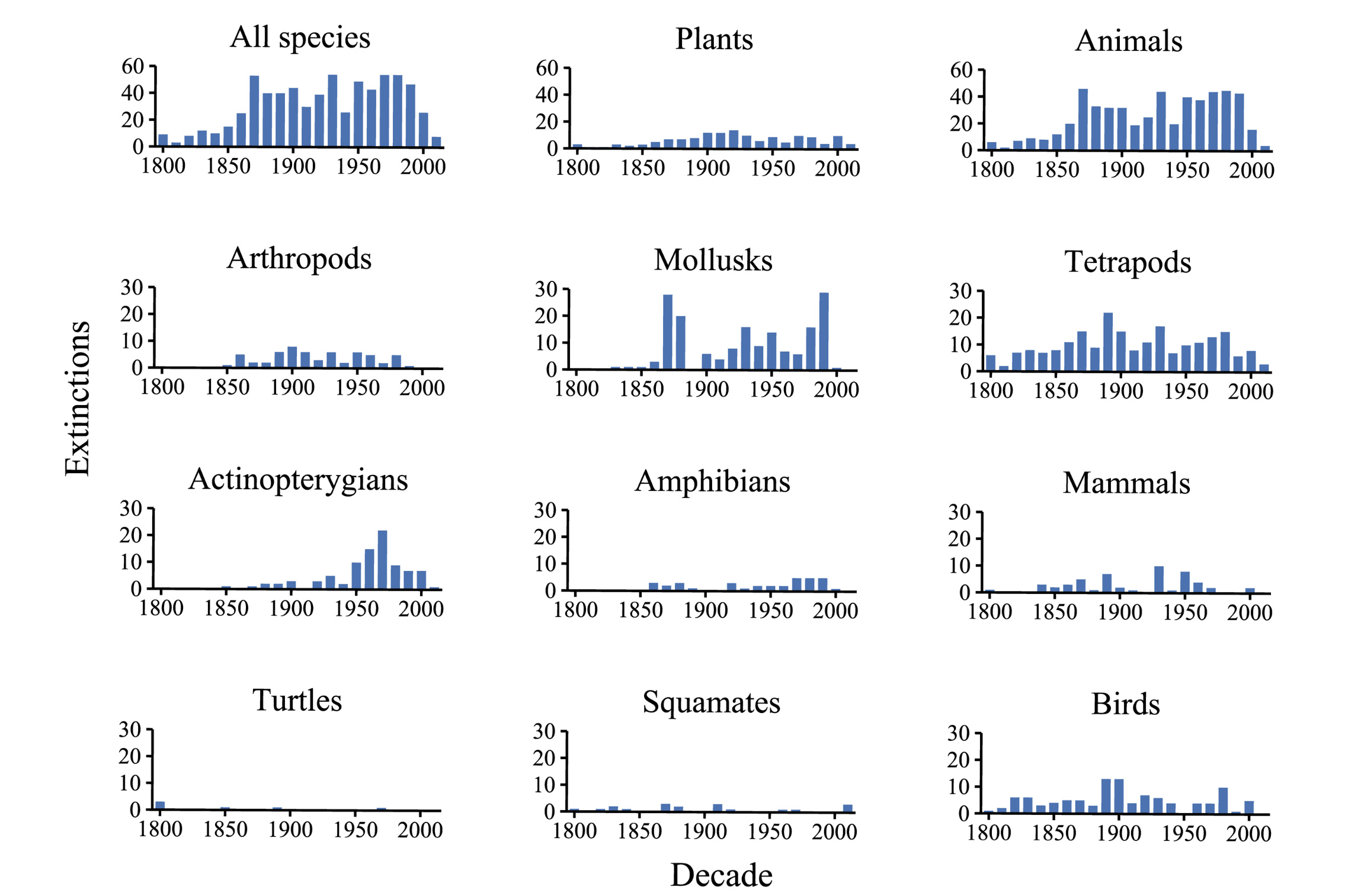
By Jo Nova If man made CO2 emissions have any effect at all on extinctions — it stops them happeningNew research looked at 500 years worth of extinctions and concludes that species loss peaked about a century ago. Far from the rate accelerating as we pour carbon dioxide into the sky, fewer species are disappearing now than forty or fifty years ago.
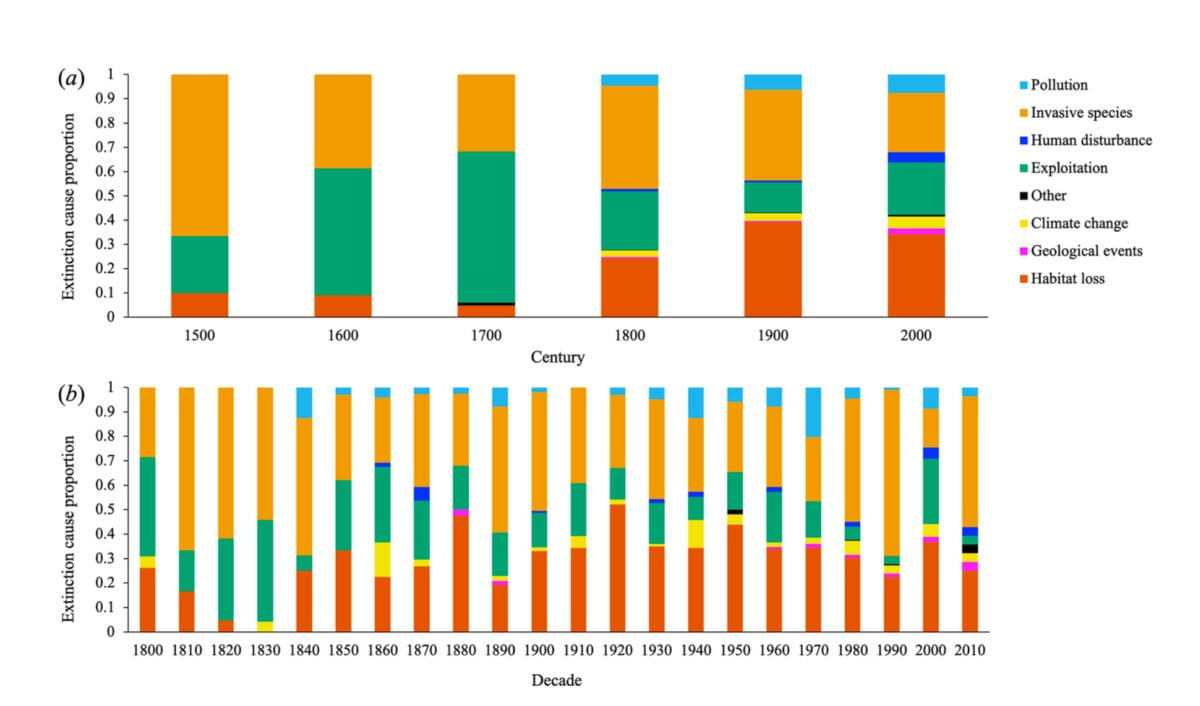
Many of the doom and gloom forecasts took extinction rates from long ago and extrapolated them mindlessly forward, as climate modelers are want to do. Extinction rates have slowed across many plant and animal groups, study showsEurekaAlert “To our surprise, past extinctions are weak and unreliable predictors of the current risk that any given group of animals or plants is facing,” said lead author Saban, who recently graduated from the U of A and is currently a doctoral student at Harvard University. Humans have wiped out species, but mostly by bringing in rats, pigs and goats to isolated islands: Extinction rates varied strongly among groups, and extinctions were most frequent among mollusks, such as snails and mussels, and vertebrates, but relatively rare among plants and arthropods. Most extinctions were of species that were confined to isolated islands, like the Hawaiian Islands. On continents, most extinctions were in freshwater habitats. Island extinctions were most frequently related to invasive species, but habitat loss was the most important cause (and current threat) in continental regions. Many species appeared to go extinct on islands because of predators and competitors brought by humans, such as rats, pigs and goats. The researchers could not find any evidence suggesting climate change was increasing the rate of extinction: Somewhat unexpectedly, the researchers found that in the last 200 years, there was no evidence for increasing extinction from climate change. “That does not mean that climate change is not a threat,” Wiens said. “It just means that past extinctions do not reflect current and future threats.” It seems like a very comprehensive study. Given it’s importance, I’m sure the UN will be delighted. It’s a wonder they didn’t commission a study just like this 30 years ago…
There are many reasons for extinctions but “climate change” barely rates a mention, which is not at all surprising given that every species alive today has lived through hotter times, colder times and times that changed faster than today. Man-made climate change is nothing compared to asteroids and volcanoes.
The best way to protect biodiversity is to understand what actually causes extinctions, not to shamelessly exploit the threat of them as a political tool for power and profits. Shame on the UN, the Greens and Greenpeace. And in the end, rich nations protect the environment better than poor ones. The best thing we can do for the Mountain pygmy possum is to protect our GDP. Poverty has terrible effects on national parks and land use. As I wrote 5 years ago — there’s only been one supposed mammal extinction due to climate change — a rat on a sandbar:Let’s get a grip on the current state of the Sixth Mass Extinction — so far the only mammal extinction officially due to “man-made” climate change was a colony of little brown rats which had washed up on a sandy spit south of Papua New Guinea. The “island” is so small it has no fresh water, no trees, and the highest point is all of 3 meters above the high tide mark. One king wave could have wiped out the colony. Relatives of these rats live in Papua New Guinea, and presumably more rats will wash up there again sometime and the cycle will start over. As of 2019, that was the only actual mammal anyone can name as an extinction “caused by climate change”. As of 2025, there doesn’t appear to be any others. Hat tip to Marc Morano at Climate Depot REFERENCESSaban K.E. and Wiens J. (2025) Unpacking the extinction crisis: rates, patterns and causes of recent extinctions in plants and animals” by , 15 October 2025, Royal Society B: Biological Sciences. DOI: 10.1098/rspb.2025.1717 Tiger photo by Frida Lannerström on Unsplash
December 13th, 2025 | Tags: Biodiversity, Biology, Evidence, Extinction | Category: Global Warming |  Print This Post | | Print This Post | |  …. By Jo Nova It was never about The ScienceAnd so we find that the global consensus quietly dispersed, there were no press releases, no ceremonies, just the dawning realization that nearly everyone had left the party without saying goodbye. And they didn’t wait for the UN to say “the science” was fine. The herd is on the move regardless… One of the top majordomos at BHP delivers the bad news to Anthony Albanese. Everywhere on Earth is more attractive to a miner than Australia is. The world has changed, and everyone wants cheap energy, critical minerals, and lower taxes and other countries are giving it to them. Even Canada (ferrgoodnesssake!) is “walking back policies that the country can’t afford”. While Australia is the last nation on Earth steaming ahead to Renewable-nirvana. Brandon Craig specifically mentions problems with climate targets, competitively priced energy, and Net Zero. In the nicest possible way he’s telling our PM that his Net Zero plan is a dog. Mining giant’s rising star Brandon Craig warns even green policy stalwarts like Canada are moving to protect their economiesBy Brad Thompson, The Australian BHP rising star Brandon Craig has warned Labor it needs to reconsider how policy settings are calibrated, including around emissions and climate targets, or risk being left behind by governments hungrier for mining investment. Investment rivals like Chile, Argentina, the United States and Mark Carney’s Canada were acting to attract and secure multi-billion dollar investment from miners, but Australia was failing to meet their terms. Mr Craig suggested it was time to reconsider net zero and decarbonisation policies to safeguard Australia’s economy. “I would let readers form their own conclusions but I think if we contrast directionally where the rest of the world is going versus where Australia is going across energy policy, tax policy, industrial policy, deregulation, even in some respects net zero positioning and decarbonisation, even stalwarts like Canada – in the face of tariffs and the impact to the economy from US policy – is walking back policies that the country can’t afford anymore,” he said. The two things BHP particularly wants are the corporate tax rate lowered from 30 to 20% and reliable cheap power. Brandon Craig is working in Argentina to develop the Vicuna copper project. He points out the tax rate there fell from 35% to 25% under the leadership of Javier Millei. And the successes of small government in Argentina are spreading to Chile — where voters go to the polls this weekend, and are expected to also elect “a hard right leader”. According to Craig, the word is that it’s likely the next government in Chile will improve their tax regime because they are competing with Argentina for mining investment. The effect of liberty is infectious, isn’t it?
By Jo Nova Panic-stations in Renewable UtopiaEven the AEMO, our green grid operators, have realized Australia is not ready to shut down the last coal plants by 2037 which was the plan up until five minutes ago. Things must be desperate. After 20 years of telling us how wind power was absolutely, definitely cheaper — for the first time, an official admitted the blasphemy — “wind is becoming too expensive”. Now they tell us. Reality for ALP as coal will be needed until 2049, says AEMOBy Colin Packham and Richard Ferguson, The Australian Coal will be needed to stabilise the energy grid until 2049 under an extraordinary 12-year extension of the fossil fuel that threatens Labor’s net-zero target, as the green-energy revolution leads to a 100 per cent explosion in power transmission costs. In a 115-page document that mentions “net zero” just once, the Australian Energy Market Operator has warned that wind is increasingly becoming too expensive and there is a risk the nation is overbuilding transmission lines through rural and regional Australia. So, “Net Zero” has vanished from the pages, and what appears in its place is a 100% explosion in transmission costs. The AEMO must have realized how daft the Net Zero label would look next to a plan to keep coal fired power on… So where are the apologies?The AEMO should have known all this three years ago before the Labor Party launched their rocket mission to a Renewable Moon. Or were they expecting some miraculous discovery, some wonder-battery, hydrogen plant, or supersized windmill to pop into existence in 2024 and it didn’t happen? Perhaps they thought they understood the Australian climate… What a shame they were willing to place a $128 billion dollar bet (of our money) on it. They could have just read poetry from 1904 and been better prepared. Ponder that the AEMO could have told Minister Bowen the bad news this three months ago, before he supersized the national Net Zero Target. The fact that they left him hanging in the breeze, suggests something has shaken even the AEMO in the last few months. Was it the catastrophic collapse of transformers at the Waratah superbattery? The breakdown occurred as the battery was being hooked onto the grid to start. Did the failure signal that a battery driven grid was going to be much more risky and difficult than they had expected? Was it the steady stream of wind turbine projects that collapsed before they were started, or the hydrogen dreams that fell to pieces? Or was it the fierce opposition to the high voltage lines? And lets not forget last week — when the AEMO also got a nasty shock. The Australian pointed out they assumed the wind power never goes below 14% capacity for days on end only to find out that it already has? The plan is still to build massive infrastructure that doesn’t work most of the time:Optimal for who? China? AEMO’s Optimal Development Path said grid-scale wind and solar capacity would need to rise from 23GW to 58GW by 2030, and double to 120GW by 2050, to replace coal. Their excuse is that solar power is surprisingly popular, ignoring the fact that all the demand for it was created by government subsidies and incompetence, and everyone hates living next to a wind turbine. Rising capital costs and supply-chain constraints have pushed developers more firmly toward solar rather than wind, a tilt that has implications for storage requirements given the daily generation profile of each technology. Now, apparently, the old coal plants will keep going through the 2040s. The story is that they will shift to a “flexible role” (also known as an inefficient role). They will be used “sparingly” during the extended dunkelflautes that the AEMO forgot to plan for. So either the giant shell of the old coal plants will be left running on standby most of the year to provide the frequency stability for a few weeks a year, or this flexible-coal-fantasy is just the marketing spin to disguise the truth. It’s what they would say to the Greens to soften the blow. It’s how they pretend this is just a small policy tweak. They could hardly come out and say “we’ll just keep running the coal plants full bore…”
The A.E.M.O. is growing apprehensive, — Ruairi h/t Bally December 10th, 2025 | Tags: AEMO, Coal, Renewable Energy | Category: Global Warming | Print This Post | |
By Jo Nova Europe is starting to drill for oil and gas againEurope has always been the most pious climate ideologues, but there is a growing realization that they need their own supplies of oil and gas. Greece and the UK are reopening offshore oil and gas platforms and Italy is thinking about it. Australia looks set to be the last place on Earth where people are still playing climate-vanity games. Last month Greece issued its first gas exploration license in 40 years. The UK loosened its ban on new exploration in the North Sea and the Freech Energie Giant said it would spend $6b USD to buy 50% stakes in natural gas fired plants across Europe. Meanwhile Germany, the home of thousands of wind turbines, is building 10 GW of gas powered plants. By Stanley Reed: The world has changed since the Paris agreement was adopted decade ago with ambitious goals to tackle climate change. It has become increasingly apparent that the agreement’s targets to reduce global greenhouse gas emissions will not be met, and not just because the Trump administration has pulled out of the Paris process. Energy companies have taken note. “They’ve certainly abandoned the idea that they can lead the world along that kind of pathway,” said Luke Parker, vice president for corporate research at the energy consultant Wood Mackenzie, referring to the Paris agreement. Even Germany, which has long prided itself on being a leader in renewable energy, is building gas-powered generation plants capable of generating 10 gigawatts, a substantial amount. Thank Donald Trump. Even though the US supplies 16% of the EU’s gas, he and U.S. Energy Secretary Chris Wright have been leaning on the Europeans to drill for their own again instead of importing it from Russia and he’s told Britain it was making a “big mistake” and should be opening the North Sea. Just yesterday, the US Deputy State Secretary was pointing out to the Europeans that they spend more on Russian oil and gas than they do helping Ukraine. Who the hell ever heard of that one?” said Donald Trump:It comes as US President Donald Trump has piled pressure on NATO members to stop buying Russian energy, in a bid to end the Russia-Ukraine war. At the UN last week he said, “They’re funding the war against themselves. Who the hell ever heard of that one?” Trump was referring to the more-than one billion euros ($1.35bn) EU countries are still paying to Russia each month for fossil fuels. — Aljazeera “Germany — Ukraine’s largest European donor with about $17.5 billion in assistance — still purchased approximately $20 billion worth of Russian oil and gas over the same period.“…” Italy delivered around $3 billion in aid but bought $27.5 billion worth of Russian oil and gas.” … France paid more than $20 billion for Russian energy while giving roughly $6 billion to Ukraine. — New Voice of Ukraine EU legislators agreed last week to stop buying Russian gas by 2027 — to stop “Moscow weaponizing energy”. Europe’s drilling comeback challenges US energy pledgesBy Ron Bousso, ReutersLONDON, Dec 1 (Reuters) – European countries are loosening their strict opposition to new oil and gas drilling, reversing years of climate-driven resistance to fossil fuels as governments seek to reduce a heavy reliance on costly energy imports, including from the U.S.
The change in tack in Greece, Italy and Britain reflects a new paradigm shaped by the 2022 energy price shock: an acceptance that fossil fuels – natural gas in particular – will remain a key part of the energy mix for decades, even as the region also builds out renewables capacity to slash greenhouse gas emissions.
The change is stark in Greece, which in November issued its first offshore oil and gas exploration licence in over four decades to a consortium of Exxon Mobil, Energean, and Helleniq Energy.
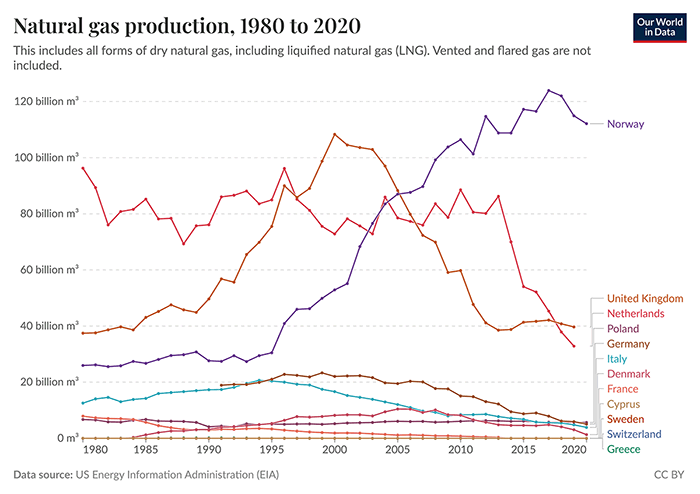
Europe has been cutting gas production for 20 yearsIn Europe, only Norway increased production of natural gas. In the graphic below, the gas industry in the UK and the Netherlands have spend two decades in decline. Only Norway kept exploring for more gas. For comparison, Australia’s natural gas production is higher than Norway’s at more than 140 billion cubic meters.
This is a big policy shift for Greece:
“It’s a big change in policy for Greece that has shifted from ‘we don’t want hydrocarbons, only renewables’, to a new narrative that exploration for gas is key for energy security,” said Mathios Rigas, the CEO of Energean, which will lead the exploration campaign. If commercial, the field will not start production before 2030.
Italy has been trying to expand gas and oil drilling for three years, but is fighting a battle in the courts. Nonetheless, moves are afoot, as Ron Buosso reports in Reuters:
In neighbouring Italy, Giorgia Meloni’s government is also considering reviving offshore oil and gas exploration, which was suspended in 2019. Shell, the country’s top producer, last week said it was willing to invest more in upstream production.
In Britain, the government last week loosened its strict ban on new exploration activity in the North Sea to allow companies to expand production in existing fields. It is also expected to give the green light to two major new fields in the coming months.
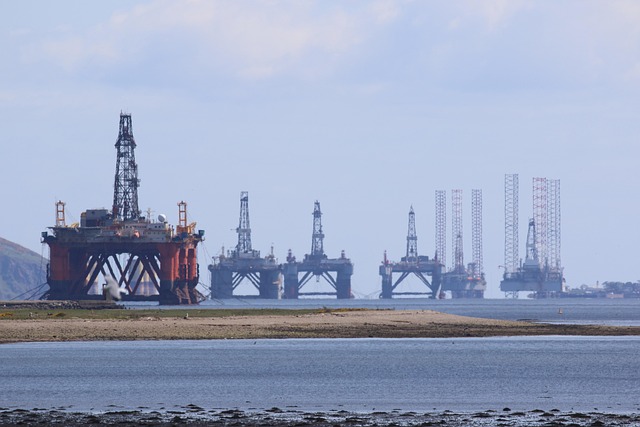
When will Australia (and Canada) wake up? Oil rig image by Elliott Day from Pixabay
By Jo Nova Donald Trump wants to bring free speech, fertility, hard borders and patriotism back to Europe tooOther people have pointed out the dire state of Europe, but the continent can’t ignore the US President. He has vowed to “cultivate resistance” to Europe’s current trajectory — and raises grave concerns at the subversion of democratic processes, and the loss of European culture saying “should present trends continue, the continent will be unrecognisable in 20 years or less“. The US is officially putting the topic-that-must-not-be-discussed on the table — mass immigration, and blaming the decay of Europe on transnational bodies like the European Union. This is still an America First policy — framed as it being in Washington’s interest to “prevent any adversary from dominating Europe”. Trump’s new national security strategy takes aim at EuropeThe Wall Street Journal “A large European majority wants peace, yet that desire is not translated into policy, in large measure because of those governments’ subversion of democratic processes,” Trump’s strategy document states. “This is strategically important to the United States precisely because European states cannot reform themselves if they are trapped in political crisis.” Apparently the US releases one grand strategic policy each Presidential term with big thinking ideas about the place of US in the world. We can be sure the Blob media will repeat the quotes, but dwell on the trivia and funnel readers away from the substance. The BBC tells readers that Trump is aligned with the far right AfD party, which was classified as “extreme” in Germany, but they won’t discuss the numbers of immigrants or how European countries are changing. Politico discusses “echoes” of the racist “great replacement” conspiracy theory, but won’t ask what proportion of Europeans are fluent in their national language, and how many celebrate (or even know) the European culture and heritage of the last thousand years. Trump says The People are even more important than The Economy….Trump administration says Europe faces ‘civilisational erasure’By Brandon Livesay, BBC Trump described the document as a “roadmap” to ensure America remains “the greatest and most successful nation in human history”. The new report doubles down on Trump’s point of view, calling for the restoration of “Western identity”, combatting foreign influence, ending mass migration, and focusing more on US priorities such as stopping drug cartels. Focusing on Europe, it asserts that if current trends continue the continent would be “unrecognisable in 20 years or less” and its economic issues are “eclipsed by the real and more stark prospect of civilizational erasure”. “It is far from obvious whether certain European countries will have economies and militaries strong enough to remain reliable allies,” the document states. It also accused the European Union and “other transnational bodies” of carrying out activities that “undermine political liberty and sovereignty”, said migration policies were “creating strife” and said other issues included “censorship of free speech and suppression of political opposition, cratering birthrates, and loss of national identities and self-confidence”. Conversely, the document hails the growing influence of “patriotic European parties” and says “America encourages its political allies in Europe to promote this revival of spirit”. Trump wonders whether NATO can survive in the long run: “Over the long term, it is more than plausible that within a few decades at the latest, certain NATO members will become majority non-European,” the document reads. “As such, it is an open question whether they will view their place in the world, or their alliance with the United States, in the same way as those who signed the NATO charter.” — Euronews It is a conversation The West needs to have. Is a nation a broader family that has a lifelong pact to look after its own in War and Peace, or just a hotel where people choose to live for a while? Nationalism threatens the Blob, because it demands to know how The Blob serves the nation and The Blob serve only themselves. Photo of Statues by pierreforlin from Pixabay
By Jo Nova What’s most interesting about this is that this paper was ever published at all, given how awful it was.In April last year Nature released the Kotz study which said that climate change would cause a mind-blowingly shocking 62% reduction in economic output by 2,100AD. Now, we know it’s wrong because the climate models are useless, but it turned out that one outlier country singlehandedly trashed the world economic forecasts, and that was Uzbekistan. Instead of a 62% reduction, without Uzbekistan, the global drop was “only 23%”. So much for “peer review” then? This paper’s conclusion was wildly worse than the consensus of doomer papers, but the peer reviewers didn’t figure out why its result was so skewed, so Nature, supposedly the most esteemed repository of science, published the outlier anyway. Even the uber left The New York Times is saying they should have been more skeptical: Top Journal Retracts Study Predicting Catastrophic Climate TollBy Lydia DePillis, The New York Times Of course, erasing more than 20 percent of the world’s economic activity would still be a devastating blow to human welfare. The paper’s detractors emphasize that climate change is a major threat, as recent meta analyses have found, and that more should be done to address it — but, they say, unusual results should be treated skeptically. “Most people for the last decade have thought that a 20 percent reduction in 2100 was an insanely large number,” said Solomon Hsiang, a professor of global environmental policy at Stanford University who co-wrote the critique published in August. “So the fact that this paper is coming out saying 60 percent is off the chart.” Naturally, the mistake helped The Blob, so almost no one with a job in the climate-alarm industry wanted to look for anything that might be overdone. This study was used to justify all kinds of economic decisions that otherwise make no sense. Ka-ching. Ka-ching. It also led to a striking comparison with the costs of avoiding catastrophic warming. Damages that are essentially baked in over the next 25 years will cost six times the money it would take to lower emissions enough to limit the world to 2 degrees Celsius of warming, the goal set by the Paris Climate Accord. This is emblematic of the whole field of climate research. Monopsonistic research always finds what the one sole customer (The Blob) pays it to find. Thus the government funded establishment loved it. Look how popular this junk-research was: The paper was also cited by the Organization for Economic Cooperation and Development, and was in the top 5 percent of journal articles tracked by Altmetric, a measurement tool for research impact. Carbon Brief, a climate-focused news outlet, found it was the second most referenced climate paper in 2024. Roger Pielke Jnr points out this was the second most featured climate paper in the media in 2024. “More importantly, [Kotz et al] has been widely used in policy around the world to justify projections of catastrophic future climate impacts and as a basis for cost-benefit analyses of mitigation.” It was used in places like the U.S. Congressional Budget Office, the OECD the World Bank and the UK Office for Budget Responsibility. The Australian Climate Change Authority also cited the now-retracted Kotz et al. (2024) Nature paper in its official advice on Australia’s 2035 climate targets. They didn’t specifically quote any passages from it — but they used it as part of the “evidence base” to imply massive, climate damages that justify extremely high emissions-reduction targets. Lint Barrage, chair of energy and climate economics at ETH Zurich (said) “It can feel sometimes, depending on the audience, that there’s an expectation of finding large estimates,” Ms. Barrage said. “If your goal is to try to make the case for climate change, you have crossed the line from scientist to activist, and why would the public trust you?” So why has this been retracted now? Is Nature sensing a change in the mood where this sort of weak “activist-science” looks terrible…? Could be. The retraction might be just part of the escape plan. They’ve had their headlines of doom for 18 months already. REFERENCES (that aren’t any more)Kotz, M., Levermann, A., & Wenz, L. (2024). The economic commitment of climate change. Nature, 628(8008), 551–557. https://doi.org/10.1038/s41586-024-07219-0” Image by Pete Linforth from Pixabay h/t to Climate Depot
The The Australian Energy Market Commission (AEMC) has made up some fantasy figures suggesting a teensy weensy price rise is on the way in five years time unless we buy more unreliable generators, add more batteries and install giant high voltage lines. Somehow, miraculously, electricity prices will fall slightly in the next five years while we spend the hundreds of billions of dollars adding all that infrastructure. Sure. The AEMC report feels like it was created to fill a very specific political advertising campaign. Don’t scare the horses with big price rises, but just scare them enough to justify us spending a kiloton of money on our crony renewable friends and Chinese pals, OK? Households face sharp electricity price rise without urgent action, key agency warnsBy Colin Packham, The Australian Households could face a 13 per cent jump in electricity prices early next decade unless the rollouts of renewable energy, battery storage and transmission are accelerated, the country’s energy market rule maker has warned. And if the “decline” in prices doesn’t happen, will the AEMC staff pay Victorians the difference from their own salaries, or is there no cost at all for them being completely bonkers wrong? The Australian Energy Market Commission said it expected a decline in residential electricity prices between 2025 and 2030 if the transition proceeded along official estimates. But it warned that the transition depended on a “critical five-year window” in which the pace of renewable generation and battery deployment must keep ahead of rising demand and the retirement of ageing coal plants. The AEMC sound more and more like a late night TV informercial. Buy our product to make energy cheap and if prices start to rise, buy even more. [Ms Anna Collyer] said the analysis “clearly shows renewable energy and batteries drives prices down,” with the risk of rising prices emerging “if we slow down renewable deployment as coal plants retire”. It’s time there were consequences for Blob Agencies. Subsidies just hide the true costMr Blackout Bowen, the Minister for Weather Control, knows the answer is to fool the people into buying more subsidized solar panels and batteries, because even though none of them are worth buying outright, when we all do it together the money disappears off some electricity bills and the real cost is hidden in a million consumer bills. The rebates on the solar panels are paid by raising the cost of electricity to everyone else. But that price never appears on any invoice. Every time you buy frozen peas you pay more than you would have, so the supermarket, the farmer, and the factory can pay their higher electricity bills which subsided your solar panels. This is a dragon that eats its own tail at 50 hertz. Mr Bowen lies from beginning to end:After running coal plants into the ground and sabotaging them, he blames them for the price rises that happen when they are not there. Which industry is billing us for those high spikes in prices — it’s the battery men you love at $478 per MWh, not the coal plants! “The AEMC makes clear [that] slowing the renewables rollout and sweating ageing, unreliable coal will drive up energy bills and pollution. Yet this is exactly what the Coalition’s anti-renewables plan is designed to do,” said Mr Bowen. “It’s simple: when coal breaks down, your bills go up – that’s why we’ve got to keep rolling out reliable renewables, and help more households embrace solar and batteries,” he said. “The Coalition’s anti-renewables plan will cost Australians more.” Conversely, faster construction of renewables, grid batteries and transmission could ease pressure. The commission finds that “faster wind and transmission delivery could reduce prices by up to 10 per cent,” while a faster uptake of household batteries “can reduce electricity costs for all households by up to 3 per cent annually”. Watch the poison pea — see how the word “average” disguises the theft: Despite the projected increase in per-unit electricity prices, household electricity bills themselves may not rise. The AEMC notes that “average household electricity costs are projected to remain stable”, as improved energy efficiency and rooftop solar uptake more than offsets increased demand from gas switching and EV charging. So the key question is who gets to pay the below average costs and who gets to pay the above average cost? It’s a stupid question — in Socialist-Paradise they both pay above average. There are no savings. Poor people pay more for rich people to put on economically inefficient solar panels, and the richer people pay more for solar panels no one needed when we ran a cheap coal fired grid. In a world of subsidies, we all lose! ————————– This post is dedicated to Max Hedt, ROM, a commenter we wish was still with us. Known for some long but contemplative, big-picture, original, thoughts. (Sorry I don’t have time to find the best of 3,400!) December 4th, 2025 | Tags: Net Zero, Renewable Energy | Category: Global Warming | Print This Post | |
By Jo Nova The world really is waking up to the terrible truth about the forced “green transition”. The Wall Street Journal (finally) speaks the blasphemy out loud — countries with a lot of renewables are “hemorrhaging industry”, they face right-wing revolts in elections, they can’t keep up in the AI race, and the system wide costs of renewable electricity are crippling. The pagan quest to do rain-dances with electrical generators has become an existential threat. If AI is the next revolution, then the lands of green fantasia have already lost the race. There’s a global contest to create the first world dominating AI before anyone else does. This is not an exponential curve we can afford to lose. The first nation to crack adversaries encryption codes, hack their defenses, design the killer bioweapon, or build a self replicating drone army — potentially takes it all. The contest is, above all, an energy competition. Ponder that gram for gram, each day the human brain uses ten times the energy than muscle does, yet despite that stupendous cost, it conquered the world. For twenty years some rich countries became mired in corruption and virtuous beauty contests. They toyed with fripperies like imaginary weather-control a century hence, while their adversaries built the engines of real power. Europe’s Green Energy Rush Slashed Emissions—and Crippled the EconomyBy Tom Fairless and Max Colchester, The Wall Street Journal Europe has succeeded in slashing carbon emissions more than any other region—by 30% from 2005 levels, compared with a 17% drop for the U.S. But along the way, the rush to renewables has helped drive up electricity prices in much of the continent. Germany now has the highest domestic electricity prices in the developed world, while the U.K. has the highest industrial electricity rates, according to a basket of 28 major economies analyzed by the International Energy Agency. Italy isn’t far behind. Average electricity prices for heavy industries in the European Union remain roughly twice those in the U.S. and 50% above China. Energy prices have also grown more volatile as the share of renewables increased. It is crippling industry and hobbling Europe’s ability to attract key economic drivers like artificial intelligence, which requires cheap and abundant electricity.
The WSJ authors have plenty of stories of crippled business — Ireland had to stop new data centres opening for at least three years, because existing data centres consumed a fifth of the nations electricity supply. One German data centre operator wanted to expand but was told he’d have to wait ten years for the electricity supply to grow. Polls show half of British consumers are planning to ration energy use this winter as they struggle with wholesale electricity costs that are 80% higher than the U.S. Suddenly the consensus has flippedThis is a big shift. After twenty years of “clean energy” being cheaper , now they say that while the high energy prices aren’t completely the fault of the green transition… (did you see what they did there?) “a good chunk of the increase is thanks to the shift to renewables, say business executives and some economists.” So the generalized, unnamed mass of experts are now on the same side as the skeptics? It’s reasonably big pictureThe WSJ explains all the things that skeptics have been saying for years. That the wind and sun might be “free” but collecting, distributing and storing the free energy turned out to be horribly expensive. Only in Europe and the UK (and in Australia) did nations foolishly cut off (or blow up) the old reliable energy system before they had a working substitute in place. In past energy transitions people kept using the old fuel until the new one was widely available and cheaper. This fake transition was driven by ideology, not the free market: “Very clearly the cost of the transition has never been admitted or recognized,” said Gordon Hughes, a professor at the University of Edinburgh and a former adviser on energy to the World Bank. “There is a massive dishonesty involved.” Finally — A professor said something useful! Even the Greens themselves want oil and gas nowThe tide is receding so fast on green energy that even former fans are calling for oil and gas to step up (probably because they know a widespread blackout or horror show in the bills would be bad for renewable subsidy farmers): Some green entrepreneurs in the U.K. have started pushing politicians to ensure the oil-and-gas industry can help ease the transition. Greg Jackson, founder of Octopus Energy, which has championed wind farms, called on the U.K. to renew offshore oil-and-gas exploration in the North Sea, so that it doesn’t have to ship gas in from across the globe. Dale Vince, founder of Ecotricity and a climate activist who used to fund the protest group Just Stop Oil, wants lower taxes for existing oil-and-gas projects in the North Sea. It’s just one feature article in one newspaper, but word will spread. One of the first comments: h/t to Helen Dyer who says “Energy poverty in this country, so rich in coal, gas, uranium and thorium, is a crime against our people. ”
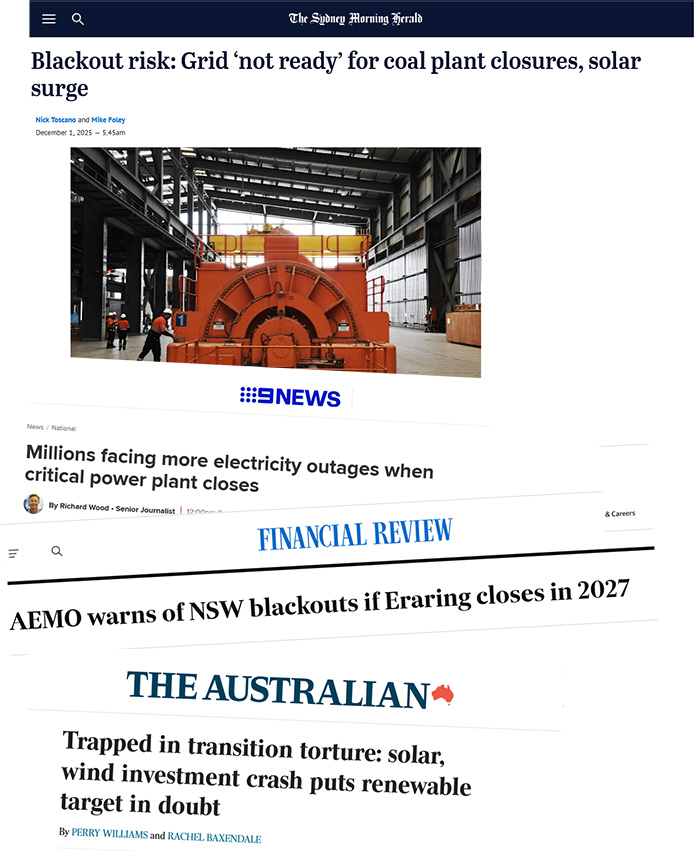
December 3rd, 2025 | Tags: Germany, media, Renewable Energy | Category: Cost, Economics, Europe, Free markets, Global Warming, Renewable | Print This Post | | By Jo Nova It’s hard to keep up with the bad newsIs Australia finally waking up to the ugly truth about unreliable electricity? Last week, the Australian Bureau of Statistics dropped the bomb that electricity costs were up 37%, foiling hopes of an interest rate cut. They tempered it by saying it was due to the government stopping the rebates, as if that made it understandable instead of being a national disaster. The government promptly promised to make electricity cheaper by giving up plans to change the the polar vortex with our power plants. No, wait, — of course, they promised to think about paying rebates again… The coal is dead, long live the coalAnd so we reach the point of where headlines fill our main newspapers this week with warnings that blackouts are coming if one particular coal plant closes and prices are destroying businesses just like we said they would years ago. The old coal plant that was supposed to close in August now looks unlikely to close in 2027, because of blackout fears. Eraring supplies about 20% of the energy to our largest state grid. Suddenly newspapers are explaining what system inertia means and talking about frequency stability. It’s like were training up a nation of electrical engineers. They’re also explaining SynCons, the big spinning machines called synchronous condensers which cost $150 million dollars each, and don’t generate any energy at all. They just provide the stability we get for free with every coal turbine, except for only for a tenth of a second or even less.
Meanwhile, investments in large scale solar and wind power crashed by 80% in the last yearNot one single wind project reached a final approval in Australia this year. We’ve slid all the way back to 2016 levels of spending: Trapped in transition torture: solar, wind investment crash puts renewable target in doubtBy Perry Williams, and Rachel Baxendale,– The Australian Australia faces its worst year of investment in large-scale solar and wind in a decade, heightening concern the nation will fail to meet its 2030 renewable energy target. Large-scale investment in solar and wind generation totalled 1.05 gigawatts at the end of October compared with 4.5GW for the 2024 calendar year, Clean Energy Regulator data shows. Origin Energy chief executive Frank Calabria last week said Australia’s shift away from coal was increasingly being held back by a stubborn gap in onshore wind development. No onshore wind project in Australia has reached a final investment decision this year – a striking absence that has cast doubt over Anthony Albanese’s climate ambitions. As the illusion wears off, and the subsidy farming gets tough, investor interest disappears. Soberingly, most of this collapse occurred before the Australian Opposition finally came out with a No Net Zero policy. Imagine how bad things will be next year, if the Liberals start to actually fight the Net Zero fight? Then we found out our grid Managers weren’t even planning for the worst wind droughtsThe Australian caught the AEMO preparing for a worst case scenario where our wind turbines fell to only 14% capacity for a few days in a row. Embarrassingly for them, the same month they released the 2024 Integrated System Plan, our wind turbines fell to half that. In response to that news last week, they have quietly tweaked their assessment and preparations for wind droughts or dunkelflutes. In May 2024 for seven days in a row, the entire fleet of Australian NEM wind turbines was running almost entirely below 14%, apart from two brief periods. Our grid managers are so inept that even mainstream journalists are correcting their errors in system planning. It’s that bad. I mean, “yay for the free press”, but really, our Blob-o-crat web must be so one-sided that all the other government funded agencies, the ABC, AER, AEMC, CER, CEFC, ARENA, ECA, ESB, CCA, CSIRO and all our universities, didn’t notice that the AEMO modelling was wrong? 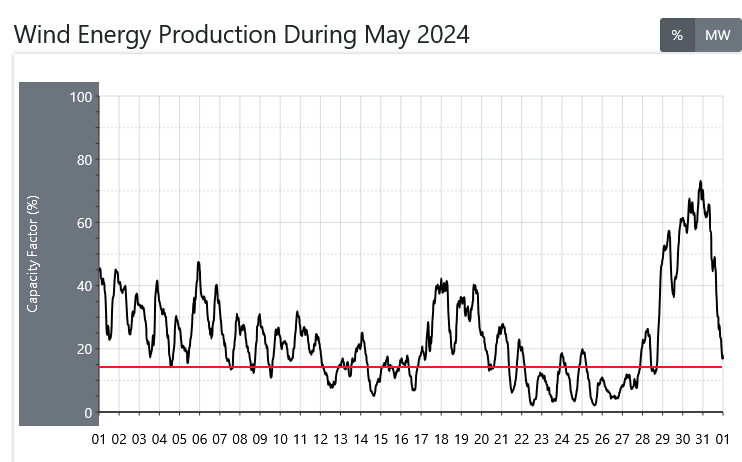 The red line marks 14% below which wind turbines were not supposed to stay for long. Graph by Anero.id All these agencies are just cheer-squads for Blob Renewables. Not one of them is paid to serve the public. Shut them all down…
 Image by Vilius Kukanauskas from Pixabay By Jo Nova The phase change in the Climate Apocalypse Trade rolls on, and the US leads the wayAlready some US ‘grassroots’ organizations are having an existential crisis. Actually, the Sierra Club has been struggling for three years, but no one wanted to mention that. Francis Menton at the Manhattan Contrarian points out the extraordinary collapse of the largest US environmental group, the Sierra Club: The Sierra Club is in the middle of what might well be called an implosion. The New York Times reported the story on November 7. Excerpt: The Sierra Club calls itself the “largest and most influential grass roots environmental organization in the country.” But it is in the middle of an implosion — left weakened, distracted and divided just as environmental protections are under assault by the Trump administration. The group has lost 60 percent of the four million members and supporters it counted in 2019. It has held three rounds of employee layoffs since 2022, trying to climb out of a $40 million projected budget deficit. . . . [T]his year, as the Trump administration returned better organized and better prepared than in its first term, the Sierra Club was the opposite. While Mr. Trump boosted coal power, canceled wind farms and rolled back pollution limits, the club was consumed by internal chaos, culminating when the board fired its executive director, Ben Jealous, a former president of the N.A.A.C.P. No doubt some of the pain is due to Donald Trump, and the DOGE effect, but a lot of this was an inside job with help from the cheer-squad-media. The Sierra Club forgot it was supposed to care about the environment and jumped into all the crazy lefty bandwagons they could find. As they ran off the road, the media cheered them on, and censored anyone who tried to tell them how the real world works. Thus and verily, they went double or nothing over Lemming cliff. Proving even the Green left can “Go Woke, Get Broke”: The Sierra Club Embraced Social Justice. Then It Tore Itself Apart.By David A. Fahrenthold and Claire Brown, The New York Times During Mr. Trump’s first term, when the Sierra Club was flush with donations, its leaders sought to expand far beyond environmentalism, embracing other progressive causes. Those included racial justice, labor rights, gay rights, immigrant rights and more. They stand by that shift today. By 2022, the club had exhausted its finances and splintered its coalition. It drove away longtime volunteers who loved the club’s single-minded defense of the environment, by asking them to fully embrace its pivot to the left. Some even felt they were investigated by the club for failing to go along. Many hard-core supporters felt the Sierra Club was casting aside the key to its success: It was an eclectic group of activists who had one, and sometimes only one, cause in common. The club hired Mr. Jealous, its first Black executive director, that year to stop that slide, but his tenure accelerated it as accusations of sexual harassment, bullying, and overspending piled up. Another casualty is 350.org which has lost revenue and suspended operationsAnd then there is 350.org. This organization is the baby of uber-climate-activist Bill McKibben, with the “350” supposedly designating some limit of ppm of CO2 in the atmosphere that must never be exceeded, or else . . . something may happen that they think is really, really scary. (The current level of CO2 in the atmosphere is approximately 424 ppm.). On November 13, even as COP 30 was going on, 350.org “suspended operations.” From Politico, November 13: Environmental group 350.org, which spearheaded the movement to block the Keystone XL oil pipeline, will “temporarily suspend programming” in the U.S. and other countries amid funding woes, according to a letter obtained on Thursday by POLITICO. . . . The letter to outside organizations from Executive Director Anne Jellema said 350.org had suffered a 25 percent drop in income for its 2025 and 2026 fiscal years, compelling it to halt operations. The group will keep three U.S. staff members in hopes of reviving operations in the future. In the US, the giant UN climate event in Brazil wasn’t even on the news. “…were you even aware that this year’s COP 30 happened? In a piece today for the Civitas Institute, Steven Hayward notes that not one of the American television networks sent reporters to this year’s event. Coverage in the American print and online media was also dramatically reduced. Hayward writes, “A few reporters at the conference filed stories wondering whether this would be the last COP meeting.” It appears that since Donald Trump didn’t go, the US TV networks didn’t bother sending camera teams. I can’t remember a COP meeting ever, where anyone discussed how it might be the last…
Memorial Service for Viv Forbes NEXT Friday at 9am EST time. (Apologies for getting the Fridays mixed up!) Address: at Centenary Memorial Gardens, 353 Wacol Station Road, Sumner, Qld 4074. There will be a live stream of this event at that time. PIN for access is 5918. Live steam link in case it does not come through: https://cmgcc.com.au/live-streaming/client?nid=08556218-2e27-45e2-9f85-6b8a128def77 Behind the scenes in the world of skeptics and libertarians, Viv was a source of wisdom, and tenaciously productive. He will be missed. — Thank you Viv! From his family: Viv lived a remarkable life — born in Warwick in 1939, he became a geologist, economist, farmer, writer, and above all, a man of principle. He was devoted to his family, passionate about learning, and unwavering in his commitment to libertarian ideals. He also dedicated much of his later life to climate science, challenging conventional wisdom with rigorous study and advocating for honest debate grounded in evidence. Viv was a Dux, Geologist, Economist, Intellectual, Libertarian, Writer, Poet, Political Commentator, Coal Miner, Sheep Farmer, Grandfather, Carbon Sense Coalition Founder and tireless campaigner for freedom. He will be remembered not only for his achievements but for the values he instilled in us and the legacy he leaves behind. Memorial details will follow in due course.
 Image by gugacurado from Pixabay By Jo Nova We now know that when AI is trained on AI generated content, its output degrades. The more artificial the training material is, the more it hallucinates and becomes delusional. But humans are a sort of large-language-model and we are running that same experiment on us. We are gradually raising children on more and more artificial content and less real experience. There are adult children who have never grown and harvested a single piece of food, who live online, watch anime, and know that electricity comes from wall sockets, and food comes from Coles. We thought they were just detached from reality, but what it it’s something much deeper? What if AI shows us a universal truth of a neurological network? This is the thesis of The Copernican:Urban Bugmen and AI Model Collapse: A Unified TheoryModel collapse is a serious limit to AI systems; a failure mode that occurs when AI is trained on AI-generated data… In reviewing model collapse, the symptoms bear a striking resemblance to certain non-digital cultural failings. Neural networks collapse, hallucinate, and become delusional when trained only on data produced by other neural networks of the same class. …and when you tell your retarded tech-bro boss that you’re “training a neural network to do data-entry,” upon hiring an intern, are you not technically telling the truth? It may be that, by happenstance in AI development, we have stumbled upon an underlying natural law, a fundamental principle. When applied to trained neural network systems, information-fidelity loss and collapse may be universal, not specific to digital systems. This line of reasoning has serious sociological implications: decadence may be more than just a moral failing; it may be universally applicable. Model collapse is visible in this study published in Nature last year  The more artificial the training content (the poison) the faster the output degrades. In any normal human society a three year old can guess who is a man and who is a woman, but there are adults now, raised on pure academic artificial material who seem to have lost this ability. Afterthought from Jo: During our earliest years the human brain appears incredibly well adapted to learning languages and music. For example, teaching children music at a young age increases the size of the corpus callosum which doesn’t happen in the late starters. (See: “Why musical genius comes easier to early starters”.) Similarly, “Neural and behavioral research studies show that exposure to language in the first year of life influences the brain’s neural circuitry even before infants speak their first words. ” Up to the age of 7 children appear able to learn a second language with grammatical proficiency that is increasingly difficult to gain afterwards. (see Fig 2) https://pmc.ncbi.nlm.nih.gov/articles/PMC2947444/ “People who grew up outside cities, or in more spatially complex cities (think Prague rather than Chicago), also appear to be better able to navigate as adults. This is related to the distances travelled and the variety of areas traversed.” What if there is a critical window of development of our neural network that needs to feel the pull of gravity, and get the bumps and bruises, or grow the pumpkin, or get lost in the bush? A retraining program in adulthood might recover some, but not all of the connections that should have formed in childhood. Copernicus pulls no punches: When it comes to navigating the real world, urban bug-people often behave as if they’re retarded. Socially (they’ve never been punched in the face), Geospatially (they have no idea how to navigate by the sun or shadows), Culturally (without some pop-fiction touchstone, culture doesn’t exist), etc. They’re entirely bound to a world of artificial ideas: human-produced data, and unable to accurately model from first principles anything outside their extremely limited sphere of artificial experience. The bugman’s neurological model of reality is divorced from reality. They hallucinate truths that make no sense, and they delude themselves into provably false ideas, and violently attack anyone with a model of reality more accurate than their own. They don’t understand violence, hunger, or (real) social organization because they’ve never encountered those things. And by the time they’re adults, their models of reality are too set to be easily changed. Those who don’t have a lived experience of physics or biology perhaps grow up to be the feminists who want biological males to win boxing medals in women’s division. They are the gays protesting to help a culture that would kill them if they visited. He points out there are programs growing to build purely non-AI-generated databases so they can train more useful AI models. Perhaps we need to grow these programs for our own children? Perhaps they need time on real farms and forests instead of just watching videos about someone else’s experience? A Thesis: Unified Model Collapse TheoryThe proposed thesis is that neural-network systems, which include AI models, human minds, larger human cultures, and our individual furry little friends, all train on available data. When a child stubs his wee little toe on an errant stone and starts screaming as if he’d caught himself on fire, that’s data he just received and which will be added to his model of reality. The same goes for climbing a tree, playing a video game, watching a YouTube video, sitting in a chair, eating that yucky green salad, etc. The child’s mind (or rather, subsections of his brain) are neural networks that behave similarly to AI neural networks12. People use new data as training data to model the outside world, particularly when we are children. In the same way that AI models become delusional and hallucinate when too much AI-generated data is in the training dataset, humans also become delusional when too much human-generated data is in their training dataset.
When a person watches the Olympics, they’re seeing real people interacting with real-world physics. When a person watches a cartoon, they’re seeing artificial people interacting with unrealistic and inaccurate physics. When a human climbs a tree, they’re absorbing real information about gravity, human fragility, and physical strength. When a human plays a high-realism video game, they’re absorbing information artificially produced by other humans to simulate some aspects of the real physical world. When a human watches a cute anime girl driving tanks around, that human is absorbing wholly artificial information created by other humans. Are we living in a Mouse Utopia?Copernicus talks about experiments from the 1960s where 8 mice were placed into a rich habitat with all the things a city of 6000 mice could need. In mouse utopia soon 8 mice became 16. They doubled every 55 days, reaching 2,200 mice after 19 months. But even though they could have doubled another time before the food ran out, they never did. Things went very wrong in the colony, some mice dubbed “the beautiful ones” guarded a prime spot and then did nothing with it. The lower ranked males just gave up trying to get a girl. The girls lost the ability, or the interest, in raising the pups, even forgetting them. And apparently fertility fell to nothing. A month after the population peaked very few baby mice survived more than a few days. “The mice were trained on datasets where there was little or no real-world intrusion. As a result, their training reached a state of catastrophic failure after roughly 13 generations. At that point, the fertility dropped to zero in the youngest populations, and the entire mouse society collapsed into nihilistic extinction.” People are still debating exactly why everything fell apart, but Copernicus offers it as an example of a model collapse in a social animal that had little contact with the real world of hunger, physics and surprises. He notes ruefully in capitals, that We Need Replication of the experiment. But Mouse Utopia must have ended up looking like a horror show, because, he says, ethics boards won’t allow a repeat experiment. Synthetic data is not all bad, but we don’t know what the limits are and we are running the experiment live:Clearly, humans have a tolerance for synthetic data. We’re surrounded by it, but we can manage ourselves as long as we have real first-principles and real interactions with the world around us. Combative martial arts. Shooting. Hiking. Hunting. Even cooking and realistic meal preparation can dramatically improve the quality of input data that a child receives. Without real data, the human mind ceases to function, and its disparate parts begin hallucinating information that doesn’t exist, and which will often be confidently and violently defended. The modern political Left is a product of delusional psychology… It’s a long piece. Read it all at Always The Horizon. There are many reasons humans adopt seemingly self-destructive behaviours, and this is just one, but the parallels with AI failure are uncanny. H/t David E
November 27th, 2025 | Tags: Cognition, Mental Health, Psychology | Category: Global Warming, Health, Social Media | Print This Post | | Sadly, last week we lost the extraordinary Viv Forbes, of the Carbon Sense Coalition. A very smart and politically savvy man who will be sorely missed. There will be a service tomorrow morning. “A fearless Champion of Liberty”. There’s no one quite like him. Memorial Service for Viv Forbes. FRIDAY 5 DECEMBER 2025, 9AM (AEST – Australian Eastern Standard Time) In addition, there will be a live stream of this event at that time. For access, use the PIN 5918. Live steam link in case it does not come through: https://cmgcc.com.au/live-streaming/client?nid=08556218-2e27-45e2-9f85-6b8a128def77
 Photo Steve Nowakowski By Jo Nova Just another day trapped in the impossibility paradox — trying to change the troposphere on the cheap…Asbestos has been found in GoldWind turbines, and now in Vestas turbines too. Both were using brake pads supplied by 3S Industry, a company based in China. The brake-pads are small, and contained within the lifts inside the towers, so at the moment, not likely to be spraying asbestos fibres across forests and farms. But no one will be sending unprotected workers up any of those wind turbines until those pads are replaced. However as Rachel Williamson says at Renew Economy, it’s likely this is just the “tips of the iceberg”: “Several sources confirmed to Renew Economy that 3S supplies the brake pads to almost every turbine OEM [Original Equipment Manufacturer] supplying Australia. “ The opposition has called for a halt on new turbines as the asbestos scare spreads. Both companies are quarantining an undisclosed number of turbines. So at best, even if the health risk is small, it’s just another nasty surprise, another delay, and another cost for the Renewable Crash Test Dummy. Who would have thought that building thousands of square kilometers of industrial infrastructure to catch the sun and breezes would be so complicated? Federal opposition demands halt to new wind turbines as asbestos scare spreadsBy Christine Middap, The Australian It comes as opposition industrial relations and employment spokesman Tim Wilson urged Climate Change and Energy Minister Chris Bowen to order a national safety review and temporary moratorium on new turbine installations, warning of the operational and reputational risks the issue posed to the country’s clean energy transition. “The importation of asbestos-containing goods into Australia has been banned since 2003, yet this incident suggests that components containing asbestos may have been distributed widely within the renewable energy sector,’’ he said. We might not want to be 100% dependent on China to make us all the widgets we want: Australian Workers Union national secretary Paul Farrow said the asbestos cases highlighted the risk of relying entirely on overseas supply chains for Australia’s renewables transition. “Right now we are building these massive infrastructure projects with nearly zero per cent Australian content. That is unacceptable and unsafe,’’ he said. We’d love to revive Australian manufacturing, but we’re buying it all from China because it’s all we can afford. If we make the brakepads and widgets ourselves, it’ll make renewable energy even more expensive than it already is. Let’s not forget — things cost less in China because they’re burning our coal, they treat their workers badly, the quality assurance is poor, and the environmental standards are terrible. That is not a race that we want to win. How many people should we kill today to save one spotted quoll in 2095? Where are those sums? Still, it could have been worse. At least we didn’t put the Chinese-made brake pads in preschools across the country and then have to close 70 schools while we clean the carpet in hazmat suits.
|
Jo appreciates your support to help her keep doing what she does. This blog is funded by donations. Thanks!
 Follow Jo's Tweets
   
 
|
|||
|
Copyright © 2026 JoNova - All Rights Reserved |
||||












Recent Comments