By Jo Nova
It’s the worst kind of surprise for the Renewable fantasy
The billion-dollar “shock absorber” for NSW’s renewables grid has effectively short-circuited before it even ramped up to full power.*
One of the world’s most powerful battery storage projects has suffered a crippling failure just a couple of months before it was supposed to be ready for full operation. The problem with one, and possibly two of its three transformers is so bad, it’s the kind of glitch that affects the whole national transition. This battery was supposed to provide stability for the grid as coal power stations were forced out by the renewable subsidies. But suddenly generators all over NSW are recalculating maintenance schedules and closure dates.
The company is saying it will be six months to a year-long delay, but, given the waiting times for transformers in the US have blown out to an astounding 120 weeks, and up to 210 weeks or 2 to 4 years, it seems wildly optimistic to hope this can be back in action next year. Currently the AEMO officially describes this fault as continuing until May 3rd, 2026.
This highlights the fragility of the whole transition which is dependent on new technologies that are being invented just-in-time (or not). This giant battery was supposed to arrive in time for Eraring Coal to shut last August.
And the grid, once again, is rescued by an old coal plant that keeps running.
The big battery project is part of a $500 million BlackRock consortium which include NGS Super and $100m from the Australian government “Clean Energy Finance Corporation” — just to make sure the foreign bankers make some money.
Two transformers fail on hook up
The one-billion-dollar Waratah Super Battery is rated at 850 MW (1680 MWh) — in other words, it can deliver 850 megawatts of power for about two hours before it’s a flat battery.
The team had one transformer running on October 18th, and was testing the other two to add them in, when it suffered what the CEO of Akaysha Energy describes as a “catastrophic failure”.
Nick Carter’s internal message to staff: — As seen in The Australian Financial Review
Dear Akayasha Team, I wanted to let you know of an incident that occurred at Waratah over the weekend that is serious and has implications for Akayash in a number of ways. On Saturday, High Voltage Transformer (HVT) #3 had a catastrophic failure. This results in damage to the transformer and it is beyond repair.
… As a precaution, HVT#2 has been de-energised and put into a safe state pending further inspection. Of course, everyone is bitterly disappointed as we were only a few hours of testing away for passing Hold Point #5 and a week or so away from final SIPS testing, which the final step in completing the project.
Each of these custom-built transformers was a feat of engineering in itself. The three at Waratah were made in Victoria at Wilson Transformer Company, and according to Tristan Rayner at PV Magazine, it took nine days to transport the last 477 ton unit 950 kilometers from Glen Waverley to its new home, about 100 kilometers north of Sydney. For the engineers reading, the unit is described as 350MVA 330/33/33kV. It converts the grid’s 330 kV transmission voltage down to 33 kV for the battery inverters. The three transformers arrived in May last year, so they’ve been waiting 18 months to feed them into action.
SIPS stands for System Integrity Protection Scheme (it’s a thing we didn’t need a name for twenty years ago because spinning coal turbines provide it for free).
But exact details of the fault or the state of the third transformer are hard to come by. According to Colin Packham today in The Australian “industry figures said they had never seen two transformers suffer crippling issues simultaneously.”
NSW’s $1bn Waratah Super Battery faces a year-long delay after major fault
By Colin Packham, The Australian
“Transformers can be a difficult asset to quickly replace in the energy market. The Waratah Battery is located within the 330kV network so getting a like-for-like replacement might be difficult as it is not a common network voltage across the planet,” he said.
“The Waratah transformers were delivered in May 2024 more than 18 months ago.”
The delay underscores the growing pains facing Australia’s transition to renewable energy. Large-scale batteries, considered vital to smoothing the intermittency of solar and wind-powered generation, rely on complex electronics systems and high-voltage equipment but industry figures said they had never seen two transformers suffer crippling issues simultaneously.
It’s not clear if both transformers need to be rebuilt from scratch, or whether one can be refitted, or whether the problem was with the control unit, testing process, or system harmonics. The fact that the third unit was locked out of action suggests they suspect it would have catastrophically failed on contact too.
Transformers are the new bottleneck
In the US the demand for transformers is so high that waiting lists are measured in years, not months. Though the US only makes 20% of its own transformers. Demand for transformers is surging with new data-centres for AI work. Because transformers need to be made to custom specifications they are not mass produced factory items sitting in a warehouse waiting to be put on a truck. Plus, in this case, the need for a 330 kV transformer is not very common. Even with the full force of a desperate government behind them, it may be difficult to commandeer a half finished transformer and rejig it to speed things up.
The left are baffled, it’s such bad luck
The left wing Grattan Institute is mystified. The director of energy there says that we thought transforming our energy was going to be easy and cheap but it’s not turning out that way. Like, it could happen to anyone, you know…
It’s almost like redesigning major infrastructure with new technology that was crafted with a century of engineering — was nothing at all.
Waratah’s $1 billion super battery failure throws coal-to-renewables transition into disarray, experts warn
Tony Wood, senior fellow and director of energy and climate change at the Grattan Institute, said the energy transition has turned out to be increasingly difficult.
“When we began this transition, I think there was some optimism that almost it was going to be easy and pretty cheap, and it’s turning out not to be easy or cheap,” he said.
“I think our governments didn’t realise how challenging getting it all lined up was going to be.”
The arts graduates running the country have no clue how engineering works — which would be fine if they just listened to the engineers.
*UPDATE: I’ve rephrased that first line. Technically it has started, just not reached full power. To clarify — the Waratah Super Battery is currently working at about half pace at 350MW and 700MWh, so it is still “useful” (but only for a grid crippled with unreliable generators and if you don’t mind wasting a billion dollars). But until we know exactly what went wrong, questions remain about how much we can rely on it. It’s lost a key redundancy, and it could be that there is a lot we don’t know about operating giant batteries that could come back to bite us so easily.
The video of the nine day trip of the last transformer:
h/t Neville, Bally, Penguinite.






It’s difficult to imagine how such catastrophic failures can happen.
Was DEI involved? Was there no or insufficient preliminary testing?
No or insufficient protective mechanisms?
Did they rely on system “modeling” and not actually understand how it really worked?
I hope taxpayer money doesn’t pay for the repair or extra subsidies extracted from consumers to pay for it.
These are all things to consider in these woke projects that would never happen in a free market.
680
Ahhh, David, I love a good laugh to start the day. Hats off.
570
Forced to pay once already for a white elephant, and I’m certain the pollies won’t be tapping their own bank accounts for repairs when the bottomless pit taxpayer still exists.
Time to sack the government again.
510
Meanwhile, here in America we are doubling our capacity of LNG shipments overseas from 15 billion cubic feet a day to 27 billion cubic feet a day by 2029. We are already the world’s largest exporter of LNG
We started this at ZERO in 2016.
In 2008 in November Obama was elected and he said we couldn’t drill our way out of energy crisis.
October 2008 – 3.9 million barrels of oil a day production
2025 – 13.5 million barrels a day
October 2008 natural gas production – 18 billion cubic feet a day
2025 – 41 billion cubic feet a day
We have a glut of fossil fuels and we are now the world’s largest producer and exporter. Huge new field just discovered in Texas
Thank you Donald Trump.
When his term has ended in 2029 we will lend him to you for a fee.
480
Thank you, but I don’t think we can wait that long.
180
Just think of all that lovely lignite in North Dakota. US$23 Trillion of C6-C20 light oil at US$12T EBIT. After that you sell the remnant as coke, yet another US$1.5T
Going to put a very big smile on Doug Burgum’s face.
70
You are not aware that at least since the Whitlam Labor Government terms the Labor Party has access to unlimited funding from taxpayers and borrowing and creating debt with interest liabilities every financial year.
The tax revenue when Labor is in power continues to flow regardless of business closures, related job losses and supplier businesses losses.
It’s magic.
80
Worse than DEI being involved …. Chris Bowen & the Liebor / Greens Coalition are involved! What could possibly go right!!
I think this is just the beginning of the CC farce in Australia coming apart.
The other fiasco, the LNP, now has another excuse to dump net zero & THE SUBSIDIES.
Or maybe they are thinking of approving another $$ billion or two for more flat batteries??
330
There IS another issue.
I haven’t checked other MSM news as I only consider Sky News to be remotely reliable ,
& as at 8.30am no news outlet has reported the “battery “ failure.
Will they or won’t they. Maybe only “Outsiders” viewers will ever be told!!!
350
Reminds me of the net zero emissions regular media comment that the Morrison Government “signed up to …”. No agreement was signed, and various left leaning foreign media criticised PM Morrison for refusing to sign an agreement and saying that instead Australia would have “an aspirational goal subject to development of new technology and without damaging the economy”.
Nuclear reactor technology, zero emissions, for power stations would for Australia be an example of the new technology and introduced in the Dutton Plan for electricity supply that included all existing technologies installed here being utilised, with changes to subsidies and other government interference.
Australia achieved the emissions reduction target signed agreement at Kyoto COP Japan, one of few signatory nations that even achieved their target.
And has been on target for the Paris Agreement from late 2015 signed in 2016.
30
Missed the reference to Colin Packham of The Australian then?
10
The commissioning of a transformer is not as simple as just throwing a switch. It is the first time that the full magnetic forces will be involved in the windings.
It is also the first time that significant currents will flow in the windings. The voltage rating and hence the insulation have all been tested prior, often on DC first, at multiples of the AC voltage rating so the voltage is not likely to be the problem.
As soon as magnetics become involved, (think current flow), the windings not only get hot they shift. If they shift too far then they run the risk of abrasion, (at 50Hz), against anything inside the transformer, even other windings and of course the steel frame and core. At 330kV it only takes a small hole in the insulation to make a large problem. Hopefully a well wound transformer will keep the voltage between coil layers as low as practical but at 330kV, the insulators at the terminals need to be perfect. No exceptions. Arc lengths are very long at 330kV.
I would hope that the defect was not a result of water having infiltrated the cooling oil. But it is an obvious risk when the transformer has been on site for so long without any residual heating to maintain the oil. Desiccants are only so good. After that…. well you’ve got a conductive solution rather than an insulator. Hopefully they have oil quality tests to cover their backsides.
I would imagine that the technical expert from the transformer company was present during commissioning, if not, then expect there to be no warranty. It would be good to see their report, (their insurance agent will get to read that and respond to any claims). Oh to be a fly on the wall. But not the transformer blast wall.
400
My first thought was that while the wind & solar zealots want to believe that power from an inverter is the same as power from a spinning alternator , it’s not . The sine wave from an inverter is made up of lots of switching steps . So it will be full of harmonics . Those harmonics are at much higher frequency than the 50hz that most power transformers are designed for . If you take apart a small switch mode power supply you will see that the core ( of any inductor ) is made from ferrite material , not steel laminations . If the transformer was just designed for 50hz but it was fed with a heap of harmonics , it will be very lossey . It will heat up and cook itself , even with no load .
They may be facing not just the expense of replacing the transformers but a major re-design . Maybe some substantial filtering between the inverters and the transformers ? I appreciate that there will already be some filtering but perhaps it is not enough . Or maybe a reeeeeeeely BIG ferrite core !
220
SMPS use ferrite in the core because they WANT the core to be performing with little losses at very high frequencies, sometimes in the MHz range. The 50Hz transformer is iron cored because they don’t want any harmonics to travel through it. Iron is very losses, (due to eddy currents), at anything above a few thousand Hz. It is precisely for that reason that ALL mains transformers are iron cored. It’s better to lose the harmonics as heat than send them down the line.
Transformers heat up just with pure 50Hz too. It’s a feature of the windings having a resistance and the small magnetic losses. If you want to look at the mathematics of it, imagine the transformer with a couple of thousand Henrys of induction. You’ll quickly discover that it already looks like a very high impedance to frequencies above a couple of thousand Hz, {Z=2 x Pi x Freq x L}. For the same reason, a transformer in an SMPS has to have a very low inductance winding, they just won’t carry any current if the inductance is too high.
And for a square wave, the harmonics will all be odd multiples, falling off at the inverse of the frequency, so most of the energy is still in the first 3 or 4 frequencies. eg at multiples of 1x, 1/3x and 1/5x after that they continue to fall off.
90
Could have been a phase error. Delta transformer into a Wye load, or vice-versa. Mistakes happen.
My brother was a EE Power Engineer for a Utility company. A crew mis-phased a substation installation. 11 Men were boiled in oil in 3 cycles. 20 cm windings were blown out like spaghetti. 12 cm casing steel was blown out like it was paper. Bad day.
Simple mistakes can be catastrophic. Result was that no installation crew may energize a substation before a separate, distinct, safety oversight crew double checks everything. Hasn’t happened since.
200
When and where was that failure?
Do you know the size of the transformer?
30
It was a 750 MVA transformer if I remember correctly, 348 KV primary, in Oklahoma usa, maybe circa 1990 or so? . I’d have to ask him about anything else. It was a big deal.
Crew was allowed to wire and energize txfmr. That was the mistake. Nobody checked it out prior to energizing. Bad situation.
Somebody F’d up. I don’t know the details. Bad day.
80
I worked in the insurance industry from 2002 to 2012 and those sort of events were of great interest because they give insight into the risks and risk prevention. I did a lot of research on all sorts of big failures but I did not see that one.
I tried to find it but the words explosion and Oklahoma give endless list of Oklahoma bombing.
40
Wye?! That’s unStrayan, dude.
30
Lance, they are the kind of mistakes that are only made once.
Thankfully people and the industry learn from those events. There are significant tests undertaken prior to energising a transformer, phase, wiring and connections are just a very small part. It’s easy to do at low voltages, eg induce 10VAC into the secondary side and see what appears on the primary, etc. You’d never connect a large transformer without at least these simple tests. At least in the first world anyway.
Maybe that last sentence is a clue to what went wrong but I hope not.
20
Have seen some videos of HV switching going wrong. Very nasty. Wouldn’t want to be anywhere near HV switching equipment or switch yards.
30
To test a HV transformer on a large system that is going live is a VERY dumb idea.
Equally, there would be no change from A$5 Billion to conduct proper life cycle testing at a “Proving Ground” of bespoke transformers, switches, etc. connected to renewable power and large scale base load.
Without such life cycle testing over a 12 month period we connect have much confidence in reliability of the “Woke” grid.
Expect more failures due to lack of such testing.
The good news is a lithium firestorm was avoided. A billion dollars of lithium batteries can make a VERY BIG fire.
150
If anyone still has their superannuation in NGS Super, GET IT OUT NOW…LOL
40
Hard to imagine?
Made in Victoria!
00
Don’t let politicians and arts graduates make engineering decisions!
450
Bit late now …
Auto
320
I don’t think you need the ‘and’ in that comment, it goes without saying. A little like the leftist and criminal simile.
160
The Trump people feared electronic components in transformers from a foreign country could be triggered in a quiet warfare manner. While the large weight parts of these transformers here were assembled in Victoria, is it possible that some of the small electronic components were from overseas and so a candidate for quiet sabotage?
I have no idea if this scenario is possible, no inside knowledge, so be sceptical about what I wrote. Geoff S
00
It was ever my view that the Callide breakdown should have been subject of a police investigation.
20
Test run?
00
There are people who would consider such sabotage an act of heroism..
How high could they infiltrate?
00
Do we get a choice?
70
Good engineering always excites me. The transporter seemed bigger, heavier and more complex that the transformer. I don’t usually cheer failure but in this case I will make an exception because this expensive piece of technology is inherently unwanted. As has been pointed out many times here, the spinning mass of our big steam generators kept the grid stable for many decades without the need for fragile electronics. Using the adage of keeping it simple, it was, and could be again if only we could find some brave politicians who dare to listen to real engineers.
180
If Australian coastal shipping wasn’t such a disaster area the best way to transport that thing would have been to put it on a ship in Melbourne and offload it in Newcastle, instead of sending it on a 600 mile road trip.
But when it’s cheaper for Melbourne and Sydney to source tiles from Spain than from Perth you know things are screwed badly.
60
Others with high standards agree, Lawrie.
It seems like our Federal Libs took a positive baby step away from net zero today. What a mistake most of us made over the decades to allow politicians to dictate over us instead of performing the collective wishes of voters.
Geoff S
40
Baby step? Hard to know.
They have tied our parliamentary opposition up to net zero when they should be piling in with all guns blazing on the Brittany Higgins saga.
Just how rotten can a supposed democracy get?
10
Net Zero’s accomplices love to commit “integrity”.
130
This was a further statement from the Blackrock owned Akaysha
So, batteries produce power do they? Which means if I put petrol in the car, my vehicle is producing petrol. So similar to wind and the sun being free, so renewable energy must be cheap.
490
Ross, #4,
____Sounds like electrons had a head on collision. That would’ve been spectacular.
130
I am guessing one possibility is that there was a phase or frequency mismatch between the inverters and the grid causing overload in the transformer. But there should have been protective mechanisms to prevent damage.
150
Switches won’t close when the voltages don’t align. Protection makes sure of that. It was more than likely the first soak tests.
You’d never try to sync before closing the 330kV line. Syncing would occur at the 33kV switch level or even lower. The smoke is less damaging at the lower voltages, it’s also less likely to get out. Better to have the 330kV switchgear switch whilst not under load and after that, bring the power to the LV side of the transformer.
120
“When we began this transition, I think there was some optimism that almost it was going to be easy and pretty cheap, …” [Tony Wood]
Is there a saying in OZ similar to “He got his certificate out of a Cracker Jack box”. {coated popcorn and peanuts known for being packaged with a prize of trivial value (until 2016)}
What can be done with a 477 ton battery that has failed?
260
“He got his degree out of a Weet-Bix box.”
Weet-Bix is an iconic Australian breakfast cereal and often has mail-in (or online these days) offers or prizes.
240
There is a mind boggling level of naivety in that statement. Such is the level of thinking in and around the halls of power.
30
It surprises me that Wilsons is still going – proof they are a quality company. They are a good company but they must struggle under current operating conditions.
Wilsons would not be my goto place for large transformers. 350MVA is at the top end of their range and harmonics on the input creates local heating issues. But it will not be the first transformer that has failed during commissioning and certainly not the last.
That battery has the same capacity as the sum of the household batteries installed in the first 10 weeks of Sleezy’s battery handout. So its loss will be offset in another 10 weeks of household batteries going in. This highlights why the grid is stuffed.
202
Household batteries aren’t generally giving their power back to the grid, as per your installation or have you changed the settings to allow the grid to tap in?
I think this grid scale unit is intended to operate as a grid resource rather than a domestic appliance, it will supply demand on demand. I still wonder if the domestic batteries are just going to make the issue far worse. Imagine the grid with a lot of domestic batteries. The solar factories will ultimately have somewhere to send their power instead of curtailing, (as currently occurs). With this extra confidence, more solar factories are built and the coal fired plants are switched off.
When the storm comes over, the state/east cost goes black. And all those domestic batteries switch off at once because of anti-islanding requirements. What then?
I think the problem with batteries is that we, the consumer, are paying for them and not the solar factories who should have been forced to buy them before they can bid, (on a 24 hour demand curve basis, as the pair of us have noted many times). When commercial solar bids win, they are not required to supply anything for the morning and evening peaks. That places a burden on all other reliable/dispatchable generators to run inefficiently during the day or operate stop/start, it also forces problems onto the managers of the grid. Solar is not a good end term solution unless it is 100% battery backed and can supply power to match the demand curve, preferably for many days. Domestic storage, being so small, will not even match the household demand in the majority of cases. Industry be damned.
250
But the grid is no longer an economic entity. Rooftops have killed the demand and grid power is now too expensive for industry so it is leaving.
Just focus on household batteries and let the remaining coal plants run flat out.
It will always be lower cost for solar/battery at the load than having them on the grid.
What most are yet to realise is the grid is no longer an economic entity. That was destroyed by the RET, which permitted WDGs to bid into into the wholesale market thereby destroying the economics of coal.
There are still people who think grid scale WDGs are not stranded assets. But not the current owners.
81
Rick,
I’ve no idea why you got a down vote on those observations. It would be nice if the person who disagrees could throw some type onto the topic to discuss. If not, they are just pigeons or seagulls and I’ve got no time for either.
40
..On that subject….. A question that keeps resurfacing…
How far does any energy fed back from domestic roof top solar or batteries at 240 volts, single phase, flow back to the grid distribution and transmission network (330 KV) ?
IE,… will my local solar feed in reach anyone outside the local (100 km ?) radius. ?
I have heard conflicting answers from various sources.
20
Of course, this question has a temporal dimension, so your mileage can vary and any answer applies at some particular season and time of day.
The vast LV networks were not really designed for upwards flow. Eg wires have always got thinner further away from transformers.
LV “tie points” are designed for night-peak down flow as are manual voltage taps on thousands of LV distribution transformers.
This all leads to a completely stupid LV network for only a few hours of midday solar generation feeding up into higher networks.
So it’s no wonder the question keeps resurfacing … there is no tried engineering answer. Losses will be ridiculous but as they say … energy is free.
There are lots of other network components including clamps, crimps, switch blades, etc that have also been designed for only down flow.
And all heated by crazy currents in the midday sun … a coincidental temporal phenomenon.
Sure, maybe smart compensators but they will take years to be installed and just create another failure element in storms … more and longer blackouts.
21
Chad,
If you think of the grid as a large WATER reservoir. You might pour a cup back into the pondage and you wonder who gets your cup full. In reality, it could be anywhere where water is removed. The electrical grid is dynamically balanced which means, (back to the reservoir analogy), the water level is exactly balanced to a very fine level, as measured at each of the inflowing pipelines. They open or close the tap, a little at a time, to make sure that the water level is exactly correct. If you pour a cup of water in, the inflowing pipes would just reduce their inflow, (by a very, very small amount), but would still be balancing the demand.
If you were at the one side of the lake and the in flow and out flow pipes were all the way at the other end, then in reality your water won’t move far. But the small increase in volume affects the whole lake level. Similar for electricity. The driving force supplied by your inverter will not push a few extra electrons into and out of a motor at the opposite end of the grid but it will mean that less will be required to be generated next door to the motor.
So in summary, if there was ever a case where NO ONE had any loads on the grid apart from one person at the far end, then your energy input would supply them, you would effectively be the only generator supplying power. In reality, the electrical losses between you and them render your energy almost as useless to their demand and of course the grid will never have no one drawing a load.
So how far can you send power….. FOR AN EXAMPLE. If your inverter is limited to a maximum of 5V above the grid, (at a specific moment in time), and the resistance in the grid was 0.001 ohm per metre of cable, then you could supply 5000Amps to a demand one metre away. Or 500A to someone 10 metres away or 50A to someone 100m away, etc, etc. etc. 10A is about 2300W, (real power). Of course you can do a more detailed analysis, with actual voltages and cables, for example, a copper cable at 25mm2, which is very large for a domestic supply, has a resistance of 0.78 Ohms/km. The actual voltage difference permitted from your supply is the maximum allowed from your inverter, (probably around 10% over 230V), around 253V MINUS the actual grid voltage AT THE POINT WHERE IT IS CONSUMED, which could also be around the same level, no transfer, or it could be as low as 230Vac minus 5%, or roughly 218Vac.
Anyway, that might give you some more info.
20
Ian , thanks, but might i expand on that analogy a little..
The reservior (grid) is being supplied from a river (transmission line) .
If i put my cup of water back into the reservior, will that cup flow back up the river ,
..or simply slow the river flow a small amount ? ( if the resevior level remains the same )
Specificaly , if there was no other consumers on the grid, can my 240v feed in ever reach upstream of the 33+KV distribution transformers ?
00
Chad,
You don’t supply the generator, (the river), you supply the drain in this analogy.
What happens is that the river can supply just that little bit less and still keep the reservoir at exactly the correct level. But you’ll never send water back up the river. There are methods to make a generator look like a motor but that usually involves the generator having a LOT of spinning inertia and the demand falling almost to zero. The weakest generator on the grid will be forced to spin up first, loosing the torque load on its axle and then the continuing forcing will turn the axle harder, (and faster), than the steam driving it. But that’s all another topic. Your cup of water, (small inverter), is never going to do it.
00
Eng_ Ian,
Whilst you seem to indicate a significant knowledge on electrical matters your comment to Chad about pushing electrons into and out of a motor and less being required to be generated next to the motor is incorrect. Electrons don’t get generated anywhere or sent anywhere. They exist as charge carriers in the atoms of metal conductors and never move more than a few centre metres per hour – they are not electrical energy. It is photons as electromagnetic radiation called voltage that move along outside the wire at just under the speed of light – that is what is generated at power stations
Electrons do generate magnetic fields when they rotate and cause a magnetic moment that creates voltage but are not generated.
00
You keep resurfacing it.
Look at the dotted line through the yellow portion on this chart:
https://explore.openelectricity.org.au/energy/sa1/?range=1d&interval=30m&view=discrete-time&group=Detailed
That is the point of zero operational demand for South Australia. All of the state is being powered by rooftops. A small amount of the bright yellow below the line indicates that some rooftop is being exported as is some wind and gas. The Heywood interconnector is rated at 275kV so power transfer from SA to Vic has to be at that level.
Domestic grid in the street is three phase. However many homes just have one phase but there will usually be enough spread across the phases to make the rooftops appear as three phase once going back up the system. There are means of active managing as well but I have no idea if AusNet or other distributors have active balancing.
This is from a story on new export Tariffs in SA:
South Australia’s electricity grid is evolving. Originally built for one-way energy flow (from generators to homes), it now supports two-way energy exchange thanks to the state’s world-leading rooftop solar adoption. To ensure fair and sustainable grid access for all, SA Power Networks will introduce an Export Tariff from 1 July 2025.
https://www.energyloop.com.au/blog/sa-new-solar-tariff
This is why retailers are offering free lunchtime power because they will be charged to have it sent up the grid when there is a surplus.
10
Rick, im afraid i cannotput much faith in the accuracy of that graphic.
The -ve value may appear to suggest that there is a few MW of RT solar being exported to Vic, ..but it also appears to suggest that there is a -ve value of IMPORTED power ( Purple , lower right corner ) , which contradicts other Imported power shown above the dotted line ?
Is there any tabulated data to support the RTsolar exported. .
I also find it very suspicious that there is only ever a few MW of RTsolar appearing “below the line”
10
The street voltage automatically limits the amount the solar can pump back up the grid.
Have a look at the executive summary in AEMO Q3 report:
The impact of distributed PV growth was evident in minimum demand levels, with the NEM as a whole (10,175 MW), New South Wales (3,265 MW), Queensland (2,790 MW) and South Australia (-14 MW) all recording new lows for Q3 minimum demand.
https://www.aemo.com.au/-/media/files/major-publications/qed/2025/qed-q3-2025.pdf?rev=7436be91333e4603bc59158b0bf095a1&sc_lang=en
South Australia minimum operational demand -14MW. How is that possible if rooftop cannot go back up the grid. South Australia has industrial loads like Whyalla and Port Pirie. So they are being fed from rooftops.
The lowest operational demand across the NEM was 10.17GW some of that would require some of the industrial loads to be fed from rooftops.
Within a decade, the minimum operational demand will be zero across the NEM. So all of that capital spent on utility WDGs being robbed of demand by rooftops. There may not be much industry then but what there is will be fed from rooftops.
The chart I linked to has a table with all the generator and battery information. You can run the curser across to see the 30 minute intervals as well. At noon today, rooftops 1871MW and net demand 1870MW for SA.
10
SA is just one hailstorm away from a blackout.
20
In the case of a sufficiently large hail storm.
Historically wind storms are equally effective and of adequate coverage
00
Those “unreliable” and “ageing” coal plants sure do a lot of reliable heavy-lifting to rescue the youthful “renewable energy superpower” and enable Pants-on-Fire Bowen and his flunkies to save face (and continue to lie about the true causes of network instability).
290
So we again become dependent on ageing plant being run down towards decommissioning. Setting the stage for when a failure happens, the “renewables” acolytes will conveniently forget this mess and say see! We told you coal generation was unreliable!
180
What a disaster for their so called CHEAP, CLEAN energy transition, when we know that this TOXIC, UNRELIABLE rubbish only lasts for 2 hours before their fantasy battery is FLAT.
Can anyone not understand that spending a BILLION $ on this lunacy is a waste of time and money?
For all we know this two hour long battery rubbish may have to replaced within ten years.
So do we line up again and WASTE another one to two BILLION $ for another 2 hours worth?
Why are these loonies running this barking mad clown’s show?
360
Doesn’t give you much confidence.
I hope some of the more affluent Greens had heaps of share in it. That would be fantastic. And the ABC can sweep it under the rug….
190
Note that one of the reasons for the transformer shortage in the United States is the reluctance to use Chinese transformers or ban due to the possibility or actuality of back-doors into their control systems that could bring down the grid.
Also, the US is re-energising and re-industrialising and needs a LOT of transformers which its domestic industry has to gear up to supply. These things are huge and weigh hundreds of tonnes. It is not a trivial matter to ramp up supply.
https://www.chinatalk.media/p/gridlocked-transformer-shortage-choking
And Gulag AI says:
200
No matter, the whole installation looks like a great Chinese missile target anyway,
130
I wonder why they wouldnt just use the Chinese hardware but replace all the controls etc with “safe” home grown systems ?
50
Chad, the answer is ….Warranty.
50
Whats is a warranty worth ….compared to the potential of foreign disruption of key infrastructure ?
10
Ask the bank funding the project if they will allow you to build a power grid with no manufacturer’s warranty.
The computer says no.
10
You have all heard this before but it’s worth repeating.
For every complex problem there is a solution that is neat, simple, and wrong.
As we all know there are simple solutions for our energy grid which work and are simple and reliable.
180
We should demand only RELIABLE BASELOAD energy for our future generation and ditch the TOXIC, UNRELIABLE W & S rubbish + batteries forever.
BASELOAD energy will last until the 2090s and Nuclear until 2100 at least and at 93% capacity factor.
Why WASTE TRILLIONs of $ on the W & S rubbish when we could build RELIABLE BASELOAD generators for a fraction of the cost?
190
Again, we already have a NET co2 SINK SH and the world is greening because of the extra beneficial co2 emissions.
So again, why are we WASTING billions of $ on TOXIC, UNRELIABLE W & S rubbish and batteries and DESTROYING thousands of klms of our pristine wilderness areas?
And the return for our investment is a lousy two hour battery that doesn’t work.
150
I’m only speculating about the cause of the transformer fault, but the three trannies would have been robustly tested in the workshop before they were sent out on the road, so you can probably rule out design/construction mistakes. I always tell my students that any insulator can be turned into a conductor if the applied voltage is big enough. So the catastrophic fault possibly resulted from overvoltage on the 33kV side (in excess of 47kV peak), which is where the battery/electronics lives. It’s also possible that the fault occurred on the 330kV side, but where would a large enough overvoltage (in excess of 467kV peak) have come from?
40
Nice photo of one of the said transformers on route to site …
https://reneweconomy.com.au/origin-to-double-size-of-eraring-battery-to-soak-up-solar-next-to-countrys-biggest-coal-generator/.
30
Tony,
Yon can easily test the insulation upto and above the operating voltage but no one has a spare multi megaWatt supply ready to test a transformer under load. I doubt that the manufacturer even has a 330kV line coming over their fence.
30
Nope, no 330kV line over the fence.
https://www.google.com/maps/place/Wilson+Transformer+Company/@-37.886518,145.1648427,427m/data=!3m1!1e3!4m6!3m5!1s0x6ad63fc6278111c7:0xab7c520cbff2920d!8m2!3d-37.886391!4d145.1659263!16s%2Fg%2F1v76zsxv?entry=ttu&g_ep=EgoyMDI1MTEwOS4wIKXMDSoASAFQAw%3D%3D
30
Ian, by “testing” I don’t mean they hooked it up to 330kV or 33kV in the shop, I mean they tested it in the usual ways.
It’s reasonable to expect Wilsons, who have been making trannies since Steinmetz was a boy, would have tested it properly. Then when it was hooked it up, the 330kV side was connected to a “normal” grid tie, whereas the 33kV side was connected to an “abnormal” bus, namely a battery via electronics. I know which of the two sides I’ve got my money on as the culprit.
20
Tony,
Unless you connect it to the full line voltage it will not be tested anywhere near the load current, (even at idle), and unless you connect it to the full line voltage AND under full load then you aren’t really testing it, it will barely even warm up or feel any magnetic loads.
For an analogy, a large V8, twin diesel engine in a large SUV/truck. You can put fuel in it, you can test the fuel pump, you can even measure the water and dip the oil for depth but until you start it up, run it in and take it around the mountains with a couple of tonnes behind it, then you just won’t know if you’ve bought a shiny piece of technology or an expensive mess.
These types of transformers are tested under load in situ, at the customers business address.
20
Ian, I think we’re talking the same language, but from opposite directions. I’m agreeing with you.
10
This question has to be asked, perhaps in the hope that in denying it, those involved will inform us as to what is the real fault. I am aware of at least one “renewable” project here in Oz where the supplied transformer turned out to be designed for 60 Hz mains not 50 Hz. Attempting to use such a transformer may well lead to overheating and hence failure. I realise that the transformers in the present instance were manufactured in Australia, but the question has to be asked: is this a possible reason?
I do realise that this is Elec Eng 101 stuff, but it is always useful to go back to basics and to ask the hard questions when expensive failures happen.
“Rick Will” mentions the possibility of uncontrolled harmonics on the transformers’ input – presumably from switch-mode DC to AC conversion – as being a potential cause of uncontrolled heating. I would have thought that dealing with this source of unwanted energy is not some sort of “bleedin’ edge” design challenge. I would have thought that transformer design principles are fairly well understood both in this regard and more generally. That two transformers are reported as being suspect does suggest a design flaw of some sort.
As to Jo’s comment above about “Arts graduates running the country”, it may be of interest that some months ago I did try to explain to one of the policymakers in charge of Liddell battery project that BESS’ are NOT generators. It was to no avail, he remained convinced that the Liddell Big Battery was a direct plug-in replacement for the coal-fired power station.
These are the sorts of people making the decisions to build this nonsense. Utter madness.
I sense a David Maddison investigative article for Silicon Chip about this fiasco coming on!
Thanks Jo. Incisively written, as always.
Paul Miskelly
230
Wilson are a reputable transformer maker for normal utility transformers in Australia and have their in-house design capability. They would be designing for 50Hz most of the time.
The harmonics are not as easily sorted as you might think. I have seen hot spots develop in large rectifier transformers that are difficult to resolve and I expect similar issues with inverter operation.
Any new transformer design can have issues with poor oil circulation or a myriad of other issues. I doubt Wilsons have the capacity at any factory to do load testing on these transformers.
Malaysia was the goto place for large transformers in my most recent experience – now 15 years out of date.
70
I was using South Korean transformers but that was 10+ years back. And they weren’t tested once you get over a MW or two. There just isn’t a reliable and available test bed to set them up on. And I’ve never seen a circa 330kV line transformer tested on line before installation.
Your best bet was, (and probably still is), to buy a known good design from a known good manufacturer and to hope that whatever made the previous units work has been replicated in the one you bought.
30
Follow the science but look out for the engineering.
90
Their ABC and the CSIRO told us that a large Nuclear plant would cost at least 8.5 billion $.
So let’s call it 10 billion $ and we could build 10 plants for 100 billion $ and have cheap, CLEAN, reliable energy at 93% CF for another 80 years.
Again why are we wasting time and TRILLIONs of $ on the W & S rubbish + batteries and destroying our environments forever?
210
China can build nuclear and coal plant relatively quickly and inexpensively.
Gulag AI says (I assume US$):
If Australia wants to build coal or nuclear quickly, assuming we ever get a rational-thinking government, we would be best to hire the Chinese to do it, including the entire workforce to prevent extortion from CFMEU union thugs. The construction site would have to be given 24 hr armed protection to protect from CFMEU and Leftist violence.
It would be necessary because under Australian management and labour they couldn’t be built in any reasonable time at any reasonable cost. Australia urgently needs power stations. There is no time to lose. And as RickWill says, existing grid scale wind and solar subsidy farms are stranded assets and won’t be replaced. What then?
These power stations have to start being built now because when wind and solar start disappearing when the subsidies end in 2030 (AFAIK, according to Rick) we will run out of power if we don’t have power stations.
130
It’s a bad idea to allow China to build anything in your country because of their reputation for Tofu-dreg construction.
80
FWIW – bumped
“Tracking China in the Americas: Hongqi Bridge Is Falling Down — and Everything Else Is Too”
https://pjmedia.com/sarah-anderson/2025/11/11/tracking-china-in-the-americas-hongqi-bridge-goes-falling-down-n4945875
00
Hell, no!!!!!!!!!!!!!!!!!!!!!
Get the South Koreans to build it. They managed 10 years from decision to the commissioning of 4 nuclear power plants in the UAE, and I’d much rather their engineering than the the slipshod garbage full of backdoors that you’d get from China.
30
Will that mean a tax credit for the Australian people from the Cayman Islands . . . ?
70
Earlier this year, the UAE started up the fourth of 4 nuclear power plants designed and built by South Korea. The price was USD 25B for the lot. In the process an increasing number of UAE workers were used, generating a significant nuclear power knowledge base in the UAE – I think the last one, which started operation earlier this year, was mostly built by UAE workers.
At the end of September this year, Russian company Rosatom, Russia’s state nuclear corporation, signed a deal with Iran to manufacture 4 reactors with a combined output of 5000 mW. The price announced was a total of USD 25B.
https://www.reuters.com/business/energy/iran-russia-sign-25-billion-agreement-build-four-nuclear-power-plants-iran-irna-2025-09-26/
100
I have to admit that I have been into a number of coal mines and coal fired power stations and I was the third employee for what is now the largest coal export facility in Australia. Although coal paid my wages for a few years I was never impressed with the black stuff. Then along comes solar panels that are more than curiosities that take sunshine and turns it into electricity. Such wonderful technology.
I was so impressed with solar that, in 2012, I started my own pilot study of modern solar panels paired with modern lithium batteries to power my fridge and freezer. That pilot study is still going today with the same equipment – all direct from China with the exception of panel mounting brackets and some aluminium extrusions.
In 2016, I used my knowledge from the pilot study to scope a solar/battery system set up inland in the vicinity of Broken Hill based on the output of the BH solar farm. I presented the data to the Finkel enquiry.
I determined that Australia’s NEM would need 240GW of solar panels and 750GWh of batteries to meet the 2016 demand. The actual grid operational demand has declined since then because rooftop solar has taken load out of the wholesale market.
My working life taught me that there was great value in testing any idea at pilot scale before embarking on a major project. I provided valuable information to the Finkel enquiry based on 4 years of pilot scale data combined with actual grid scale data. I know for certain that it was not even considered. The resulting Finkel report was a fairy tale of nonsense, disconnected from reality.
There has been no review of the Finkel fantasy just more of the same with a slow burn toward economic destruction and a third world grid that is being run from rooftop solar and household batteries.
There would need to 1000 Waratah big batteries to match the size I specified in the scoping exercise. But households are able to install that capacity every 10 weeks and Australia will need quite a bit less capacity for just households than an industrial grid. With some real effort, Australia could have enough household batteries installed by 2100 to power the homes if the country stops immigration.
A transition by 2050 – pure fantasy with even existing population.
The cost of solar panels and batteries just to power BSL is $18bn at present prices.
70
“With some real effort, Australia could have enough household batteries installed by 2100 to power the homes if the country stops immigration.” What powers everything else that isn’t a home? What powers the homes and other accommodation that aren’t owner occupied? That aren’t suitable for solar for whatever reason, that aren’t a house but a high rise etc?
People that are into their home solar seem to forget there’s a whole bunch of other stuff than requires power, that has much greater electricity demand than a household.
I don’t mean to cause offence Rick but a number of times in various comments I’ve struggled to understand your point and you sometimes come across as pro solar, pro green ideologies, i guess everyone tends to lean towards their bias, but I really don’t understand your overall view on our energy systems.
Also what’s BSL?
60
Blackout’s new retail plan is to encourage more people to just use Sleezy’s battery offer to buy only batteries rather than solar panels. There is a glut of rooftop solar already that is difficult to control. So more batteries will help out with that.
Right now you have Australia’s Solar Citixens at COP30 telling them how well rooftops are doing in Australia and pushing for governments top legislate rooftop solar for rental properties. Victoria already has rooftop solar schemes for apartment buildings.
https://www.solarcitizens.org.au/raise_the_roof
You only heed to tale a look at google maps to see how much roof space there is yet to fill with solar panels.
Payback on batteries now is under 4 years if you size optimise.
BSL is Boryne Smelter in Queensland. It pulls around 80MW but you would want 1GW to run it.
My point is that the grid is stuffed economically unless the bidding system is changed. I predicted that way back in 2016. The reason being is that distributed solar/battery will always outperform grid scale wind, solar and battery. The reason now obvious is that rooftops have captive demand and are taking that demand ut of the wholesale market.
Everyone who owns a roof or has room for a battery can accelerate the demise of the grid so it is so obvious that even morons like Blackout and Sleezy can see the inevitable.
The longer it takes, the harder it will be for Australia to recover any heavy industry.
I gave what I consider a good picture of where Australia is in the linked article:
https://wattsupwiththat.com/2025/10/18/australias-energy-transition-de-industrialisation/
Australia’s story is different to other countries. It appears there is a transition under way but it is actually de-industrialisation. And not many people understand why.
20
Rick, Thanks for the explanation, that sounds to me like accelerationist theory? Push a bad plan to completion since those controlling the plan can’t see the errors in their actions?
10
My point is that the grid is stuffed economically unless the bidding system is changed.
Why do I think the solar and wind farms will be economically stuffed if the bidding system is changed.
00
On top of your pilot study at a household level, the Finkel enquiry had access to at least 2 medium scale renewable energy projects. One is the King Island Rewnewable Energy Integration Project which is still operating and the other was the Central Victoria Solar City Project.
The Central Victoria built a medium scale solar park adjacent to the Ballarat Airport of about 2 acres size with both steerable and fixed solar panel arrays. The park was proudly promoted by the local council and by the business partners including Powercorp and Origin Energy. The project ran for 2 years.
The park now sits abandoned and useless, with long grass engulfing the solar panels. As far as I know nothing useful ever came if it.
https://www.cvga.org.au/central-victoria-solar-city.html
40
It would be worth getting a current photo of that Solar City project and publishing as widely as possible on social media.
The batteries at King Island were lead/acid so I was ahead of them there. I understand they have already replaced the batteries; no using lithium.
I am really surprised my system is still going. The Winston batteries have proven reliable. Still no sign of swelling or dramatic loss of capacity. The low cost inverter has done amazingly well. As has the low cost solar chargers.
20
“The billion-dollar “shock absorber” for NSW’s renewables grid has effectively short-circuited before it even started.”
What about the $20Bn+ on Snowy II so far? The first monster drill was buried in collapsed mountain in its own length before it had even started. Now they have quadrupled down, renting four of the massive machines and it has still taken nearly twice as long as the Chunnel! And over half the cost. Basic salary $300,000 + 6% compound. For what? A storage system which loses at least 40% of the electricity in pumping the water back up hill? What sort of backup is that? Half the groceries fall though a bottom in the bag. Assuming it works at all.
A billion here. A billion there? Who cares? Like the Gladstone water pipe, a billion to bring water from the Fitzroy river for Andrew Forrest’s hydrogen making plant, which he just cancelled. Can we have the cash back he was given? The Billion back? And now he is being given more hundreds of millions for another scheme. No need to repay the cash. No fall back position. A river of money to one of Australia’s richest people so he can make a profit? Who’s running these scams?
170
It all pales into insignificance with the Safeguard Mechanism CO2 taxes, now at 10% and rising to 35%. On ALL major users of oil, gas, coal and even makers of concrete and smelters. Why not tax horse racing and dog racing and zoos? Too much unnecessary CO2. Like Parliament. The biggest collections of monkeys and gibbons and baboons in Australia.
140
As I have said before, the number “billion,” is meaningless to most politicians.
I would bet most couldn’t even write it in numerals. I’m not joking.
80
Victorian government regarding possible project costs. “Snowy Hydro II, pffft, hold my beer”. Incredible to think that the Suburban Rail Loop for Melbourne will cost somewhere between $125-200b (initial stages only) if it goes fully ahead. That’s 200 thousand million $!!!
40
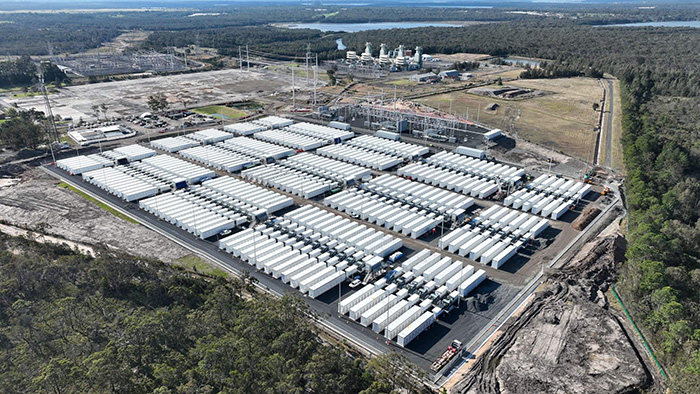
Look at that nice gas fired power station sitting quietly in the background of the “superior BIG BATTERY” an the article image. from Wikipedia- “Colongra Gas Generation Plant (also known as Colongra Power Station[1]) is a 667 MW gas-fired power station located in Colongra, New South Wales, Australia, and is the largest gas-fired power station in New South Wales. It will generally be used during peak demand periods in New South Wales.”
“The plant’s construction was tendered to Alstom which began the construction in October 2007, adjacent to the Munmorah coal-fired power station. The plant was completed and commissioned in December 2009 at a cost of A$500 million.”
Also the Waratah big battery is built on the site of the former Munmonah COAL FIRED power station that was shut down because they didn’t see the value in spending $400 mil to refurbish it. Also from Wikipedia:
“Munmorah Power Station is a demolished coal-fired power station with four 350 MW English Electric steam driven turbo-alternators for a combined capacity of 1,400 MW. The station was located near Doyalson, on the shores of Lake Munmorah, New South Wales, Australia and was owned and operated by Delta Electricity, a company owned by the New South Wales Government.
In July 2012 the coal-fired generators were permanently retired from service, with demolition occurring from 2016 to 2018. However, the nearby gas-fired Colongra power station, which was commissioned in 2009, remains in operation.
Delta Electricity announced on 3 July 2012 the closure of Munmorah power station after 45 years of operation due to decreasing energy demand. Parts of the boilers and turbines needed to be replaced which would have cost about $AUD 400 million.”
so 1400MW of 24/7 capacity hasd beemn replace by 1400MWh for max 8 hour batteries at a cost of 1 billion plus.
60
Can’t wait to read RenewEconomy’s spin on this one.
20
Thank you, Jo and thank you to those who submitted possible explanations for the failures.
50
Nuclear energy is as close to a miracle or magic that we’ve ever seen.
The USS Ronald Reagan and other US Super Carriers can last for 25 years without refueling and ditto our Submarines when/if we get them.
The massive Super Carriers are engineering marvels and very lethal if ever they had to go to war.
Here’s a recent 42 minute video of the USS Ronald Reagan and I wonder why we can’t buy a SM Reactor like the two that power the carrier.
Just think that this 300 + meter long ship is powered by small nuclear pellets and can stay on a war operation for decades.
https://www.youtube.com/watch?v=APs59M94EJA
60
I feel sorry for the Wilson company. It was probably almost impossible for them to load test the massive transformers before commissioning, and the grid system might have introduced unforeseen circumstances.
I hope there’ll be updates on what went wrong.
50
Not many companies have a 350MW test bench, although spending the extra money on a good software simulation might be worthwhile in this instance.
The supplier still has some control of how their contact gets written so they could insist on having their own engineering team onsite for the commissioning … with very gradual ramp up of power transfer … that’s what I would do.
00
What has been a success though was the transformation of NGS Super Fund and taxpayer monies into a dud battery boondoggle.
30
How is what politicians and Leftists have done to Australia’s electricity grid not treason?
140
Operating under orders from outside influence. Ask them ‘Whose orders are you implementing?’
50
net zero is treason
20
Don’t worry. They just haven’t magically-thought quite enough. A little bit more magical thinking and the problem with the magical fix for the phantasmagorical crisis will be resolved.
Meanwhile, real world, real poverty. Who cares? Dreams are real.
80
The power stations do not need firming, no battery storage, and I recently learnt that if the remaining largest interconnected grid (SA TAS VIC NSW ACT QLD) utilised the remaining coal fired power stations, most of the last fleet built remain in operation and some have thirty years scheduled to go, the available installed capacity not being utilised would add about the outputs of two now shut down coal fired power stations.
40
Meanwhile at Snowy 02 pumped hydro project one good turn deserves another, but achieving another is bogged down in soft ground.
40
For less effort and cash and energy cost we could have pumped water from the Ord river and drought proofed vast areas of Australia. The agricultural output would have been massive. Now we have a system to make windmill energy cost effective by spending more and more billions? Who is doing any ROI on this?
110
Long forgotten is the 2013/14 Abbott Plan based on CSIRO reporting on an area equivalent to Europe covering from Western Australia, through Northern Territory and into Northern Queensland and building dams on major rivers to extend the Ord River Irrigation Area across the top end of Australia.
PM Abbott and QLD Premier Newman did manage to abolish the “Wild Rivers” legislation that had blocked development of the rivers but after PM Turnbull replaced PM Abbott the plan was not continued.
Part of the scheme was to send water south harvesting wet season rainfall into storage dams, and for crop irrigation in the northern areas.
The massive nation building plan would have created new population areas and infrastructure, hydro electricity power stations, and so on.
100
Brilliant. But it is still a puzzle that Abbott gave up and started writing books and into retirement when he was at his peak and still incredibly popular. It is his right to do so of course, but a lifetime preparing for the job and then one hit? His mentor John Howard bounced back from oblivion to become the second longest PM after Menzies. Abbott could do it even today.
30
Apologies, I thought I had mentioned that the Waratah Unit is working partially, but I hadn’t. So I added this note to the post.
UPDATE: Technically it has started, just not reached full power. To clarify — the Waratah Super Battery is currently working at about half pace at 350MW and 700MWh, so it is still “useful” (but only for a grid crippled with unreliable generators and if you don’t mind wasting a billion dollars). But until we know exactly what went wrong, questions remain about how much we can rely on it. It’s lost a key redundancy, and it could be that there is a lot we don’t know about operating giant batteries that could come back to bite us so easily.
120
So , it’s actually running, you don’t know what went wrong and “it could be that there’s a lot we don’t know “ but until you do if’s best to put the boot in ?.
09
Its called having an enquiring mind around what is presented as a vital part of a States infrastructure. Most here arent that fragile that they think the article is anything like putting the boot in.
30
Unless the “0ut of Order” notice on the battery is shifted to a date earlier than May 2026, I don’t see what your point is. Partial energy supply to a grid is not going to cut it if base load power is entirely removed.
Your reasoning is as bad as your grammar.
10
Has anyone told Sussan and her cohorts in their meeting?
30
You could make a movie of this saga, “Fall of the Transformers”.
But seriously, having this fail during testing would indicate a likely transformer design or construction problem and trying to find out what went wrong in the mangled wreckage might not be easy and they’ll need to come up with a root cause and a fix before any attempt is made to build a new one and that might take years. I’m not a transformer expert, but I did read that the failure occurred during high load cycling tests, which is where they toggle from high current charge to high current discharge. I’m guessing that the issue was caused by over heating, causing a breakdown of the insulation, based on their comment of catastrophic failure. If it’s a design issue then we’ll be looking at a very long delay and a possible switch to more smaller transformers, rather than 3 very large ones.
30
Revenge of the windmills.
20
Rick,
I think it’s time to get a sense of perspective in this matter.
The numbers you arrived at in your submission were based on only a few weeks of data, admittedly in the middle of winter when solar input was at a minimum.
However, if you had chosen to analyse a couple of years of AEMO data, using a mix based on, say, the present mix of hydro, rooftop, solar farms and wind farms, you would find that not 1000 or so Waratah Big Batteries, but more like 20,000-plus would be the requirement. Yes, I really did add that extra zero.
Now, while we can argue about how many zeros, what you have done here is to make an absolutely unassailable case for nuclear generation.
Let me explain. Each of these Waratah BB’s takes up as much space, has the footprint or larger of a 1200 MW nuclear power station. And, the materials complement for each is similar. We wouldn’t need even 100 such reactors to replace our fleet of coal-fired power stations. And, unlike batteries, these reactors are a drop-in replacement for the coal-fired plant.
Oh, also, no one has yet demonstrated, to my knowledge, that they can get a fleet ov batteries to supply so-called “grid-firming” reliably and at scale, sufficient to replace the absolutely essential synchronous inertia that is supplied free of charge by conventional generators, of which nuclear generation is one.
Your vast quantity of lithium batteries is not going to last 20 years, indeed more like 10 years, after which they are junk. The few required nuclear stations would each have a lifetime of 80 years. And, unlike batteries, they are their own 24/7, 365 days per year power supply. They are, after all, unlike batteries, actual generators.
Clearly, the materials requirements for the equivalent nuclear generation is minuscule compared to all the “stuff” required, even if it only 1000, for battery technology.
Unlike batteries, solar and wind, the nuclear industry is required to manage its waste, of which there is far, far less than any produced by these other technologies. And, need I remind you that we are already looking at millions of tonnes of highly toxic waste from the present installed capacity of batteries, solar and wind.
Then of course there are the billions of tonnes of mine waste already generated in the production of these “renewable” technologies.
Those people who are serious about reducing CO2 emissions may not ignore nuclear power.
Food for thought.
Regards,
Paul Miskelly
50
Paul, A great comment. But you have left out one major consideration that everyone else here commenting has also. That is severe weather and the widespread destruction of solar and wind and power lines. Because we have not seen really severe thunderstorms in this country for 40 years everyone seems to over look this danger and ignore it. All weather is cyclical and these storms will return. Unless you have experienced big thunderstorms first hand you have no idea of their power. Let me define what a really severe thunderstorms is, something the BOM know nothing about – it is a line of storms with tops above 40,000′ with large embedded cells, contouring and around 10 klms across or bigger. The last such storm was that which hit Brisbane on the 18th of January 1985 and did enormous damage blowing all the windows out of the old Brisbane airport control tower with recorded guests up to 187 k.p.h – it had radar returns at 76,000′
As someone who flew aircraft for 54 years from 1965 up until 2019 and as a former domestic airline captain I have seen many of these storm systems especially in the 1970s where lines of storms 400 miles long with tops around 70,000′ were prevalent in summer.Back in 1988 I operated an evening flight from Brisbane to Cairns and every aerodrome up the Qld coast ended up closed with severe thunderstorms even out to Mt.Isa. Once these weather conditions return again we can expect to see enormous damage to wind and solar installations and that will really demonstrate the stupidity of trying to generate intermittent power from these sources.
80
“It is beyond repair”. Translation: it melted. There is a pile of a few hundred tons of newly solidified Copper standing somewhere north of Sydney. The time to clear that will be substantial and adds to the delay.
40
😃😃😃
10
TRUTH 101 💪⚡⚡⚡⚡
If you want to build a sustainable Australia, you need to build nuclear power.
If you want nuclear submarines you need to build nuclear power.
Every single nation with nuclear submarines has a domestic nuclear power industry.
No nuclear cities = no nuclear submarines. 😱⚡⚡⚡⚡⚡
40
Wait until the CCP activates its kill switches it installed in batteries it supplies.
30
Manapouri had a number of large Wilson transformers fail prematurely so the problem may be a manufacturing issue.
00
Just looking at all those battery units so close together reminds me that in one US state the issue of a minimum spacing to prevent a conflagration sweeping through came up and they found there was no standard distance. If one of those units goes up I think it would be surprising if others did not join in.
10
It would be interesting to see what a super flare from the Sun akin to a Carrington event would do to these batteries.
00