By Jo Nova
It’s hard to keep up with the bad news
Is Australia finally waking up to the ugly truth about unreliable electricity?
Last week, the Australian Bureau of Statistics dropped the bomb that electricity costs were up 37%, foiling hopes of an interest rate cut. They tempered it by saying it was due to the government stopping the rebates, as if that made it understandable instead of being a national disaster. The government promptly promised to make electricity cheaper by giving up plans to change the the polar vortex with our power plants. No, wait, — of course, they promised to think about paying rebates again…
The coal is dead, long live the coal
And so we reach the point of where headlines fill our main newspapers this week with warnings that blackouts are coming if one particular coal plant closes and prices are destroying businesses just like we said they would years ago. The old coal plant that was supposed to close in August now looks unlikely to close in 2027, because of blackout fears. Eraring supplies about 20% of the energy to our largest state grid. Suddenly newspapers are explaining what system inertia means and talking about frequency stability.
It’s like were training up a nation of electrical engineers. They’re also explaining SynCons, the big spinning machines called synchronous condensers which cost $150 million dollars each, and don’t generate any energy at all. They just provide the stability we get for free with every coal turbine, except for only for a tenth of a second or even less.
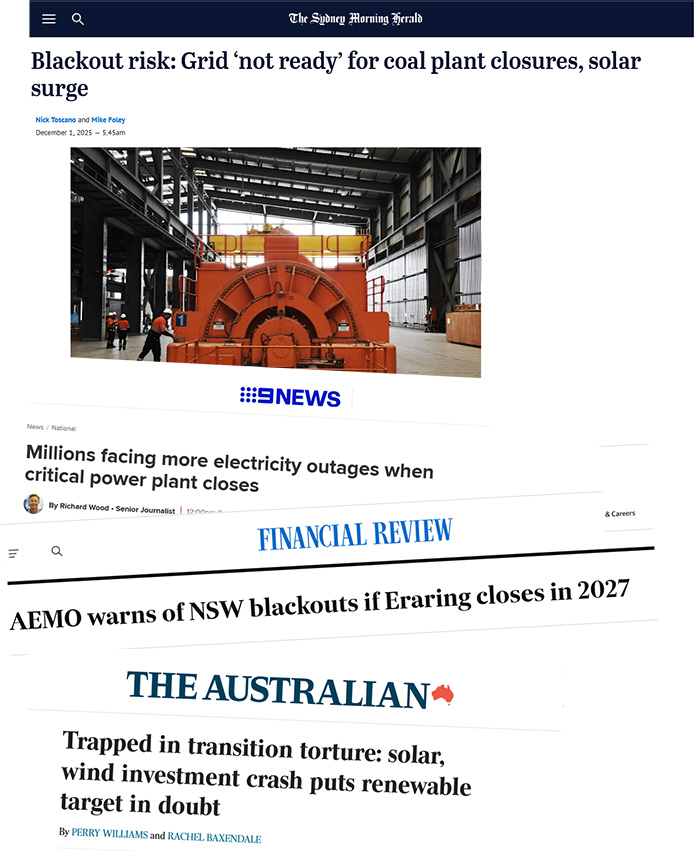
Meanwhile, investments in large scale solar and wind power crashed by 80% in the last year
Not one single wind project reached a final approval in Australia this year. We’ve slid all the way back to 2016 levels of spending:
Trapped in transition torture: solar, wind investment crash puts renewable target in doubt
By Perry Williams, and Rachel Baxendale,– The Australian
Australia faces its worst year of investment in large-scale solar and wind in a decade, heightening concern the nation will fail to meet its 2030 renewable energy target.
Large-scale investment in solar and wind generation totalled 1.05 gigawatts at the end of October compared with 4.5GW for the 2024 calendar year, Clean Energy Regulator data shows.
Origin Energy chief executive Frank Calabria last week said Australia’s shift away from coal was increasingly being held back by a stubborn gap in onshore wind development. No onshore wind project in Australia has reached a final investment decision this year – a striking absence that has cast doubt over Anthony Albanese’s climate ambitions.
As the illusion wears off, and the subsidy farming gets tough, investor interest disappears. Soberingly, most of this collapse occurred before the Australian Opposition finally came out with a No Net Zero policy. Imagine how bad things will be next year, if the Liberals start to actually fight the Net Zero fight?
Then we found out our grid Managers weren’t even planning for the worst wind droughts
The Australian caught the AEMO preparing for a worst case scenario where our wind turbines fell to only 14% capacity for a few days in a row. Embarrassingly for them, the same month they released the 2024 Integrated System Plan, our wind turbines fell to half that. In response to that news last week, they have quietly tweaked their assessment and preparations for wind droughts or dunkelflutes. In May 2024 for seven days in a row, the entire fleet of Australian NEM wind turbines was running almost entirely below 14%, apart from two brief periods.
Our grid managers are so inept that even mainstream journalists are correcting their errors in system planning. It’s that bad.
I mean, “yay for the free press”, but really, our Blob-o-crat web must be so one-sided that all the other government funded agencies, the ABC, AER, AEMC, CER, CEFC, ARENA, ECA, ESB, CCA, CSIRO and all our universities, didn’t notice that the AEMO modelling was wrong?
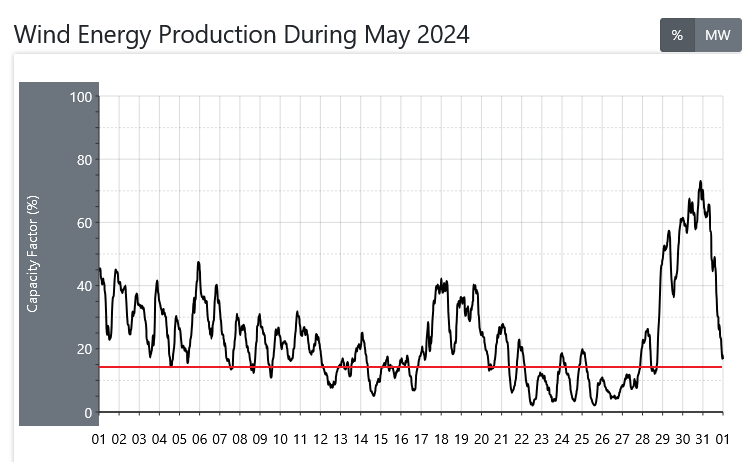
The red line marks 14% below which wind turbines were not supposed to stay for long. Graph by Anero.id
All these agencies are just cheer-squads for Blob Renewables. Not one of them is paid to serve the public. Shut them all down…