…
|
|
||||
|
UPDATED: See below The Western World has mostly succeeded in reducing emissions by shifting their emissions to factories in developing nations. In industries like Steel, Cement and Plastic as much as 20 – 50% of all production has gone overseas. All this was achieved in just 20 years or so… 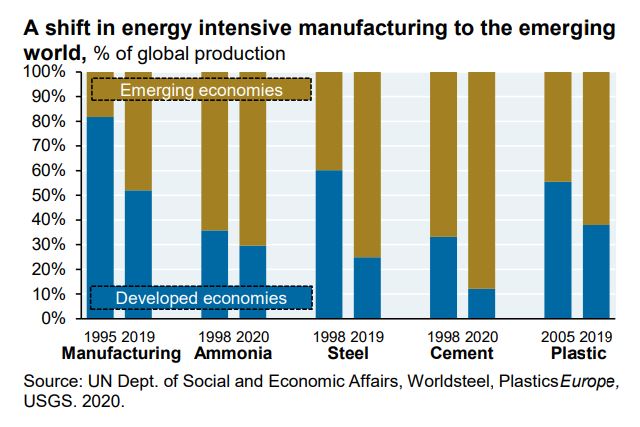 … In the game of emissions reductions the West will become irrelevant (and in so many other ways too): …The even more important and larger question: even if the US succeeds, what about everyone else? Over the last 25 years, the developed world shifted much of its carbon-intensive manufacturing of steel, cement, ammonia and plastics to the developing world. As a result, developing world adoption of wind, solar, storage and nuclear power may end up being the primary determinant of future global emissions outcomes. That has certainly been the case over the last decade: Europe and Japan reduced primary energy use by 4%-6% but developing world increases were 6x higher than their reductions –Michael Cembalist, JP Morgan Annual Energy Paper
UPDATE: David Wojick makes the good point that some of shift is due to an increase in China for China’s own use, as opposed to a loss in the West. But the shift is still real (perhaps less so in the US compared to countries which “decarbonised” without the benefit of massive shale gas production). Consider steel production from the Yearbooks of WorldSteel from 1998 to 2019 . Despite populations growing over that 20 year period, Australia produces 40% less steel, the UK production fell 60%, Canada fell 17%, France fell 36%, USA produces 12% less steel, and Germany 14% less. The nations that adopted some of the highest UN carbon fashion stakes also suffered the greatest losses. China’s steel production grew 1000%. The Australian population has grown 30% since 1998. US population has grown 20% (and unknown others?). China’s has grown about 17%. Patterns of energy use tell the story: here’s the shift in the last ten years. Focus on the tan colored columns in the graph below. The US has not changed, but the EU and Japan have shrunk. The blue columns are only a projection. 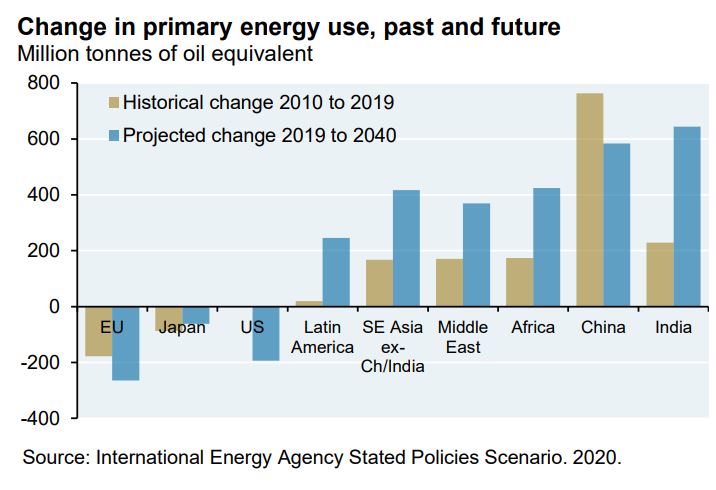 … After the Legacy Media, comes the Legacy Superpower. REFERENCES-Michael Cembalest, JPMorgan, 2021 Energy Review h/t Thanks to Rafe Champion at Catalaxy and Old Ozzie. I knew they were bad, but this was blistering: Big Tech’s Monopoly Creepby Napolean Linarthatos, The AmericanConservative … generations that come after us will have the opportunity to wonder how on earth we had been duped for so long and so pathetically by a few Big Tech monopolists, how it was possible to have such a grand accumulation of power and wealth preserved by a system so bluntly corrupt in its modus operandi. In October 2020, the House Antitrust Subcommittee issued a damning report of steamrolling corruption. It was so brazen, Amazon even sold counterfeit copies of products until the targets gave in — even big names, like Nike. The supergiant went into business against smaller companies, dumping product on the market in impossibly good offers, until it beat them, and stole their customers, and then bought them anyway. (After that customers discovered the deals were not so sweet.) Employees of Amazon even admitted they used private customer data to find market opportunities for Amazon to exploit. The situation is so rapacious now that little companies are not even bought out anymore, they are just cloned and crushed. And it’s not just Amazon. Smaller partners of Apple might find themselves suddenly competing with a new inhouse Apple product, only to also find that Apple updated the OS in ways that made the original product look faulty. In the year 2017, Facebook and Google captured “an astounding 99% of revenue growth from digital advertising in the US.” Thus, though astonishing, it is no surprise that, “due to Google and Facebook’s dominance, ‘the average growth rate for every other company in the sector was close to 0’.” It’s got to the point where startups against any flavour of the Big Tech oligarchs are so likely to fail that investors are balking, and this segment of the market is known as “the kill zone”, where few who enter survive. Killing with Counterfeits (how is this not illegal?) The Amazon abuse in question was about counterfeit PopSockets products sold on Amazon. The founder of PopSockets, David Barnett, “testified that ‘Amazon was aware that large quantities’ of counterfeit PopSockets products were selling on its platform, but that Amazon allowed the problem to continue until PopSockets agreed to spend nearly two million dollars on Amazon marketing services.” In a free market economy, Amazon would have readily apologized to PopSockets and got on with cracking down on the illegal products. But when 63 percent of the online searches for products start on Amazon, then PopSockets has to give in to what even Tony Soprano would call extortion. Basically, Bezos’s Amazon wanted a piece of the business if PopSockets wanted the problem to go away. Would you like predatory-price-wars with that?Lina Khan, recently appointed to the Federal Trade Commission, has documented the case of Quidsi, once “one of the world’s fastest growing e-commerce companies.” Quidsi was very successful selling many different products through its subsidiaries, like Diapers.com. Amazon wanted to buy Quidsi back in 2009 but the founders of the company declined. It was then that Amazon used its size, reach, and financial heft to start a price war against Quidsi.
It was not long before Quidsi was sold to Amazon for $545 million. David Evans says: Obviously these are the companies we want in charge of public speech. They are the ones we’ve been waiting for. Ponder the timing: The Predatory behaviour of the Big Tech menace was laid out a month before the US election last year but at the time, as scandalous as it was, few realized the triumph of the report would be neutralized weeks later, as the Big Tech played out its election gambit, thwarting the political oppononents that threatened to break the monopoly. How prescient the headline here from October 2, 2020: Alexis Keenan
Zephyr Teachout, associate professor of law at Fordham University School of Law, told the subcommittee on Thursday that Congress, not the Supreme Court, should regulate Big Tech. “It is quintessentially a congressional job to respond to this threat,” Teachout said, calling for “significant” new legislation.
Read it all: https://www.theamericanconservative.com/articles/big-techs-monopoly-creep/
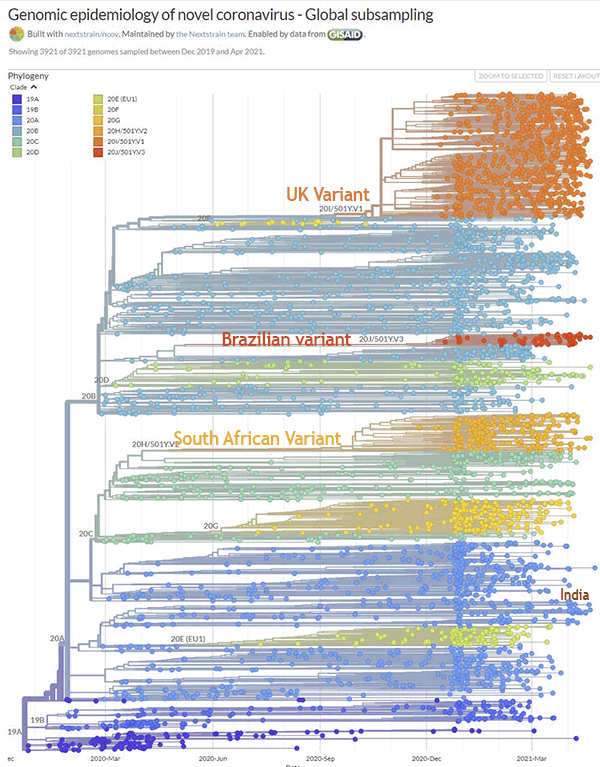
May 9th, 2021 | Tags: Tech-Giants | Category: Big-Government, Corruption, Free markets, Social Media, USA |  Print This Post | | Print This Post | | … For five decades, experts have been predicting renewable energy would supply 20 – 50% of the US Electricity Grid. Instead it’s taken twice as long to get to one fifth of the original prediction. (And to get to that pitiful 10%, that includes Hydropower). Renewable Energy is the wordsmiths Great Hopium. The seductive temptation of “free energy” rolls on, never mind about the vast infrastructure and land it takes to capture a low density energy source. The price for “free fuel” is expensive maintenance, costly transmission, extra stability charges, and eye-bleeding storage costs (or an entire national spare grid for “back up?”). 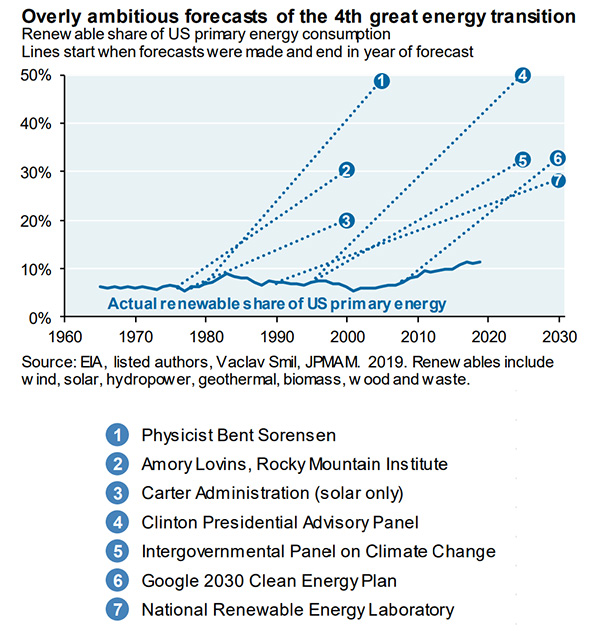 For fifty years people have been overestimating the renewables transition. The graphs comes from the JPMorgan, Energy Review. Even back in 1970, the need for 24 hour supply and frequency stability were well known. A search online did not find a copy anywhere of Bent Sorensen’s original 1970-ish prediction, but it did find about 500 articles and nine of his books, showing that if at first you don’t succeed, you can make a career out of it. Joe Biden is also marching down Failure Boulevard: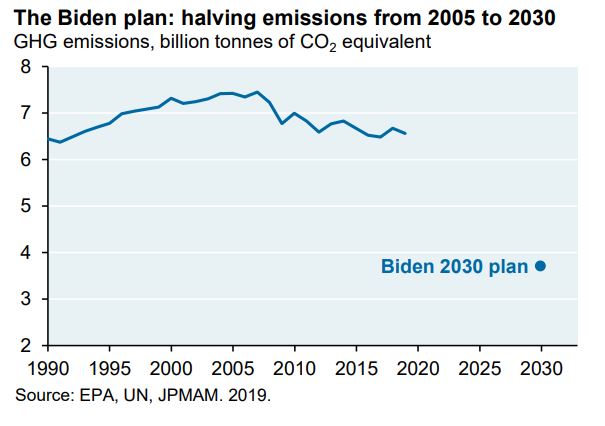 What are the odds? Globally we used to get 95% of all our energy from fossil fuels. After half a century and a trillion dollars, now that’s plummeted all the way down to … 85%. Yeah. : How is the global energy transition going? Taken together, the aggregate impact of nuclear, hydroelectric and Can any readers can find the original quotes listed in the graph above? I wonder which part of the “forward projections” failed the worst. They knew the wind and sun wouldn’t work all day, so were they depending on the birth of a Super-battery that never came? REFERENCES-Michael Cembalest, JPMorgan, 2021 Energy Review h/t Thanks to Rafe Champion at Catalaxy and Old Ozzie. May 8th, 2021 | Tags: Predictions (that went wrong), Renewable Energy | Category: Energy, Renewable, USA | Print This Post | | Evil weather-destroying equipment will be banished: 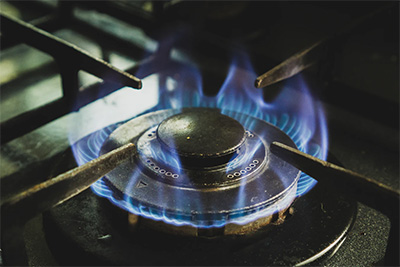 Photo Kwon Junho Victorians building new homes will be denied the choice to pick their preferred heating and cooking appliances in the hope that this will stop storms and droughts for their great grandchildren. As household prices rise, the money that could have been used for holidays, health, or education will be used to enrich a few corporations and make a small percentage of the population feel important and calmer. If only the low carbon revolution was clean, green and cheap, no one would have to ban anything. Suffer the children: Push to turn off gas to help reach state’s climate goalTom Cowie and Nick O’Malley, The Age Gas appliances including heaters, hot water services and cooktops would be phased out under a proposed moratorium on new gas connections to Victorian households to help the state achieve its 2030 target to cut carbon emissions by up to 50 per cent. Victorians are the nation’s biggest users of natural gas for heating, hot water and cooking due to the state’s historically cheap and plentiful supply piped in from Bass Strait since the 1970s. But the state may need to cut back on gas if it is to meet its climate goal, announced on Sunday, to reduce greenhouse pollution by 28 to 33 per cent of 2005 levels by 2025, and 45 to 50 per cent by 2030. “I love cooking on gas too, but there are certain luxuries that we are going to have to abandon if we are serious about climate change,” City of Yarra mayor Gabrielle de Vietri said. Even though unreliable energy will “theoretically” fill that void (and raise those prices), what are the odds Victoria will just have to build new gas plants to make electricity? Instead of piping gas to homes and burning it there, gas will be burned at distant plants and converted to electricity, which will be transported miles. First they came for Coal, and the Gas industry didn’t protest… Keep reading → May 6th, 2021 | Tags: Fossil Fuel, Victoria | Category: Australia, Big-Government, Fossil Fuels, Free markets, Global Warming | Print This Post | | … Mutations of SARS2 are roaming. Currently there are 19 million active (known) cases of Covid. Due to copying errors, mistakes are accumulating in the genes of the virus. It’s a relentless process of trial and selection. A trillion monkeys on keyboards blindly working its way around vaccines, and immune systems. To beat this, we need to understand it. Below is a map of known variants created from the samples which have had full sequences done. This is the remarkable “Nextstrain“ — an opensource tool. I have labelled a few clusters by their “country names”, (though we’re not supposed to do that. Let’s all say “WuFlu”.) The family tree of SARS-Cov-2 starts at the bottom left corner with two samples from Wuhan around Christmas 2019. This is called the 19A clade, which appears to have almost died out now, though there are still remnants left of this original virus in corners like Iran and PNG. Otherwise, the Wuhan 19A virus has been superseded by its children. The branches and time marches to the right. The code for one full virus is 29,000 bases long and as best as I can tell, all the dots on the branches have been sequenced in full. At the Nextstrain page you can mouseover and click on every point to find out which lab and town the sample came from, and which mutations it has. Be aware the “tree” above is heavily shaped by the nations doing the most testing and sequencing. Australian labs pop up often, sampling the cases flying into airport quarantine. But India has done very little sequencing and Mexico even less. Some African nations have virtually none. So there will be thousands of invisible branches and strains that we can’t see above, because no one has tested them. The only reasons the Indian and Brazillian variants are not branching as much as the UK variant is because those variants haven’t yet dominated countries which do a lot of sequencing. That not-so-fortunately is about to change as smart wealthy countries have, daftly, let these variants in. The UK variant has spread farThese graphs below on the Nextstrain Covariants by country page show the predominance of each variant. The UK variant is marked as an orangish brown. It was first noticed in October last year, but within a few months was responsible for nearly every infection in the UK. Similarly, throughout the European lands the takeover is almost complete. The US is a different cauldron. There, the pink zone is successfully competing with it in the USA graph is the Californian “484K” variant. But starting to spread are both the #P1 Brazillian variant and the Indian ones. But the strains that will dominate in just a few months time may be invisible now. It’s an arms race The graphs below show that the newer faster-spreading variants usually wipe out the older slower ones. Partly this is because a new strain brings a new wave, and as infections rise (not shown in these graphs) the proportion of older strains is squeezed out. But in the end the faster-spreading arrivals breach the previous norms for quarantine, restrictions, and hospital care. After new cases rise rapidly and set off alarms, governments and citizens inevitably raise their own level of response. The new stricter restrictions, by default, then wipe out the old slower variants. Obviously, some combination of restrictions, masks, isolation and lockdowns work — starving the old variants out of existence by depriving them of new bodies, but at great expense. The cheapest restrictions, of course, start at the border. (Just stop the flights!) A hard border means almost no need to lockdown. It also means no new mutants arise within that country. 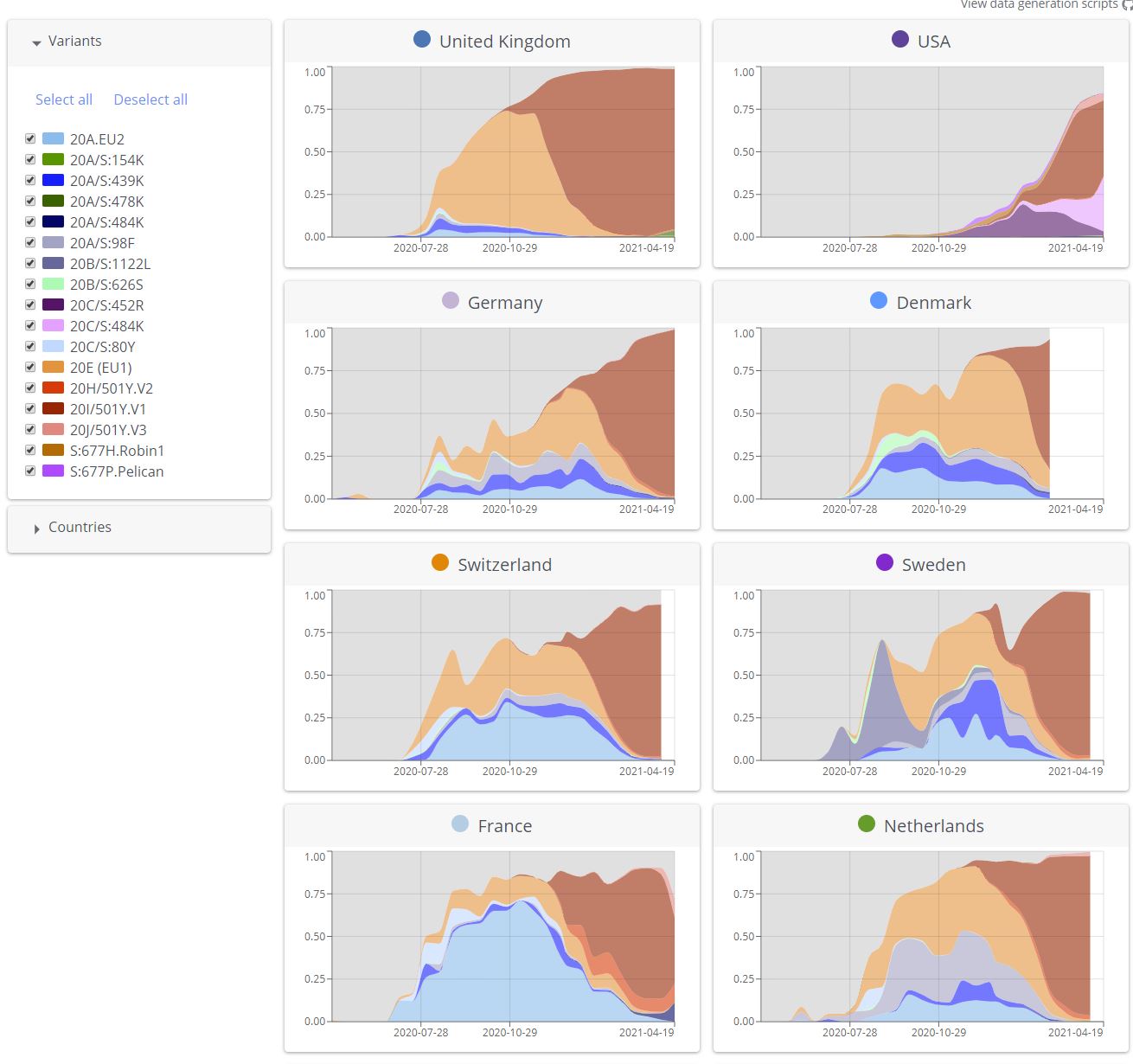 The UK variant has taken over nearly everywhere in Europe. The grey background were the unknown variants.
It’s barely visible above — but seeping into the latest UK data (top left graph above) is a tiny barely visible, green wedge. This is the ominous strain from India. In India, the new double mutants are growing rapidly, but despite the catastrophe unfolding, they’re still only half of all the samples. Most of the variants in India are “grey”. Not known. 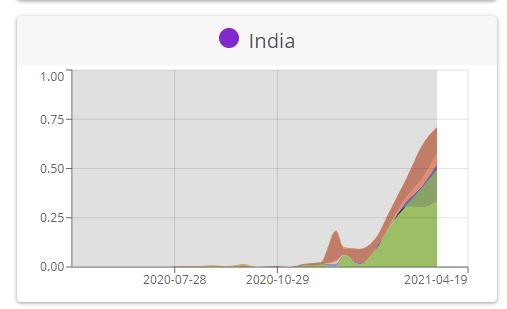 Indian new variants of covid (green). The Indian variant has arrived in South Korea. See how fast it is growing. 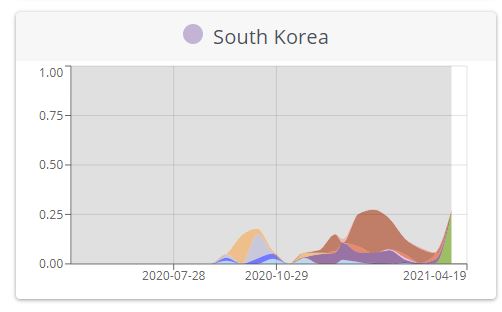 … To appreciate how much data is held in this system, here’s the information for one “dot” in the orange section growing from the “UK Variant” branch. A 41 year old man was diagnosed in Raipur India, 3 to 7 days ago. His sample was sequenced with a full list of mutations. (To see this, mouseover a dot, then click inside the black small data box to see the larger more detailed one. Or not. It’s a nerdy thing. But you will be able to appreciate just how far and fast these versions are travelling.) You can, if the urge takes you, trace the branches and see how often the strains are leaping borders. Even if you are a data nerd, and not a Covid one, the Nextstrain system is impressive. The data can also be sliced by country, by region, by strain and by mutation. Scroll down — agog. Click particular strains in the legend to clear the clutter out.  … Things we know The virus exists. PCR is useful. The virus has been sequenced in full many times. Symptoms and transmissibility are linked to different variants. Never before has the world had live data like this. Yet we still need more. There is almost no data from so many countries that matter. The variants are coming — as long as people are getting infected somewhere, this virus is adapting. New variants may well throw a spanner in the works of vaccine programs, and natural immunity. Herd immunity to a virus that no longer exists may not be useful, and in some cases can be a disadvantage. Eliminating the virus stops the mutations arising. Vaccination will slow the development of new mutations locally, but once they arise it will select for viruses that escape the vaccination. PCR looks, smells and acts like a useful test. The PCR test is used to sequence viruses (and to do legal, forensic, medical and paleo-fossil studies). Like any tool, it can be overdone, abused, or faked. But the tree at the top of the page was made with a continuous branching structure and with data from hundreds of independent labs on five continents. That suggests, Occams razor style, that despite the masses of money and vested interests doing their best to skew results, that the bulk of these PCR tests and mapping would be hard to fake. Restrictions are eliminating strains: That less infectious strains are universally wiped out shows that restrictions (as expensive, ugly, and unpopular as they are) do work. If the higher restrictions were used, without the presence of the newer strains, obviously that would eliminate all versions of Covid. (See Australia, NZ etc). As the virus gets more infective and transmissible, restrictions would need to be harder and faster. Eventually a nicer strain of Covid will probably arise, one which doesn’t overwhelm hospitals. It may however become a nastier strain on the path to being kinder. Spanish flu did that and took three years. We need antivirals: The arms race means there will be an ongoing competition between our immune systems, vaccines, anti-virals and new strains. “Herd immunity” is likely only a temporary illusion. Antivirals that act on our enzymes or entry portals are more likely to work against multiple strains because our biochemical machinery isn’t changing like the virus is, and it’s much harder for the virus to find a new port of entry into our cells, or a new path to hijack. If we used antivirals as well as vaccines, we’d prevent more mutations and eliminate clusters faster. This is why it is still a rank scandal of the highest order that our public medical research dollars have not focused first on antivirals and our public health responses failed to do the most useful, cheapest restriction of all — just closing borders. Anthony Fauci should have been fired a year ago. The UN WHO is responsible for every case outside China which could have been stopped. It was obvious to anyone with microbiological training on Twitter by February 2020 that the borders should have been sealed. The WHO should be defunded immediately. It serves the CCP but fails the world. The Indian strain looks bad, it’s hard to tell how bad, the data is awful (as in, poor testing, inadequate sequencing, high positivity. What’s the actual mortality rate? Who-the-heck knows. ). The governments dilemma is the competing duty of care to people at home versus abroad. One case getting into the community could cost millions to resolve. But we owe it to citizens to find a way to get them home. I’d like to see us offer them tents near military air bases (or something!) and give them at least one path to return? It’s not five star, but it might still be better than a small apartment in Delhi. Those with better options will just wait. The desperate will be grateful to get home anyway they can. See: Nextstrain and Nextstrain Covariants by country .. The CCP say that China has to stay with coal, but The West ought pay attention more to the rapid growth of nuclear power. Last September I noted that China was poised to be the largest global nuclear power by 2030, overtaking the USA in the next nine years. In the last twenty years, China has increased its fleet of nuclear power reactors from three to 49, with 17 more plants under construction. That means it will soon surpass France which has 57 reactors. At the rate the USA is closing plants, China may hit the No 1 spot faster than expected. China has also opened an experimental fusion reactor called the Artificial Sun, while the ITER international consortium keeps delaying the opening of the French fusion experimental reactor. 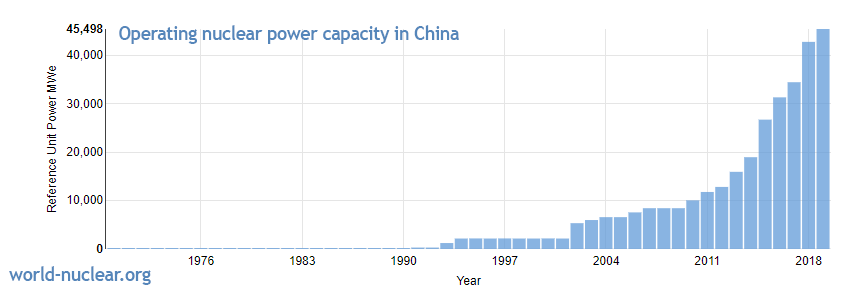 Rise of Nuclear Power in China. It is sobering to know that despite the rapid growth of nuclear, it is still only 5% of the total energy supply in China.* Electricity generation in 2019 increased by 5% compared with the previous year, to 7.3 PWh, according to figures published by the China Electricity Council. That from fossil fuels was 5045 TWh (69%), from hydro 1302 TWh (18%), nuclear 349 TWh (5%), wind 406 TWh (6%) and solar 224 TWh (3%). In 2012, China became the worlds largest power generator (from all forms of generation). Since then it’s nearly doubled. The International Energy Agency (IEA) notes that since 2012, China has been the country with the largest installed power capacity, and it has increased this by 85% since then to reach 2011 GWe in 2019, about a quarter of global capacity. The balance of power is shifting fast: China has half the capacity of the USA in nuclear power, but it doubled capacity in the last five years while the USA closed 39 reactors: China Will Lead The World In Nuclear Energy, Along With All Other Energy Sources, Sooner Than You ThinkJames Conca. Forbes, April 23, 2021 China now leads the world in total energy production and also produces almost twice the amount of electricity that the United States does, 4.4 trillion kWh versus 7.5 trillion kWh per year, respectively. As of this month, China has 49 nuclear reactors in operation with a capacity of 47.5 GW, third only to the United States and France. And 17 under construction with a capacity of 18.5 GW. This is just about half of the nuclear capacity of the United States which has 94 nuclear reactors in operation with a capacity of 96.5 GW and 2 under construction with a capacity of 2.2 GW. But 39 reactors have been shutdown, many for no particularly good reason.  The Chinese Lion advances. | Image by AngMoKio China is now largely self sufficient in building and operating nuclear plants. China has most nuclear power plants in progress: industry reportby Gong Zhe, CGTN China completed research and development on third-generation nuclear power technology called CAP1400 (Guohe One) in September 2020, according to an announcement by State Power Investment Corporation (SPIC). CAP1400 has broken overseas technology monopolies in many areas and owns independent intellectual property and export rights, said Lu Hongzao, assistant general manager of SPIC. It will be a powerful provider of electricity. “For example, it can provide 1.5 million kilowatt-hours of electricity to the grid. So basically it can provide nearly 13 billion kilowatts per hour annually.” With a design life of 60 years, the CAP1400 nuclear reactor improves safety performance against natural disasters including earthquakes and floods by 100 times, compared with the second-generation version. In December 2020, China turned on the Artificial Sun in Sichuan provinceThe group plan to collaborate with the International Thermonuclear Experimental Reactor (ITER) project — which is the worlds largest research project in fusion reactors, sited in France. The total cost of ITER was around $22b, half paid for by the EU and the rest by a consortium of Japan, China, South Korea, the USA and Russia. It was started in 2007 but after many delays and cost overruns, the French fusion reactor is not expected to start operating until 2027, 11 years late. Ain’t that the way? 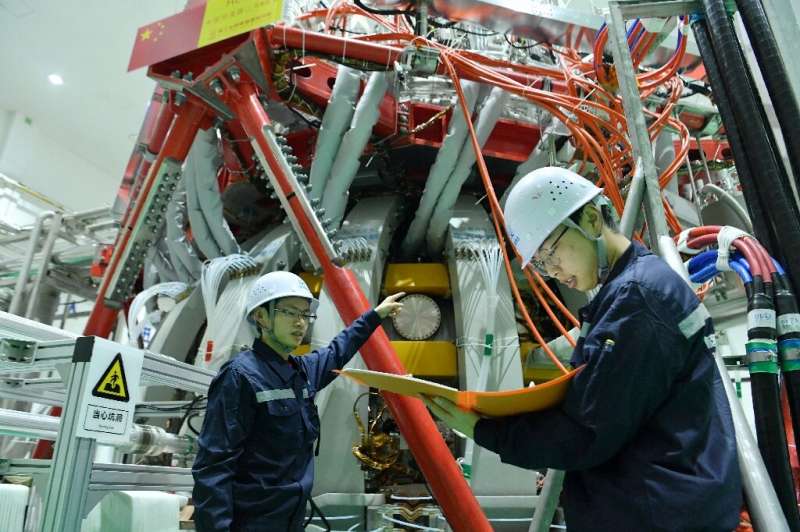 The HL-2M Tokamak reactor China turns on nuclear-powered ‘artificial sun’China successfully powered up its “artificial sun” nuclear fusion reactor for the first time, state media reported Friday, marking a great advance in the country’s nuclear power research capabilities. The HL-2M Tokamak reactor is China’s largest and most advanced nuclear fusion experimental research device, and scientists hope that the device can potentially unlock a powerful clean energy source. It uses a powerful magnetic field to fuse hot plasma and can reach temperatures of over 150 million degrees Celsius, according to the People’s Daily—approximately ten times hotter than the core of the sun. The future is surely fusion — one day, though there are many obstacles to overcome. Australia could use that 300 year supply of coal now, while it’s still worth digging up. China has a nuclear Belt and Road project too, Argentina, Iran, Pakistan:Future projects are also being developed in Eastern Europe, the Middle East, and South America Why China is eager to promote Nuclear Energy Keep reading → May 4th, 2021 | Tags: China, Nuclear Energy | Category: China, Energy, Nuclear Power | Print This Post | | Late today. (oops)
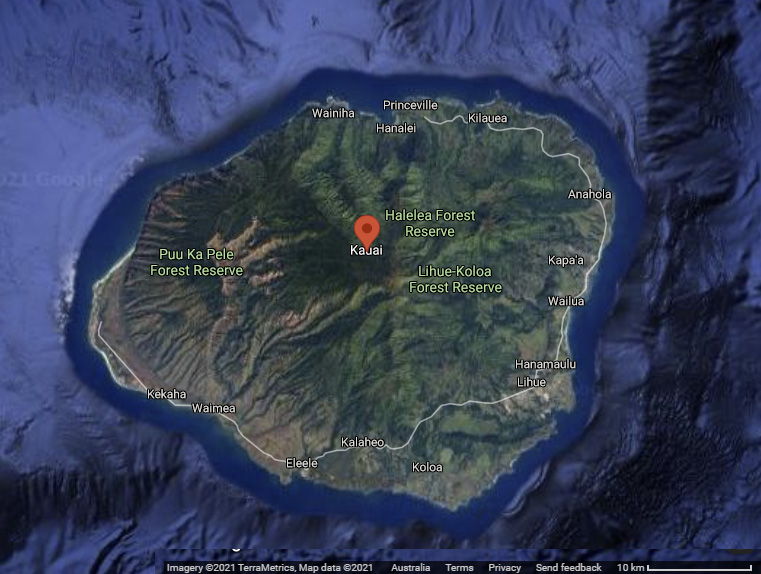
Mark Zuckerberg, the Facebook chief who deletes people to save The Earth, is also apparently working on owning a Hawaiian island by suing the hapless natives who were in the way. His holiday house on Kauai Island is apparently worth $80 million, is 57,000 square feet, and has 8 bedrooms and nine baths. Mark Zuckerberg, Priscilla Chan pick up 600 more acres in HawaiiConor Skelding, New York Post The Big Tech billionaire and wife Priscilla Chan snatched up 600 additional acres on the island of Kauai — and an existing online petition demanding that Zuckerberg stop “colonizing” the Aloha State is now well over 1 million signatures as of Saturday. The pair purchased the land for $53 million from the local nonprofit Waioli Corp., according to Pacific Business News. The couple now owns more than 1,300 acres on Kauai, known as the “Garden Island” for its extensive tropical rainforests. The online petition, with 1,014,219 signatures, says, “Mark Zuckerberg is the sixth richest man in the world … and he is suing Native Hawaiians in Kauai for their land so he can build a mansion. He’s building a mansion to do what? Live in Kauai for two months out of the year? This is inhuman.” Any normal billionaire, doing things like that, might find a HLM protest on his doorstep — burning down the guardhouse and butlers quarters and shouting “privileged”. Instead, the nastier Zuckerberg is to skeptics of climate change, the more the progressive left need him, no matter what Woke crimes he is guilty of. It doesn’t matter how many private jet trips he takes, if he’s useful to the other parasitic power climbers, who cares? In 2015, he was generously joining “The Breakthrough Energy Coalition”, and was committed to using his wealth to “invest in clean energy companies”. So the worlds sixth richest man who holds a vested interest in renewable energy is also man in charge of what people are allowed to say in the public square. What could possibly go wrong? Facebook is investing in giant solar farms in Texas. I’m sure he won’t mind if critics on Facebook want to bag out solar power and campaign to get rid of subsidies for it. We’d never let a Government Minister have that much power. h/t Marc Morano, Climate Depot. China seems to operate in its own bubble of rules  Image by Chris Feser Imagine the apoplexy if our ecology minister said we’d fund coal power in the third world? Why is it only China that gets to build coal at home and abroad? What kind of developing nation can’t afford to run on “solar and wind” but is rich enough to be helping build coal plants in other nations too? China has ‘no other choice’ but to rely on coal power for now, official says Evelyn Cheng. CNBC “China’s energy structure is dominated by coal power. This is an objective reality,” said Su Wei, deputy secretary-general of the National Development and Reform Commission. CNBC translated his Mandarin-language comments, which he made late last week following Xi’s separate remarks at a U.S.-led global leaders climate summit. “Because renewable energy (sources such as) wind and solar power are intermittent and unstable, we must rely on a stable power source,” Su said. “We have no other choice. For a period of time, we may need to use coal power as a point of flexible adjustment.” He added that coal is readily available, while renewable energy needs to develop further in China. In 2018 China cut solar subsidies because it was making electricity too expensive. China also intends to keep financing coal power in other countries. China’s ecology ministry indicated that China’s funding of coal power in the developing world will continue. “China has supported some developing countries in the construction of coal-fired plants overseas,” Li Gao, director general of the ministry’s department of climate change, told reporters in Mandarin that CNBC translated. It suits China if no one else is competing with its Belt and Road ProjectHow many favours will China earn by being the only major power providing useful energy? China Is the Odd Man Out on Overseas Coal FinancingLaura Edwards, National Interest.org, April 26th Despite its growing role in sustainable development finance—President Xi Jinping reiterated at the [recent Biden] summit that ecological cooperation is a key aspect of China’s Belt and Road Initiative—China made no promises to end coal financing abroad, even as Japan and South Korea, the second and third largest financiers of overseas coal power plants, take ambitious steps to stop funding overseas coal plants as part of their new climate change agendas. China, the world’s largest financier of overseas coal, is now the odd man out. Reducing global emissions cannot be achieved without moving away from coal. A pledge from China to end its financing for overseas coal plants would be a major boon to international climate efforts. Who wants to be a superpower? h/t GWPF
May 3rd, 2021 | Tags: China, Coal | Category: China, Energy, Fossil Fuels, Global Warming | Print This Post | | …. How to wreck a democracy: Let judges decide complex national policies based on who sues first. What could possibly go wrong? German climate change law violates rights, court rulesBBC Germany’s climate change laws are insufficient and violate fundamental freedoms by putting the burden of curbing CO2 emissions on the young, its highest court has ruled. It says the law fails to give enough detail on cutting CO2 emissions after current targets end in 2030. “The provisions irreversibly offload major emission reduction burdens on to periods after 2030,” it found. Like the EU legislation, Germany’s domestic climate change law provides for a 55% reduction in greenhouse gases by 2030. But the German Constitutional Court said on Thursday that current measures “violate the freedoms of the complainants, some of whom are still very young” because they delay too much of the action needed to reach the Paris targets until after 2030. Since when did young people have right to be protected from climate change? It’s time for other young people to sue the court, and the government. Germany’s climate change laws are wildly expensive and pointless, and will have no measurable benefit. Expensive electricity will create an unfair debt-burden on the young. It will slow or break the economy, destroy jobs and harm the environment. That’s a violation of their human rights. Young people could sue governments for not doing due diligence on a UN committee report and for selling out their civilization. Let it rip, commenters.  Emden, Germany by Gritte See also The Guardian: for more info. May 1st, 2021 | Tags: Germany, Lawfare, Legal Action | Category: Global Warming, Lawfare | Print This Post | | What grows on a wind “farm” ? Debt-cowsOn Wednesday nearly all the wind generators in the country failed. About 4,000 turbines across five states of Australia were hit by some kind of simultaneous fuel crisis. At one point all the wind power in our national grid was only making 3% of Australia’s electricity, and that was the best part of the day. At its worst, all those turbines produced about 1.2% of the power we needed. It was that bad. Across the nation, something like $15 to $20 billion dollars of infrastructure ground to a halt. Welcome to the clean green energy future: 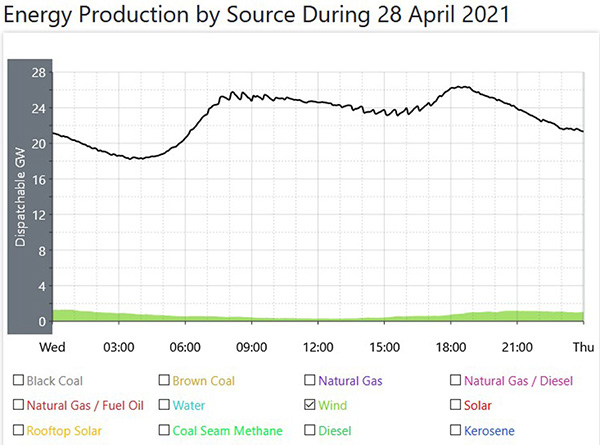 The black line in this image is the total power generation across the day, and that equates equally to power consumption across the day. The green colour rolling along the bottom is wind generation, all of it, across the day. Who pays for the battery back up for these dysfunctional non-farms? As Rafe Champion would say — it was a “choke point” all day. It would be nice to believe this incident was due to all the old failing wind towers that used to be reliable workhorses. If only. Then there would be hope we could fix things. But these were mostly new towers, and this is as good as it gets. We could double the money and build Snowy 2.0 power storage, state interconnectors, and batteries. Otherwise we just have to pay off the Sun, the Moon and the Southern Oscillation. Or, of course, we could back up 99% of the entire grid with fossil fuels (and some Hydro), which we do. But then the wind farms are completely superfluous, except to make the Greens feel good, and the Renewables Industry rich. 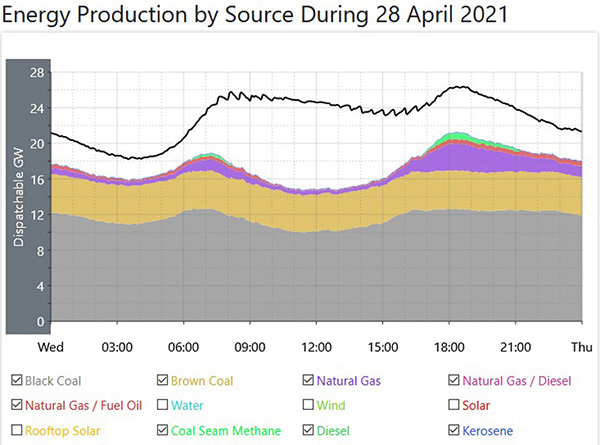 … TonyfromOz estimates we get a day like this once a year, but there are a lot of 6-hour-type squeezes when all 4,000 plus turbines make even less. A battery just isn’t going to cover that… Who pays for the back up? We the People. As TonyfromOz says: compare the productivity of a 50 year old coal plant Let’s look at the ancient old clunker Liddell, now coughing its last, after 50 years of operation. Only two of its four Units are in operation, and both of them are operating at much reduced Capacity. Liddell delivered more power across the day than did EVERY wind plant in the Country, in fact nine percent more power across the whole 24 hour recording period. So, on this day, every single wind plant in Australia cannot match the delivery from HALF of the oldest coal fired plant in the Country. We’ve spent something in the order of $20 Billion dollars to get an 8GW generator that doesn’t work most of the time. Liddell, if they fixed it, and it could run in a free and fair market, would still be profitable. BTW — The graphs come from Anero.id, a site set up by one man — Andrew Miskelly — that provides an essential service our well funded AEMO and the entire Ministry of Energy and Infrastructure can’t manage to provide. Amazing what one determined bright guy can do. For more information see TonyfromOz: Daily power for Tuesday 28th April: All day wind power was generating between 1 and 3% of the total Grid requirements. References and estimates belowKeep reading → April 30th, 2021 | Tags: Wind Power | Category: Global Warming, Renewable, Wind Power | Print This Post | | … This might be one of the most incompetent studies of 2o21 Hanigan, Dear and Woodward have done a “unique”, first of, *groundbreaking study* that finally shows climate change is having a detrimental effect on our health (so they say). With great effort to ignore almost every variable that mattered, they found the seasonal ratio of deaths in Australia has changed: ”More people die in winter than summer, but climate change may see this reverse In our study published today, we show some of the first evidence climate change has had observable impacts on Australians’ health between 1968 and 2018. We found long-term heating is associated with changed seasonal balance of deaths in Australia, with relatively more deaths in summer months and relatively fewer deaths in winter months over recent decades. Our findings can be explained by the gradual global warming associated with climate change. Over the 51 years of our study, annual average temperatures increased by more than 1°C in Australia. The last decade (2011 to 2020) was the hottest in the country’s recorded history. The other interpretation is that it got warmer and deaths in winter declined more than deaths in summer did. Basically if climate change does anything, it’s saving us from even more deaths in cold weather. Three cheers for fossil fuels. The climate trend is unequivocal: The hotter it got the longer we livedLooks like climate change saves lives even in hot sunny Australia: 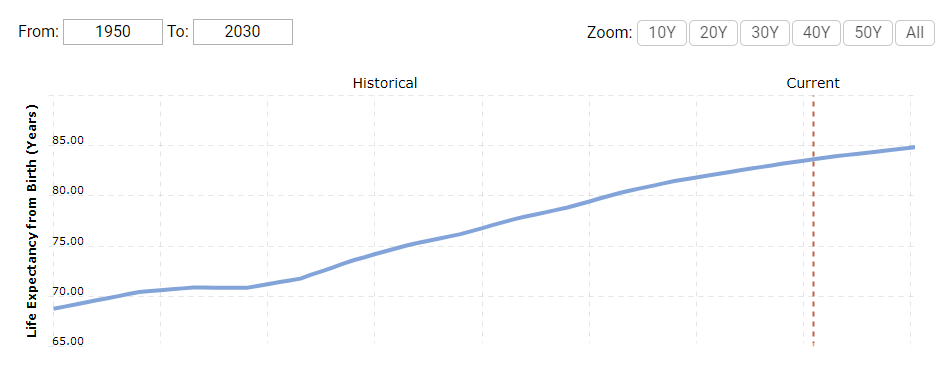 Source: Macrotrends But Hanigan et al miss the obvious and work pretty hard to find that the slope of the summer deaths (diamonds) below is rising slightly faster than the winter deaths (squares). Panic now. That’s how bad climate change is (and that how overfunded our universities are.) 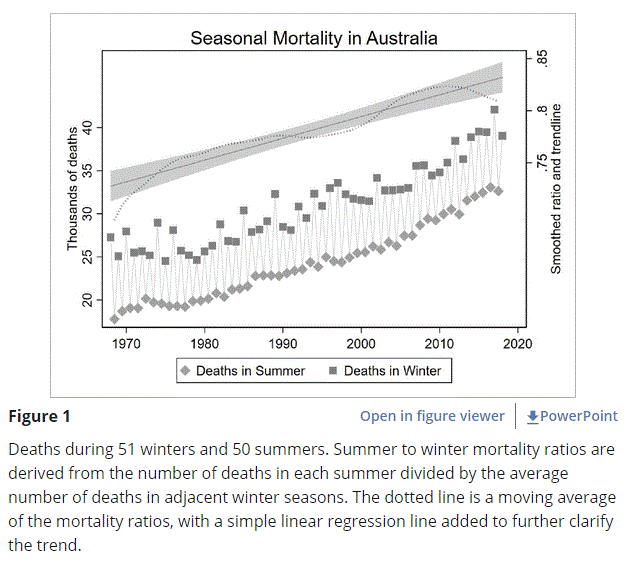 … Here’s another awkward fact: Heatwave deaths in Australia peaked around World War I?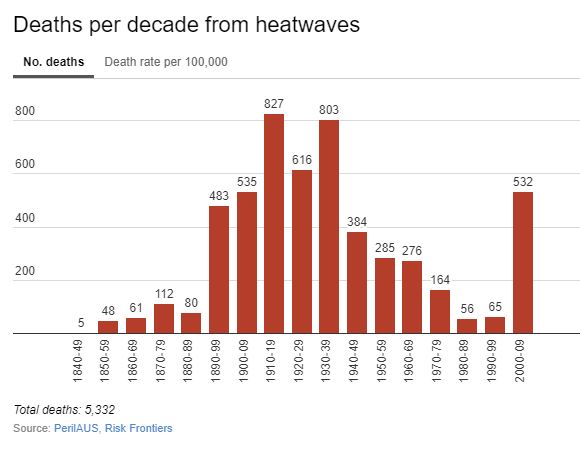 Australian heatwave deaths peaked around World War I. Source: PerilAUS Even in the deadly decade of 2000 to 2009, heatwave deaths were less than 0.5% of total deaths. That scary last column is not the big killer you might think. “Our research is unique“Globally, our study is one of very few that directly shows the health impacts of climate change. Instead their study directly shows what a waste of money higher education is: In our study, we used Australian mortality records that have been collected with remarkable consistency of detail and quality over the last half century. And by focusing on the ratio of summer to winter deaths within each year, we avoid possible confounding associated with, say, improvements to health care. So they avoided the confounding factor of “improvements in health care” but completely forgot that people predominantly died of different things in 1968 — like especially heart failure and influenza, both more common in winter. Lately, the increase in deaths due to Alzheimers and dementia spread those fatal events across the year. This one factor alone probably explains the minor trend they found. They haven’t found a climate change effect at all, it’s just the effect of a changing pattern of diseases: 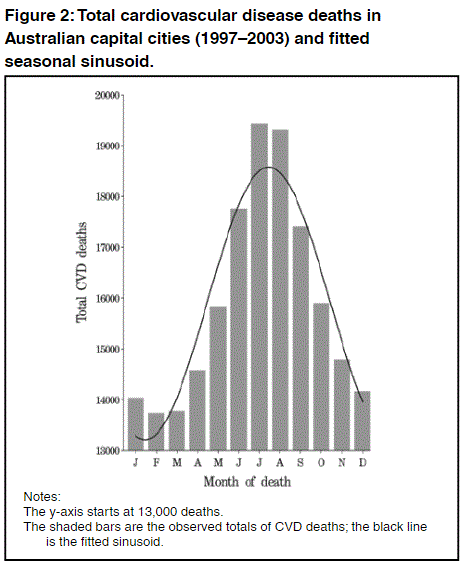 Many more people die of cardiovascular deaths in winter rather than summer. Barnett et al 2008 Ischemic heart disease is surprisingly more of a winter disease. There’s less sun, less vitamin D, room temperatures are colder, blood pressure goes up, and inflammation is more likely and makes everything worse. Nothing kills as many people as moderate cold. For a second, the researchers even have to admit that more climate change might save more lives (and we can’t have that!): In one study on the topic, the authors found Australia may initially experience a net reduction in temperature-related deaths. That is, increased deaths from heat during summer would be offset by fewer deaths in winter, as winters become more mild. What do you know: models arrive to rescue the doomer narrative: However, they predict this pattern would reverse by mid-century under the business-as-usual emissions scenario. Just one more irrelevant discovery: We found the speed of change in the ratio of summer to winter deaths was fastest in the hottest years within each decade. So on long term rising trends for both temperatures and deaths, what’s the bet that the last years of each decade are more likely to be both hotter and more deadly? Shock me. This paper is more evidence that it takes ineptitude to have a good career in science these days. Being sensible is a handicap. Who gave them their grant money? Related:
REFERENCESBarnett et al (2008) The seasonality in heart failure deaths and total cardiovascular deaths, Aust and NZ Journal of Public Health, vol 32, no 5. Ivan C. Hanigan , Keith B.G. Dear, Alistair Woodward (2021) Increased ratio of summer to winter deaths due to climate warming in Australia, 1968–2018, 26 April 2021 https://doi.org/10.1111/1753-6405.13107 PDF ABS: https://www.abs.gov.au/ausstats/[email protected]/0/b066d450abaaa4c7ca256dea000539dc April 29th, 2021 | Tags: Heatwaves, Mortality, Temperature (Effect on Mortality) | Category: Global Warming, Mortality | Print This Post | | Who voted for Superannuation funds to decide energy policy?And you thought we elected a government to manage our National energy policy? Businesses must adopt Paris emissions targets even if the government fails to do so, big investors say. The Guardian So even if voters don’t want “climate action”, by default, it’s sneaking in the back door, unless they pay attention. The “big investors” in this case being a small team of activists running a club that some Superannuation corporates have joined, though it’s not clear why. Perhaps they joined to “look Woke” or perhaps they are feeding the crocodile for fear of being targeted? The Australian Council of Superannuation Investors (ACSI) is not trying to persuade funds or investors to go Green with reason, instead they seem to operate by Cancel Culture principles on a corporate scale. Their aim, apparently, is to bully Directors of your Superfund into themselves bullying the companies they invest in. In a Saul Alinsky fashion they effectively threaten Directors that they might be personally isolated and targeted if they are not seen to be supportive enough of the Woke religion (ie, climate, slavery, femo-glass-ceiling stuff). Somehow ACSI may “recommend members vote against the re-election of directors”? In Australia the government forces everyone to put money into “Superannuation” (like the 401K in the US). ASCI gets some of that forced money from the Superfunds as membership fees, then, in turn, demands companies use your money to achieve something you wouldn’t have voted for or invested in yourself. It’s big bucks. ASCI has a “membership” of 36 Superannuation funds: together they manage over one Trillion dollars worth, or as they say… they “own on average 10% of every ASX200 company”. Last year ASCI creamed off nearly $4m in fees for themselves from superfunds in order to put greenie-woke pressure on superfunds. See how this works? SBS leaked the news with glowing praise last night that ACSI was going to target (and bully) Directors of companies that were more concerned with making profits for you — rather than with meeting the Paris agreement. The shame! This week ASCI has a “new climate policy” thus appointing themselves rulers and Science Geniuses. If the media exposed this power-grab and activism, people en masse might pull their funds out and Superfunds which indulged in these pointless “fashionable” councils for misusing your money would abandon them. Superannuation council serious about climate riskCliona O’Dowd, The Australian  Louise Davidson, ASCI. “Instead of just asking people to report and to talk to us about what they’re doing, we’re now saying governance for this sits with the board, and we will hold the board accountable if we don’t believe that the company is doing as much as they need to on climate. Banks put on notice over climate risks “Climate change risks are deeply embedded in the financial system and impact all sectors and asset classes. For long-term investors, this poses a serious challenge to long-term value creation across investment portfolios.” ACSI’s “active and constructive engagement” with the top 200 listed companies had led to improvements in company practices, she said, as she cautioned that more needed to be done. “Not all companies have listened to investor expectations … In order to increase the focus on climate-related risks in the companies they invest, ACSI may recommend members vote against the re-election of directors.” One of the mysteries is why any fund would be a part of ASCI? What do they get? According to ASCI, they get lectures, and the opportunity to join their board and lecture other people, but not much else. Is membership of this group just driven by spineless fear or is it an advertising strategy? Time to vote with your dollarsIf your fund is listed here, it would be helpful if you wrote to them to ask why they are members of a group that specifically says its aims are “not on returning a profit to shareholders”? Does your superannuation fund support you or the Religion of Woke? If they don’t give a satisfactory answer let them know you plan on finding another fund, and on spreading the word. If you get a response, please share it with us.  Members of ASCI
Who is this energy and climate genius — CEO Louise Davidson?She knows a lot about generating electricity and making profits (not): Appointed as the investor group’s chief executive in April 2015, Ms Davidson has more than 20 years’ experience in the financial services and superannuation industry. She joined ACSI from Cbus, where she managed their Environmental, Social and Corporate Governance (ESG) investments. Who’s happy to hide their role as corporate bully? Ms Davidson says ACSI often gets described as “social activists”, but the intent is not to act against companies. She says it is to engage and help them become more successful and profitable. Since the whole point of ASCI is “not profitability” and they don’t agitate against Directors who run unprofitable entities but against Directors who aren’t yet evangelistic about the Woke Religion, it’s clear she is happy to mislead and misinform with a straight face. It’s just another way to take power out of your hands. But all’s fair in love and war, and they are taking advantage of sleeping investors who think they can give their money to other people without paying attention. Parasites wouldn’t get away with this if the media cared, the politicians were brave and investors were able to invest in funds that “chose cheap profitable energy” over Voodoo and fads. Time to pay attention.
April 27th, 2021 | Tags: Climate Money, Psychology, Superannuation, Thought-Police | Category: AGW socio-political, Australia, Bankers, Global Warming, Politics | Print This Post | | … The CCP is still not being honest about bioweapons research in China. How stupid does the West have to be?
The title of the project was ‘the discovery of animal-delivered pathogens carried by wild animals’. The man in charge was Xu Jianguo. In 2019 he was heard bragging at a conference that “‘a giant network of infectious disease prevention and control is taking shape’.” He was part of the first expert group called in to deal with Covid in January 2020 and was the one who denied human transmissibility. In mid-January he said that the “epidemic is limited and will end if there are no new cases next week”. Well that was helpful. The group had five leaders — one was Professor Shi Zhengli who works in the Wuhan Institute of Virology, is known as the “bat woman” for her work hunting in caves for bat viruses. Only last month she denied that there was any military involvement. But one of the other leaders was Cao Wuchun, who was high up in the army and an advisor on “Bioterrorism”. He studied in Cambridge and now works in the Academy of Military Medical Sciences of the People’s Liberation Army. His name is on the project reports. Perhaps Prof Shi didn’t read them and they only met on the phone? Worrying new clues about the origins of CovidHow scientists at Wuhan lab helped Chinese army in secret project to find animal viruses by Ian Birrell, Daily Mail They found plenty of new viruses: One review of his virus-hunting project admitted ‘a large number of new viruses have been discovered, causing great concern in the international virology community’. It added that if pathogens spread to humans and livestock, they could cause new infectious diseases ‘posing a great threat to human health and life safety and may cause major economic losses, even affect social stability’. An update in 2018 said that the scientific teams – who published many of their findings in international journals – had found four new pathogens and ten new bacteria while ‘more than 1,640 new viruses were discovered using metagenomics technology’. Such research is based on extraction of genetic material from samples such as those collected by Prof Shi from bat faeces and blood in the cave networks of southern China. It’s almost like someone knew a bad virus was about to leak out? Prof Shi also admitted that eight more unidentified SARS viruses had been collected in the mine. The institute took its database of virus samples offline in September 2019, just a few weeks before Covid cases exploded in Wuhan. And there was that order to destroy all the samples at the WIV on Jan 2nd 2020. Why would China do that if the virus was a natural agent? This is not how good global citizens behaveIn recent years, China’s military has ramped up its hiring of scientists after President Xi Jinping said this was a key element in the nation’s march for global supremacy. Lianchao Han, a dissident who used to work for the Chinese government, said Cao’s involvement raised suspicions that military researchers who are experts in coronaviruses might also be involved in bio-defence operations. ‘Many have been working with Western research institutes for years to steal our know-hows but China still refuses to share critical information a year after the pandemic has killed over three million.’  Image by Reinhold Möller. The CCP is hardly being a good global citizen, stealing IP but not even answering honest questions when lives are at stake. The Daily Mail says the US State Department was worried about the “Gain of Function” experiments, and has claimed that researchers at the WIV got sick with something like Covid in the weeks before the outbreak started in Wuhan. Back last May I wrote about how genetic fingerprints in the sequence showed it was almost certainly a synthetic virus. Prof Shi Zhengli supposedly found a bat-virus in a cave in 2013 that is a close relative of SARS2. But inexplicably, she forgot to register this deadly pathogen until Jan 27th 2020, seven long years later. The first Nature paper on it magically appeared just six days after that. “So much for peer review”. The only copy of this supposedly natural “missing link” virus called RaTG13 appears to be on her computer, not in a vial. It’s almost like someone stayed up late one night altering the letters in the viral code and in the rush, forgot to add in a realistic amount of background non-coding noise. The sequence has been showered with fantastical background radiation that only altered coding parts of the gene and not the usual random smattering across the full length of the non-coding parts too. Odds of that are almost ten million to one. Must be bad luck. Right now, the West is spending billions installing uncompetitive energy sources, and researching how to get reliable energy from unreliable, low energy density sources, when there is plenty of energy available but a screaming need to get very advanced in biomedical research. h/t A friend in Switzerland. Other posts on bioweapon-like SARS viruses
April 26th, 2021 | Tags: Bioweapon, China, Coronavirus, Virology | Category: China, Microbiology, Science, war | Print This Post | | |
Jo appreciates your support to help her keep doing what she does. This blog is funded by donations. Thanks!
 Follow Jo's Tweets
   
 
|
|||
|
Copyright © 2026 JoNova - All Rights Reserved |
||||







Recent Comments