Recent Posts


It’s the biggest medical scandal since 1850 — there are even claims the US President was treated in secret

History books will be written and some professors, academics, and bureaucrats will have no excuse. 

The Red Cross serves humanity

Which organisations can serve now?

It took two court hearings and major complaints and assertive activism to save eighty year old Judy Smentkiewicz. But how many others died because their sons or daughters didn’t see Pierre Kory on TV? Or they didn’t have the wherewithal to go to court? Or their friends trying to share the message were censored on Facebook? It shouldn’t have to be this way.

This is Judy’s story below, but so much more. Read the whole thing. It’s very well written by Michael Capuzzo. Surely, this is a story that needs an answer. Where are the Forth Estate, the Opposition, The AMA, or the publicly funded professors at our universities?

I am but a cog passing on points of view that should be part of our national conversation. Some things matter: like antivirals and closed borders.

Nick Corbishley says “I don’t know of a bigger story in the world”

Michael Capuzzo, a New York Times best-selling author , has just published an article titled “The Drug That Cracked Covid”. … But unfortunately most reporters are not interested in telling the other side of the story. Even if they were, their publishers would probably refuse to publish it.

That may explain why Capuzzo, a six-time Pulitzer-nominated journalist best known for his New York Times-bestselling nonfiction books Close to Shore and Murder Room, ended up publishing his article on ivermectin in Mountain Home, a monthly local magazine for the people of the Pennsylvania mountains and New York Finger Lakes region, of which Capuzzo’s wife is the editor.

But if you want to share the story on the Anti-social Media, perhaps avoid spelling out the I word, lest the censors strike.

Jo


These doctors are heroes.

The Drug that Cracked COVID

By Michael Capuzzo, Mountain Home

Marik was accustomed to beating the odds. The legendary professor, a 6-foot, 230-pound, balding, barrel-chested, bear of a man with a crisp native South African accent touched with the South after thirty years, is the second most published critical care doctor in the history of medicine, with more than 500 peer-reviewed papers and books, 43,000 scholarly citations of his work, and a research “H” rating higher than many Nobel Prize winners. Marik is world famous as creator of the “Marik Cocktail,” a revolutionary cocktail of cheap, safe, generic, FDA-approved drugs that dramatically reduces death rates from sepsis by 20 to 50 percent anywhere in the world—whether you’re in a hospital in Zurich or Zimbabwe, Chicago or Chengdu—down to near zero, when given soon after presentation to hospitals. Since he published what he calls the “HAT Therapy” (Hydrocortisone, Ascorbic Acid [intravenous Vitamin C] and Thiamine) in 2016 in the most prestigious peer-reviewed journal in the field, Marik has received worldwide publicity, is celebrated in James Bond Internet memes with the “Marik Cocktail” shaken, not stirred, and is seen in ICUs around the globe as a historic figure in medicine for improving care of sepsis, which last year passed cancer and heart disease as the world’s number one killer, according to Lancet. Marik, known as a quirky genius and an exceptionally kind-hearted doctor (his most published peer in the annals of medicine doesn’t see patients), has been searching for an effective treatment for COVID-19 since it began.

The deadly time is week two, paradoxically, as Covid is dying off:

They made their first major breakthrough in March 2020, by the third week of the pandemic when only 3,800 Americans had died. It was based on the idea that COVID-19 has one great weakness: the coronavirus doesn’t kill anybody. In a mechanism so diabolical Marik believes “human beings aren’t smart enough to have figured it out,” the trillions upon trillions of coronaviruses that overwhelm and sicken the host don’t kill it. But in the second week of the disease, all the coronaviruses die, and like suicide bombers flooding out of a Trojan Horse swamp the body with a “vast viral graveyard” that triggers a friendly-fire hyper-immune response that in turn unleashes monstrous multi-organ inflammation and clotting like doctors have never seen. A body dying of COVID-19 is a complex, terrifying sight. But its weakness is simple: “As pulmonary critical care doctors we know how to treat inflammation and clotting, with corticosteroids and anticoagulants,” Marik says. “It’s first-grade science.”

It was even allegedly used to help President Trump. Could it be true that this widely used Nobel Prize winning drug threatens so many bank accounts, it was done in secret:

In addition, Kory, Marik, et. al published the first comprehensive COVID-19 prevention and early treatment protocol (which they would eventually call I-MASK). It is centered around the drug Ivermectin, which President Trump used at Walter Reed hospital, unreported by the press, though it may well have saved the president’s life while he was instead touting new big pharma drugs.

*There is no documentary proof offered for this remarkable claim. It depends upon the reputation of the author (read his reasons here), and indirectly on all the doctors named as heroes. Would Trump himself have said nothing? With only weeks til an election would he have wanted to set that bonfire alight, knowing the media would want to brand him as reckless. I seem to recollect Trump recommending these doctors or their group prior to this, in which case it would seem odd for him not to have conferred with them or them with him. He’d already taken HCQ earlier showing a willingness to try “unapproved” medicines. It’s all hard to search for in this day of “filtered” search results to confirm.

  • The MATH+, protocol:  methylprednisolone, ascorbic acid, thiamine, and heparin, plus a statin, zinc, vitamin D, famotidine, melatonin, and magnesium.
  • I-MASK+ protocol, which focuses on ivermectin, but also includes vitamins C and D, quercetin, zinc, and melatonin for prophylaxis, and adding aspirin;

It’s all listed in detail at the Front Line COVID-19 Critical Care Alliance website (www.flccc.net).

Many prominent doctors and scientists around the world believe that Marik, Kory, Meduri, Varon, and Iglesias deserve the Nobel Prize in medicine.

…by October Marik’s concerns were answered. The studies were well-designed university trials that showed amazing anti-COVID-19 activity at the normal doses used to treat parasites. Though small and endlessly diverse by large, Western big pharma “one-size-fits all” random control trials, the Ivermectin studies were a mosaic of hundreds of scientists and many thousands of patients in trials all over the world, all showing the same remarkable efficacy against all phases of COVID-19 no matter what dose or age or severity of the patient. “Penicillin never was randomized,” Marik says. “It just obviously worked. Ivermectin obviously works.”

The conflict of interest that almost no media outlet will report:

Remdesivir costs $3,000 a dose. It is the only anti-viral treatment for hospitalized COVID-19 patients approved by the NIH COVID-19 Treatment Guidelines Panel, and as a result is a standard of COVID-19 care in many hospitals, even though many doctors say it doesn’t work, and the WHO recommends against it. It has been shown in studies to have no mortality benefit for COVID-19 patients. (Coincidentally, seven members of the NIH COVID-19 Treatment Guidelines Panel acknowledge in financial disclosures that they have received research support or consultant payments from Gilead, or sit on the advisory board of the $60 billion company). As The Washington Post reported, “Remdesivir may not cure coronovirus, but it’s on track to make billions for Gilead.”

Ivermectin has even been used to save Doctors  (but not in the West):

Six prevention studies showed Ivermectin reduced the risk of getting COVID-19 by 92.5 percent, superior to many vaccines. Dr. Hector Carvallo, a professor of medicine at the University of Buenos Aires, gave 788 doctors and other health care workers in three medical centers weekly Ivermectin prophylaxis, with a control group of 407 doctors and others who didn’t get the drug. In the control group 236 people, or 58 percent, “had become ill with COVID.” Among the 788 who got Ivermectin, “no infections were recorded.”

Doctors in the West are both guilty of not doing more, but are also victims of the system. How many doctors could have been saved? How many young doctors feel they can say anything?

Kory nearly broke down pleading with the NIH to review the “immense amounts of data that shows that Ivermectin must be implemented and implemented now,” and reverse its negative recommendation of August 27, when no data was available.

“We have 100,000 patients in the hospital right now dying,” he cried out to the committee. “I’m a lung specialist, I’m an ICU specialist. I’ve cared for more dying COVID patients than anyone can imagine. They’re dying because they can’t breathe. They can’t breathe…and I watch them every day, they die….I can’t keep doing this.

Kory’s testimony, titled “I can’t do this anymore” on YouTube, went viral and reached eight million views and counting before being censored by YouTube for “misinformation;”

This was that speech:  Thank goodness for Bitchute.

This is a global battle:

In South Africa, where use of Ivermectin was criminalized, civil rights activists hung posters with Kory’s data urging revolt, and a group of physicians won permission from the Ministry of Health in Zimbabwe on January 27, 2021 to treat COVID-19 with Ivermectin; case fatalities dropped in one month from seventy a day to two a day, “and our hospitals are virtually empty,” said Dr. Jackie Stone, who was subsequently taken in for questioning for her use of a controversial drug. In Phnom Penh, Cambodia, a doctor trained in Milwaukee, Wisconsin, was using Kory’s data to persuade the Ministry of Health of Ivermectin’s efficacy and was making a personal appeal to the king. “Thank you for your amazing courage and love for humanity,” he wrote. “You’re a real doctor who is living up to the Hippocratic oath. All doctors need to follow your example!!”

And in the UK too:

Belgian Red Cross

Angels are few…

In Bath, England, Dr. Tess Lawrie, a prominent independent medical researcher who evaluates the safety and efficacy of drugs for the WHO and the National Health Service to set international clinical practice guidelines, read all twenty-seven of the Ivermectin studies Kory cited. “The resulting evidence is consistent and unequivocal,” she announced, and sent a rapid meta-analysis, an epidemiolocal statistical multi-study review considered the highest form of medical evidence, to the director of the NHS, members of parliament, and a video to Prime Minister Boris Johnson with “the good news…that we now have solid evidence of an effective treatment for COVID-19…” and Ivermectin should immediately “be adopted globally and systematically for the prevention and treatment of COVID-19.”

Ignored by British leaders and media, Lawrie convened the day-long streaming BIRD conference—British Ivermectin Recommendation Development—with more than sixty researchers and doctors from the U.S., Canada, Mexico, England, Ireland, Belgium, Argentina, South Africa, Botswana, Nigeria, Australia, and Japan. They evaluated the drug using the full “evidence-to-decision framework” that is “the gold standard tool for developing clinical practice guidelines” used by the WHO, and reached the conclusion that Ivermectin should blanket the world.

Suddenly only randomized controlled trials were good enough. It was another Gatekeeping exercise:

Everywhere the problem was the same, Kory said. The WHO, NIH, and other public health agencies were suddenly recommending only COVID-19 therapies proven by the “gold standard” of large randomized controlled trials of treatment and placebo groups, which were powerful but had several limiting flaws, including the fact that they took months to complete and cost ten to twenty million dollars that only big pharmaceutical companies could afford. They had thrown out all the other time-tested forms of clinical and scientific medical investigation still taught in all the medical schools, such as observational trials (which had eliminated widespread crib death), case histories, and anecdotes. They also restricted the use of essential off-label and generic drugs with blatant disinformation campaigns that reminded Kory of big tobacco’s efforts to hide the dangers of smoking.

For Merck (and all the other Pharmaceutical giants) the conflict of interest is obvious. It makes perfect business sense to talk down their own old out-of-patent drug. The thing that would slow that would be bad press, mass protests, government action:

Ivermectin is the generic name for Merck’s Stromectol, which they developed in 1981. Though the drug went off patent in 1996, Merck still distributes millions of doses each year in Africa for free, with a statue honoring the drug and the great humanitarian eradication effort in its headquarters and one at the WHO in Geneva. But recently Merck issued a stern warning that seemed written by marketing, Kory says, “as it had no scientific data to support the conclusion,” that Ivermectin was suddenly dangerous. Another pharmaceutical company’s CEO privately noted that “People must think Merck knows what they’re talking about because it’s their drug,” but Merck has “tremendous disincentives” to say nice things about the generic pill, as it has already spent hundreds of millions of dollars developing an oral anti-viral COVID-19 treatment, rival to Ivermectin, that may be priced at $3,000 a dose.

Brazil too:

Not just in media but in social media, Ivermectin has inspired a strange new form of Western and pharmaceutical imperialism. On January 12, 2021, the Brazilian Ministry of Health tweeted to its 1.2 million followers not to wait with COVID-19 until it’s too late but “go to a Health Unit and request early treatment,” only to have Twitter take down the official public health pronouncement of the sovereign fifth largest nation in the world for “spreading misleading and potentially harmful information.” (Early treatment is code for Ivermectin.)

Facebook, Twitter and all of the Pharmaceutical Giants are telegraphing exactly how much they care about their customers.

Picking the right hospital or doctor is a matter of life and death, and one wife even hired a helicopter to rescue her dying husband from the wrong hospital:

Dr. Manny Espinoza was dying of COVID-19 in his Texas hospital when his wife, Dr. Erica Espinoza, asked the doctors to try Ivermectin as a last resort, and was refused. Erica hired a life-flight helicopter to take Manny to the Houston hospital of FLCCC co-founder Joseph Varon for the cheap little pill that in four days had her husband sitting up smiling and telling their children about the “miracle” that saved his life. “We see this every day,” Dr. Varon says. “They say it’s a miracle, I say it’s the science, but it’s the truth.”

For what it’s worth, I was impressed with Paul Marik’s revolutionary ICU treatment which used cheap vitamins (C and B1) with a steroid — long before Covid arrived and seemingly has such an excellent rate of success.

More information:

  • See also, The Story of The Cover Story, where Capuzzo explains why he wrote this article.
  • MEDPAGE today discusses the drawbacks of some of the Ivermectin trials. But why haven’t there been larger better studies? They also comment that Paul Marik was vaccinated in January and does not see Ivermectin as a threat to that, though nor does he see vaccinations being the solution on their own. He just wants the politics out of medicine.
  • The FDA warned against using veterinary ivermectin in humans.
  • FLCCC site: Frontline doctors Critical Care Alliance.
  • The MATH+, protocol:  methylprednisolone, ascorbic acid, thiamine, and heparin, plus a statin, zinc, vitamin D, famotidine, melatonin, and magnesium.
  • I-MASK+ protocol, which focuses on ivermectin, but also includes vitamins C and D, quercetin, zinc, and melatonin for prophylaxis, and adding aspirin;

h/t Old Ozzie, via David from Cooyal

Images: Red Cross (Wikimedia) and Belgian Red Cross. Image by Buchel, Charles A.


9.6 out of 10 based on 134 ratings

Weekend Unthreaded

8.3 out of 10 based on 19 ratings

Did a short sharp Geomagnetic storm contribute to the Callide Coal plant explosion?

Ben Davidson speaks from Spaceweathernews.com and claims that there was a short sharp geomagnetic storm over the East Coast of Australia around the time the Queensland Callide Power plant exploded.

The CME that flew past Earth didn’t do much around the world,  causing a small 1% deviation in magnetometers. But there was a burst of activity in the Southern Hemisphere that appears to have hit the east coast of Australia. Magnetometers there saw a 300 – 500% change* between noon and 3pm on the same day as the Callide Coal Power Plant blew up. The explosion happened at 1.44pm and the 275 kV transmission lines tripped at 2:06pm.

*(UPDATE: There is some contention in comments about the Australian DST figures — we’re they really that high or unusual? I’ll update the post when I can confirm it either way).

We don’t know if this tipped something over the edge at Callide, but the timing is highly coincidental. If Earth’s magnetic field is weakening it would seem urgent, to say the least, to understand the risks these spaceweather events pose to our critical infrastructure.

Perhaps an engineer who knows the design of (hydrogen cooled) supercritical coal reactors might be able to explain if or how a geomagnetic storm might contribute to an explosion, or even if that is possible?

h/t To Cardimona, Peter C, and Rafe at Catalaxy.

Australia, Estimated DST Index, Bureau of Meteorology.

Australia, Estimated AusDst-index, Bureau of Meteorology.  “The Dst-index was derived to quantify the decrease in the geomagnetic field H-component observed during the main phase of magnetic storms produced mainly by the equatorial current system in the magnetosphere referred to as the ring current.”

Davidson mentions a paper by Wang that suggests that geomagnetically induced currents (GIC) pose a risk to power stations and grids. At the moment things are quite active over Australia and New Zealand.

Earth Magnetic Anomaly Grid EMAG2v3

Geomagnetic map of the world showing activity over Australia and New Zealand.

From the NOAA page on EMAG2

EMAG2 is compiled from satelliteship, and airborne magnetic measurements. Magnetic anomalies result from geologic features enhancing or depressing the local magnetic field. These maps increase knowledge of subsurface structure and composition of the Earth’s crust.”

Ben Davidson  talks about Australia from 35 seconds to 1:45

If anyone has a spare copy of  The Weathermans Guide to the Sun I’d love to read it. I would especially appreciate a print copy if anyone would like to donate one? Please email me joanne At this domain, or message in comments. Thank you! (They’re $65).

UPDATE: Consensus is “probably not”

One of the better summaries was sent in an email. Thanks to Greg:

Did a solar flare blowup the Callide power station? In short, no. The evidence is too localised and the latitude is too low.

It is true that the vertical component of a rapidly changing magnetic field can induce strong currents to cycle around electric power network loops. Normally the loops in a power grid are closed by a transformer, which only lets through the intended 50 Hz or 60 Hz. Lower frequencies have higher resistances, so if a sufficiently high voltage of low-frequency has been induced, an unprotected transformer overheats and may explode.

Solar eruptions send out vortices of plasma containing strong magnetic fields. When they happen to hit Earth’s magnetic field, the disturbances are most likely to reach the ground in polar regions where the earth’s magnetic field is most vertical. Thus they are far more threat to Canada’s power supply than Australia’s. In 1968 I was processing the hour-by-hour geomagnetic records from stations in Australia and Antarctica – and only saw significant magnetic storms in Antarctica.

I suspect that all transformers would be supplied with a low-frequency bypass to protect them. Power lines themselves routinely have lightning jumps in them. We see them on cable supports on occasional power poles, a pair of metal points separated by a gap of several centimetres. Although these may be sufficient to short out lightning strikes, they couldn’t completely drain an induced power surge, because the soil under the power poles is suffering the same induction.

The most powerful solar flares recorded to hit Earth was the so-called Carrington Event of 1859, which burnt out many telegraph readers worldwide. Doomsayers predict that the next time we are hit by a flare of that magnitude, the world’s power grids will all fail, leaving us in the cold and darkness until replacement transformers are built and installed. But heck, now what would they know that grid designers don’t?

Keep reading  →

8.7 out of 10 based on 35 ratings

A message for the school strikers: Get serious, and tell your teachers to switch off the air con…

Saint Greta’s comeuppance 

US site RedState was very impressed with this letter sent to Alan Jones, and read on SkyNews, Australia.

Someone was very fed up with the vainglorious students who skipped school to do a rent-a-crowd climate protest:

“To all the school kids going on strike for climate change, you’re the first generation who’ve required air conditioning in every classroom. You want TV in every room and your classes are all computerized. You spend all day and night on electronic devices.

More than ever you don’t walk or ride bikes to school, but you arrive in caravans of private cars that choke suburban roads and worsen rush-hour traffic. You’re the biggest consumers of manufactured goods ever. And update perfectly good, expensive, luxury items to stay trendy. Your entertainment comes from electric devices.

Furthermore, the people driving your protests are the same people who insist on artificially inflating the population growth through immigration, which increases the need for energy, manufacturing, and transport. The more people we have, the more forest and bushland we clear, the more of the environment that’s destroyed.

How about this? Tell your teachers to switch off the aircon, walk or ride to school, switch off your devices and read a book, make a sandwich instead of buying manufactured fast food.

No, none of this will happen, because, the piece says, ‘you’re selfish, badly educated, virtue-signaling little turds inspired by the adults around you who crave a feeling of having a noble cause while they indulge themselves in Western luxury and unprecedented quality of life’.

The piece ends by saying ‘wake up, grow up, and shut up until you’re sure of the facts before protesting.’”


Watch it on YouTube.

h/t Scott of the Pacific


9.9 out of 10 based on 108 ratings

A Dutch Court says Shell is causing storms and floods. And Exxon shareholders vote to lose money

Who knew?

Shell lobbies for climate change, and gets what it lobbied for.

It doesn’t matter how much a company panders to the Religion.

The Pagan Chieftan hath spoken and decided that Shell not only has to cut its own emissions nearly in half, it improbably, somehow, is responsible for its customers emissions too. Will Shell put photos of heatwave casualties with warning labels on oil cans: “This product may cause Tornadoes”?

Shell is reaping the rewards of playing the “climate” game. They didn’t stand up against the climate witchery when it came for the coal industry, and now its come for them.

Oil Giants Are Dealt Major Defeats on Climate Change as Pressures Intensify

By Sarah McFarlane and Christopher M. Matthews, Wall Street Journal

In a first-of-its-kind ruling, a Dutch court found that Shell is partially responsible for climate change, and ordered the company to sharply reduce its carbon emissions. Hours later in the U.S., an activist investor won at least two seats on Exxon’s board, a historic defeat for the oil giant that will likely require it to alter its fossil-fuel focused strategy.

The Shell ruling, issued by the district court in The Hague, found that Shell must curb its carbon emissions by 45% by 2030 compared with 2019 levels—and that the company was responsible not only for lowering its own direct emissions from drilling and other operations, but also those of the oil, gas and fuels eventually burned by consumers.

The target is in line with United Nations guidance …

Figure the kind of precedent this sets. It’s like consumers are babies who aren’t responsible for their own emissions. Like people who sell cars cause the road deaths and potato farmers need to make sure customers drink Vodka responsibly. Don’t pull too hard on this string or our civilization might unravel.

Shell was obeying all the laws made by governments elected by voters, but who cares about them? The unelected and unaccountable UN declared that oil raises the tide, and therefore a judge now sets national policy on energy, and on tides.

Meanwhile Exxon become a kind of Transgender company — a company with an identity crisis.

The shareholders who bought Exxon because it made profits on oil and gas apparently voted (or enough of them did) to put two activists on the Board to make the oil giant invest in something other than oil. Whether two seats out of 12 can achieve much is a fair question but the company is already bleating about “getting the message from shareholders”.

Activists are very good at political games like winning board seats, but they won’t be good at making profits. So what’s next? Will the oil giants gradually grind down — effectively sabotaged into putting more money into loss making green ventures? That will increase the Green-Blob jobs market at the expense of shareholders, customers and tax revenue. But the world will still want fossil fuels. Will Shell or Exxon become hollowed out shells, transmogrifying into some other entity, while some other companies start up in the Cayman Islands to supply the oil instead? Will those companies be owned by Chinese or Iranian investors, will the tax dollars and jobs still go the USA or the Netherlands — or will a new empire of industrial giants rise up to replace the old ones led by CEOs who bow to no one and apologize for nothing?

Ultimately these companies were lost years ago when they stopped believing in what they sell

Shell advert for alternative energy.

Both Shell and Exxon lost a lot of their branding and goodwill in the last 20 years. Even the shareholders don’t believe in Exxon any more,  or not enough to fight for it.  Exxon tried, putting in about $30 million dollars to help some skeptics — but against the $79 billion put in by Big Government, it was nothing, and Exxon was vilified. It gave up the intellectual fight for oil and gas, and gave in to the bullies. Shell didn’t even fight. (Though they will appeal the court decision, they’re hardly taking up the battle to defend oil and gas, and real science.) The companies were already hollowed shells. For years Shell were happy to play the “climate” games. They leaned on the World Bank to nobble the competition (coal). 

It took very few shares to push them over:

Exxon’s loss came at the hands of Engine No. 1, an upstart hedge fund owning only about 0.02% of the oil giant’s stock. It had waged an aggressive campaign challenging the company’s energy transition strategy and response to climate change, depicting it as a corporate dinosaur.

The vote at the company’s annual meeting capped a pitched, monthslong battle between the company and the activist to persuade Exxon shareholders, that turned into one of the most expensive proxy fights ever.

Engine No. 1 called for Exxon to gradually diversify its investments to be ready for a world that will need fewer fossil fuels in coming decades.

Exxon has spent millions on renewable energy research, but it doesn’t matter. Feeding the crocodile only makes it a bigger crocodile:

Exxon defended its strategy to expand drilling, saying demand for fuels and plastics will remain strong for years to come, and pointed to a new carbon capture and storage business unit as evidence it is taking climate change seriously.

The votes were leveraged by pension funds which invest money for people who mostly don’t vote nor spend their own money on “climate change”:

The hedge fund got a big boost from some of Exxon’s largest shareholders. BlackRock Inc. backed three of Engine No. 1’s candidates, and some of the largest U.S. pension funds also supported the activist’s slate.

Asset managers are, themselves, under pressure to exert influence on their portfolio companies…

Once upon a time companies were run by and for shareholders?

Marvel at how the tail wags the dog. In Australia a little committee called ASCI parasitically creams $4m a year off big companies who pay a tithe to them to be a member in order to get a badge to shield them from climate bullies or something. But then ASCI uses that money to isolate and harrass individual directors and bully them into submission or oust them in votes.

These industrial giants like Exxon are a microcosm for the West in so many ways. They forgot their reason for being, then got set upon by white ants while tens of thousands of sleeping consumers, employees and  shareholders have wealth and opportunity quietly eaten away.

Shell and Exxon are not dead yet. But who will resuscitate them?


.

9.8 out of 10 based on 74 ratings

Thursday Open Thread

8 out of 10 based on 16 ratings

Queensland’s Near Miss: hydrogen may have exploded at a coal plant (and renewables don’t save the day)

Tuesday was a wild day for Queensland Electricity. An explosion struck the Callide C Power Plant triggering a cascade of other plants to switch off within seconds. The massive 2.5GW fall in supply took the grid frequency in Brisbane to a hair raising 49.55Hz. How close did it come to falling over? Half a million people lost power for a couple of hours but a Statewide blackout was averted. Luckily no one was hurt.

Meanwhile the people in power were not saying “Hydrogen”, or “explosion” but the Supercritical Units at Callide are cooled with hydrogen, and there was an explosion. The owner CS Energy called it just “a fire”. But in other news reports people in the nearest town said it was “the loudest explosion they have ever heard”.

Hydrogen, it seems, is used in some coal plants as a coolant, but Holy Hindenberg, it is known to explode. (See Ohio in 2007, Pittsburg in 2017 and India, 2019) . A Union official said it appeared the hydrogen filled generator of the main turbine had suffered a catastrophic failure. And it’s all exquisitely awkward,  as David Archibald points out, happening while a two day Hydrogen Conference is on — as we speak — to sell us a half billion dollar “investment” in hydrogen hubs in the hope they might change the weather. The last thing the new Hydrogen-hopeful-industry needs is for the nation to be reminded of how explosive the first element of the periodic table is. It’s not too good for Scott Morrison either, who is selling the “hydrogen economy” to taxpayers.

Perhaps we should ask the Queensland Minister for Energy, Renewables and… Hydrogen?

In terms of the shaken Queensland electricity grid, TonyfromOz tells us gas power came in to save the day and carry the load. Other coal plants returned. The renewables though, were not much help. Hydro power was missing in action for a few hours until prices peaked at $14,500/MWh. Probably the delay was because the Wivenhoe dam was only 41% full, near its lowest level in a decade, and water is not-so-renewable at the start of the dry season in Queensland. Predictably, other intermittent power was also not there when we needed it. Wind power was doing not much in the lead up to the big bang, and nothing at all in the key minutes after. Solar production fell slightly after the explosion, then trailed off to nothing as solar does at that time of day.

h/t To David Archibald, TonyfromOz, plus Analitik, Ronin, Hanrahan, Dave.

CORRECTED:  “Bagasse” changed to “Coal seam methane”. So many flavours of fossil fuels saved the day.


Queensland, Electricity generation, fossil fuels, May 25 2021, graph. Solar Wind power.

The shock that hit Queensland on May 25th around 2pm.        Source: Anero.id

The Callide Power plant was first commissioned in 1965. It has 8 units that make 1.7GW of power. At the time of the explosion the Queensland grid was running at nearly 8GW.

TonyFromOz has a long post on PaPundits: 

…sadly, while this was almost a catastrophe, not one of the renewable power sources contributed in any way to the recovery. But, hey, that didn’t stop the Premier, and her Ministers saying later in the evening and today that renewable power helped to keep the power on. In fact, the opposite was the case. When the power failed, then those renewables also failed as well, and none of the renewables assisted in the recovery. All the heavy lifting was done by natural gas fired plants, the dreaded fossil fuelled power plants, and they did not get a single mention from any of those politicians.

This was one of the largest power failures in the State for more than 45 years. The fact that it was not worse than what it could have been is testament to how those engineers are looking after the grid, trying their hardest to keep the power on. All of this resulted from a catastrophic accident, and the resultant blackout, while huge in nature could have been much much worse.

Keep reading  →

9.4 out of 10 based on 80 ratings

Florida Governor stops Silicon Valley Tech Giants biased silencing

Make this man President. Ron DeSantis has signed into law something that will allow Floridians to sue Big Tech if they have been banned by one sided “selectively enforced” rules. Finally, Big Tech, at least in Florida, will have to set some rules and apply them to both sides of any debate or the aggrieved party can sue Big Tech.

It’s aimed at Silicon Valley:

“I, along with the legislators and this great governor, do not think that a handful of kids behind some desks in Silicon Valley get to be the arbiter of what free speech is,” House bill sponsor Blaise Ingoglia, R-Spring Hill said.

The new law comes into effect on July 1. It applies to any company with a revenue over $100 million or who have 100 million monthly participants. This is about maintaining a free and open town square. If political candidates are deplatformed it will cost the Tech Giants a quarter of a million dollars a day. (Those fines might have to be raised).

Coming soon: Big Tech to create all kinds of rules that benefit people who like Oligarchs.

Presumably Big Tech have already convened a team to deal with this. Expect their new rules to allow expressions of anything in peer reviewed literature, or approved by the FDA, AMA, Fed Reserve, or New York Times. And after the Biden Government sets up a Ministry of BLM, and a Department of Gender-Rights, then, “that too”.

It’s only step one in an arms race, but it’s a step.

DeSantis Signs Bill to Stop Big Tech Censorship of Floridians

by Bowen Xiao, Epoch Times

Courts may award up to $100,000 in damages to an individual if a social media platform censors or shadowbans a user’s content, deplatforms a user, or if it hasn’t applied censorship or deplatforming standards in a consistent manner, according to the text of the bill.

“We will be the first state to hold Big Tech accountable,” DeSantis said at a press conference. “They are exerting a power that really has no precedent in American history.”

Big tech companies that violate the bill, SB 7072 Social Media Platforms, can be sued by Floridians for monetary damages. The state’s attorney general can bring action against companies that violate this law under Florida’s Deceptive and Unfair Trade Practices Act.

Big-Tech are protected by Section 230, which treats the publishers as if they were really neutral platforms. DeSantis can’t change that, but he can enforce it:

According to Florida state, the new law will likely be able to withstand legal challenges, as it contains language that explains how Big Tech companies are different from other corporations, and that Section 230 requires companies to act in good faith—something the governor accuses Big Tech of not always following.

Hannah Bleau, Breitbart

The bill allows the state attorney general to use Florida’s Unfair and Deceptive Trade Practices Act.” That might hurt a lot more:

“If social media platforms are found to have violated antitrust law, they will be restricted from contracting with any public entity. That ‘antitrust violator’ blacklist imposes real consequences for Big Tech oligopolies’ bottom line,” his office said.

Amazon has nearly 500 federal subcontracts, how many state contracts does it have? If Florida leads the way in cutting off public contracts — other states will follow suit.

Keep reading  →

9.5 out of 10 based on 83 ratings

Tuesday Open Thread

8.3 out of 10 based on 15 ratings

Clickbait is a winner: The most cited articles in top science journals turned out to be flops

When it comes to scientific truths, even in top journals like Science and Nature, the more wrong it is, the more it gets cited. Even after other researchers have failed to repeat it, and been published saying so, the citations don’t slow down. Almost 9 out of 10 of the new citations keep citing it as if it were still correct. Who said science was self-correcting?

It’s so bad that the junkier articles in Nature and Science that couldn’t be replicated were cited 300 times as often as the more boring papers that could be replicated.  In other words, the supposedly best two science journals, and the industry that reads them, have become a filter for eye-candy-science-junk.

And it was all so predictable — with  the fixation on “counting citations” as an inane substitute for analysis: we got what we didn’t think about.  The drive to get citations and media headlines means the modern industry of science has become a filter to amplify sensationalism, not science.

Science is a form of entertainment, not a search for the truth.

A new replication crisis: Research that is less likely to be true is cited more

The authors added that journals may feel pressure to publish interesting findings, and so do academics. For example, in promotion decisions, most academic institutions use citations as an important metric in the decision of whether to promote a faculty member.

This may be the source of the “replication crisis,” first discovered the early 2010s.

So much for the theory that peer reviewed journals are supposed to be the rigorous guardians of modern science.

Circular scientist

..

What a trap:

The more interesting and surprising a science paper is, the more it is likely to be published and cited. But the more cited it is, the more likely it is that no one will be able to replicate the results. Since “interesting” is judged through Big-Government-feeding-troughs, what’s interesting is often political activism.

A new replication crisis: Research that is less likely to be true is cited more

Science and Nature Journals, need a jolly close up look.The paper reveals that findings from studies that cannot be verified when the experiments are repeated have a bigger influence over time. The unreliable research tends to be cited as if the results were true long after the publication failed to replicate.

“We also know that experts can predict well which papers will be replicated,” write the authors Marta Serra-Garcia, assistant professor of economics and strategy at the Rady School and Uri Gneezy, professor of behavioral economics also at the Rady School. “Given this prediction, we ask ‘why are non-replicable papers accepted for publication in the first place?'”

Their possible answer is that review teams of academic journals face a trade-off. When the results are more “interesting,” they apply lower standards regarding their reproducibility.

The link between interesting findings and nonreplicable research also can explain why it is cited at a much higher rate — the authors found that papers that successfully replicate are cited 153 times less than those that failed.

“Interesting or appealing findings are also covered more by media or shared on platforms like Twitter, generating a lot of attention, but that does not make them true,” Gneezy said.

Only 60% of Science and Nature papers could be replicated:

Serra-Garcia and Gneezy analyzed data from three influential replication projects which tried to systematically replicate the findings in top psychology, economic and general science journals (Nature and Science). In psychology, only 39 percent of the 100 experiments successfully replicated. In economics, 61 percent of the 18 studies replicated as did 62 percent of the 21 studies published in Nature/Science.

Keep reading  →

9.2 out of 10 based on 80 ratings

No News: G7 says it will stop doing what it’s mostly not doing: China will keep financing Belt n’ Road Coal

Symbol China Map.
It’s all a charade. The news was no news. A group of countries that mostly don’t fund coal plants overseas agreed to keep not doing it. And Japan and Korea, who had already said they were phasing out their programs in 2016, said they would keep phasing it out.

This abdication of global charity leaves the path clear for the largest funder of foreign coal plants, the Chinese Communist Party. China can win even more favours and UN votes by being the only supplier of coal fired assistance to a desperate third world. That’ll suit President Xi.  He thanks the G7 patsies who limit their gifts to dinky unreliable solar panels and wind towers. Ten or twenty years from now, those gifts will be so much landfill. The coal plants will power on.

This was another nothingness press release just to look like a “win”, like progress was happening, and to give irrelevant former PMs a chance to grandstand. And the ABC and SBS bored us with another advert for Green-Fantasy-Island and didn’t mention that this was largely a repeat of a 5 year old agreement. Nor did they mention that  China is the largest funder of foreign coal, and it’s going to keep doing that.

G-7 countries commit to restrict international coal funding

Yahoo News,

Environment and climate leaders from Group of Seven (G-7) countries, made up of several advanced economies, said Friday that they will aim to put restrictions on funding for international power produced from coal.

The officials from the U.S., United Kingdom, Canada, France, Germany, Italy and Japan also reaffirmed their country’s 2016 commitment to phase out “inefficient” fossil fuel subsidies by 2025.

The “news” was just a form of advertising

Given who benefits from the big non-announcement, it would be good foreign policy if the CCP were funding the likes of Greenpeace and co, or sending some “1000 talents” professors to help the IEA. Maybe someone should look?

China is not even pretending to feel pressured or follow suit. This is China a month ago:

Why China Is the Odd Man Out on Overseas Coal Financing

April 21, 2021, AsianPolyglotView

President Xi Jinping reiterated at the summit that ecological cooperation is a key aspect of China’s Belt and Road InitiativeChina made no promises to end coal financing abroad, even as Japan and South Korea, the second and third largest financiers of overseas coal power plants, take ambitious steps to stop funding overseas coal plants…

Indeed, China is working directly against the Paris accord, flagrantly, openly, on a massive scale, and the coal plants it is providing are not even the cleaner sort:

How China’s Big Overseas Initiative Threatens Global Climate Progress

Jan 3, 2019, Yale Environment

China’s Belt and Road Initiative is a colossal infrastructure plan that could transform the economies of nations around the world. But with its focus on coal-fired power plants, the effort could obliterate any chance of reducing emissions and tip the world into catastrophic climate change.

*Only* 70 nations have signed the Belt and Road program:

 China has over ten gigawatts of overseas coal power in the pipeline, and the central government has indicated coal will continue to be a part of the country’s overseas financing strategy for the foreseeable future. Chinese officials claim the country’s foreign direct investment and development financing for coal are simply meeting the demands of other countries. Yet comparing China’s financing side by side with Japan and South Korea, China has been willing to fund coal-fired power plants that use less efficient, higher-emissions technologies, even within countries that have also received Japanese and South Korean financing.

Chairman Mao, China. Propanganda Poster.

Do we forgive China for this intransigence because it’s a developing country?  How does that work? It’s like they’re too poor to cut coal power at home, which means they have to build it in Africa?

Meanwhile the advert meant a former PM and father to a hedge-fund-manager known-to-invest-in-renewables, got prime time publicity to lecture us on how far we are behind the rest of the world, despite that Australia doesn’t fund coal overseas either, and we’ve cut emissions per capita more than nearly anywhere on Earth.

The public broadcaster is just an advertiser for whatever policy journalists want to see forced on the people that pay their salary:

Australia accused of being ‘out-of-step’ on climate

Former prime minister Malcolm Turnbull has warned that Australia is more “out-of-step” with its allies than ever on the issue of climate change after G7 countries agreed to stop international funding for coal-fired power.

The world’s seven largest advanced economies agreed on Friday to stop international financing of coal projects that emit carbon by the end of this year, and phase out such support for all fossil fuels, to meet globally agreed climate change targets.

Australia doesn’t finance overseas coal projects, but Mr Turnbull said Australia’s “coal-hugging gas-loving sentiment” made it an outlier.

“I cannot recall Australia ever being so out-of-step with our friends and allies as we are today on climate,” he tweeted.

Time we built coal plants for the third world, starting with Australia.

Chairman Mao poster: Wikimedia public domain. 

Keep reading  →

9.4 out of 10 based on 78 ratings

Weekend Unthreaded

7.3 out of 10 based on 10 ratings

NSW power so erratically expensive an aluminium smelter powered down three times in a week

The Tomago smelter uses more than 10% of the entire New South Wales electricity grid supply. But the price spikes in electricity are so crippling the industrial giant could not afford to keep running on three occasions in the last week. Welcome to Venezaustralia.

And it’s not even winter yet:

Prices peak. Wholesale electricity prices. Australia, NSW.

Prices were spiking in four states on May 17th.. Thanks to WattClarity.

Tomago aluminium smelter powers down three times in a week due to electricity shortages

A massive 35,000 per cent spike in wholesale power prices due to supply shortages has forced a NSW aluminium smelter to shut down three times in the past week to keep the lights on in Sydney.

The Tomago smelter, which supports more than 1800 local jobs, has had to power down multiple times since May 12 to ensure households across the state have enough power for heating as winter sets in.

Tomago chief executive Matt Howell said the sudden power price hike to $14,500 a megawatt hour was the equivalent of ­petrol prices going up to $400 a litre.

This time it was mega-price-spikes but other days Tomago plays Electricity-Saint for NSW, saving it from blackouts because it can dump 630MW in five minutes.

Rafe Champion, Catallaxy

Tomago provides critical energy security to NSW and the National Energy Market (NEM) because it has the largest interruptible load in the NEM. It can reduce load by as much as 630MW in as little as five minutes to ensure blackouts are averted when there is a system security risk. By way of comparison, the next largest interruptible load in NSW is 50MW. The grid cannot currently operate without the fallback option of being able to request that big industry users power down.

It says something about an economy that uses its largest capital infrastructure as a sort of random battery back up for a dodgy grid. Once upon a time, the job of companies was to make products for customers and money for shareholders.

The effects of the fixation with weather-control are pervasive. Thanks to the Glorious Green Energy Quest, the Deep State Octopus can reach right into the private world and sucker a thousand tons of jelly on the conveyors of civilization.

Keep reading  →

9.4 out of 10 based on 78 ratings

ClimateStrike: The oldest mass protestors still willing to “strike” for climate change are children

Did any of them even give up their pocket money this week? 

When you can’t talk adults and real voters into marching en masse or losing pay in an actual strike, the only protesters left are children — the cheapest “Rent-a-crowd” around.

Is there any audience easier to find on a weekday than school children told they can skip school for a walk in the park? There are 4 million school students in Australia, and less than 0.5% may have turned up today.

#ClimateStrike: Why not let ten year olds set national energy policy?.

What are these students learning?

ClimateStrike

Advanced grid management?

We all know why they don’t hold these protests on the weekend:

Child protestors, Australia, climate change.

These students are learning that old people are selfish and dumb, and that 80 year olds don’t realize “there is no spare planet”. Let’s teach them humility, and history and why Autocrats always use children to sell their agendas.

Chumpy cliches make for cute TV moments as long as journalists don’t ask any hard questions. But they don’t solve the high maintenance costs of collecting low density energy across vast square kilometers of wilderness.

Let’s teach our children what inertia and 50Hz frequency stability means instead, and why intermittent renewables can’t provide either. Let’s take them on tours of coal plants run by actual engineers. Let’s use government funding to make computer games where students have to design national electricity grids with real costs (not subsidies). Let them figure out how to go “net zero” on a 10GW grid, when every system blackout costs a billion dollars, battery storage lasts 3 minutes, and fuel makes up only a tiny part of the total bill.

There is still no evidence CO2 will cause a catastrophe.

9.5 out of 10 based on 72 ratings

Chinese Prof says US was defeated in 2020 “in a Biological War”

Bragging, so soon? This kind of talk will not endear:

The comments were made by Chen Ping, a Senior Researcher at The China Institute of Fudan University, a CCP affiliated think tank, and a professor at Peking University.

The video, which appeared online recently, was translated by New York-based Chinese blogger Jennifer Zeng:


Note the caveat. Professor Ping says that the Biological War was launched against China.

Ping states in the video that “In 2020, China won the trade war, science and technology war, and especially the biological war.”

…“the Western model has failed, the 500-year maritime civilization is doomed, the CCP has won and ‘will lead the way of the modernization in the new era after the biology revolution’ after the 2020 CCPVirus (COVID19) pandemic.”

The achievement is unprecedented. This is an epoch-making historical record,” he continues, adding “So for the liberal, America-worshiping cult within China, their worship of the U.S. is actually unfounded.”

When will the West find its feet and stop hating itself?

Speaking of Biological war:

There’s fruit from the Chinese 1000 Talents Plan: Song Guo Zheng was part of a team collecting $4m from the US NIH while he was also drawing in funding from the Chinese National Natural Science Foundation — something he failed to mention. He was caught attempting to fly to China with suitcases packed with laptops, memory sticks, silver and paperwork for what looked like a “new life”.

May 14th 2021: A former Ohio State University professor, renown for his research work, was sentenced to 37 months in prison after admitting he did not disclose his China affiliations when securing federal grant funding for medical research.

Song Guo Zheng, 58, of Hilliard, also will have to make restitution of $3.4 million to the National Institutes of Health and nearly $414,000 to Ohio State under a sentence announced Friday by Chief U.S. District Judge Algenon L. Marbley.

 Acting U.S. Attorney Vipal J. Patel said in a released statement. “Stealing is stealing, but stealing at the behest of a foreign government’s concerted effort to pilfer our nation’s innovations and technology takes things to a new and significantly worse level.”

Meanwhile, the Seychelles, which is already 60% vaccinated, is getting its first wave of Covid infections. Two vaccines were used, the Sinopharm Chinese vaccine, and an Indian made version of AstraZenica. While other vaccines may have higher efficacy, it’s a reminder that vaccines aren’t going to easily save us from a mutating pandemic which is a cluster spreading disease from a family of viruses that don’t seem to create lasting immunity. In the Seychelles, vaccinated people got infected at about half the rate of unvaccinated people. We’re told they have a lower chance of being hospitalized, which is good. But they can still infect others, and we’re risking the awful immune escape potentially leading to nastier mutants, plus other side effects like Antibody Dependent Enhancement, and Original Antigenic Sin which could both misdirect our immune responses so we a more severe disease.

Antivirals could change all that, but they are too cheap, and out of patent, for Big Pharma to profit from, hence, banned in “rich markets” but used in the third world. To expose this scandal, where are our publicly funded universities? What exactly do we pay them for?

h/t Charles M, Lance, David.

Keep reading  →

8.6 out of 10 based on 48 ratings

Thursday Open Thread

8 out of 10 based on 12 ratings

Covid cases falling in the parts of India that approved Ivermectin use

Things are turning around in India — starting within days of increasing the use of Ivermectin again.

But where is the media? Who is reporting that the turnaround in some states of India has started within a couple of weeks of the expanded use of Ivermectin — the 50 cent old drug that has been used for 3.7 billion prescriptions worldwide, given to children to treat headlice, scabies and worms and is used by the ton on cattle and sheep farms.

Hallalujah? Or read and weep — how much of the ghastly debacle could have been stopped before it even started? 

Ivermectin starts again in India

Ivermectin starts again in India (shaded dark grey)  @jjchamie

On April 20th, New Dehli, AIIMs reccommended Ivermectin be added to the take home care package. So people getting tested would be able to start early treatment.

Cases started slowing down almost immediately.

Cases of Covid in New Dehli. India.

….


On May 10th the Health Minister for Goa recommended the use of Ivermectin in Goa. Indeed, he offered it to the entire adult population.

The next day, the WHO, ever so helpfully, warned against the use of Ivermectin in India.


Goa, India. Cases of Covid, after Ivermectin introduction.

,,,

  • Just three weeks after adding Ivermectin, Delhi now leads India out of the deadly second surge of the COVID pandemic. Cases that had peaked at 28,395 on April 20 plummeted nearly 80% to just 6,430 on May 15. Deaths peaked May 4, and now they are also down 25%.
  • Meanwhile, three other Indian states have followed Goa’s lead in adding Ivermectin: Uttarkhand, Karnataka, and Uttar Pradesh. And, as expected, they have seen a drop in new daily cases as well, with Uttar Pradesh down nearly 75% from a peak of 37,944 just four days after they began following the April 20 AIIMS guidance to just 10,505 on May 16.

Sadly Tamil Nadu is going the other way, they used Ivermectin for three days, then stopped it, and bought up Remdesivir instead (a Gilead drug that costs around $3000 a patient.) Still, it’s handy to have a control group.

Shame the people of Tamil Nadu are part of the experiment. Hard to believe the Chief Minister in Goa is M K Stalin.

Cases of Covid in Tamil Nadu, Graphed.

Twenty thousand doses of Remdesivir cost 60 million dollars, while 20,000 doses of Ivermectin go for a few hundred. Where is a developing country getting the 60 million dollars a day to purchase the Remdesivir? Why is their leader throwing away a cheap drug, Ivermectin, that has saved lives in other countries?

India started using Ivermectin back on August 8, 2020 at the peak of the first wave. It’s not easy to find out when or if the use of Ivermectin slowed or stopped. Indeed it is strangely difficult to find anything on most search engines apart from fact checks that warn against the use of Ivermectin.

There are claims that the use of the drug stalled in January, but very little official confirmation.

Waves of Covid in India

From Twitter

Could the media get the situation more wrong?

Back on April 28th at the peak of new cases in India the geniuses on Business Insider said it was the perfect storm for India and blamed, among other things, the slow roll out of the vaccine.  Nameless experts even blamed Ivermectin.

Experts said some doctors in India have – whether due to a lack of training or sheer desperation – tried administering medications that don’t work against the virus, like ivermectin, a prescription used to treat parasitic infections.

“I’ve heard stories of people getting three, four, five, six meds prescribed to them, medications that have not been shown to be effective at all,” Kuppalli said. “I think people are just grasping for straws and that just adds to the chaos and the anxiety.”

The message from one doctor in India:

Keep reading  →

9.2 out of 10 based on 83 ratings

Did they forget to tell us? Leaky vaccines may trigger an arms race that makes Covid more dangerous

Imperfect storm on the way?

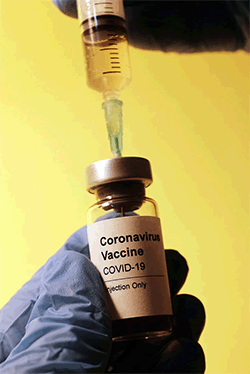
Coronavirus-vaccine. Photo

Adam Gaertner has posted a zinger of a provocative article, to say the least. Thanks to David Archibald author of The Anticancer Garden in Australia for pointing me at it.

A New Mutation threatens a Fragile Recovery

What if mass vaccination with imperfect vaccines could promote the survival of nastier strains of Covid? What if the leaky vaccines act like a filter for more dangerous versions of SARS2?

This doesn’t happen with most vaccines, only “leaky” ones.  But it has happened in chickens with a virus called Marek’s disease.

Leaky vaccines generate a half-baked immune response  — one that stops illness, but allows transmission, so a vaccinated person can theoretically infect others. This is bad but not awful — as long as the virus gets eliminated in a timely fashion. But if the virus can cloak itself from the immune system, and hide in protected cells, then it can keep replicating for a long time, and eventually, randomly, it will escape the imperfect immune response. Those  mutants will be resistant to the antibodies or t-cell tricks. Thus newer strains of Covid may arise that are already pre-loaded with goodies to get around our immune system.

This is not how pandemics normally work

In most pandemics, after a few years, the nicer strains out-compete the nastier ones. Natural selection favours viruses that don’t kill or disable their human shedders. A sick body on the move is a more efficient spreader than someone flat out on their back in bed. It takes two things to break that pattern. One is a leaky or imperfect vaccine. The other thing is that this virus appears to have the ability (like Marek’s disease) to cloak itself from our immune system and hide in protected cells. This combination could make for a perfect storm, where vaccinated people feel OK, but viruses hidden away within keep sending out copies that test the half-baked immune response in a holding pattern until one lucky mutant virus escapes the net. The new variant is nastier and trickier than the last one and we need to redesign a new vaccine. Repeat, rinse, recycle a few times and we might be breeding a virus that is more easily spread and has a higher mortality rate — especially for unvaccinated people.

This process is called immune escape, and once you know where to look, it seems virologists have been warning of it (and here, and here).  But not necessarily expanding on just how bad it could be. They only mention that we might have to produce a new vaccine. (Gosh, darn, won’t Big Pharma be disappointed?) But there are reports of new “immune escape” variants, like the one in West Bengal.

Look at what happened to chickens and Marek disease

Chicken, Photo. William Moreland. Unsplash.

Photo by William Moreland.

Who knew? In the last six years it’s been confirmed and accepted that vaccines played a role in creating a much nastier and deadlier form of Marek disease in chickens (MDV). Over the last 50 years, we’ve made vaccines that stop the chickens getting cancer and dying, but don’t stop them shedding virus and infecting other chickens. Unlike most viruses MDV can sit latent “for life” and slowly churn out copies while also suppressing the immune system. So each chicken becomes a kind of slow slot machine in a game of viral poker. The chickens immune system holds it at bay, but sooner or later, the virus finds an escape route around the immune system, becoming more infectious, more virulent, and effectively bypassing the current vaccine. This process started in 1970 with the first vaccine which at the time stopped 99% of Marek’s disease. The disease originally had a low mortality but after 50 years, the MDV virus has become a kind of monster, and is considered to be 100% fatal to unvaccinated chickens. For a chicken, the odds are worse than Ebola. What have we done?

How imperfect vaccines created the conditions to select for a nastier disease

Andrew Read et al, in 2015:

MDV became increasingly virulent over the second half of the 20th century [,]. Until the 1950s, strains of MDV circulating on poultry farms caused a mildly paralytic disease, with lesions largely restricted to peripheral nervous tissue. Death was relatively rare. Today, hyperpathogenic strains are present worldwide. These strains induce lymphomas in a wide range of organs and mortality rates of up to 100% in unvaccinated birds. So far as we are aware, no one has been able to isolate non-lethal MDV strains from today’s commercial (vaccinated) poultry operations [,]. Quite what promoted this viral evolution is unclear.

 The imperfect-vaccine hypothesis was suggested as an evolutionary mechanism by which immunization might drive MDV virulence evolution [], but there has been no experimental confirmation. Our data provide that: by enhancing host survival but not preventing viral shedding, MDV vaccination of hens or offspring greatly prolongs the infectious periods of hyperpathogenic strains, and hence the amount of virus they shed into the environment.

Andrew Read proposed this imperfect-vaccine idea in 2001, but it was purely theoretical until he was able to test and confirm it in 2015. His work was described by Ed Yong, National Geographic:

The duo infected vaccinated and unvaccinated chicks with five different strains of Marek’s virus, of varying virulence. They found that when unvaccinated birds are infected with mild strains, they shed plenty of viruses into their surroundings. If they contract the most lethal strains, they die before this can happen, and their infections stop with them. In the vaccinated chicks, this pattern flips. The milder strains are suppressed but the lethal ones, which the birds can now withstand, flood into the environment at a thousand times their usual numbers.

So don’t mix vaccinated and unvaccinated chickens, right? I can’t see this working in humans…

Read and Nair also found that the “lethal” strains could spread from one vaccinated individual to another, and that unvaccinated chickens were at greatest risk of disease and death if they were housed with vaccinated ones.

The chicken industry has learned to live with Mareks disease. Unvaccinated chickens though, have not.  And the industry loses $2b a year as well. Chicks are reared separately from mum and dad apparently, so they can survive long enough to get the vaccine and get protection before they risk catching the disease. Some people keep unvaccinated backyard flocks, but those chickens don’t go on holidays, or to weddings or funerals and rarely meet other chickens. None of this translates too well to homo sapiens. Dystopia 2025?

Look at the mutations in just one patient alone:

To get an idea of how big a problem this could be, consider that one particular transplant patient who had Covid and was on immunosuppressants, was infected for 170 days last year before finally clearing the infection. Weigang et al 2021, followed him closely. They identified the different mutants as they arose, and also testing them to see if they could infect live cells in a lab. For those of us who like genetic engineering, this paper is like a reality TV show with live sequencing. Hot

Dr Liji Thomas MD

The patient developed mildly symptomatic COVID-19, and tested positive for 145 days. The daily swabs showed the virus was developing an array of substitutions and deletions of amino acids in the spike protein, which were partly resistant to neutralizing antibodies.

Did remdesivir save the day? Using antivirals to stop extended infections makes sense, given the risks. (But why wait til Day 140 when we could start on Day 1?)

The aim was to allow the body to mount a more effective antiviral response. On day 140 the patient remained RT PCR positive, and was put on remdesivir for 10 days. From day 149 to 189, all subsequent tests were negative, and the pathogen could no longer be isolated, indicating viral clearance.

Do the math: There are 1-2 new mutations per month, per infected person?

The typical rate of mutations is about 1-2 mutations a month, and this was confirmed in the present patient, with the relative stability of the viral genome over the early period of the infection.

From day 42, mutations began to accumulate, including the D614G substitution that is now globally dominant.

The researchers tested the various versions of SARS2 in mice and found that the mutations made the virus less deadly between days 35 and 105. But the virus was also picking up mutations that meant antibodies were not binding as well to it.

The study thus supports the emergence of new variants that evade immunity in chronically immunosuppressed patients, as also reported with patients treated repeatedly with antibody cocktails and convalescent plasma. The variants in this study resemble the current UK, South African and Brazil variants, with escape mutations in the same spike region. (Weigang et al 2021).

Those were some pretty serious mutations in just one guy?

This doesn’t happen with all leaky vaccines. For example, Poliovirus vaccine allows some leakage but after fifty years of use, the virulence hasn’t increased. However shedding of poliovirus only lasts for two weeks, not months, not long enough to generate mutations perhaps?

Where to next?

If vaccinated people are or start to produce more deadly variants, there will be even more calls (if that’s possible) to vaccinate everyone on Earth plus their cats. People may use the term “herd immunity” but it doesn’t apply. Herd immunity means immunized people protect the vulnerable by not transmitting the virus. And even if we could and did vaccinate everyone (ignoring all the risks and ethical questions for the moment) that isn’t a solution. It’s just a temporary stop-gap until the next and nastier round in the arms race. Obviously we are not going to live like chickens with a highly fatal disease knocking off the unvaccinated. (Surely?!)

Things we can do:

  1. Use antivirals to finish the job and kill off the dangerous mutations in vivo before they get out. We already have  Ivermectin, Hydroxychloroquine, Budesonide, Bromhexine, Zinc, and others. Did I say Ivermectin?
  2. Develop perfect vaccines (figure out how to get our immune systems to avoid infection, and eliminate the virus). The good new is that five years after the idea of leaky vaccines was confirmed, there is a new Marek’s Disease vaccine that has stopped chickens shedding the virus. So it can be done.
  3. Develop new techniques like CRISPR or siRNA to edit those viral genes right out of our cells.
  4. In the meantime, hard borders will slow this down (for nations like Australia and New Zealand). Incoming travellers may need to be monitored to make sure the virus is not hiding and being reactivated

In a bioweapons arms race (with a virus, if not a nation) all the West should be setting up bigger and better biotech labs. A bonanza of discoveries will come out of these medical advances, but every month matters. We may be on the cusp of the new glorious antivirals era, much like the transformation we saw after World War II with antibiotics. Feeling sick, just pop in to the doc and get an antiviral on the way to work?  Why waste another dollar on fake green energy if we can be biotech leaders instead?

It’s possible that our immune system may have some extra tricks we don’t know abou

Keep reading  →

9.4 out of 10 based on 70 ratings

Tuesday Open Thread

….

7.6 out of 10 based on 10 ratings

UK Labour chained to political correctness, set to lose, and lose, and lose…

Political correctness is the correct way to lose every election. By its very nature, virtue signalling is almost guaranteed to be an electoral disaster. The whole game is to get to the top of the pecking order and mark yourself as being above the unwashed riff raff. A long time ago, if your brain wave was a good idea, the riff raff would adopt it too, which was all fine and good, except then you need another different good idea.  And when all that’s left are more absurd signalling displays:  Can you control the weather with your plastic shopping bag? Can you set people free by vandalizing statues?

Labor Parties all over the world suffer from the same thing. They stopped listening and caring what the workers think.

h/ t David  E

Look at the massive disconnect here:

Poll proves wokery lost Labour ‘red wall’ seats: 

Glen Owen, Mail on Sunday

Sir Keir Starmer’s Labour Party is out of touch with public opinion on woke issues, a Mail on Sunday poll has found. The survey revealed that the party was overwhelmingly associated with support for politically correct issues – such as pulling down statues of historical figures – that are not backed by voters.

The figures will add to concerns among Labour strategists that the party’s metropolitan image is alienating its working-class base, particularly among its former supporters in the North.

UK poll on politically correct values

….

The Labor Party have an image problem. They tried to look politically correct and everyone believed them.

At least the conservative government is trying to make it harder to cheat in the election:

UK government to introduce criticised voter ID law this year

…Britain’s government will introduce a new law this year to crack down on the potential for voter fraud and intimidation by including rules requiring voters to prove their identities, a move critics said could deter people from casting ballots.

“Stealing someone’s vote is stealing their voice. We must go further to protect and modernise our precious democracy,” Chloe Smith, minister for the Constitution and Devolution, said in a statement.

POST NOTE: And this is not a good thing for Western democracy. When the opposition party is captured by Wokeness there is no one left in the centre to argue for better policies. The so-called Conservative party slides toward political correctness too. Always better to have two strong major parties than none.


9.7 out of 10 based on 54 ratings