Recent Posts
-
Lucky us, The UN deigns to not list the Great Barrier Reef as ‘in danger’ (yet again)
-
Wednesday
-
Blackouts and maintenance problems hit farmers forced onto solar and batteries in Western Australia
-
Tuesday
-
Monday
-
Sunday
-
One Nation are now the Party of the workers, and Labor the party of wealth and academics
-
Saturday
-
Net Zero anyone? USA bets big on coal and gas — overtakes China in spending.
-
Friday
-
Winning: Trump persuades The World Bank to drop its huge spending target on “climate”
-
Thursday
-
Bafflement?! Germany, a global leader in renewables but has one of the highest EU electricity prices
-
Wednesday
-
Horse-drawn carriages must have caused a Megadrought in Europe in 1540, right?
-
Tuesday
-
Monday
-
Sunday
-
UK facing devastating 36 degree heat — can’t decide whether to use air conditioners or rip them out
-
Saturday
-
Batteries failed on day One: A four day wind drought in South Australia wreaks havoc, high prices
-
Friday
-
The UN wants to be One World Government and it starts with a carbon tax on ships and planes
-
Thursday
-
What if Global Warming was just because something made the clouds go away…
-
Wednesday
-
Snowy 2.0 is the Trillion dollar Black Hole of Australia — sucking in energy, money, land, industrial relations, the dollar, our lifestyle
-
Tuesday
-
Monday
-
Winter Solstice
-
Saturday
-
We were throwing-renewable-energy away at record levels in 2025
-
Friday
-
Pauline Hanson, the centrist, just wants a free market in electricity, and an end to the renewable energy bribery
-
Thursday
-
Blame the Climate Yeti again for making your life more expensive! (It’s a smokescreen)
-
Wednesday
-
The Sunrise Project funneled $343 million from overseas to push net zero
-
Tuesday
-
Monday
-
Sunday
-
The US government has been secretly funding 120 dangerous biolabs around the world
-
Saturday
-
New report shows renewables are a drag on our national productivity
-
Friday
-
Thursday
-
Well, how convenient. AI data centers have arrived to be the fall guy for the Energy Minister
-
Wednesday
-
Billionaires are leaving the room with excuses — Bezos says “AI will solve climate crisis”
-
Tuesday
-
Monday
-
Sunday
|
Dear Paul,
Thank you most sincerely for writing to reply to my email. Thank you for taking the time to contact Nature, and thank you for the recognition that the term “denier” causes offense.
Do we also agree that the term denier fails basic English, and cannot be defined as a scientific label because you still are unable to say what deniers deny?
“I think if you understood where skeptics were coming from it would help you design surveys that produced useful results. Basic research, like reading what leading skeptics were saying, would seem a bare minimum requirement before designing a study.”
As far as I can tell, I suspect what you feel deniers deny (though you appear reluctant to actually state it) is not any scientific observation, but the pronouncements of the highest authority of climate science (which you deem to be the IPCC).
“I do believe that the technical aspects of this debate should be between climate scientists, as with complex multi-disciplinary issues it is very easy for findings to be misconstrued by non-experts. Whether you like it or not, the majority of climate scientists agree that there is a high likelihood that anthropogenic climate change exists and is likely to be a problem”
Since the IPCC, and all climate scientists are government funded, “deniers” then are the people who doubt the propaganda, the dictat, and in other times you would call people like these “dissidents”, or “heretics”, or indeed, the true scientists — since they keep asking for evidence. You are essentially asking us to believe in authority, a fallacy known since Aristotelian times, and a concept deeply anti-scientific.
You say it’s definitely valid to debate climate science, but then say that only “climate scientists”TM can do it. Which means, you do think it’s invalid for us to debate climate science, or to ask questions of the registered approved government appointed hierarchy. We should all be obedient citizens right? — even if those experts broke the law by hiding their data, lost entire global record sets and make “skill free” predictions too?
Is Jo Nova inconsistent? She “talks about politics and funding too”.
Should I chastise myself for delving into social issues? Dearest Paul, here’s the brutal truth. I’ve been utterly consistent in my 850 articles — when I make conclusion about the climate, I use observations from the planet. When I make conclusions about socio-political matters, I talk money, politics, and people.
There are dual separate strain of topics of which evidence from one stream never crosses into the other:
Planetary Temperature (measured in C) –– > depends on Sun, moon, types of gases, orbits, dust, cosmic rays from the centre of the universe etc etc —> Uses observations from thermometers, proxies, coral slices, ice cores, stalagmites, tree rings, mud layers –> predicts (not much yet) … more cycles like the last ones.
Consensus (a “Yes-No” thing) –> depends on opinions, research, fashion, money, best estimates, personal motivations, political parties, demographics of peer group surveyed, and decade —> measured in dollars usually, and occasionally votes. (Subject to change rapidly)
I have never said: The IPCC are wrong because the government funds them (which would be an ad hom). The IPCC are wrong because 28 million weather balloons, 6,000 boreholes, 3,000 ocean buoys, and hundreds of thousands of original raw surface stations suggest the IPCC are exaggerating the future temperature increases by around 6 – 7 fold.
The reason why a science institution could be so wrong, when so much evidence points against them, is a socio-political discussion, and I go there, but I don’t mix up the reasoning. (Will it stretch the friendship if I say that you do?). You ask me to believe the world will warm by 3.3 degrees because a government appointed agency (the IPCC) says so, and to corroborate that, you mentioned that the IPCC has “even” convinced governments to act on its’ policies? Is there a more circular form of argument-from-authority that this?
I always know which point I’m making. But when you say the future temperature of the planet is measured in consensuses, I wonder what the standard deviation is, and I suspect it’s not normal.
Here’s Denial: The real socio-political evidence that many won’t “see”
Keep reading →
9.6 out of 10 based on 134 ratings
I’m impressed (really quite surprised) that this made it to the top story of the front page of The Australian. The syllabus for Years 10 -12 science students in Queensland contains this nonsense. What is good about it though (see below) is how it forces influential science leaders in the country to pick sides. Is science a “consensus”? Even on Climate Change? No says the Dean of Deans…
The Queensland Studies Authority:
“Science is a social and cultural activity through which explanations of natural phenomena are generated,”
“Explanations of natural phenomena may be viewed as mental constructions based on personal experiences and result from a range of activities including observation, experimentation, imagination and discussion.
“Accepted scientific concepts, theories and models may be viewed as shared understandings that the scientific community perceive as viable in light of current available evidence.”
[QSA, Physics Senior Syllabus, 2007] [QSA Chemistry, 2007] [QSA, Biology 2004 amended 2006]
The answer from QSA (The Queensland Studies Authority)?
They said the statements concerning a view of science and science education should be read in the context of the entire syllabus and it was not, and was never intended to be, a definition of science.
In other words, they have nothing. No defense. Someone was asleep at the wheel when that syllabus got approved and since it has sat there for five years with little protest we can only assume: 1/ Most science teachers in Queensland don’t know what science is, or 2/ Most science teachers in Queensland don’t read the science curriculum, or 3/ perhaps some science teachers read it, and complained to the QSA and it did nothing.
Either way, it’s not a good look. But given that people like Prof Tim Flannery, ABC Science Presenter Robyn Williams, Prof Will Steffen and Prof Andy Pitman don’t know what makes science different to religion perhaps it shouldn’t be a surprise that curriculum writers are struggling.
Prof John Rice understands the scientific method
“Australian Council of Deans of Science, Executive Director, John Rice from Sydney University said it was a misleading view of science and misunderstood “the unique way in which science goes about understanding things” “That’s quite wrong. It fails to understand the way in which science grounds itself in observation and testable hypotheses.”
Professor Rice said the national science curriculum made a similar error, oversimplifying the idea of scientists proving and disproving hypotheses to suggest that scientific knowledge was agreed by consensus among scientists.”
In an interview with Emily Bourke on the ABC, Prof Rice is confronted with the “climate change” monster, and sticks to his point:
Keep reading →
8.8 out of 10 based on 52 ratings
Dr Paul Bain has replied to my second email to him which I do most appreciate. (For reference, see the letter he is replying to here: “My reply to Dr Paul Bain — on rational deniers and gullible believers” ). He deserves kudos for replying (it’s easier to ignore inconvenient emails), and also for taking some action to improve the article he published. I will reply properly as soon as I can. For the moment, and for fairness’s sake, it’s here for all to see.
Please be constructive and polite in comments. No, I don’t think there is any scientific reason (or definition in the English language) that validates the term “denier”, but Nature is going to publish an addendum this time, and that will be noticed by other researchers in the field. That is progress. Though there is a long way to go. — Jo
——————————————————————————–
Dear Jo (if I may)
I apologise for my long and delayed response – while I would like to be more succinct, I have to resort to Pascal’s excuse that I’m writing a long response because I didn’t have time to write a short one.
First, an update. As we all know, after publication it quickly became clear that the “denier” label was causing offence, and I contacted the journal’s editors to canvass options for addressing this. As the article was already published, it was agreed that the most practical option would be to include an addendum to the paper where we publicly expressed our regret about any offence we caused. This will be appended to both the online and printed versions of the paper. As you said, you yourself did not mention a link with Holocaust denial (and I myself did not hold such a link), but this was by far the most common association made by people who took the time to write to me personally to express their offence. By doing this, I don’t expect this to resolve (or even reduce) any issues (I fear that the damage is done), but I thought this was an appropriate thing to do nonetheless.
To your point about the issue being only about climate science (specifically that this is the “only real point”), I am definitely not saying that it is invalid to debate climate science and the reality of anthropogenic climate change (or its extent or causes). However, I do believe that the technical aspects of this debate should be between climate scientists, as with complex multi-disciplinary issues it is very easy for findings to be misconstrued by non-experts. Whether you like it or not, the majority of climate scientists agree that there is a high likelihood that anthropogenic climate change exists and is likely to be a problem. You and your fellow-travellers may not be fans of the IPCC, and all institutions have their faults, but that is their overall conclusion. Further, through the IPCC and other sources, scientists have provided evidence that may not convince you, but has been of a sufficient standard that governments over the world are prepared to act, often despite its political unpopularity.
Now perhaps you might claim (and some of your fellow-travellers do claim this) that the IPCC is a corrupt political institution, and that scientists are dramatizing the problem to gain funding, etc. However, this would be admitting that there is a social and political dimension to the issue, and such assertions directly contradict your claim that the issue is only about the science. So if you were to be consistent, you should be chastising not just me, but your supporters/commenters who make claims that go beyond the science, and even revisit some of your own blogs to see where you have strayed from just assessing the science and delving into social and political issues.
Returning to the science argument, I don’t begrudge your view that there is insufficient evidence – this befits the idea of skepticism. But if you and others truly believe the science is wrong, then in my view the most productive approach would be to produce an alternative expert report (say the ISPCCE – Inter-Scientist Panel on Climate Change Errors) – I expect you could find a source of funding for it. In this document (contributed to by experts on climate science, not the general public) you would need to come to a consensus on what the issue is (is climate change occurring, is it anthropogenic or not, if anthropogenic – is it harmful or not, if harmful – how harmful), and to a consensus on the scientific basis for that view (or for a plausible range of views). On each of these matters I was emailed with widely diverging views from climate skeptics, which will probably represent quite a challenge for such a document. But if you could produce a coherent scientific document that faithfully summarizes skeptics’ views on climate change, and provided a better explanation of the science than the IPCC, then I expect you would have a much better chance of stopping the policies you oppose. Some might argue that you shouldn’t have to –it is the responsibility of the proponents to prove their point. I would counter that while this view is defensible as a debating point, it is unproductive in advancing scientific understanding – and to change the field in the “right” direction requires replacing dominant theories with better ones.
Of course the scientific issue is necessary, but it is one with political and social implications, and it would be foolish to deny these. Indeed, in blogging about bias in the IPCC and among climate scientists, and commenting on politically-motivated actions, it seems you don’t really believe it’s only about the science either. So it’s a bit bold to claim it is invalid for us to do research on broader social and policy perspectives, when it’s ok for you to comment on the same. Some might even say it’s doctrinarian, though I won’t go as far as making the Soviet comparisons you incorrectly imputed to us. It is also sending a message that those in the climate skeptic community who think about the social and policy implications beyond climate change itself should be ignored.
And finally to our study and it’s supposedly manipulative deception. Our original submission to the journal only had the first study, where all we did was ask about what the effects of taking action on climate change would be. Our finding was that some people, though unconvinced that anthropogenic climate change was occurring, were willing to support action because they thought it would have some positive social benefits. This is just a description of the pattern of responses, and describing people’s reaction to a neutral question can hardly be called manipulative. The editors, as scientists, wanted more than correlational evidence, hence the second study. We were wary of not being too leading in this study, so all we did was tell participants that there were a range of views of the effects of taking action on climate change (a true statement), and that they were going to read one of these views. It is no more manipulative than if they heard the views of a real participant from Study 1 on the street. What is interesting is that I don’t see these views expressed publicly – possibly because they are seen as unacceptable in the skeptic community, or perhaps because the most prominent public skeptics such as yourself portray such views as illegitimate. But back to the study, being exposed to a broader perspective must have been valuable to some of them at least, as they were more supportive of action when they considered these broader consequences. Now this outcome was not inevitable – they could’ve thought such arguments were garbage and have been unaffected or less supportive. But some of them didn’t, and this was probably because they were able to reflect for themselves on a perspective that they may not have heard before. It is not manipulation to give someone a different perspective on an issue that reflects a real view, and let them draw their own conclusions from it.
Now you seem to find the views of these people as illegitimate because they do not address the only real point, and those who hold those views are probably not the people represented in your blog. But our research suggests that there are a substantial number of skeptics who have this view, and I would encourage them to speak up in these debates. That’s democratic.
Regards
Paul.
——————————-
Thought from Jo: What about NIPCC?
I will do a proper reply soon, but in my email reply to him I wrote: “I’ll mention only one point now, though I have many I could make, and that’s when you suggest “ ISPCCE – Inter-Scientist Panel on Climate Change Errors” – I agree, but it’s such a good idea, that it’s already been done. See NIPCC (Nongovernmental-International-Panel-on-Climate-Change): cumulatively more than a thousand dense pages of peer reviewed references, purely scientific, non-politicized discussion of all the evidence. Unlike the IPCC it doesn’t quote activists, magazines, or ignore important papers.
PS: I have asked mods to [snip] unhelpful comments. This is your chance to help Bain understand the group he studies.
PPS: Dr Bain sent this Friday, but I held his reply to post first thing in business hours his time. It seemed a fairer thing to do that having the conversation over the weekend.
8.1 out of 10 based on 57 ratings
Dr Paul Bain sent me his second reply to my second letter late on Friday, which I am grateful for. I’ll post it in a few hours (scheduled 9am Monday morning Eastern States time, which is 7pm NY Time). It seemed fairer to let the conversation unfold in business hours, rather than releasing it over the weekend or at midnight.
It’s your chance to help researchers studying skeptics learn more about what we think. — Jo
8.3 out of 10 based on 20 ratings
Keep talking…
6.1 out of 10 based on 23 ratings
It was a dumb memo to write:
“Brumby’s recommended some “simple things for you all to do to find some extra sales”.
“We are doing an RRP (recommended retail price) review at present which is projected to be in line with CPI (consumer price index), but take an opportunity to make some moves in June and July, let the carbon tax take the blame, after all your costs will be going up due to it,” Mr Priest wrote.”
“It is understood the newsletter was sent to franchise owners last month.” [The West Australian]
But the outcry about it is over-the-top. It has drawn national interest, been published on the news around the country. The company has issued apologies. The outrage has been so overdone, that today managing director of Brumbies bakery’s (Deane Priest) resigned.
The memo was dumb because it wasn’t suggesting a totally honest approach, and because it projected the wrong attitude to staff of Brumby’s, and it was especially dumb, because there is a witchhunt on for any business which blames a fraction of a cent more than they should on the carbon tax. With 300 stores across the country there was a 100% chance of at least one staff member being a fan of the carbon tax, or the Labor Party, and leaking it to the press, whereupon it would fuel the fire at the stake being readied for some random unlucky sod.
Don’t mistake me, trying to pull one over on customers is a bad-and-mad business strategy, but at the end of the day, the customer was still getting the same load of bread, for a price agreed in advance. If they didn’t like the price (or the tax quotient), they can always shop at Bakers Delight, right?
In normal times, sloppy memos like that one never make it to the national news. The company is not making itself richer by promising that the bread contained Hand-Seeded Organic Aztec Flax while it was really made with GM wheat from Weifang, China. If the memo was cheating anyone here, mostly it wasn’t the customer, it was the government. If Brumby’s was trying to sell more bread by pretending that a larger cut of the price was “helping the environment” then that would be deceptive, and customers could rightly feel aggrieved that more of their money was not subsidizing bird-chopping fans, as they had been led to believe — but they weren’t. Brumby’s, or rather, Deane Priest, was trying to cheat the government of it’s story that the price rise due to the carbon tax would only be 2 cents.
So look how effective that threat of fining businesses $1.1million dollars is already? It didn’t need to be invoked, or tested in the courts (which could potentially backfire badly) it just needed to be announced, as long as the furore against it was moderate and bearable, and it was.
Thus the Labor Party have silenced their critics – and I’m not talking about Deane Priest, I’m talking about all the honest business people watching the news for the last two days who now know absolutely that it’s better not to mention the carbon tax, unless they do it in cautious careful terms, with their lawyer at their side.
The regulation never needs to be tested in court, it merely needs to hang like a cloud of dengue-filled mosquitoes. The drone with encephalitic undertones will clear the area.
Keep reading →
9 out of 10 based on 48 ratings
We know there is something wrong when we pay public servants to serve us, and they provide us with temperature records that are not the same as the original data, but they won’t explain why they adjusted them. We know the system is rotten when the inexplicable adjustments are used as an excuse to take even more money. We’ve tried FOI to get the information, but they ignore it. We’ve asked the National Audit Office to audit the records, but the people who adjusted the records are essentially the same ones who control them, so they just changed the records again, and said the audit request applied to a set they did not use now.
Today we announce a new approach — Anthony Cox and others are pursuing the legal option. It’s a creative strategy — he‘s approaching this through consumer protection laws.
Is there a chance consumers could be misled by reports that don’t include the uncertainties? We think so. – -Jo
—————————————————————————-
Guest Post: Anthony Cox — Legal Action Against AGW
 Image: Wikimedia
In New Zealand there is an ongoing legal action against the government producer of the New Zealand temperature record, the National Institute of Water and Atmospheric research Limited [NIWA].
Researchers found the temperature record produced by NIWA had a warming bias which basically created a warming trend of 1C per century when the raw data showed no increase at all. After being stonewalled by NIWA the researchers issued a Statement of Claim seeking a Judicial Review of the temperature record.
The Defence issued by NIWA was novel in that it claimed there was no official New Zealand temperature record [clauses 6 & 7].
An Amended Statement of Claim was issued and the case is now at the Affidavit stage. Could a similar case be brought in Australia challenging the validity of the Australian temperature record which is prepared by the Bureau of Meteorology [BOM]? There are similarities between BOM and NIWA: both have adjusted their temperature record and both have created a warming trend through the adjustments. The BOM’s has adjusted their temperature trend by approximately 40%. This appears not to be consistent with criteria for adjusting temperature laid down by Torok and Nicholls and Della-Marta et al.
Keep reading →
8.7 out of 10 based on 71 ratings
It was for a moment the clash of the Nobel Prize winners on climate change… just barely, but nothing like this has happened before in the debate-that-isn’t. Normally this is not a show the heavyweights turn up too. But there were three Nobel winners in the room at the same time.
Paul Crutzen, Mario Molina and Sherwood Rowland won the 1995 Nobel for work on Ozone. Both of the first two are fans of the man-made global warming theory and they both spoke just prior to notable skeptic Ivar Giaever (who won a Nobel for tunneling in superconductors in 1972).
[UPDATE: Watch Giaever speak – the whole speech – it’s excellent. h/t Roberto Soria]
As usual, the core arguments of believers comes down to argument from authority. Can they attack the credentials of the dissenters? The skeptics, the real scientists, talk about evidence.
From Scientific American by Mariette DiChristina
Crutzen:
“The scientific evidence is really overwhelming. Most experts agree; maybe two or three in 100 disagree.” He added, “I know who they are and why they are wrong.”
Keep reading →
8.7 out of 10 based on 146 ratings
Australians are spending $77 million a week to try to replicate the stable climate we had with CO2 at 280ppm. So just how ideal was that climate? Newspaper reports of the times were filled with stories of droughts, then floods, bitter cold, and fires that wasted the land. Hmm. Something to aim for then?
And what did the scientists of the day say then? Back before anyone had a hand-calculator or a satellite, the choices were: Orbits, natural cycles, magnetic effects and man’s influence. How times have… not really changed all that much.
Published in 1860 The Sydney Morning Herald.
THE following paper was read at the fortieth monthly meeting of the Australian Horticultural and Agri- cultural Society, on Tuesday evening, by Mr. Robert Meston.
 If the 60 year PDO cycle is sketched backwards we would expect temps to be cooler in the 1790’s and 1850’s and hotter in the 1820’s and 1890’s. During the “perfect” climate of the preindustrial era — apparently there were still floods and storms. (?!)
“To begin with British observations. 1697-98-99 were three bad years—years of floods and storms. 1700 proved hot and dry during sum- mer, and 1703 was the last of what are technically termed the seven dear years. 1740 was memorable for its great flood, and was distinguished as the rainy harvest (wetty harvest). 1701-02-03 came in as dear years again. Next 1768, and its great floods, in which year Britain imported 1,300,000 quarters of wheat. 1769 was noted for its mild winter ; 1782 as the snowy harvest in Scotland, and 1784 as the year of abundance. 1799 brings another great flood, and 1800 a dry year, with wheat 110s. a quarter. 1802 is remarkable for the great shake of September 10th, and severe frost of the 13th following. February 14th of 1811 is recorded as the coldest in a century, the thermometer falling two degrees below 0. 1822 is famous for a general snow storm, and 1828 as a most abundant year for Scotland, but very dry in England. Then we note 1829 as the recurring great flood, and next mention the three bad years of 1837-38-39, fore- told by Captain McKenzie six years before their advent.
“For hurricanes of wind, the great gale of October 10th, 1838, and of January 8th, 1839, have only been matched by the wind storms on the British coast in 1859. At midday, previous to the gale of 1839, the barometer fell to 26½.
“In course of our flood predictions, reports of floods in 1856 were anticipated years ago over Europe and Britain. Nor were our forebodings unfulfilled. To beg or borrow a term, some of these form the greater phenomena, and other observers may be able to fill up gaps which, very probably, have been overlooked or omitted in the compiler’s memoranda.
Keep reading →
8.7 out of 10 based on 46 ratings
Just which Big Scare Campaign is the worst?

Thanks to Thanks to Steve Hunter h/t Andy’s Rant.
The Australian Labor Party has been crying “Tony Abbott’s Scare Campaign” in every second interview on the carbon tax. I guess we could call this whipping up a scare about the scare campaign. Except that Abbott was responding to the primary scare, so cries of “Scary Abbott” are the counter scare to the scare that counters the real scare campaign.
We’re not just talking of job losses and electricity bills. The ALP forecasts Hell. The prophesies are for centuries of killer heatwaves and mega-fires — seas may rise 7 m threatening 700,000 houses and melting Greenland; the houses that aren’t inundated might be razed by fire; acid will leach through the oceans wiping out the Great Barrier Reef (and 60,000 jobs). The entire agriculture industry of the Murray Darling irrigation basin will disappear….and deadly mosquito plagues will spread and put more than a million people at risk.
The Labor Party are The Primary Scareholders
Here’s a member of Parliament doing his best to scare the pants off Australians (guess who?)
Excerpted:
“The massive stores of heat in the world’s oceans means climate change cannot be reversed for many centuries.
… if we fail to control global greenhouse gas emissions global average atmospheric temperature could rise by up to 5 or 6°C above 1990 levels by the end of this century. These are dramatic temperature increases. To provide a point of comparison, the difference in average global temperatures between the last ice age and today is about 5°C. These temperature changes would be accompanied by significant and ongoing rises in sea level, heat waves, bushfires and droughts, disruptions to ecosystems including the extinction of many species, disease threats, and social and geopolitical destabilisation.
Keep reading →
8.7 out of 10 based on 66 ratings
Australians will pay $77 million per week in carbon taxes, while Europe with the 30 most green countries pays just one third of that, according to the Mineral Council of Australia.
“Australia’s carbon tax starts generating $77.3 million per week from today. New figures from the Centre for International Economics show that Europe’s emissions trading scheme — which covers 30 nations — has generated $23m per week so far in 2012.”
Wholesale electricity prices have stepped up by $21-25MWh (roughly doubling) overnight across the three largest states – apparently $2 more than was expected.
The ACCI points out the contradiction in sending a price signal but intimidating anyone who dares to say how big that signal is.
THE Australian Chamber of Commerce and Industry has taken a swipe at the consumer watchdog, accusing it of intimidating commercial operations and trying to mask the cost impact of the carbon tax on business.
ACCI’s director of economics and industry policy, Greg Evans, said yesterday the purpose of the carbon tax was to introduce a price signal into the market, but the Australian Competition & Consumer Commission was trying to prevent businesses from attributing increases to the impost.
“It’s basically saying to business: don’t attribute price rises to the carbon tax, otherwise we’ll come after you,” he said. “Wasn’t one of the whole points of this that you are actually trying to send a price signal? [The Australian]
Companies can incur fines of $1.1 million per breach and private entities could pay $220,000 per breach if found guilty of deceptive and misleading conduct under the Australian Consumer Law.
Flashback to all those signs I wrote up when we first heard we could be forced to pay a $1.1million fine for overestimating the effect of The Carbon Tax on our prices.

Shop owners — do feel free to plagiarize ad lib. No copyright on those images.
Keep reading →
8.9 out of 10 based on 89 ratings
Posted in comments by “Carbon Free”
———————————————-
I sit here in my living room with just a few minutes left before midnight & ‘Carbon Sunday’, now in my dark cold residence, using only a battery powered smart phone to blog, as I start my new low greenhouse gas existence. Already the new evening meal of beans and vegetables is starting to become uncomfortable. I dare not pass wind for fear of adding to the earth’s methane levels, and I have tried not to exhale my CO2 directly into the atmosphere, but rather store it in environmentally friendly plastic bags where it will be released into my new hermetically sealed backyard greenhouse, where plants will convert my CO2 back to pure O2 and stored carbon.
My only sadness today was having all my pets put down. My dogs caused far too much emissions for the planet. Perhaps the vegan diet proved too much for their digestion systems but the thought of any living creature eating meat is far worse. Anyway, they will make good fertiliser food for the greenhouse.
Keep reading →
9.1 out of 10 based on 103 ratings
From the Liberal Party site June 29th 2012 the details we hope to see unfold. The thought makes the arrival of The-Tax-On-Everything this Sunday easier to bear… savour the anticipation, and hope we don’t have to wait too long.
Abbott vows he will dissolve the Parliament if the voters choose “No Carbon Tax” (again) and the Labor party denies them their choice. Could they? Would they? Is it possible the Labor Party might knock back the legislation to remove That Tax?
The Coalitions Plan to Abolish the Carbon Tax
As soon as an election is called, the Coalition will take immediate and concrete steps to repeal the Carbon Tax.
Repealing the Carbon Tax will ease cost of living pressures on families, help small business and restore confidence to the economy.
On the day the election is called, I will write to the Secretary of the Department of Prime Minister and Cabinet to make it clear that, if elected, the first priority of a Coalition Government will be the repeal of the Carbon Tax.
Within the spirit of the Caretaker conventions, I will also formally request the Clean Energy Finance Corporation to desist from making any further determinations in relation to grants, funds or financing.
If elected, the Coalition will take immediate steps to implement our plan to abolish the Carbon Tax.
On day one, I will instruct the Department of Prime Minister and Cabinet to draft legislation that repeals the Carbon Tax and to have the legislation ready within one month.
On day one, the Finance Minister will notify the Clean Energy Finance Corporation that it should suspend its operations and instruct the Department of Finance to prepare legislation to permanently shut-down the Corporation.
Keep reading →
9.6 out of 10 based on 90 ratings
UPDATE: Dr Paul Bain has replied to say that pressing work commitments mean he cannot respond to this until next week. We look forward to that, and I will make sure it is available for readers here (should Dr Bain permit). – Jo
———————————————————————————-
Dear Dr Paul Bain,
Thank you for replying (and so promptly). I do sincerely appreciate it. Apologies for my tardiness.
I do still think I can help you with your research. Indeed, in more ways than you realize.
You describe in your Bain et al letter in Nature, that the number of deniers is growing despite “enormous effort”. There is a policy problem. I absolutely agree. No one is having any success getting deniers to believe in anthropogenic climate change. Could it be that they don’t understand deniers at all?
Let’s go through the points in your email reply to me, then the bigger implications.
First and foremost – obviously you did not provide evidence to back up your assumption that the “existence” of catastrophic anthropogenic climate change is real. That doesn’t mean it does not exist, but I’ll get back to this. It is the key and only real point.
Secondly, you may regret the connotations with Holocaust denial (that’s good) but it is not the point (which is why I didn’t mention it). My problem with “denial” is more simple: it’s the conflict with its literal English meaning. The climate change debate is sold to the public as a science topic — so it follows that denier (as you use it) refers to being a “science denier”. Yet, despite that being the key logical definition of the term, that awkward point still remains, we still don’t know what evidence deniers deny?
if thousands of people are becoming deniers, they must have been believers before, and just what kind of denier changes their mind…?
Thirdly, there is another problem with defining deniers: if thousands of people are becoming deniers, they must have been believers before, and what kind of denier changes their mind — is there such a thing as a “flexible denier”? We have to wonder about deniers that are apparently able to adopt a new position, but then are unable to change it again? (Is it a form of group-Alzheimers where people were convinced, but “forgot” why, and now are impervious to hearing the same reasons that once convinced them, or could it be — alternate hypothesis here — that the believers are getting new information, and the explanations they used to believe are no longer convincing?) The first hypothesis involves a mass brain dysfunction, the second involves the internet working. Occam’s razor beckons.
I gather you feel that evidence about “the science” is not the point because you are studying the social policy? To which I would ask: Can social policies change the climate, or does climate change our social policies? Is reality the tide gauge results, or the council zoning? Dare I suggest that the point of all the evidence you published rests entirely on the evidence for man-made global warming (that base assumption) that you have not investigated? If there is no empirical evidence for catastrophic anthropogenic climate change, or if the formerly convincing evidence has changed* there is the mystery solved of the rise of the deniers, right then and there. Deniers are the ones following reality.
Using accurate terms
One group in our society thinks it can change the weather (you call these “believers”), the other half of the population are not convinced (you call these the “deniers”). The believers have not yet named any empirical evidence to back up their ambitious claims, yet expect the deniers to pay $1,000-$2,000 per household per annum in Australia. The believers want money from the deniers, while the “deniers” want evidence, data, logic and reason (and preferably a debate with good manners). Clearly these labels are inappropriate. Using standard English definitions, those who believe in phenomenon without evidence are gullible. Those who want evidence are rational.
Keep reading →
9.7 out of 10 based on 117 ratings
 CATA have organised a protest CATA have organised a protest
10 out of 10 based on 24 ratings
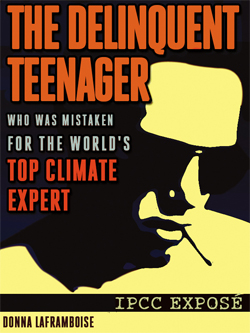
Donna Laframboise — author of the ground-breaking book “The Delinquent Teenager Who Was Mistaken for the World’s Top Climate Expert” and writer of the NoFrakkingConsensus Blog — is finally coming to Australia. I’ve booked. Have you?
Donna has been a key player, researching the way the IPCC works with an experienced eye of a real journalist (how rare). Her book scored media attention around the world as it documented how the so-called experts at the IPCC had often not even finished their PhD’s.
“In 1994, Kovats was one of only 21 people in the entire world selected to work on the first IPCC chapter that examined how climate change might affect human health. She was 25 years old. Her first academic paper wouldn’t be published for another three years. It would be six years before she’d even begin her doctoral studies and 16 years before she’d graduate.”
She described how WWF affiliates are lead authors and involved in two thirds of the IPCC’s 44 Chapters. She organized the citizens audit of the 18,000 odd references in the last IPCC report. The 40 volunteers checked every reference to see which were peer reviewed, and found that a staggering 5,587 or 30% were not.
Read her book if you haven’t already. See you at the presentation 🙂
Jo
Details on the events in Australia below…
Keep reading →
9.3 out of 10 based on 38 ratings
The Galileo Movement are offering to send out 1 – 5 cartoon posters to you to coincide with that Tax-on-Everything that starts this Sunday. To order, email Galileomovement AT gmail.com. Let’s help the people of Australia understand just why we will be paying billions.
The Galileo Movement are looking for 100 people to donate $5 each to cover the costs of printing and posting. I like this idea. I’ve ordered and donated. Do join in.
The Galileo Movement suggest posting this on shops and business in their local area and displaying it on windows or notice boards — anywhere it will be seen.
I like it… 😀

(Click on the image to enlarge it)
A special big thank you to artist Steve Hunter who has allowed The Galileo Movement to use his illustration. Click here to visit Steve’s website. (He’s good!) [Try here if that first link stops working, his site is moving.]
You can download copies and print them yourself:
Keep reading →
9.2 out of 10 based on 45 ratings
 I’m humbled and delighted. People are finding all kinds of creative ways to use that carbon tax compensation. (Thank you!) Gillards naked vote buying bribe is a step too low for conscientious hard working Australians. Here Geoffrey Houston wrote to let the Prime Minister know (and CC’d me): I’m humbled and delighted. People are finding all kinds of creative ways to use that carbon tax compensation. (Thank you!) Gillards naked vote buying bribe is a step too low for conscientious hard working Australians. Here Geoffrey Houston wrote to let the Prime Minister know (and CC’d me):
Dear Ms Gillard,
This note is to thank you for my Clean Energy Advance of $350, which arrived in my bank account yesterday. As a self funded retiree, extremely concerned for Australia’s future, it will certainly come in handy in the fight against your government’s destructive policies.
I have disbursed it as follows:
· $100 donation to the IPA, an organization working to defend free speech against the efforts of the Greens helped by your government and to reveal the futility and underlying deceipt of your carbon (dioxide) tax.
· $100 donation to the Liberal Party to support the fight led by Tony Abbott to win the next election and remove the carbon (dioxide) tax.
· $100 donation to Joanne Nova whose web site is a resource for all who wish to understand the science which refutes the alarmist claims underpinning your destructive carbon (dioxide) tax.
· $50 to the Galileo Movement, a grass roots organisation campaigning to remove your carbon (dioxide) tax.
I will be pleased to disburse in a similar fashion any further bribes which you send.
Geoffrey D. Houston., PhD
Another productive Australian seeking a good use for “tainted money”
Dear Joanne,
Attached is a Bank Transfer receipt for $344.88 being the amount that the Labor/Greens Parties are attempting to bribe (essentially my money anyway) me with by way of a ‘Clean Energy’ transfer to gain my vote.
I was born in 1942 and brought up in, what was then, a British colony in Africa. I lived and worked in that country for over a decade after their independence. In this way, I witnessed firsthand the transfer from a reasonably well administered country to what is now one of the more corrupt countries in the world. I have travelled quite widely and experienced different cultures over reasonably long periods in some. For instance, I worked and studied in UK for almost four years, I studied in USA for over a year and I worked in Papua New Guinea as a pilot/engineer for four years. I have also visited India several times over the years.
I never expected to see a third world level of corruption, in my lifetime, in Australia. The Labor/Greens are attempting to drag this great country down to those levels. I hope we, the voters, will be able to turn this situation around soon.
I would like to use your good services to ‘launder’ this tainted money as a contribution to your efforts in exposing the fraud that is ‘global warming/climate change/sustainable development’ fraud/scam. Please do not feel any bad conscience over the use of this dirty money – I know that you will put it to good use.
Prævalere veritas – Temperi gradus illegitimus carborundum
Best regards
Graham Chubb, Queensland
If you decide to invest your carbon tax compensation in removing the carbon tax, make sure you email the relevant Australian Parliamentary Representatives. (Please do not abuse this list, hand written emails are an asset, spam is not.)
For anyone who wonders: no, I don’t have a rich miner or oil producer supporting me. Unlike the scientists who call us names, there are no ARC Grants, or CSIRO and University jobs I can apply for. Which government fund will pay someone to point out the flaws in big-government policies? David and I are self supporting (and don’t want to be any other way), and donations mean I can spend more time writing, researching, and working to help reduce the tax burdens, red tape, and spectacular wastage of your tax dollars. Thank you.
(Remember that your costs will rise. So make sure you can cover those bills before you give away any compensation. )
Donations (Paypal) | Donations (other ways) .
Smiles and thanks aside. When someone who’s lived in the third world anxiously compares corruption there to Australia now, there is much to do.
9.6 out of 10 based on 66 ratings
Desmogblog mark yet another day in the Diary of How the Skeptics Won. They thought they had Brazil sewn up, but now realize with dismay that skeptics are getting heard (funny how the truth spreads). Brazil with the 6th biggest economy in the world and 200 million people is “influential”.
Chris Mooney, of DeSmog, shows us his prowess in predictions. Did he see this wave of skepticism coming? Shock me, No!
Last year, I wrote about how journalists in developing nations were doing a better job of covering climate change, largely because denial hadn’t really taken root in many of these countries. In particular, I singled out Brazil for praise: According to a study by James Painter of the Reuters Institute for the Study of Journalism at Oxford University and his colleagues, Brazil’s major papers contained the least climate skepticism in all of the 6 major nations surveyed (U.S., UK, China, France, India, Brazil).
So it is with much dismay that I report to you that, in conjunction with the Rio+20 conference, climate denial is making a strong showing in Brazil.
Memo to Chris: See what happens when you rely on the mainstream media? (They are not the ones leading the trends.)
Chris has only just now noticed a geographer called Ricardo Augusto Felicio (who has been a smash hit on the big Brazilian talk show in May. Mooney describes it as the ” nearly half-hour denial fest that has gone pretty viral”.) Ricardo, I’m happy to say, appeared on this blog more than two years ago. He helped to translate the Skeptics Handbook into Portuguese: Manual dos Céticos. (Thank you Ricardo!)
As always, like with the Australian Greens, when you can’t convince others that you are right, the answer is to shut down the debate:
… there is a clear issue of journalistic ethics that needs to be raised. Here in the U.S., I and many others have explained not only why one shouldn’t give science denialist claims such dramatic airings in the media…
🙂
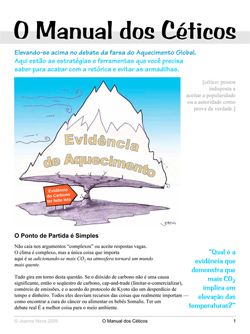 Click to download a copy in Portuguese. H/t Marc Morano
Athelstan points to Ecotretas for people wanting more skeptical articles in Portuguese.
9.6 out of 10 based on 66 ratings
UPDATED AGAIN #4 — Now with Vukcevics Hale cycle graph of Echuca. and #3 David Archibalds suggestion of the Hale Cycle at work. #2 with Willis Eschenbach’s graph and my thoughts, (see below)
Ian Bryce sent me a striking graph (or two). Looking at the original raw data from Echuca Victoria shows a dramatic cooling trend of nearly half a degree since 1900, and rather than being a siting anomaly, it’s repeated in two towns about 100km away.
Curiously he also finds peaks in the maximums at Echuca that look for all the world like they match the solar cycle. Is it a fluke, or could it be real? If it’s real, what conditions make the solar sun-spot cycle so apparent in Echuca — where its maximum temperatures seemingly peak with each second solar cycle. Can anyone find this signal in other places? — Jo
 The area is inland Northern Victoria Has there been Global Warming or Global Cooling in Echuca
Guest post: Ian Bryce
I have spent about 37 years working with processing tomatoes in the Goulburn Valley in Australia, and the last 25 years or so, with research into growing and processing canning tomatoes. Since 1984, our industry in Australia has trebled the tomato yields from our paddocks, which is quite extraordinary. I was wondering whether yields have partially improved due to hotter temperatures, and increased carbon dioxide.
Most of our tomatoes are grown within a 100 kilometre radius of Echuca, so I decided to look at the temperature data from the BOM for that site. It is a high quality site according to the BOM, and has a long temperature record. It also has a small population (10,000?), and therefore should not experience the “Urban Heat Island” effect [at least not at the rural airport, where the thermometer is — Jo].
 Echuca is on the Murray Darling River (top left) Wangaratta and Benalla are on the plains to the West of the Snowy Mountain Range. The only other high quality sites in our area are Benalla, and Wangaratta. Echuca is about 200 km from the coast and about 100 km inland from the Great Dividing Range. So it has an inland Mediterranean climate with hot dry summers and cool wet winters. It is about 36o south and 96m above sea level. North and west of Echuca are flat plains for hundreds of kilometres.
Below is a graph of the Echuca mean temperatures, which is the yearly average of the maximum and minimum temperatures. I was most surprised to find that the temperatures had decreased, rather than increased, and therefore the tomato growth should have been slower with the lower temperatures. So obviously the yields increased due to better tomato varieties and better farming techniques.
I then decided to check Benalla & Wangaratta as well, and low and behold the result was similar, with temperatures decreasing in both cases.
Jo Nova suggested that I contact Frank Lansner (Hidethedecline), who has undertaken the painstaking work of graphing all the temperatures around the world. In Australia he has divided the data into different climatic sites, including South-East Australia. His graph for about 52 sites is at the bottom. Once again we find that the temperatures are trending down. This was also confirmed by Ken Stewart (kenskingdom) in Australia.
I then decided to look at the maximum and minimum temperatures individually from the Echuca site, to understand what was actually happening to them. Surprisingly I found that the minimum temperatures were decreasing (see the lowest three graphs), but the maximum trend line was flat.
 … The thing that intrigued me about the maximum temperatures is the high peaks, which occur at the peak of the odd solar cycles, and four other times, when we had strong El Nino events. (Most recently, three in four years) It is interesting to note that we did not have the Super EL Nino in 1998!
Keep reading →
8.5 out of 10 based on 52 ratings
|
JoNova A science presenter, writer, speaker & former TV host; author of The Skeptic's Handbook (over 200,000 copies distributed & available in 15 languages).

Jo appreciates your support to help her keep doing what she does. This blog is funded by donations. Thanks!


 Follow Jo's Tweets
 To report "lost" comments or defamatory and offensive remarks, email the moderators at: support.jonova AT proton.me
Statistics
The nerds have the numbers on precious metals investments on the ASX
|






Recent Comments