Recent Posts
-
Lucky us, The UN deigns to not list the Great Barrier Reef as ‘in danger’ (yet again)
-
Wednesday
-
Blackouts and maintenance problems hit farmers forced onto solar and batteries in Western Australia
-
Tuesday
-
Monday
-
Sunday
-
One Nation are now the Party of the workers, and Labor the party of wealth and academics
-
Saturday
-
Net Zero anyone? USA bets big on coal and gas — overtakes China in spending.
-
Friday
-
Winning: Trump persuades The World Bank to drop its huge spending target on “climate”
-
Thursday
-
Bafflement?! Germany, a global leader in renewables but has one of the highest EU electricity prices
-
Wednesday
-
Horse-drawn carriages must have caused a Megadrought in Europe in 1540, right?
-
Tuesday
-
Monday
-
Sunday
-
UK facing devastating 36 degree heat — can’t decide whether to use air conditioners or rip them out
-
Saturday
-
Batteries failed on day One: A four day wind drought in South Australia wreaks havoc, high prices
-
Friday
-
The UN wants to be One World Government and it starts with a carbon tax on ships and planes
-
Thursday
-
What if Global Warming was just because something made the clouds go away…
-
Wednesday
-
Snowy 2.0 is the Trillion dollar Black Hole of Australia — sucking in energy, money, land, industrial relations, the dollar, our lifestyle
-
Tuesday
-
Monday
-
Winter Solstice
-
Saturday
-
We were throwing-renewable-energy away at record levels in 2025
-
Friday
-
Pauline Hanson, the centrist, just wants a free market in electricity, and an end to the renewable energy bribery
-
Thursday
-
Blame the Climate Yeti again for making your life more expensive! (It’s a smokescreen)
-
Wednesday
-
The Sunrise Project funneled $343 million from overseas to push net zero
-
Tuesday
-
Monday
-
Sunday
-
The US government has been secretly funding 120 dangerous biolabs around the world
-
Saturday
-
New report shows renewables are a drag on our national productivity
-
Friday
-
Thursday
-
Well, how convenient. AI data centers have arrived to be the fall guy for the Energy Minister
-
Wednesday
-
Billionaires are leaving the room with excuses — Bezos says “AI will solve climate crisis”
-
Tuesday
-
Monday
-
Sunday
|
 Steve McIntyre weighs in: Steve McIntyre weighs in:
“As others have observed, the number of actual respondents purporting to believe in the various conspiracies was, in many cases, very small. Only 10 respondents purported to believe in Lewandowsky’s* signature Moon Landing conspiracy. These included a disproportionate number of scam responses. Indeed, probably all of these responses were scams.
However, Lewandowsky’s statistical analysis was unequal to the very low hurdle of identifying these scam responses. Lewandowsky applied a technique closely related to principal components to scam and non-scam data alike, homogenizing them into a conspiratorial ideation.”
Josh is so quick these days :- ) Thank you Josh. An excellent job.
* Correction: “Curtis’s” should have been Lewandowsky.
Josh is so quick these days :- ) Thank you Josh. An excellent job.
9.8 out of 10 based on 49 ratings

What can I say? Prof Lewandowsky, expert in conspiracies, thinks we are postulating a conspiracy — but the bad news for him is that we are postulating straight out incompetence, no conspiracy required.
How does Lewandowsky define “conspiracy”? However he wants.
I hate to say I told you so, but I did. Back in May 2010, before Lewandowsky posted his survey, he foresaw the results:
“This attribute of conspiracy theorising applies in full force to the actions of climate “sceptics” who operate outside the peer reviewed literature” [ABC Drum]”
and I foresaw what he would do with them:
“Lewandowsky uses the name-calling to “poison the well” against people who don’t even believe in a conspiracy [about man-made global warming], but happen to also be skeptical…Jo Nova May 2010“
Graham at OnLine Opinion (OLO) has posted Part II of a Fish rots from the Head and it’s quite something to see.
This post will look at the question of what is a conspiracy, and also what constitutes “conspiracist ideation”. The conclusion, just to save you reading to the bottom, is that Lewandowsky has no clear idea so adapts it to what fits his thesis. This is not science because he moves the goal posts to a spot where he will get a positive correlation. It more or less doesn’t matter where he kicks the ball, it will land in the goal because the goal will move to accommodate the ball.
The key point here is that some conspiracies are real, most are not. Those who believe all of them are nutters, but those who believe none are gullible patsy fools. So who has the wand of truth? Who decides what is “real”. As I said in May 2010 “Conspiracy Theorist” is his name-calling fairy dust.
Lewandowsky uses his Magic Fairy Debating Dust to preemptively stop discussions of climate science evidence. If anyone complains against any mainstream position on anything, he can define whatever it is as a “conspiracy theory”. Then his omnipotent powers as a cognitive scientist kick in. I quote: “The nature of conspiracy theories and their ultimate fate is reasonably well understood by cognitive scientists”.He who knows can foresee the ultimate fate of all conspiracy theories. A handy talent which could save us doing expensive Royal Commissions, or Supreme Courts, or heck, we could just use this talent to save us the bother of any courts or commissions or investigations at all.
So God and Lewandowsky, apparently, can always tell the difference between a whistle-blower and conspiracy theorist.
The Prof of Psychology chews through the English language, converting the normal use of the word “conspiracy” into something different:
Lewandowsky tries to define conspiracist ideation in terms of belief in “mad” ideas, such as that the moon landing was faked, but by doing this he ends up with a definition that is really only limited to belief in certain conspiracies, not a tendency to believe in conspiracies per se.
What’s the truth and what’s a false conspiracy? There is often no way to know. The conspiracies which made the list appear to be the ones Stephan “knows” are false:
… his first problem is that what he defines as a conspiracy (which in his terms seems to be something which people believe in, but which he doesn’t believe exists) is that there is no objective test of whether the conspiracy exists or not.
So he decides on a subjective basis what is a conspiracy, which means he has no scientific basis for his definition.
Graham makes the astute observations that some conspiracies were not included in the survey.
There is a conspiracy theory that global warming skeptics are funded by big oil. Lewandowsky excludes this from his list. His writings confirm that he believes in this conspiracy. Why isn’t it on the list? The fact that it isn’t indicates that he isn’t interested in “conspiracist ideation” in general, but only specific conspiracies.
Here’s the big money conspiracy Stephan didn’t ask about, that’s posted on hundreds of blogs. Here’s a typical example:
[Stolen documents that are] Revealing to the public the active, vicious, and well-funded campaign of denial that seeks to delay action against climate change likely constitutes a classic public good.
Who believes this baseless line about the big funds that no one can document? Stephan Lewandowsky (h/t Foxgoose). Any funds sent to Heartland are dwarfed by the money rolling through science, carbon trading and renewables. Who thinks that stealing documents through deception is OK, if it reveals 1% of his pet conspiracy? Professor Lewandowsky.
Who believes that corporate funded media could deceive large segments of the population?
…without vigorous competition and meaningful legal checks, there is no reason why a privately-owned media conglomerate could not create an Orwellian environment that deceives politicians and large segments of the public alike.
Stephan Lewandowsky The Conversation, 29 August 2011
Graham points out that if you only look for “big-government” type conspiracies, but leave out “big-corporate” ones, it’s hardly surprising when you find a link where people who don’t believe official government answers tend not to believe in the biggest big-government theory there is: man-made global warming.
If we looked for people who don’t trust the free market, we’d quite probably also find people who believe big-corporate conspiracies.
——————————————–
Don’t miss Part II of a Fish rots from the Head. Drop in, read it all, and thank Graham
——————————————-
PART I Lewandowsky – Shows “skeptics” are nutters by asking alarmists to fill out survey
PART II 10 conspiracy theorists makes a moon landing paper for Stephan Lewandowsky (Part II) PLUS all 40 questions
PART III here Lewandowsky hopes we meant “Conspiracy” but we mean “Incompetence”
PART IV Steve McIntyre finds Lewandowsky’s paper is a “landmark of junk science”
PART V Lewandowsky does “science” by taunts and attempted parody instead of answering questions
——————————————
REFERENCE:
(If you could call it that)
Lewandowsky, S., Oberauer, K., & Gignac, C. E. (in press). NASA faked the moon landing—therefore (climate) science is a hoax: An anatomy of the motivated rejection of science.. Psychological Science.
9.4 out of 10 based on 81 ratings
The NZ court case of skeptics versus NIWA has come down against the skeptics.
The National Business Review does tabloid-style sensational namecalling in the headline (does it consider itself to be a proper newspaper?)
“Climate change deniers shot down in NIWA court challenge”
Judge Geoffrey Venning threw out claims by the NZ Climate Science Education Trust that the Crown Research Institute known as NIWA breached its statutory duties, were mistaken in fact, failed to consider mandatory considerations and acted unreasonably in publishing its work.
NIWA will be entitled to costs, which are yet to be set, as a result of the case, Justice Venning’s judgment says.
Why did the skeptics lose? According to the news report, it was not because NIWA provided good answers, or found the missing data, but because the skeptics didn’t have “authority” to question it.
Some evidence in the case was ruled inadmissible, including that of Terry Dunleavy, a former journalist who is a founding member of the trust and secretary of the associated NZ Climate Science Coalition.
Justice Venning says Dunleavy “has no applicable qualifications” and “his interest in the area does not sufficiently qualify him as an expert”.
He also questioned the credentials of Bob Dedekind, a computer modelling and statistical analyst whose “general expertise in basic statistical techniques does not extend to any particular specialised experience of qualifications in the specific field of applying statistical techniques in the field of climate science”.
Perhaps the judgement is quite different from what the NZ Business Review reported, but unless it is, the outcome had nothing to do with science, but everything to do with a logical fallacy.
What’s unnerving about this is that if “authority” is determined not by behavior, logic or quality of reasoning, but simply by government decree, then the court becomes a de facto arm of the government — because only people who are funded by the government (all “climate scientists” are funded by government) can give evidence that the court recognizes. Who can criticize and hold government or statutory authorities to proper standards? Not the citizens, for they are not “qualified”.
If non-experts protested unfairly at the NIWA results, surely NIWA would find it easy to explain why they were wrong, and a judge would be more than capable understanding, but if NIWA is not even expected to answer those questions then no justice has been done.
The credibility of NIWA staff ought to rest on their record rather than their titles. The unscientific behaviour of Jim Salinger and others is endorsed by the court, apparently, as long as they are paid by the government.
The courts are supposed to be independent of the government. When these two institutions are effectively working together we lose one of the major safeguards of democracy. All the more reason to fight to keep the free press, free. What else is left?
And again, we get the line that NIWA is OK, because it’s just as bad and incompetent as all the other agencies around the world which adjust data without detailed explanations, and which lose data ad hoc:
“I am satisfied that the methodology applied by NIWA was in accordance with internationally recognised and credible scientific methodology,” Justice Venning says.
This decision is all the more preposterous given that even the highly questionable Australian BOM obviously didn’t endorse the NIWA methods and after asking for an Australian BOM review, NIWA went to extraordinary lengths to hide that review. Did they hide that review, because it would have lent support to the very evidence the so-called “non-experts” put forward?
Keep reading →
9 out of 10 based on 60 ratings
Jinan Cao has been dissecting the nature of the greenhouse effect and a key calculation that I normally just accept without questioning. This will set a few pigeons loose, but it will be interesting to see where they land. The claims analyzed here are the oft repeated ones that the Earth’s greenhouse effect already warms us by 33°C and that a doubling of CO2 directly causes a 1.1°C rise (that’s with no feedbacks taken into account).
Jinan points out that these numbers, repeated as “fact”, are merely a result of misuse of the Stefan-Boltzmann equation. If Earth is not a perfect black body, but has an emissivity of 0.7 (as satellites suggest), then the temperature of the planet’s surface without any greenhouse effect would not be -18°C, but more like 5°C. That would mean the entire warming due to the greenhouse effect is only around 10°C, not the more impressive 33°C that is usually claimed. It means the greenhouse effect is probably less important than implied.
The 1.1°C direct rise that is predicted from doubling CO2 without feedbacks would also need to be recalculated. This paper does not try to do that, but if Jinan is right, that figure would be significantly lower too. Jinan looks at how that figure was derived. David Evans has been helping review Jinan’s work and writes the introduction below. — Jo
 This is the official IPCC version of the Earths Energy Budget as shown in the IPCC AR4 in 2007. Introduction by Dr David Evans
The Stefan-Boltzmann equation describes how much radiation (energy) is given off by a body, such as a planet or a layer of air. It figures extensively in climate science, especially in simple calculations of where energy is flowing on average as the earth radiates heat into space as infrared radiation.
The Stefan-Boltzmann equation is used to obtain known nostrums of the climate debate, such as “it would be 33C cooler without greenhouse gases” and “the direct (no feedbacks) effect of doubling the CO2 levels is to raise the surface temperature by about 1.1C”. The equation is a standard one in physics. Its application to radiation from the earth can be done by any physicist or scientist; only a very rudimentary knowledge of climate science is required. (No mystical climate science secret knowledge relevant here; the laws of arithmetic and physics are sufficient.)
Jinan Cao clinically dissects several of these applications of the Stefan-Boltzmann equation and finds it has been sloppily applied. Do you think the errors in application by the climate science community work in the direction of understating, or overstating, the role of CO2? Jinan’s article, although technical, is not difficult.
This paper will ruffle a few feathers and deserves a fair hearing. It brings up valid points, and challenges the application of the SB equation that are, by everyone’s admission, somewhat unsatisfactory.
Today’s climate scientists will attempt to laugh off these criticisms by saying that their models are much more sophisticated and accurate than the crude 0-D models considered when applying the SB equation. (A 0-D model treats the earth as a point, with zero dimensions. A 1-D model takes account of one dimension, either height in the atmosphere or latitude. A 3-D model treats the earth as having latitude, longitude, and height.)
But there are two problems with this defense. The first is authority. We don’t know what goes on inside these models, so are we supposed to just take the word of their modelers, that they have got it right? The models are too opaque and not open to public scrutiny, so this amounts to argument by authority. As the motto of the Royal Society says, take the word of nobody. The second problem is that today’s climate science community have demonstrated a habit of exaggerating issues even as straightforward as death threats, so how might they handle issues as vital to their funding as the importance of greenhouse gases to our well-being?
Keep reading →
8.7 out of 10 based on 61 ratings
There were only ten positive responses.
There are many questions to be answered about this paper in “Psychological Science.“ Questions worth asking at all kinds of levels.
The authors, Lewandowsky, S., Oberauer, K., & Gignac, C. E., drew conclusions about skeptics by largely surveying alarmist sites. They got hardly any positive responses, some of which may have been faked (who can tell?). Then with a tiny ten positive responses out of 1147, the authors drew inferences about a group of people which must number between one hundred thousand to one million or more individuals. Worse, of the ten who thought the moon landing was faked, only three or four were skeptics. In the UPDATE below note that there appear to be three different forms of the survey, a point that surely needs some explanation.
The headline of the study “NASA faked the moon landing—therefore (climate) science is a hoax: An anatomy of the motivated rejection of science” is drawn from only those ten responses. Do I need to say it’s a sample size too small to draw any conclusions? I shouldn’t. But this point alone should have been enough for the paper in its current form to fail review, yet it didn’t.
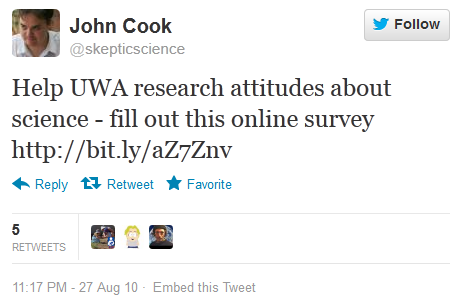
Furthermore, the questions and the aim of the survey was so transparent (see below) that commenters on the sites where it was hosted openly discussed whether “deniers” (the obvious targets) would be fooled by them.
Graham from OnlineOpinion was so struck by the study he’s written a post titled: Fish rot from the head Part 1.
He uses this paper to ask questions about falling standards of Australian university academics. “If credentialled, well-funded and tenured tertiary institution staff are capable of dishing-up research which should fail an undergraduate, what chance have lower echelons.”
Professor Stephan Lewandowsky’s… latest project is a study entitled MOTIVATED REJECTION OF SCIENCE and sub-titled “NASA faked the moon landing|Therefore (Climate) Science is a Hoax: An Anatomy of the Motivated Rejection of Science”.
It could have been sub-titled “The man who polled his prejudices and mistook them for the facts”. Prof Lewandowsky’s paper is certainly motivated, but it is not scientific or competent.
Visit Online opinion to read his Part I analysis with graphs. It also includes links to the full screenshots of the survey — Graham was so astonished at the survey back in 2010, he kept the images. I’ve transcribed them below.
Graham and I both wonder why there were 40 42 questions in the original survey, but only 32 in the data tables of results. What happened to the demographics data and the other missing questions? It may mean nothing, but sometimes what is left out tells a story all of it’s own.
Questions 28 to 32 have also been removed. It was a mystery to me why they were in there in the first place as they ask how I feel about my life. That they play no part in the paper suggests that whatever theory was being investigated using them failed to pan out. If this is the case it is bad practice… not to report the failure.
Graham points out that there were two substantial findings in the paper: one on people who believe in free markets, and one for people who believe in conspiracies. There were between 80 – 244 respondents who felt strongly about a free market, and, depending on the conspiracy, there were between 3 and 289 who ticked “yes”. Graham adds up the numbers of people who agreed with the conspiracies mentioned in the press release: AIDS (9), Moon landing (10), Princess Diana (25), SARS (42) and Climate Change (134).
He will be publishing more on this, as will I.
Thanks to Australian Climate Madness, ManicBeanCounter (who has pivot tables), Lucia, and Anthony Watts
UPDATE Are there two or three different forms of the survey?
Geoff Chambers tells me that Leopard on the Bishop Hill thread has noted that Steve McIntyre is asking Lewandowsky why there are two or even three different forms of the survey? Why indeed?
Paul follows them up:
The Deltoid, Tamino, Mandia and Hot-Topic blogs were sent the survey number surveyID=HKMKNF_991e2415 on about August 29th. That survey is on the archive, and starts with 6 questions about free markets.
Keep reading →
9.1 out of 10 based on 60 ratings
Why do we need a carbon tax? A study by John Reilly candidly “explains” (albeit indirectly) why this is not and has never been about the environment. It’s all about power and money — specifically $1,500 billion dollars of it over 10 years. What better excuse to raise funds for politicians? They pretend to save the planet and use the funds to buy votes from people who don’t realize that they themselves pay for the “free” handouts — if not with their dollars, then with their jobs.
This is another piece of magic-pie economics:
A carbon tax would take pressure off Congress to find “tradeoffs” between closing the deficit gap and reviving the economy, according to John Reilly, an author of the study.
“Congress will face many difficult tradeoffs in stimulating the economy and job growth while reducing the deficit,” Reilly, the co-director of MIT’s Joint Program on the Science and Policy of Global Change, said in a statement.
“But with the carbon tax there are virtually no serious tradeoffs. Our analysis shows the overall economy improves, taxes are lower and pollution emissions are reduced.
The study found that taxing carbon at $20 per ton would generate $1.5 trillion in revenue in a 10-year period. That could be used to reduce corporate and personal income taxes and maintain social services spending, all while reducing the deficit.”
So if there are no tradeoffs, why not make the price $40/ton? Why not $100? $1,000?
The report writers assume that governments would use the revenue to decrease other taxes, so it would not increase the size of government. But putting aside the fact that governments are all too willing to promise cuts they never deliver, it’s never good policy to make policy for the wrong reason. There are always perverse outcomes. If the US wants a flat tax, then do suggest one, but don’t make a monster out of a fertilizer-gas.
Keep reading →
9.6 out of 10 based on 56 ratings
Anna Rose is the head of the Australian Youth Climate Coalition. She visited us with Nick Minchin to film the doco “I can change your mind” and has produced a book called Madlands about the filming of the doco. Another author, David Mason Jones, has written a review and comes at this from a fairly neutral background. Anna’s approach, which is essentially an ad hom from beginning to end, punctuated with other fallacies, was evident when we met her, and sadly been amplified in her book. When they have no evidence, they attack the messenger. — Jo
[See our one-page version of this whole issue.]
Guest Post by David Mason-Jones
A review of ‘Madlands: a journey to change the mind of a climate sceptic’ by Anna Rose. Melbourne University Press. ISBN9780522861693
His site: www.journalist.com.au
Dare not peer into the forbidden room …

…. and dare not speak to the unspeakable people. Dare not test the nasty taboos and dare not open the Pandora’s box labelled ‘the nature of the scientific process’. Above all, do not admit the integrity of the people on the other side of the debate in which you are involved. Instead, smear and ridicule your opponents remorselessly before looking at their arguments.
These seem to be the guiding principles of Anna Rose’s somewhat less-than-intellectual approach in her book, ‘Madlands: a journey to change the mind of a climate sceptic.’ The approach Anna takes is to turn the sceptics we are about to meet into non-persons – or persons who are easy to hate, villains. The effect of doing this is to make it easy for the reader to dismiss their arguments with hardly a thought.
Anna carefully character assassinates all the sceptical people she is about to introduce. She then gives them a fairly cursory hearing, ignores their arguments, and responds with personal attack and ridicule, appealing to the twin arguments of authority and consensus all the way.
The adjectives Anna assigns to adherents of the anthropogenic global warming hypothesis are; eminent, highly respected, thorough, forward thinking, moderate and polite, intellectual, diplomatic, world-renowned, progressives and mainstream. Sceptics are described with derogatory words and terms like; attack dogs, more than a touch arrogant, fringe, wackiest, plays dirty, bizarre, contrarian, nutty, abrasive, notorious, bullying, dishonourable tactics, gang, cyber bullying, sexist, curious (in a derogatory context), petulant, bitter, web of denial, ideological warriors, generating hate towards climate scientists, and warped world vision. This sets the scene for the tone of her work.
“In the inquisitions the inquisitors had to climb up into every last village, high in the mountains of France and Spain, to track down every last heretic…”
After you are only part way through the book, the set-piece use of these descriptors starts to wear thin. If you have an honest desire to read Anna’s point of view, it becomes harder and harder to do so objectively as you become aware that the writer is endlessly outlining her ‘good-versus-evil’ view of the debate.
Special vilification is reserved by Anna to demolish the character of Professor Richard Lindzen who she implies is just a nutty professor. In her terms, he is a ‘used to be’. Anna tries to malign him as an old man with the evil habit of smoking, and makes out that she even struggled to breathe. I do not know Professor Lindzen, and I have never been to his house, but I understand that while he is a smoker, he doesn’t smoke in the area where Anna was. [Editors note: Anna’s attack is a measure of Lindzens influence. This is all so irrelevant to anything that matters except to note how far some people will go to vilify their opponents. It tells us all something about Anna, that when I asked Nick Minchin if Lindzen was a smoker, Minchin said he didn’t know, and couldn’t recall any clues from visiting his house. Nick Minchin is a non-smoker too, he’d notice. In an email, Lindzen remarked to me that Anna seemed to be perfectly comfortable while enjoying his hospitality and that the ABC tapes would show that. Message to skeptics: video everything. It means the activists have to stay closer to the truth — Jo]. This shameless attempt to demonize Lindzen, based on his personal habits, has little to do with the question of whether or not he is raising valid scientific objections to the anthropogenic global warming hypothesis? Why can’t the scientific issue be discussed without maligning his personal habits? Should we all, like Anna, feel free to dismantle the credibility of other people, with whom we disagree, based on their personal habits? How far should this license go? Would Anna approve if people on either side of the debate extended her technique to other personal aspects such as; gender, age, race, sexual orientation, body shape, disability, religious affiliation or any other irrelevant characteristic? What are the intellectual processes Anna is trying to set up here?
[Editors note: Richard Lindzen is one of the top meteorologists in the world, with over 200 publications to his name, as well as awards, medals, prizes and is a member of the NAS, AAAS, AGU, AMS. He is The Alfred P. Sloan Professor of Atmospheric Sciences, Massachusetts Institute of Technology and his work includes major contributions to our understanding of the Hadley Circulation, small scale gravity waves on the mesosphere, as well as atmospheric tides and oscillations in the tropical stratosphere. That he should face this kind of petty and personal attack is disgraceful. What kind of message does this send to younger, less secure scientists who doubt the IPCC dictat? There is more science, insight and good manners in one article of Richard Lindzen’s than in Anna Rose’s life’s work. – Jo]
Some pages after that she moves on to again to demolish another character. Before we even meet Marc in the book she is already maligning him. Maybe I’m not very widely read but I have not before heard of Marc Morano. I have never visited his blog and, at the time of writing this, still haven’t. So I had no preconceived ideas about him before I read what Anna had to say. After Anna’s onslaught, however, the attitude I had to Marc was that he must be a pretty bad person. This was irrational, I know, especially given the fact that I was already suspicious of her technique of character demolition. But it shows that character assassination works! It works even with the sceptical reader. It seems to be human nature to be swayed – at least in the first instance – by the rumors and insinuations made by others about someone you don’t even know.
[Editors note: I do know Marc Morano, who runs the excellent Climate Depot blog. He is ever the gentleman, polite, staunchly patriotic (without being over-the-top), has a wide grin and a warm optimistic nature. He’s a riot to be around, the life of the party, and genuinely considerate, always diplomatic, and not domineering in ways that smooth talking effusive people can sometimes be. In short, — I’d work with him any day, he’s a delight to be around, and inspiring to watch in action. A hero in his relentless quest to get the true story told. — Jo]
Keep reading →
9.4 out of 10 based on 97 ratings

A Disinformation Statement by the
Armenian Meteoastrological Society
(Adapted by AMS Archdruids 20 August 2012)
As told to Christopher Monckton of Brenchley
The following is an AMS Disinformation Statement calculated to provide an untrustworthy, prejudiced, and scientifically-outdated misrepresentation of pseudo-scientific issues of great concern to us in getting more grants but of no concern to those of the public still at large.
Background
This statement provides a brief overview of why we want more money now, and why we will continue to want more money in the future. It is based on a highly-partisan selection from the scientific literature, presented as though science were based upon the ancient logical fallacy of argument from “consensus”, and further distorted by the bureaucrats of the Mental Panel on Climate Change, the US Notional Academy of Science and Television Arts, and the US Global Cash Recoupment Program.
How is our funding changing?
Well, every summer solstice we all dress up in dustsheets and go to Stonehenge to pray for grants. And our prayers have worked! The increase in funding now is unequivocal, according to many different kinds of evidence. Observations show increases in globally averaged grants. We got them by pretending that globally averaged air and ocean temperatures have increased, but in the past 15 years they haven’t. Never mind – our grants have!
For the nation as a whole, there have been twice as many record daily high grants as record daily low grants in the first decade of the 21st century.
We’ve been talking about widespread melting of snow and ice, but that hasn’t really happened either. Sea ice in the Antarctic has actually grown, but of course we don’t mention that: it would spoil the grants.
Meantime, those grants just keep rolling in. In the US, most of the observed grants have occurred in the pockets of Hansen, Mann, Santer, Solomon and other global warming profiteers. All of the 10 best years in the global grant records up to 2011 have occurred since 1997, with grants in most of those years being the greatest in more than a century of global records.
The funding trend is greatest in northern latitudes and over land, though there are some grants for oceanographic research in Hawaii and Tahiti. For the nation as a whole, there have been twice as many record daily high grants as record daily low grants in the first decade of the 21st century.
The effects of these grants are especially evident in the planet’s polar regions. Arctic meteorologists and climatologists have been increasing for the past several decades. Both the Greenland and Antarctic ice sheets have gained significant amounts of grant-gatherers. Most of the world’s glaciers have never been visited (not that that stops us claiming that most of them are retreating), but what with all those grants we’ll soon be able to afford to ski – er, conduct field research – on all of them.
Other grant increases, globally and in the US, are also occurring at the same time. The amount of grants falling in very heavy amounts (we call these the heaviest 1% of all funding precipitation events) has increased over the last 50 years throughout the US. Grant levels are rising in elevation, with fewer and fewer grants frozen and more and more liquidity.
Keep reading →
8.8 out of 10 based on 71 ratings
The line that everyone seems to have missed (or become numbingly inured to) is one where Combet claims that Australians won’t be able to get rid of the carbon price even if they want to:
“(Greg Combet) said the linkage of the schemes would make it more difficult for Mr Abbott to axe the carbon price if the Coalition were elected.” [Source: The Australian]
The spiffy idea, apparently, is that voters won’t have an option of voting to decide a major part of our economic system. The Australian Labor Party’s proud contribution to the national debate is to tell us they have deliberately crafted the legislation that way. We the voters are supposed to be impressed that it will be harder for any newly elected representatives to remove it without major penalties. If the Australian people decide to toss the current government off an electoral cliff, the current government is going to fall, but make the nation pay. Yes, score ten points for Machiavellian behaviour, but I’m not so sure the voters will be impressed when they have to foot the bill.
Over 80% of Australian’s at the last election voted for parties that promised “no carbon tax”, do I need to use the words arrogant and undemocratic?
I suppose the smile-with-me-excuse is that the ALP “knows what’s best for Australia” and are so smart they can stop the stupid punters from choosing differently? Though a cynic might say that the ALP knows voters hate the carbon tax, and knows that it’s a gift campaign for the opposition to run against it, so they are protecting their political hides by neutering the advantage — bugger the cost to the citizens of Australia. I’m not sure which is worse, narcissistic tyrant, or pragmatic parasite.
It’s traitorously selfish, but where is the evidence that the ALP have higher aims?
The Labor Party were bragging about this back in October 2010, so over the last two years of dismal polls, they still haven’t done any soul searching about the philosophy of what The Australian Labor Party stands for? It tells us much about the current malaise within the Australian Labor Party that no wise elders have quietly advised these hollow men in their party that this is not in the spirit of western democracies. Aren’t the citizens of Australia supposed to decide which policies they want to live by and pay for? If 90% of Australians wanted to remove this legislation, theoretically, the Labor Party have booby-trapped it and there is no way Australians can vote against it to use their resources in ways of their choosing. If that isn’t unconstitutional, it should be.
9.4 out of 10 based on 99 ratings
 Thanks to Steve Hunter Thanks to Steve Hunter illustrations
Victoria’s windfarms have saved virtually no coal from being burnt.
South Australian windfarms have saved 4% of their rated capacity in fossil fuels at a cost of $1,484 per ton.
That’s only $1,474 above the current price of carbon credits per ton in the EU. They are 96% useless, and cost 150 times more than necessary for what they do (except for the times they are more useless and more expensive).
The point of a windfarm is not so much to produce electricity but to reduce greenhouse emissions.
If we built windfarms for the electricity they generate, we’d be better off paying for reliable electrons from cheap brown coal, and using the savings to research a cure for cancer. The point in putting up expensive, infrasonic thumping towers of steel and concrete that kill eagles and explode bat lungs is because it reduces our carbon dioxide emissions, except that it doesn’t really.
Mechanical engineer Hamish Cumming has written a whopper of a report (though I can’t find an online copy of it*). Because Victoria doesn’t have much of a gas powered grid, it can’t take advantage of the odd intermittent peaks of wind power. Like a huge car, the big coal fired plants run best at a steady pace, and all the switching up and down just reduces their mileage so they need more coal per kilowatt.
South Australia does have some gas power, but don’t get too excited, even there, wind farms reduce CO2 statewide by about 1%.
Keep reading →
7.8 out of 10 based on 138 ratings
The Australian Government,via Greg Combet, announced this week that Labor’s version of certainty is the kind that is un-certain. For two years they’ve been emphatically declaring that “Australia needs certainty” or it’s variant, “Business needs certainty” . (Right before that, they were emphatically declaring that “There will be no carbon tax”, so later, when they did exactly what they said they wouldn’t do, we found out what certainty means to the Australian Labor Party. It isn’t the kind of certainty that helps business and voters “establish beyond doubt” what a vote for a Labor Government means.)
While people are saying we have now linked Australia’s carbon “price” (from 2015 onwards) to the EU market. In effect it was linked before, as I mentioned here. Now that link is rearranged. Previously Australian companies could buy ultra cheap EU options but had to top them up to the floor price, but now they won’t have to pay extra to lift it to $15/ton.
Mr Combet said the government was not considering any other changes to the scheme. [Source: The Australian]
Yes, and we believe him don’t we?
Things are slightly more sane than they were last week, but the difference is negligible, and may not come into effect if the Coalition wins the next election a year from now. We are discussing changes to a scheme that may never occur in order to solve a problem that never was.
BlueScope Steel chairman Graham Kraehe said that the government’s move to dump the controversial $15-a-tonne floor price was a “tiny step in the right direction”.
“However it completely fails to address the major issue,” Mr Kraehe said. “For three years until July 2015, Australian businesses already struggling to compete due to a high Australian dollar, high costs and excessive regulation will also be subject to the world’s highest carbon price.” [The Australian]
I explained previously that while Europeans can buy credits for $4 per ton (and Australians will pay $23 — or at least $15) This new move would change that from 2015.
Scott the energy trader puts the changes into perspective with some details
When I spoke to Scott on the phone, the word he used about these changes was “panic”. He said he could not explain the details of this madness easily to the man on the street, but the number of changes, the backflips and the unexpected and random nature of them suggested bureaucrats were in a state of panic.
Keep reading →
9.4 out of 10 based on 61 ratings
I‘m putting on a conservative, understated hat. This could be the worst paper I have seen — an ad hom argument taken to its absurd extreme, rebadged as “science”.
Professorial fellow Stephan Lewandowsky thinks that skeptics who are “greatly involved” in the climate debate believe any kind of conspiracy theory, including that the moon landings never happened, that AIDS is not due to HIV, and that smoking doesn’t cause cancer. But he didn’t find this out by asking skeptics who are “greatly involved” in the climate debate or by reading their popular sites. He “discovered” this by asking 1,000 visitors to climate blogs. Which blogs? He expertly hunted down skeptics, wait for it… here:
This is the point where the question has to be asked: Did Lewandowsky, Oberauer, and Gignac really think they would get away with it? Did none of the reviewers at “Psychological Science“ think to ask if the “sampling” of alarmist blogs would affect the results?
The paper is titled:
“NASA faked the moon landing — Therefore (Climate) Science is a Hoax:
An Anatomy of the Motivated Rejection of Science”
Lewandowsky, S., Oberauer, K., & Gignac, C. E. (in press) Psychological Science
Faked the Moon landing? Not only do skeptics agree that the moon landing was real, two skeptics actually went to the moon and took photos (that’ll be Harrison Schmidt and Buzz Aldrin). Since many guys with years of top NASA service are skeptics too why doesn’t Lewandowsky ask them if they faked it? This is where cumulative nonsense takes us: the golden path to cosmic inanity.
Given that the survey audience was mostly alarmist (see the blog list above), and the survey’s intent was clear to commenters on those sites (see their comments below), its possible the team has “discovered” that some alarmist readers are prepared to fake the answers that they’d really like to see. The survey was so transparently designed to link climate skeptics with “conspiracy nutters” it would hardly be surprising if a percentage of alarmists readers of those blogs understood what was required, and dutifully performed.
Commenters could see what the survey was “getting at”:
pointer | August 30, 2010 at 11:42 am
Yeah, those conspiracy theory questions were pretty funny, but does anyone think that hardcore deniers are going to be fooled by such a transparent attempt to paint them as paranoids?
Also, here are two words that, when put together, ought to make anyone critical of this research: “online” and “survey”.
————————————————————-
Keep reading →
9.3 out of 10 based on 141 ratings
It’s another useless question written in a another pointless poll.
Define “climate change”: does it mean the climate doesn’t stay the same year after year, or is it code for “man-made global warming”? The term is so overused, so cliched, it is a meaningless part of any survey. Since “partially” means any number greater than zero, technically I’d have to answer that climate change is partly natural and party man-made. So the survey finds that many dedicated skeptics hold the majority opinion, but that’s not the way it’s being reported. With vague questions, this survey is not designed to find out what the population really thinks, it’s there to support media headlines and the propaganda push. A cheap trick to try to convince politicians that “carbon action” is a vote winner, and a ploy to try to demoralize skeptics into thinking they are a small and shrinking part of the community.
It shows, as do many other studies, that only a third of the population believe the IPCC message that all the recent warming is due to man-made emissions. 65% of the population know there is natural component to the way our climate changes, the question that matters is “how much”.
But look out! Fully 32% think that climate change is occurring due only to human activity and not due to any natural variation. It’s as if the orbits of the planets got stuck in a rut in 1945. It’s like the sun finally reached an unchanging equilibrium after four and a half billion years, the continents stood still, the oceans stopped slopping, and the winds stopped shifting. What do we teach people at school?
 Perception of Climate Change
Respondents were asked to choose the statement which best reflects their views about the causes of climate change. One third (32%) believe that climate change is occurring due to human activity, while one half (54%) believe that climate change is occurring partially due to human activity and partially due to natural climate variation. One in ten (9%) believe that climate change is occurring due to natural climate variation and few (2%) believe that climate change is not occurring at all. Page 26.
The headlines keep pushing the propaganda “Only 2% of Canadians deny climate change, suggests poll” [CBC]. The aim is to make people with one scientific opinion look like freaks.
He also told CityTVthat the two percent figure is similar to people believing in “little green spacemen” and that the number is still “pretty significant.” He did concede that a study will never have 100 percent. [digitaljournal.com]
The study has a 3% margin of error.
Keep reading →
8.3 out of 10 based on 36 ratings
There’s a letter in the paper today in response to my article:
Climate scientists are not failing to convince others
From: The Australian
August 27, 2012 12:00AM
Every significant science academy supports the case made by the climate science community. These academies encompass the full spectrum of science and members are elected by merit.
As a researcher in immunobiology, I watch the climate field from the sideline, go to some seminars, talk to scientists, monitor key websites and read leading journals such as Science and Nature.
Climate researchers are rigorous and conservative, and I don’t see anything that gives me unease. The Bureau of Meteorology and the CSIRO, for example, input 50,000 pieces of new data every day. These are the people who dedicate their lives to grappling with the massive experiment we’re doing with our atmosphere. Unlike my field, this is an experiment that can never be repeated.
Peter C. Doherty, Medical School, University of Melbourne, Vic
My point was that argument from authority is not science, and Doherty’s response is to argue from authority.
One of the reasons “Argument from Authority” is a fallacy is because people are human, and associations of humans don’t always neutralize our failings, sometimes they magnify them.
Yes, science academies and science associations do support the “consensus” – but none of those agencies asked for their members to vote, and none have hosted a public debate. The academies may pretend to represent 50,000 members, but the committee that declares the official position may have only eight members. Members of many of these associations are resigning or launching revolts in protest at the slipping, or non-existent scientific standards in relation to pronouncements on climate science. Nobel Prize winner, Ivar Giaever resigned from the American Physical Society, over 80 prominent physicists petitioned the APS , Steven J. Welcenbach resigned in disgust from the American Chemical Society (ACS) saying “ACS has died as a scientific society. ”
While science funding comes from government and science funding bodies are controlled by warmists, how can you expect any science academy or association to say that the CO2 theory is bunk?
The Royal Society made pronouncements on climate science that so outraged its membership that for the first time in history members rebelled, with 43 calling in a private petition for The Royal Society to rewrite it’s position, which it subsequently did. While the protest came from only a small group within the membership, it’s telling that it was arranged by an email, and two-thirds of those approached signed the petition. The dissatisfaction was widespread.
Keep reading →
9 out of 10 based on 113 ratings
I’m published this weekend in The Australian (building on the post I did previously here. Manne himself popped in there to tell us “Deniers Hunt in Packs” — demonstrating his true depth of insight into the libertarian independent psyche — a group defined by it’s non-pack nature.)
—————————————————————–
Manne declares that the “Denialists are Victorious” (in The Monthly, August 2012) but his sole reasoning that the victorious are “deniers” is merely that some chosen experts tell us a disaster is coming and he feels they could not possibly be wrong. Argument from authority is a fallacy known for 2,000 years, and it is a key point, it is the disguise of the witchdoctor — “Trust me, I am the chosen one”. The one defining difference between science and religion is that the devout can argue from authority, but the scientific cannot. In science there are no Gods and there is no Bible — what matters is the evidence. The highest experts may declare the world is headed for catastrophe, but if 3,000 thermometers in ocean buoys disagree (and they do: see “Argo”), the scientist questions the opinions and goes with the observations.
Robert Manne thinks internet surveys of scientists are a valid way to test whether planetary atmospheric dynamics is changing in dangerous and unprecedented ways. It’s an anti-science position. Since the dawn of time tribal witchdoctors have been forecasting storms and asking us to pay tribute to their idols. Discussion of climate science has descended into abject farce.
To understand the danger of quoting surveys of scientists, let’s look at the three Manne names.
The first (Anderegg) is a blacklist of “good guys” and “bad guys” in the world of science. It doesn’t measure the climate, but it is a reasonable proxy for government grants. Just add up the salaries of all the believers vs the unconvinced and the ratio would be similar. The US government bestowed $79 billion (1990 – 2009) on scientists who looked for a crisis, but very little on those looking for natural causes or holes in the theory. It is a non-event of no proportions that there are more believers publishing papers than skeptics, and the ratio is similar to the funding (though quite a few skeptics manage to publish despite having no tenure, no staff, and no easy access to data.) The number of papers tells us nothing about the quality of the research, it’s not that hard to write papers that are largely irrelevant or repetitive, or the output of another flawed climate simulation.
His approved “climate scientists” might as well be a list of anointed preachers of the Cult of Climate Science. The esteemed?
Keep reading →
9.1 out of 10 based on 147 ratings
Australia’s politics is boiling at the moment, but you’d barely know if you got all your news from the Love Media ABC.
Yesterday in a long press conference our Prime Minister was finally forced to address “questions” that have been burning across through the net.
I heard our Perth ABC drive time presenter Geoff Hutchison discussing this at length yesterday, and in that time I heard all the ad hominem answers the Prime Minister gave, and how well she gave them, and how powerful she sounded. I’m now full bottle on all the names she calls the malicious misogynist nut jobs and how they will not accept any answer or any evidence. I heard that The Australian has apologized. Apologized! And then I heard that again. Twice? It must be significant. I also now know that Larry Pickering is bankrupt (though I can’t quite see what that has to do with running our country).
I did not hear what The Australian apologized for, which was strange, because the tone of voice conveyed that it was an important and unusual event. (Apparently, it appears The Australian said it was a “Trust” which is, go figure… defamatory. Accurate reporters should have used her term: a slush fund.)
I did not hear what allegations were made online about the Prime Minister, or even what questions she was answering. But I heard that “some sections of the media” were running with these old claims (whatever they were).
Regular ABC listeners would have no idea what’s being discussed by a growing slab of the Australian population. Just like they were baffled when former Prime Minister Kevin Rudd was “suddenly rolled”. Didn’t see that coming? Really.
Some ABC listeners wouldn’t have a clue why 65% of the population don’t vote Labor.
The worst thing is I get the feeling that some ABC listeners do “know” — they know that those who don’t agree with them are stupid.
“They’re misinformed by the Hate Media.”
Blind love breeds hate
The Love Media keep their listeners in the dark, and breed more hatred and contempt than the Hate Media could. They breed hatred from the ignorant towards a mythical beast, and they alienate those informed of both sides of the story by suppressing their views and by calling them names.
ABC listeners wouldn’t know there is a house-sized amount of money missing from a union of workers. Julia Gillard strenuously denies she did anything wrong, but once she realized something was wrong, what exactly did she do to right the wrongs, and recover the funds stolen from workers? If she’s the innocent victim — as a naive 30 something legal partner having an affair with a deceptive boyfriend — why won’t she call a Royal Commission, clear her name and track down that misused money? To say nothing of union corruption and the methods by which the money was obtained in the first place…
Let’s try to imagine what the ABC would say if opposition leader Tony Abbott had been involved directly in a situation where workers funds had gone missing, if he’d set up an account for “worker safety” for a union (but didn’t tell the union or the law firm he worked for), and later described that same account as a “slush fund”.
Pickering is blistering today asking 24 questions you won’t hear on the ABC.
Bolt: The AWU scandal – Brilliant, except for the bit about the real issue. “It’s a media masterpiece.”
Shane Dowling at Kangaroo Court has been drilling through this for a year. A reader, Keith, suggests this link: http://www.kangaroocourtofaustralia.com/julia-gillard-bruce-wilson-awu-fraud-page/
Douglas sends in a link to watch Julia Gillard answers (ABC): http://www.abc.net.au/news/2012-08-23/gillard-responds-to-false-defamatory-accusations/4218242
9.1 out of 10 based on 94 ratings
Ove Hoegh-Guldberg wants us to consider putting sun shades over the Great Barrier Reef, but it begs the question — how much is the reef heating up, and how sure are we that it’s man-made and not natural?
John McLean digs into the data and finds that temperature variations on the reef appear to be closely tied to the ENSO cycle, and that there is little reason to think our SUVs and coal fired plants have anything to do with the rises and falls.
We wonder, as usual, why those paid by taxpayers can’t do the same basic calculations and graphs that the volunteers do online.
Great Barrier Reef sea temperatures – What the data says
John McLean
Inspired by the absurdity of putting shades on the Great Barrier Reef (GBR), I studied the observational data.
We can extract data for the grid cells that cover the reef from NOAA’s “Optimal Interpolation” sea surface temperature data (see here). When that data is averaged across the entire reef we find that the average sea surface temperature along the Great Barrier Reef has an annual cycle very similar to that of Willis Island, a Bureau of Meteorology observation station on an island near the middle of the reef. Sometimes the sea surface temperature is slightly higher than Willis Island and sometimes it’s slightly lower. The trend since 1982 for both is around one degree/century, but if we look at the Willis Island trend since 1940 it’s almost flat, amounting to around 0.1C/century. The rise in the trend since 1982 is interesting but there’s more to it than you might imagine.
Using the average temperatures across the entire reef we can establish a 25-year average for each calendar month (1982-2006) and from that calculate the anomaly in each month of each year. That monthly anomaly is shown in Figure 1.
 Figure 1- Monthly sea surface temperature (SST) anomalies for the GBR since 1982 At first glance that graph suggests a warming in recent years but before we rush to claim it is due to human activity, as Hoegh-Guldberg did, it’s worth comparing to the major climate force in that part of the world, the El Nino Southern Oscillation (aka the ENSO). It’s a force that’s existed for more than 125,000 years and it as a known influence on temperatures around much of the world, so maybe it’s the cause of the variation in sea temperatures on the Great Barrier Reef.
The drivers of the ENSO are still in dispute – the latest CSIRO marine climate report lists six candidates and I know of at least two others – but the situation is easily characterised. During neutral conditions easterly winds blow across the Pacific and warm water is found at the west side. During El Nino conditions the winds decrease or even cease and the warm water is found in the centre of the Pacific, typically at the intersection of the equator and international dateline, and incidentally very close to the Pacific Warm Pool mentioned above. During La Nina conditions the winds are stronger than normal and temperatures in the west are above normal. It’s no wonder that El Nino events are often followed quickly by La Nina conditions; the warm water from an El Nino shift west with the wind.
This is a slightly simplistic description because the ENSO doesn’t switch between three distinct states but is a continuous range of conditions over which arbitrary thresholds have been applied to divide the range into three states.
We measure the ENSO using the Southern Oscillation Index, with a sustained period (typically 3 months) above 8 regarded as a “La Nina” event and the same length of period below -8 being regarded as an “El Nino” event.
What’s ENSO got to do with the Great Barrier Reef?
The reef is west-southwest of the Pacific’s centre and that means under normal conditions the reef water will be warm and the winds predominantly easterly. Under El Nino conditions the reef water will generally be cooler because there’s little inflow of warm water and the water had will cool by evaporation and convection. With La Nina conditions the heat from the east is greater than usual and Great Barrier Reef sea surface temperatures rise.

Figure 2a – Monthly SST anomaly and SOI 1982-1996. Note the correlation between changes in SOI and temperature at the major shifts
…
Keep reading →
8.7 out of 10 based on 46 ratings
You may not have heard of the World Federation of Scientists – it certainly isn’t run with a budget of millions or a professional PR team, instead it’s exactly the kind of organization that outstanding scientists would set up. No flash graphics, no spiffy logo, and no inundation of press releases. It’s only got two colours, but the people who meet and talk there range from world leaders in politics to people who changed the modern world with their science.
It’s the opposite of UN “science”, what it lacks in marketing skills, it more than makes up for in sheer heavyweight scientific brainpower and kudos. The Federation has 10,000 scientist members apparently, including T. D. Lee (parity violation, the Lee Model, particle physics, Nobel Prize) and Prof Antonino Zichichi (1000 papers in particle physics, first example of antimatter). Former members (until their deaths) were Laura Fermi, Eugene Wigner (Nobel in Physics fundamental symmetry principles), Paul Dirac (Nobel Prize, Dirac Equation, Fermions, theoretical physics, “genius”), and Piotr Kapitza (Soviet scientist, Nobel Prize and superfluidity, “Kapitsa resistance“).
Prof Antonino Zichichi founded the World Federation of Scientists and he’s angry at the state of Climate Science.
Christopher Monckton writes from the World Federation of Scientists in Erice Sicily.
President Vaclav Klaus’ delivered the keynote address to the Federation is (see here).
Professor Antonino Zichichi, one of the world’s top six particle physicists (he discovered a form of anti-matter 40 years before the multi-billion-dollar Large Hadron Collider did), is the most famous Italian scientist since his hero Galileo. He founded the Federation half a century ago and, at the age of 83, is its president to this day.
Nino looks like a proper scientist. Imagine giving his friend Albert Einstein an electric shock, and that is what his hair looks like. He is fitter than me and attributes his good health to walking an hour every day, not drinking alcohol and not eating lunch (that’s for wimps). He lives in a medieval stone house in the unspoiled, monastic village of Erice, Sicily, perched high on a 2,500-foot crag overlooking the blue Mediterranean.
He is an angry man. Angry because he, like me, was brought up in the Classical tradition, which insists that the duty of every “seeker after truth” (Al-Haytham’s beautiful phrase for the scientist) is to be logical and rational. He founded the Federation at the height of the Cold War to remind scientists of their moral responsibility to use their craft for good, not for ill, and of their intellectual obligation to adhere rigorously to the scientific method.
Nino is furious at the politicization of climate science. Science these days is a monopsony. There is only one paying customer: the State. Scientists increasingly produce the results their political paymasters want rather than seeking after truth.
Keep reading →
8.8 out of 10 based on 99 ratings
GE — A clean energy revenue machine
GE is so large that its annual revenue ($150 billion) is greater than New Zealand’s gross domestic product ($140.43 billion). But GE stands to profit in solving man-man global warming, whereas New Zealand will just pay.
In 2011 GE generated $21 billion in “clean energy revenue”. (GE Annual Report 2011, p 3).
GE boast that their “technology helps deliver a quarter of the world’s electricity”. “We are one of the largest clean energy companies in the world” (page 18) “GE wind turbines, among the most widely used in the world, will soon power the largest wind farm in the U.S ”
 Not just a whitegoods company any more. In other words, they are one of the largest companies in the world which makes profits that depend on a climate of fear. How much would their wind turbines be worth if western governments pulled the pins on all the subsidies?
Here’s how much:
“Manufacturers of turbines and other components will shed an estimated 10,000 workers in the U.S. this year in anticipation of a slowdown in orders, says the AWEA. If Congress doesn’t extend the production tax credit, that figure will hit 37,000 next year—about half the industry’s workforce. The incentive, first offered in 1992, grants owners of wind farms a credit equal to 2.2¢ per kilowatt-hour for electricity produced over a 10-year period. Extending the break for just one more year would cost $4.1 billion in forgone tax revenue over a decade,…” [Businessweek, June 7th 2012]
GE explain that they are concerned about the environment.
“The US industrial and financial conglomerate said it had long seen climate change as a valid concern after an internal evaluation of the scientific case in 2005.” The Financial Times
Notably, GE entered the industry through the acquisition of Enron Wind in 2002. Did it buy into the market before it “bought” into the science? Who knows?
“We found enough data there to have a company like GE respond and we have responded,” said Mark Vachon, head of the “ecomagination” sustainable business initiative GE launched in that year. He said revenues generated by operations in his portfolio now totalled $100bn and were growing at more than twice the rate of those in the rest of the company. The Financial Times
For GE the green revenue stream is growing twice as fast as the rest of the company’s income. No wonder GE is so enthusiastic about the alarming threat of carbon dioxide. It’s a problem that they are being paid handsomely to solve.
Otherwise, it’s been a tough five years for GE: Yahoo finance. No wonder they are promoting the sector that is growing, when so many of their other product lines are shrinking.
 Yahoo finance. GE Market cap is roughly $220 billion. (Click to enlarge).
GE stock price would suffer if governments stopped their anti-carbon policies:
Trefis estimates a quarter of the GE stock price is provided by it’s “energy infrastructure” — which is mostly wind turbines, but also some solar panels. GE has a high growth opportunity, apparently, “in the growing European wind energy industry, which has had an average annual growth rate of 15.6% over the last 17 years.”
Other parts of GE are being steered towards green income. “We redeployed capital from NBCU to support $11 billion of Energy acquisitions, which should provide an earnings boost in 2012.” (2011 Annual Report page 4).
GE sponsors and lobbies for Climate and Green projects:
Keep reading →
9.5 out of 10 based on 77 ratings
These people are not good with numbers.
In a paper published in Nature Climate Change today, Ove Hoegh-Guldberg, director of the Global Change Institute at the University of Queensland, together with Greg Rau of the Institute of Marine Sciences at the University of California, and Elizabeth McLeod of The Nature Conservancy, say new tactics are needed to save oceans from CO2 emissions.
“It’s unwise to assume we will be able to stabilise atmospheric CO2 at levels necessary to prevent ongoing damage to marine ecosystems,” Professor Hoegh-Guldberg said.
“In lieu of dealing with the core problem – increasing emissions of greenhouse gases – these techniques and approaches could ultimately represent the last resort.”
In addition to using shade cloth over coral reefs, the paper suggests novel marine conservation options, including applying low-voltage electrical current to stimulate coral growth and mitigate mass bleaching; adding base minerals such as carbonates and silicates to the ocean to neutralize acidity; and converting CO2 from land-based waste into dissolved bicarbonates that could be added to the ocean to provide carbon sequestration.
Alistair Hobday Research Scientist – Marine and Atmospheric Research at CSIRO said novel solutions are required. “We need to be mature enough to listen to all sorts of arguments.”
To which Jo Nova, unfunded non government critic said: We need scientists who are mature enough to spot a plan that is bonkers.
The Great Barrier Reef has an area of 348,000 square kilometers. It’s bigger than the UK, Holland and Switzerland combined. So perhaps we could just cover 1%, that’s only three and a half thousand square kilometers and then ask the water to stay in one spot?
The idea apparently is not to drive thousands of pylons into the reef (phew), just to cover “hundreds of square meters” with floating shade material. One wonders how predatory sea-birds will feel about this, not to mention photosynthetic marine life. Air breathing mammals might not “feel right at home” under the shades. (But its not like anyone cares about whales and dolphins right?) Tidal and wave action, with floating material near lots of spiky coral and rocks suggests maintenance could be “expensive”.
The cost? Who knows?
I have no idea what floating shades will cost. It’s probably nothing like land shades, and doesn’t need the poles but will need anchor cables (or there will be a new hazard in shipping lanes). Failing any details, I’ve costed the land sails option here, just for a ball park, give or take $100m (or a billion here and there).
If shade sails on land cost $2,800 to cover 6m by 5m (30 m2), assuming bulk discounts can keep the price the same (even though the installation may be 100km offshore, in salt water, and pounded constantly by waves) that’s only 33,333 shade sails to the square kilometer, at a cost of $93m. All up, covering 1% of the reef (if that were the aim, though it appears not to be that ambitious) is about $300 billion. That’s more than ten times Australia’s annual defense budget. What could possibly go wrong?
The commenters at The Conversation are a case study in why free speech is its own reward. People are volunteering to correct the nonsense put out by paid scientists and paid journalists. It takes months of work to flesh out a really gonzo idea, and yet it takes people five minutes for free to explain the flaws. Why do we spend tax dollars to employ people to be silly? Why didn’t the “editor” run the idea past a skeptic? Why does Nature Climate Change publish this type of material? (And for that matter, when will The Conversation discover that they can add links in their articles?)
Keep reading →
9.1 out of 10 based on 79 ratings
|
JoNova A science presenter, writer, speaker & former TV host; author of The Skeptic's Handbook (over 200,000 copies distributed & available in 15 languages).

Jo appreciates your support to help her keep doing what she does. This blog is funded by donations. Thanks!


 Follow Jo's Tweets
 To report "lost" comments or defamatory and offensive remarks, email the moderators at: support.jonova AT proton.me
Statistics
The nerds have the numbers on precious metals investments on the ASX
|






Recent Comments