Another day, another apocalypse. Life in a perfect climate
Poor sods. After 90,000 dismal cold years things were finally just warming up when a bunch of comet fragments from a a 62 mile-wide comet, crashed into our atmosphere. It was around 13,000 years ago, and the fireballs started the ultimate black Saturday blaze which converted 10 million square kilometers of wilderness into unauthorized carbon emissions*. Somehow, all those reckless greenhouse gas additions didn’t seem to stop the airborne dust triggering a return to a mini ice age for a thousand years. It also punched a hole in the ozone layer meaning everyone probably had to wear more yak-fat sunscreen or get more skin cancer (I suspect data is bit lean on that).
Glaciers started growing again, some ocean currents changed and thus the Younger Dryas unfolded according to a couple of new papers.
In a fairly dramatic shift of landscaping styles, mother nature razed whole pine forests and replaced them with poplars.
Gaia is full of surprises: in the end, falling lumps of ice set fire to 10% of land on Earth, and making 10,800BC the worst carbon footprint since the last 62 mile wide rock hit Earth. Primitive tribes blamed each other and tried to stabilize the climate by banning cooking fires.
On a ho-hum day some 12,800 years ago, the Earth had emerged from another ice age. Things were warming up, and the glaciers had retreated.
Out of nowhere, the sky was lit with fireballs. This was followed by shock waves.
Fires rushed across the landscape, and dust clogged the sky, cutting off the sunlight. As the climate rapidly cooled, plants died, food sources were snuffed out, and the glaciers advanced again. Ocean currents shifted, setting the climate into a colder, almost “ice age” state that lasted an additional thousand years.
Finally, the climate began to warm again, and people again emerged into a world with fewer large animals and a human culture in North America that left behind completely different kinds of spear points.
This is the story supported by a massive study of geochemical and isotopic markers just published in the Journal of Geology.
The results are so massive that the study had to be split into two papers.
Everyone is talking about The Nunes memo, possibly because the bigger implications of what it reveals — something like an attempted coup. Explosive. Corruption at the highest level.
Big Claims:
Bigger than Watergate. Tip of the Iceberg. More Memos to come.
This thread covers the most interesting things I’ve read. First up, some very provocative talk. Further down, elected Reps. speaking I presume in careful legally vetted words. Lastly, some Democrat replies. In the middle, a diversion about the role of the media — also a part of the Deep State. h/t David. Roger. Scott of the Pacific. Charles. Pat. RAH. others… Thanks.
With the release of the memo, we finally have proof that … the Clinton machine, powered by the Obama Administration, using the DNC as its main appendage, funded the creation of a false dossier, that they simultaneously leaked to the press and sold to the FBI, and then pressured top government employees to turn that into a FISA warrant, and more broadly into what the MSM refers to as the “Russia Investigation”.
Hillary Clinton, her campaign, and the DNC manufactured a completely false dossier, which led to the United States government, under the Obama administration, spying on Trump staffers. The DNC paid for the Steele dossier and then used their Obama administration contacts to say that it’s grounds for an investigation. … The information from the ongoing investigation … was then illegally leaked to the press in an attempt to steer public opinion toward the impeachment of now elected President Trump. …
These supposedly neutral government agencies acted and functioned as wings and branches of the DNC.
The Hill: The FISA memo is a ‘deep state’ bombshell
The Nunes memo is out, and it is a stunning rebuke of the prevailing Democrat narrative on Trump-Russia collusion. It shows, beyond reasonable doubt, that extreme abuses of authority and bad faith were instrumental in getting the Foreign Intelligence Surveillance Court (FISC) to approve a counterintelligence warrant that circumvents normal 4th Amendment processes for an American citizen.
This is a deeply concerning development, one for which there must be accountability at the government level, and a complete rethinking of the entire Russia collusion storyline that has news coverage for over a year.
There can no longer be any doubt — oppo research was used to weaponize the intelligence collection process on behalf of one American political party against the other during a presidential election.
It gets worse. We now know that, despite the highly dubious provenance of this dossier, senior DOJ and FBI officials never once, in three renewals of the FISA request, told the secret court about the dossier’s origins.
It defies belief and common sense that seasoned lawyers and investigators like James Comey, Andrew McCabe, Peter Strzok and Bruce Ohr would have missed the massive significance of this omission. The much more likely explanation is that they felt they could get away with it, and stopping Trump was more important than fulfilling their oaths to uphold and defend the Constitution.
Top figures in the DOJ and the FBI, some loyal to Obama and Hillary, abused the FISA process in the hopes of influencing or reversing the results of an election by targeting their political opponents. The tool that they used for the job came from the Clinton campaign. Using America’s intelligence services to destroy and defeat a political opponent running for president is the worst possible abuse of power and an unprecedented threat to a democratic system of free, open elections.
We have been treated to frequent lectures about the independence of the DOJ and the FBI. But our country isn’t based around government institutions that are independent of oversight by elected officials. When unelected officials have more power than elected officials, that’s tyranny.
A Justice Department that acts as the Praetorian Guard for a political campaign is committing a coup and engaging in treason. The complex ways that the Steele dossier was laundered from the Clinton campaign to a FISA application is evidence of a conspiracy by both the DOJ and the Clinton campaign.
h/t Pat
For those who want the key background points, the excellent Ross McKitrick sums up the story so far in an 11 page PDF. h/t commenter Ross (not the same Ross)
The media is part of the deep state
Things would never have got so far down the well if the media were not part of the campaign team for one side of politics. Thanks to commenter Pat for the video of Newt Gingrich speaking from a few days ago. The comments are at 4:45 and 6 minutes, but the opening comments are interesting too.
Youtube: 7mins44secs: NEWT GINGRICH FULL ONE-ON-ONE INTERVIEW WITH SEAN HANNITY (1/31/2018)
4mins49secs: “The elite media is part of the deep state. The elite media group has survived by being in collusion with the senior bureaucracy, the city of Washington, the senior reporters, the senior bureaucrats, the senior lobbyists, they all hang out together, they all talk to each other, they all compare notes.”
6mins28secs: “The elite media in the United States is not neutral. They’re not referees. They’re the offensive wing of the other team. You saw this in some of the clips you had, some of which are frankly outrageously anti-Trump in a way that is almost bizarre. These are folks who are so deeply hostile to what Donald Trump is trying to accomplish that they are fully as much a part of the opposition as is Nancy Pelosi or Chuck Schumer and that’s part of why you’re getting this unbelievably biased coverage.”…
The bottom line
What does it mean at the bare minimum? The Republican Reps are talking about the spying issue, presumably waiting for more pieces of the puzzle to pick up the more sweeping implications. This presumably is the strongest point (legally).
That’s it? Top brass at FBI/DOJ take “salacious & unverified”(your words, not mine) partisan funded dossier to get secret warrant from secret court to spy on private American on rival campaign. Doesn’t bother you? Bothers me. And more importantly, it bothers the American people. @Jim_Jordan
FBI doesn’t tell the court that the DNC/Clinton campaign paid for that dossier. And they did that FOUR times. @JimJordan
What this issue is all about: whether the Department of Justice and FBI, under President Obama, abused their surveillance authority against American citizens and political opponents. Put another way: was the Obama DOJ weaponized to spy on the Trump campaign?
AEMC is the Australian Energy Market Commission. It’s “the rule maker for Australian Electricity and gas markets”. They make the National Electricity, Gas, and Energy Retail rules. There are a lot of government bureacracies. AEMC sound more influential than most, and they are asking for consultation, but by Monday. There will be a chance to comment in March, but I know some readers have material already written that is relevant. Sorry about the short notice.
AEMC invites consultation on ways to deliver a reliable supply of energy at the lowest cost
Stakeholders are encouraged to provide input on the Interim report.
Here’s a smattering of US news that isn’t being heard much in Australia. 75% of Americans liked Trump’s speech, and 80% felt proud. Trumps tax reforms means companies are returning to the US for the first time in decades. (How will Australia compete?) In the last month, approval for his tax bill has tripled as people figure out they will get to keep more of their money. Meanwhile James Delingpole notes a big moment in the climate debate: “It’s over” he says. Climate change didn’t rate a mention in The State of the Union or in the Democrat rebuttal.
On the other hand, the Australian ABC said Trump’s State of the Union call for unity falls on deaf ears. Sure. Listen to the crowd. There is so much applause you will get bored of it. The ABC spin is the sanitized reference to how the left half the crowd sits, stony faced, wearing black, with sad expressions, apparently disapproving of wages rising and other good news. Black jobs. Tax cuts. Car companies coming back to the US. Who cares? Meanwhile, the other half of of the audience is doing a fitness workout, up, down, up, down. Stand, sit, clap, clap, more clapping. At least Bernie Sanders could clap. Give him a point.
I am astonished, very relieved and most importantly incredibly grateful for the support. I would also particularly like to thank Anthony, Jennifer Marohasy, Jo Nova, Willie Soon, Benny Peiser and many others for getting the issue up on blogs and spreading the word.
Kind regards, Peter
_________________________
JCU is trying (and failing) to gag Peter Ridd from discussing why we can’t trust scientific organisations
Last August Professor Peter Ridd said the unsayable — that we can no longer trust scientific institutions. His employer, James Cook University (JCU) could have explained why they were trustworthy, but instead they fired back with a formal censure and ordered him to be silent, effectively to stop him criticizing the current state of science or scientific institutions. Then knowing exactly how respectable, ethical, and scientific this is, they also ordered him not to mention the censure too. Let’s censor the censure!
If there was a crisis in science, what academic would be allowed to point it out?
It gets dirtier, apparently now they are even trawling through his private emails as well, hunting for more ammunition for their misconduct case. Who’s a bit desperate?
Hypothetically, if there was a crisis in modern science, with a failure to replicate results or a lack objectivity, this could cost the nation billions, risk the reef, slow medical research, and hurt our children, but JCU have effectively said that no one they employ can talk about it. Does the state of science matter to JCU? Not as much as their right to issue prophecies, no hard questions asked, star on the tellie, and help their favourite political cause. (Science for Big-Government’s sake).
Obviously, Ridd is having none of this, and is determined to openly and brazenly breach both instructions. Tell the World! Furthermore, he’s taking the matter to the Federal Court, and raising funds to fight for free speech. (You can help!)
If Ridd loses, what person at any Australian university will be able to discuss systematic, cultural problems with the practice of science that are damaging our research and trashing the reputations of great institutions? JCU have a dismal record of isolating, blackbanning, and ousting people who disagree with the consensus (vale, Bob Carter!) This has to stop now.
Thou shalt not question the Cardinals of Scientificness!
“The basic problem is that we can no longer trust the scientific organisations like the Australian Institute of Marine Science, even things like the ARC Centre of Excellence for Coral Reef Studies – a lot of this is stuff is coming out, the science is coming out not properly checked, tested or replicated and this is a great shame because we really need to be able to trust our scientific institutions and the fact is I do not think we can any more.”
“I think that most of the scientists who are pushing out this stuff they genuinely believe that there are problems with the reef, I just don’t think they’re very objective about the science they do, I think they’re emotionally attached to their subject and you know you can’t blame them, the reef is a beautiful thing.” — Sky News with Alan Jones, August 2017.
On the basis of these comments I was accused of not acting in a ‘collegial’ manner.
Ironically, Ridd had submitted a paper on exactly this topic, which was published a few months later in November in the Marine Pollution Bulletin. It’s a peer reviewed paper on the problems with peer review (among other things). Eleven days after it was published, JCU wrote saying he had engaged in serious misconductand issued him with a “final censure”!
So that which can’t be said on a Sky News chat show can be published in a peer reviewed science journal. It might be good enough to pass expert review, but don’t mention it to “a shock jock”. Imagine if the public started to question the words of certified, authorized scientists? (Imagine if the public realized that all those certified, authorized scientists are only certified and authorized as long as they speak the Uni-commissars approved lines?)
From Peter Ridd:
The way I have been treated, if they get away with it, will have a serious chilling effect on future research and public discussion.
I am putting myself on the line – this action will be costly in terms of time and reputation – but I have spent my whole life fighting for scientific truth and I do not intend to stop now.
A revised statement of claim alleges JCU trawled through private email conversations in a bid to bolster its misconduct case against him.
“This is as much a case about free speech as it is about quality of science,” he said.
“I am very keen that the trawling of emails to dig up more dirt becomes known.”
From The Institute of Public Affairs (who have been very supportive of Ridd from the outset):
JCU claimed that Professor Ridd’s comments denigrated the university and the university directed him to make no future such comments.
“The actions of James Cook University (JCU) follow a now-familiar pattern of behaviour by Australia’s universities. The search for truth has been replaced by unquestioning allegiance to consensus, group-think, and orthodoxy. The treatment of Professor Ridd by JCU is no different to what the University of Western Australia did to Bjorn Lomborg in 2015,” said Mr Roskam.
IPA research has found a worsening state of free speech on Australia’s university campuses. The IPA’s Free Speech on Campus Audit 2017 found 34 of Australia’s 42 universities are hostile to free speech on campus through their actions and policies.
Professor Ridd has launched a GoFundMe to fundraise the legal costs for action against James Cook University to protect his academic freedom to discuss integrity in science.
I spoke with Peter Ridd today. He’s calm, well spoken, and absolutely determined to get science back to where it should be. We can’t let the forces of groupthink win.
The group-thinking warmists who preach,
A consensus, will censure free speech,
And those who might dare,
Have their science laid bare,
They would gladly dismiss and impeach.
Perth was lucky enough to see a full blood moon eclipse last night (and at a sensible hour). The red color comes as sunlight passes through dust, and became much more obvious once we got half the moon covered. It was also a supermoon and a so-called blue moon (being the second full moon in January). h/t Tom Q. Thanks for the call.
Blood Moon, Super Moon, Blue Moon. Photo, Jan 2018
With a different exposure the shadow of the Earth was more obvious.
Blood Moon, Super Moon, Blue Moon. Photo, Jan 2018
Unlike the edge of sunrise on the moon, which is beautifully sharp, the edge of the Earth shadow was blurred and spread over a wider area. The camera found it hard to cope with both the intense full moon light and the shadow side. In some exposures there is a real sense of it being a 3D ball hung in space. A curiosity, but well worth the look if you get the chance. The next total lunar eclipse that will be visible in the UK is on July 27, 2018. Americans and UK folk can look forward to another “super blood moon” eclipse coming on Jan. 21, 2019. (No “blue” artefact, but whatever). The next super blue blood moon will happen exactly 19 years from now, on Jan. 31, 2037.
More bad luck for the renewables industry. Despite providing free energy from the sun and wind, electricity prices keep rising relentlessly, shockingly fast. Even doubling in wholesale costs in South Australia and Victoria.
Electricity prices have jumped by six times the rate of the average pay rise, new figures reveal, as family wallets are increasingly squeezed by essential services such as education, utilities and fuel.
The most significant price rises were electricity, up 12.4 per cent, fuel up 10.4 per cent, domestic holiday travel up 6.3 per cent and fruit up 9.3 per cent.
If you think our economy is flaming out now, wait til we reach the 23% RET target, and pay for the $1 billion interconnectors and the $4 billion extra hydro storage that we didn’t need when we had enough coal power. Then, after we reach the bottom, we’ll have to pay more to build new USC coal baseload, just to keep up with Indonesia, because we were too frightened to upgrade the old cheap plants; and it’s too frightening for any investors to do it for us.
High energy prices make everything else more expensive too. How much of the rise in hospital services, education, and beer is due to the higher costs of energy? Last week Victorian hospitals couldn’t even afford to keep all their lights on. The only thing that high energy prices don’t push upwards, is wages.
Most of the rises were in states that blow up or disassemble their coal plants
Samantha Hutchinson and Michael Owen, The Australian
…
Average wholesale energy prices in Victoria and South Australia have more than doubled since this time last year, as experts warn that blackouts and supply issues are likely to increase as state governments chase aggressive renewable energy targets.
The mass outages [last weekend] affected more than 60,000 residents, some of whom were cut off for more than 28 hours.
Grattan Institute energy director Tony Wood said Sunday’s and Monday’s blackouts and high pricing showed that the state had botched its energy transition program by allowing baseload power sources — such as the Hazelwood power station — to be replaced by renewables, which delivered intermittent power.
The Victorian State Premier blames privatization (can someone tell him about Texas?)
In Victoria, Mr Andrews blamed the outages on the Coalition’s decision to privatise the state’s energy assets in the 1990s. “Fact is, there was more than enough power being generated to meet the demand yesterday — but the private companies and their distribution systems failed yet again,” he said on Twitter.
The SA government thinks SA electricity is cheap:
SA Energy Minister Tom Koutsantonis said wholesale power prices were “notoriously volatile”. “Since August, wholesale power prices in South Australia have been consistently cheaper than Victoria, and in September and October, SA had the cheapest wholesale prices of mainland states in the National Electricity Market,” he said.
In fairyland people only need electricity in months starting with O and S. Can someone remind him that a couple of years ago, in 2015, every state had cheaper wholesale electricity. The wholesale price in SA in 2015 was $41/MWh. By 2017 it was the “cheapest in the nation” at $69/MWh. Laugh til you cry.
Odd 2018 CPI trivia: Three of the four fastest rising items are energy: energy for our homes and businesses, energy for human bodies, energy for cars. Is that a message there?
What happens to a poor tree when you withhold rain for a whole month, then hit it with four days in a row of 43C temperatures? It was so hot, some of the leaves on these trees got close to 49-50 °C.
In at least one gum species in Australia, the answer is “not much”. They suck up lots of water from their deep roots and sweat it out til the heatwave passes. The trees become evaporative coolers “siphoning up” water. They cope so well, that not only did the trees not die, but their trunk and height growth were unaffected. Indeed, only about 1% of the leaf area even exhibited browning.
Whole tree chambers in Richmond, New South Wales, Australia. Twelve 9-m-tall chambers in a field setting (a) enclose the canopies of individual Eucalyptus parramattensis trees rooted in soil (b). Two heatwave chambers can be seen on the left of the infrared image, along with several control chambers (c; temperature in °C).
But with global warming running at a heady 0.13C per decade, you might wonder how many years will it take for the trees to adapt?
From the paper — “one day”:
The gums rapidly increased their tolerance for extreme heat, the researchers found. Within a day the threshold temperature for leaf damage had increased by 2C.
Righto. At the current rate of warming, the world might get two degrees hotter in 150 years. So these trees can adapt 55,000 times faster.
The researchers say the trees were not just likely, but remarkably good with heatwaves:
“We conclude that this tree species was remarkably capable of tolerating an extreme heatwave via mechanisms that have implications for future heatwave intensity and forest resilience in a warmer world.”
This research (yet again) fits the hypothesis that life on Earth is well adapted to a wildly variable climate, probably because it happened all the time. The researchers even looked to see if exposing trees to hot weather first would help adapt them to extreme heat, but found it didn’t matter. The trees ability to adapt was innate. They just coped.
The models didn’t predict this
As the trees transpired more, they also stopped photosynthesising — they shut down in a survival mode. This breaks a pretty long standing biology rule, and thus breaks most plant growth models (and some climate ones too). It’s pretty central to plant biology, leaves give up water to bring in CO2. As plants transpire more, they absorb more CO2 and turn it into carbohydrate (i.e. more plant) which is photosynthesis. We now know that rule breaks under extreme heat when trees take a sauna-break, stop working, and just … sweat. I’d probably do the same if my leaves were 50C.
As usual in the news, no one mentions that the models were totally wrong on this, they just say, they found “the opposite” and it needs revising.
Victoria is suffering the largest rises in wholesale electricity prices in the country, as it sits on large gas fields that it won’t touch. Why — geniuses hope to reduce global droughts and floods and sea level in 2100.
If Victoria allowed its gas to be developed the energy scene in Australia would be transformed, as would the outlook for the nation.
But that’s not much consolation for those in vast areas of rural NSW and Victoria plus suburban Melbourne and small areas of South Australia who suffered blackouts or reduced power on Sunday night. It’s true part of the outages were caused by fuses, but the outages were too widespread. It’s another smokescreen.
If similar conditions are repeated on weekdays and/or extend over several days the blackouts will be devastating as a result of the political vandalism. Government spin doctors and others are desperately trying to conceal the truth about the damage governments headed by Victorian Premier Daniel Andrews, NSW Premier Gladys Berejiklian (plus her predecessors Mike Baird and Barry O’Farrell) and South Australia’s Jay Weatherill have caused.
South Australia suffered its blackouts last year so it was appropriate that this week’s blackouts were worst in Victoria — just as the residents of the gas-rich state discovered they suffered the biggest wholesale gas price rises in the country. –-The Australian
It costs a lot to conceal that much cheap gas
Specifically, it takes a $42 million committee to not consider the things that matter.
The art of bureaucrats is to make a lot of noise about pots and kettles in the hope that no one notices the elephant.
Taking its concealment one step further the Victorian government last year appointed a $42 million committee which this month declared the state short of onshore gas, but it did not look at the vast reserves of lignite gas that don’t require fracking (because development was banned) nor the reserves of Lakes Oil in Gippsland and the Otway (because Lakes Oil are suing the government). Unbelievable.
But they did reveal a fascinating diagram, which showed that Lakes Oil’s Otway areas are linked to those in South Australia. A few days after the report Beach discovered a major find in South Australia six kilometres from the Victorian border. –-The Australian
Blackouts are not caused by governments trying to change the weather and help crony parasitic industry supporters. Blame capitalist retailers for faulty fuses:
The Government said the spike in demand caused blown fuses and failed transformers on the distribution network.
About 50,000 homes across the state lost power, and many were still blacked out this morning.
“The distribution companies are required to maintain and improve the network and they’ve been charging customers handsomely to do that,” Mr Andrews said. — ABC
Can we find an excuse to call this a record — yes, we, can.
Energy Minister Lily D’Ambrosio said it was the highest peak demand ever recorded in Victoria on a Sunday.
Nobody mention that there have been plenty of days higher than this in every other day of the week (like 10,496MW). Victoria can’t even manage a Peak Sunday now. It’s sheer luck the heat didn’t hit on any other day. If only the ABC had real journalists, they could have asked D’Ambrosio a hard question. Instead … “crickets”.
Blackouts are your fault for wanting to use an air conditioner:
Andrew Dillon from Energy Networks Australia told ABC Radio Melbourne the statewide system held up under the strain of demand, but local networks were overwhelmed.
He said all five energy distributors across Victoria experienced outages, putting the problems down to air conditioner use.
The government blames the energy retailers, the energy retailers blame the customers, and the AEMO serves the government, not the people:
The Australian Energy Market Operator [AEMO] also said the outages had nothing to do with supply.
Did the ABC ask the AEMO hard questions, like, wondering why we have the most expensive energy in the world because of “network poles and wires” costs (that’s what we’re told). If network costs are so high, how come the network is the problem?
With not enough watts to go ’round,
Australia keeps gas in the ground,
Where politicians won’t act,
Being media backed,
And by Green ideology bound.
The temperature reached 38C in Melbourne (100F) on Sunday — something it has probably done most summers since 10,000BC.
CitiPower, Powercor and the United Energy spokeswoman Emma Tyner said that as of 9.25pm, about 41,190 homes were without power across those three networks. — Sydney Morning Herald
Now why would that be? Ms Tyner puts a lack of supply in the nicest possible way:
“The extreme heat has significantly increased electricity use and this has resulted in localised power outages,” Ms Tyner said.
It’s not that governments didn’t plan energy policy — it’s the users who wanted too much (i.e your fault.) Though Victorians used to use more power than this. On Sunday, peak electricity demand was 9,124MW, about 13% less than the all time peak of 10,496MW in 2009. (In case you are wondering, Hazelwood (now closed) produced 1600MW or about 25% of Victorian baseload power.)
Mr Armstrong from Ausnet Services (another power company) blamed unreported air conditioners:
“There are a lot fuses blowing in the hot weather and a significant power pull with people having put in air-conditioners they didn’t tell us about,” Mr Armstrong said. — The Age
Who knew you needed to tell your power company when you put in an air conditioner?
Gone are the days when people could willy-nilly run down to Retrovision and just buy an air con.
Ms Tyner and Mr Armstrong may have inadvertently let the cat out of the bag. Perhaps they will get quiet reeducation tomorrow on how to phrase the cause of blackouts. (Aren’t they due to old coal turbines breaking?) 😉
Next, expect people to start saying how normal it is to have blackouts on hot days. “It’s just a part of life.”
If only the same people would say that about hot days.
You know things are serious when Kmart runs out of fans.
A Kmart in Northcote on Sunday has completely sold out of all cooling devices, from fans to air-conditioning units, its duty manager said.
So no willy-nilly fan buying either.
Tonight some people have fans, but no electricity. Others have electricity but no fans.
Welcome to Australia’s deadly game of Melbourne and Sydney blackout roulette. The stakes involve hundreds of millions of dollars of refrigerated food and the operations of thousands of factories and offices who don’t have emergency power contingencies in place.
…Victoria took longer than NSW to wake up but it too has been working hard to reduce the risk of blackouts. For the most part, both states are borrowing ideas from third world countries by getting industry and consumers to cut back on power usage when days are hot. In addition, those organisations with back up power (like phone companies) are being asked to use it so as to cut demand and, if possible, put power back into the grid. Accordingly, highly polluting diesel becomes the saviour.
Could someone teach editors what “record-breaking” means?
Last night the minimum was 22.8C in Melbourne. Tonight was forecast to be 28C. If the Bureau are right, it won’t be close to breaking the record. (UPDATE: It ended up being 27.5C min)
UPDATE: Worth watching. He is quite the statesman. He could have used the economic success to laud himself, to scorn those who mocked him, but instead he is saying — This is what we’re doing. It’s working brilliantly. You can do it too. He’s talking about how tax cuts and lower regulation have created a flood of investment to the US. In the audience are a group of people who may well mock him, but they are quietly thinking, “how do we catch up”. Trump has created a race, and all the investment that flows into the US is coming from all the nations sitting in the audience.
We knew something apocalyptic was coming in Davos today. Those tactically released photographs of President Trump arriving by helicopter with his entourage were the giveaway: the silhouetted choppers strung out in extended line in the orange-yellow light above the mountains.
Why, if you’d listened carefully, you might almost have heard the strains of Wagner’s Ride of the Valkyrie…
The enemy on this occasion, of course, was Davos Man. Or – if you prefer – the globalist elite which has spent the last several decades stitching up the world in its own interests: the Vampire-Squid-trained central banksters; the EU technocrats; the corporatist crony capitalists; the rent-seeking sustainability experts; the priggish, politically correct, sermonising NGOs; the controlling one world government freaks; the woke Hollywood groupies; George Soros; pretty much all the reasons that made us vote for Donald Trump or Brexit, all gathered in one very expensive Swiss ski resort.
Trump’s speech in Davos today establishes him as – by some margin – the most significant and inspirational and ideologically robust leader of the free world since the era of Ronald Reagan.
Trump’s vision is not – as his enemies mischaracterise it – one of insularity and narrow self interest. It’s about Making America Great Again in order to help the world follow by example and become great too.
Like all nations represented at this great forum, America hopes for a future which everyone can prosper and every child can grow up free from violence, poverty, and fear. Over the past year, we have made extraordinary strides in the U.S. We’re lifting up forgotten communities, creating exciting new opportunities, and helping every American find their path to the American dream. The dream of a great job, a safe home and a better life for their children.
Trump is restating here truths which ought to be obvious…
I mean, he’s so blatantly stupid. He’s a punk, he’s a dog, he’s a pig, he’s a con, he’s a bullshit artist, he’s a mutt who doesn’t know what he is talking about, doesn’t do his homework, doesn’t care. — Robert De Niro.
“A person who thinks only about building walls — wherever they may be — and not building bridges, is not Christian.” Pope Francis. [Bridges good: Walls bad, says a man who lives in a 40ft high walled enclave. – Jo]
This nation [the U.S.] is going to fail if it goes into the hands of a crazy guy.” Former Mexican president Vicente Fox.
“Mr Trump is so stupid, my God!” Paris Mayor Anne Hidalgo
Since my election we’ve created 2.4 million jobs…. We lowered our corporate tax rate from 35 percent all the way down to 21 percent. As a result, millions of workers have received tax cut bonuses from their employers in amounts as large as $3,000. The tax cut bill is expected to raise the average American’s household income by more than $4,000. The world’s largest company, Apple, announced it plans to bring $245 billion in overseas profits home to America. Their total investment into the United States economy will be more than $350 billion over the next five years. Now is the perfect time to bring your business, your jobs, and your investments to the United States.
He is winding back the clock on the growth of big-gov, and the self-serving green blob after decades of non-stop growth. Here’s hoping the message will spread.
UPDATE: Thus did the crony climatista capitalists speak
Businesses should seize a $US6 trillion ($7.45 trillion) opportunity to invest in tackling climate change over the next two decades, the head of an Indian multinational said at Davos on Thursday.
“Climate change is the next century’s biggest financial and business opportunity,” Anand Mahindra, chairman of the Mahindra Group, a $US19 billion conglomerate, told the World Economic Forum (WEF), an annual meeting of global business and political leaders held in the Swiss Alps resort of Davos.
Mahindra likened the transformation to when cars were first introduced and the industry that developed around them. Climate change will also bring new appliances, technologies and retrofitting of old ones, he said.
Today the South Australian government destroyed the smoke stack of the Playford B Plant, one more part of what’s left of the cheapest base-load electricity generators in the state.
For about $8 million a year over three years, they could have kept some coal power going and wouldn’t have needed to spend $400 million on emergency diesel generators they don’t want to use, and over $100 million on a battery that can supply 4% of the state for one hour. They also would’ve paid less than $120 million for two days of electricity last week.
On the upside, they can feel good and pretend to be “world leaders”. Virtue signalling is expensive, eh?
….
The plant employed 185 people, the coal mine 200. Other businesses in the town, who knows? People are leaving.
SA, a star in the race away from being a competitive, powerhouse rich state. Creating wealth and jobs in China.
The concrete and brick structure at the 240MW Playford B power station, named after long-serving South Australian premier Sir Thomas Playford and mothballed in 2012, leaves only the 200-metre high stack at the nearby Northern power station standing in Port Augusta, 280km north of Adelaide.
That is expected to be demolished in April or May as part of a decommissioning process undertaken by Flinders Power, an offshoot of former power station operator Alinta Energy.
Before announcing the closure of Northern in mid-2015, Alinta unsuccessfully sought $25 million in subsidies over three years from the South Australian Labor government to keep it operating until this year, to ensure an effective transition occurred, after a rapid rise in renewable energy made it unviable.
However, the Weatherill government, which is ideologically opposed to coal, rejected the offer.
It’s wrecking the town too:
Locals in Port Augusta this week expressed frustration…
Deirdre McKerlie, who works at KD’s Hair Flair, told The Australian that not having a transition plan was “just stupid”. She said Port Augusta hit “rock bottom”, with many businesses unviable and residents moving away.
Premier Jay Weatherill said “Port Augusta is a symbol of South Australia’s transition from old to new…”
Exactly our point.
The boilers were blown up in November.
The rest will be demolished in April or May. SA, living standards thereafter.
This ETSA PR film from 1954 may be of interest. https://www.youtube.com/watch?v=tMKPz-kVgcc
Shows the opening of Playford A power station, the first of three powered by Lee Creek coal.
Tom Playford himself appears briefly in the film.
A brief history of the complex is here.
A Bristol professor has told MPs they have the power to put a stop to fake news appearing on Facebook and other social media platforms.
It is possible for a regulation or law to be passed that tells those IT giants how to behave,” said the cognitive scientist,…
Knock me over. Who would have thought of that — apart from every dictator and tyrant for the last 5,000 years?
His big new idea has been done before:
…libraries in the Soviet Union were repeatedly purged of all books deemed “harmful”. … between 1930 and 1932, libraries lost sixty percent more of their stock that was already purged at least three times.
Professor Stephan Lewandowsky, an expert in “misinformation” at Bristol University, said MPs could bring in laws to prevent anything that amounted to “hate speech” – a move already undertaken by law-makers in Germany.
“And guess what? Facebook hired the people to make that happen.”
This state censorship makes free speech subject to the arbitrary decisions of corporate entities that are likely to censor more than absolutely necessary, rather than risk a crushing fine. When employees of social media companies are appointed as the state’s private thought police and given the power to shape the form of current political and cultural discourse by deciding who shall be allowed to speak and what to say, and who shall be shut down, free speech becomes nothing more than a fairy tale.
Meanwhile, the district court in Munich recently gave a German journalist, Michael Stürzenberger, a six-month suspended jail sentence for posting on his Facebook page a historical photo of the Grand Mufti of Jerusalem, Haj Amin al-Husseini, shaking the hand of a senior Nazi official in Berlin in 1941.
The court found Stürzenberger guilty of “disseminating the propaganda of anti-constitutional organizations”. While the mutual admiration that once existed between al-Husseini and German Nazis is an undisputed historical fact, now evidently history is being rewritten…
Lewandowsky plan: Censorship, 1: Truth, 0.
But wait, it’s not censorship, because Lewandowsky says so. Back to the Bristol Post:
The city academic, who has previously worked in both Australia and the US, said social media outlets should not be censored but called for stronger “regulation” of the big players.
Well, that’s alright then. If we redefine the word censor to mean something completely different, he would be correct. But what about the truth of what the word censorship used to mean?
Wait for the grand insight from the “expert on misinformation”:
Prof Lewandowsky said … the “very concept of the knowability of truth” was now “under attack” in UK society.
Yes, Truth itself is under attack, and Lewandowsky is apparently the one doing it.
Copy Germany, he says; speak the truth and end up in jail?
Get to people before the misinformation does, then there’s evidence to show that they will be able to filter it out better. One example is a recent study which I published with colleagues last year where we told people about the way the tobacco industry in the 50s and 60s was trying to create the appearance of a scientific debate about tobacco, when in fact the science was quite clear. Once you remind people of that precedent they then became extremely resilient to misinformation about climate change which followed the same playbook. So it is possible to give people inoculation like a vaccine almost against misinformation by pointing to specific rhetorical strategies that are misleading. But you have to get to them first.
Go right ahead, Stephan. Rush in with your logical fallacy. People will be “extremely resilient” until the next person points out that any professor calling people “climate deniers” and confusing tobacco with the planetary climate is not much of a scientist. Say, let’s use the handy Tobacco Tool of Truth! Cut through complex debates in an instant. Doctors are always right, have some Vioxx. The Government is always right, eat more margarine! Renewables are cheap, pay your electricity bill.
But seriously, it’s true that paid hacks from Big Tobacco were trying to create the illusion of debate. But what stops paid hacks from multinational-renewables firms trying to falsely create the illusion that there’s no debate? You know, the science is clear, wind farms will fix the climate! (Give us your money).
When nice honest people explain why his trick is a cheap smear by association — blurring tobacco, holocaust deniers and skeptical scientists (who walked on the moon and won real Nobel Prizes), the post-post-Lewandowsky crowd will be inoculated (so to speak) — against his cheap propaganda.
Free speech works both ways, but only one side of the debate is afraid to let the other speak.
The Mystery: The most resource rich nation on Earth has the highest electricity prices?!
Ask anyone and get confused: It’s poles and wires, gaming of the system by capitalist pigs, excessive taxes, privatization, and record gas prices. The CleanEnergy Council tells us that Australia has one of the longest electricity networks in the world — we need lots of poles! And so we do. But once upon a time Australia had the cheapest electricity in the world and we still had lots of poles. Not only were miles of poles and wires, there were also capitalist pigs, excessive taxes, and privatized generators. There were wild gas price spikes too, (during which we probably just burned more coal).
But of course, cause and effect are devilishly difficult. The one thing we know for sure is that even though sunlight and moving air is free, there is no country on Earth with lots of solar and wind power and cheap electricity.
Any day now, renewables are going to make electricity cheap, but when that happens, it’ll be a world first.
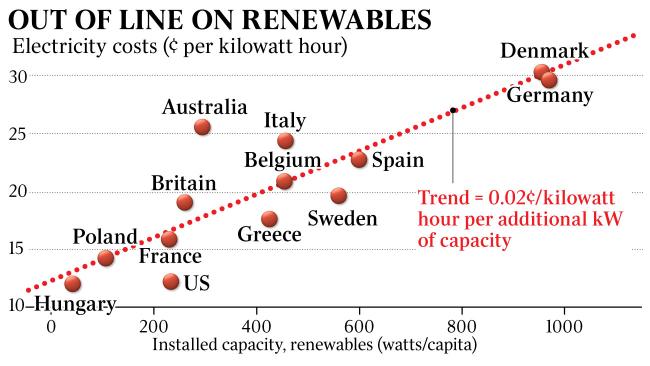
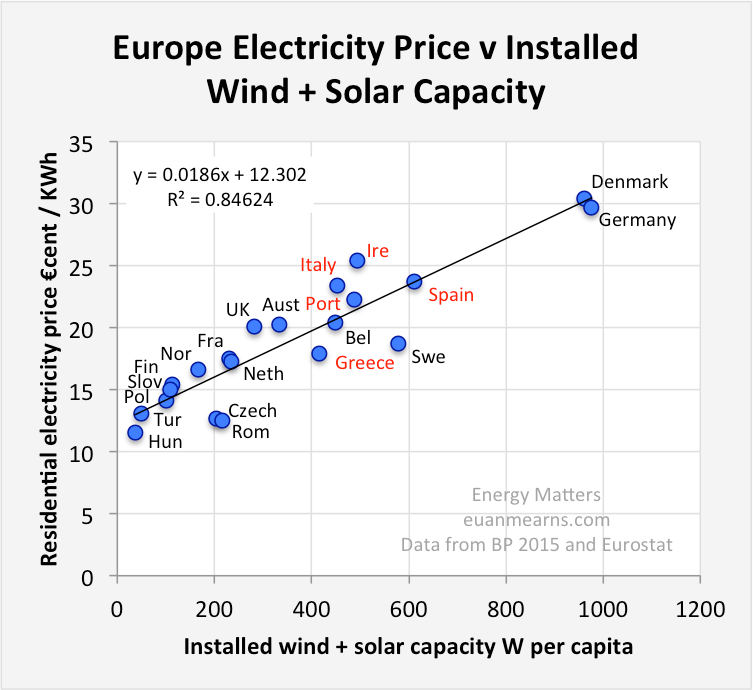
See the graph: the more renewables we have the more we pay…
The countries with more wind and solar power pay more for electricity.
Australia is far above the trend-line. Our electricity is even more expensive than it should be for the amount of renewables we have. At a guess this might be because other nations have more “hydro” in their renewable mix and less wind and solar. Or they have access to nuclear power (like all the EU countries). It may be made worse by the way our energy markets are managed, the profusion of bureaucracies, the subsidies and rebates, the renewable energy target, or the overlapping state and federal green aims. It also may be that in our smaller market we have a few big players gaming a volatile, complicated market. Stability may cost more here, due to the fragility of our network.
Figure 1 The Y-axis shows residential electricity prices for the second half of 2014 from Eurostat. The X-axis installed wind + solar capacity for 2014 as reported in the 2015 BP statistical review normalised to W per capita using population data for 2014 as reported by the UN.
As Euarn Mearns says, there’s more than one variable at work here, but the inescapable conclusion is the countries with the highest levels of renewables pay the highest prices. h/t Don B.
Is that another 10 cent price rise coming?
According to wikipedia our wind power capacity is set rise 250% or something crazy (I’m skeptical):
For a population of 24 million that means we would add another 500 watts/capita. Eyeballing the trendline in the graph, prices would rise by another 10c/KWhr. (Don’t try to unpack the x and y units exactly and calculate it. That’s another story.)
Say it again: there is no country on Earth with lots of solar and wind power and cheap electricity.
Hope foreign readers are enjoying the spectacle of a first world nation destroying its competitive advantage with renewables. Hope that helps you avoid the same fate.
Praise the lord, states without coal don’t have to load-shed-industry (because they don’t have much left):
“In terms of supply we should be okay,” he [the SA Treasurer] said.
“Victoria I understand is about to load shed industry. So they’re not coping with the power supply.
“They are a coal-dependent state and they are having to take industry offline to support their households. In South Australia we’re not having to do that today.” — h/t A H
The Treasurer didn’t mention that SA shed the load already over the last two years by driving heavy manufacturers out of business, and out of the state. Let’s name some:
Gone from the SA power load: Mitsubishi, GMH, Plastics Granulating Services (Recyclers), Caroma (76 jobs) after 79 years in business, Penrice, Arnotts biscuits (120 jobs), Aldinga Turkeys (79), ACI Glass (60 following previous 50 jobs), Arrium (600), BHP (90), SANTOS (~200), Alinta Energy (Pt. Augusta power stations and Leigh Creek mines) (438), Unibooks (100), United Dairies (>100). Plus many more…
Nor did he mention that when peak times hit, SA couldn’t generate enough electricity for itself, even at $14,200/MWh and was drawing around 350MW from Victoria (which was mostly coal fired).
ABC rent-seekers do free PR for Labor-Green-renewables:
The ABC political reporter Nick Harmsen, above, swallowed this one-sided Labor party fantasy, and didn’t bother to interview anyone (skeptic or industry) who knows what rot the Treasurer was speaking. Harmsen probably votes Labor (or Green), has been trained not to “seek balance” lest the public vote out the innumerate, expensive vanity-signalers (who also pump up the ABC budget) at the up and coming SA election.
I’m sure no one ordered him to toss his journalistic standards, but if he ever showed any talent for asking real questions it would have been quashed in the tea rooms, or, was pre-quashed at university, where everyone is trained to think the exact same way.
In masterful form, Harmsen described the Lack of Reserve level 2 (LOR2) notice as meaning “there is a small buffer of surplus left”. Nice spin-winner-way to put an emergency notice that is there to let the market know the buffer is frighteningly small, and far below recommended.
At LOR2 level, things are so bad, the AEMO is throwing our money at the electrical grid to keep it from crashing.
If only he had the internet or a phone he could have used the actual AEMO terms. At least he wouldn’t look like a PR hack instead of a journalist.
While geniuses are bragging that the Australian grid survived two normal hot summer days without falling over, they don’t mention the flaming spectacle of the cost.
Tom Quirk and Paul Miskelly, after a couple of suggestions from me, have calculated the full staggering electricity bill at $119m for SA and $267m for Victoria, making it nearly a $400 million dollar bonfire — for two days that were neither the hottest ever, or records for peak electricity use. See their work and details below.
To put this in perspective, a whole new gas plant could have been built for around $230 million. Instead of vaporising this money, Australians could have constructed one whole new gas generation plant, paid it off, and had money left over to give away free electricity.
Every household of four in Victoria just lost something like $170 of productivity for two days of electricity, and in South Australia, $280. Respectively, $45 per Victorian and $70 per South Australian. While businesses also share this burden, ultimately companies are made of people, and this is productivity lost to both states. The losers are shareholders, customers, and employees. Some will be interstate, but the pain flows back. The price is also paid in higher cost items, lower investment, and fewer jobs. Coles and Woolies still have to cover the cost of keeping the fridges running. The money will be squeezed out of citizens one way or the other.
And this is not the total bill, it’s theexcess electricity bill above and beyond the normal but inflated January prices of the last few weeks. Even normal prices now are twice what they were in 2015. Back then, the average price in Victoria and SA was $35 per megawatt hour and the average peak price was $49/MWh. Now the average on a January day are $82MW/h, and $87/MWh respectively.
But wait, it’s worse than that. Even above this excess electricity price, there is the price of buying the diesels (a secret ’til the $400m bill was revealed), plus the cost of all the businesses which bought their own diesel generators (aren’t we a first world country any more?), plus the cost of all the “Demand Response” — the mini blackouts required to stop the system breaking (more on that tomorrow).
Then, then, there is the awful cost of all the businesses that were affected — the stress, the lost production, the investments that won’t happen, and the bizarre spectacle of Australia not having enough electricity to keep the lights on at our hospitals. We are leading the way to the third world!
Ponder the bureaucrat brain that asked hospitals to turn off spare lights
Victorians were using nine billion watts of electricity at the peak on Friday. How much difference was it going to make to turn off some 100W lights at hospitals? (Aren’t they using the horrid blue-white sleep-destroying-LED’s, in which case, how many 18W globes do you need to turn off to save a state? It would take 2.7 million globes to get 50MW of safety margin). At this point, the people making decisions were either desperately afraid of a meltdown, or not very good with numbers. Either way, it’s bad. The message has gone out to the world that this leading vanguard of renewables doesn’t have enough electricity to run lights at hospitals. A “gift” to skeptics. (Yeah, thanks a lot).
Fergoodnesssake?! Why didn’t the SA government run those diesels — Could’ve saved millions?
Businesses everywhere were running their diesels. Yonniestone reports that ” Fairfax press rural Victorian factory had two shipping container sized diesel powered generators running complete with black exhaust smoke.” (They were probably printing newspapers telling everyone of the evil of fossil fuels, and advising they turn their air conditioners down.)
Can South Australia waste even more money? Yes. it. can.
Meanwhile, the SA Energy Minister seems proud that the diesels “weren’t needed”. Reader Andrew writes: What if they’re right, and while BHP et al turned on the diesel, Weatherill didn’t, to preserve his “battery miracle” story?? That would mean he has spent $400m on diesel – diesel that is purely decorative and he never plans to use! Electricity at $14,000 a MW? Not an emergency. Load shedding? Not an emergency. Businesses like smelters closed? Not an emergency. Economically, the diesel should be on whenever the price reaches $300/MW.
Stupid piled on stupid in the quest for virtue signaling. How much is too much to spend to “look green” and achieve nothing?
More than 800 properties in North Adelaide were blacked out just after 5pm on Friday. Businesses and pubs in North Adelaide were forced to close their doors on a night owners say would have been one of their busiest of the week.
Co-owner of Lion Hotel Tim Gregg said it was hard to have to ask customers to leave after the lights went out. “It is disappointing when you have got people booked in for a meal and you can’t call them because their details are in a system which doesn’t work when the power is out,” Mr Gregg said, sitting in the darkened and empty restaurant area which would have been just starting to fill if the power was on. “We have to ask people to leave because of OH and S issues. It is lucky that it was between lunch and dinner service but the bar would be losing in the thousands of dollars. Mr Gregg said he had more than 40 staff who were at a loose end until the power comes back on.”
Never forget the point of all this suffering. All these householders, spending up to two or three hundred on electricity for two days, are paying to make the weather nicer in 100 years, according to a theory that no official ever did due diligence on.
Hands up, who thinks residents would pay this kind of money if the government knocked at their door and gave them a choice? Anyone?
Analysis of electricity costs for 18 and 19 January heat wave
Guest Post by Paul Miskelly and Tom Quirk
The cost of electricity for the 18 and 19 January two day heat wave may be found from data on the AEMO website. For January there are half hour demand and price tables for each day. The extra cost of 18 and 19 January can be estimated by finding the cost differences from the average daily costs over the period 1 to 17 January after adjusting these costs to match the higher demand on 18 and 19 January.
The changes in prices can be clearly seen in the figure below with South Australia and Victoria having price spikes at the same time (AEMO data). New South Wales and Queensland had no such trouble.
….
The table below shows an estimate of the extra cost; The AEMO website dashboard gives average daily prices that are not weighted by the change of demand and price during the day. There are high prices with high demand and low prices with low demand. The costs have been calculated using the weighted electricity prices.
State
South Australia
Victoria
24 Hour averages
From
30 min data
AEMO*
From
30 min data
AEMO*
18 January
Average MW
2,016
6,444
Average price/MWh
$1,404
$1,074
$1,210
$905
Total day cost
$68,015,878
$187,279,332
19 January
Average MW
2,091
6,878
Average price/MWh
$1,195
$1,012
$648
$523
Total day cost
$59,917,331
$106,777,887
1-17 January week day average
Average MW
1,409
4,865
Average price/MWh
$91
$87
$84
$82
Total day cost
$2,865,478
$9,817,774
Total day cost
Scaled to 18,19 January demand
$4,177,600
$13,450,111
18-19 January
Extra costs
$119,578,009
$267,156,997
The total extra electricity cost is some $400 million. This is an amazing example of the problems resulting from the introduction of too much renewable energy and the closure of coal burning power stations.
___________________
UPDATE: Alan Moran discusses these costs at Catalaxy and argues that with extra coal back up, the loss of any one unit would not cause a price spike. As I mentioned, looking at those forecast graphs, the AEMO was predicting prices to hit the peak cap of $14,200 in SA, and $8,500 24 hours before the single generator failure at Loy Yang B.
Commenter David Bidstrup asks some valuable questions about the way our electricity bidding system works:
Why does the market call “bids” every 5 minutes instead of contracting for firm power over a longer period, say a year?
Who decides that “bids” of 160 times the going rate should be accepted when it is clear that they are just predatory bids made when the generators know the market is caught with its pants down?
When are those who “lead” us going to realise that their policies are destroying the country and making ordinary folk electricity paupers?
When will the leaders realise that renewables are the problem and not the solution, and when will they realise that there is no climate change problem to “fix”?
When will the realisation hit that the electricity crisis is a creation of stupid policy decisions and is a technical problem requiring folk who actually know something about power generation. It is not one to be fixed by intellectually challenged politicians, economists and pet scientists who push their own agendas, egged on by renewable rent seekers and rabid left wing greenies.
The physical market (i.e. the NEM) is set around 5 minute dispatch due to the need for supply to meet demand instantaneously. Contracting for longer periods of time occurs in financial markets either via over the counter agreements between counter parties or via the ASX electricity futures exchange. These markets are settled purely financially and while they influence what happens in the physical market, they are not a direct component of it.
The market decides. A true market however would not place price controls like in the NEM. High prices provide information to entrepreneurs to direct capital investment in the market (i.e. where to build more poles and wires and/or power plants). Labelling the behaviour of generators as predatory seems to imply they should be prevented by force from doing so. This will simply distort the market and lead to adverse outcomes.
Jo says:
The market is already hugely distorted by the RET and other subsidies. It’s not a free market, and will not act like one, and will not send useful price signals anyway. It’s predetermined to send the signal to close coal and open wind farms. It is “succeeding” for bureaucrats and renewables companies, but failing for consumers.
At the moment all the successful bidders are paid the price of the highest successful bidder. So it is in every bidders interest to have price spikes, and for the low cost supply to be insufficient. Why do we have that system? Is there any disadvantage in paying only the successful bidders exactly the price they bid?
*Correction:The per capita cost in SA is $70 per head, not $80 as first written. (Though for lots of reasons the real cost is far larger, but specifically, for these two days, it is $70pp. Thanks to Stephen H).
_______________
*AEMO estimates: These are the official AEMO costs, but they assume each hour is equivalent during the day. Quirk and Miskelly instead weight the charges according to the load each hour of the day to reach a more accurate average cost.
We use cookies to ensure that we give you the best experience on our website. If you continue to use this site we will assume that you are happy with it.


.jpg)







Recent Comments