Recent Posts
-
A country betrayed: less than 1 in 3 trust CSIRO and half the nation don’t want to pay a single dollar for Net Zero
-
Wednesday
-
Rewards for climate zealotry include $4 million worth of beachside golf holidays in Fiji
-
Tuesday
-
Monday
-
Sunday
-
Saturday
-
Typhoon Bavi strikes solar parks in China giving a new meaning to “distributed energy”
-
Friday
-
PM will force Data Centres to use renewables (because he knows they would use gas or coal if they could)
-
Thursday
-
The crisis in conservative politics: Half the voters are fed up with climate propaganda, and the Liberals ignore them
-
Wednesday
-
The Bankers bullied Australia into Net Zero
-
Tuesday
-
Monday
-
Sunday
-
Climate change causes child marriages
-
Saturday
-
Friday
-
Vote Left to get expensive electricity
-
Thursday
-
Lucky us, The UN deigns to not list the Great Barrier Reef as ‘in danger’ (yet again)
-
Wednesday
-
Blackouts and maintenance problems hit farmers forced onto solar and batteries in Western Australia
-
Tuesday
-
Monday
-
Sunday
-
One Nation are now the Party of the workers, and Labor the party of wealth and academics
-
Saturday
-
Net Zero anyone? USA bets big on coal and gas — overtakes China in spending.
-
Friday
-
Winning: Trump persuades The World Bank to drop its huge spending target on “climate”
-
Thursday
-
Bafflement?! Germany, a global leader in renewables but has one of the highest EU electricity prices
-
Wednesday
-
Horse-drawn carriages must have caused a Megadrought in Europe in 1540, right?
-
Tuesday
-
Monday
-
Sunday
-
UK facing devastating 36 degree heat — can’t decide whether to use air conditioners or rip them out
-
Saturday
-
Batteries failed on day One: A four day wind drought in South Australia wreaks havoc, high prices
-
Friday
-
The UN wants to be One World Government and it starts with a carbon tax on ships and planes
-
Thursday
-
What if Global Warming was just because something made the clouds go away…
-
Wednesday
-
Snowy 2.0 is the Trillion dollar Black Hole of Australia — sucking in energy, money, land, industrial relations, the dollar, our lifestyle
-
Tuesday
-
Monday
-
Winter Solstice
|
8.9 out of 10 based on 8 ratings
The environmental fashion parade suddenly has a smell…
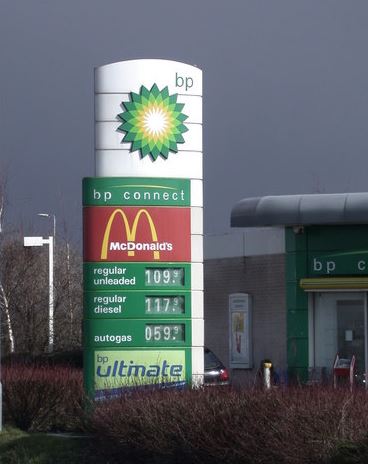
This is a notable shift: Twenty years ago BP called itself “Beyond Petroleum”, and only one year ago the CEO said BP was “accelerating” its green investments. But now the CEO is reassuring investors that BP is not going to be distracted by environmental goals, and are focused on maximizing profits. Furthermore those profits would be found where it has a competitive advantage, including it’s “legacy oil and gas operations”.
Just like that: it’s OK to talk about profits and energy security. Key words here are “dialing back”, “disappointed”, “narrower” and “less emphasis” and they are all used in relation to environmental investments.
After years of sunshine and unicorns on the forced transition to unreliable energy, the mood appears to be changing.
h/t Paul Homewood at Notalotofpeopleknowthat
Bernard Looney seeks to sharpen strategic focus, with less emphasis on environmental goals
Jenny Strasberg, Wall Street Journal
Chief Executive Bernard Looney plans to dial back elements of the oil giant’s high-profile push into renewable energy, according to people familiar with recent discussions.
Mr. Looney has said he is disappointed in the returns from some of the oil giant’s renewable investments and plans to pursue a narrower green-energy strategy, the people said. He has told some people close to the company that BP needs to do more to convince shareholders of its strategy to maximize profits in areas where it has a competitive advantage, including its legacy oil-and-gas operations.
In some of the conversations, Mr. Looney has said he plans to place less emphasis on so-called ESG goals—a catchall term for environmental, social and governance—to help clarify that those aren’t distracting the company from its ability to deliver profits, the people said.
One BP investor said shareholders were carefully watching the performance of renewable investments.
They said: “Societally, people are now more focused on the question of energy security – we’ve got to be mindful that as we run up the new system of renewables, you can’t run down the old system too aggressively; it’s a transition, it’s not a step change.”
This appears to be a company wide shift. Only three days ago the chief economist at BP said that we’d need oil and gas for decades yet.
By Rachel Millard, The Telegraph
Fossil fuels only way to combat energy shortages, oil giant claims
Investment in oil and gas production will be needed for the next three decades if the world is to avoid more shortages and price swings, BP has warned. The oil giant said in its annual energy outlook published on Monday that fossil fuels are still likely to account for about 20pc of primary energy in 2050 even under a significant tightening of climate policies.
“This would be the first time in modern history that there has been a sustained fall in the demand for any fossil fuel.”
Media spin runs as strong as ever
The New York Times and Reuters readers though, are seeing headlines like this generated from the same BP report.
The head of the world’s leading energy organization called the war in Ukraine an “accelerator” of the transition.
“The increased focus on energy security as a result of the Russia-Ukraine war has the potential to accelerate the energy transition as countries seek to increase access to domestically produced energy, much of which is likely to come from renewables and other non-fossil fuels,” BP Chief Economist Spencer Dale said in the report.
It’s like we live in two different worlds. Some investors may be in for a nasty surprise.
To be fair though, BP are generating the kind of reports that “appeal both ways”. But what’s different is that a few years ago they wouldn’t have dared pouring cold water on the environmental message or talking about energy security and the need for fossil fuels.
But make no mistake there is still a lot of conflict in the companies core mission
Are these plans still current?
BP has said it plans by 2030 to slash its fossil-fuel production by 40% from 2019 levels. Mr. Looney has set a target of increasing investments in what it calls “transition growth businesses” including renewable energy and convenience-store operations to around 50% of total capital spending by 2030, up from more than 40% by 2025. Mr. Looney and his lieutenants have said the company is balancing its deeper push into low-emission projects while still nurturing legacy cash cows like oil-and-gas production and trading. — WallStreetJournal
According to the Wall Street Journal, earnings from oil and gas were projected to be $30 to $35b annually by 2030, while the renewables earning target was $10b.
In 2011–2015, BP cut down its alternative energy business. The company announced its departure from the solar energy market in December 2011 by closing its solar power business, BP Solar.[136] In 2012, BP shut down the BP Biofuels Highlands project which was developed since 2008 to make cellulosic ethanol from emerging energy crops like switchgrass and from biomass.[137][138] In 2015, BP decided to exit from other lignocellulosic ethanol businesses.[139] It sold its stake in Vivergo to Associated British Foods.[140] BP and DuPont also mothballed their joint biobutanol pilot plant in Saltend.[141] — Wikipedia
If there were easy profits to be made in solar or biofuels, presumably BP wouldn’t have axed them.
BP Energy Outlook 2023 | Photo by Keith Edkins |
9.8 out of 10 based on 69 ratings
8.8 out of 10 based on 9 ratings
By Jo Nova
A new paper estimates that if we increased our tree canopy in cities to 30% we could cool our cities by nearly half a degree. Works better than a windmill…
The trillion dollar global warming camp obsesses over 1.5°C of heat, but the urban heat island has already made our cities 1.5°C hotter than the countryside around them, and nobody gives a toss. Cities are where the lived human experience is for most of us, and despite the threat of that extreme heat made “worse by climate change”, no government does the obvious and sets a tree cover target. There are no Ministers of Regreening, and no carbon credits for suburbia. All we’re getting is concrete bollards and fifteen-minute-cities of pain.
In the green revolution instead of growing gum trees, people are cutting them down because they shade their solar panels. In our capital city they razed a majestic avenue of trees in order to add light rail. A true Green hates cars more than they like trees.
Urban flora not only cleans the air, it also reduces suicides, improves cardiac health, and reduces particulate pollution. One Canadian study estimated that living close to green spaces even reduces all cause mortality and by a remarkable 8 to 12%. (Crouse et al 2017). We’ve known this for years but no one has organized an annual UN convention.
Greening our cities won’t change the global temperature, but it lays bare the hypocrisy
They say they are here to help but they pick the paths that make them money.
Planting more trees in urban areas to lower summertime temperatures could decrease deaths directly linked to hot weather and heatwaves by a third, researchers said Wednesday.
Modeling found that increasing tree cover to 30 percent would shave off 0.4 degrees Celsius (0.7 degrees Fahrenheit) locally, on average, during hot summer months, they reported in The Lancet.
Of the 6,700 premature deaths attributed to higher temperatures in 93 European cities during 2015, one third could have been prevented, according to the findings.
On average, the temperature in cities was 1.5C warmer during summer 2015 than in the surrounding countryside. The city with the highest difference—4.1C—was Cluj-Napoca, Romania.
Earlier studies have shown that green spaces can have additional health benefits such as reducing cardiovascular disease, dementia and poor mental health, as well as improving cognitive functioning of children and the elderly.
REFERENCES
Cooling cities through urban green infrastructure: a health impact assessment of European cities, The Lancet (2023).
Crouse et al (2017) Urban greenness and mortality in Canada’s largest cities: a national cohort study, Lancet Planet Health, . 2017 Oct;1(7):e289-e297. doi: 10.1016/S2542-5196(17)30118-3. Epub 2017 Oct 5.
Photo by Maria Orlova.
9.9 out of 10 based on 74 ratings
9.8 out of 10 based on 8 ratings
By Jo Nova
The science is settled except we only just realized that the benzene and toluene gas over the vast Southern Ocean were not man-made pollutants after all, but were made by industrious phytoplankton. For the first time someone went and measured the benzene and toluene in the water and discovered that instead of being a sink for human pollutants in the air above, the ocean was the source.
This matters because these two gases increased the amount of organic aerosols by, wait for it, between 8% and up to 80% in bursts. And all that extra aerosol matters, of course, because aerosols seed clouds, which change the weather.
And the expert climate models, upon which a $1.5 Trillion dollar industry depends on for its’ very existence, did not know this. If hypothetically there has been less phytoplankton in the worlds oceans in the last few decades, there may also have been less cloud cover, and thus more warming. But who knows?
The modelers are always saying climate change can’t be natural because they can’t think of anything else that could have could have caused the warming, then people keep finding another factor they forgot to put in the models…
“In any case “climate models will have to consider benzene and toluene emissions from the oceans if they want to get the clouds right in climate projections for both the past and the future,” says IQFR-CSIC researcher and head of the atmospheric modeling part of the study Alfonso Saiz-López.”
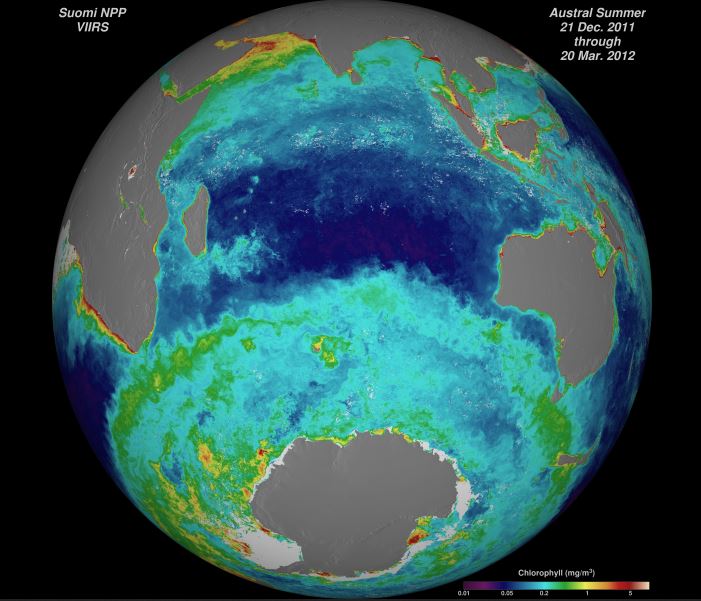
This is an image of rolling eddies of blooms of phytoplankton in 2017 between the Antarctic peninsula and South America. Like a giant artist was marbling patterns in the worlds oceans.
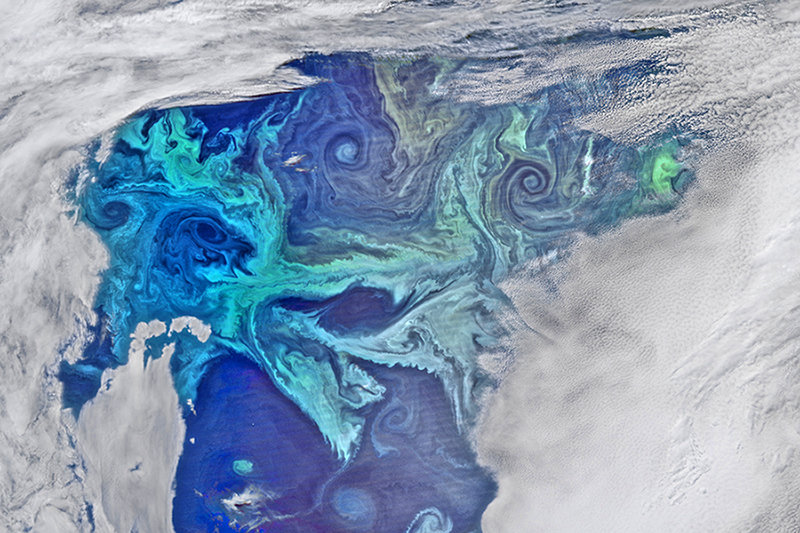 Southern Ocean drives massive bloom of tiny phytoplankton 2017. On January 13, 2016, the Visible Infrared Imaging Radiometer Suite (VIIRS) on the Suomi NPP satellite captured this view of extensive phytoplankton blooms stretching from the tip of South America across to the Antarctic Peninsula.* Does this sound like a mature field ready to have a $7 trillion dollar carbon market set up around it?
PhysOrg
“If we don’t get the clouds right, we won’t get the climate right,” says Charel Wohl, ICM-CSIC researcher and lead author of the study. “We are just beginning to unveil the multiple ingredients that form cloud seeds,” he adds.
The work, published in the journal Science Advances, describes the first measurements of benzene and toluene in polar oceans and indicates that these compounds have a biological origin. Until now, their presence in polar marine air was thought to be a proof of the extent of human pollution from coal and oil combustion or solvent use, among others.
A biological origin
The only way to know how the atmospheric composition was regulated before the profound changes generated by human activity in the industrial era is to study those regions where the air is still clean, such as the polar areas.
To carry out the study, the team measured the concentrations of benzene and toluene in surface water and air during the course of two oceanographic campaigns: one in the Arctic and the other in the Southern Ocean. The distribution of these gases, their relationship to the amount of phytoplankton, and the fact that the ocean was constantly emitting them into the atmosphere rather than capturing them from it, led the researchers to conclude that they were of biological origin.
Then, by incorporating the data into a global atmospheric chemistry and climate model, the scientific team realized that benzene and toluene emitted by the ocean contributed significantly to aerosol production. This was especially true in the extremely clean and unpolluted atmosphere of the Southern Ocean, where these two gases increased the amount of organic aerosols by 8% and up to 80% in transient situations.
The ocean is a net supplier — it’s outgassing far more than it absorbs
From the paper: Benzene is the top row, and clearly, in this two month period in 2019 there are big fluctuations, which could affect cloud cover (Click to enlarge. ) The fluxes of gases are shown in C and D and most of the time the ocean is neutral or outgassing.
 Fig. 2. Underway measurements from the Southern Ocean.
Hourly underway surface seawater concentrations and atmospheric mole fractions of benzene and toluene in (A) and (B), respectively. Interpolated air mole fractions are also shown in (A) and (B). The calculated sea-to-air fluxes are shown in (C) and (D). Positive fluxes indicate ocean outgassing, i.e., sea-to-air fluxes. The other plots show the wind speed (WS) (E), underway sea surface temperature (SST) (F), and Chl a and surface seawater salinity (SSS) (G). https://www.science.org/doi/10.1126/sciadv.add9031
This unique combination of measurements points toward a biological source for these two compounds previously thought to be predominantly released to the environment from anthropogenic activity.
Chlorophyll concentrations marks out where phytoplankton were in a three month period. The highest concentration blooms are marked in red.
Secondary Organic Aerosols (SOA) may have a big effect on cloud formation:
Keep reading →
9.9 out of 10 based on 97 ratings
8.7 out of 10 based on 15 ratings
By Jo Nova
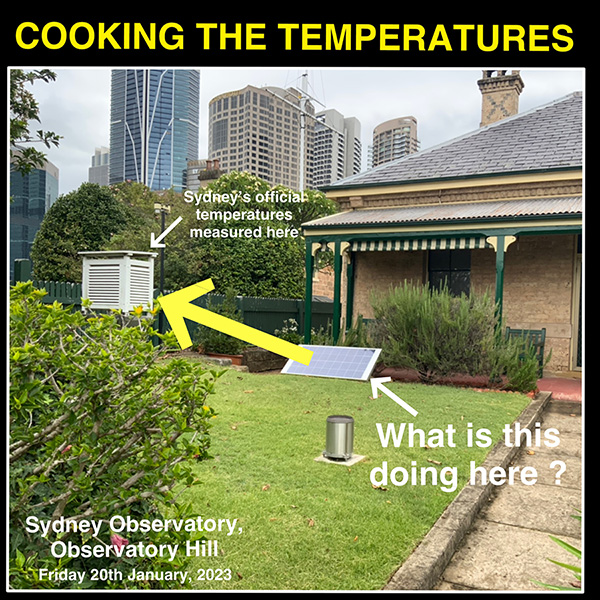
Remember the nomadic solar panel that appeared a few meters due south of the Sydney Observatory thermometer at the same week as the city ended it’s coldest streak in 140 years? Well Craig Kelly, who took the original photos, went back and now its gone.
Today there is just grass and shrubs to reflect the midday sun towards the back of the thermometer box.
As Craig Kelly said: “The fact that it’s disappeared shows that it was never installed – someone at the BOM just happened to grab a random solar panel and place it at such an unexplained position…”
So much for expert rigorous science accurate to a tenth of a degree.
Kelly explains that this site is nearly invisible: “The only way you can see it is by holding a camera above your head – it’s not visible to the eye – even if you were 6’6” and standing on your toes you can’t see over the fence – and the Observatory is closed to the public for some unknown reason.”
Perhaps the BOM just thought no one would notice, and “it’s for a good cause, eh?” We can’t have the punters thinking Sydney was cooler today than in 1883.
As I said:
The solar panel was exactly due south of the Stevenson screen on exactly the right day. If, hypothetically, someone wanted to leave a reflective object pointed at the box at midday, that’d be the place to do it.
Look for the handy BOM guidebook:
“How to create temperature records with spare parts lying around the house”
It’s the year without a summer for Sydney. There’s only been one day above 30°C since Feb 21st last year in Sydney, and that was a day when the wandering solar panel was visiting the thermometer, seemingly connected to nothing and leaning on a bush.
Guilty, what? Will the BOM retract the 30.2°C “official temperature” or do secret homogenisation adjustments to figure out what the temperature might have been with thermometers 800 km away?
I wonder how often this is happening at other sites around Australia? Time to start looking?
By onlookers, not easily seen,
At just the right angle to lean,
One odd solar panel,
Some heat for to channel,
Straight on to the Stevenson screen.
–Ruairi
Keep reading →
9.8 out of 10 based on 101 ratings
9.5 out of 10 based on 10 ratings
After the blockbuster revelations, the Babylon Bee right onto it: 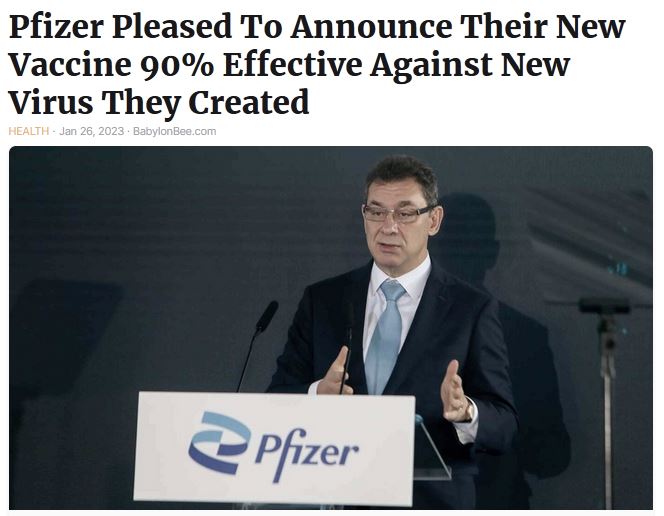
 NEW YORK, NY — Pfizer Inc. dropped their new COVID variant and accompanying vaccine Thursday at midnight, much to the delight of CDC officials. The new vaccine is reportedly shown to be 90% effective against the COVID variant Pfizer created in their lab. NEW YORK, NY — Pfizer Inc. dropped their new COVID variant and accompanying vaccine Thursday at midnight, much to the delight of CDC officials. The new vaccine is reportedly shown to be 90% effective against the COVID variant Pfizer created in their lab.
Experts suggest Pfizer’s radical approach to virus treatment may be tantamount to an abusive relationship, but that’s okay because we probably deserve it.
“I’d suggest we investigate this immediately,” said Congresswoman AOC. “But I don’t want to burn any bridges. I might have to get a job there someday.”
h/t John Connor II, David
PS: Huge congratulations to the indominatable Novak Djokovic, a man we discussed so much a year ago when he was deported for not taking drugs. See the raw emotion as he breaks down in the stands a few minutes after his win. It really is remarkable. It’s not just the vaccine debacle last year, but serious injuries in the last few weeks as well. The man is a champion who will not submit. Last year, they were afraid he would win and spread freedom, not viruses.
9.9 out of 10 based on 108 ratings
8.8 out of 10 based on 75 ratings
8.4 out of 10 based on 16 ratings
By Jo Nova
UPDATE: Pfizer have responded! Wow. They don’t even mention the unwitting informant Jordon Walker, thus suggesting he is one their own. They deny they do Gain of Function or Directed Evolution, but admit “we have conducted research where the original SARS-CoV-2 virus has been used to express the spike protein from new variants of concern.” AND: “In a limited number of cases when a full virus does not contain any known gain of function [GOF] mutations, such virus may be engineered to enable the assessment of antiviral activity in cells”.
Pfizer are admitting to adding GOF mutations, and to mixing the new spike and old nasty virus!
Are they not saying they engineer viruses — starting with the original Wuhan virus and adding the new spike from new “variants of concern”? The new Omicron variants have incredibly well evolved spikes that are so much more infectious than the original variant, but the Omicron virus “in toto” is much less dangerous than the original Wu-Flu. So by mixing the old nasty variant with the new spike, they could be playing with a virus that has the worst of both? How’s that for “potent”?
In the second quote they are admitting they engineer and add “Gain of Function” mutations to a full virus in order to blah blah blah… Is that not exactly what the accusations are suggesting?
And it’s being done in BSL3 labs, not the most secure BSL4?
One way or the other, it’s setting the internet on fire.
Project Veritas has footage of a Pfizer executive bragging on camera about utterly reckless profit-seeking immoral behaviour and corruption at the highest level. If this is what it appears, it’s dynamite. It’s almost “too good”.
 … Jordon Trishton Walker appears to be the Director, Worldwide R&D Strategic Operations and mRNA Scientific Planning. In the video he candidly discusses how Pfizer are talking of creating mutant Covid viruses. Walker is utterly cavalier about the risks, he brags about the profits, and also claims Pfizer has complete captured the regulatory agencies. “It’s a cash cow”.
The video was released Thursday, but within hours, it was hard to independently verify who this man was. As impressive as Project Veritas’ record is, what if this was a Pfizer sting instead? James O’Keefe from Project Veritas offered some internal Pfizer Documents. But Walker doesn’t seem very old, articulate or particularly smart enough to be a glorious high level director of Pfizer. He speaks far too easily, as if he’s never met the company’s lawyers. Other strange things were happening, like his Linked in account, had disappeared off the internet and for an hour or so The Daily Mail covered the story, then their article disappeared without a word (a copy was archived here). The internet was being “scrubbed”. No other news outlets were mentioning it. The censorship, though, suggested he was the real deal. If he wasn’t, Pfizer would surely have said so? Brian OShea went on a hunt for information to confirm Walkers identity, and pieced together a timeline of his career. But Walker has a very strange career path — so strange, I’ll write more on that soon. One way or another careers hang in the balance…
When caught, Walker said he was lying to “impress a date”. And perhaps he was exaggerating and embellishing. Nothing he claims here is necessarily true or verified yet.
Today Tucker Carlson has weighed in (see that segment below). Pfizer have not denied that Walker is who he says or that anything he said was false. They have not responded at all to repeated requests for answers, but suspiciously they apparently quietly shut down comments on some of their social media accounts.
Dramatically, James O’Keefe says that other insiders at Pfizer are coming forward as whistleblowers today. If so, this could be a game-changer. He has also released more footage of Walker getting violent and trying to smash the tablet when he finds out it was recorded (see that, far below).
This video is now up to 18 million views on Twitter after little more than a day and a half. When will the news media investigate?
Must watch. Pfizer exec explains how Pfizer is mutating the Covid virus to create new variants so it can sell new vaccines and the regulators turn a blind eye because they are going to work for Pfizer. It’s good for us but bad for everyone else he says laughing.
— Rebecca Weisser
Robert F Kennedy says:
Amazing reporting by James O’Keefe showing us what we already knew: Pfizer is a craven venal homicidal morally bankrupt criminal enterprise that has captured and corrupted its regulators.
Pfizer may be talking about mutating Covid…
- “One of the things we’re exploring is like, why don’t we just mutate it [COVID] ourselves so we could create — preemptively develop new vaccines, right? So, we have to do that. If we’re gonna do that though, there’s a risk of like, as you could imagine — no one wants to be having a pharma company mutating f**king viruses.”
It’s not Gain of Function experiments on Covid, it’s just “directed evolution” to make it more potent:
- No, no, no, no. Though directed evolution is very different. Well, you’re not supposed to do gain of function research with the viruses. They recommend not. But you do things like selected directional mutations to try to see if you can make more . So there is research ongoing about that. I don’t know how that’s going work. There better not be any more outbreaks, because like Jesus Christ.
Pfizer are just trying to save lives right?
- “Don’t tell anyone. Promise you won’t tell anyone. The way it [the experiment] would work is that we put the virus in monkeys, and we successively cause them to keep infecting each other, and we collect serial samples from them.”
By the way, Covid was a lab leak from Wuhan:
- “You have to be very controlled to make sure that this virus [COVID] that you mutate doesn’t create something that just goes everywhere. Which, I suspect, is the way that the virus started in Wuhan, to be honest. It makes no sense that this virus popped out of nowhere. It’s bullsh*t.”
And we wouldn’t want to create another pandemic like that last one:
- “From what I’ve heard is they [Pfizer scientists] are optimizing it [COVID mutation process], but they’re going slow because everyone is very cautious — obviously they don’t want to accelerate it too much. I think they are also just trying to do it as an exploratory thing because you obviously don’t want to advertise that you are figuring out future mutations.”
On capturing government agencies
From Project Veritas comes the claim that Pfizer has the government agencies under its command by offering jobs to everyone in the agency after they have approved the drugs Pfizer wants them to approve:
Walker went on to explain how Big Pharma and government officials, such as at the Food & Drug Administration [FDA], have mutual interests, and how that is not in the best interest of the American people:
Walker: [Big Pharma] is a revolving door for all government officials.
Veritas Journalist: Wow.
Walker: In any industry though. So, in the pharma industry, all the people who review our drugs — eventually most of them will come work for pharma companies. And in the military, defense government officials eventually work for defense companies afterwards. …
Veritas Journalist: How do you feel about that revolving door?
Walker: It’s pretty good for the industry to be honest. It’s bad for everybody else in America.
Veritas Journalist: Why is it bad for everybody else?
Walker: Because when the regulators reviewing our drugs know that once they stop regulating, they are going to work for the company, they are not going to be as hard towards the company that’s going to give them a job.
We already knew we should raze those agencies.
Tucker Carlson
If legit, Pfizer is admitted their vaccines can’t keep up with viral evolution
At 16:20 Robert Malone points out that Pfizer are repeating the kind of risky work that was being done in Wuhan. (It’s that bad). But also that they have made a big admission here –“This is an acknowledgement of defeat”, he says. They’re saying that even with the new mRNA technology they can’t keep up with the virus’s evolution. They’re trying to jump ahead with “directed evolution” which is a way of not saying “Gain of Function”. It’s a desperate measure to outdo the virus. (Showing that vaccines were never the right solution to a rapidly evolving coronavirus, and antivirals were always the better solution.)
The idea that Pfizer are mutating things in “advance” to try to beat the virus and develop the next vaccine seems suspiciously futile. There are so many ways this virus could change — there are 29,000 bases to mutate, in every combination and permutation, and we won’t know which are truly successful mutations until they get tested in real people. Some can be guesstimated with testing in humanized mice that carry copies of human proteins like ACE2 receptors. But how realistic is it to make 5,000 different vaccines “just in case”? Perhaps the combinations and permutations can be reduced enough to make this viable. Maps of mutations in the genome of the virus (below) show that some points are hot-spots, and other points hardly vary because they are too essential to viral fertility.
These are the rate of mutations that occur naturally at each of the 29,000 base pairs since 2020
The spikes in the graph below show the parts of the viral genome that have mutated the fastest, but also show which parts of the virus are so important they do not mutate (changes at these sites are presumably “fatal” for the virus). It still seems a desperate and daunting task for Pfizer to out-do what is already occurring all over the world in millions of people with covid.
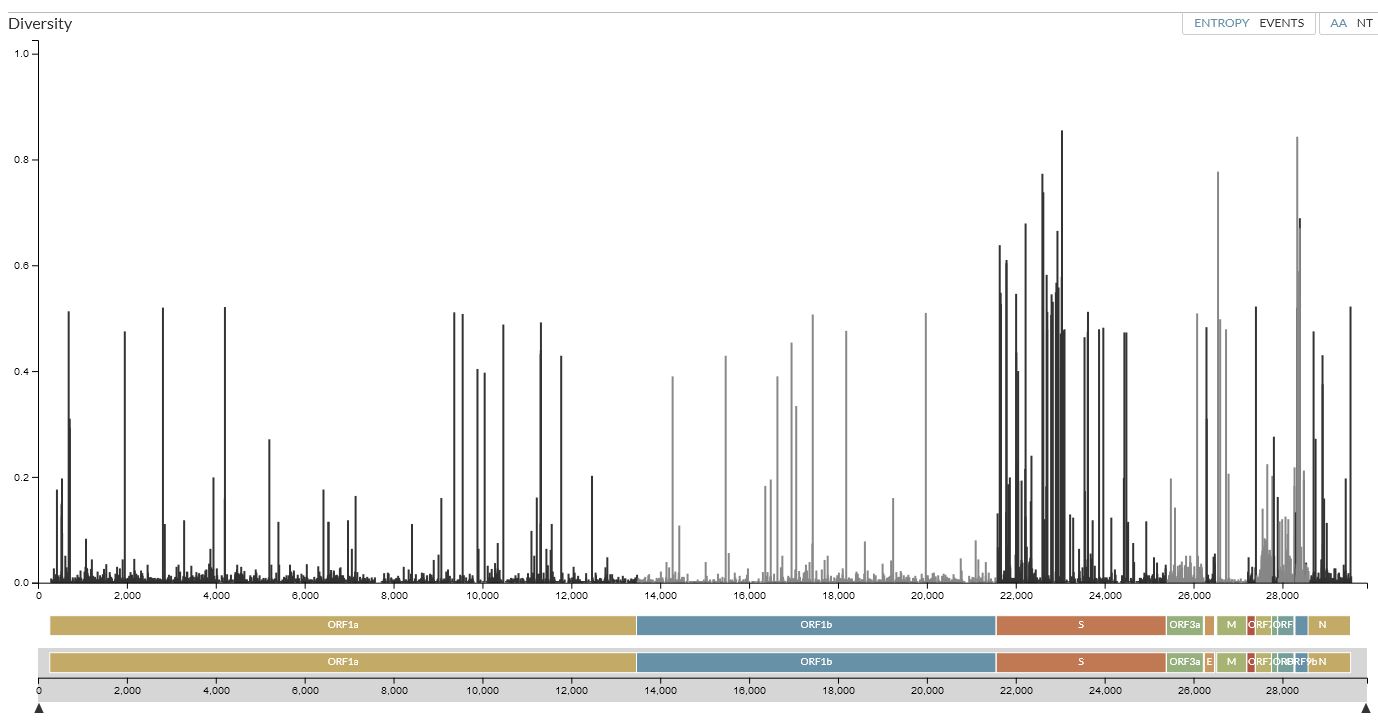 Click to enlarge. Source — Nextstrain. Scroll down, mouseover their graph for more detail. Desperation: Walker descends into violence
When Walker realizes he’s been recorded, he loses it. He says he was lying “to impress a date”. Then calls the police and won’t let them leave, and then tries to destroy their tablet. He even tries to stop a car from leaving which he thinks has the Project Veritas team in.
He is flummoxed, caught in the headlights, but aware this is terrible:
…
James O’Keefe gives an update today on Steve Bannon’s War Room
In this interview below, O’Keefe explains that Pfizer has not responded except to shut down comments on their social media accounts. But most encouragingly new Pfizer whistleblowers are appearing and he believes that the path forward is with insiders coming forward:
In the original sting Walker was apparently talking to a former Pfizer worker (according to O’Keefe in the Bannon interview), which might explain why he let his guard down. Presumably he’s gay because his date is a man.
There will be so much more to say on this…
h/t Lance, Scott of the Pacific, Jill J, John Connor II, Charles, Leo G, Honk R Smith, Tides of Mudgee. Bill in AZ, George Christiansen from NationFirst, @Rebeccaweisser.
9.7 out of 10 based on 84 ratings
By Jo Nova
The headline is a PsyOp all on its own. You didn’t know you were not allowed to eat crickets and powdered mealworm larvae before. Rejoice in a freedom won:
Retail Detail
 The European Commission declares new insect products safe for consumption. So from Tuesday, powdered house crickets and the small mealworm will also be allowed in food. The European Commission declares new insect products safe for consumption. So from Tuesday, powdered house crickets and the small mealworm will also be allowed in food.
Back in February last year, the European Union announced that three species of insects would henceforth be allowed for human consumption: the migratory spider cricket, the yellow mealworm and the house cricket. Now the European Commission is adding several more insect products to the authorised list…
Insects, they tell us, are “highly nutritious” in a vague non-specific way that does not list a single nutrient which we can’t get enough of at the moment. Instead the main, “unique” selling point is that if we eat crickets we might slow storms eighty years from now:
Insects are also seen as part of the transition to a more environmentally friendly and plant-based food system. The creatures emit less greenhouse gases, have a lot less water and arable land, and convert food into protein much more efficiently than traditional sources of meat.
Ponder that this is yet another vested industry — dependent on the broken climate models. Another cheer squad for carbon taxes.
Cricket Flour could turn up anywhere:
Daily Wire
Cricket powder will now be permitted in a number of food products, such as multigrain bread, crackers, cereal bars, biscuits, beer-like beverages, chocolates, sauces, whey powder, soups, and other items “intended for the general population,” according to the new regulation.
Get ready: It doesn’t need to have specific labeling because we aren’t absolutely sure if it will kill people yet:
Because evidence linking cricket powder to allergic reactions is “inconclusive,” the European Commission decided that no specific labeling requirements should be included in the EU list of authorized novel foods, according to the regulation.
The New York Allergy and Sinus Centers has nevertheless found that “several allergic reactions to crickets” have been reported in the past two years. Individuals allergic to shellfish such as shrimp, crabs, and lobsters “may develop an allergy to crickets” because the species share many of the same proteins.
While insects don’t need a “special label” they do need to be listed somewhere in 4 point font on ingredients lists:
However, the European Commission insists that ingredients must always be properly declared on packaging labels. Manufacturers must always indicate which type of insect it concerns. After all, some people may be allergic to insect food, although this needs to be investigated further. This would mainly concern consumers who are also allergic to crustaceans, molluscs or house dust mites.
On the downside, if you have a prawn or dust-mite allergy you may now need an epipen since prawns and dust-mites didn’t use to suddenly appear in chips and crackers. And hardly anyone sold prawn-flavoured-beer or dust-mite-in-dips. On the upside, if you don’t die, after a few painful years you may have done your own oral desensitization program which normally costs $3,000 from an immunologist.
Of course, we could all just share photos and boycott them all. Vote with your wallet.
“It’s better for the environment” chirps the local Woolworths Australian variety. At least this is not hiding in a cake mix.

The globalists ever so crappy,
Say eat ze bugs and be happy,
But Jiminy Cricket,
Their taste is so wicked,
That we all end up wearing a nappy.
–Ruairi
h/t John Connor, David Maddison.
Photo from Thailand Unique Cricket Flour Shop
9.5 out of 10 based on 77 ratings
8.5 out of 10 based on 10 ratings
8.5 out of 10 based on 8 ratings
By Jo Nova
 Zion Lights If we don’t teach our children how to spot cults and con artists they might grow into adults who lie on roads, tie themselves to cranes, and throw soup on a Van Gogh. Those who benefit from Climate “action” are exploiting mentally ill people.
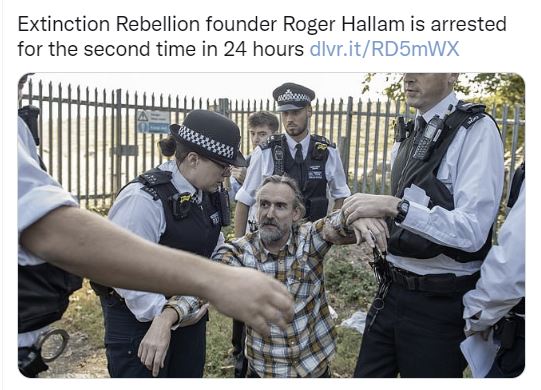
A lady with the unlikely name of Zion Lights was once a spokeswoman for Extinction Rebellion but quit and is now speaking out about their brainwashing, destructive behaviour, and the way they never seemed to want to solve climate change.
“The whole thing was a masterclass on how to manipulate emotions”, she says. She was told to “cry on TV” and bring her children to protests. Fellow activists there were so brainwashed some were sure they were going to die before thirty, and the leader of the movement, Roger Hallam offered them salvation, preyed on their guilt, compared himself to Gandhi and MLK and called himself a prophet. But was rude to followers, wouldn’t listen, and really didn’t care about “the people” at all. Ultimately, while he talked about armageddon, “he did nothing to prevent it” she said.
The hypocrisy finally got to her. Ms Lights wanted to talk about nuclear power as a way to solve climate change, but wasn’t allowed to. Indeed, for even suggesting it, she was attacked and called a “climate denier”. What could be worse than that, eh?
As XR hit speed bumps, Roger Hallam did what all self-respecting narcissist con-men do when the going got tough, he avoided answering questions and moved on to set up “Just Stop Oil” — the new incarnation of climate cultishness and road-gluing behavior.
The climate movement is splintering under the weight of absurdities and over-reach, tearing itself apart because there aren’t any real principles to hold itself together. If they cared about CO2 they’d care about reducing it, if they cared about people they wouldn’t treat them so rudely.
A key turning point was when XR protestors jumped on the tube train in London and were tossed off by fed up commuters, most of whom were the working poor the movement was supposed to be helping. It was such a selfish inconsiderate act, about half the key people at XR refused to defend it on TV. It was the beginning of the end. A few days later one of the other XR leaders said the movement wasn’t about the climate anyway, it was really about “toxic white European racist heterosexists“, which left XR supporters a bit flummoxed, since they were mostly white.
Three years later and XR is so irrelevant they tried to get attention recently by announcing that they would stop being a public nuisance and do normal protests instead.
At its peak the movement was paying key activists up to £400-a-week to lead protests. Somehow £200,000 was being fed into a “grassroots movement” semi-staffed by professionals who happened to be the right personality type.
Ms Lights left XR two or three years ago and went on to work with Michael Shellenberger for a while promoting nuclear power, but he’s become such a skeptic, perhaps it’s not a good fit anymore. She has set up her own group called “Emergency Reactor“. Obviously, she still believes in the climate change religion, and thinks reliable facts come from “the UN, IPCC and the WHO” — just that she tells green groups to “back nuclear or back down”. Her movement is sort of half-sensible but suspended on an ocean of absurdly stupid science, so it will appeal to the few who are pragmatic enough to solve climate change but not pragmatic enough to check the science. Without help from marxist fans, minions-of-doom, the renewables industry, big-bankers, and China or Russia — which she obviously won’t get — her movement looks doomed.
I see Zion Lights has an MSc in Science Communication, (my very own field) which is presumably why she has no idea what science is. Science Communicators are trained to be marketers for Big-Gov-Science, not journalists to serve the people.
Thanks to Climate Depot
By Zion Lights
As a member of Extinction Rebellion, writes Zion Lights, I watched people brainwashed into pulling outrageous stunts in the name of ‘saving the planet.’
But there were red flags.
At my first XR media training, I was instructed to cry on television. “People need to see crying mothers,” Jamie Kelsey-Fry, the trainer and longtime XR activist, told me. “They need to be woken up to what they should really care about.” They asked if I’d bring my children to climate marches for the same reason. The whole thing was a masterclass on how to manipulate emotions. We were instructed to bring everything back to the climate emergency and how politicians were failing us. Nothing about solutions or science.
“You could almost describe Roger as the leader of a cult.”
… over time, I realized there was something wrong, and that the guy in charge of XR, Roger Hallam, was the root of it.
Roger, 56, an organic-farmer-turned-radical, is XR’s most dominant leader. He turned to activism after his farm business in Wales collapsed—a failure he blamed on extreme weather. In 2018, Roger founded XR with several people, but his ego propelled him to the top.
When I first saw Roger in the XR office in London, I didn’t see his appeal. His wiry gray hair was unkempt, and he sat behind his desk every day eating pungent homemade hummus. I noticed he didn’t pay attention to people when they talked. That we were facing certain death was his justification (or rationalization) for being rude to everyone.
Members called him a hero, and fell for his constant self-comparisons to MLK and Gandhi. He referred to himself as a prophet, and “proved” he was a martyr through regular arrests and stints in jail.
“He’s a genius,” Joel Scott-Halkes, another spokesperson, told me. Another common refrain: “He’s the only chance we’ve got.”
Roger liked to claim that war, murder and “the rape of young women on a global scale” are just around the corner.
While Roger insists he’s saving the human species from Armageddon, he doesn’t do the things you need to do to prevent it—like lobbying for legislation, electing sustainability-focused politicians, or fighting for actual solutions. (The Free Press got no response from Roger Hallam after sending requests for comment via email and his website.)
Keep reading →
9.6 out of 10 based on 79 ratings
9 out of 10 based on 12 ratings
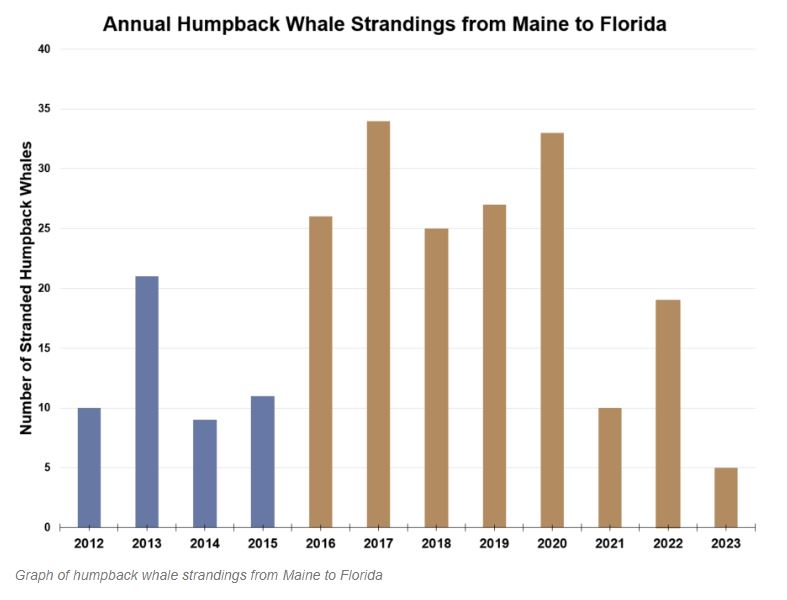
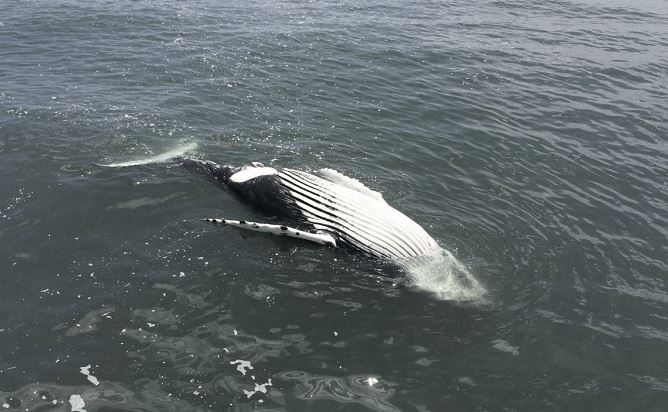 Floating humpback whale offshore of Delaware. Photo: Marine Education, Research & Rehabilitation Institute. There have been a lot of dead whales on the East Coast of the US lately. David Wojik noticed that NOAA was investigating 178 dead whales in something called an Unusual Mortality Event, or a UME — it’s like an episode of X-Files.
NOAA says this wave of strandings mysteriously started in 2016 which was before the offshore wind factory industry got going — but Wojik points out the timing matches very well. Offshore lease sales for the wind industry ramped up 2015-16. There were nine big sales, he says, off New Jersey, New York, Delaware and Massachusetts. And not so coincidentally, apparently 2016 was also the year that NOAA started giving permission slips for whale hunts, sorry whale harrassments for “geotechnical and site characterization surveys“.
In bureaucrat-valium-lingo, the license to cause incidental dead whales is called an IHA — or an Incidental Harassment Authorization. This appears to have fooled Greenpeace.
Although since wind turbines are a sacred totem, NOAA could have called them a 007 License to Kill Humpbacks and they might not have cared either. The whales are dying for the planet you know. They’re probably happy about it too.
David Wojik, CFACT
The “unusual mortality” data is astounding. Basically the humpback death rate roughly tripled starting in 2016 and continued high thereafter.
To date NOAA has issued an astounding 46 one-year IHA’s for offshore wind sites. Site characterization typically includes the protracted use of what I call “machine gun sonar”. This shipboard device emits an incredibly loud noise several times a second, often for hours at a time, as the ship slowly maps the sea floor.
Wojik explains why wind “farms” might pose a threat to whales, and why it’s likely to get worse with bigger turbines and larger farms going in:
Keep reading →
9.5 out of 10 based on 69 ratings
6.8 out of 10 based on 9 ratings
|
JoNova A science presenter, writer, speaker & former TV host; author of The Skeptic's Handbook (over 200,000 copies distributed & available in 15 languages).

Jo appreciates your support to help her keep doing what she does. This blog is funded by donations. Thanks!


 Follow Jo's Tweets
 To report "lost" comments or defamatory and offensive remarks, email the moderators at: support.jonova AT proton.me
Statistics
The nerds have the numbers on precious metals investments on the ASX
|











Recent Comments