A new paper shows islands are young, dynamic creatures, and mother nature is mean. And nothing we see today on Indian or Pacific Islands is unprecedented. All the panic about islands disappearing is nothing compared to what nature does all the time. Indeed, man-made climate change, if it has done anything at all — has been a boon for islands in the last fifty years.
The new paper by Kench et al looked at 1,100 islands across the Pacific and Indian oceans, and even though CO2 levels rose from 325ppm to an apocalyptic 420ppm, the average island got bigger instead of smaller, and only 3 small uninhabited islands completely disappeared. And when we say small, some of the islands we are tracking are mere 30m wide sand spits. Is it really fair to call that an “uninhabited island”?
The world may have Olympic-sized junkets every year because shorelines have moved 40m in the last fifty years, but it turns out that shorelines moved 200 meters before anyone built a coal plant.
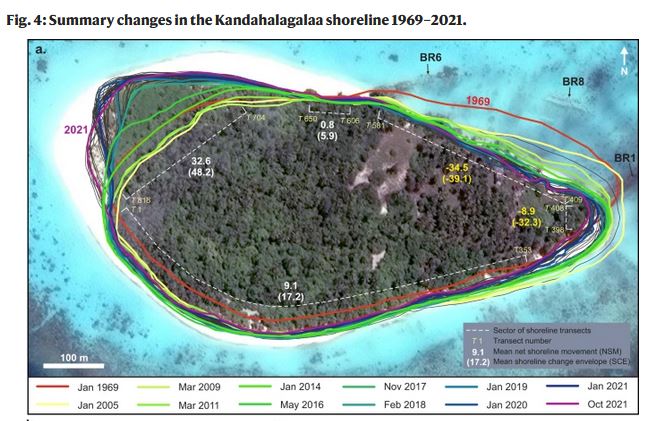
This, below, is just the last fifty years in the life of Kandahalagalaa Island, and about 20% of the island has shifted.
Currently sea levels are rising 3mm a year, but in its short life sea levels at Kandahalagalaa have already gone down and up some 900mm without humans doing a damn thing.
Satellite data is all very well for the last fifty years, but it can’t tell us whether islands used to move so much before humans invented the Ford Model T. So Kench and co. got very serious about one little island in the Maldives with the tongue-twisty name Kandahalagalaa. They drilled the holy smoke out of it, and radiocarbon dated the layers until they pieced together its history. They discovered that its whole life has been in a state of flux. It only emerged out of the ocean a during the dark ages, 1,400 years ago, shifted and grew to the south, and the ocean has turned a lot of the island upside down.
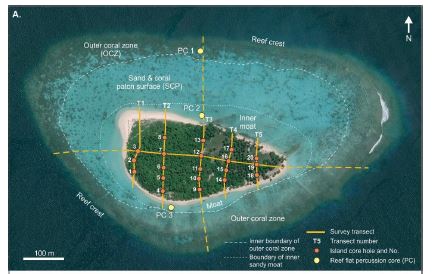
The Kench team are data nerds and did some serious drilling — taking some 154 sediment samples from 20 cores, they used 23 samples of a particular green algae to do radiometric age tests. They also did laser levels six different ways to survey the island. They took 11 other cores of outcrops, and used four different satellites to get lots of photos of the shoreline.
Supplementary Figure 2: The drill holes
This is one churned island
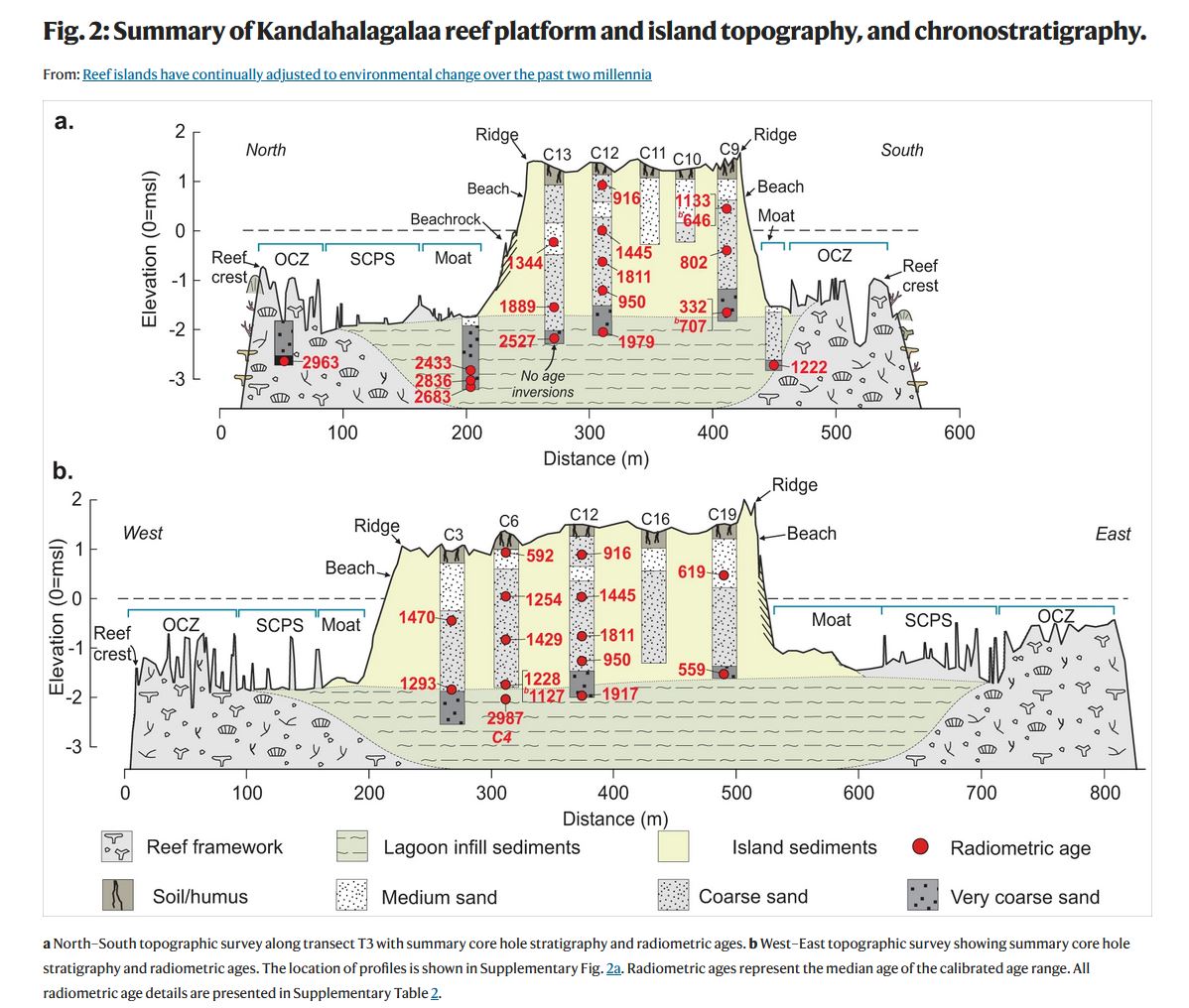
Most of the cores were upside down, with the older layers at the top. Nature is evidently reworking the island, dropping 1100 year old deposits on top of 300 year old ones, in various combinations that were different in nearly every hole.
They drilled lots of holes and found the islands age history was a jumble of old layers on younger layers (ages in red) | Click to enlarge.
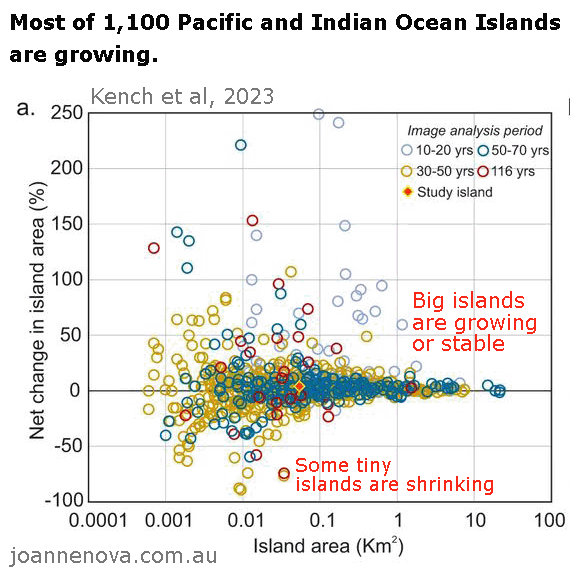
1,100 Islands of the Pacific and Indian Oceans are stable
Despite the threat of man made climate change, nearly every island larger than a tenth of a square kilometer is the same size as it was or expanding. This is an update on a previous survey of 700 islands which showed they were mostly growing. It’s not necessarily an improvement — Kench et al appear to have just added 400 teeny tiny islands to spread the splatter on the left hand side.
Notice how the log scale gives tiny islands a big role? An island 0.01 km2 is a mere 100m by 100m across. Half the graph is really plotting the fate of shifting sand dunes.
The authors comment that they were unable to implicate climate change:
Collectively, these studies have been unable to establish specific environmental drivers of island change, nor directly and unambiguously implicate climatic change as a mechanism for observed changes. To date, local-scale processes appear to have blurred any climatic change signal22,24.
Translated: even though everyone says climate change is real and obvious expert researchers couldn’t find a signal above the noise. I suspect Kench et al were disappointed not to find that signal, given he was not happy some skeptics used his study a few years ago. But full credit to the team for being so dedicated at collecting data and writing it up so honestly.
Islands were forming as the holocene sea levels fell
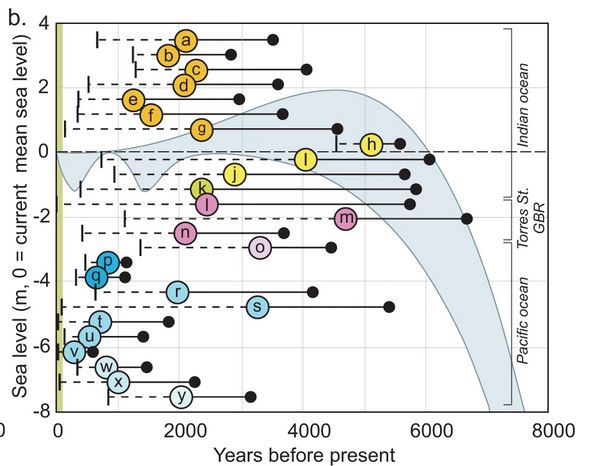
Giving some idea of just how young these islands are, Kench et al reviewed about 15 different studies of islands between the Maldives and Fiji and found that the oldest known samples from each was about 1,500 to 7,000 years old (black circles below). Holocene sea levels (marked in blue) were an unthinkable 2 meters higher 5,000 years ago. Sea levels have been falling around Australia for thousands of years.
The little very-drilled island of Kandahalagalaa is “e” below, with the oldest samples from nearly 3,000 years ago, presumably underwater then, since that was long before Kench declares it it to have emerged from the sea.
b Summary of reef island evolution studies highlighting the onset and period of island accumulation in the mid-to-late Holocene. Blue-shaded area defines the envelope of sea-level behaviour in the Indo-Pacific. The solid black circle denotes the earliest radiometric age, the coloured circle denotes the mean radiometric age of samples, vertical line denotes the latest radiometric age. Different coloured circles reflect islands in different reef provinces and the letter inside the circle denotes specific islands, a = Mainadhoo, b = Boduhini, c = Galamadhoo, d = Baavanadhoo, e = Kandahalagalaa, f = Kondey, g = Vaadhoo, h = Dhakandhoo, i = Hulhudhoo, j = Thiladhoo, k = Cocos (keeling) Isld., l = Warraber, m = Bewick, n = Lady Elliot Isld., o = Mba, p = Tepuka, q = Tutaga, r = Laura, s = Jabat, t = Jeh, u = Jabnodren, v = Jin, w = Malamala, x = Navini, y = Makin. Source references of data are listed in Supplementary Table 1.
h/t Kenneth Richards, El Gordo, Another Ian.
REFERENCES
Kench, P.S., Liang, C., Ford, M.R. et al. (2023) Reef islands have continually adjusted to environmental change over the past two millennia. Nat Commun14, 508 doi.org/10.1038/s41467-023-36171-2
By Jo Nova Twenty six months after the so called “deadly insurrection” at the US Capitol, the video tapes that have been hidden are finally available. This was a day that “echoed through history” according to Kamala Harris, who compared it to Pearl Harbor but didn’t want you to see the footage. People are in jail because they dressed up and walked with a police escort through open doors. It’s a Redpill moment. The few people who did break windows or incite the crowd to do acts of violence have not been arrested. Who were the Feds?
“Even 57% of Democrats think that it’s at least somewhat likely that Feds were not just there but were also encouraging people to riot or go into the Capitol.” — Thomas Massie Rep Congressman.
UPDATE: Youtube deleted the original video. Many thanks to Rumble for this even better one.
“The tapes show the Capitol Police never stopped Jacob Chansley. They helped him. They acted as his tour guides.”
And yet in the narrative formed that day by Democrats and much of the media, “Jacob Chansley became the face of January 6, a dangerous conspiracy theorist dressed in an outlandish costume who led the violent insurrection to overthrow America’s democracy,” says Carlson.
Chansley, the horned “Shamen” became the perfect Photo Op for the Democrats. His sentence is four years. Why were these tapes released now? Apparently Tucker Carlson was given the footage as part of a deal to win over the last few Republican votes that were needed to get Speaker Kevin McCarthy elected as Speaker of the House.
* * *
Those with discernment don’t buy it, The much hyped up Capitol riot, That a wild mob broke in, To do battle and win, But once inside, turned peaceful and quiet.
–Rauiri
This site is but a cog in an information war. Every news outlet that ran the Insurrection story on January 6th should have been showing these tapes tonight. h/t Bill in AZ, another ian.
Everything is a PsyOp now: even the weather maps are on fire
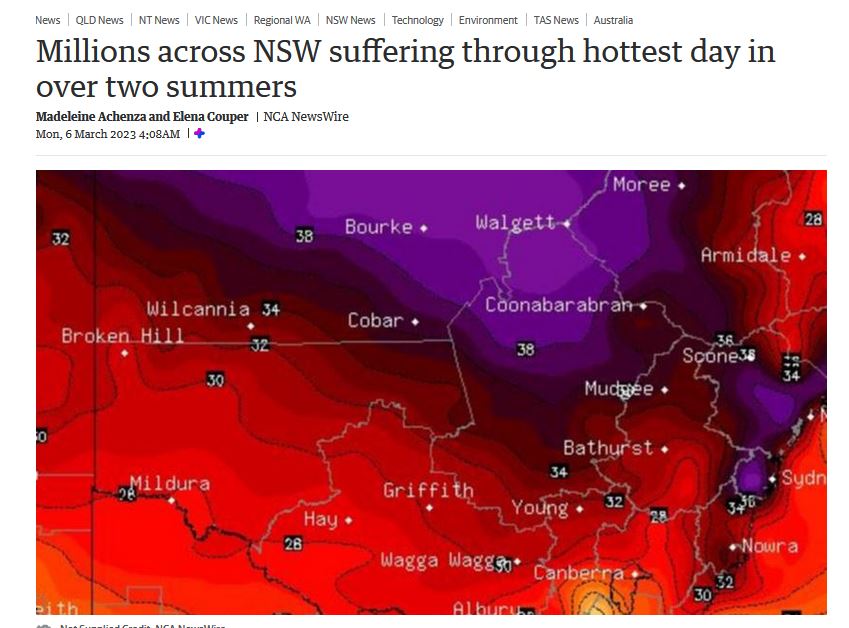
Australia has had a mild summer, a mild year, but that’s a reason for another meaningless “hottest” headline. “Millions across NSW suffering through hottest day over two summers“. So outback New South Wales finally gets an average warm summer day and the climate map makes it look like a nuclear meltdown. Since when was 35 degrees C a shade of heat so hot it was black? (That’s 95F).
To put this in perspective, the town of Cobar near the centre of the map made it to 37C today (98.6F). But a few years ago the average temperature for the whole month of February was 37C. Any Cobar resident who feels like 37C is unusually warm, moved there this morning.
If newspapers were not paid agents or religious acolytes for the cult of climate change the headlines would have said “finally a last blast of summer warmth after two cold years”. But that doesn’t sell solar panels.
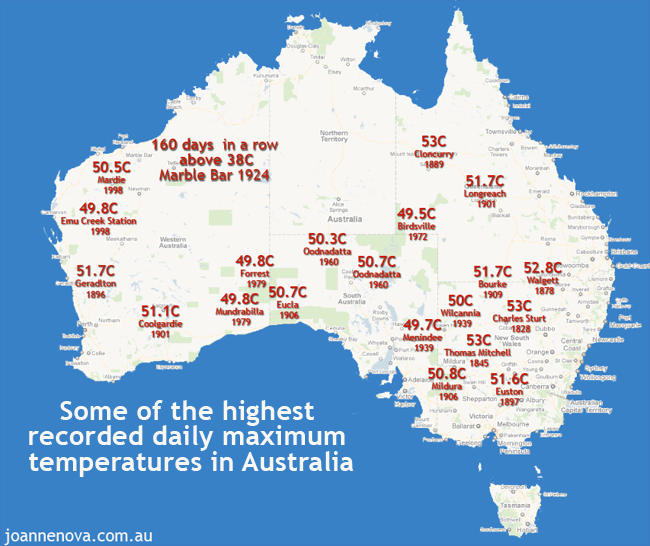
Call it color inflation. The value of any color is shrinking. Satellites show Australia hasn’t warmed at all in the last ten years, but the headlines and artwork still look the same. Back then, it was a different kind of PsyOp. In 2013, the BOM announced climate change had made Australia so hot they needed to change the color scale of their maps so they could add “purple heat” for a prediction of over 50 degrees C (a temperature that didn’t even happen). Now, 40C is the new 50C and what was an average day in 2020 in January for Bourke is now a purple holocaust. (40C is 104F and 50C is 122F).
To be fair the BOM has the same color chart it had then, and the new radioactive maps are made by some other agency, NCA NewsWire or Stormcast, whoever they are. But the BOM says nothing about this, and the media are happy to play deceptive color tricks on their hapless audience.
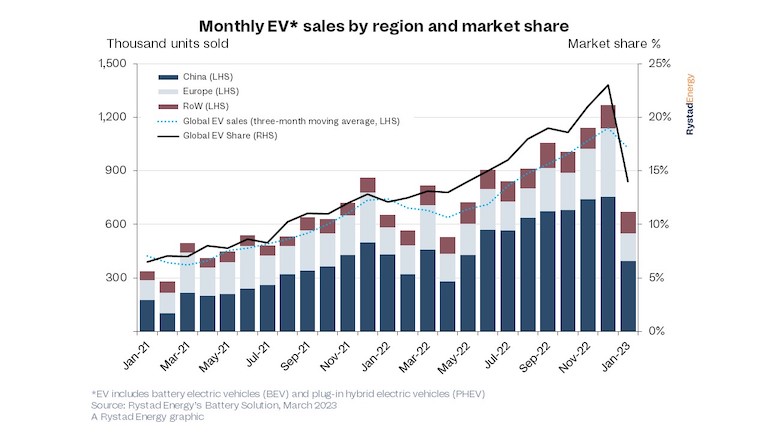
The magic of the free market was suddenly applied to EV sales last month. Tax credits and subsidies for electric cars in the EU and China ended on January 1, and sales promptly halved.
So half the entire EV market apparently only existed because governments took money from poor people to help rich people buy EV’s. Everyone wants nice weather in 100 years, but no one wants to pay for it.
Let’s all sing “equity”.
EV sales collapse as subsidies and tax credits come to an abrupt halt
The global electric vehicle (EV) market is reeling from one of the most dramatic collapses in monthly sales to date, with Rystad Energy research showing that only 672,000 units were sold in January, almost half of December 2022 sales and a mere 3% year-on-year increase over January 2022. The EV market share among all passenger car sales also tumbled to 14% in January, well down on the 23% seen in December.
The US is a ray of hope for the industry. Not because American EV’s are necessarily better but because of “better” government interference:
EV subsidies in many European countries and mainland China were sliced at the start of the year, and a return of any significance is highly unlikely in the immediate future. One ray of hope for the global outlook is the US market, which is just beginning its electrification journey and rolling out tax credits thanks to the Inflation Reduction Act.
There have been a number of car-crash-holiday-tales of EV journeys of late, which won’t be helping sales either.
EV owner has unexpected holiday inside car
It wasn’t so much a holiday with an EV, as a holiday imprisoned in one:
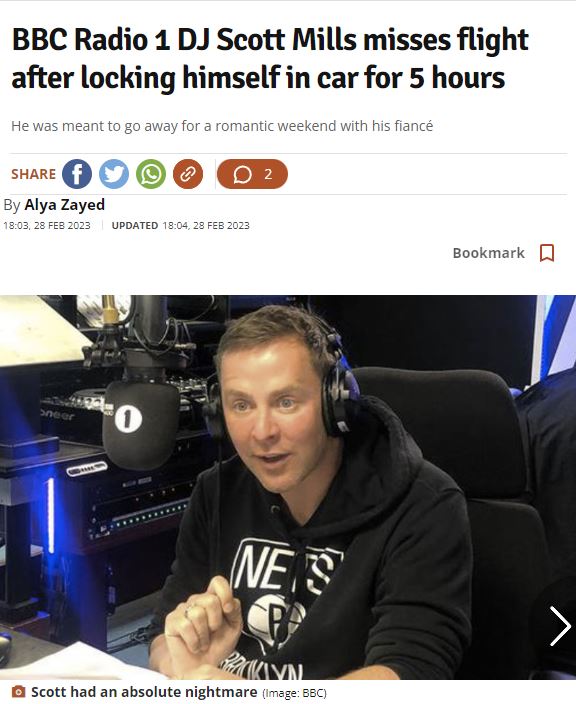
Scott Mills has revealed he was trapped in a car for five hours and missed his flight as a result. The BBC Radio 1 DJ had intended to set off on a romantic weekend with his partner, but instead was trapped outside the BBC studio.
“I’ve had quite the weekend,” he said. “I said goodbye to you on Friday. Me and Sam agreed to head to the airport in my electric car at 4pm. Flight is at 8pm. “Get in the car. Car doesn’t start. In fact, nothing works. I go to get out of the car. I can’t get out. Sam tries his door. Nothing. Also cannot leave the car.”
Scott says he had charged the car’s main battery, but the secondary battery had run empty.
British people bought more cars overall in January, they just wanted the ones that run on petrol:
How drivers are returning to buying petrol vehicles in droves due to lack of charging stations.
Oliver Price of This Money UK
Eighteen-month waits after ordering your new car and seemingly unending queues to power it up due to a dearth of new charging stations being built. This seems to be the experience for many UK motorists when buying and owning an electric car.
By forcing people to put money into pension funds in a form of investment that they weren’t necessarily comfortable with, governments created vast piles of money that was essentially left unguarded on the beach in a bay with a hundred pirate ships. Sure, there were regulatory agencies and accountants up the kazoo, but money is also power: the paper dollar would get returned to the owner, but the whole time it was out of his hands, its power was being used against him.
In a free market, millions of voters can vote with their wallet. It’s a form of democracy. But for hapless sleepy investors in a pension plan — sometime in the 1980s that power to choose the kind of industries and values they wanted to support was silently given away to a guy called Larry Fink and a few of his colleagues.
Snoozing-at-the-wheel, citizens voted for cheap energy every two years, while their money voted for “ESG” every day. And ESG is the expensive Environmental, Social, Governance kind of electricity which freezes your peas AND corrects the weather (in theory).
The size of the pension funds managed by the likes of BlackRock, Vanguard and StateStreet became The Financial Swamp Monster:
When the UN invited global financial institutions to sign onto the Principles for Responsible Investment (PRI) in 2007, the total global assets managed by ESG-minded investing vehicles was around $10 trillion. By 2020, a mere 13 years later, that has grown to more than $30 trillion worldwide and more than $17 trillion in the US. New private equity firms and investment outfits devoted purely to ESG — such as Al Gore’s Generation Investment — were springing up every year, and most large US investment firms began offering ESG-mandated mutual funds, leading Bloomberg in 2021 to project $53 trillion invested in ESG by 2025.
This was years in the making:
As the ESG agenda took hold, the individual investor increasingly found himself shunted aside. Admittedly, the roots of this shift lay in the early Eighties, when federal proxy voting rules were changed to allow fund managers such as BlackRock to vote on behalf of their clients. The idea was a good one at the time, in that it recognised that few individual investors have the time to attend shareholder meetings or the wherewithal to make their views known to company leadership. But it handed vast power to investment companies — admittedly under the understanding that they would vote on behalf of their clients for one purpose only: the maximisation of profits and shareholder returns. It was, however, only a matter of time before this power was exploited.
Larry liked climate change, so BlackRock became the Monster Climate Police:
In 2020, BlackRock voted at 16,200 shareholder meetings on 153,000 company proposals. Frequently, these votes were against company management. According to the company’s own Investment Stewardship Annual Report: “In 2020, we identified 244 companies that were making insufficient progress integrating climate risk into their business models or disclosures. Of these companies, we took voting action against 53, or 22%. We have put the remaining 191 companies ‘on watch’. Those that do not make significant progress risk voting action against management in 2021.”
In the same report, BlackRock boasted of having voted against management more than 1,500 times for “insufficient diversity” in company management.
See how this works? All those crazy oil and gas companies who gave up without a fight were crazy for a reason.
Then Larry Fink realized he didn’t even need to control the votes. With $10 trillion in funds, BlackRock could be the Climate Mafia, and all he needed to do was write a letter every year telling the corporate world “nice business you have there, shame if something happened …”
In his words: “Companies must benefit all of their stakeholders, including shareholders, employees, customers, and the communities in which they operate.”
Allow me [John Masko] to translate: On behalf of millions of shareholders I’ve never met, I declare that they no longer truly own the companies they have invested in. Society does.
Australia is adopting Net Zero because the Global Financiers, who only want to save the world, would have refused to lend us money without jacking up our interest rates by 1.5%. The banker punishment would have meant a “17% investor exodus”. Fancy a stock market collapse?
The good news is that 25 US States have realized the game, and are fighting back. And word is spreading that ESG is a dog financially….
In 2022, eight of the top ten actively managed US ESG funds (including one of BlackRock’s) performed worse than the S&P 500. This demonstrates two things. First, that ESG funds are not some financial miracle. And second, that the performance of ESG funds is tightly bound to the tech industry, which had a terrible year in 2022.
Ed Dowd is the former BlackRock executive, who has been drawing attention to the excess death data. As a Wall Street trader he likes to find and arbitrage the realities that aren’t well known so he can bet against the realities that aren’t real. And so he found himself last year looking at death trends that were off the charts. At this point the trader turned into a human trying to warn hundreds of CEO’s of insurance companies (among others) but they did not want to know…
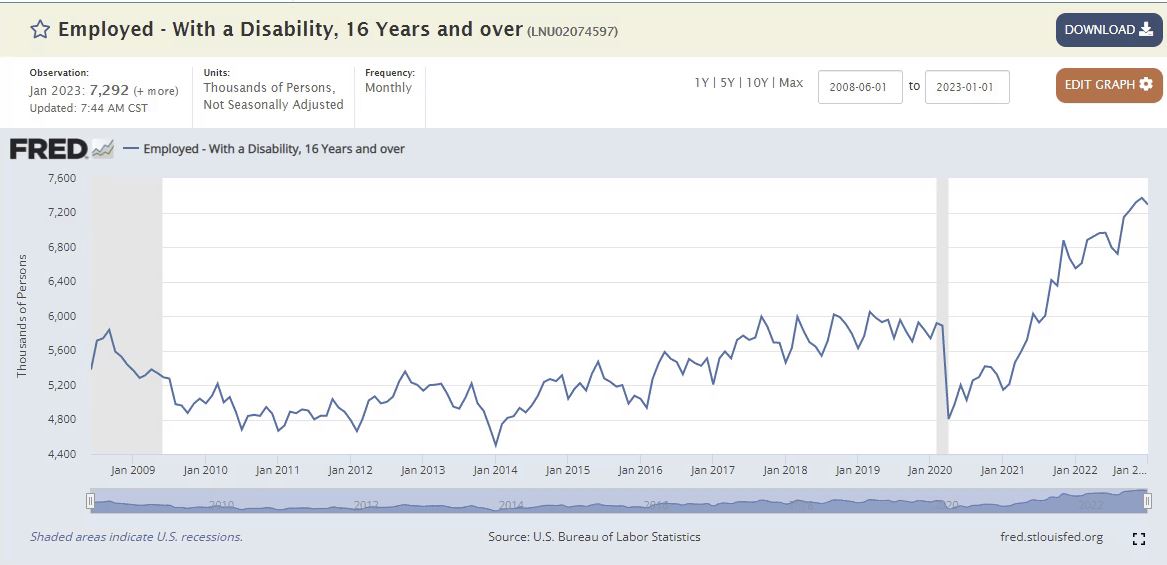
Of the 3.2 million newly disabled in the USA, it’s remarkable (though sad) that 1.7 million came from the employed sector. Normally working people are the healthiest group — but since February 2021 their disability rate is up 31%. That compares to a rise of just 9% across the “general population”. And in a complete turnaround — those who quit or got fired — normally the sickest ones — their disability rate rose only 4%.
So something changed. What could it be, we wonder, that took place in 2021 and caused more of those who stayed in their jobs to become disabled. Why was quitting work or being fired a seeming benefit to your health… unless it was medical experiments mandated by bosses?
His interview with Tucker Carlson is well worth watching. It’s food for the soul to see good men solving problems. And that’s even though they’re discussing death, corruption and fraud. There’s something hopeful about this that suggests that honest smart players are finding their feet.
Tucker and Dowd also discuss the effect this era has had on them, how he deals with fear, why this is the third time in his life he has gone against the flow, and he called it right the last two times. (The BlackRock fund he managed made billions.)
As he says: We’ve never seen these kinds of excess deaths and yet we’re not even talking about it.
During Covid we had ticker tallies of daily deaths, but not any more. It’s very telling that they stopped counting.
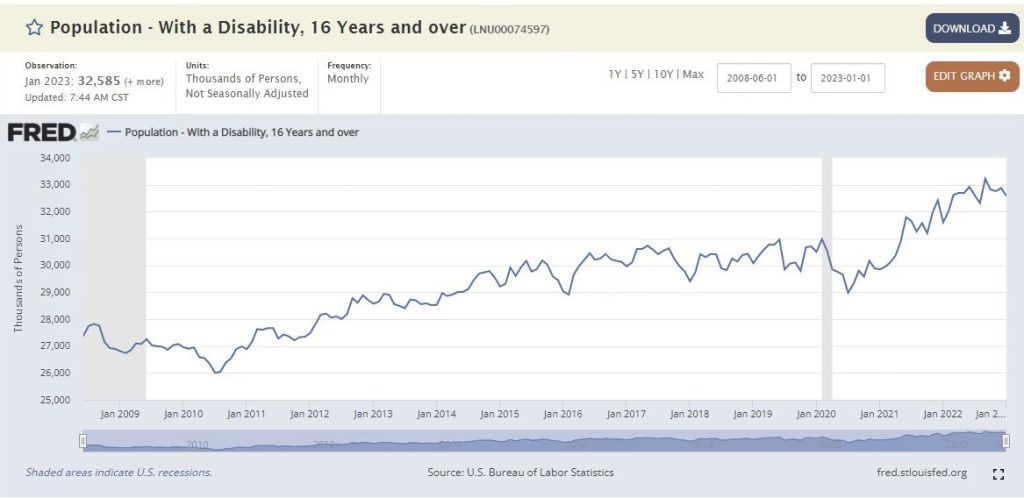
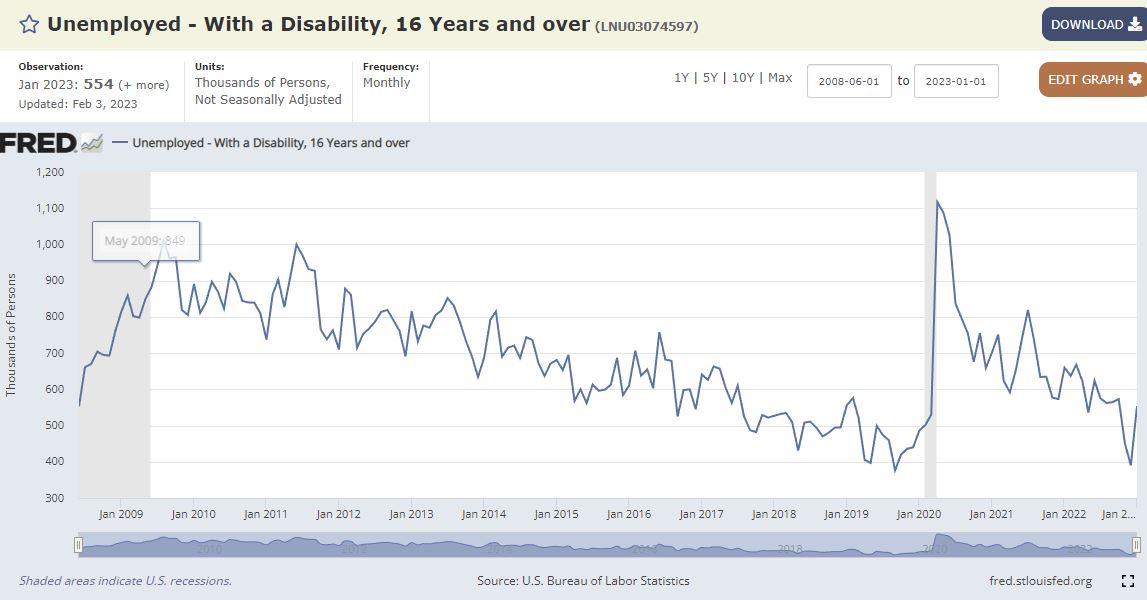
The official statistics on disability:
Disability in the general population has been gradually rising (2009 – 2023)
Don’t need a PhD or Wall Street background to see something changed here or to see from eyeballing these 2 charts that the employed disabilities are rising faster than the general population due to vaccine mandates.
This is a sick joke at this point. Institutions will be razed.
UPDATE Unemployed with a disability
Wow that trend is not like the other ones.
Thanks to Strop who says: “This chart of unemployment figures shows the number of unemployed people with a disability is now only at about the same level as it was at Jan 2020. This indicates that the big increase in the number of people employed with a disability hasn’t come from the unemployed with a disability pool. Otherwise this chart would show a reduction in unemployment similar to the increase in employment in the chart ”
https://fred.stlouisfed.org/series/LNU03074597
h/t William Astley, Another Ian, Tim. Scott of the Pacific, and Stephen Neil.
The Pagan Witchdoctors send forth their girlie pawns
The science is so overwhelming they need 16 year old girls to evangelize for them. The girls are human shields sent to deliver the agitprop and protect it from scrutiny. If a man asks a girl a hard question they’re a misogynist, and if a women does, she’s rude. Grown-ups can’t even laugh at their transparent hypocrisy. That’s bullying you know, say the same people who call half the world “climate-deniers”.
Izzy Cook is the 16 year old version of Greta Thunberg in New Zealand. She unraveled spectacularly as a political leader and a climate star during a radio interview last September. Right after telling everyone that it wasn’t really necessary for people to travel to Fiji because of the climate crisis, Izzy Cook had to admit under questioning that she had just got back from a flight to Fiji. Interviewer Heather du Plessis-Allant laughed out loud at her vapor-thin dedication to the cause. As anyone would.
Apparently Izzy couldn’t really get out of the trip because her parents wanted her to go. Well, shucks.
But now some government Watchdog in New Zealand has declared it was an unfair joke and the broadcaster was reprimanded and has apologized. Apparently the Broadcasting Standards Authority (BSA) thinks radio interviewers must not deter “passionate young people” from making fantasy declarations and issuing vaporous wish lists live to air. Who knew — thousands of listeners be damned — it’s the job of interviewers to train the next activists?
You, silly thing, thought you were listening to the radio to be informed…
It’s time to ask why New Zealand needs the BSA? Just another Big Government censor to tell journalists what they can say and interfere with what New Zealanders are allowed to hear as well.
Judge for yourself: Who is exploiting the children here? The one who set her up to play in adult politics or the one who asks the questions her mother should have asked…
Broadcaster reprimanded by watchdog for questioning travel methods of Izzy Cook, New Zealand’s answer to Greta Thunberg
New Zealand’s Greta Thunberg, who flew to Fiji for a holiday, was unfairly “ridiculed” by a journalist who questioned the teenager’s travel, a watchdog has ruled.
Ms Cook replies it was “ironic” but says she could not “really get out of it because my parents wanted to go”.
Her mother made her go to Fiji, forgot to tell her not to put the holiday shots on social media, then lined up the interviews and follows-up with “righteous indignation”. Perhaps she should be doing the interviews herself?
Ms Cook’s mother Rose Cook said it was her idea for her daughter to take the family holiday. She had “listened in horror” as the journalist “appeared to be bullying” her daughter.
Du Plessis-Allan viewed the teenage activist’s social media profiles to “discredit her personally and derail the conversation about climate action”, Mrs Cook said.
“Izzy does what she does because she cares… I try to help by proofreading and preparing her for media interviews where I can,” Mrs Cook said.
New Zealand Media and Entertainment [NZME], the owner of Newstalk ZB has apologized to Ms Cook.
The BCA want to scare talk-back radio hosts into softball promotion of the BCA’s favourite silly ideas, but they’ve just revived and spread the train-wreck interview, so even more people will hear it. The interview was played all over the world last September. That can’t be good for Izzy. But it might work out for Newstalk ZB.
On twitter, the most common reply is “and they want to give 16 years olds the vote”.
Young alarmists need lots of safe spaces,
To prevent getting egg on their faces,
As they quickly unravel,
Caught out on air-travel,
To exotic and faraway places.
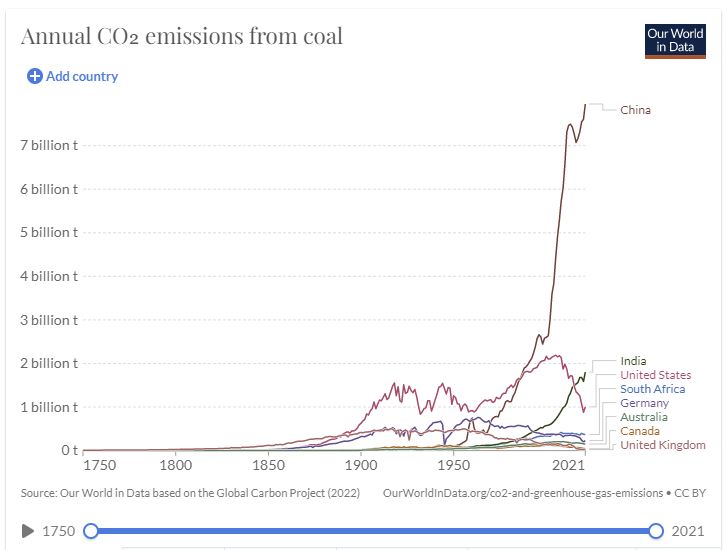
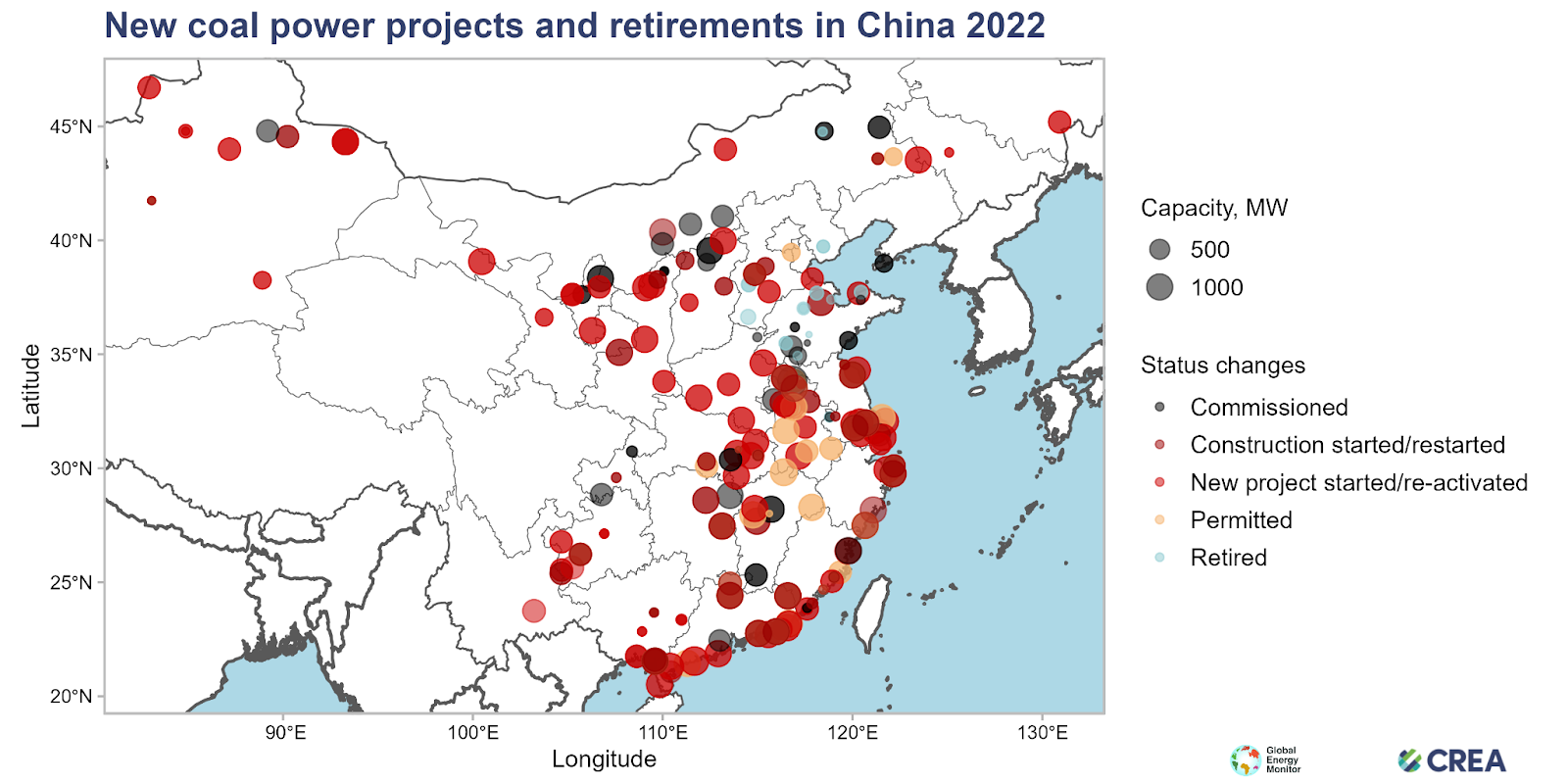
It’s the sixth mass extinction of life on Earth and one country is building six times as much new coal power as the rest of the world combined. But no one cares.
Sinful Australia hasn’t even built a coal plant in 12 long years, but Saint China is approving a new one every three and a half days. One nation is theoretically destroying the world’s corals, creating droughts, floods and bad storms, and making reef fish reckless but no one is gluing themselves to the Chinese Embassy. The same universities who lecture us on carbon pollution are not even boycotting Chinese students. We have to ask — do reef fish matter? Are floods a bad thing?
Either CO2 is just a shiny amulet or everyone who cares about it is functionally innumerate. It could be both.
Meanwhile on the cat-walks of intellectual fashion shows the Western world’s elite competes to be more concerned than the next guy about the dire problems of CO2. President Xi cheers them on, promises to act, then builds another coal plant.
UPDATE: The pledge was to phase coal down between 2026 – 2030
China aims to peak CO2 emissions before 2030 and achieve carbon neutrality before 2060
China has stated in the updated NDC that it will stringently curb coal-powered projects, set strict limits on the increase in coal consumption during 2021-2025 and to phase it down during 2026-2030.
A “peak” before 2030 means a permanent reduction. If you were planning a permanent reduction from Dec 2029, would you be building 100 coal plants a year, just seven years before then, or would you be lying…
But a tactic of pretending to be Green whilst doing the exact opposite — as your adversaries wreck their own industrial bases — would make you a bad citizen, but a good strategist, if you can get away with it. Remember the research group that says pro-China groups are posing as fake green protestors to try to stop rare earth mines in the US.
China last year approved the largest expansion of coal-fired power plants since 2015, according to a study published Monday, despite its vow to begin phasing down use of the fossil fuel in just three years.
The coal power capacity that China began building in 2022 was six times as much as that in the rest of the world combined, the report by the Centre for Research on Energy and Clean Air (CREA) in Finland and the Global Energy Monitor (GEM) added.
China needs these coal plants for “when renewables fail”
Local officials say new coal plants will serve as a backup to ensure stable supplies when renewables fail.
So the West is demolishing coal plants, and hoping to use batteries and pumped hydro for back up power, but China is using coal, and if it accidentally finds out that coal is cheaper than coal-plus-wind they can just keep running the back up plants can’t they, while someone slowly restores the trailing edge on the wind blades. The slower the better.
It’s one of those rare times when the more maintenance you do, the cheaper it gets.
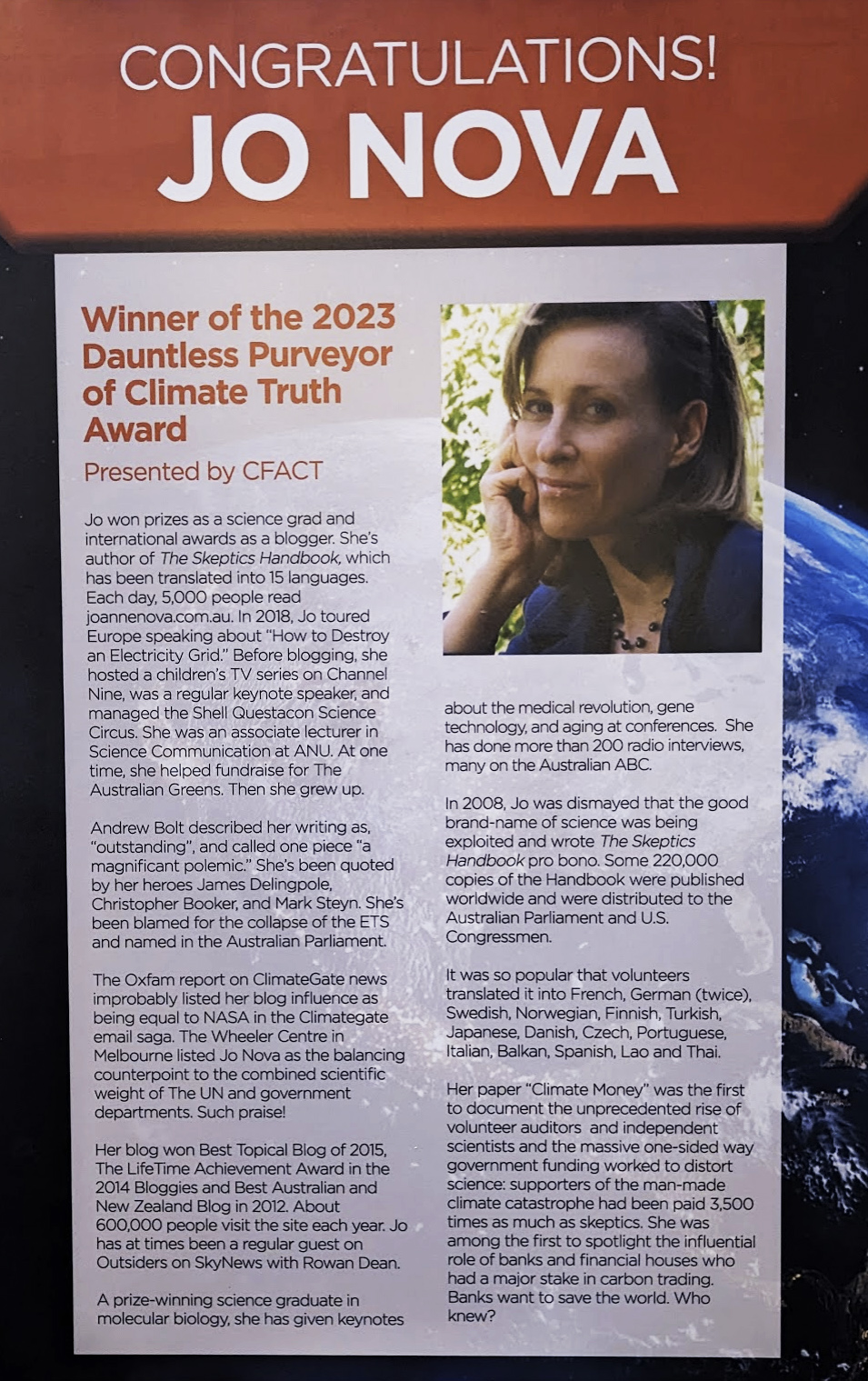
What an honor. I am just so humbled to win the Dauntless Award of 2023. I mean apart from the towering giants of the Climate Skeptic world who have already won it, to be on the same page as Walt Cunningham, one of the three Apollo 7 astronauts, who risked their lives for science, is a career highlight. Walt Cunningham helped make NASA what it is, and he could have said nothing, but he became an outspoken skeptic of the way NASA was abusing the trust of the public, and abusing science. He was a fighter pilot and a physicist who flew on the first manned launch after the tragic fire that killed all three astronauts on Apollo 1. Sadly the world lost Walt only weeks ago.
Thanks to Ric Werne for the photo. Click to Enlarge.
Other Dauntless winners include Dr Jay Lehr (who helped set up the US EPA fifty years ago and then spent decades working to undo that) and legends like Marc Morano (Climate Depot), Professor Fred Singer, and Christopher Monckton. People who I have learnt so much from.
Craig Rucker announces the award from 25.20. From 28 minutes Heartland and CFACT went to so much trouble to make a mini documentary of yours truly. From 33 minutes I accept live from Perth Australia, the other side of the world. Isn’t technology great?
Redpill the world — The NASA heroes the media buries
In 2013 I wrote about Walter Cunningham and pointed out four Apollo Astronauts then were outspoken climate skeptics, yet the ABC, BBC and mass media would not even pick up the phone to call them and ask “why?” This is a great RedPill moment to share with people who still think journalists are still journalists, instead of obedient propaganda hacks and weak minions of the powers that be. Where were the real reporters who interviewed Buzz Aldrin or Harrison Schmidt (2 of the 12 men who walked on the moon), or Phil Chapman (Apollo 14) and Walter Cunningham (Apollo 7)?
I asked Walt Cunningham then about journalism. He replied:
Donn F. Eisele, Walter M. Schirra, Jr. and Walter Cunningham.
No one in the media has ever asked if I was a “skeptic,” although it has always been rather obvious. I have been writing and speaking on the climate and environment since about 2000. The frequent reaction to my writings is: “What can he know about climate science? He’s just an astronaut.”
I was a founder of an environmental concern organization back in 1970. I also spent 5 years on the board of NREL.
Don’t miss the first ten minutes of the video above — a tribute to the excellent men we’ve lost in the last year, not just Walt but also Jay Lehr, Tom Wysmuller, Pat Michaels, and Tim Ball.
I was booked to do a podcast with Jay Lehr in May this year, sadly he too died a week or so after Walt Cunningham in January. I will do one with Tom Nelson soon instead, details coming.
CFACT generously offered to fly me to Florida to accept the award, which I would have been delighted to do, however the US still requires full vaccination for entry. Hard to believe, but true.
Subscribe to the Youtube channels for Heartland and CFACT.
PS: Special thanks to Stan in the Netherlands who sent a card with a heartwarming message but no return address. Message received. 🙂 Bedankt.
My post box is: PO Box 1931, Malaga, Western Australia 6944.
We use cookies to ensure that we give you the best experience on our website. If you continue to use this site we will assume that you are happy with it.












.jpg)
Recent Comments