Recent Posts
-
Horse-drawn carriages must have caused a Megadrought in Europe in 1540, right?
-
Tuesday
-
Monday
-
Sunday
-
UK facing devastating 36 degree heat — can’t decide whether to use air conditioners or rip them out
-
Saturday
-
Batteries failed on day One: A four day wind drought in South Australia wreaks havoc, high prices
-
Friday
-
The UN wants to be One World Government and it starts with a carbon tax on ships and planes
-
Thursday
-
What if Global Warming was just because something made the clouds go away…
-
Wednesday
-
Snowy 2.0 is the Trillion dollar Black Hole of Australia — sucking in energy, money, land, industrial relations, the dollar, our lifestyle
-
Tuesday
-
Monday
-
Winter Solstice
-
Saturday
-
We were throwing-renewable-energy away at record levels in 2025
-
Friday
-
Pauline Hanson, the centrist, just wants a free market in electricity, and an end to the renewable energy bribery
-
Thursday
-
Blame the Climate Yeti again for making your life more expensive! (It’s a smokescreen)
-
Wednesday
-
The Sunrise Project funneled $343 million from overseas to push net zero
-
Tuesday
-
Monday
-
Sunday
-
The US government has been secretly funding 120 dangerous biolabs around the world
-
Saturday
-
New report shows renewables are a drag on our national productivity
-
Friday
-
Thursday
-
Well, how convenient. AI data centers have arrived to be the fall guy for the Energy Minister
-
Wednesday
-
Billionaires are leaving the room with excuses — Bezos says “AI will solve climate crisis”
-
Tuesday
-
Monday
-
Sunday
-
The Craziest eco laws against Farmers. Let’s check that science…
-
Saturday
-
China cooks the carbon accounting books by 400 million tons
-
Friday
-
The Wind Power Puzzle (add more wind turbines and get the same output)
-
Thursday
-
To save the world, Cement Australia stops burning coal and burns trees instead
-
Wednesday
-
On Fire! US hunger for gas power so large, wait time for turbines blows out to 5+ years
-
Tuesday
-
Monday
-
Sunday
-
Saturday
-
Perth event Saturday May 30th: Green Greed and the Grid
|
UPDATE: 6:30pm for a 6:45 start.
AGL has promised to close the Liddell Coal generators early. Why won’t they sell this generator? Perhaps they want to save the planet (Corporate Saints?!), or maybe is it better for business not to have another cheap coal plant competing with their profitable gas and subsidized-renewables generators in Australia? Perhaps they like to feast off million dollar power price spikes and forced subsidies from the Renewable Energy Target?
How screwed is our free market when the cheapest form of generation is so “worthless” corporates buy it to “throw it away”?
Archibald is a take-no-prisoners presenter. If you can get there, do!
Save Liddell and keep the Hunter Valley working (not to mention our national grid).
Thursday 22nd February, Singleton Diggers Club, cnr York and Church St Singleton, NSW.
- The Science of Climate
- Power Prices
- The true story at Liddell
- The Lesson from the US
- What’s needed for the Hunter
Presented by David Archibald, Geologist, climate scientist and energy analyst.
Contact David.archibald AT westnet.com.au
Ph 0410 664 853
9.1 out of 10 based on 70 ratings
….
7.3 out of 10 based on 15 ratings
Funny how the answer to everything always turns out to be a pet lefty cause?
TO STOP CLIMATE CHANGE, EDUCATE GIRLS AND GIVE THEM BIRTH CONTROL
Robyn George Andrews has a paradigm shaker: if we could just keep girls in school, and give them contraception — droughts, floods and nasty storms will go away. I wonder if condoms are better than the pill for climate control?
Andrews seems to think that if we could somehow just sneak teachers with emergency girls schools into Rwanda et al, the atmosphere on the Third Rock will right itself and achieve the stable ideal weather that it never had. Too bad about the boys though. As it happens, in Rwanda, they’re slightly more likely to miss out on school than girls are (88% of boys, versus 90% of girls attend primary school). If we could just fix that gender bias…
Nevermind about Rule of Law, endemic crime and corruption, and a complete lack of infrastructure, if the girls had studied The Sociology of Myley Cyrus (at Skidmore) they’d be too busy tweeting about twerking to overpopulate the planet and generate hot spots and cold holes in the atmosphere.
But Andrews seems to have missed the real and devastating implications of female education
On Earth, the more we educate women, the higher our emissions are. I graphed UNDP and World Bank statistics, and the trend is stark:
 There’s no hope for Earth if we keep educating women.
Give women more than five years schooling, and the planet is facing a crisis. It’s simply impossible to keep per capita emissions below 2 Mt.
Perhaps someone had better let Andrews know, or maybe he does, (he is really a satirist, right?)
Keep reading →
8.6 out of 10 based on 53 ratings
Brought to you by the Theory That Can Never Be Wrong — what’s the opposite of hot? A hole!
Next time you are feeling cold you will know you are in a hole instead. Stop digging.
h/t Climate Depot
BY STUART LEAVENWORTH, February 15, 2018 05:00 AM
… “according to a scientific study published this month, the Southeast’s colder winter weather is part of an isolated trend, linked to a more wavy pattern in the jet stream that crosses North America. That dipping jet stream allows artic air to plunge into the Southeast. Scientists call this colder weather a “hole” in overall global warming, or a “warming hole.”
“What we are looking at is an anomaly,” said Jonathan M. Winter, an assistant professor of geography at Dartmouth College and the principle investigator in the study. “The Southeast is the exception to the rule.”
Coming soon, new discoveries will show that the Little Ice Age was not cold, just part of an isolated trend that happened all over the world.
This particular modern hole is happening over SE USA. Obviously some of the cold air in the upper troposphere is falling down the hole.
The Southeast’s warming hole has been studied many times before, but the Dartmouth study in Geophysical Research Letters nails down some of its key features. The study concludes the trend started in the late 1950s, and is concentrated in six states — Kentucky, Tennessee, Louisiana Mississippi, Alabama and Georgia. Nearby states are also affected, such as east Texas, Florida, South Carolina and North Carolina.
Genius communication analysts with PhDs at Yale have done a study that shows no one (especially not truck drivers or farmers in redneck states) could doubt university experts except through random happenstance or because of cold weather.
Either because of coincidence or cooler climes, residents of these states tend to be relatively doubtful that global warming is happening and is largely caused by human activities, according to surveys compiled by Yale and George Mason universities.
This new discovery changes many things. During hole-y times when you might get goosebumps, don’t turn on the heater, get into the troposphere and fix the hole with some pink batts.
Next month, we’ll find out that every day is an anomaly.
9.1 out of 10 based on 77 ratings

Just another day at a suburban beach in Perth at sunset. See the hordes…
Clearly Perth has too many beaches.
The weekly wrap:
Renewables will have a minor place,
As future power for the human race.
Renewables can’t make the Vic. grid blossom,
Because of debris and a brushtailed possum.
Some eco-activists have necks of brass,
To shut a pipeline and its flow of gas.
The I.P.C.C. leaks a warming scare,
To fool the world that warmists really care.
A state grid that runs smoothly on the cheap,
Will give its people much reward to reap.
-Ruairi
8.2 out of 10 based on 53 ratings
Here’s the long-awaited followup to Part 1: The history of the Climate Debate from 1850 -2008, where history is tragedy reënacted as comedy, adapted for irony and syndicated as sarcasm. By Brad Keyes from Climate Nuremberg (whose motto is Deride And Conquer). — Jo
Guest Post by Brad Keyes
2009
- Documents liberated in the so-called Climategate leaks don’t show any impropriety on The Scientists’™ part whatsoever, which is why 19 independent inquiries are held to make sure.*
- Glaciergate happens
- Using nothing but schoolboy logic and denier logic, voodoo scientists identify a false prediction in IPCC AR4.
- Citing something called the scientific method, fundamentalist Feynmanites point out that if the IPCC’s prediction was wrong, its hypothesis must be wrong.
- Jubilation worldwide as the Intergovernmental Panel decides to hold onto its apocalyptic hypothesis anyway.
- After a lifetime questioning the claims of pea-thimbling ghost-realtors, evolution-denying WMD-existers, telekinetic psychopaths and telepathic psychokines, James Randi suddenly turns his back on everything Skepticism stands for by questioning The Science™. Skeptic authorities take the 87-year-old legend aside for a quiet chat about CAGW and, 24 hours later, Randi has freely accepted how silly he was to doubt something so rock-solid that no other Skeptic with a capital S even feels the need to examine it.
*Independent of each other, not of the Climate Research Unit in question.**
**Independent in a poetic, not a legal, procedural, or quote-unquote ‘actual,’ sense.
2010
- Climatologist Will Steffen simply tells PM Gillard to “Make tax hurt”—yet within hours, skeptics have somehow politicized his science.
- With the complicity of fellow fabulists, Prof. David Karoly concocts the meme that skeptics are waging a “relentless campaign of death threats” against scientists. If journalists are gullible enough to parrot this libel, then maybe, just maybe, the public will finally see why you can’t trust skeptics.
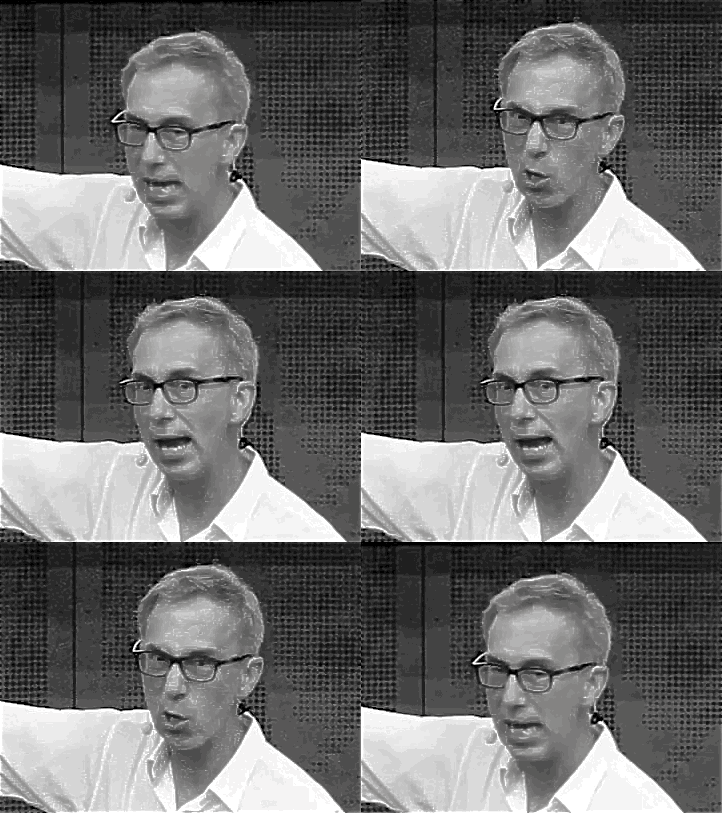 There is “real, physical evidence” that our atmosphere is in crisis, Prof. David Karoly reassures demoralised students. And scientists would love to reveal what it is, he says—if only someone hadn’t put a rat on Ben Santer’s doorstep in 1996. The resulting climate of fear (no pun intended) has condemned a generation of honest researchers to silence, euphemism and self-censorship.
- Motley CRU rehabilitated
- Desperate to restore trust in British climate science, between 7 and “dozens” of official exonerations are launched into the non-consensually leaked material from the UEA: the private publicly-funded data; the private work-related emails; private conversations between anonymous peer reviewers; private admissions that Steve McIntyre “has a point”; etc., etc.
- A “trick to hide the decline” is explained away when investigators learn that trick, to, the, decline are perfectly normal science words.
- The consensus on a particularly infamous email, in which CRU boss Phil Jones appears to celebrate the death of a skeptical scientist, is that it was an appalling choice of medium.
- With the single caveat that “the science was not the subject of our study,” the Science Appraisal Panel declares the science sound.
- Even more reassuring to the public, though, is the finding that Prof. Jones may have been secretive and unhelpful, “but that was true of all the climate scientists.”
- Journalist Donna LaFramboise is thumbing through IPCC AR4 one morning when she spots an embarrassing oversight: 5,587 non-peer-reviewed citations.
- When AmazonGates Attack, Part 1: He Never Signed Up For This
- Dana Nuccitelli is a successful environmentologist with the whole world at his feet, but deep down, all he ever wanted to be was a psychic book reviewer. So he can’t resist posting a one-star prefutation of Andrew Montford’s Hockey Stick Illusion, prebutting what he previsions as the “misinformation, lies, and nonsense” that presumably comprise the “work of science fiction.”
- Like a good scientist, Nuccitelli is careful not to defame Montford in more detail than his own limited imagination can support. The last thing he expects is for other Amazon customers to use this virtue against him, teasing him mercilessly over his vague, hand-wavy hatchet-job.
- SkSFührer John Cook chides Dana for taking it personally when skeptics demand that he “read the book, Nutticelli [sic]” or “be honest for once!” This tactic—Impossible Expectations—is just a Characteristic of Denial, explains Cook; and he ought to know, having literally written the book on rejecting reality.
- Even in antisemitic circles, the Oreskes/Conway conspiracy yawner Merchants of Doubt has few fans until it’s ingeniously re-released as non-fiction.
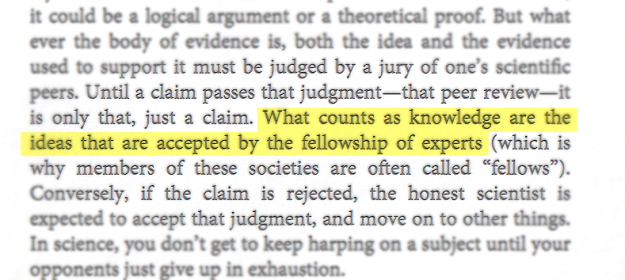 Taken from Chapter 4, this long-overdue correction to millennia of Western epistemology is one of several gems in Merchants of Doubt. Everyone from Aristotle onwards has made the mistake of thinking knowledge meant justified true belief. Simply by dropping the ‘truth’ requirement, Oreskes and Conway usher in a golden age of human ‘knowledge’ about climate change. 2011
- The Müller’s Tale
- The press is calling Prof Richard Müller a converted skeptic, after he asks the press to “call me a converted skeptic.” It’s the ultimate Man Bites Dog data point! For reasons not yet understood, scientists who are born believing inevitably become more skeptical the more they examine the evidence. Yet Prof. Müller seems to have gone the other way, overturning a law of nature. It would be unethical for science journalists to waste time fact-checking such an historic scoop.
- It’s worse than anyone thought logically possible!
- Professor Will Steffen uses Australian television to break the news that’s too terrifying for the peer-reviewed literature: far from pausing, announces the popular Klimakommissar, the effects of climate change are actually happening faster than anyone dared dream, in just about every metric except temperature.
- The implications are disturbing: if this is what global warming is capable of now, what horrors would it produce if the globe was actually warming?
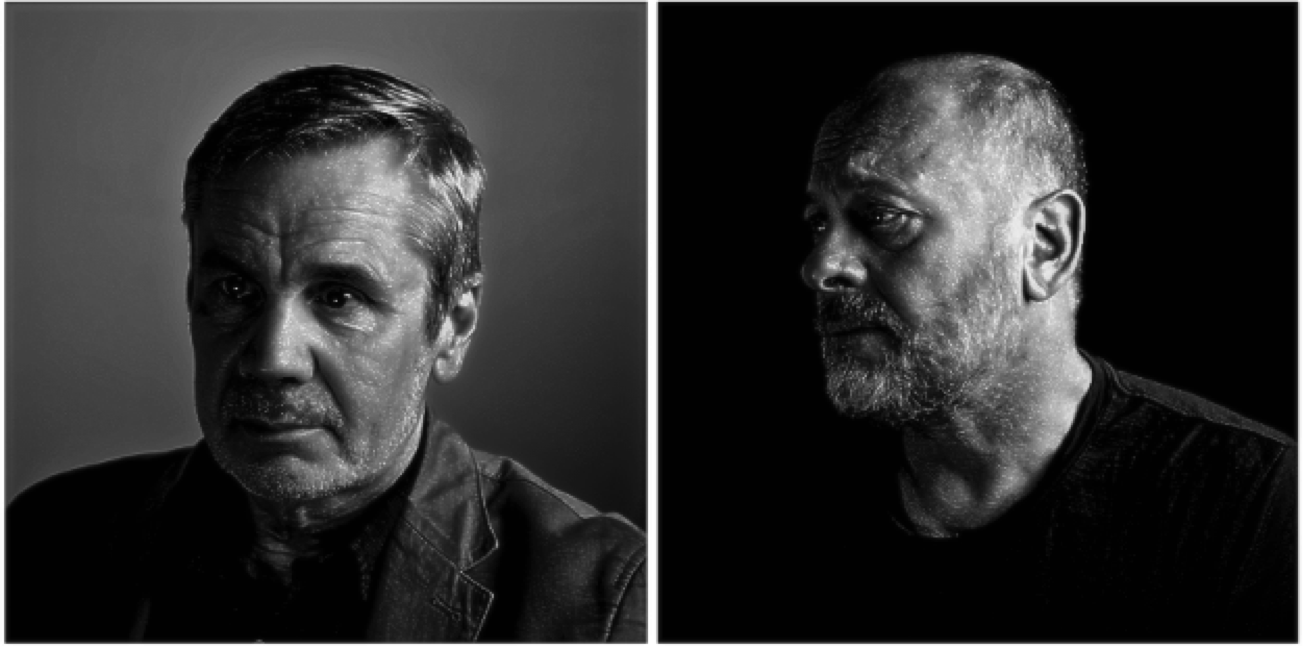
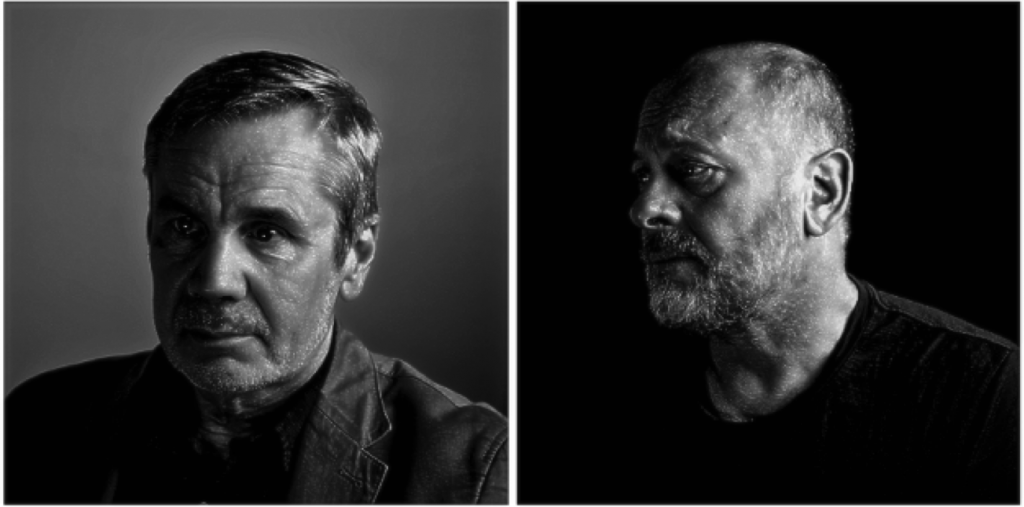 With a PhD in chemical engineering, Prof. Steffen [left] is obviously one of our top climate scientists—second only in climato-credibility to former Australian Gillard Government Climate Commission Chief Commissioner Distinguished Panasonic Sustainability Chair Professor Timothy J. Flannery, PhD, the zoologist who’s forgotten more about ancient wombat stride lengths than most people will ever know [right]. (Glamor shots courtesy of ScaredScientists, the website so scared, it’s too scared to exist anymore.)
- Cheering news, in an odd way, with the unveiling of Climategate 2.0. The cyberterrorists known only as FOIA have been busy, carefully selecting the one or two thousand emails that look bad when seen out of context.
Keep reading →
8.9 out of 10 based on 94 ratings
To understand the real value of electricity, consider the price at which people will give it up. “Demand Response” is the nice euphemism for a voluntary blackout. At what point do people volunteer to go without? For most of the market, apparently, it’s more than $7500/MWh.
If I read this graph correctly, look how fast the prices rise, and how small the response is. For example, in South Australia there is only about 10MW available at less than $300/MWh? (From this AEMO report). For reference the total SA demand is around 1500MW. So 10MW is less than 1%.
 (See below for the Consider how few people are willing to turn the electricity off:
AEMO expects there to be approximately 50 MW of demand response in NSW when the price reaches $1,000/MWh.
The total size of the NSW state market is about 10,000MW. Retail electricity sells for $250 — $470MWh (and only $100/MWh in the US). Hence when the price hits two to four times the normal retail cost of electricity, only about 5% of the market say they will willingly stop using it. When the price hits $7500MWh another 2% will give it up. We can’t take this reasoning too far, but the message is clear that the pain of giving up electricity costs a lot more than generating it. Demand is “inelastic”.
Electricity generation creates wealth. People value the product far above the cost of production.
We could raise prices but business locations are “elastic”….
Keep reading →
8.1 out of 10 based on 73 ratings
Six months to go and why waste a perfectly good press opportunity?
Hold on to your hat: This draft is almost the same as every other draft ever was.
A draft United Nations climate science report contains dire news about the warming of the planet, suggesting it will likely cross the key marker of 1.5 degrees Celsius, or 2.7 degrees Fahrenheit, of temperature rise in the 2040s, and that this will be exceedingly difficult to avoid.
Blah. Blah. Must act urgently. Blah. The two messages we will never hear is that we are doing enough or spending too much.
The leak is so predictable, and such a standard marketing tool, that the IPCC even has an excuse at-the-ready:
The document’s leak has become a standard affair for major United Nations climate science reports, because they are seen by so many reviewers.
This is supposed to be a transparent process to solve a global problem. How can that be “leaked?”
A slight change in flavour is that while we were always aiming for two arbitrary degrees of warming, now we are now also aiming for an arbitrary 1.5C as well. The lower target is unachievable, apparently, allowing script writers to simultaneously say we “are past the point of no return”, going to overshoot” and “not on track” and also say “we can keep warming under the target” (just, barely, etc) depending on which target you want to refer to. This scores double points in keyword bingo. Something for everyone.
Since such rapid and severe cuts aren’t likely, the report notes that it’s virtually unavoidable that the planet will “overshoot” 1.5 degrees Celsius. To cool the Earth down afterward and avoid staying at dangerously high temperatures for long, it would then be necessary to remove carbon dioxide from the air at a massive scale — but that, too, is highly problematic.
9.2 out of 10 based on 103 ratings
Great news (though how low is our bar, that it’s “great” that after seven long expensive years Tim Ball can speak freely?). As reported on WUWT: Tim Ball’s free-speech victory over Andrew Weaver – all charges dismissed!
Anthony Watts: I got word tonight from David Ball, son of Dr. Tim Ball via Facebook messenger:
This morning the judge dismissed all charges in the lawsuit brought against Tim by BC Green Party leader Andrew Weaver. It is a great victory for free speech.
Andrew Weaver launched the suit in 2011.
In 2014 Ezra Levant’s wrote: “Silencing Critics instead of debating them”
Weaver sued climatologist Dr. Tim Ball for, amongst other things, saying Weaver was “lacking a basic understanding of climate science,” according to a glowing New York Times article, cheering on his SLAPP suit.
Seriously? Suing someone, in a court of law, for saying you don’t understand global warming? This from a scholar, an academic, a teacher? And now a politician – an opposition politician, no less. Weaver is now a Green Party MLA in British Columbia, someone who hurls insults as part of his job description.
That’s not what true academics do. That’s not what politicians do – especially opposition politicians. Andrew Weaver is acting like a thug, not a scholar or a public servant. He is trying to censor and punish his enemies, not debate his opponents.
And from DeSmog in 2011 — all the prescience we’ve come to expect:
The suit arises from an article that Ball penned for the right-wingy Canada Free Press website, which has since apologized to Weaver for its numerous inaccuracies and stripped from its publicly available pages pretty much everything that Ball has ever written.
Ball, famously slow to notice the obvious, apparently didn’t realize that he was overmatched.
—Richard Littlemore, Feb 4th, 2011 at DeSmog Blog:
Congratulations to Tim Ball today, but most of all, a big thank you. Thanks for taking the harder road. We, all of us who value free speech, are sorry you had to do it, but so grateful you did.
See also Tim Balls Blog (though there is no announcement there yet).
*Headline edited. Weaver didn’t drop the charges. The judge dismissed the case. If only it had been done 6 years sooner.
9.3 out of 10 based on 113 ratings
 “Valve Turners” in action. The Hi-vis vest will help a lot if that gas leaks. The Five “Valve Turners” broke in and turned off valves on the Keystone Pipeline and four other cross-border pipelines — in Washington, Montana and Minnesota. They are in their fifties and sixties and brave enough to risk jail, but not apparently brave enough to read skeptical material that might show that the actions they think are noble are really misguided, illegal, narcissistic, risky stunts as well as being pointless and inconvenient to thousands.
Foster, who is 53, was charged with criminal trespass and criminal mischief, conspiracy to commit criminal mischief and reckless endangerment. At his bond hearing in Cavalier, N.D., he learned that he faced a maximum sentence of more than 26 years.
The NY Times gives them hero treatment. Scott of the Antarctic could not get a write up this nice:
What Foster didn’t expect was that once he’d broken through the chain-link fence, he would be briefly overwhelmed by the magnitude of what he was about to do. He faced away from the biting wind, and allowed himself to cry. He then put a gloved hand on the steel wheel, which was almost three feet across and mounted vertically as if on the helm of a ship, and began to turn it. For long minutes it spun easily, but then both the wheel and the ground below his feet began to shake. Foster had been told to expect this, but still he hesitated. When he resumed turning, he had to throw his body into the task, at times dangling from the wheel to coax it downward. Finally, he could wrestle it no farther, and the shaking stopped. He felt a profound sense of relief. He replaced the lock on the wheel with a new padlock, sat down and, breathing heavily, began to record himself on his phone. “Hey, I’ve never shot video for grandkids that I don’t have yet,” he told the camera, “but I want any grandkids, or grandnephews and nieces or whatever, anybody in any family tree of mine, to know that once upon a time people burned oil, and they put it in these underground pipes, and they burned enough, fast enough, to almost cook you guys out of existence, and we had to stop it — any way we could think of.”
Not necessarily a harmless protest:
Lonny Johnson, the TransCanada employee who visited the site after Foster turned the valve, testified that the valve wasn’t designed to be closed against pressure as Foster had done, but that he’d found no cracks or leaks when he inspected it. The prosecutors, however, argued that a leak could have caused a fire or explosion or polluted the nearby Pembina River.
One trial ended in a hung jury, and that Valve Turner got 2 days jail, plus 30 days community service. He should have been been given 30 days boot camp with skeptics as therapy for his delusions and a lesson to read both sides of the story so he is not an easy victim for rent-seeking, self-serving industries and bankers.
Foster however got a real one year sentence:
Judge Fontaine … rejected the necessity defense because, in her view, there were still legal means to address climate change. “If you can’t convince the government, then you convince the people,” she said, “and it seems to me the way you convince the people in this world is by 60-second sound bites, by commercials.”
Commercials cost thousands and are unattainable for many. Someone should tell the judge about blogs, radio interviews and cartoons. Then again, perhaps she did say that.
…“Everything about you, and everything you’ve said to me, is this was the right thing to do, this is what I’m called to do, this is what I have to do. So nothing about that tells me you wouldn’t do the same thing next month, next year, next week.”
Judge Fontaine sentenced Foster to three years in prison, with two of those years to be suspended and served on supervised probation. Jessup was given a suspended sentence of two years.
Michael Foster and Emily Johnston set up 350.org.
Foster, a family therapist, longtime environmentalist and father of two….
Check the irony. He’s a former family therapist, now divorced and estranged from his own kids. I can’t throw in a wry line. This is just sad:
When Foster committed himself to the climate movement, he also recruited his children, then 8 and 10, to march and speak alongside him. His older child, now a cleareyed 16-year-old, says that both siblings were initially happy to participate — in part because it gave them a chance to spend time with their father, whom they saw less and less of as his activism increased. But before long, they felt pressured. “When we would try to refuse, when we would say, ‘Hey, I’m tired,’ or ‘Hey, I have homework,’ or ‘Hey, I have school today,’ it would be: ‘Don’t you care about the planet? Don’t you care about the future?’ ” the older child explains. “That felt awful, because of course we cared, of course we wanted to do our part. But it felt like he was using our voices to spread his message.”
He couldn’t let his family off the hook either, and resentments deepened. “When people asked me how things were going, how I was doing, I’d say, ‘He’s doing important stuff, and it matters,’ ” says his ex-wife, Malinda, who asked that her last name and her children’s names not be used to protect her family’s privacy. “I’d also say, ‘I really respect Gandhi, but I wouldn’t want to be married to him.’
Both Malinda and her older child say they felt constantly judged, and frustrated, by Foster’s inflexibility. In 2014, Malinda filed for divorce, and his children said they no longer wanted to be part of his activism — or part of his life.
The media, spineless politicians, and university academics who fail to do their jobs take advantage of weak-minded, obsessive types. That doesn’t excuse reckless action and personal responsibility. But taxpayer funded operatives shouldn’t be feeding that element with a personality flaw either.
h/t to Howard “Cork” Hayden: author of many skeptical books including NEW! Energy: A Textbook, at www.energyadvocate.com. There are free resources at the site too.
9.4 out of 10 based on 85 ratings
Australia has a gold plated network, which is why our electricity is so expensive.
However we also have gold plated possums:
More than 20,000 homes in Melbourne’s southeast had another night without electricity on Sunday, the third major power outage for Victoria in three weeks.
An Ausnet spokeswoman confirmed 23,915 customers were left without power for about 90 minutes from 11.42pm in suburbs including Bayswater, Boronia, Ferntree Gully, Heathmont, Knoxfield, Scoresby and Wantirna. She said the power cut was the result of a fault at the Boronia substation, which could have been triggered by leaves or branches or other plant debris flying into overhead power lines, or animals, birds or possums on the line.
Incredibly bad luck.
Or not. They don’t really know why this blackout occurred yet.
Workers are still investigating the cause of the fault…
The Victorian government blames the privately owned retailers, and has ordered them to pay compensation. This is the funny asymmetry with electricity pricing – it costs less to generate it, than to not generate it. A 3 – 20 hour blackout might “earn” $80 in compensation.
Keep reading →
8.9 out of 10 based on 74 ratings
7.1 out of 10 based on 16 ratings
What energy transformation?
The EIA Annual Energy Outlook 2018 is out. The hard heads at the US Dept of Energy crunched the numbers, assumed technology will improve, and modeled the outcomes. According to their best estimates (and even their “worst” estimates) thirty years from now, the main energy source for the US is natural gas and fossil fuels. Renewables grows from 5% to 14%, but coal, nukes, hydro stays about the same. When the Australian Greens say “we don’t want to be left behind”, the answer is “Exactly! So explore for gas! Use Nukes!”
The World’s largest economy will still be nearly 80% fossil fueled in 2050.
On the road, most people are still using gasoline cars, and here’s the kicker — electricity prices are still at about 11 cents per kilowatt hour. Weep all ye Australians, Brits, Germans and other who would be grateful if electricity only rose 10% a year, not 10% over 30 years.
How much does an interconnector cost from Townsville to Texas? 😉
h/t Paul Homewood who has quoted Mark Perry from AEI:
Despite all of the hype, hope, cheerleading, fuel standards, portfolio standards, and taxpayer subsidies for renewable energies like wind and solar, America’s energy future will still rely primarily on fossil fuels to power our vehicles, heat and light our homes, and fuel the US economy.
 EIA, 2018, Graph, Total energy use projections. Electricity prices are dirt cheap and will stay that way:
 EIA, 2018, Graph, Electricity Prices, projections.
Of the renewables, only solar PV is forecast to increase. Wind stays the same; Hydro stays the same; Geothermal is still tiny.
Big-solar does not even rate a mention.
 Which renewables are growing? The Big Picture
Renewables, a small non-essential part that isn’t going to change much.
 Industrial energy use will be … about the same mix. Electric Vehicles? Spot the green sliver:
Not the car transition some are expecting.
 EIA, 2018, Graph, Total energy use projections. h/t to Manalive and Pat
REFERENCE
The EIA Annual Energy Outlook 2018, US Dept of Energy. https://www.eia.gov/outlooks/aeo/
9.1 out of 10 based on 69 ratings
…
8.1 out of 10 based on 30 ratings
The Green Blob is going to have to get rid of satellites. Real data is so inconvenient.
For years many people called scientists have assumed, like any smart 5 year old would, that islands are fixed blobs of rock and sand that just sit there and sink as oceans rise. Now satellite images show that three quarters of the islands in Tuvalu are growing rather than shrinking.
Total land area is up 2.9%. Total government funded scientists who predicted reality, down 97%.
 Examples of island change and dynamics in Tuvalu from 1971 to 2014. a Nanumaga reef platform island (301 ha) increased in area 4.7 ha (1.6%) and remained stable on its reef platform. b Fangaia island (22.4 ha), Nukulaelae atoll, increased in area 3.1 ha (13.7%) and remained stable on reef rim. c Fenualango island (14.1 ha), Nukulaelae atoll rim, increased in area 2.3 ha (16%). Note smaller island on left Teafuafatu (0.29 ha), which reduced in area 0.15 ha (49%) and had significant lagoonward movement. d Two smaller reef islands on Nukulaelae reef rim. Tapuaelani island, (0.19 ha) top left, increased in area 0.21 ha (113%) and migrated lagoonward. Kalilaia island, (0.52 ha) bottom right, reduced in area 0.45 ha (85%) migrating substantially lagoonward. e Teafuone island (1.37 ha) Nukufetau atoll, increased in area 0.04 ha (3%). Note lateral migration of island along reef platform. Yellow lines represent the 1971 shoreline, blue lines represent the 1984 shoreline, green lines represent the 2006 shoreline and red lines represent the 2014 shoreline. Since our emissions helped create nearly a square kilometer of free real estate in Tuvalu, it seems only fair that they return any climate funds, and pay a royalty. 😉
The whole of Tuvalu is 26km2 and about 10,600 people live there. Total GDP is $32 million. It’s a cheap marketing tool. In May last year, despite Tuvalu being used as an advertising posterchild for climate change for years, it had not received funding from the Green Climate Fund. In August 2017 UNDP finally promised $38 million. That’s theoretically an extra income equivalent to 20% of their GDP for the next seven years. No wonder these islanders are keen to talk “climate change”.
Scientists who have been getting it right for years are Kench (author of this study) and people like Nils Axel Morner. Organisations that are still getting this wrong include The IPCC and The World Bank. Another star of sea-level science is Dana Nuccitelli at Skeptical Science who said:
Nils-Axel Mörner’s claims regarding sea level rise are the very definition of denial, involving nothing more than conspiracy theories and unsubstantiated accusations of data falsification wich (sic) are easily proven untrue.
Indeed, highly adjusted tide gauges agree with highly adjusted satellite altimeters, and that land you see on satellite images is not there.
What’s the “definition of denial” Dana?
9.5 out of 10 based on 93 ratings
With headlines like these, you might think that electric vehicles are competitive:
“In the third quarter, global sales of electric vehicles (EVs) soared 63 percent”
–Business Insider
You might think your nation is way behind:
In 2017, 652,000 plug-in battery cars were sold in China, up 59 per cent, or almost half of worldwide sales.
–Sydney Morning Herald
But then there is this:
Tesla car sales in Hong Kong fell from 2000 to just 300 cars in one year, a crushing indictment of their competitiveness and … No wait, it’s worse:
Data from Hong Kong´s Transport Department shows Tesla sales fell to just 32 between April and December 2017, a dramatic decline from the near 2,000 sales notched up over the same period of 2016.
The removal of tax incentives in Hong Kong almost doubled the price of some Tesla models.
In total, including non-Tesla models, just 99 electric cars were registered in Hong Kong over the last nine months of 2017.
It’s rare we see the complete evaporation of a market. In Denmark, when subsidies stopped, sales of EV’s and hybrids only fell by 60%.
Holey Moley, look at those government incentives?
We get some idea of why so many Chinese people are “willing” to buy EV’s by reading the SMH. By Kirsty Needham:
Beijing’s annual quota for conventional tail-pipe licence plates was more than halved this year, from 90,000 to 40,000, and the capital is among seven major Chinese cities to restrict conventional licence plates. Would-be drivers wait years in an annual lottery. Those willing to get behind the wheel of an electric vehicle wait just a few months, with 60,000 plates on offer.
Once she had the plates, Ms Dan went shopping. Government subsidies brought the price of her zippy white car with electric blue hub caps down to 70,000 Chinese yuan ($A13,800).
Is this writer, Kirsty Needham, a journalist for the SMH or a PR marketer for the EV industry?
Lecture coming:
In Australia, the Turnbull government is debating the merits of electric cars, with conservative Liberal and National politicians pushing back against the suggestion of government subsidies while complaining about the impact on fuel tax excise and the environmental cost of electric vehicles if they are charged using coal fired electricity. Meanwhile China is simply getting on with converting its enormous fleet.
Greenpeace interview following:
Greenpeace’s China energy analyst Lauri Myllyvirta: “The share of coal in the electricity mix is on track to fall below 50 per cent by 2030, which is the earliest that you could expect a substantial share of the car fleet to be electric,”…
“The popular simplification that China’s power generation comes almost exclusively from coal is no longer true, and emissions from manufacturing and charging an EV – as well as from manufacturing a gasoline car – are falling at a significant rate in China.”
So sometime after 2030, if any of today’s Chinese EVs are still running then, they will be only 50% coal fired.
h/t GWPF
9.5 out of 10 based on 72 ratings
 …. Complexity has a price
Royal Adelaide Hospital, dubbed the “third most expensive building in the world” is doing more to help with global climate control than any other first world hospital. But a few weeks ago some of the planet saving batteries leaked all over the floor.
The government has claimed it [Royal Adelaide Hospital] produces half the greenhouse gas emissions of other hospitals.
Shame about 80 litres of sulphuric acid spilled into a hospital room. Firefighters were called in, and one person had to be decontaminated.
Are battery acid burns covered on your health plan?
Four giant batteries installed inside the new $2.4 billion Royal Adelaide Hospital to help the facility meet the Weatherill government’s strict low-emission targets have ruptured without warning, spilling 80 litres of sulphuric acid.
The toxic accident in a power generator room inside the hospital, which opened in September after delays and legal disputes over building defects, saw one person exposed and decontaminated at the scene by firefighters.
The batteries won’t be replaced til people know what went wrong:
Central Adelaide Health Network chief executive Jenny Richter said replacement batteries had been ordered but would not be installed until the cause of the initial rupture was determined and all issues had been resolved.
The affected batteries are separate to the hospital’s back-up power system, which includes six diesel generators.
The acid spill comes weeks after it was revealed the hospital had to employ people to hold some doors open for orderlies because of a design defect.
Nevermind about the investigation. The batteries were replaced anyway:
An investigation into the incident has yet to determine what caused the batteries to rupture. However, an SA Health spokeswoman yesterday confirmed the batteries had been replaced with a newer model and that “tests … have declared the system safe to resume normal operations”.
This week: Surgery in the dark
Back up generators failed at two South Australian Hospitals during the power blackout in 2016. In 2016, Queen Elizabeth Hospital lost air conditioning on a 34C day. Late last year, the same thing happened at Royal Adelaide Hospital (RAH). The new big expensive showcase RAH only opened last September. So since then, I expect the State Government has been more careful about testing those back up generators. But even testing them has a price. Yesterday, in routine maintenance, Royal Adelaide Hospital had an unexpected 20 minute blackout. Patients and doctors were left in “limbo” during operations. People could have died (but didn’t). Not surprisingly other people waiting for surgery felt even more anxious than people waiting for surgery usually do.
Keep reading →
9.2 out of 10 based on 74 ratings
Another variation of Climate-Panic was unleashed today on hapless tourism operators. The whole entire $40b tourism industry in Australia is at risk apparently. Here are three points the doom-mongers and our “journalists” didn’t think of:
- People like hot weather holidays. “Climate change” (if it happens) would mean longer beach seasons, more greenery, and coral reefs could spread.
- Average temperatures vary by 14C across Australia. The average January maxes range from 22.5C to 36.5C. Some fans of the renewables industry want you to believe that a two degree rise will wipe the nation off the list of visitable places, as if Hobart at 24C will be unvisitable? Sure. (Please sell me your tourist resorts now.)
- In recent record breaking hot years, international tourist arrivals to Australia have grown 40%. See the devastating effect of the last super hot years on international tourism to Australia.
 Australia got more tourists than ever in the hot El Nino years of 2015, 2016.
Amos Aikman in The Australian:
Australia’s $40 billion tourism industry is in danger, with visitors likely to face more bad weather, deadly jellyfish and damaged beaches due to climate change, the Climate Council has warned.
Some of the nation’s most prized natural assets, such as Uluru, Kakadu and Ningaloo Reef, are most at risk from rising temperatures, while more than half of the continent could see conditions deemed “unfavourable” for visitors by 2080, the council says.
“Climate change is placing one of Australia’s most valuable and fastest growing sectors under threat. In 2016 alone, more than eight million international visitors arrived on our shores to see our natural icons, bringing in more than $40bn.
“In fact, tourism employs more than 15 times more people in Australia than coalmining.”
The ABC :
Good Weather or your Money Back : how climate change could transform tourism
9.6 out of 10 based on 71 ratings
Australia’s oldest and most iconic site has changed dramatically, but major site changes are not even being recorded.
The way the Bureau of Meteorology (BoM) treat this site says a lot about the unscientific, shoddy, biased standards it uses at sites everywhere. This was their headquarters. Experts walked past new walls, construction and highways, yet they didn’t record them? Beggars belief.
Just as Peter Ridd warns us that we can’t trust some marine and reef institutes, Bill Johnston is the whistle-blower warning us about the Bureau of Met. There is no law of science that says human institutes are infallible. When they run off the rails, how do we find out? Ridd issued a warning from the inside and ended up in the Federal Court. When people, like Bill write from the outside, the BoM waves the peer-review gatekeeper, and anonymous reviewers can easily shut that gate, and without any penalty.
 The louvered thermometer house in front of the Observatory in 1864. (Courtesy of the State Library of NSW.) Sydney Observatory is one of the longest running stations in the Southern Hemisphere, starting in 1859. It was Australia’s premier meteorology site and in the 1800’s it was known as a cool breezy place that recorded temperatures that were lower than the rest of Sydney. One hundred and fifty eight years later and it sits on the verge of the main route to the Sydney Harbour Bridge which carries 160,000 cars a day and right beside the CBD of our largest city. What is really gobsmacking is that most of those significant site changes are not even recorded in the BoM metadata file. Oddly, the BoM makes corrections for site changes that don’t appear to affect the thermometer readings (see Bill Johnston’s full report) but they don’t compensate for site changes that do. Why are some changes overcorrected, yet others disappear from the record? The BoM are ignoring shrinking screens, walls that come and go, and new highways. Perhaps they tell themselves they have found other ways to correct, or check, these major changes, but if it isn’t published, it isn’t science. When a big screen became a small screen, where is the comparison data? When a wall is built nearby, what correction factor do they use? Is it “zero”; ignore the artificial heating, and pretend it’s CO2? Do they cheer when taxpayers have to pay billions to mollify atmospheric hob-goblins?
The details below come from exhaustive research by Bill Johnston. Around the same time as photos and documents show these unrecorded “forgotten” changes, the temperature record changes in a step. It’s quite possible that most of the warming in Sydney — since 1859 — is due to man-made site changes.
The biggest question for me, is why were most of these site changes not even recorded, or if, as Bill suggests, if they were — what happened to those records?
As he says:
After 1938 when work on the Cahill Expressway up-ramp started, staff passed within 15 m of the Stevenson screen to access their former office and observers were constantly in attendance. It’s impossible that rebuilding of the school, the move in 1947/48, opening of the expressway, construction of the wall and traffic-changes were not noticed or that works were not documented in local files. As they are not in the National Archives or other repositories, it’s plausible that site and instrument files (and possibly the data register) have been deliberately destroyed.
Don’t let anyone tell you this site is not important just because it is not an official ACORN station. This site “buys” history and prestige for the BoM, even as they forget, ignore or wash out the history of it. It features in the news constantly, and is used to “homogenise” many official ACORN stations. So artificial step-ups here can be spread to other sites. In a different kind of PR blur, short data sets (like Penrith’s which started in 1995) get converted into 150 year records by the mere mention that Sydney Observatory started in 1859 in the same story.
The BoM is behaving as a PR machine, a marketing arm of the renewables industry, and a political support team for Big Parasitic Government. They are not even competent at keeping a written record of major site changes, yet they expect us to believe their tricky statistical games with homogenization? Where’s the accountability? The ABC never asks a hard question, and the SMH amplifies the fake news. The minister should be all over this.
Sydney Observatory used to be the coolest spot in Sydney, even in “unprecedented heat”
In 1896, the site was called the coolest, loveliest site, 10 degrees F cooler than the rest of Sydney. :
It has been a matter of surprise that when the thermometric-readings in various parts of the country were so high that of Sydney should be so low. The following clipping from Tuesday’s Herald fairly explains the matter. In future, in order to understand what the proper shade temperature of Sydney is, as against country towns, it will be well to add about 10 or 12 degrees (on the authority of the Herald) to the official reading of the thermometer at Sydney Observatory.
The truth is that on Sunday night at 9 o’clock, when the temperature at the Observatory, was 88.6 F, it was 98 F in one of the coolest buildings in Sydney with all windows open. And it is easily accounted for when one takes into account the heat of last week and its effect upon the buildings—how they absorbed it all the week and retained it, never cooling.
This estimate [that the Observatory was 10 F cooler than the rest of Sydney] was certainly verified by a corrected thermometer (one low rather than high) at Ultimo. There, covered by a strong passionfruit vine, the reading on the shadeside of the building was 120 F.
The Herald might have added that the Observatory with its “loveliest little summer house, almost buried in foliage,” is situated on the highest hill in Sydney where breezes off the water blow on nearly all sides of it. — Trove, Sat Jan 18, 1896, The Armidale Chronicle
Ten degrees Fahrenheit is 5.5 degrees C. You might think past records from there should be raised by at least 5 C (or more) in order to compare with temperatures today. Instead the Bureau of Meteorology ignores most of the changes to this site since 1896.
 The brick wall was built behind the Stevenson screen around 1972, but the BoM does not record it. The official history of this site only mentions three changes — the last of which occurred in 1917. A brick wall was built around 1972 (see the photo). The Western Distributor (a giant spaghetti hwy) was done around the same time. These would have changed those “cooling breezes” but are not even listed in the metadata. Johnston estimates temperatures warmed there at the same time by a third of a degree. That’s a third of the whole warming trend of the last century.
As usual Johnston analyses records by looking at rainfall and temperature together. Wet years are cooler years, and dry years are warmer. If a thermometer moves to a warmer spot, the relationship changes — the rain stays the same, but the temperatures rise. This marks an artificial change.
Instead, the site is surrounded by walls, traffic masses, buildings, and the BoM puts out fake news press releases about records. Did the opening of the Cahill Expressway make the area warmer? The BoM apparently don’t think so.
Another major change (which has occurred in many other places too) was the switch from the old large Stevenson screen to a small one in the late 1990s. These are very different boxes — the older, large ones are 230 litres the new smaller ones, 60 litres. How could such a small screen not make any difference to the responsiveness of the thermometers within? Small boxes heat faster, they respond to the surrounding changes quicker. Even if the averages were somehow similar, the extremes, the distribution, or the seasonal spread may change. Data could be skewed in so many ways. Surely, the BoM didn’t just ignore this. Could it be that the BoM experts feel they could compensate for this big change with statistical tricks? Where is that published? There is another step up in temperatures in 2013, a big one of 0.77C — one that doesn’t fit with rainfall patterns. Johnson finds that the spread of datapoints changes after 2013. He wonders if the BoM changed the filter algorithms and allowed more spikes (noise) through, which would make the temperature appear to rise when it hadn’t.
 The Stevenson screen is located next to the Expressway that feeds Sydney Harbour Bridge, and beside the CBD.
The BOM needs an independent audit. No one would accept this from a public company.
— Jo
________________________________________
Sydney Observatory’s temperature trends, extremes and trends in extremes
By Dr. Bill Johnston
Former NSW Department of Natural Resources Senior Research Scientist (and weather observer).
The Sydney Observatory weather station seems to tick all the boxes:
- Starting in 1859 it is Australia’s longest continuously operating weather station and the main reference weather station for Australia’s largest city.
- Observations were initially made under the watchful eye of NSW Government Astronomers, and since 1908 by the Bureau. As the Bureau’s (1922) NSW office, situated behind the historic 1862 Messenger’s cottage, was 35 m west of the site, datasets and the site should be rigorously documented and non-climate effects understood.
- Now an annex of the Museum of Applied Arts and Sciences, the Observatory itself is well maintained and preserved; a site of exceptional national significance; it is interesting, easily accessible and free to visit.
 Figure 1 The two Stevenson screens at Sydney Observatory are beside an open wire fence in 1966 (A); the school gymnasium opened in 1952 (B); west is the 1922 Sydney Weather Bureau office (C); north, the Fort Street School (D); the original (pre-1917) site was in the Observatory grounds (E). The area enclosed by the Cahill Expressway up-ramp is about 1 ha; school grounds are concrete and the buildings and heritage-listed fig tree in front shade the site in the late afternoon, especially in winter. (A 1974 aerial photograph shows the open wire fence (A) replaced by an 8-foot high (2.4 m) solid brick wall.) (Portion of “View from IBM; Max Dupain and Associates 1966”. State Library of NSW, Mitchell Library, courtesy of Hely, Bell & Horne.) The Stevenson screens have always been close to where the action is: they moved to the front yard of the cottage in 1917 just before work started on construction of the Harbour Bridge (1920-1932). The Weather Bureau office behind the cottage was built in 1922; the Fort Street school was demolished and rebuilt from 1938 to 1941; they moved away from the school (and fig tree) to the southeastern corner of the yard probably in 1948/49, and the school gymnasium opened in 1952.
The Cahill expressway opened in 1958; a brick wall replaced the open fence south of the screens probably in 1972/73; an electronic automatic weather station (AWS) was installed in 1990 and thermometers were removed on 31 May 1995. A small screen replaced the large one (and the AWS was probably replaced) in 1997. Also, immediately in front (east) of the cottage the Bradfield Highway was widened three or four times and various changes implemented to smooth the movement of traffic out of the city centre.
 Figure 3. Residual step-changes in Sydney Observatory temperature data aligned with changes verified independently (the effect of rainfall is removed statistically). Red squares indicate statistical outliers. As step-changes are aligned with site changes post hoc, analysis is independent and unbiased by prior knowledge. The Tmax decline in 1879 is not climate-related and can only be due to cooling in the vicinity (watering) or changed exposure (shading) or a change of instrument (changing to a thermometer having a different calibration). The question is: why haven’t all these changes and their effects been documented by the Bureau or the many climate scientists who use the data as a climate-change reference?
 Figure 2. The small Stevenson screen seems neglected; there are cobwebs between the louvers and in the roof cavity and it is covered in a thin coating of black soot, which would make it warmer (left). The serial number (right; 97/C0526) indicates it was made in 1997; data stepped-up in 1998 but Bureau documentation says the screen was replaced in 2000. (Its also possible that nobody really knows!) In their haste to make the weather warmer Bureau-metadata (data about the data) only mention the 1917 site move, the AWS being installed in 1990 and the small screen (in 2000). They forgot that the site moved away from the school building and fig tree in 1948/49; the Cahill Expressway opened in 1958 and that the wall was built in 1972/73.
But here’s the big problem: homogenisation changes the data to achieve the warming trend they want. Adjustments are made arbitrarily for changes that made no difference (like the maximum temperature in 1917 and the minima in 1964), while changes that did impact on data (for example, the 1948/49 move; the expressway and the wall and small screen) are blamed on the climate.
When journalists describe normal summer days as ‘scorchers’, ‘weekends from hell’, ‘sweltering’, ‘record-breakers’ the BoM doesn’t correct them and mention our hot history. Every time there’s a day warmer than the last time it was cooler its announced as significant event. They even create inflated stories about events that haven’t happened yet, with creatively adapted file-photos to make it seem they have.
For the last 158 years Sydney’s climate has not changed or warmed. There are no records being cracked; not at Sydney; nor at Newcastle’s Nobbys Head where the AWS and small screen moved to the edge of the cliff above the beach in 2001; not Brewarrina Hospital where new accommodation warmed the site; or Wanaaring where they put the small screen beside a dusty track; nor Moomba between the airport runway and materials dump; neither at Melbourne’s Laverton RAAF (also a small screen) nor Sydney airport where the small screen is 35 m from traffic emerging from the General Holmes Drive tunnel; nor Alice Springs, Hobart, Charleville, Adelaide, Mandora, Launceston, Ceduna, Cape Leeuwin nor … (insert so many here). Site changes have happened everywhere, and nowhere does warming unequivocally reflect the climate.
The bottom line
Evidenced by careful analysis (and tracking-down historic aerodrome maps and information at the National Archives of Australia; the National Library of Australia (NLA); state libraries; museums; searching NLA’s collection of historic aerial photographs and the online collection available from Business Queensland; local historians and groups such as the Civil Aviation Historical Society at Essendon) it’s clear that the Bureau of Meteorology either doesn’t know what’s going-on or they “know” the answer they are looking for before they start. Either way, they are crafting an enormous myth about Australia’s climate.
REFERENCE
Johnston, Bill (2018) Sydney Observatory’s temperature trends, extremes and trends in extremes. PDF (580Kb)
9.8 out of 10 based on 88 ratings
….
8.8 out of 10 based on 15 ratings
|
JoNova A science presenter, writer, speaker & former TV host; author of The Skeptic's Handbook (over 200,000 copies distributed & available in 15 languages).

Jo appreciates your support to help her keep doing what she does. This blog is funded by donations. Thanks!


 Follow Jo's Tweets
 To report "lost" comments or defamatory and offensive remarks, email the moderators at: support.jonova AT proton.me
Statistics
The nerds have the numbers on precious metals investments on the ASX
|








Recent Comments