In January 2011, a record La Nina was in play known to cause higher rainfall in Australia, then flooding rains were forecast, yet the main dam holding water above Brisbane wasn’t releasing water and getting ready to be the flood buffer it was supposed to be. (It was almost as if climate scientists had advised them that the droughts would never end?). When the emergency releases came, it was too much, too late, and a bad flood became a devastating one. How much did the politically correct culture of the day cloud minds and lay the groundwork for a crisis, and how much was just mismanagement?
Hedley Thomas at The Australian was instrumental in drawing attention to the disastrous dam management:
At a policy level, it was a perfect storm. The Queensland government-owned dam’s operators, or engineers, were at its epicentre. There was growing hysteria before January 2011 because bureaucrats and politicians had heeded the alarmist predictions of climate warriors that floods were unlikely to trouble Australia in future. Tim Flannery’s dire warning that “even the rain that falls isn’t going to fill our dams and river systems” was followed by a drought that blighted Queensland.
The best journalists don’t get treated like heroes, they get called names:
For contradicting the official line being peddled across the media, we [Hedley Thomas and engineer John Craigie and Mick O’Brien] were ostracized and branded conspiracy theorists.
O’Brien’s qualifications as a highly experienced chemical engineer were lampooned — engineers in dam management wanted him disciplined for having the temerity to investigate their colleagues and question their conduct. Craigie grows exotic plants — his critics scoffed: “What would he know?”
Hundreds of millions of dollars and many reputations were at stake. The truth wins in the end, but with literally trillions at stake in the climate debate, how many years will it take to overcome the same namecalling, fogging whitewash reports and system inertia.
Maybe the dam managers had their eye on the wrong ball — distracted by imaginary catastrophes that never came:
The Australian: Justice Beech-Jones agreed that engineers negligently managed the dams and that they did not factor in extraordinary rainfall forecasts in deciding how best to respond to the flood event. That was despite them being obliged, under the dam manual, to do so. He found that during days of heavy rain, before the peak of the flood on January 11, dam engineers prioritised keeping downstream bridges open over trying to limit flooding in urban areas.
. This is all very much SEQ Water’s work. They all took the weekend off and watched a 1 in 120 year flood event turn a simple task into a crisis they couldn’t deal with by Monday afternoon. All the folks who’s homes and businesses didn’t go under until Wednesday can rest assured that, despite their policies, they are actually fully insured, courtesy of the SEQ Water public liability policy. And if they SEQ Water doesn’t have a policy then the rate payers of the major shareholders, the State Government, Brisbane City Council, Ipswich Council and a number of others who are not anywhere near the flood zone, will eventually foot the entire bill. The meter is already ticking on the class action.
Commenter Robuk at the time:
It appears that your government have stopped development near the coast because of the non existent sea level rise but allowed development within a flood plain.
Every day, grownups pay the bills, feed the world, and operate millions of heavy machines that move at deadly speeds. These same adults mostly don’t buy carbon credits, don’t vote Green, and don’t march in XR protests.
But evidently all those engineer-doctor-dentist-farmer humans are wrong:
“The bottom line is, we’re saying the schoolchildren have got it right — this is a climate emergency.”
The public broadcasting geniuses tell us we must listen to the experts, but the experts say we must listen to the kids.
Apparently the kids are invoking the unprovable endless tipping point. Anytime, anywhere, sorcerers can claim an event is just around the corner.
But the kids are right. The world is now dangerously close to tipping points that will set in motion unstoppable ecosystem collapses. This is a climate emergency.
As usual, Nick Kilvert writes good advertisements, but doesn’t ask a single semi-soft decent question like: “So Prof Steffen, do you have any empirical evidence that implicates CO2 directly in a cause and effect way? Is this just another prediction from climate models which overstated warming, got the Antarctic wrong, failed on the upper troposphere, and can’t predict droughts, floods, rain or wind trends and don’t include solar magnetic, solar winds, or solar spectral changes?”
A decade ago, it was widely thought that most tipping points wouldn’t be reached until around 5 degrees Celsius of warming, but now evidence is mounting that they’re more likely to happen at between 1C and 2C above pre-industrial levels, according to Will Steffen from ANU’s Climate Change Institute, one of the authors of the paper.
Currently we’re at a global average of about 1C degree of warming.
“The more we learn, the riskier it looks,” Professor Steffen said.
The more we run computer simulations the more we get exactly-the-same media headlines. The path may change but the tipping point is always “10 years ahead”.
But he was also very much, unmistakably, an outspoken skeptic. Something the ABC couldn’t bring itself to say. What was Clive James’s position on the most expensive national policy gambit in a hundred years?
The ABC lies by omission. If he wrote a glowing Chapter about Greta in his final years we know the ABC would have told the world.
Bless you Clive: Brilliant, funny, disciplined and a climate skeptic.
The Fin Review headlineis entirely misleading. “Climate rises as the No. 1 voter concern“. In fact, the same survey shows that two thirds of Australians didn’t even mention “climate change” as one of their top three concerns. The exact same survey shows that when prompted with different topics (rather than just asked what was on the top of their mind) the main concern of a whopping 61% was “cost of living”. Only 34% had said “climate change” in the unprompted question, and that was probably only because climate change is all over the media with bushfires, droughts and duststorms this month. It was the first issue that came into their heads, but not the issue they cared about when asked to choose among the major issues.
The exact same survey also showed that when it comes to Energy Policy fully 70% of Australians wanted cheap reliable energy more than they want “lower emissions”.
Australians prioritise energy affordability (38%), ahead of security and reliability (32%) and reducing emissions (30%).
So the message is unmistakable, yet JWS and all the media missed it. The JWS media release appears to have an agenda. How could JWS miss the main meaning in their own survey? Somehow none of the media geniuses bothered to check the results of the original survey.Phillip Coorey of the Fin Review swallowed the press release saying “climate change was No.1 concern” when five minutes of analysis shows the opposite.
UPDATE: Not only that but as TdeF points out they’ve bundled “environment” and “climate change” together. Many studies show that far more people are concerned about water pollution, litter, extinction, crown of thorns and other environmental causes. 55% of the population worries about water pollution but only 32% feel the same level of concern for global warming. (Gallop poll, 2015). In 2016 Australians were just as concerned about beach litter as they were about climate change. (Goldberg et al). If JWS was serious about finding out what people thought about climate change (as in their press release) they would ask better questions to find that answer. If, however, they were being paid to create a particular headline, they would conflate the two, ignore their own contradictory data….
What’s top of mind? Whatever the media say:
This first graph is mostly just a proxy for media coverage.
…
Whereas, the same group said something totally different when prompted with a bigger list of topics.
Send this graph and the next one to your M.P. and send a letter to the Editor. Don’t let gullible politicians be fooled into thinking that the voters will actually vote “for climate change”.
…
And on energy policy, the 30% who care most about reducing emissions are probably already voting for the Greens or Labor.
UPDATE #2:There are Christmas drinks events in Perth, Rockhampton and Melbourne on this Friday. Adelaide on Saturday. Sydney Dec 12th. Plus Buddina (Sunshine coast) Dec 13. Sydney Dec 12th. There may be others too, apologies if I’m not keeping up with comments below. EMAIL: joanne AT joannenova.com.au. and I’ll forward on your email to the key people.
UPDATE: Other events being discussed in many locations. Do a “find” search in comments….
Australia: Melbourne, Adelaide, Sunshine Coast, Hunter Valley NSW, Rockhampton Qld, and Marysville, Geelong, Ballarat, Glenrowan, Vic. Gold Coast. There is already a fabulous group in Sydney running that started ten years ago on this blog by the great Jim Simpson. Ask and ye shall be connected.
New Zealand: Nelson and Wellington.
USA: How about central Washington State USA, and CT USA?
Perth, Australia: Party time, Christmas drinks and dinner is on from 6pm Friday 6th December.
We are lucky enough to have spectacular views, a central location, free parking, and just $20/head for steak and salad. Beer and wine for sale. Families welcome. No speeches. If you’d like to come, I’d love to see you there Friday week from 6pm — email me to find out where this quiet, brilliant, private venue is.
EMAIL: joanne AT joannenova.com.au.
For other skeptics in other cities (even in other countries) — why not organise something? I’ll mention it here… let’s get skeptics together.
There’s another round of push-poll fake surveys telling us how much the public want action on climate change. Part of the aim is to scare politicians and trick them into thinking that voters won’t vote for skeptics and will be happy to pay more for electricity, food, cars, and everything. But the awful truth is that the voters “vote” with their own wallets every time they fly, and 98% of them don’t care enough to spend a single dollar. That’s even when the airlines do all the work and just ask their customers to “tick a box”.
So that’s six bucks to save the world but hardly anyone can be bothered
When airlines do offer a [carbon offset] scheme, generally fewer than 1% of flyers are choosing to spend more.
Prices vary but a return flight from London to Malaga, Spain, would cost around £4 to offset.
That tells us exactly how much the punters are panicking about climate change, and suggests that most western democracies are absolutely ripe-for-the-picking for any politician with the balls to make the case that changing the global weather will cost a fortune, and the costs will all go back to voters, and it’s an insane waste of money to even try.
The only reason voters ever tick the “we should do more” box is when they think “the government”, i.e. someone else, will have to pay for it.
Verra, the biggest program for voluntary credits globally, has seen the monthly retirement, or usage, rate for offsets jump about 23 per cent this year to 3.8 million tons a month. — AFR, August 2019.
So 1% becomes 1.23%. Some “boom”? Shame on the Fin Review for forgetting to mention the startling nothing-burger that this news really is.
There is major social pressure to “be green” and yet still they fly…
Susanne Becken, a professor of sustainable tourism, tells us flights are too cheap and we really shouldn’t just fly for fun:
The bitter truth is that there is only one way to reduce aviation emissions – to fly less, says Becken. “The key problem is of course that flying is far too cheap and too many people often travel for reasons that are not always necessary,” she says, highlighting that putting an end to the dump fares offered by low-cost carriers such as Ryanair would go a long way. Britons still take three to four holiday trips each year, half of which are to foreign destinations.
Next on the Green wish-list, obviously, flight bans:
Some governments have suggested going further. In Germany, the Green Party has suggested banning domestic air travel altogether to force Germans to travel by train, which pollutes less.
As long as the carbon religion hasn’t collapsed, the perfect storm is brewing. In 2018, the aviation industry emitted about 859 million tonnes of CO2, which is 2% of all human emissions, rising to 2.5% any minute:
Over all, air travel accounts for about 2.5 percent of global carbon dioxide emissions — a far smaller share than emissions from passenger cars or power plants. Still, one study found that the rapid growth in plane emissions could mean that by 2050, aviation could take up a quarter of the world’s “carbon budget,” or the amount of carbon dioxide emissions permitted to keep global temperature rise to within 1.5 degrees Celsius above preindustrial levels.
Nostradamus, where are you? Who would have thought holidays on tropical islands would catch on, or that people would rather spend a day in a plane than two weeks on a boat.
This week 75 years ago. Dust storms, bush fires and unbelievable heat across New South Wales. 118 fahrenheit is 47 degrees C, and there were 100+ temperatures in many places. The sun appearred as a “red sky”. A dust storm created a “terror” in Mildura (just like last week in 2019).
In Parkes, it was the worst dry spell on record. People were going without milk because the cows have died. Thanks to Siliggy, Lance Pidgeon. Holy apocalypse!
The air was calm in Sydney today, but diffusion of sunlight through a dense blanket of fine dust bathed the city in a strange orange glow. Practically the whole of the NSW coast this morning lay under a shroud of yellowish-red dust and bushfire smoke blown from inland regions.
Maximum temperature in Sydney today was 98.7 degrees at 2.55 pm. Early reports at the Weather Bureau today indicated that a heatwave, unprecedented in intensity, was raging’ practically everywhere in northern, western and southern NSW.
Temperatures in many centres remained at over 100 degrees throughout the week-end. At Jerry’s Plains, Hunter Valley district, the mercury reading yesterday was 118 degrees. This was the highest reading reported there for nearly 20 years, and a State record for the present season.
Monday 20th November, 1944: City Haze: Densest for years, yellow pall of bushfire smoke and western dust enveloped Sydney today. This is all the camera could show Elizabeth-street, on a “sunny Sydney” November morning. Searing Westerly winds and swirling dusts forms swept with renewed fury over inland NSW yesterday and throughout’ the night.
In the Blue Mountains in November 1944 “only” 27 houses were lost. In Victoria in Feb 1944, one million ha burned, 500 houses were lost and 15 to 20 people died.
In a rare move for consumers, US citizens will not be forced to buy LED soul-and-body-clock destroying globes next year as was planned. Instead they can frivolously continue to buy incandescent globes if they so choose.
Despite the Democrats best efforts to stop droughts and bushfires with indoor lighting, no US citizen will be denied the chance to save their own money and enjoy a more natural spectrum of lighting in the privacy of their own home.
If you like your sleeping patterns, you can keep them…
BBC
(This was announced in September 2019)
The US is scrapping a ban on energy-inefficient light bulbs which was due to come in at the beginning of 2020.
The rule would have prohibited the sale of bulbs that do not reach a standard of efficiency, and could have seen an end to incandescent bulbs.
Many countries have phased out older bulbs because they waste energy.
But the US energy department said banning incandescent bulbs would be bad for consumers because of the higher cost of more efficient bulbs.
The Department of Energy said it had withdrawn the ban because it was a misinterpretation of the 2007 Energy Independence and Security Act.
While light of any kind can suppress the secretion of melatonin, blue light at night does so more powerfully. Harvard researchers and their colleagues conducted an experiment comparing the effects of 6.5 hours of exposure to blue light to exposure to green light of comparable brightness. The blue light suppressed melatonin for about twice as long as the green light and shifted circadian rhythms by twice as much (3 hours vs. 1.5 hours).
Look who wanted an excuse to justify what he never felt motivated to do anyhow:
When I got engaged, my fiancée, Virginia, and I started planning for the future. It wasn’t just my dog Wiley and me against the world anymore. All of a sudden, I started thinking ten to 20 or more years ahead.
People who want kids don’t mention US presidents, forest management, or generic family pets in their decision-making:
Children are an obvious thing to plan. With a sudden focus on responsible decision-making, it no longer made sense to leave hypothetical future offspring up to chance. When should we have them? What did our careers look like on that timeline? Who’d be responsible for staying home and raising them? Couldn’t we just have one of the dogs do that?
We got engaged in June 2018, a couple months before a wildfire destroyed an entire town in California and another one wiped out sections of Malibu. Shortly after that, most of the Mississippi River basin flooded, something that might be the new normal, virtually eliminating the future for industrial agriculture throughout a region that produces much of this nation’s food. And, of course, the whole Donald Trump thing has been going on.
Is this a world we want to bring kids into? Is this a world it’s responsible to bring kids into?
Since he wasn’t going to have kids, why not score a few fashion points along the way? Carbon accounting will be a big hit on a Saturday night dinner party among unmarried, career oriented people. Might not go down so well in twenty years among a cohort that went on to have kids:
I’d save the planet 2.4 tons of carbon emissions a year. That’d be a massive sacrifice, but it’s nowhere near the carbon emissions I’ll save by skipping becoming a daddy, which comes in at around 58 tons annually, per kid.
Luckily (for him) he can’t ask his future children what they’d prefer:
That’s because there are simply too many humans on this planet. We’ve all been told that driving an electric car or putting solar panels on our roofs will help, but that involves buying more stuff, which has a terrible impact on the environment, no matter how green the image. Two people deciding to make fewer humans eliminates the entire cycle of consumption that would fuel that kid’s life.
How self-focused is he:
The worst part was taking a week off from the gym…
I wonder what his parents (and hers) think. He apparently doesn’t.
Friday James Taylor then Benny Pieser, the Dr Helmut Alt,
After lunch, Peter Ridd,Dr. Michael Schnell, Dr Nicola Scaffetta, Dr Susan Crockford, Myron Ebell.
Saturday:Prof. em. Dr. Christian Schlüchter, Prof. Dr. Nicola Scafetta, Prof. Dr. Henrik Svensmark, Prof. Dr. Nir Shaviv
After lunch, Dipl.-Ing. Michael Limburg, Dr. Sebastian Lüning, Prof. Dr. Horst Lüdecke, Dr. Lutz Niemann, Dr. rer. nat. Götz Ruprecht, Günter Ederer, Wolfgang Müller
I know they have good translators working non-stop. Some of this is in German, much is in English.
Coldplay won’t tour its new album until the band’s concerts can be environmentally ‘beneficial’
Paul Donoughue, ABC “News”
Singer Chris Martin says the band will not be touring new record, Everyday Life, until it can find a way to tour that is not harmful to the environment.
“We’re taking time over the next year or two to work out how our tour can not only be sustainable [but] how can it be actively beneficial,” Martin told BBC News.
He said that rather than just be sustainable, he wanted to the tours to have a positive impact, but that flights for the band, crew and gear represented the biggest hurdle to that.
These fashionistas are just not good with numbers. Flights for the band and crew are probably nothing compared to flights and car travel for 10,000 people in the audience. Look, even the ABC (not good with numbers either) can find quotes to that effect:
Stage structures need to be trucked from town to town, or shipped between continents. The band and crew, often dozens of people all up, need to be flown and bussed around. Large venues require a lot of energy to power and they produce food and plastic waste.
Berish Bilander, the co-chief executive of Green Music Australia, which campaigns for sustainability in the industry, told the ABC earlier this year that plastic waste had been the main talking point so far in the music industry.
He agreed that, based on research by UK music sustainability group Julie’s Bicycle, the biggest emissions impact with festivals and concert tours was likely from fan travel to and from events.
I’m betting Coldplay might have enough money to rent a yacht, but no band on Earth has enough money fly solar.
In other words, Coldplay didn’t have to make this a news announcement, they could have just “solved their own emissions” quietly.
Stone Island is the reef that put Peter Ridd’s career on the road to the high court. Last week Jennifer Marohasy released a mini documentary showing corals around Stone Island that weren’t supposed to be there. It was a bad look for Dr Tara Clark, the expert who had said the corals were gone.
This week Graham Readfearn hit back with “Scientists say rightwing think tank misrepresented her Great Barrier Reef study”. Apparently Marohasy must have used a right wing camera or something. (Those corals you saw are not really corals). If only Readfearn had not used a left wing keyboard, where the only truths it could tell were projections of his own flaws onto everything else.
Dr Clark apparently now denies she said the corals were all dead. Saying “We never claimed that there were no Acropora corals present in 2012.” Poor Guardian readers, as usual, get spoon-fed thin slices of technicalities and weasel words, never the whole truth.
This picture was taken with Jen Marohasy’s drone, Skido, looking south east towards the edge of Pink Plate Reef on 26th August 2019.
Are you now or have you ever been an Acropora coral?
At Stone Island, the reef crest was similar to that observed in 1994 with a substrate almost completely devoid of living corals.”
For Stone Island, the limited evidence of coral growth since the early 19th Century suggests that recovery is severely lagging.”
… by 1994 the reef was covered in a mixture of coral rubble and algae with no living Acropora and very few massive coral colonies present …”
It’s clear Dr Clark said the reef was similar to a report from “1994” when there were “no living Acropora” and the “substrate was almost completely devoid of living corals.” So that’s all right then, Clark only said it was “like” there were no live corals. It’s not “like” that is misleading.
Acropora sp and Turbinaria mesenterina, both hard corals, on 27th August 2019, at an inshore reef fringing Stone Island.
Jen Marohasy’s study was too small says Mr Readfearn, but Tara Clark’s was even smaller…
Jen Marohasy says:
According to the nonsense article by Mr Readfearn, quoting academic Dr Tara Clark, I should not draw conclusions about the state of corals at Stone Island from just the 25 or so hectares (250,000 square metres) of near 100 per cent healthy hard coral cover filmed at Beige Reef on 27 August 2019. Beige Reef fringes the north-facing bay at Stone Island.
But Tara Clark… “based this conclusion on just two 20-metre long transects that avoided the live section of healthy corals seaward of the reef crest.”
The whole Great Barrier Reef covers 348,000 km2. Rather than just a couple of transects, Jen Marohasy surveys more and also describes a bigger better study that the whole media “forgot”:
A study published by Reef Check Australia, undertaken between 2001 to 2014 – where citizen scientists followed an agreed methodology at 77 sites on 22 reefs encompassing some of the Great Barrier Reef’s most popular dive sites – concluded that 43 sites showed no net change in hard coral cover, 23 sites showed an increase by more than 10 per cent (10–41 per cent, net change), and 17 sites showed a decrease by more than 10 per cent (10–63 per cent, net change)
It is uncontroversial in the technical scientific literature that there has been sea-level fall of about 1.5 metres at the Great Barrier Reef since a period known as the Holocene High Stand thousands of years ago.
It is also uncontroversial that sea levels fall with the El Niño events that occur regularly along the east coast of Australia most recently during the summer of 2015–2016. As a consequence, the reef crest at many such inshore fringing reefs may end up above the height of mean low spring sea level. This is too high for healthy coral growth; because of sea-level fall, corals in this section of these reefs are often referred to as ‘stranded’ and will be dead.
Dr Clark studied the reef crests which are the high parts of the reef. Join those dots and the parts Clark studied were probably the most likely to have stranded, dead corals.
Dr Clark and colleagues clearly state that they began their transects at Stone Island at the reef crest, which they also acknowledge is at ‘the upper limit of open water coral growth’. It could reasonably be concluded that Dr Clark’s study set out to sample the section of this reef that could be referred to as stranded.
Watch this. There’s no electricity involved, and also no smart government operatives. The US and Canadian military couldn’t see much potential. The inventors tried to keep it secret and give the military a heads-up but they’re only getting replies now that it is on youtube. Another case of incompetence rising to the top in Western bureaucracy. If the West survives it will be despite our governments…
UK Express: Invisibility breakthrough: It’s cheap and it’s thin, and it would foil heat-seeking cameras as well.
HyperStealth Biotechnology Corp. has announced four patent applications for “Quantum Stealth,” its own version of the fantasy cloak that could be used to make things appear to be invisible.
“It can hide a person, a vehicle, a ship, spacecraft and buildings,” the British Columbia-based company said in a statement. “There is no power source. It is paper-thin and inexpensive.” …
It works just by bending light. An optical illusion.
“It bends light like a glass of water does where a spoon or straw looks bent except I figured out how to do it without the water or volume (thickness) of material,” he told the news outlet. …
“The light comes from the sides and comes out the middle,” CTV’s science and technology specialist Dan Riskin said.
“You think, intuitively, that the light comes straight through the middle and comes and hits your eye, but the light that’s coming out the middle has bent there from around (the sides). It’s the bending of light that makes it look like it’s not there at all,” he added. …
“Hiding shadows in the solar industry can potentially solve the problem of the newly MIT developed 3D Solar Towers from achieving their potential of 1 Terawatt solar power generation.”
“With the laser splitting, apart from the many military and commercial LIDAR type applications, I can foresee quantum computers utilising this as it solves two of their big requirements: millions of lasers and room temperature quantum computing.
“Currently quantum computers need to be industrial cooled and just a little, they need very cold temperatures to operate, whereas I demonstrate the splitting at room temperature.”
No actual clothes yet due to the distance required around an object.
The West is weak to the point of collapse. A major hotel chain has canceled a 200 person conference mere days beforehand because 20 activists yelled at them. Where are the police? These people are a public nuisance. EIKE has hosted regular scientific conferences for 12 years without incident, they are regular clients, the conference is worth thousands, but a small group of shouty people overrules a long working relationship instantly?
The hotel group cited “security” concerns for its cancellation of the event after activists from the “Anti-Capitalist Climate Society,” whose motto is “system change, not climate change,” staged a protest of the conference including the formation of a flash mob in the hotel lobby, causing a disturbance and distributing flyers to hotel guests.
“The safety and well-being of our guests and staff is always our top priority,” hotel management declared in its cancellation letter. “Due to the polarizing effect of the EIKE association we could not guarantee this security for our hotel guests or for the participants of the event. For this reason, our responsibility as hosts requires you to cancel this booking.”
I spoke at the European Institute for Climate and Energy (EIKE) 12th conference last year, I would have recommended the NH Hotel group myself til this morning when I discovered the management wilt like teenage girls under the merest hint of pressure.
The EIKE Conference is a fabulous event. Last year I had a wonderful time, especially meeting “dangerous” people like Nir Shaviv, Henrik Svensmark, Nils Axel Morner, Thomas Wysmuller, and James Taylor. All of them apparently, a threat to democracy so terrible that the Munich police will not remove 20 teenage loudmouths and allow them to discuss science.
I know the organisers are determined to find a venue for the event which starts tomorrow. Professor Peter Ridd is probably on the plane headed there as I write.
…on November 11 at a Munich hotel and conference center. Not to book rooms there or to announce a conference, but: “We cordially ask you not to provide any premises for the EIKE conference, as this organization spreads dangerous propaganda and opposes our basic democratic values.”
EIKE , the European Institute for Climate and Energy, is also a non-profit association. The “dangerous propaganda” consists in scientifically justified doubts about the media narrative of the Klimatsatstrophe, of the imminent end of the world by CO2 and of the only possible rescue by jumping panic children. To hold a conference in a hotel, no airport staffing, no traffic, but a completely non-violent conference, in which facts are analyzed and ratings are exchanged, is in the opinion of the letter writer Dr. med. Hauke Doerk “contrary to our democratic values”.
The EIKE Congress is scheduled to take place on 22 and 23 November, but the hotel has since terminated the contract “for security reasons”. This decision was probably helped by the fact that last Saturday a flash mob of 15 to 20 people with megaphone and leaflets penetrated into the building and distributed an imprintless leaflet, which said: “We do not want this conference to take place undisturbed. Therefore, we meet on Friday, November 22, at 7:30 clock at the S-Bahn station München-Riem! “How it stands in these circles with the understanding of democratic values, shows a particularly bad reproach, which is also raised in said leaflet : “Parts of the CDU, for example in Thuringia, also rely on publications by EIKE.”
The mindless activists will be emboldened at their ability to vandalize months of work and customer relations as well as free speech all with so little effort, planning or funds.
EIKE organiser, Wolfgang Muller tells me that other hotels are afraid of the activists too:
The original hotel cancelled the venue 10 days before our event was supposed to take place. Other hotels that I have contacted and had capacity and which sent me specific offers have also since pulled out once they understood that the other hotel cancelled the contract because of “security reasons“ and that the event was not liked by the eco-establishment. In the end, I did not even get quotes from many hotels.
The great thing is, that 200 people are signed up to attend.
The complete failure of the police to respond appropriately, and hotels to cave so pathetically will mean this kind of intolerant protest will spread around the world. The mob wins, free speech is not free, and bullies rule.
I think I shall have to return to EIKE next year! They are “over the target”. (And it was an excellent event!) The way we skeptics win is to make this event twice as large next year and use the protests as a way to get more publicity — the Streisand effect. If you can get to Germany next year, put it in your calendar.
Pretty soon, skeptics may only be able to hold events at a Trump tower. Does anyone know if he owns any hotels in Germany?
Today it’s an ominous sign,
That the state think it ok and fine,
For a bullying gang,
To shut down and harangue,
Free speech in the land of the Rhine.
What a bombshell. Despite the non-stop stories of unprecedented heat the original data at 60 of the oldest sites across Australia shows there are no more Very-Hot-Days now than there were early last century. That’s no trend in 40 degree days for 100 years. No change — that is, until the Bureau of Meteorology adjusts the data…
After we were shocked at the latest ACORN changes to our Very Hot Days data, I asked Chris Gillham if we could see the effect of Bureau of Meteorology changes to the original raw data – and he replied it would be too time-consuming writing the code to calculate 40C+ days among the millions of daily temperatures from 112 weather stations across Australia since 1910. Then he did it anyway.
Wow. In 2011, the BoM’s ACORN 1 adjustments wiped out some of the “very hot days” recorded at weather stations in the early 1900s. These were records that had stood for a whole century. Then, quietly six years later, the ACORN 2 readjustments turned the statistical air conditioner on again and cooled people from 100 years in the future.
It’s all especially miraculous given that even the old World War I data was recorded in official BoM-approved Stevenson screens. The BoM won’t consider pre 1910 data because it wasn’t standardized, but even when it is, they still have to “fix” it. And in the intervening years after 1910, the Urban Heat Islands have grown and electronic equipment that can record one-second-records have been introduced across the nation. With the old equipment, 40C+ extremes were harder to get than with today’s micro-minute spikes caused by gusts of hot air rolling off carparks and tarmacs.
What we see in the 60 longest running ACORN sites, all open in 1910, is that the raw temperature data had just as many “very hot days” in the World War I era as it does now. Oh boy.
No wonder the BOM was keen to move the “Very Hot Days” graphics and data and tuck them away in a remote page on their website.
Chris also analyzed larger pools of sites (see below) but these include new stations that have opened since 1910, many of which are in hot arid locations that skew the averages as the proportion of “hot region” thermometers grows. The addition of new “hot” stations probably makes an upward trend all by itself. The 60 long-term stations then, are more useful because they’re the originals, even though many of them have shifted down the road from post offices to airports and got new electronic gizmos. None of them are ideal, but at least they are in the same locality.
Presumably with a million-dollars-a-day the Australian BoM might have been able to do this graph themselves. But somehow we need unpaid volunteers to tell Australians basic things about the trends across the country. With billion dollar decisions about how to change the global weather, you might think a responsible bureau would want to let Australians know that the original temperatures recorded show there are no more 40C+ days now than there used to be?
No more extreme hot days in Australia than 100 years ago
Guest Post by Chris Gillham, who maintains waclimate.net
Despite a community belief that global warming is creating a climate of extremes with more very hot days in Australia than ever before, analysis of the Bureau of Meteorology’s 112 ACORN weather stations shows nothing much has changed since 1910.
The BoM defines a very hot day as having a maximum of 40C or greater, and the bureau’s own official data show that the recently released but virtually unknown ACORN 2 dataset has significantly increased the frequency of very hot days compared to its predecessor, ACORN 1, mostly by decreasing 40C+ days in the first half of the 1900s (see blog post).
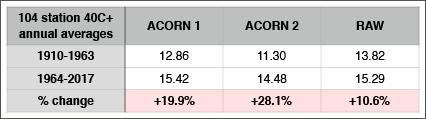
Analysis of the annual 40C+ average numbers and temperatures at the 112 stations allows a comparison between original RAW daily observations and the homogenised ACORN 1 and ACORN 2 datasets. The following analysis is from 1910 to 2017 as this is the final full year of ACORN 1 daily temperatures.
The first analysis compares the three datasets at the 104 non-urban ACORN stations used by the bureau to calculate national and regional average temperatures …
Australian Very Hot Days, Graph, Bureau of Meteorology, Chris Gillham.
It’s clear that ACORN 1 reduced the number of RAW very hot days in the early 1900s, and ACORN 2 has created a staircase.
However, the animation nevertheless suggests a RAW increase in the annual number of very hot days in Australia, although the observable step changes coincide with 1972 metrication and the introduction of automatic weather stations in the mid to late 1990s that are believed to increase maxima because of their instant electronic response to warmth compared to the slower responsiveness of liquid thermometers. The very hot day increase in the new millennium also coincides with the introduction of smaller Stevenson screens that decreased their internal space by almost 74%.
The trend and dataset differences in the 104 non-urban stations are similar among all 112 ACORN stations …
We use cookies to ensure that we give you the best experience on our website. If you continue to use this site we will assume that you are happy with it.


 In a rare move for consumers, US citizens will not be forced to buy LED soul-and-body-clock destroying globes next year as was planned. Instead they can frivolously continue to buy incandescent globes if they so choose.








Recent Comments