This week the world woke up to realize that silver is a critical mineral for the high tech, AI, solar panels, and renewables. In four days time, China, which supplies more than half of the processed silver on Earth, effectively blocks their exports of silver.
Meanwhile it turns out JP Morgan, which has been aggressively shorting the silver market for 15 years — was accumulating it all along. The entire COMEX silver market in New York has 30 million ounces of silver that is ‘immediately deliverable’. But JP Morgan is widely reported to control or custody up to ~700–800 million ounces of silver across vaulting, ETFs and proprietary holdings. It is de facto, the US strategic reserve, but controlled by a private bank, not by the Treasury.
The phase change is in progress. I’m not trying to cover all the details, just to let people know that something very big is unfolding.
The largest single use of silver has become “industrial applications”:
Silver, it turns out, is the best electrical and thermal conductor of all the elements. It is essential to the solar panel industry, EV’s, and data centres. And for the last five years the demand from the tech giants and renewable industry has been so great the global silver miners have not been able to keep with demand. The cumulative deficit in silver production since 2020 is 1.1 billion ounces. That’s a lot of silver that has been pulled from physical stores and sent to industrial buyers.
When Elon Musk says “it’s not good” he is thinking of the silver his factories need. Without enough supply, production lines will grind to a halt. Current EV’s use about twice as much silver as a petrol and diesel car (25-50 grams per car.) But the demand is only going to rise. The new Samsung sold state battery is rumored to need hundreds of grams, or even 1 kilogram of silver in every battery. It’s only a prototype, but supposedly charges in nine minutes and has a range of 900km (600 miles). You know they will want silver…
And even if the price of silver rises substantially, it’s still a small part of the whole cost of an EV, therefore the factories are going to pay the new higher prices. Anything is better than shutting down…
It is possible to substitute other metals for silver, but the losses are significant. Copper oxidizes badly, and has higher resistance.
Meanwhile, inconveniently, China announced two months ago that export licenses will be required for silver in 2026 (this is the same treatment they have done with rare earths). So technically, the CCP can say they haven’t banned anything, but the new rules just happen to restrict supply leaving the country from January 1 (Friday). The Export licenses are just “sanctions by paperwork”. Hence many industrial players are just starting to realize their supply lines are suddenly at risk.
There is a big silver shortage, which may bring down some bankers, the ones left holding the short contracts on silver… At the very least, the money printers will have to work hard.
The most calculated trade in inside trading
The Asian Guy in the videos below, is telling (or selling) a story. Strangely, his YouTube channel only started three weeks ago, yet his reports on silver have been so detailed and prescient he has gathered 43,000 subscribers. He appears to be pure AI, and, we should keep in mind that he may even be a product of the JP Morgan marketing team. Who knows? He almost seems to know too much.
Title: JP Morgan Flips LONG + China Ban Starts In 4 Days
WARNING: There are many copies and imitators and ambush spam videos acting as decoys. The original is OG Jon AG. Also on X: OGJohnAGand the backup channel is here.The transcript of this video (now made private) is here.
..
The Asian Guy describes himself as a silver bug, and talks the talk of the long suffering silver nerd, and yet, in the end, we have to ask why he is suddenly making these videos and “who benefits” from them. Obviously JP Morgan comes out looking very powerful, (albeit, also rather predatory. They told everyone not to buy silver while they bought it themselves).
The Asian Guy is effectively telling Elon Musk he has been out-gamed by JP Morgan and he will need to knock at their door and wait for them to set the price. Presumably they don’t want him to buy up Mexican silver mines…
In this video (below) made a few days ago, The Asian Guy claims last Friday, one banker must have gone to the US Federal Reserve to beg for $17 billion in Repos (Repurchase agreements) to keep them alive in the disastrous silver shorts gamble. A repo is a loan of last resort. If it’s true, it suggests things are getting very close to the wire for some traders.
It also confirms that the US central powers are willing to inflate their way out of trouble.
The Blob bureaucracy depends on fiat currencies
If the Blob can print money — they can keep giving away other people’s purchasing power in order to buy votes. The game is up though, if the voters realize what is going on and abandon the dollar in favor of something else, like gold or silver.
Because the Blob bankers can always print more money, they have created vast numbers of layers of derivatives, options and hedge contracts. Astonishingly, the ratio of “paper silver” to real silver is estimated to be over 100 to one, or much higher. What’s changing is that people are demanding the physical silver, not just another paper contract. They can’t make solar panels or EVs with paper silver. But once people realize there isn’t enough silver, everything falls apart just like a bank run, and panic sets in.
_______________
PS: My other half, Dr David Evans and I own Goldnerds. We’ve been watching the precious metals market for 30 years, and waiting for the house of cards to come undone (as have many skeptics). Obviously anything I write here is not market advice, just posted for information…
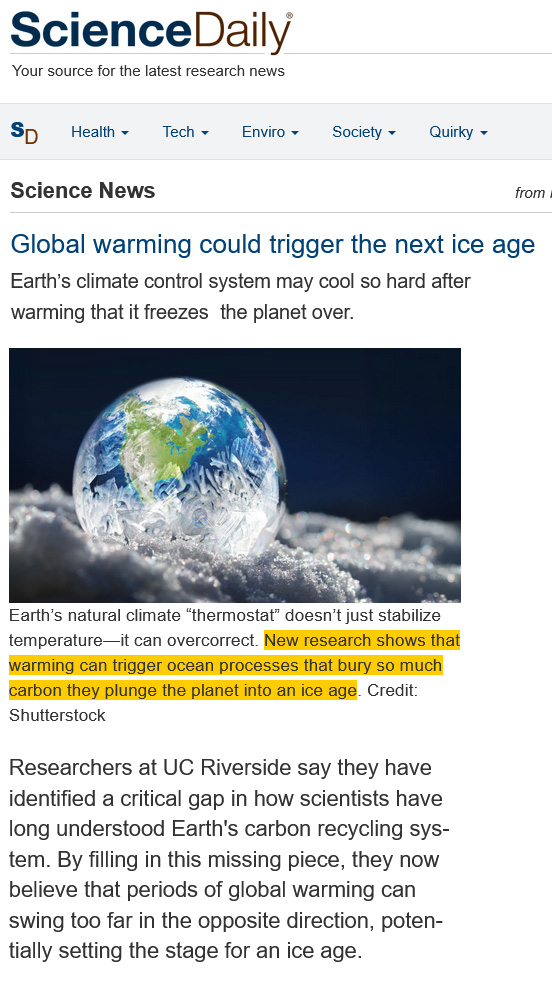
To the devotee, CO2 is the magical control knob of global weather. So a team at UC-Riverside wondered why, 600 million years ago, when CO2 was extremely high, Earth ended up frozen over in a Snowball Earth horror show. I mean, how could that be when CO2 ‘boils the oceans’? Normal people would say this shows CO2 is irrelevant — but the cult scientists went hunting with their broken computer models until they found “a new feedback” excuse that can explain this puzzling anomaly.
In their new vision, CO2 warms the world, but under the right conditions, it sets off a ghastly negative spiral where more warming causes more phytoplankton, which suck the CO2 out of the sky in a feeding frenzy and then sink and die at the bottom of the ocean, taking the CO2 down with them. As the CO2 drains out of the sky, we lose its warming glow, and the world sinks into a frozen oblivion.
Though unlike actual scientific advancements it doesn’t explain any of the other thousand anomalies, and is falsified by most of the last 500 million years of history. Pretty much all that time, CO2 and temperature were higher than today but we didn’t keep flipping into a snowball Earth.
The other awkward problem is that phytoplankton grow much more slowly in cooler temperatures, and it will happen in minutes. It’s not like the Earth could drop 20 degrees and the microalgae and diatoms won’t notice for a thousand years, and will just keep chugging along. Volcanoes add a stream of CO2 back to the sky, so the phytoplankton would have to outpace them.
Imagine the quicksand the modelers are playing with. They are trying to cover 100,000 year timescales, geological weathering of silicate rocks, and blend it all in happy-happy to model life forms that breed every 24 hours and have a lifespan of six days. The models don’t work to start with, and now we’re extrapolating every variable in every direction.
We might as well read tea leaves. It would be cheaper and we can fertilize the garden afterwards.
100 shades of irrelevant
If carbon dioxide doesn’t cause much warming in the first place, it can’t cause much cooling when it’s gone, and we know its minor. The hot spot has been missing for 20 years. Most of the warming effect of CO2 is supposed to come from amplification by water vapor in the upper troposphere, but we looked for decades and 28 million radiosondes didn’t find it. Until the climate modelers admit this, apologize and fix their models, their models won’t work. But we all know they can’t fix their models, because that might accidentally “solve” the climate crisis which would be a disaster for all the subsidy seekers.
To explain why this dire whipsawing feedback worked in 600 million BC, but hasn’t been noticed in the last half a billion years, the researchers do some convoluted excuse-making. Apparently it was more likely then because oxygen levels were lower. In that scenario, the CO2 sinks, but the phosphorus recycles at the surface which feeds even bigger phytoplankton blooms, like a global vacuum sucking CO2 out of the sky and pumping it down the Mariana trench. It’s all just-so reasoning.
Until the climate modelers make models that work in the last 50 years, they haven’t got a clue about the Precambrian.
What this paper does show though, is that Climate Science functions like a cult. This is what happens with 30 years of government funded research that no one can question. Teams of semi-functional desk-jockeys with PhDs take a bad assumption, amplify it in broken computer models and come up with nonsense that unfunded bloggers can disassemble on sight.
But handily, if an ice age happens, they’ll be able to say “we were right” and blame CO2.
The 500 million years of CO2 and Temperature on Earth. | Berner and Scotese
h/t Peter C and Krishna Gans
REFERENCE
Dominik Hülse, Andy Ridgwell (2025) Instability in the geological regulation of Earth’s climate. Science, 2025; 389 (6767) DOI: 10.1126/science.adh7730
Thanks to the wonderful souls who helps me cover the bills, so I can roast those who abuse science for profit and power.
This year saw the Net Zero mythology take a mortal blow. Electricity prices hit a bleeding point just as the Trump hammer fell, and the insatiable AI race spooked the Blob, which suddenly realized there actually was a global energy contest and we are the losers. But despite these wins, the bankers that created the bubble took the profit and ran (for Prime Minister of Canada), the witchdoctor-scientists still give terrible advice, and billions are still being poured into glorified rain-dances.
We still have to win the science war. The modern shaman tell us batteries will change the jet streams, save koalas, stop domestic violence and end wars. Then the ARC gives them another grant. And the ABC gives them free advertising. And we pay for all of it: the CSIRO-bad-science, the subsidies, and the ABC-BBC-CBC blob.
Then there is the free speech war. The Ministry of Misinformation will return. The government wants to stop us reaching the children with our dangerous graphs of the Holocene, the Eemian and Chinese coal use. We all know they banned X for under 16s but not its mirror leftie twin “BlueSky”. Age Verification is just an excuse for Digital ID which starts softly and quietly two days after Christmas. Shh!
Meanwhile, The cyber attacks on this site started on Easter Saturday, two weeks before the Australian election, crippling the blog for days until we added better armor, which costs more. The hostile force behind that kept coming back. This was a graph below of a typical day in September when a thousand ‘people’ in Singapore suddenly needed to read this site at half past the hour, every hour. Similar artificial patterns came often from Chinese servers, or through Hong Kong or Vietnam. There was also a lot of US traffic, but not with this screaming spike pattern. Those who were attacking didn’t bother to hide it. They wanted me to know, perhaps hoping I would be intimidated?
It’s been 17 years here on this blog, somehow, outside the system, living off goodwill and donations, debating the U.N. and trillion dollar cartels. Real freedom is writing with no corporate sponsor, and no major advertiser. There’s no billionaire publisher to cancel me. The government can’t take away a grant it never gave me, and the cowards of Cancel Culture can’t scare away the advertisers I don’t have.
I am not dependent on any institution, but I am of course, dependent on you, the reader, which is exactly how it should be. To serve the people direct, instead of serving Disney, Pfizer or President Xi. When no one holds the strings, everyone does.
I don’t ask for a subscription here, just some help if you can spare it.
Thank you to everyone who cancelled subscriptions to the propaganda sheets, and sent that money to someone in the new independent media instead.
Never surrender
Please hit the tip jar, buy me a coffee, a steak, a month on the server (now $194) and money to pay the bills. Australians may prefer to use direct deposit (details below) where you can also set up a monthly donation which helps me plan ahead. Thanks for your contribution, no matter how big or small. I know times are tough for some people.
Due to ridiculous legal froufrou, Paypaldonors will need to “buy” a number of “units of emergency chocolate” — (1 unit=$1) so write a number of dollars into the Quantity Field! (Apologies it’s not more user friendly). This works in AUD, CAD, EUR, GBP, NZD or USD.
OR send help directly via National Australia Bank for UnQwerty Pty Ltd BSB: 086420 Account number: 563148308 or via International transfer or even via snail-mail.
I will try again to set up GiveSendGo. I’ll update as soon as I can…
Merry Christmas and best wishes to everyone here.
With a special thank you and best wishes to Bryant.
Thanks in recent weeks to JS, PM, RK, RR, FA, CK, DL, RI, PC, DM, AD, JE, TK, FF, AC, AH, RG, LA, DM, TP. CM and other Delcons.
The EV bubble, or what’s left of it, popped this week
After carmakers invested billions into EV designs, and the EU and UK vowed to ban internal combustion engines, it’s all come undone. Donald Trump pulled the pin on subsidies for EVs and eased the strict emissions rules that punished petrol and diesel cars. US sales of electric cars promptly fell 40% in November. Ford’s fell by nearly 60%.
In response, Ford has killed off several electric cars, and will swallow a bitter pill of a $19.5 billion US dollar write down. That’s a lot of cars it will have to sell to make that money back. Gone is the fully electric F-150, the next generation electric truck, and any plan to make electric commercial vans. Instead Ford says it will shift into gas and hybrid models.
The day after the Ford announcement the European Commission let the world know it would wind back the total ban on internal combustion engines which was supposed to come into effect in 2035. Theoretically they’re only dropping the 100% ban to a 90% one. But the ideology has cracked, largely due to the uproar from European car makers who were not selling enough EV’s to make it work.
There are already calls to drop the 90% rule. It will mean that only the rich will be able to afford the few new petrol and diesel cars available for sale. Presumably the unwashed masses will just keep driving their old cars,.
The car maker takes a $19.5 billion write-down on its electric-vehicle business.
The Wall Street Journal
Not long ago, auto makers were touting electric cars as the future. Well, now they are slamming the brakes hard on that future as market reality has hit them like a 16-wheeler. See Ford Motor’s stunning announcement Monday that it will take a $19.5 billion charge on its electric-vehicle business.
“Instead of plowing billions into the future knowing these large EVs will never make money, we are pivoting,” Ford CEO Jim Farley said as he explained the company’s plan to boost its lineup of gas-powered cars and hybrids. Ford will also scrap its all-electric F-150 Lightning pickup, which has been a favorite of the EV-loving press.
Ford has lost $13 billion on its EV business since 2023, with bigger losses expected in years to come. Last year Ford lost about $50,000 for each EV sold. The truth is that the business case for EVs has always rested largely on government subsidies and mandates. Now that this combination of government favoritism and coercion is mostly going away, most car makers have much less reason to make EVs.
STRASBOURG, Dec 16 (Reuters) – The European Commission unveiled a plan on Tuesday to drop the EU’s effective ban on new combustion-engine cars from 2035 after pressure from the region’s auto sector, marking the bloc’s biggest retreat from its green policies in recent years.
Dominic Phinn, head of transport at non-profit group Climate Group, countered that the measures were a “tragic win” for the traditional industry over electric cars. “The watering down of the petrol and diesel-engine phase-out flies in the face of leading companies across Europe, who are investing billions in electric fleets and desperately need the stability it provides,” he said.
Under Tuesday’s proposal, EU targets would shift to a 90% cut in CO2 emissions from 2021 levels, instead of current rules that all new cars and vans from 2035 have zero emissions.
The lesson, yet again, is that in trying to artificially make EV’s cheaper, Big Government has made all cars more expensive. Ford and everyone else will have to make up those losses somehow. And in trying to reduce emissions, the bureaucrats have almost certainly increased them. By denying the poor a chance to own a new car, they’re undoubtedly kept older, higher emission cars on the road. Not that emissions matter — the point is that whatever it was that the geniuses with the magic wand wanted, the free market would have done it better.
“It was less than three years ago — early 2023 — that I was writing about the then-universal government and industry line that electric vehicles (EVs) would soon be taking over the American car market. “
In a post in January 2023, I linked to the websites of Ford and GM, where they both touted their grand plans for rapid conversion of their companies to the manufacture of mostly or entirely EVs. At that time, Ford was claiming that it would “lead America’s shift to EVs,” and would achieve 50% of its sales in that category by 2030. GM bragged about its “path to an all-electric future” by 2035.
Let’s face it, this was always ill-conceived central planning, and it was never going to work. I went back to the links that I had included to the Ford and GM websites in my January 2022 post. Both links remain active, but the excited talk about leading the way to an all-EV future has been scrubbed from both.
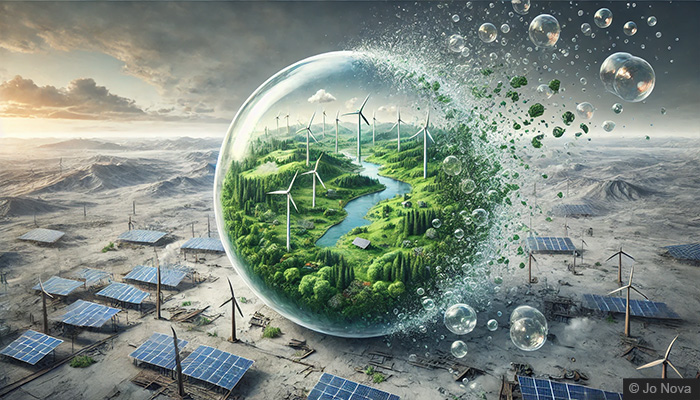
Despite the government plans to cover the country in wind turbines, the wind industry fell in a very big hole in 2025
Things in Renewable-Land must be worse than they seem. Giles Parkinson at RenewEconomy has been reduced to celebrating that *one* sole wind plant in Australia (one!) finally got a green light to proceed. This was “a first for 2025”. Ouch. Which is another way of saying that the economics of wind turbines are so awful, no one else in Australia wanted to build one this year.
Auaetralia’s year-long wind energy investment drought has finally been broken after Tilt Renewables gave the green light to the 108 megawatt (MW) Waddi wind project in Western Australia.
The Waddi wind farm, located in the state’s wheatbelt about 150 kms north of Perth, is the first wind project to reach financial close in 2025 in Australia, and will begin construction in 2026 and reach full operations in 2028.
“This will be the first wind farm to reach a Final Investment Decision in 2025 and shows that the investment drought for new projects in Australia is finally breaking,” said Tilt CEO Anthony Fowler.
“Wind projects have been held back by a combination of grid access, connection challenges, social licence, and rising costs, although the industry says these have now started to ease. “
Even though the Green-Labor Party won the Australian election in May, everything has gone wrong for wind farm developers. The drought in wind projects that started before the election has continued afterwards too. Even a compliant, delusionally-supportive government can’t change geography, or high pressure cells. What’s killing wind power was always going to kill it.
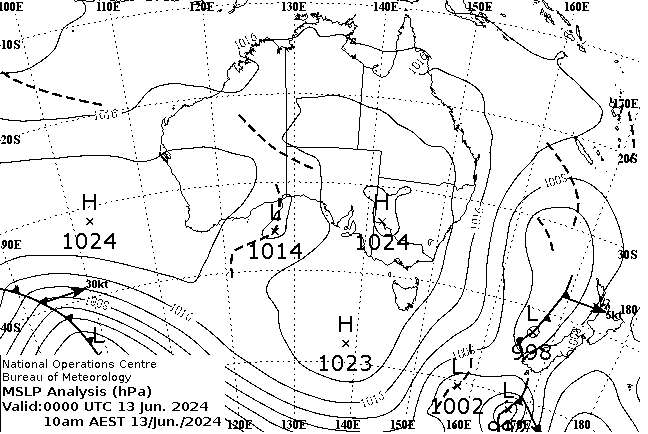
One big high pressure cell can stop the wind all over the country at once (Jun 2024)
Sooner or later, as intermittent energy dominated the grid, the value of more random generation would fall to nothing. We reached a point where all the good locations for wind plants were filled, so there were no nice windy spots near transmission lines left. Then the horrible farmers got organized to stop the big new high voltage lines going through, which meant new sites would be delayed by years, or never get connected at all.
Making it worse, the unstoppable rise of subsidized solar power ate the profits of every generator at lunchtime forcing the market into negative prices. Then the rise of subsidized batteries chewed through the bonuses that might have come in frequency control markets and the bonanza evening price spikes.
As if that wasn’t bad enough, and it was terrible — the diabolical uncertainty of marginal losses was ruining business plans — each year the AEMO applies a new marginal loss value on projects that are too far from the cities, or who have too many other generators around them. This reflects the electrical losses in long lines or congested wires. But it means effectively the generators lose income for 10, 20 or 30% of all the electricity they make, and if a competitor builds a wind plant next door, they both suffer higher marginal losses.
Thus and verily, new wind plant developers faced an impossible Gordian knot — they needed to be close to cities, but far away from other generators. They had to be near high voltage lines, but in a different climate region so it might be windy for them when it was calm for everyone else. Wind turbines needed to be near, but far, alone but together — It was never going to work.
It’s all so unfair. They just wanted to save the world and be treated like heroes, but nothing is working out.
The CSIRO has suddenly stepped back from promises of a Green Utopia. Only last week the AEMO (which manage the grid) admitted we’d need to keep coal plants running ’til 2049. Now, in a double shock, the CSIRO says we won’t reach a 100% renewables grid, because eliminating the last 10% of emissions is too expensive.
Don’t miss what a huge backflip this is:
— Suddenly, the CSIRO experts are saying that fossil fuels are an essential part of the Australian grid, in order to reduce costs.
— Suddenly gas is not just a short bridging fuel to get us to the land of pure renewables.
— Just like that, Net Zero Electricity is dead. If the land of the baking sun and roaring forties can’t make it work, who can?
They don’t specify what the last 10% of non-renewable energy is, but without nuclear power, it has to be fossil fuels, doesn’t it? They just can’t bring themselves to say “10% fossil fuels”. Holy green electron!
If only they could have told us that a few years ago before we wasted all the money, or even in April before we had the election?
Either they didn’t know — an astonishing failure of foresight — or they did know, and chose not to tell voters before the election. Their excuse is that costs have “unexpectedly” risen. Building gas plants is now 32% more expensive, they say, “amid soaring turbine technology costs”. And this comes on top of the seismic 55% rise in transmission costs which the AEMO — coincidentally — announced four weeks after the election.
Funny how the Blob agencies don’t seem to notice the bad news in time to alert the voters?
Who could have imagined that the whole world would want cheap fossil fuels again, and Australia would be left begging for gas plants, because we ruined our manufacturing base when we threw away the cheap coal power we used to have. I mean, apart from almost all the engineers in the country, who knew?
But it doesn’t make sense anyhow. They say the price of gas plants went through the roof, but if the grid was pure renewables, we weren’t supposed to need any gas? So they’ve slid that in there, the excuse that never was, hoping we don’t notice. And if a 10% fossil fuel grid is OK because it’s cheaper, why wouldn’t a 15% or 20% proportion be fine too? This could be just the first baby step out of the ideology.
Australia faces a blowout in the cost of gas needed to back up a renewables-dominated electricity grid, while the prize of fully greening the system by 2050 is undermined by challenging new economics that make it difficult to stack up.
A joint report by Australia’s national science agency CSIRO and market operator AEMO concludes that achieving 100 per cent zero emissions from electricity generation is more expensive than a framework that targets 90 per cent emissions reduction from electricity, and relies on abatement for the rest.
They find decarbonising power generation is economically compelling, just not at maximum intensity. That is because expelling the last 10 per cent of generation emissions comes at a high cost.
The bill for building gas power plants has soared by 32 per cent over 2025-26 amid soaring turbine technology costs, the science agency found in its draft report, with gas costs not projected to return to normal levels until 2035.
Ominously, they are not even pretending renewables will reduce electricity costs anymore. Instead there is word salad about returning to a “normal cost path” — whatever that means in a technology that’s still developing and has never been rolled out en masse. There is no “normal”, only models that pretend they know the answer:
“Our current view is that it may take longer than 2030 for technologies to return to a more normal level of costs … if a technology has not already started to show strong signs of recovery it will not return to their normal cost path until 2035. This includes technologies such as onshore wind, coal, gas and nuclear,” the report said.
The most interesting point, which they don’t have the honesty to say, is what really shook them into the realization that 100% “renewables” wouldn’t work? Was it the utter failure of the hydrogen gas plants; the pathetic progress of Snowy 2; the deaths of two transformers at the Waratah super battery, or the collapse in investor interest in building wind farms, or the organized resistance of farmers to stop the high voltage transmission lines, or all of the above, plus the Spanish blackout?
Or was it the shocking price rises of the last two years which proved that everything they said about renewables being cheaper wasn’t true?
It’s a High-Voltage Wealth Transfer Disguised as Climate Policy
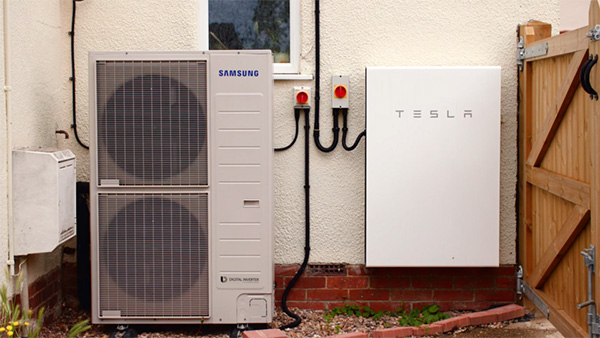
The big new “cheaper battery scheme” was so badly designed it accidentally burned through $2.3 billion in just 6 months. We could have built two new gas plants… instead we blessed a few wealthy homes with batteries bigger than they can use, which will probably sit around doing nothing most of the time. The scheme is so bad, the government has already promised to add another $5b to the pyre.
And since most homeowners are not opting to share their battery in a virtual power plant with the voracious retailers, this extra battery power will probably just sit there unused in homes around the country, hopefully not catching fire too often. It’s just another Soviet-style failure of communist midwits.
The government keeps bragging about the rampant success of the program but it is a globalist lemon from end to end. The Cheaper Battery Scheme was supposed to save homeowners $4,000 on a new 10kWh home battery, but the rebate was offered “per kilowatt hour” not per battery. (Does Chris Bowen does even know what a kilowatt hour is?).
The design meant solar installers had every incentive to offer homeowners a supersize battery (a 20, 30, 40 or 50kWh monster) and the homeowners had every reason (apart from morals and ethics) to let taxpayers foot the bill for batteries that were much larger than they needed or would have bought themselves.
Finn Peacock, founder of “Solar Quotes” explained to the ABC that instead of buying a 10kWh battery homeowners could order a whopping 50kWh battery which would get a rebate as high as $18,000 dollars. In the end, he said, it would cost the homeowner effectively the same amount regardless of the size of the battery. That would also give people a reason to buy the biggest cheapest battery they could get — what could possibly go wrong, eh?
The government experts thought people would buy 10kWh systems, like they did in the free market, but in the new fake market, the average size installed is now more like 25kWh.
The scheme started in July, and failed in a predictable fashion, but the government apparently only realized things were running amok after 160,000 big batteries were installed in homes around Australia. According to the ABC, solar and battery installers were asked last Friday to join “an urgent briefing by the minister on Saturday outlining major changes to the policy.” Righto then, panic stations at the Dept of Weather and Energy?
The original plan was to help a lot of households reduce their electricity bill (at the expense of the other households who subsidised the solar panels and the batteries). Instead a few homeowners with enough money lying around to spend thousands on a battery, have had a bonanza with up to $18,000 in battery bonuses.
The policy was supposed to slash the purchase price of a battery by about 30 per cent, saving consumers roughly $4,000 when buying a typical system with 10 kilowatt hours of storage.
But industry insiders say poor design has fuelled a rush towards much bigger systems up to the maximum eligible size of 50 kilowatt hours, and drained the available budget much sooner than the government was anticipating.
While the government stated the money would last until 2030, analysts say much of the budget has already been spent and will be exhausted by mid-next year.
The glorious waste of it all:
Other industry participants, who were not authorised to comment because of their work advising the government, said the scheme had created significant waste.
They pointed out that most households were only using about 10 kilowatt hours of power overnight and would struggle to fill a system with five times as much storage.
One critic said: “You end up with a lot of batteries that will never fill up, just sitting there empty forever, paid for by the Australian taxpayer.”
If the government then mandates free electricity for everyone at lunchtime, the wealthier battery owners can really capitalize on it.
Too bad about the national economy.
And too bad about the battery chemistry. Some worry that running the batteries flat-tack to make the most of the “free electricity” window is stressing the batteries…
One of his biggest concerns was the flight by consumers to the cheapest batteries on the market — a trend that was being fuelled by the incentive to maximise size rather than quality.
On top of that, he said the spread of “free” electricity periods during the middle of the day to help soak up excess solar power was creating another risk.
“People get the big battery and then they run them absolutely full throttle for three hours a day to charge them from the free electricity,” he said.
“What we’re seeing is that it’s really stressing these batteries to the extent you’ve had a recall already.”
If man made CO2 emissions have any effect at all on extinctions — it stops them happening
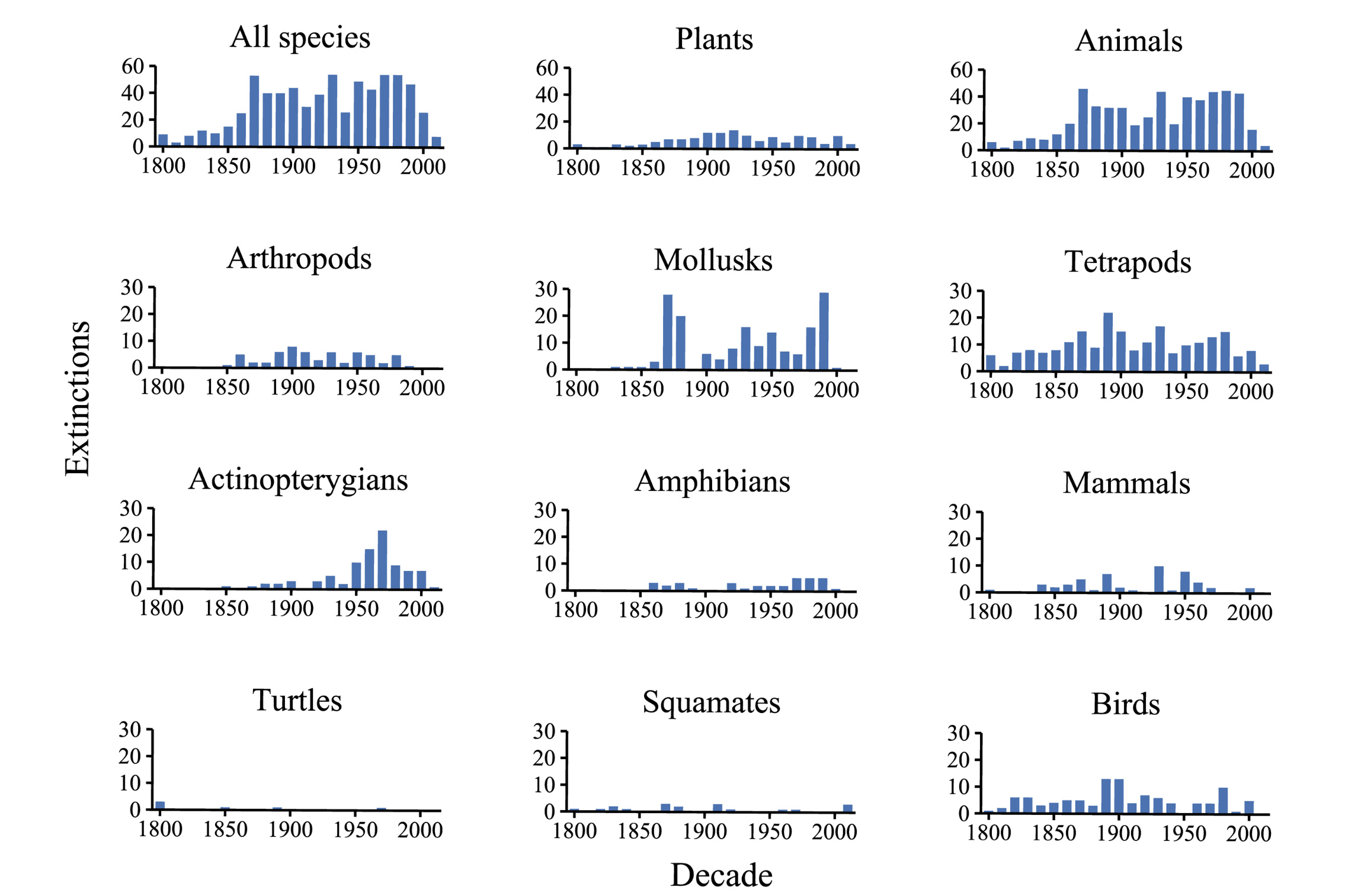
New research looked at 500 years worth of extinctions and concludes that species loss peaked about a century ago. Far from the rate accelerating as we pour carbon dioxide into the sky, fewer species are disappearing now than forty or fifty years ago.
Kristen Saban and John Wiens considered data on as many as two million species. They specifically analyzed some 912 plants and animals that became extinct in the last 500 years.
“To our surprise, past extinctions are weak and unreliable predictors of the current risk that any given group of animals or plants is facing,” said lead author Saban, who recently graduated from the U of A and is currently a doctoral student at Harvard University.
Humans have wiped out species, but mostly by bringing in rats, pigs and goats to isolated islands:
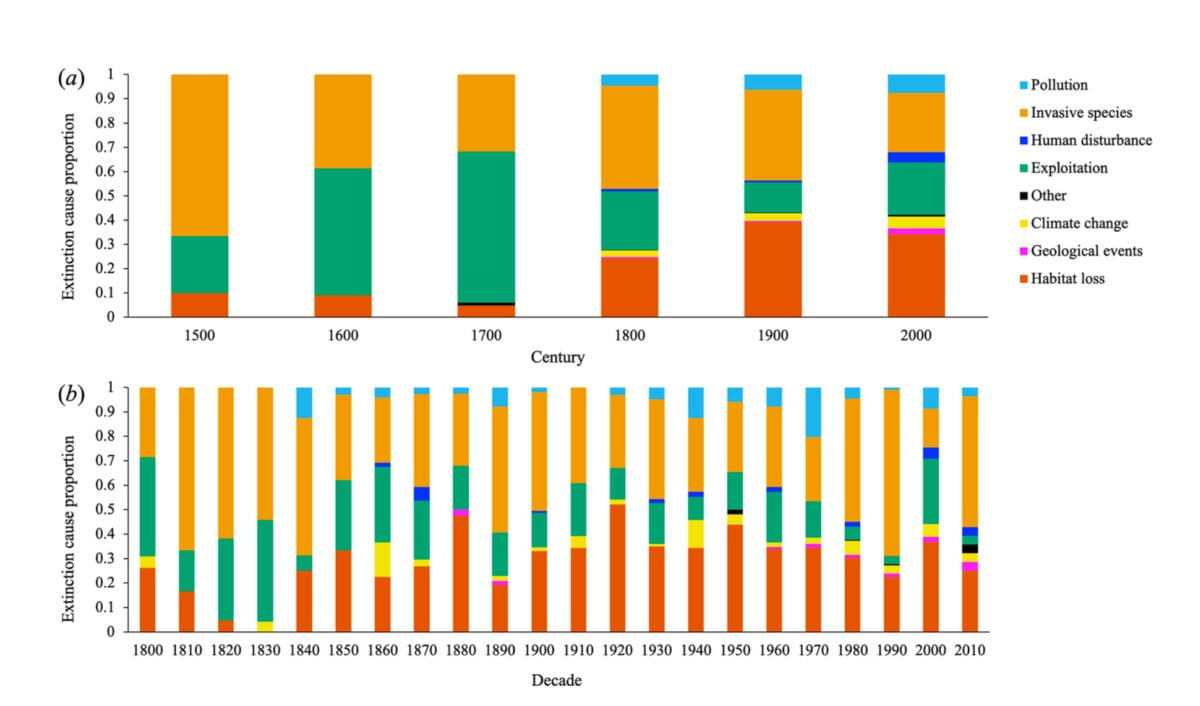
Extinction rates varied strongly among groups, and extinctions were most frequent among mollusks, such as snails and mussels, and vertebrates, but relatively rare among plants and arthropods. Most extinctions were of species that were confined to isolated islands, like the Hawaiian Islands. On continents, most extinctions were in freshwater habitats. Island extinctions were most frequently related to invasive species, but habitat loss was the most important cause (and current threat) in continental regions. Many species appeared to go extinct on islands because of predators and competitors brought by humans, such as rats, pigs and goats.
The researchers could not find any evidence suggesting climate change was increasing the rate of extinction:
Somewhat unexpectedly, the researchers found that in the last 200 years, there was no evidence for increasing extinction from climate change.
“That does not mean that climate change is not a threat,” Wiens said. “It just means that past extinctions do not reflect current and future threats.”
It seems like a very comprehensive study. Given it’s importance, I’m sure the UN will be delighted. It’s a wonder they didn’t commission a study just like this 30 years ago…
There are many reasons for extinctions but “climate change” barely rates a mention, which is not at all surprising given that every species alive today has lived through hotter times, colder times and times that changed faster than today. Man-made climate change is nothing compared to asteroids and volcanoes.
The best way to protect biodiversity is to understand what actually causes extinctions, not to shamelessly exploit the threat of them as a political tool for power and profits. Shame on the UN, the Greens and Greenpeace.
As I wrote 5 years ago — there’s only been one supposed mammal extinction due to climate change — a rat on a sandbar:
Let’s get a grip on the current state of the Sixth Mass Extinction — so far the only mammal extinction officially due to “man-made” climate change was a colony of little brown rats which had washed up on a sandy spit south of Papua New Guinea. The “island” is so small it has no fresh water, no trees, and the highest point is all of 3 meters above the high tide mark. One king wave could have wiped out the colony. Relatives of these rats live in Papua New Guinea, and presumably more rats will wash up there again sometime and the cycle will start over. As of 2019, that was the only actual mammal anyone can name as an extinction “caused by climate change”.
As of 2025, there doesn’t appear to be any others.
Saban K.E. and Wiens J. (2025) Unpacking the extinction crisis: rates, patterns and causes of recent extinctions in plants and animals” by , 15 October 2025, Royal Society B: Biological Sciences. DOI: 10.1098/rspb.2025.1717
And so we find that the global consensus quietly dispersed, there were no press releases, no ceremonies, just the dawning realization that nearly everyone had left the party without saying goodbye. And they didn’t wait for the UN to say “the science” was fine. The herd is on the move regardless…
One of the top majordomos at BHP delivers the bad news to Anthony Albanese. Everywhere on Earth is more attractive to a miner than Australia is. The world has changed, and everyone wants cheap energy, critical minerals, and lower taxes and other countries are giving it to them. Even Canada (ferrgoodnesssake!) is “walking back policies that the country can’t afford”. While Australia is the last nation on Earth steaming ahead to Renewable-nirvana.
Brandon Craig specifically mentions problems with climate targets, competitively priced energy, and Net Zero.
In the nicest possible way he’s telling our PM that his Net Zero plan is a dog.
BHP rising star Brandon Craig has warned Labor it needs to reconsider how policy settings are calibrated, including around emissions and climate targets, or risk being left behind by governments hungrier for mining investment.
Investment rivals like Chile, Argentina, the United States and Mark Carney’s Canada were acting to attract and secure multi-billion dollar investment from miners, but Australia was failing to meet their terms.
Mr Craig suggested it was time to reconsider net zero and decarbonisation policies to safeguard Australia’s economy. “I would let readers form their own conclusions but I think if we contrast directionally where the rest of the world is going versus where Australia is going across energy policy, tax policy, industrial policy, deregulation, even in some respects net zero positioning and decarbonisation, even stalwarts like Canada – in the face of tariffs and the impact to the economy from US policy – is walking back policies that the country can’t afford anymore,” he said.
The two things BHP particularly wants are the corporate tax rate lowered from 30 to 20% and reliable cheap power.
Brandon Craig is working in Argentina to develop the Vicuna copper project. He points out the tax rate there fell from 35% to 25% under the leadership of Javier Millei. And the successes of small government in Argentina are spreading to Chile — where voters go to the polls this weekend, and are expected to also elect “a hard right leader”. According to Craig, the word is that it’s likely the next government in Chile will improve their tax regime because they are competing with Argentina for mining investment.
Even the AEMO, our green grid operators, have realized Australia is not ready to shut down the last coal plants by 2037 which was the plan up until five minutes ago.
Things must be desperate. After 20 years of telling us how wind power was absolutely, definitely cheaper — for the first time, an official admitted the blasphemy — “wind is becoming too expensive”.
Coal will be needed to stabilise the energy grid until 2049 under an extraordinary 12-year extension of the fossil fuel that threatens Labor’s net-zero target, as the green-energy revolution leads to a 100 per cent explosion in power transmission costs.
In a 115-page document that mentions “net zero” just once, the Australian Energy Market Operator has warned that wind is increasingly becoming too expensive and there is a risk the nation is overbuilding transmission lines through rural and regional Australia.
So, “Net Zero” has vanished from the pages, and what appears in its place is a 100% explosion in transmission costs. The AEMO must have realized how daft the Net Zero label would look next to a plan to keep coal fired power on…
So where are the apologies?
The AEMO should have known all this three years ago before the Labor Party launched their rocket mission to a Renewable Moon. Or were they expecting some miraculous discovery, some wonder-battery, hydrogen plant, or supersized windmill to pop into existence in 2024 and it didn’t happen? Perhaps they thought they understood the Australian climate… What a shame they were willing to place a $128 billion dollar bet (of our money) on it. They could have just read poetry from 1904 and been better prepared.
Ponder that the AEMO could have told Minister Bowen the bad news this three months ago, before he supersized the national Net Zero Target. The fact that they left him hanging in the breeze, suggests something has shaken even the AEMO in the last few months. Was it the catastrophic collapse of transformers at the Waratah superbattery? The breakdown occurred as the battery was being hooked onto the grid to start. Did the failure signal that a battery driven grid was going to be much more risky and difficult than they had expected? Was it the steady stream of wind turbine projects that collapsed before they were started, or the hydrogen dreams that fell to pieces? Or was it the fierce opposition to the high voltage lines?
And lets not forget last week — when the AEMO also got a nasty shock. The Australian pointed out they assumed the wind power never goes below 14% capacity for days on end only to find out that it already has?
The plan is still to build massive infrastructure that doesn’t work most of the time:
Optimal for who? China?
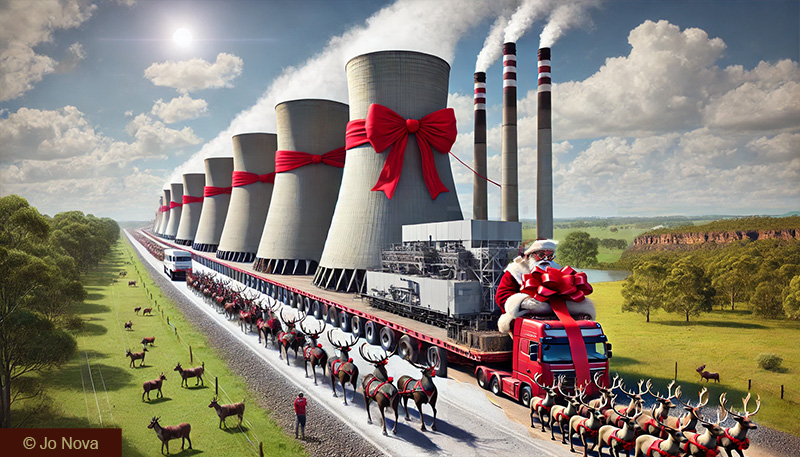
AEMO’s Optimal Development Path said grid-scale wind and solar capacity would need to rise from 23GW to 58GW by 2030, and double to 120GW by 2050, to replace coal.
Their excuse is that solar power is surprisingly popular, ignoring the fact that all the demand for it was created by government subsidies and incompetence, and everyone hates living next to a wind turbine.
Rising capital costs and supply-chain constraints have pushed developers more firmly toward solar rather than wind, a tilt that has implications for storage requirements given the daily generation profile of each technology.
Now, apparently, the old coal plants will keep going through the 2040s. The story is that they will shift to a “flexible role” (also known as an inefficient role). They will be used “sparingly” during the extended dunkelflautes that the AEMO forgot to plan for.
So either the giant shell of the old coal plants will be left running on standby most of the year to provide the frequency stability for a few weeks a year, or this flexible-coal-fantasy is just the marketing spin to disguise the truth. It’s what they would say to the Greens to soften the blow. It’s how they pretend this is just a small policy tweak.
They could hardly come out and say “we’ll just keep running the coal plants full bore…”
The A.E.M.O. is growing apprehensive,
Because “wind is becoming more expensive”,
So wind power isn’t cheaper,
As the cost is much steeper,
For Australia, with coalfields extensive.
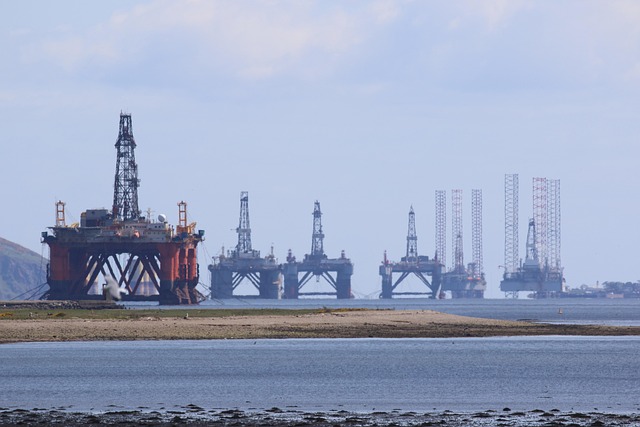
Europe has always been the most pious climate ideologues, but there is a growing realization that they need their own supplies of oil and gas. Greece and the UK are reopening offshore oil and gas platforms and Italy is thinking about it.
Australia looks set to be the last place on Earth where people are still playing climate-vanity games.
Last month Greece issued its first gas exploration license in 40 years. The UK loosened its ban on new exploration in the North Sea and the Freech Energie Giant said it would spend $6b USD to buy 50% stakes in natural gas fired plants across Europe. Meanwhile Germany, the home of thousands of wind turbines, is building 10 GW of gas powered plants.
The world has changed since the Paris agreement was adopted decade ago with ambitious goals to tackle climate change. It has become increasingly apparent that the agreement’s targets to reduce global greenhouse gas emissions will not be met, and not just because the Trump administration has pulled out of the Paris process.
Energy companies have taken note. “They’ve certainly abandoned the idea that they can lead the world along that kind of pathway,” said Luke Parker, vice president for corporate research at the energy consultant Wood Mackenzie, referring to the Paris agreement.
Even Germany, which has long prided itself on being a leader in renewable energy, is building gas-powered generation plants capable of generating 10 gigawatts, a substantial amount.
Who the hell ever heard of that one?” said Donald Trump:
It comes as US President Donald Trump has piled pressure on NATO members to stop buying Russian energy, in a bid to end the Russia-Ukraine war. At the UN last week he said, “They’re funding the war against themselves. Who the hell ever heard of that one?” Trump was referring to the more-than one billion euros ($1.35bn) EU countries are still paying to Russia each month for fossil fuels. — Aljazeera
“Germany — Ukraine’s largest European donor with about $17.5 billion in assistance — still purchased approximately $20 billion worth of Russian oil and gas over the same period.“…” Italy delivered around $3 billion in aid but bought $27.5 billion worth of Russian oil and gas.” … France paid more than $20 billion for Russian energy while giving roughly $6 billion to Ukraine. — New Voice of Ukraine
LONDON, Dec 1 (Reuters) – European countries are loosening their strict opposition to new oil and gas drilling, reversing years of climate-driven resistance to fossil fuels as governments seek to reduce a heavy reliance on costly energy imports, including from the U.S.
The change in tack in Greece, Italy and Britain reflects a new paradigm shaped by the 2022 energy price shock: an acceptance that fossil fuels – natural gas in particular – will remain a key part of the energy mix for decades, even as the region also builds out renewables capacity to slash greenhouse gas emissions.
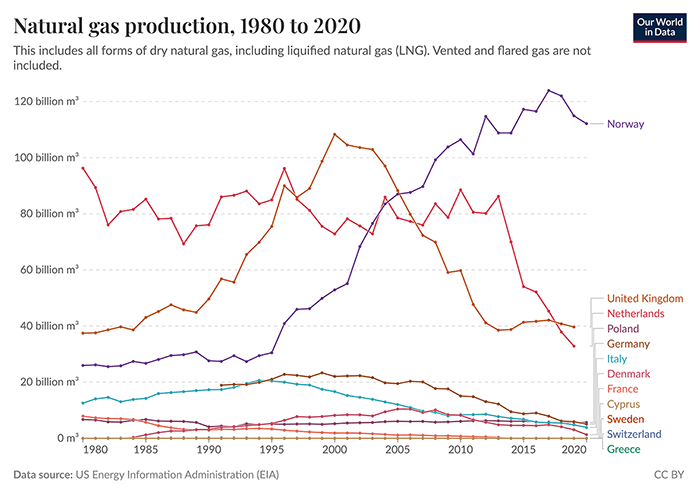
Europe has been cutting gas production for 20 years
In Europe, only Norway increased production of natural gas. In the graphic below, the gas industry in the UK and the Netherlands have spend two decades in decline. Only Norway kept exploring for more gas.
For comparison, Australia’s natural gas production is higher than Norway’s at more than 140 billion cubic meters.
This is a big policy shift for Greece:
“It’s a big change in policy for Greece that has shifted from ‘we don’t want hydrocarbons, only renewables’, to a new narrative that exploration for gas is key for energy security,” said Mathios Rigas, the CEO of Energean, which will lead the exploration campaign. If commercial, the field will not start production before 2030.
In neighbouring Italy, Giorgia Meloni’s government is also considering reviving offshore oil and gas exploration, which was suspended in 2019. Shell, the country’s top producer, last week said it was willing to invest more in upstream production.
In Britain, the government last week loosened its strict ban on new exploration activity in the North Sea to allow companies to expand production in existing fields. It is also expected to give the green light to two major new fields in the coming months.
Donald Trump wants to bring free speech, fertility, hard borders and patriotism back to Europe too
Other people have pointed out the dire state of Europe, but the continent can’t ignore the US President.
He has vowed to “cultivate resistance” to Europe’s current trajectory — and raises grave concerns at the subversion of democratic processes, and the loss of European culture saying “should present trends continue, the continent will be unrecognisable in 20 years or less“. The US is officially putting the topic-that-must-not-be-discussed on the table — mass immigration, and blaming the decay of Europe on transnational bodies like the European Union.
U.S. President Donald Trump and his administration blame the EU and migration for what they say is imminent, total cultural unraveling in Europe.
The explosive claim is made in the U.S. National Security Strategy, which notes Europe has economic problems, but says they are “eclipsed by the real and more stark prospect of civilizational erasure” within the next 20 years.
“The larger issues facing Europe include activities of the European Union and other transnational bodies that undermine political liberty and sovereignty, migration policies that are transforming the continent and creating strife, censorship of free speech and suppression of political opposition, cratering birthrates, and loss of national identities and self-confidence,” the Trump administration says in the 33-page document released overnight.
This is still an America First policy — framed as it being in Washington’s interest to “prevent any adversary from dominating Europe”.
“A large European majority wants peace, yet that desire is not translated into policy, in large measure because of those governments’ subversion of democratic processes,” Trump’s strategy document states. “This is strategically important to the United States precisely because European states cannot reform themselves if they are trapped in political crisis.”
Apparently the US releases one grand strategic policy each Presidential term with big thinking ideas about the place of US in the world.
We can be sure the Blob media will repeat the quotes, but dwell on the trivia and funnel readers away from the substance. The BBC tells readers that Trump is aligned with the far right AfD party, which was classified as “extreme” in Germany, but they won’t discuss the numbers of immigrants or how European countries are changing. Politico discusses “echoes” of the racist “great replacement” conspiracy theory, but won’t ask what proportion of Europeans are fluent in their national language, and how many celebrate (or even know) the European culture and heritage of the last thousand years.
Trump says The People are even more important than The Economy….
Trump described the document as a “roadmap” to ensure America remains “the greatest and most successful nation in human history”.
The new report doubles down on Trump’s point of view, calling for the restoration of “Western identity”, combatting foreign influence, ending mass migration, and focusing more on US priorities such as stopping drug cartels.
Focusing on Europe, it asserts that if current trends continue the continent would be “unrecognisable in 20 years or less” and its economic issues are “eclipsed by the real and more stark prospect of civilizational erasure”.
“It is far from obvious whether certain European countries will have economies and militaries strong enough to remain reliable allies,” the document states.
It also accused the European Union and “other transnational bodies” of carrying out activities that “undermine political liberty and sovereignty”, said migration policies were “creating strife” and said other issues included “censorship of free speech and suppression of political opposition, cratering birthrates, and loss of national identities and self-confidence”.
Conversely, the document hails the growing influence of “patriotic European parties” and says “America encourages its political allies in Europe to promote this revival of spirit”.
Trump wonders whether NATO can survive in the long run:
“Over the long term, it is more than plausible that within a few decades at the latest, certain NATO members will become majority non-European,” the document reads. “As such, it is an open question whether they will view their place in the world, or their alliance with the United States, in the same way as those who signed the NATO charter.” — Euronews
It is a conversation The West needs to have. Is a nation a broader family that has a lifelong pact to look after its own in War and Peace, or just a hotel where people choose to live for a while?
Nationalism threatens the Blob, because it demands to know how The Blob serves the nation and The Blob serve only themselves.
What’s most interesting about this is that this paper was ever published at all, given how awful it was.
In April last year Nature released the Kotz study which said that climate change would cause a mind-blowingly shocking 62% reduction in economic output by 2,100AD. Now, we know it’s wrong because the climate models are useless, but it turned out that one outlier country singlehandedly trashed the world economic forecasts, and that was Uzbekistan. Instead of a 62% reduction, without Uzbekistan, the global drop was “only 23%”.
So much for “peer review” then? This paper’s conclusion was wildly worse than the consensus of doomer papers, but the peer reviewers didn’t figure out why its result was so skewed, so Nature, supposedly the most esteemed repository of science, published the outlier anyway.
Even the uber left The New York Times is saying they should have been more skeptical:
Of course, erasing more than 20 percent of the world’s economic activity would still be a devastating blow to human welfare. The paper’s detractors emphasize that climate change is a major threat, as recent meta analyseshavefound, and that more should be done to address it — but, they say, unusual results should be treated skeptically.
“Most people for the last decade have thought that a 20 percent reduction in 2100 was an insanely large number,” said Solomon Hsiang, a professor of global environmental policy at Stanford University who co-wrote the critique published in August. “So the fact that this paper is coming out saying 60 percent is off the chart.”
Naturally, the mistake helped The Blob, so almost no one with a job in the climate-alarm industry wanted to look for anything that might be overdone. This study was used to justify all kinds of economic decisions that otherwise make no sense. Ka-ching. Ka-ching.
It also led to a striking comparison with the costs of avoiding catastrophic warming. Damages that are essentially baked in over the next 25 years will cost six times the money it would take to lower emissions enough to limit the world to 2 degrees Celsius of warming, the goal set by the Paris Climate Accord.
This is emblematic of the whole field of climate research. Monopsonistic research always finds what the one sole customer (The Blob) pays it to find. Thus the government funded establishment loved it. Look how popular this junk-research was:
The paper was also cited by the Organization for Economic Cooperation and Development, and was in the top 5 percent of journal articles tracked by Altmetric, a measurement tool for research impact. Carbon Brief, a climate-focused news outlet, found it was the second most referenced climate paper in 2024.
The Australian Climate Change Authority also cited the now-retracted Kotz et al. (2024) Nature paper in its official advice on Australia’s 2035 climate targets. They didn’t specifically quote any passages from it — but they used it as part of the “evidence base” to imply massive, climate damages that justify extremely high emissions-reduction targets.
Lint Barrage, chair of energy and climate economics at ETH Zurich (said) “It can feel sometimes, depending on the audience, that there’s an expectation of finding large estimates,” Ms. Barrage said. “If your goal is to try to make the case for climate change, you have crossed the line from scientist to activist,and why would the public trust you?”
So why has this been retracted now?
Is Nature sensing a change in the mood where this sort of weak “activist-science” looks terrible…? Could be.
The retraction might be just part of the escape plan. They’ve had their headlines of doom for 18 months already.
We use cookies to ensure that we give you the best experience on our website. If you continue to use this site we will assume that you are happy with it.

















Recent Comments