
By Jo Nova
Despite the government plans to cover the country in wind turbines, the wind industry fell in a very big hole in 2025
Things in Renewable-Land must be worse than they seem. Giles Parkinson at RenewEconomy has been reduced to celebrating that *one* sole wind plant in Australia (one!) finally got a green light to proceed. This was “a first for 2025”. Ouch. Which is another way of saying that the economics of wind turbines are so awful, no one else in Australia wanted to build one this year.
“The investment drought is breaking,” says CEO hails first Australia wind project to reach financial close in 2025
Giles Parkinson, RenewEconomy
Auaetralia’s year-long wind energy investment drought has finally been broken after Tilt Renewables gave the green light to the 108 megawatt (MW) Waddi wind project in Western Australia.
The Waddi wind farm, located in the state’s wheatbelt about 150 kms north of Perth, is the first wind project to reach financial close in 2025 in Australia, and will begin construction in 2026 and reach full operations in 2028.
“This will be the first wind farm to reach a Final Investment Decision in 2025 and shows that the investment drought for new projects in Australia is finally breaking,” said Tilt CEO Anthony Fowler.
“Wind projects have been held back by a combination of grid access, connection challenges, social licence, and rising costs, although the industry says these have now started to ease. “
Even though the Green-Labor Party won the Australian election in May, everything has gone wrong for wind farm developers. The drought in wind projects that started before the election has continued afterwards too. Even a compliant, delusionally-supportive government can’t change geography, or high pressure cells. What’s killing wind power was always going to kill it.
One big high pressure cell can stop the wind all over the country at once (Jun 2024)
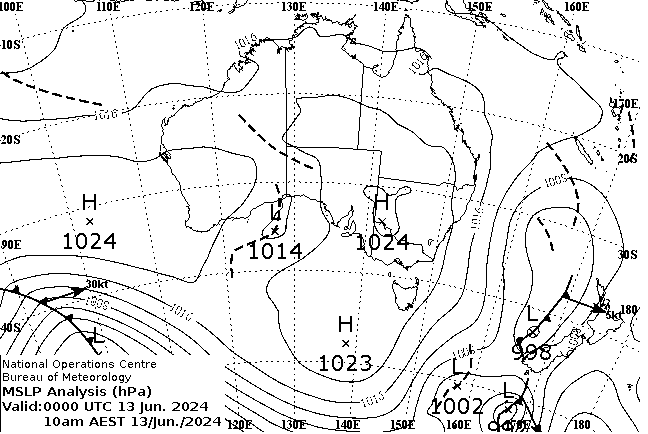
Sooner or later, as intermittent energy dominated the grid, the value of more random generation would fall to nothing. We reached a point where all the good locations for wind plants were filled, so there were no nice windy spots near transmission lines left. Then the horrible farmers got organized to stop the big new high voltage lines going through, which meant new sites would be delayed by years, or never get connected at all.
Making it worse, the unstoppable rise of subsidized solar power ate the profits of every generator at lunchtime forcing the market into negative prices. Then the rise of subsidized batteries chewed through the bonuses that might have come in frequency control markets and the bonanza evening price spikes.
As if that wasn’t bad enough, and it was terrible — the diabolical uncertainty of marginal losses was ruining business plans — each year the AEMO applies a new marginal loss value on projects that are too far from the cities, or who have too many other generators around them. This reflects the electrical losses in long lines or congested wires. But it means effectively the generators lose income for 10, 20 or 30% of all the electricity they make, and if a competitor builds a wind plant next door, they both suffer higher marginal losses.
Thus and verily, new wind plant developers faced an impossible Gordian knot — they needed to be close to cities, but far away from other generators. They had to be near high voltage lines, but in a different climate region so it might be windy for them when it was calm for everyone else. Wind turbines needed to be near, but far, alone but together — It was never going to work.
Photo By Tedder – Own work, CC BY 3.0,