Hypothetically, suppose you were distracted while you tried to change tropospheric jet streams, and accidentally gave away your national manufacturing to a foreign adversary. Next thing you know, you’re buying the batteries they make, and installing them in essential grid infrastructure and thousands of homes. You’re patting yourself on the back for getting a cheap deal (never mind the slaves) and it all seems dandy until one sunny day, a leader who was cheesed off with a trade deal, quietly switched off the “overcharge protection” on all of them remotely.
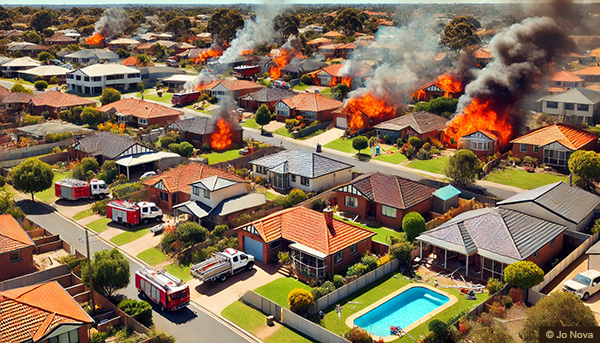
At that point, millions of solar panels are pumping excess electricity into batteries that have no safety cut off. A few houses start to go off like popcorn, and an hour later we’re all living at the Western Front.
Brian Craighead – chief executive of Energy Renaissance, has come to warn us — it’s a hidden threat to national security. He says Australia has already installed 220,000 batteries that were made in potentially unfriendly places, and each home battery has roughly 7,500 times as much energy as a pager. As he remarks: “overcharge is when all hell breaks loose”.
Now, he happens to sell secure battery management systems — so he has an interest in scaring the socks off Energy Ministers and hyping things up, but ask yourself this: would Anthony Albanese have seen this coming?
“When everyone talks about battery safety, we tend to think about the chemical stuff – these fires that you see on videos of Tesla cars going up. But those are relatively unusual. The key thing to focus on is battery software … that’s what protects them from overcharging.
“Let’s say you were a bad actor from a bad country, here’s what you could do, and this would be horribly easy. For example, you could say on January 7, 2025, I’m going to turn off the overcharge on 200,000 batteries installed in homes in Australia. Nothing is going to happen until then.”
It would make a great movie, but a lousy life:
“A co-ordinated attack exploiting these vulnerabilities could lead to widespread fires, explosions, and a crippling of our energy infrastructure. The risk extends beyond individual homes. Large, imported grid-connected batteries are becoming integral to Australia’s national energy grid. These massive storage systems, often managed by foreign-developed software, could be susceptible to cyber-attacks or sabotage, posing a threat to national security and public safety.
“There’s a clear and present danger.”
As Craighead says (so colorfully) — it’s like pink-batts on steroids. (A program here in Australia where a Big Government-made bubble in home insulation killed 3 poorly trained people and set fire to 200 homes.)
In the end, after the bombs and the blackouts, the hit to the GDP and the death toll — it will all be deemed a dreadful accident, due to a fault in a minor part, and a hot day caused by climate change. Everyone will know what happened, but no one will want to risk the lobster-wine-coal-barley-beer-students deal, and besides the nation needs to order new fridges and solar panels.
Unless, of course the home-battery-bombs were a decoy in a larger hostile plan, in which case we’ll have bigger things to worry about.
Speaking of which:
The US banned the Pentagon from buying batteries from six Chinese manufacturers earlier this year.
It takes a lot of money to get a Green saviour out of bed…
If these green groups were really tin-rattling charities supported by Mum and Dad donors, there would be outrage that so many funds were diverted from forests and fluffy animals to lining the pockets of the staff. But apparently the largest donors to these groups don’t care either, because the money keeps on flowing.
According to E&E News the CEO of the World Wildlife Fund, Carter Roberts, takes home a nifty $1.2 million each year in compensation. Similarly the president of the Environmental Defense Fund (EDF) gets close to one million each year, and the head of the Nature Conservancy gets three-quarters of a million. It takes half a million dollars to get the chief of the “Rainforest Alliance” to turn up for work, and $415k to feed the account of the president of the Wilderness Society. The two co-directors of Greenpeace USA get about $330,000 a year each. “Nice work if you can get it”…
The heads of influential groups including the World Wildlife Fund, Environmental Defense Fund and Nature Conservancy are among the top-paid leaders in the environmental movement, according to an E&E News analysis of 29 groups’ most recent tax filings.
1. Carter Roberts, president and CEO, World Wildlife Fund
Roberts, who has led the massive international conservation group since 2005, remains one of the environmental world’s top-paid leaders. His base pay in 2022 was $904,841, according to the World Wildlife Fund’s tax records. Roberts’ total reported compensation that year was $1,204,775.
The WWF gets about $470 million USD in revenue each year, of which “government grants” amounted to a nice $74 million last year (did you vote for that?). The WWF is hardly going to bite the hand that feeds it, so no wonder the WWF is missing in action when Big Government policies wipe out whales or kills koalas.
Last year WWF spent $145 million on things classed as “public education”, whatever that means. In the hands of a political activist, it might look a lot like a disguised election fund. Or in the hands of an industry player it might look like advertising, speaking of which, did you know WWF worries about climate change but actively opposes nuclear power?
Can anyone see any wildlife worth protecting here?
WWF appear to be trying to save the solar industry…
Purely hypothetically, if President Xi is not funneling money through to the WWF, he’s missing an opportunity to sabotage the West. And if he was funding the WWF through large philanthropic trusts, who would know?
WWF is deep within The Machine
To understand just how embedded the WWF is with the powers that be, consider that billionaires and bankers have been funding it for years. Among the original founders in 1961 was Godfrey Rockefeller. One of the largest donors has been the Moore Foundation, set up by Intel Founder Gordon Moore. Recently Jeff Bezoz gave the WWF at least $100 million, while bankers like HSBC have pledged “multiple millions”.
One former President of the WWF was William K Reilly, who was also at one time director of DuPont, ConocoPhillips, and of Royal Caribbean. He was Administrator of the US EPA from 1989 to 1993 and headed up the US delegation to Rio in 1992 while he was also President of the WWF. Get the picture? It just goes to show how the WWF is just another arm of Big Government and Big Business.
In terms of where the $450 million in revenue end up each year, about $44 million was used just for fundraising. And according to InfluenceWatch salary expenses were $70 million in 2020 plus another $4 million in “executive compensation” and $17 million for “other employee benefits”. So that’s a third of the budget. It is a machine that feeds itself.
Environmental non-profits are corporate conglomerates and political lobby groups masquerading as a charity.
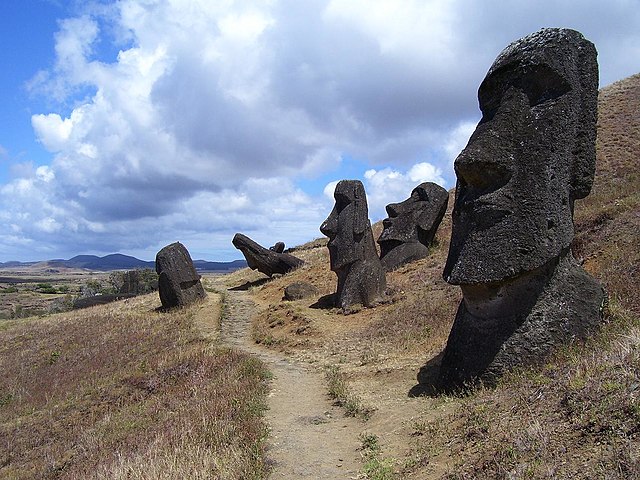
It was always the Posterchild Catastrophe of Doomsters, but two new studies suggest Easter Island might be (mostly) a story of remarkable human achievement instead.
In environmentalist legends, Easter Island was The Ecocide: they built nearly 1,000 giant stone statues but stupidly chopped down all its trees, and died in horrible wars. It was the sorry tale of ecological collapse and deforestation that we could tell small children at bedtime. After the last trees were sliced and diced, a catastrophe of horrors surely followed as the population of 15,000 people ran out of food and no one could make a boat to escape. Obsidian flakes across the island were interpreted as weapons of war and one anthropologist claimed there was a huge civil war that ended in the battle of 1680. Environmental hell on Earth was here…
But new research on the genomes of some islanders suggests that the population was probably small all along. When the Europeans arrived there were only about 3,000 people, and a genetic analysis suggests there are no signs of a recent collapse in the population. Another study of the fields suggests they made some very sophisticated gardens, improving the soil with rocks, can you believe, but they only ever had fields big enough to sustain about 4,000 people, which fits with the gene analysis. And the obsidian fragments were probably domestic tools.
Adding to this tale of remarkable survival, apparently the inhabitants somehow managed to get to South America and collect some native Indian genes which they brought back. These survived on for another 15 to 20 generations.
So it may be that an isolated island of only 3,000 people was capable of feeding itself sustainably, somehow making huge statues, and also sailing 3,700 kilometres to South America and then finding their way back again. We can imagine a wayward sailor somehow finding South America, but not perhaps on return, an island barely 24 kilometers wide in the vast Pacific. (And maybe, wonders Jo, whether some South Americans just managed a one way trip? How would we know? — On that score, the authors of the Nature paper say they can’t tell genetically, but there is archaeological evidence and oral history of trans-Pacific contact from Polynesia right across to South America and back).
Famed Polynesian island did not succumb to ‘ecological suicide,’ new evidence reveals
Most recently Carl Lipo, an archaeologist at Binghamton University, and his team used satellite imagery and machine learning to map the island’s rock gardens, a method of spreading rocks to improve soil productivity. In a paper in Science Advances in July, they concluded Rapa Nui’s agriculture was far less extensive, and its population smaller, than the “ecocide” theory had proposed. Although the ancient Rapanui did cut down most of the island’s trees, the deforestation did not trigger a cultural or population crisis, they say. “Their ability to adapt was successful,” Atallah Leiva says.
While it is true that the small island — which is just 63 square miles (164 square kilometers), or slightly smaller than Washington, D.C. — has poor soil quality and limited freshwater resources, researchers have discovered that the story of the Rapanui is one of survival in challenging ecological conditions.
One method the Rapanui used to enhance the island’s volcanic soil was “lithic mulching,” or rock gardening, in which pieces of rock were added to cultivation areas to boost productivity. The rock gardens generated better airflow in the soil, helping mediate temperature swings and maintaining nutrients — including nitrogen, phosphorus and potassium — in the soil.
Yet another paper suggests that the banal truth of the deforestation was not because humans chopped them all down, but because the first settlers bought some rats which chewed through every last nut and seedling. Imagine being able to build and move 80 ton stone statues, but not being able to make a rat-proof enclosure to save your last tree?
What really happened to the trees
More recently, a picture has emerged of a prehistoric population that was both successful and lived sustainably on the island up until European contact. It is generally agreed that Rapa Nui, once covered in large palm trees, was rapidly deforested soon after its initial colonization around A.D. 1200. Although microbotanical evidence, such as pollen analysis, suggests the palm forest disappeared quickly, the human population may only have been partially to blame.
The earliest Polynesian colonizers brought with them another culprit, namely the Polynesian rat. It seems likely that rats ate both palm nuts and sapling trees, preventing the forests from growing back. But despite this deforestation, my own research on the diet of the prehistoric Rapanui found they consumed more seafood and were more sophisticated and adaptable farmers than previously thought.
The bottom line is that the genetic analysis only has about 15 samples from remains of Islanders of the 1800s and while the rock garden analysis used field trips they also relied on some satellites and AI, so no one really knows for sure. The catastrophist environmentalist story almost certainly ran away with itself, but there is an element of indigenous sainthood working the other way too:
“Working with Indigenous groups, we face so many tropes and outdated narratives that people keep perpetuating—even scientists,” says Kathrin Nägele of the Max Planck Institute for Evolutionary Anthropology, who wrote an accompanying commentary for Nature. “I hope this … ancient DNA [study] puts the last nail in the coffin of this [collapse] narrative.”
Most likely the Rapanui were remarkable survivors who were just as capable of screwing things up as any of us. Hopefully scientists will figure out what really happened, instead of beating us over the head with their favorite ideology.
In it, he details how the real disaster came, not by the hand of the Easter Islanders, but from the slave traders, whalers and colonists:
This tiny patch of land was discovered by European explorers more than three hundred years ago amidst the vast space that is the South Pacific Ocean. Its civilisation attained a level of social complexity that gave rise to one of the most advanced cultures and technological feats of Neolithic societies anywhere in the world. Easter Island’s stone-working skills and proficiency were far superior to any other Polynesian culture, as was its unique writing system. This most extraordinary society developed, flourished and persisted for perhaps more than one thousand years – before it collapsed and became all but extinct.
While the theory of ecocide has become almost paradigmatic in environmental circles, a dark and gory secret hangs over the premise of Easter Island’s self destruction: an actual genocide terminated Rapa Nui’s indigenous populace and its culture. Diamond ignores, or neglects to address the true reasons behind Rapa Nui’s collapse. Other researchers have no doubt that its people, their culture and its environment were destroyed to all intents and purposes by European slave-traders, whalers and colonists – and not by themselves! After all, the cruelty and systematic kidnapping by European slave-merchants, the near-extermination of the Island’s indigenous population and the deliberate destruction of the island’s environment has been regarded as “one of the most hideous atrocities committed by white men in the South Seas” (Métraux, 1957:38), “perhaps the most dreadful piece of genocide in Polynesian history” (Bellwood, 1978:363).
Benny Peiser (2005)From Genocide to Ecocide: The Rape of “Rapa Nui”,Energy & Environment, Vol. 16, No. 3/4, SPECIAL ISSUE: “Institutions, Progress, Affluence, Technology and the Environment” (2005), pp. 513-539 (27 pages)
By Jo Nova
We know it’s coming. One day, sometime there will be a skyscraper inferno started by an EV or a scooter and made so much worse because there were other EV’s in the basement carpark.
At the moment companies are fined $100,000 in Australia for failing to include high fire danger warning labels on kids beach towels, but it’s no problem if children sleep in a tower above a carpark full of EVs.
But after a spate of fires in China, Hotels there are starting to ask customers with EVs to park in open areas outside the building.
… Chinese hotels and property managers have begun to ban all electric vehicles – scooters, e-bikes, family cars or commercial vans – from their undercroft car parks.
“Hotels and other buildings in Hangzhou, Ningbo, Xiaoshan and other places in Zhejiang have banned electric vehicles from entering underground garages for safety reasons, sparking heated discussions,” Chinese online dissident “Mr Li is not your teacher” reported in a post to X (which is banned in China) in September.
Local news reports that property owners were spurred into action after 11 intense battery fires in Zhejiang’s capital, Hangzhou, in May of this year.
“Based on the characteristics of electric vehicle fires and our hotel’s firefighting capabilities, we think it safer not to allow them into the underground garage,” RFA quotes one five-star hotel owner as stating.
“A lot of basement parking lots are designed with low ceilings, meaning that fire trucks can’t get inside.”
Some will point to studies that claim gas powered cars catch fire 20 or 30 times as often, but old cars are riskier and these studies don’t appear to control for age. (Can anyone find one that does?) And if one EV sets fire to 1,200 cars, hypothetically, say, at an airport terminal, we have to wonder whether the incident adds more “fire deaths” to the petrol car scorecard rather than the EV tally at the Department of Motor Vehicles.
Remember, we’re forcing EVs on people to save the world in a hundred years, but no one has the time to conduct a proper age-standardized study on the risks of storing EV’s in home garages or under apartment blocks now.
In related news, two weeks ago BMW recalled 140,000 Mini Coopers due to a battery fire threat:
The German carmaker said the recall of electric Mini Cooper SEs came after tests that revealed the potential for leaks from the battery housing.
“The high-voltage battery could also switch off and the vehicle could roll out slowly, even while driving,” BMW said. “A vehicle fire, even when the vehicle is parked, cannot be ruled out.”
Another Made-in-China EV suddenly caught fire and exploded.
This happened in Xinyue International Community, Section 2, Xihua Road, Shunqing District, Nanchong City, Sichuan Province, CCP China, on Aug. 3, 2024. pic.twitter.com/zta3Aoryn0
— Inconvenient Truths by Jennifer Zeng (@jenniferzeng97) August 3, 2024
The whole world is waiting to see who wins the US Election
The annual UN junket-fest for climate troughers — called COP 29 — starts the week after the US election. But this year things are running behind schedule as countries sit on their hands.
The oceans are boiling, the clock of doom is five seconds from midnight, and “renewables are cheap”, but if the largest economy in the world loses enthusiasm, so does everyone else. For some reason, the same cannot be said about the second, fourth and fifth largest economies.
Paris – The prospect of Donald Trump returning as president is hanging over crucial U.N.-sponsored climate negotiations, with countries “holding back” their positions until they know who sits in the White House.
This year’s negotiations hope to increase money for poorer countries to handle climate change, but some governments have not proposed a concrete dollar figure, wary of committing too soon.
“Everybody is holding back until they know who gets elected,” said Mohamed Adow, a campaigner and head of research group Power Shift Africa.
Unlike most years, it’s two month ahead and the money is not on the table. The wheeling and dealing is not being done:
The months of lead-up sessions to COP29, which is being hosted this year in Azerbaijan, have been painfully slow even by the plodding standards of global climate diplomacy, participants say.
With just two months to go, there still isn’t an agreed definition of “climate finance” let alone how much should be paid, which countries should receive it and how, and who should be on the hook for it.
Some developing countries are demanding north of $1 trillion annually, a 10-fold increase on existing pledges.
If elected, Trump could slash funding for the climate and Ukraine, leaving the EU — which saw swings to the right in elections this year — footing the bill.
The EU are not so much worried that they might have to “foot the bill” — what scares them is that an unleashed United States will outcompete their own sabotaged economies, making them look like losers. That will feed discontent and the rise of horrid far righty parties. (Those extremists that think men are men and fish don’t need wind turbines.)
We can take a tiny spec of comfort in this. It doesn’t mean Trump will win, but it means the Galactic Deep State Blob are still worried that he might. Democracy is not completely dead (yet).
Greg Sheridan explains the Australian situation, but it is the same in any Climate Patsy Land:
if Trump wins, suddenly Albanese’s energy policy will look even more unrealistic, and needlessly costly, than it does now. As it is, the world’s biggest greenhouse gas emitter, China, is increasing its fossil fuel use and not significantly reducing emissions. This is true, too, of fast-growing emitters such as India and Indonesia.
If the US at the level of national government turns against the climate action consensus, it will be extremely hard to argue that Australia must suffer vastly greater energy prices in order to keep faith with the allegedly global compact on climate change (which of course is not remotely global).
Just by running for office, Donald Trump is putting the brakes on some of the more flagrant climate payola, at least temporarily. The Swamp Monsters don’t want to look too profligate lest he win, because when the brains, the factories and the profits all leave for The Land of The Free, it will make their own positions look so ridiculous.
___________________
https://www.swpc.noaa.gov/#
PS: Aurora Watch Active –– The Sun let off a large X4.5 flare on Sept 12th which is due to arrive in the next few hours, but the best guess (plus or minus a lot) is 21:00 UTC, which is 7am this morning in Sydney (so no good) and 5am in Perth and 5pm in New York. Hopefully friends in Europe get a nice show, or if it’s later, America too. It is being discussed on SpaceWeatherLive. To get an email or alarm when it arrives, sign up for The Glendale App. Otherwise, keep checking the App screen, EPAM (Low energy Electrons and protons Monitor) or magnetometers for the earliest warnings, which will come from satellites about 1.5 million kilometres away. At best we only get 45 mins to one hour of warning. It’s not much time to drive to a dark park on a hill facing south, or to move the moon out of the way.
Frankly it’s a bit of a scandal we haven’t got any space-drones closer to the sun so we get a few hours planning time. Priorities!
Every scientific curiosity becomes a climate prayer
A year ago, within an hour, 120 seismometers all over the world started to record a freakish shake every 90 seconds like a metronome. People watching the waves were baffled. And even more so that it didn’t stop within a few minutes but continued on all day and night, eventually ringing out for nine days.
It turned out to be a landslide in an oddly shaped fjord in Eastern Greenland. A 1.2 kilometre mountain of rock and ice had collapsed, sending a 110m wall of water 10 kilometers across the gorge to smash 200 metres up the other side of the fjord. The water then came back down and the return wave apparently kept slopping back and forward for nine days. Spare a thought for the fish.
Dickson Fjord before (left) and after (right) the landslide. From Scientific American and Søren Rysgaard (left); Danish Army (right)
Thus “10,000 swimming pools” worth of repeating tsunamis keep rattling seismic detectors for days and then kept 68 scientists busy for a year figuring out what it was.
Predictably, they say, it was caused by climate change, because rock slides and ice collapses have never happened before, or at least, not while humans had a global seismographic network.
And not a single climate model predicted this.
Apparently the Dickson fjord has a 90 degree bend at end near the mouth, and a glacial dam at the other end which stopped the energy dissipating, making it the perfect resonant chamber. Then in a freak of nature, the landslide hit at the perfect 90 degree angle in the ideal chamber to drive seismologists bonkers.
Naturally, Science, the formerly esteemed top journal had to squeeze the absurd climate propaganda near the end of the press release, so giants like The Guardian could turn it into a Shock and Awe Headline.
Experts admit their tsunami models were completely wrong, but, ooh, spooky, spooky: climate change causes “global vibrations beneath our feet”. And she’s a professor — it’s embarrassing. This is superstitious bead-wringing with mystical phrases.
Prof Anne Mangeney, a landslide modeller at the Institut de Physique du Globe de Paris in France, who was part of the team, said: “This unique long-duration tsunami challenged the classical models that we previously used to simulate just a few hours of tsunami propagation – we had to go to an unprecedentedly high numerical resolution. This opens up new avenues for tsunami modelling.”
Such events will become more common as global temperatures continue to rise. “Even more profoundly, for the first time, we can quite clearly see this event, triggered by climate change, caused a global vibration beneath all of our feet, everywhere around the world,” said Mangeney. “Those vibrations travelled from Greenland to Antarctica in less than an hour. So we’ve seen an impact from climate change impacting the entire world within just an hour.”
We can’t “clearly see” any thing at all. There’s no trend, no data, no evidence. What if a warmer world means the ice doesn’t build up and go boom, but just melts away gradually. Drip, drip, drip, eh?
So the misinformation continues. In modern science lamb chops cause tsunamis, Ford F-250’s shake the world, and only solar panels can save us.
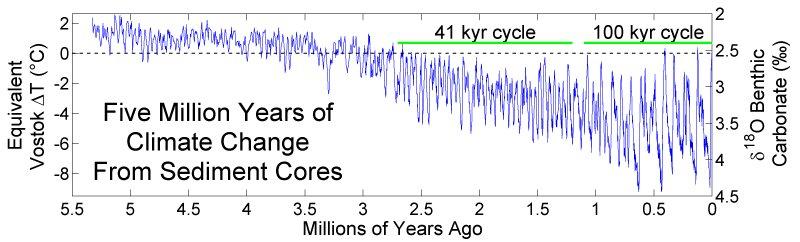
It’s all part of the hypnosis. Adults in the room need to remind the children that glaciers and rockslides have been happening for millions of years. (Eg Lieseki and Raymo) Then when kids grow up and become professors they might not say silly things.
Svennevig and 67 others (2024) A rockslide-generated tsunami in a Greenland fjord rang Earth for 9 days, Science, 12 Sep 2024, Vol 385, Issue 6714 pp. 1196-1205 DOI: 10.1126/science.adm9247
L. E. Lisiecki and M. E. Raymo (2005) — A Pliocene-Pleistocene stack of 57 globally distributed benthic δ18O records, Paleoceanography 20, 1003
Finally, 15 years and a trillion dollars too late, George Monbiot says what skeptics have been saying all along. Nearly every single carbon reduction scheme is a useless make-work machination that creates the illusion that the government is doing something. He calls it “perceptionware”.
A new paper was released in Science pointing out that in the last 25 years, barely 4% of climate policies in 41 countries have made any real difference. And by “real difference” we mean reducing a useful fertilizer, so it’s a good thing that 96% of the ploys failed, but a tragedy that a thousand billion dollars was stolen from decent people.
In any case, finally Monbiot sees the tip of the iceberg of grift and graft, but doesn’t realize his own role in it, doesn’t realize the same failures of journalists like him also failed the science world where 96% of papers have achieved nothing they set out to do as well — like predicting the climate. Climate science has been spinning its wheels, creating perceptionware and failing to figure out the climate for fifty years, but George hasn’t noticed.
Monbiot hasn’t even taken the obvious leap: Where were the Greens, the people who supposedly were the smart ones who cared the most? Most of these carbon reduction failures were obvious to anyone who owned a calculator. Could it be George, that the Greens were the dumb ones wrapped up in their own perceptionware game, pretending to care about CO2 to impress their friends at dinner parties but not actually giving a damn? Or worse, could it be that some Greens were bought off by industries and foreign countries that profit from the carbon grift?
Who stood up for the poor, the workers, and the taxpayers who were being shafted — only the skeptics.
Out of 1,500 global climate policies, only 63 have really worked.
That’s where green spin has got us
George Monbiot, The Guardian
“Grand schemes, many backed by governments, masquerade as positive action on the environment. They should be disowned”.
Let’s talk about perceptionware. Perceptionware is technology whose main purpose is to create an impression of action…
Monbiot zeroes in on the endless fantasia that is the quest for airline biofuel:
…perhaps the clearest example of perceptionware is the repeated unveiling, across the past 25 years, of mumbo-jumbo jets. Throughout this period, fossil fuel and airline companies have announced prototype green aircraft or prototype green fuels, none of which has made any significant dent in emissions or, in most cases, materialised at all. Their sole effect so far has been to help companies avoid legislative action.
Now he worries the poor are starving as we burn their food, and chop down forests so we can fly to Bali:
But never mind, this perceptionware is now Labour policy too. Failure is baked in. Even with restrictions on which feedstocks can be used, any significant deployment of biofuels for aviation will increase total demand, which means either that agricultural crops are removed from human consumption, raising the price of food and therefore increasing global hunger, or that wild ecosystems are destroyed to make way for agricultural expansion.
George still doesn’t realize the root of the problem is Big Government itself. In the crazy biofuel market, it was the government that “picked the winner” and decided we should burn food to save the world, not the free market. Who could have guessed that convenient high energy plant matter would also be the same stuff people wanted to eat?
As for using waste, this promise is repeatedly rolled out to justify disastrous policies. Biodiesel would be made from used cooking oil, but as soon as production increased, new palm oil was used instead. Biomass burners would mop up forestry waste, but soon started taking whole trees and, in some cases, entire forests. Biogas would be made from sewage and food waste, but operators quickly discovered they could produce more with dedicated crops like maize and potatoes. Why? Because waste is generally low in energy, variable and expensive to handle. Already, there’s intense competition for the small portion of waste that might be commercially useful, as companies chase carbon payments: so much so that fresh palm oil has been sold as waste oil, as this attracts a higher premium.
The government funded monopoly in science created a fake crisis that parasites could feed off, and he is surprised that parasites turned up to dinner.
Where were all our expert climate scientists, George, while 25 years of money and time was wasted? Did they or did they not want to save the world, or were they too stupid, or too scared to say the obvious?
We use cookies to ensure that we give you the best experience on our website. If you continue to use this site we will assume that you are happy with it.
 Print This Post | |
  Follow Jo's Tweets










Recent Comments