|
|
||||
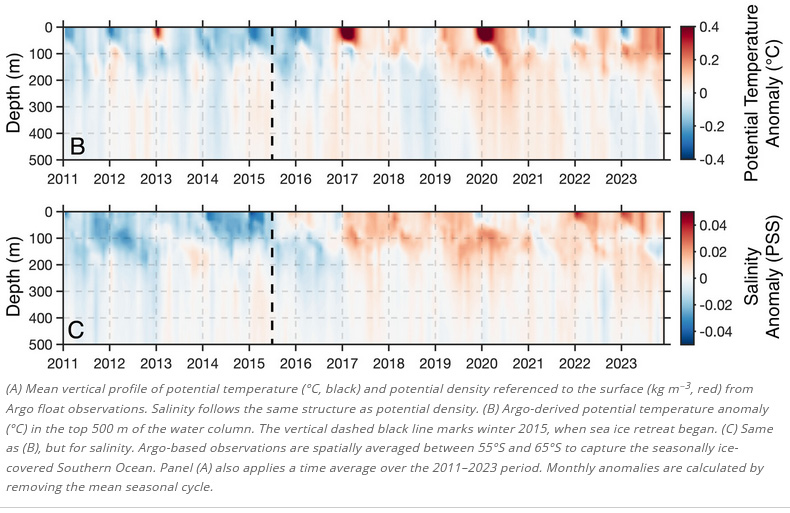
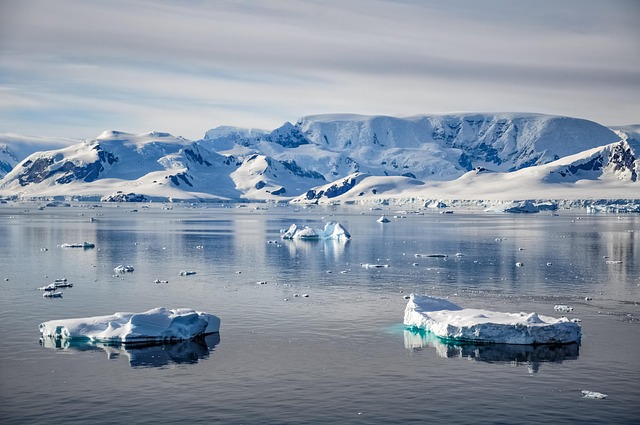 Image by AlKalenski from Pixabay By Jo Nova Something huge is happening around Antarctica and the experts didn’t see it comingMore than a million square kilometers of ice has gone: Since 2015, the continent has shed sea ice equivalent to the area of Greenland. Researchers call it the largest environmental shift detected anywhere on Earth in recent decades. Everything about Antarctica has defied the experts. For years Antarctic sea ice expanded when it wasn’t supposed to. Then, suddenly in 2016 the sea ice around Antarctica dramatically started to shrink, and that wasn’t supposed to happen either. Scientists wondered at the time if it was just a temporary blip, but then it got even smaller. Holes in the sea ice “as big as Switzerland” have started to appear for the first time since the mid 1970s. To explain this mystery (that was rarely mentioned) a new paper suggests the salinity of surface waters has changed. We’re not just talking about a small piece of ocean, this is everything south of 50°. For decades, the surface of the polar Southern Ocean was getting less salty — an “expected response to a warming climate” they said that started in about 1980, “however, this trend reversed abruptly after 2015”. So as news seeps out this week that there is a “dangerous feedback loop” where shrinking ice is warming the ocean, bear in mind that the experts also admit this is “completely unexpected” which is their way of saying “the models were wrong”. Carbon dioxide was not supposed to do this. Most likely some large natural cycle has shifted gears. Steadily rising CO2 didn’t cause the rise in sea level before 2015, and didn’t cause the decline after that either. There are bigger forces at work, and we don’t know what they are…
Graph adapted from Climate4You When the die-hard believers point out that Antarctica is “just catching up” and that they always said Antarctic sea ice would shrink, remind them that Turner et al said in 2013 ““The increase in Antarctic sea ice remains one of the great unsolved puzzles of climate science.”. Now they have a new theory, “the salinity changed” — but what caused that? They don’t know. They might as well be tea leaf readers when it comes to predicting the climate. For years Antarctica was going to warm twice as fast as the rest of the world (remember polar amplification?) But the whole idea that warming would be double-bad at the poles depended on feedbacks. In the disaster scenario, as the reflective white ice queen melted — the dark hungry ocean would absorb more heat, which would melt even more ice. Unfortunately the modelers still can’t explain ocean currents, clouds, or rain. The bad news is that we live on the Water Planet and their models can’t predict water. Blame the salt?Ten years after the mysterious shift began, the new post hoc explanation is salt. They were sure that as Antarctica catastrophically melted and poured freshwater into the oceans the water nearby would become less saline. This, they assumed would form a neat surface layer, keeping the deeper, saltier, and denser water from rising up and mixing. Instead, after 2015, the surface water got more salty, the neat layers that were supposed to stratify started to churn, and the warm water from below started to melt the ice from underneath. That’s a pretty huge shift there, that Earth system modelers had no idea was coming….
Climate modelers must be feeling pretty spooked by now. It’s been ten years since Antarctic Sea Ice started behaving in a way they couldn’t explain, and it obviously isn’t because of our rising emissions. What they are not honest enough to say is that for forty years they have completely oversold their models and their certainty, while the world suffered, and bet trillions on their guesses. They have no idea how to predict the catastrophic feedback loops, which may not even exist, and that it all may have nothing to do with CO2. And now some try to paint the shift they didn’t see coming as more proof “it’s worse than we thought”. Antarctica’s ocean flip: Satellites catch sudden salt surge melting ice from belowScienceDaily A massive and surprising change is unfolding around Antarctica. Scientists have discovered that the Southern Ocean is getting saltier, and sea ice is melting at record speed, enough to match the size of Greenland. This change has reversed a decades-long trend and is letting hidden heat rise to the surface, melting the ice from below. One of the most dramatic signs is the return of a giant hole in the ice that hadn’t been seen in 50 years. The consequences are global: stronger storms, warmer oceans, and serious trouble for penguins and other polar wildlife. Since 2015, Antarctica has lost sea ice equal to the size of Greenland — the largest environmental shift seen anywhere on Earth in the last decades. The Southern Ocean is also getting saltier, and this unexpected change is making the problem worse. For decades, the ocean’s surface freshened (becoming less salty), helping sea ice grow. Now, scientists say that trend has sharply reversed. Using European satellite data, research led by the University of Southampton has discovered a sudden rise in surface salinity south of 50° latitude. This has coincided with a dramatic loss of sea ice around Antarctica and the re-emergence of the Maud Rise polynya in the Weddell Sea – a huge hole in the sea ice nearly four times the size of Wales, which hadn’t occurred since the 1970s. Keep reading → July 3rd, 2025 | Tags: Antarctica, Climate Models, Feedback | Category: Global Warming |  Print This Post | | Print This Post | |
By Jo Nova It didn’t start that way, but it’s almost like Climate Change is just a Chinese trick…The West’s ridiculously bloated legal system sits there like a radioactive duck. For a pittance, the Chinese Communist Party can sponsor climate lawsuits that cost US companies big money, tie them up in court, slow them down, and sometimes bankrupt them, and that’s for cases they don’t win. For the other cases, left wing non-profits are running training programs for judges to indoctrinate them with climate ideology. (If we think some judges are crazy, perhaps they had help to get there?) Senate Hearing Exposes China’s Role In Backing Climate Lawsuits Against U.S. EnergyBy Olivia Rondeau, ClimateChangeDispatch The Chinese Communist Party (CCP) is financially backing left-wing climate lawfare in the United States, and Sen. Ted Cruz (R-TX), Kansas Attorney General Kris Kobach, and dark money expert Scott Walter revealed the shady details while testifying before a Senate subcommittee on Wednesday. According to Cruz, this campaign is a “three-pronged” approach. “First, foreign money from entities tied to the Chinese Communist Party flows into the United States to bankroll climate advocacy groups who litigate against American energy,” the senator said in his opening remarks. “Second, activist lawyers flood our courts with lawsuits designed not to win policy debates, but to bankrupt energy producers and to dismantle energy infrastructure through sheer attrition.” “And third, the judiciary itself is being quietly captured and brainwashed as left-wing nonprofits host closed-door trainings that indoctrinate judges to adopt the ideological goals of the climate welfare machine,” he explained. “The CCP plainly has a strategy of driving the United States away from domestic energy sources and increasing U.S. dependence on sources that rely on a Chinese supply of solar panels, electric vehicle batteries, and other technologies.” If the CCP do this in the US, why wouldn’t they do it in Australia? (Perhaps they don’t need to, they could hardly hope to sabotage the mining industry in Australia better than Tanya Plibersek has.) But if they did, who would investigate? The ABC? Of course, the Chinese Communist Party is just worried about carbon emissionsIt’s what a good global citizen does — help everyone else cut emissions, especially stupid nations:
It’s a bit like the way the CCP is suddenly so worried Australia might waste money on military expenses. Xiao Qian, China’s Ambassador to Australia, doesn’t mind us spending billions on Chinese made solar panels and wind-mills, but he’s concerned about our heavy fiscal burden for defense and our livelihoods. It’s all so touching… Don’t fall for NATO’s hyped-up rhetoric on defence spendingBy Xiao Qian, in The Australian By playing up international and regional tensions and slandering China’s normal military build-up, these countries are merely seeking nothing but excuses to drastically grow their military spending… Dramatically increasing military spending places a heavy fiscal burden on the countries involved, undermining their efforts to boost economies and improve livelihoods, and further straining a global economy already struggling with weak recovery. On a blog we might call this a concern troll. If the CCP were so worried about us wasting money on defense they didn’t have to conduct live firing exercises off Sydney… Image: Green paint for Chairman Mao. …by Daderot
July 1st, 2025 | Tags: Big Green, China, Greens (fake), Lawfare, Psy-Ops, USA | Category: China, Communism, Corruption, Geostrategic, Global Warming | Print This Post | |
By Jo Nova Everything about the Tuvalu “climate visas” reeks of a marketing ploySatellites clearly show that if “climate change” has any effect on Tuvalu, it’s to make it bigger. Not only are beaches expanding, obviously in photographs, but we’ve known about this for years. And lest anyone wonders if Tuvalu is some freakish exception to the rule, the same thing is happening to 700 other Pacific Islands. Not one habitable island got smaller. Not one. After fifty years of man-made climate change the only things sinking in the Pacific are bulk carriers loaded with EVs. Even the Blob Scientists have pushed back the “Tuvalu sinking” date until after they’ve safely retired and probably died, some 80 years from now. So faced with a big nothing, the Australian government decides to offer 280 “Climate Visas” to be raffled off each year to the 10,000 people of Tuvalu, in case it sinks in 2100AD. Naturally 3,000 people applied for the lottery, inspiring mass headlines that implied a third of the nation are so terrified of the seas rising that they want to leave. For the price of 280 visas the government, the UN, The Blob, gets the kind of advertising that money can’t buy. This has the added benefit that the merchants of panic can do this every year, and on other islands, at least until the word gets out that Tuvalu is not sinking and they all know it. It’s a pathetic marketing scam to drum up news headlines. If the Australian ABC bothered to so some research and google search their own site, they’d know that even they had to admit Tuvalu wasn’t sinking, and Craig Kelly was right back in 2018. Imagine what the ABC could do if they had 3 million dollars a day to spend and a whole ABC Science Unit to make sure they weren’t pouring out misinformation? I jest. (Don’t look now, but today’s top science story is “How deadly are sheep?”) Your mission, should you choose to accept it, is to tell as many people as possible how dishonest and cynical everyone involved in this is. The Minister, the Scientists, the ABC, the Universities, they’re all pathetic. Where are the Australian “sea level” experts to correct the ABC’s propaganda, and expose the Ministers absurd policy? h/t Sambar and David Maddison.  Examples of island change and dynamics in Tuvalu from 1971 to 2014. a/ Nanumaga reef platform island (301 ha) increased in area 4.7 ha (1.6%) and remained stable on its reef platform. b/ Fangaia island (22.4 ha), Nukulaelae atoll, increased in area 3.1 ha (13.7%) and remained stable on reef rim. c/ Fenualango island (14.1 ha), Nukulaelae atoll rim, increased in area 2.3 ha (16%). Note smaller island on left Teafuafatu (0.29 ha), which reduced in area 0.15 ha (49%) and had significant lagoonward movement. d/ Two smaller reef islands on Nukulaelae reef rim. Tapuaelani island, (0.19 ha) top left, increased in area 0.21 ha (113%) and migrated lagoonward. Kalilaia island, (0.52 ha) bottom right, reduced in area 0.45 ha (85%) migrating substantially lagoonward. e/ Teafuone island (1.37 ha) Nukufetau atoll, increased in area 0.04 ha (3%). Note lateral migration of island along reef platform. Yellow lines represent the 1971 shoreline, blue lines represent the 1984 shoreline, green lines represent the 2006 shoreline and red lines represent the 2014 shoreline. Images ©2017 DigitalGlobe Inc
REFERENCESDuvat, V. K. E. (2018). A global assessment of atoll island planform changes over the past decades. Wiley Interdisciplinary Reviews: Climate Change, e557. doi:10.1002/wcc.557 Kench et al (2018) Patterns of island change and persistence offer alternate adaptation pathways for atoll nations, Nature Communications (2018). DOI: 10.1038/s41467-018-02954-1 Kench, P.S., Liang, C., Ford, M.R. et al. (2023) Reef islands have continually adjusted to environmental change over the past two millennia. Nat Commun 14, 508 doi.org/10.1038/s41467-023-36171-2
June 28th, 2025 | Tags: Media bias, Pacific Islands, Sea Level | Category: Australia, Global Warming | Print This Post | | By Jo Nova That was a hellfire price spike yesterday. It’s not so much the height, but the width of the spike is shocking. Prices lifted off in NSW at 4:45pm and didn’t come back down til 9pm. That’s a four hour nightmare at around $10,000 per MWh. I rarely, if ever, have seen so much area under the red line — so many dollars flowing under the bridge.
“We could have bought a whole new gas plant instead”Hypothetically, there was around 11,000 megawatts of demand at $10,000 a megawatt hour for over 4 long hours which is a $450 million “price signal” (and that’s just NSW). In Victoria a similar spike consumed another $200 million*. The market — sick, injured and rigged, it seems, is beating us over the head. The average price for the whole 24 hour period in NSW, Victoria and South Australia was a red hot $2,000 per MWh. (A 24 hour average!) This is not a free market, it’s a fixed market — designed to change the global climate and maybe also keep the lights on. A free market would fix itself, but the government banned the good options, so all we’re left with is outbreaks of electromania. Even with all the subsidies and the rigging, the Renewables-Wonderland of South Australia was also hit by the exact same price smash as NSW and Victoria. All that wind, solar, synchronous condensers, batteries and renewable smuggery can’t save the state from the 6 o’clock bonfire. This is a message from the future to Victoria and NSW. If South Australia can’t save itself now, how will the big states manage when they turn themselves into South Australia? All the savings of renewables are illusory.  AEMO The wind stopped across the whole continentThe problem was a normal wintery cold blast from Antarctica combined with the collapse of wind generation across the entire east coast “national grid” — reduced to about 400MW out of 13 gigawatts of generators. The whole wind industry in Australia was working at a capacity factor of 3%. Or, as a cruel commentator might say, 97% useless. Obviously, on a day like this, it doesn’t matter how many twenty billion dollar interstate transmission lines we build, the solution is reliable power plants. That, or stopping those damn high pressure cells. Over to you Mr Bowen:  https://anero.id/energy/2025/june/26 Retailers will have hedging contracts to (sort of) cover these price spikes. However the price of future contracts will rise over the coming months. The people who cover the other side of those hedging contracts got burnt today and they will want to recover their costs. Thus events like this flow through to retail prices sooner or later. Ironically, Paul McArdle of WattClarity notes that wind powered generation set a new record all time high on Monday this week, reaching 9,491 MW. It proves only that any money saved by wind power one day can be vaporized in an instant a few days later. Batteries are starting to work so hard on the Victorian grid we can even see them on the daily chart (above in spiky pink). If people only knew how pathetically small their contribution is compared to fossil fuels. And the forecast is looking similar for tomorrow:
 https://aemo.com.au/en/energy-systems/electricity/national-electricity-market-nem/data-nem/data-dashboard-nem Unless something changes, the bonfire begins again 5pm. ____________________ *In Victoria the spike averaged about 7,800W at a price of $9,000 MWh, for a bit over 3 hours — $210 million. June 27th, 2025 | Tags: AEMO, Renewable Energy, Wind Power | Category: Australia, Cost, Electricity, Global Warming, Renewable, Wind Power | Print This Post | |  …. By Jo Nova So much for banks saving the Planet…Elections do have consequences. (Thank goodness). After 19 Republican States hounded the banker cartels to behave, and Donald Trump won, the bankers quietly fled from the Net Zero banker clubs. They had been using our pension funds to bully companies and countries. They were playing Kingmakers — punishing law abiding companies, and thus forcing their own weather-changing energy policies on democracies (despite what the voters chose). In a triple whammy, they were forcing electricity bills up, sending industries and jobs to China, and also screwing the would-be-pensioners by not investing their money in the best investments. But the bankers were earning favors from China, and profiting from renewables investments, ESG funds, and their ability to push markets around. Getting the bankers out of GFANZ was not just symbolic victory for The People over The Blob. The numbers show sixty five of the world’s largest banks put $869 billion in funding to gas, oil and coal companies last year. It was an increase of 23% from the year before. This ship is turning. So Australia will tie itself in knots to close a few coal plants, but the rest of the world are pouring billions into fossil fuels. Global Banks Increase Fossil-Fuel Funding as Climate Pledges Crumbleby Elena Vardon, Wall Street Journal Global banks significantly increased their financing for coal, oil and gas projects last year, according to a new report by climate advocacy groups, marking a reversal at a time when lenders are backtracking on climate pledges. The world’s largest lenders committed $869.4 billion to companies conducting business in fossil fuels in 2024, according to the “Banking on Climate Chaos” report published on Tuesday. The report, which tracks $7.9 trillion in fossil-fuel financing since 2016, notes that last year’s increase was partly due to a retreat from climate action by banks, with many watering down existing exclusion policies and delaying decarbonization targets. The banker-blob wants to rule the world, and for a while they acted like a quasi Global-government bossing companies and nations around. When asked to comment on their new lack of enthusiasm for saving the world most of the bankers said “no comment”. They knew there was nothing they could say. But if the US elected representatives hadn’t stopped them, who would have?
A video going viral at the moment caught the moment a road buckles.
The backstory is at the Byte. Temperatures at Cape Girardeau, Missouri reached 91.9F or a not-so-scorching 33 C. This is, I hear, a thing that happens in concrete roads designed to cope with the cold, rather than soft, flexible asphalt used in Arizona or Australia. h/t David E
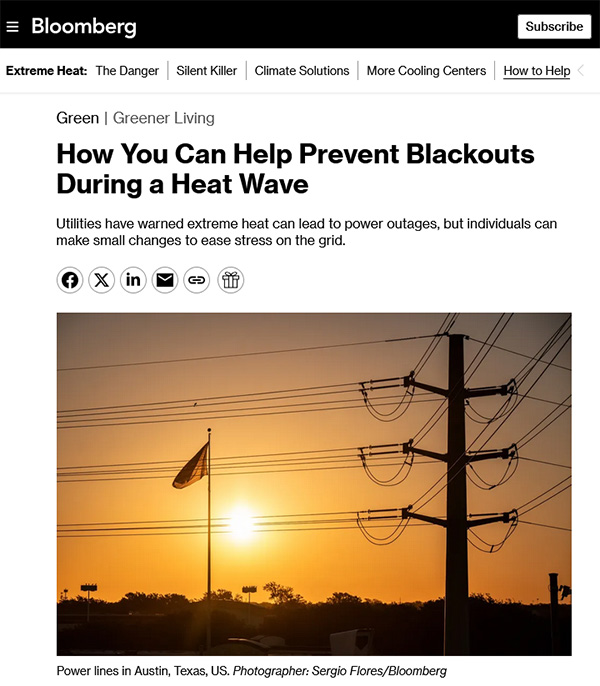
By Jo Nova Bloomberg is softening everyone up for the blackoutsThe latest Bloomberg puff-piece is straight out of Renewables-Marketing-Inc. It’s a plea for people to get used to rearranging their lives to accommodate the failing grid, but mostly it is pure Psy-Op to train the minions to blame grid failures and expensive electricity on hot weather. That way, if climate change causes the grid to blackout, the answer is “add more wind and solar power”, right?! Firstly, get used to less power and more sufferingGirls and Boys, you can’t keep using that air conditioner, or charging your car at peak times. Put down your lifestyle Susie! “Extreme weather events of all kinds – heat waves, hurricanes, flooding events – are putting immense stress on the grid and on people’s lives,” says Kit Kennedy, who leads the power division at non-profit Natural Resources Defense Council [NRDC]. Simple actions by consumers, such as avoiding charging your electric car during peak hours and raising air conditioning’s temperature, can ease grid stress, Kennedy says. “Flexibility is going to be the key.” Bloomberg makes sure readers know Kit Kennedy works for a “non-profit” agency but forgets to mention that the same NRDC, has $462 million dollars in assets to spend, and their Chinese branch is sponsored by Chinese national agencies, the staff in the Beijing office used to work for the CCP, and the NRDC thinks China is doing a great job. If Kit were linked to Exxon instead, they’d make sure we all knew that. Perhaps that explains why the Bloomberg team write like communist kindergarten teachers: Here’s what you need to know about how extreme heat affects grids and how you can help prevent blackouts. Remember, if you can prevent blackouts, that means when they happen, it’s your fault! Don’t blame us, children. You turned on the oven… Extreme heat is distorting the GridApparently hot weather now causes nameless “generators” to be less efficient, and transformers to heat up, and it “distorts the normal flow of electricity”, too. If only the world wasn’t heating by 0.1°C every decade! Get ready for some of the worst science writing you’ve ever seen, almost like someone is trying to torture metaphors: How Extreme Heat Hurts Power Grids In a way, the grid functions like a seesaw: it stays stable if the power supply and demand are equal. But periods of high heat can throttle the efficiency of power generation and transmission, impairing the supply. Meanwhile, more homes, offices, shops and factories will turn on electric fans or ACs, sucking more juice out of the grid. When the demand and supply fall out of balance, a power outage can occur, says Timothy Wang, a managing director at consulting firm Filsinger Energy Partners. Strangely, no one worried that hot days would “throttle the efficiency of generators” during all the decades that we relied on coal and gas plants? Since old coal plants operate at 540 degrees Celsius (1,000F) it’s “not likely” they give a toss about a 2 degree rise in global temperatures. The generators the Bloomberg team don’t want to name are the ones starting in S and W. Solar panels lose nearly half a percent for every degree above 25°C. If they reach 60C in the blazing sun they lose 10-17% of their generation. Wind turbines, might work in the heat, but often hot days are windless. They could have just said new unreliable generators don’t cope in the heat. The transformers needed to keep electricity flowing can also heat up, limiting their ability to handle rising power needs. Elevated overnight temperatures means equipment can’t cool when the sun sets. If the power load on the grid goes up too high, an aging transformer could blow up, likely causing a power outrage or worse, a fire, Wang says. Lord help us all. Old things break at high temperatures. So, they probably break at freezing temperatures too? Next your electricity bill will be attacked by spooky wave patterns: Extreme heat also distorts the normal flow of electricity on transmission lines, causing the electronic appliances in your home to use more power, Marshall says. That’s because electricity travels across high-voltage lines in waves, and when those wave patterns deviate from what’s considered ideal, it distorts the power that flows into homes.That can add as much as 20% more on consumers’ electricity bills, according to an estimate by Whisker Labs. What Whisker Labs is probably trying not to tell you is that solar panels can cause voltage surges at lunchtime, and that will increase some electricity bills. In Australia solar gluts have pushed up power to the 253V limit. The high voltage will make heaters, toasters, hair-dryers and old air conditioners draw more power than they normally use, hence one more cost imposition thanks to renewables. Blame Climate Change for high electricity prices too!Extreme weather causes higher electricity price spikes, it’s such bad luck… The consumers who are lucky enough to keep the lights on may end up paying more for their electricity. Wholesale electricity costs can spike in extreme weather. These prices are passed on to consumers on their monthly bills, but by how much and how quickly will vary. Lower those expectations people — you will be lucky if the lights stay on.
By Jo Nova That didn’t take long?It feels like Net Zero is undergoing a rapid unscheduled disassembly. Two months ago the UK Prime Minster was going gangbusters. He told the world Britain would go “all out”to accelerate Net Zero, to bolster energy security and weather control, because “it’s in the DNA of my government”. This week, the same Prime Minister says he will save factories by cutting power bills for more than 7,000 of the most energy-intensive businesses “by up to 25%” by slashing net zero charges. So the companies that produce the most CO2 will be excused, because they will go out of business, but the rest of the UK can pay even more, because they aren’t going broke yet. Speaking of which, industry groups warned a few weeks ago that high electricity costs threatened UK Manufacturing. And five days ago the largest fibreglass factory in the UK announced it would close because of the high electricity prices. It makes no sense to pretend that a Net Zero economy is a goal to aim for while exempting the highest emitters. Does CO2 matter or doesn’t it? Obviously Net Zero is just the moveable excuse to make the taxes as high as “whatever the market will bear”. Tax ’em til they scream? The Telegraph team report that UK business pay an eye-watering £258 per MWh in 2023, “compared to £218 in Italy, £178 in France and £177 in Germany”. Companies in the US paid just £65. Wow. But Australian brown coal still bids and wins wholesale electricity auctions in Australia for £5 or £10 a MWh. If the UK invaded Australia (it wouldn’t be hard, just avoid the Virgin flight paths) they could set up a factory next to Loy Yang, and could get the cheapest electricity in the developed world. I’m old enough to remember April 2025:
Britain will go “all out” for a low-carbon future and accelerate the push to net zero instead of slowing down as some have demanded, the prime minister said on Thursday. In his strongest declaration yet of support for the net zero agenda, Sir Keir Starmer told a conference in London of more than 60 countries that tackling the climate crisis and bolstering energy security were “in the DNA of my government”. Now in a heroic moment that is a “turning point for the economy”, and “a break, from short-termism” he will slash NetZero taxes: The marketing word salami is becoming unreal:
Some British companies that survive as long as 2027, won’t have pay the net zero levies, like the renewables obligation and the feed-in tariff: The Telegraph: June 22nd, 2025 Net zero taxes will be slashed for thousands of manufacturers as Sir Keir Starmer scrambles to save British industry from crippling electricity costs. As part of the Government’s long-awaited Industrial Strategy, the Prime Minister is to cut power bills by up to 25pc for some 7,000 “electricity intensive” manufacturers, including car makers, aircraft factories and chemical plants. It comes after repeated warnings that British manufacturers are labouring under the highest industrial electricity prices of any developed country, with output down by a third since 2021. The Prime Minister said: “This Industrial Strategy marks a turning point for Britain’s economy and a clear break from the short-termism and sticking plasters of the past. Only six months ago at COP29, the UK set a “Shining Example” of 2035 targets — committing to an 81% reduction in emissions by 2035. Back then, just days after Trump was elected, Net Zero was goal for “growth” and a race to “get ahead”: “Our goal of 1.5°C is aligned with our goals for growth,” Starmer told the global climate conference. “Because make no mistake, the race is on for the clean energy jobs of the future; the economy of tomorrow. And I don’t want to be in middle of the pack. I want to get ahead of the game.” What game did he want to be ahead in? Winning at UN Bingo? A generation from now, we must repeat all these emphatic slippery words in schools so that children grow up learning that politicians can speak 100% fantasies, right up until it all falls over, and even then they won’t stop. June 24th, 2025 | Tags: Electricity Cost, Net Zero, UK | Category: Global Warming | Print This Post | | |
Jo appreciates your support to help her keep doing what she does. This blog is funded by donations. Thanks!
 Follow Jo's Tweets
   
 
|
|||
|
Copyright © 2026 JoNova - All Rights Reserved |
||||










.jpg)
Recent Comments