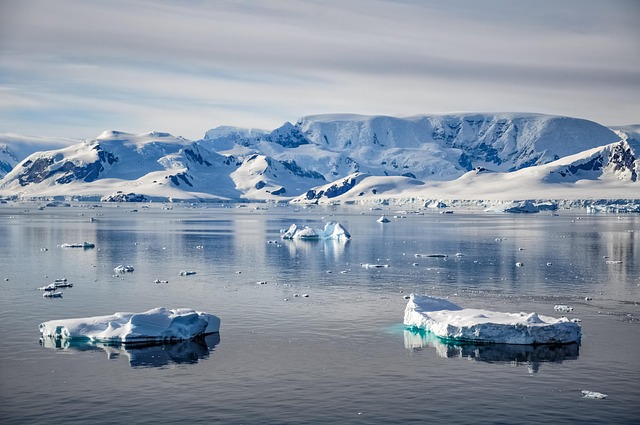
Image by AlKalenski from Pixabay
By Jo Nova
Something huge is happening around Antarctica and the experts didn’t see it coming
More than a million square kilometers of ice has gone:
Since 2015, the continent has shed sea ice equivalent to the area of Greenland. Researchers call it the largest environmental shift detected anywhere on Earth in recent decades.
Everything about Antarctica has defied the experts. For years Antarctic sea ice expanded when it wasn’t supposed to. Then, suddenly in 2016 the sea ice around Antarctica dramatically started to shrink, and that wasn’t supposed to happen either. Scientists wondered at the time if it was just a temporary blip, but then it got even smaller. Holes in the sea ice “as big as Switzerland” have started to appear for the first time since the mid 1970s.
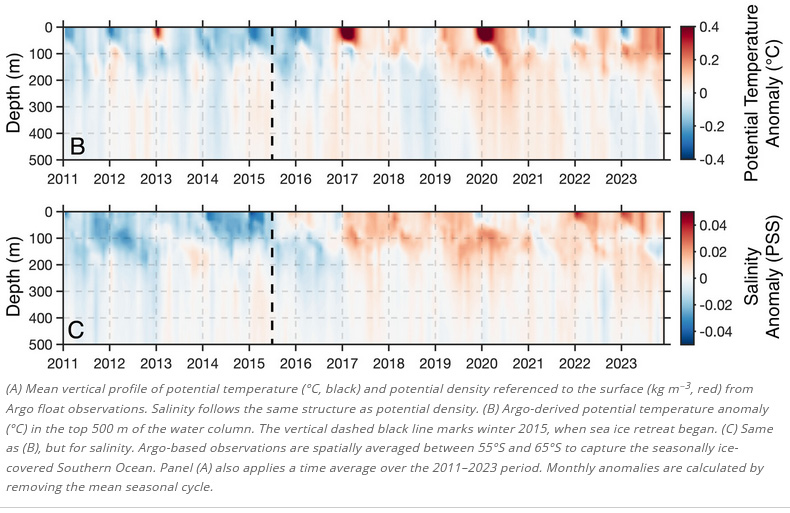
To explain this mystery (that was rarely mentioned) a new paper suggests the salinity of surface waters has changed. We’re not just talking about a small piece of ocean, this is everything south of 50°. For decades, the surface of the polar Southern Ocean was getting less salty — an “expected response to a warming climate” they said that started in about 1980, “however, this trend reversed abruptly after 2015”.
So as news seeps out this week that there is a “dangerous feedback loop” where shrinking ice is warming the ocean, bear in mind that the experts also admit this is “completely unexpected” which is their way of saying “the models were wrong”. Carbon dioxide was not supposed to do this.
Most likely some large natural cycle has shifted gears. Steadily rising CO2 didn’t cause the rise in sea level before 2015, and didn’t cause the decline after that either. There are bigger forces at work, and we don’t know what they are…

Graph adapted from Climate4You
When the die-hard believers point out that Antarctica is “just catching up” and that they always said Antarctic sea ice would shrink, remind them that Turner et al said in 2013 ““The increase in Antarctic sea ice remains one of the great unsolved puzzles of climate science.”. Now they have a new theory, “the salinity changed” — but what caused that? They don’t know. They might as well be tea leaf readers when it comes to predicting the climate.
For years Antarctica was going to warm twice as fast as the rest of the world (remember polar amplification?) But the whole idea that warming would be double-bad at the poles depended on feedbacks. In the disaster scenario, as the reflective white ice queen melted — the dark hungry ocean would absorb more heat, which would melt even more ice.
Unfortunately the modelers still can’t explain ocean currents, clouds, or rain. The bad news is that we live on the Water Planet and their models can’t predict water.
Blame the salt?
Ten years after the mysterious shift began, the new post hoc explanation is salt. They were sure that as Antarctica catastrophically melted and poured freshwater into the oceans the water nearby would become less saline. This, they assumed would form a neat surface layer, keeping the deeper, saltier, and denser water from rising up and mixing. Instead, after 2015, the surface water got more salty, the neat layers that were supposed to stratify started to churn, and the warm water from below started to melt the ice from underneath.
That’s a pretty huge shift there, that Earth system modelers had no idea was coming….
Climate modelers must be feeling pretty spooked by now. It’s been ten years since Antarctic Sea Ice started behaving in a way they couldn’t explain, and it obviously isn’t because of our rising emissions.
What they are not honest enough to say is that for forty years they have completely oversold their models and their certainty, while the world suffered, and bet trillions on their guesses. They have no idea how to predict the catastrophic feedback loops, which may not even exist, and that it all may have nothing to do with CO2.
And now some try to paint the shift they didn’t see coming as more proof “it’s worse than we thought”.
Antarctica’s ocean flip: Satellites catch sudden salt surge melting ice from below
ScienceDaily
A massive and surprising change is unfolding around Antarctica. Scientists have discovered that the Southern Ocean is getting saltier, and sea ice is melting at record speed, enough to match the size of Greenland. This change has reversed a decades-long trend and is letting hidden heat rise to the surface, melting the ice from below. One of the most dramatic signs is the return of a giant hole in the ice that hadn’t been seen in 50 years. The consequences are global: stronger storms, warmer oceans, and serious trouble for penguins and other polar wildlife.
Since 2015, Antarctica has lost sea ice equal to the size of Greenland — the largest environmental shift seen anywhere on Earth in the last decades. The Southern Ocean is also getting saltier, and this unexpected change is making the problem worse.
For decades, the ocean’s surface freshened (becoming less salty), helping sea ice grow. Now, scientists say that trend has sharply reversed.
Using European satellite data, research led by the University of Southampton has discovered a sudden rise in surface salinity south of 50° latitude.
This has coincided with a dramatic loss of sea ice around Antarctica and the re-emergence of the Maud Rise polynya in the Weddell Sea – a huge hole in the sea ice nearly four times the size of Wales, which hadn’t occurred since the 1970s.
The findings were published on June 30 in the Proceedings of the National Academy of Sciences.
Dr Alessandro Silvano from the University of Southampton who led the research said: “Saltier surface water allows deep ocean heat to rise more easily, melting sea ice from below. It’s a dangerous feedback loop: less ice leads to more heat, which leads to even less ice.
“The return of the Maud Rise polynya signals just how unusual the current conditions are. If this salty, low-ice state continues, it could permanently reshape the Southern Ocean — and with it, the planet. The effects are already global: stronger storms, warmer oceans, and shrinking habitats for penguins and other iconic Antarctic wildlife.”
In these polar waters, cold, fresh surface water overlays warmer, saltier waters from the deep. In the winter, as the surface cools and sea ice forms, the density difference (stratification) between water layers weakens, allowing these layers to mix and heat to be transported upward, melting the sea ice from below and limiting its growth.
Since the early 1980s, the surface of the Southern Ocean had been freshening, and stratification had been strengthening, trapping heat below and sustaining more sea ice coverage.
Now, new satellite technology, combined with information from floating robotic devices which travel up and down the water column, shows this trend has reversed; surface salinity is increasing, stratification is weakening, and sea ice has reached multiple record lows — with large openings of open ocean in the sea ice (polynyas) returning.
It’s the first time scientists have been able to monitor these changes in the Southern Ocean in real-time.
Contrary to the new findings, man-made climate change was generally expected to sustain Antarctic Sea ice cover over the coming years.
Aditya Narayanan, a postdoctoral research fellow at the University of Southampton and co-author on the paper, explains: “While scientists expected that human-driven climate change would eventually lead to Antarctic Sea ice decline, the timing and nature of this shift remained uncertain.
“Previous projections emphasized enhanced surface freshening and stronger ocean stratification, which could have supported sustained sea ice cover. Instead, a rapid reduction in sea ice — an important reflector of solar radiation — has occurred, potentially accelerating global warming.”
Give Prof Garabeto a medal, at least he admits they can’t predict the future:
Professor Alberto Naveira Garabato, co-author of the study and Regius Professor of Ocean Sciences at the University of Southampton added: “The new findings suggest that our current understanding may be insufficient to accurately predict future changes.”
Not far from the southern pole,
Melting sea ice has left a great hole,
A polar opposite trend,
To what alarmists portend,
By their climate-change rigamarole.
— Ruairi
REFERENCE
Alessandro Silvano, Aditya Narayanan, Rafael Catany, Estrella Olmedo, Veronica Gonzalez; Gambau, Antonio Turiel, Roberto Sabia, Matthew R. Mazloff, Theo Spira, F. Alexander Haumann, Alberto C. Naveira Garabato. (2025) Rising surface salinity and declining sea ice: A new Southern Ocean state revealed by satellites. Proceedings of the National Academy of Sciences, 2025; 122 (27) DOI: 10.1073/pnas.2500440122