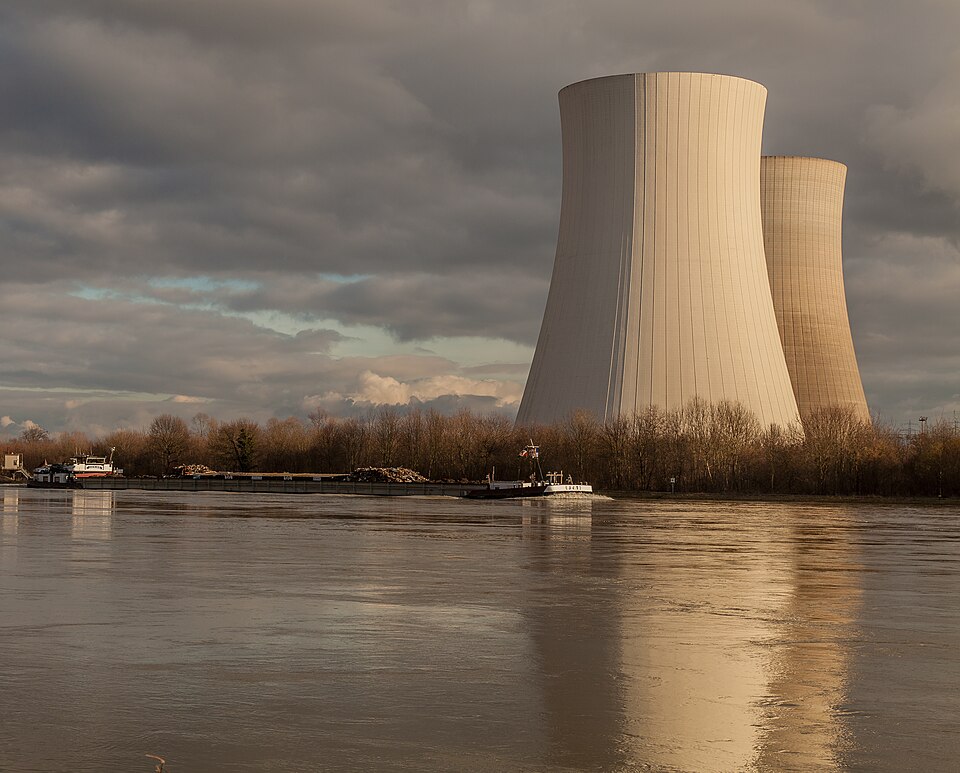
Kühltürme AKW in Phillipsburg, Baden-Württemberg, Germany By Fischer.H
By Jo Nova
If renewables are expensive, it’s volatile coal’s fault!
How can it be? Germany has all that free wind and solar power but the price of electricity is the second highest in Europe.
Apparently a nation with 45% of its generation from wind and solar is still “tied to volatile fossil fuel”. This is like a hostage situation, it’s so cruel?!
EuroNews is spinning a fairy tale at 100 miles an hour.
Germany is a leader in renewables, so why does it have one of the highest EU electricity prices?
German households pay around a third more for electricity than the EU average, despite the country’s impressive efforts to ditch fossil fuels.
According to energy think tank Ember, Germany is one of the “global leaders” for wind and solar energy deployment, with 59 per cent of its electricity coming from clean sources in 2025.
Since the introduction of its landmark renewable energy law (Erneuerbare-Energien-Gesetz) in 2000, the country’s share of generation from wind and solar alone has skyrocketed from less than two per cent to almost 45 per cent last year.
At the same time, coal – which is often described as the ‘dirtiest’ form of energy – fell from supplying more than half of Germany’s electricity to just 21 per cent.
The stark truth: The system costs are awful
A wind and solar grid is really two grids for the price of … two grids. One grid helps impress your shallow academic friends at dinner, while the other grid (the reliable one) could run all the time, but has to sit around waiting for the first grid to fail, which it does often, and then it swings in to gear to save the day. Neither grid is running efficiently, the unreliable one forces the reliable one to stop and start. So we get the worst of all worlds and a big electricity bill.
Wind and solar power are only cheap if you don’t mind blackouts or shutting down factories and destroying your manufacturing base (BASF, Volkswagon, anyone?)
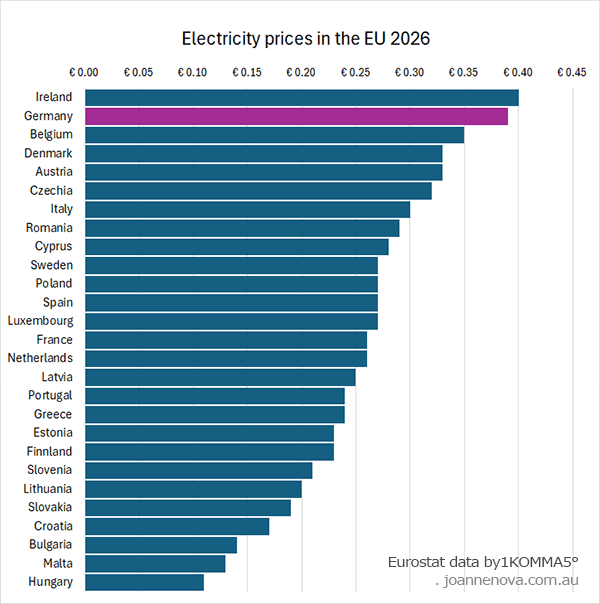
EuroNews delivers the bad news: €500 a family wasted on a weather shifting project
For a typical single household (consuming 1,500 kWh), Germany’s high electricity prices mean households will be paying around €150 per year compared to the EU average – or an additional €500 for a family with a 5,000 kWh electricity consumption.
The one thing wind and solar can’t buy — Flexibility
Why does Germany waste clean energy?
But as Jannik Schall, co-founder of 1KOMMA5°, points out: “Germany does not have too much cheap wind and solar power, but too little flexibility in the system.”
Last year, Germany spent €435 billion euros on renewable energy curtailment. This involves intentionally shutting down electricity production in areas of oversupply and ramping up supply elsewhere.
System costs get you every time
Unreliable generators need a massive oversupply of generation, frequency stability, transmission lines, back up batteries, new market arraignments, payments for curtailment of the oversupply of generators, and then you have to throw away all the generators after 20 to 25 years, bury them in a big hole and start again.
Crazy people thought two grids would be cheaper than one?






If wind and sun are free (the sun doesn’t send a bill), why then isn’t our power free.
40
It’s similar to owning a yacht, the wind is free but the equipment required to utilise the wind is expensive
20
Be careful what you wish for. Australia’s Capacity Investment Scheme is heading toward guaranteed return on estimated cost of projects. The proponents get their return on capital without even producing anything. That is how the transmission and distribution networks are funded already but generation and storage are heading the same way.
With this sort of financing, the actual generation does not matter so energy can be supplied free because the money spent is already guaranteed a return irrespective of output. Any return on energy sold is a bonus.
You will already be seeing the impact of this as cost of energy is stable or even falling but the service fee is on steroids.
00
The Germans have a reputation for being stubborn. They are likely to keep working at this wind and solar thing, now that they are committed to it,
in that same way they keep the engine in the trunk of the Beetle for 60 years. But their economy has changed considerably. If they decided today
they wanted to be a manufacturing superpower again, I doubt they could manage without abundant, low cost energy, another choice they could make.
But the energy choice they’ve made seems to preclude the foundries and forges, and giant machines at the bottom of the manufacturing pyramid,
In reality they are having a problem keeping their car plants open and competitive. Unlike many countries, their past frugality gives them a balance sheet
that is buying them some time, but decisions must be made. And without the economic beating heart of Germany, wither Brussels?
The US has reversed a lot of its energy (and economy) stupidity, and although we are drowning in dept we are also fully employed, moderately self-sufficient,
able to export both food and fuel, and growing such that a way out of debt is at least imaginable. For a place like Australia, if your attitudes changed it’s
pretty easy to imagine a small population with the resources of a continent trading with a world that is short on many thing can be as prosperous as they wish to be.
II fear for Europe, with obvious dysfunction, both in Brussels and in the various capitals; double the opportunity to mess things up and a vast number of little
fiefdoms desperate to protect what they have. Perhaps grid failure in, say, communist Spain, will sharpen people’s minds. Or perhaps, like socialism, there will
be a new crop of zealots to flog climate fear driving stupid policy no matter how many times it failed.
40
Not often mentioned is that many European vehicle brands are now manufactured in India.
20
The data is very clear that we must use very safe and reliable BASELOAD energy like Coal, Gas, Nuclear or Hydro and never invest in unreliable rubbish like toxic W & S.
Just follow proper data and evidence and don’t allow clueless, unreliable W & S to destroy your environments for a zero return on the so called investment.
IOW why continue to waste endless billions of $ for nothing but misery and a much lower standard of living for future generations.
00
There is hope. As a voting block, the millennials favor One Nation over the other options. These started formal education when the climate propaganda was already embedded in primary school teaching so these kids have spent their entire formative life being bombarded with scary stories of thermageddon unless humanity stops burning fossil fuels. Many now know they have been lied to their entire life and are revolting.
10
Pfft! Germany a global leader with 59% so-called clean power generation? Up from 2% 26 years ago? Minnows! Mere beginners learning to walk [stumble, then fall?].
Little old New Zealand with less than 6 million souls – equivalent to a small town in China – has been running on approx. 85% natural generation since the first hydro dam was built in the late 1800s. As a disgraced ex-PM used to blather, WE are ‘world leaders’ in saving the planet – or was it saving the children? Her reign seems like a bad nightmare now, better left to fade into oblivion [or the fires of hell].
And thanks to our conscientious old-school engineers using concrete & steel & bulldozers & diesel trucks to build a series of dams, hence providing renewable energy, we’re doing our bit to keep the planet cool [read: cold!] with today’s 1st of July 7-below-freezing black ice closing highways down south and causing numerous crashes for early morning commuters in Dunedin and other parts of Otago / Queenstown.
Nope, absolutely NO globular wobbly warming happening down here to speak of, and with no wind anywhere this week, all those monumental bird-chopping prayer wheels are sitting idle… whose loopy idea was this anyway?
00