Only a few schmuck countries are even trying anymore
Ten years ago 196 countries signed legally binding pledges to fix the weather. Every five years they agreed they would update their plans, and the plans could only go upwards, and never retreat.
Recently drafted climate plans from scores of countries fall drastically short of what is needed to stave off the worst effects of climate breakdown, analysis has shown.
Only 64 countries have submitted new plans to cut carbon, the UN says, despite all being required to do so ahead of next month’s COP30 summit. Taken together, these plans would cut carbon by only about 10% by 2035 compared with 2019 levels. This is only about a sixth of the drop in global emissions needed to limit global heating to 1.5C.
To keep that goal alive will require steep cuts in greenhouse gas emissions, up to 57% by 2035, according to the UN last year.
These include around 30% of global emissions, which incredibly includes the US, because Joe Biden, or one of his minders, put in an update early. Given that the US emits 14% of global emissions and is not going to be meeting any agreement, except accidentally, the current Paris agreement covers what’s left, which is 17% of global emissions.
Most countries are not even going through the motions of setting pretend targets that they have no hope of meeting. That’s how little they care. Though the EU, riven with political strife, is still arguing over how ambitious to make their commitment. By the time the US is officially out, the EU may be back in.
But at this point, even the UN effectively admits defeat on the 1.5°C target
“One thing is already clear: we will not be able to contain the global warming below 1.5 °C in the next few years. Overshooting is now inevitable. Which means that we’re going to have a period, bigger or smaller, with higher or lower intensity, above 1.5 °C in the years to come.”
— António Guterres, address to the World Meteorological Organization meeting, Geneva, late October 2025
But they got the money and another decade of junkets, which was really the point wasn’t it?
The Liberal Party need to get out and about because most of the world knows The Paris Agreement will not recover. Australia is nearly the last Global Schmuck left standing.
Despite 4 million dollars and 18 months of beta testing the new BoM website was met with anger and dismay and accusations that they put lives at risk by rolling out big unnecessary changes just before the storm season begins in the north.
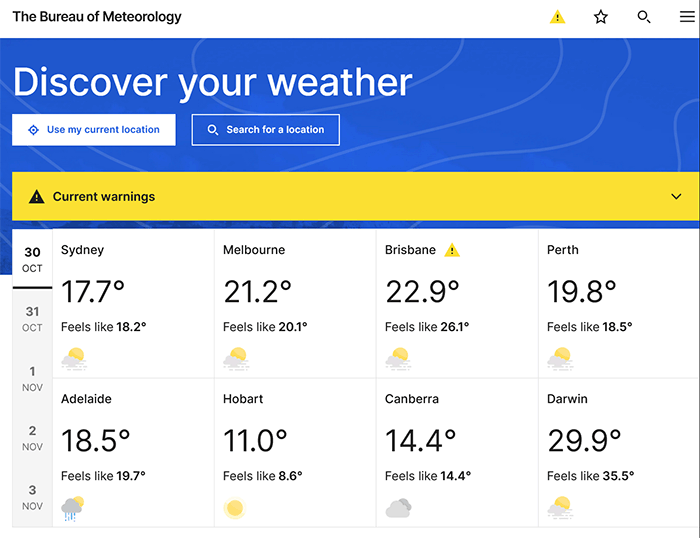
The new design radiates smug condescension. They are the experts and you are the kindy kids. The headers are done in 100 point font, with acres of screen-space used to convey almost nothing at all, apart from the temperature of the capital city near you. The BoM, apparently, thought this is what Australians wanted — “the temperature now”. Except that most people with a computer or a phone can see the temperature in the task bar or home screen. If only someone had told them “there’s an App for that” they could have saved the money.
Across the top of the home page is a giant message for four-year-old taxpayers — “Discover Your Weather”. The BoM are the authority and you, a crusty old farmer/brickie/businessman, have never known weather before.
This headline is designed to remind you of how stupid you are
It “feels like” Dick and Dora would like to teach you about clouds today.
If it grates on you, there’s a reason.
The feedback has been so bad even the federal Labor government is demanding answers.
But really, it’s your fault and you need to adjust faster:
The BoM’s top man acknowledged ‘some’ people (i.e. the stupid ones) will take time to adjust. In other words, they are sorry, not sorry.
The BoM’s CEO, Dr Peter Stone, said he recognised the unpopularity of the changes.
“We didn’t make the change lightly and we appreciate that it will take time for some to adjust. I sincerely apologise for the challenges the change has caused,” he said in a statement on Wednesday.
Because they live off constant taxpayer funding, the BoM don’t realize out in the real world, the hours Australians spend learning how to use a new website costs real money. All the knowledge millions of Australians had of how to find meteorological-data has been tossed to the wind. The BoM just drained 10 million hours of productivity from the country.
One of reasons for the change is that the “upgrade was overdue”:
“The old website served us really well, but it had been well over a decade since there has been any upgrades to it,” he said.
So? It’s as if a ten year old site simply had to change because there was grant money to spend and no one had spent it yet, right? The old public service axiom.
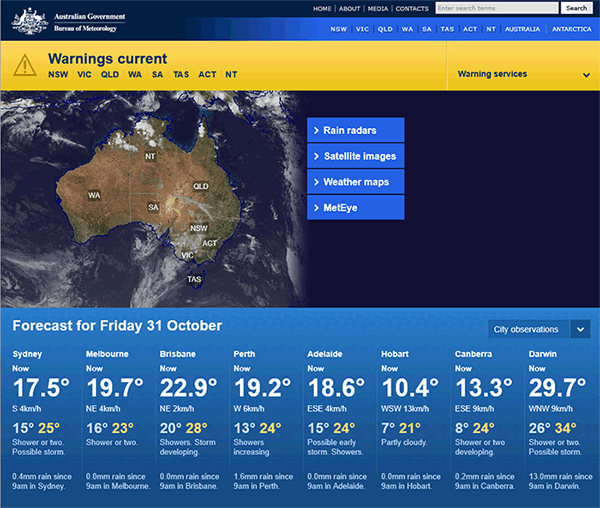
Compare the new site to the old. In the same space on the home page, the old site has a satellite map, temperatures, wind direction, wind speed, max and min temperatures, and rainfall in mm. There are one click links to warnings, forecasts and observations. That’s about 50 times as much information.
Many people are especially unhappy about the rain radars
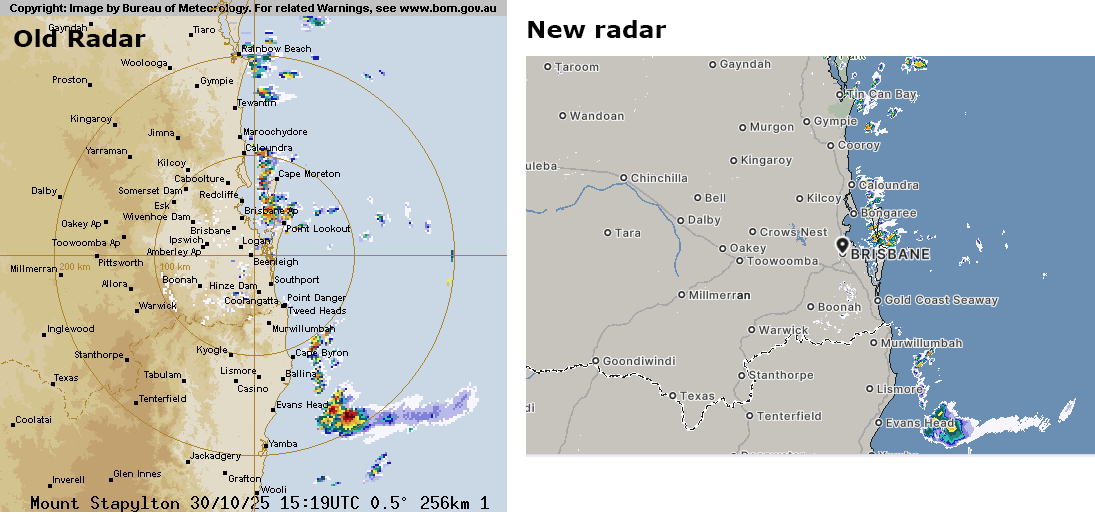
Some people in Queensland were up in arms when storms hit a few days after the new site opened, and the rain radar appeared to be underestimating the intensity of the rain. Below is the old and new versions of the same rain patterns at the same time around Brisbane last night just for comparison.
The designers have added a white halo around the town names to improve readability on a busy background, but it makes the town names stand out which obscures the rain. Kinda defeats the point…
Old Radar page and the New radar BOM. The two scales are not exactly the same (they don’t have the same menu options).
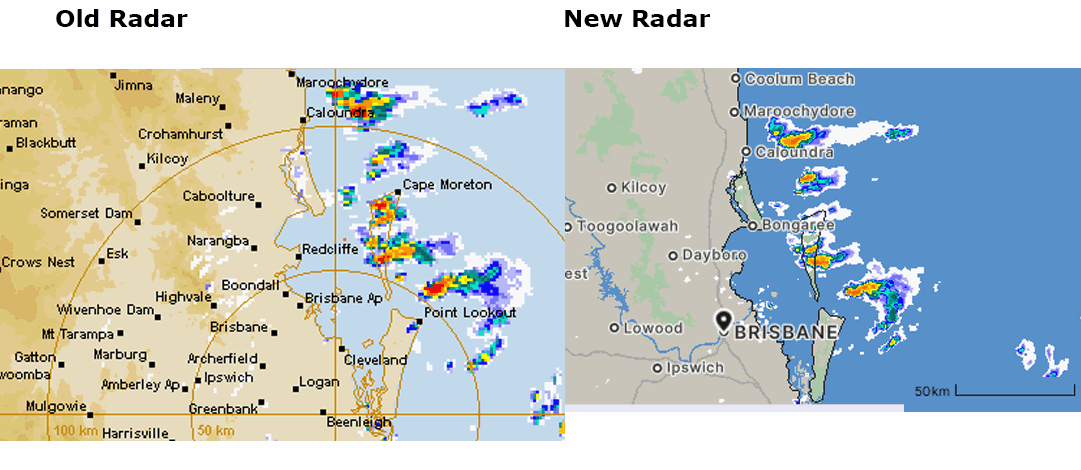
The new site works a bit better zoomed in.
Up closer, Brisbane to Caloundra 2:20am
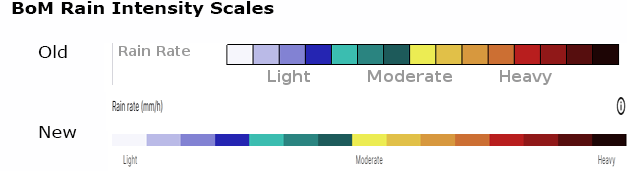
The two color scales appear to be the same in the key (below). But the colors are applied in different conditions. According to Steve Turton, the old radar site uses radar reflectivity units (dbz) while the new one uses a rainfall rate in millimeters (mm/h). Rainfall that appeared black in the old scale was only red in the new scale. Hence people got a nasty surprise because they underestimated how heavy it was.
Steve Turton also says the Doppler wind function is gone:
Farmers and fishers have been frustrated by the disappearance of the Doppler wind function. On the old site, this function was a vital way to track the intensity of winds associated with supercell storms, cold fronts and tropical cyclones.
In hilly regions such as the area between Cooktown and Townsville, local weather radars are essential as a way to give residents and farmers a better way to see rainfall. But in the new update, some areas appear to have been completely wiped from the radar view. Places such as Cape Tribulation – one of the wettest locations in Australia – can no longer access this crucial information.
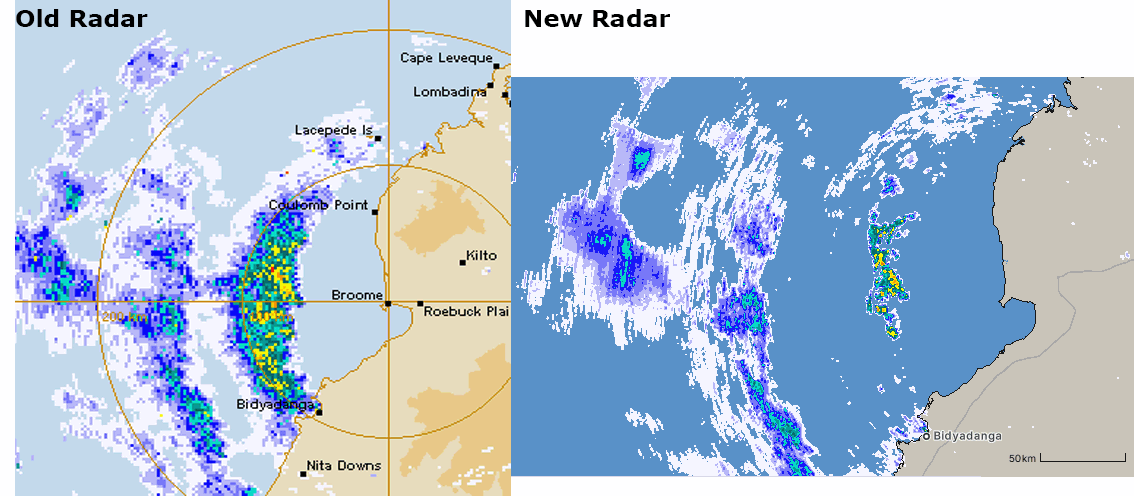
Around Broome last night the oncoming rain looked remarkably different in the two radar displays. The vast rain dropping north of Bidyadanga almost disappears (as does Broome itself, in the new radar, oops).
Broome rain radar — old and new
Let the BoM (and your MP) know what you think. The BoM wants your feedback they say:
Customers and the community can continue to provide feedback via:
•On-page: Customers can submit anonymous feedback using the feedback pop-up window or the ‘Was this page useful’ button at the bottom of every page.
•Contact form: Customers can submit feedback and enquiries on the new website’s contact form.
•Phone line: Customers can call 1300 754 389 for website help (operating hours 8am-6pm AEDT weekdays).
It appears they think taxpayers are simpletons. (Perhaps because 69% of them don’t believe in the BoM’s favourite climate religion?) Wrapped up in their inner city enclaves, many BoM staff may have never met a real farmer. Yet farmers are businessmen who make a living out of placing bets of hundreds of thousands of dollars on the weather every year. And fishermen and firemen sometimes risk their lives.
Who were testing the beta site for 18 months — not farmers, firefighters and fishermen?
h/t Geoff D, J.J. Peter C, Vicki, David Maddison, Old Ozzie, Yarpos, Ronin, OzFred
Yet another climate change heavyweight abandons ship
It’s the beginning of the end of the renewables fantasy, but there will be no apology — no admission they were wrong, or that thousands upon millions of people have suffered because of climate sorcery.
Watch as the billionaire who lectured us from private jets, pivots into word salad. Now he says we still have to solve climate change (whatever that means), but the doomsday view is wrong, and that awful carbon pollution “will not be the end of civilization.” He’s suddenly turned into a kind of Bjorn Lomborg. Forget Mitigation, say hello to Adaptation.
On the cusp of COP30 in Brazil, Bill Gates has launched a life raft for his reputation — a 17 page memo called Three tough truths about climate.
Bill Gates can see what’s coming (a reckoning for the renewables debacle), and he is repositioning himself so he doesn’t go down with the ship. Indeed, he’s almost writing an escape plan for the whole Blob. In a nutshell, he’s admitting between the lines that wind and solar power are unaffordable, and since climate change won’t actually be that catastrophic, everyone should calm down while we invent technologies, and in the mean time, get back to stopping people from starving. Wouldn’t you know, he says “Health and prosperity are the best defense against climate change.” (That’s Truth #3 ).
What he’s not saying is that he and his friends wasted untold billions (maybe trillions) of dollars of our money installing wind and solar panels which aren’t very good. He is not joining those dots.
We still need that breakthrough mythical technology to save us from the climate monster.
…though climate change will have serious consequences—particularly for people in the poorest countries—it will not lead to humanity’s demise. People will be able to live and thrive in most places on Earth for the foreseeable future. Emissions projections have gone down, and with the right policies and investments, innovation will allow us to drive emissions down much further.
Unfortunately, the doomsday outlook is causing much of the climate community to focus too much on near-term emissions goals, and it’s diverting resources from the most effective things we should be doing to improve life in a warming world.
He’s still painting himself as a savior, of course:
If given a choice between eradicating malaria and a tenth of a degree increase in warming, Gates told reporters, “I’ll let the temperature go up 0.1 degree to get rid of malaria. People don’t understand the suffering that exists today.” –– AP News
Now, at long last, he says the first priority should be to prevent suffering in the here and now. Which is all very noble, but where were you Bill for the last ten years when people in Africa needed coal plants — you were telling them to invest in wind and solar.
Compare this to Bill Gates in 2021:
“The countries that build great zero-carbon companies and industries will be the ones that lead the global economy in the coming decades.”
–Bill Gates, How to Avoid a Climate Disaster
Bill Gates
Bill Gates set up Breakthrough Energy Ventures (BEV) “the future of energy” in 2015 and often put in a star performance at the UN COP Junkets.
Only a few short years ago climate change was going to be awful in our lifetimes according to Bill:
Unless we move fast toward zero, bad things (and probably many of them) will happen well within most people’s lifetime, and very bad things will happen within a generation.”
“In other words, by mid-century, climate change could be just as deadly as COVID-19, and by 2100 it could be five times as deadly.”
Between the lines Bill Gates is admitting the wind and solar experiments were a waste of money
The tough truth he dances around is that we don’t have a realistic way to get to Net Zero yet, we still need those breakthroughs. This is a polite way of saying that we wasted lots of money, and made life tougher for poor people.
Sometimes the world acts as if any effort to fight climate change is as worthwhile as any other. As a result, less-effective projects are diverting money and attention from efforts that will have more impact on the human condition: namely, making it affordable to eliminate all greenhouse gas emissions and reducing extreme poverty with improvements in agriculture and health.
What he doesn’t say is that the UN doesn’t care less about the poor, it’s just a vehicle for dictators and corporations to profit or sabotage competitors. That’s why they are jumping up and down over the best managed reef in the world, and not spending more time talking about the murder of Christians in Nigeria.
The big shift away from climate dogma
This is the Big-pivot away from Climate Doom, the obsession with a tiny 0.14°C of warming (per decade) and wind and solar subsidy harvesting:
Truth #1: Climate Change is a serious problem but it won’t be the end of civilization.
Truth #2: Temperature is not the best way to measure our progress on climate.
Truth #3: Health and prosperity are the best defense against climate change.
Expect The Blob to spend less time talking about temperatures and 1.5 degrees of warming, and more time talking about quality of life suddenly.
The New York Times makes out that it is a bit controversial, but really, we’ll solve climate change faster if we stop harping on about the prophesies of doom. Optimism, they now say, is the most effective way to motivate people.
Bill Gates Says Climate Change ‘Will Not Lead to Humanity’s Demise’
by David Gelles, New York Times
In a memo, the Microsoft co-founder warned against a “doomsday outlook” and appears to have shifted some of his views about climate change.
Politics aside, Mr. Callahan said Mr. Gates’s change in messaging was in line with studies that have shown that alarmist rhetoric about climate change is not the most effective way to motivate people to take action. “The result of a lot of research is that it’s much better to lean into the optimism than the pessimism,” Mr. Callahan said.
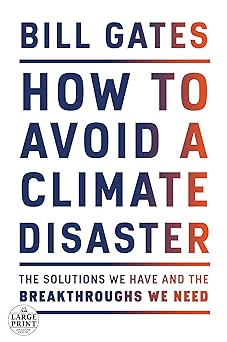
This is the man who wrote How to Avoid a Climate Disaster only 4 years ago. In it “Gates explains why the world must completely eliminate greenhouse gas emissions (“getting to zero”), rather than simply reducing them.” — Wikipedia
Feel the Quickening: the green retreat is accelerating
The Liberals are tearing themselves apart this week over what to do with Net Zero policy. Yet there is polling this week by the Centre for Independent Studies that apparently shows 69% of people would rather use more coal and gas if it made their electricity bills lower. And 55% supported delaying the Net Zero target if it meant electricity was cheaper. As reported in The Australian.
So two thirds of the nation clearly don’t think the oceans are going to boil. And lets not forget this is on the back of years of relentless Net Zero propaganda, lessons in schools, and the support of both the government and the opposition. There are no popular sit-coms mocking the windmills, nor are there celebrity endorsements, or football clubs with sponsorship from Big-coal or shirts that say “Instant Power”. There is no Trump or Farage figure here on TV (because the Blob media wouldn’t let them on). Yet somehow the voters have figured it out anyway, but they don’t know they’re in the majority. They don’t wear activist T-shirts and they don’t have bumper stickers on their car.
There’s an electoral fire here waiting for a spark
Imagine how big the support would be for cheap electricity and coal and gas if the leader of the Opposition was brave enough to take on the Global Bullies of Warming? To just laugh at the petty namecalling (“denier” — it’s a political ploy, not a term of science). To mock the delusion that we can control storms and tides with our solar panels. To calmly say that they will not cave in to coercion, when China, India and the US are increasing emissions. Australians need electricity we can afford. We need our own industries, we are not just a quarry.
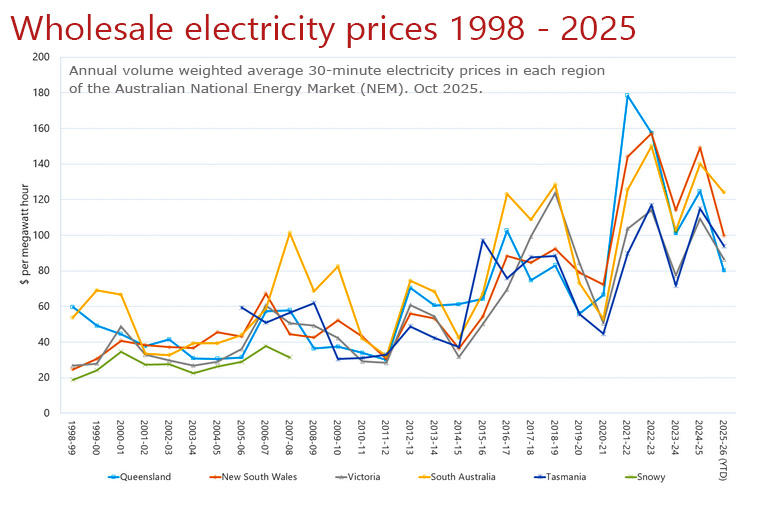
A real opposition leader could point out our wholesale electricity prices were 3 cents a kilowatt hour for year after year until we started trying to change the jet streams and ocean currents with our power stations. Who knew fiddling with the clouds would be so expensive — everyone knew. That’s why they never published reports saying “we just need 2 billion more solar panels to save Bangladesh”.
The more renewables we add the more expensive electricity gets. | Graph: AER
And that’s the thing, even without the idea being put in front of them, two thirds of Australians don’t believe the CSIRO, they don’t believe the BOM, or the UN anymore. They don’t need to have a PhD to know that people who constantly forecast doom and gloom keep getting it wrong. And they don’t need a degree in climate science to know the models don’t work, because they can see the contradictions — that CO2 causes heatwaves and cold snaps and more wind and less wind, and more rain but more bushfires too.
So will the Liberals stand on the same side as 69% of the voters, or will they chicken out? Do we live in a democracy or don’t we? A genuine question.
Real leaders try to figure out what the right answer is, then lead the way. In this case the unwashed masses have already figured it out — they’re just waiting for a leader to arise to represent them. If Sussan Ley can’t rise to the test, when even the taxi drivers can see through a fake ‘science’ debate, the Liberals need a new leader.
With Shadow Ministers like Andrew Hastie stepping down, and Barnaby Joyce talking of leaving the Nationals, the Coalition is in an existential crisis. Months after the electoral-bloodbath the Liberals still don’t know whether to try to win the old conservative inner-city seats or to follow the Trump and Farage winning formula and call a spade a spade and take the working class away from the Labor Party.
The British conservatives missed the moment, and may never recover.
The Nanny State wants to reduce speed limits to save lives, instead of building better roads
Lord help us — a few bureaucrats who probably have never driven past Parramatta think our country roads will be safer at 70 or 80 kilometers an hour. By making road trips 10 to 30% longer, and 100% more boring, they may even kill more people than they save.
When every trip becomes a longer trip there will be more drivers still on the road at dusk and in the dark. Every extra hour on the road is an hour less to sleep or an hour less with family and friends. So drivers will either be more tired or more lonely. And when a four hour trip becomes a five hour trip, some will choose not to go. Some weddings will be a bit smaller, hospital visitors a bit rarer. Tourism will suffer. Businesses will close.
The repercussions of this change is a burden on so many aspects of our lives, most of which the “safety modelers” didn’t even think of. We are in effect slowing the whole nation. It will lower productivity, raise the cost-of-living, increase social isolation, causing mental health damage and depression. On the nation with one of the lowest population densities on Earth, it is some kind of anti-human plan to increase the distances between us. Technology brings us together, but bureaucrats push us apart. It will reduce health care in country areas, and limit holidays all over the country. Add some heart attacks, suicides and divorces to the mix. Almost none of which the “modeled” costs include.
Australia — the slow nation?
What price the reputational damage as Australia becomes known as a tedious nanny state of quaking chickens afraid to drive at normal speeds on straight, dry highways with hardly any traffic? How many tourists will be turned off — bored away? How many skilled migrants will balk at moving to a grandma nation?
Any driver with sense can already slow to 90 km/h when the road is rough, the weather bad, or the traffic heavy. Changing the signs just forces safe drivers to crawl on good roads in good conditions, while the reckless ones keep being reckless — they will just have to dodge the slow cars.
The deadline for submissions about this is today, Monday. (click here.) UPDATE:Extended to Nov 10th
Australians have just a few days left to have their say on a Federal Government proposal to reduce speed limits on rural and regional roads.
The Federal Department of Transport is seeking feedback on a proposed reduction of the speed limit on roads outside of built-up areas where there are no sign-posted speed limits.
A consultation paper released in conjunction with the review suggests speed limits could be reduced to 80km/h on sealed roads and 70km/h on unsealed roads.
David Littleproud, leader of the National Party says:
“Regional Australia have lost over $3300 a kilometre in federal funding to maintain our roads, our national highways.
“This is about saying regional Australia doesn’t matter and that we’re not going to fix your roads, we’re going to let them crumble and you’re just going to have to drive slower.
The window for public feedback closes this coming Monday, October 27.
For more information or to have your say on the Department website click here.
This could be one of the more absurdly incompetent, biased reports I’ve ever seen
It’s like the researchers added in every benefit they could think of, forgot almost all the real costs, and ignored the twenty other variables that matter. One of their core points is that people die on country roads 11 times more often than city people do. Strangely, this is “per capita” not “per kilometer”? How did they not bother to do this properly?
Also strangely, they seem to think that these rates should be the same. Country deaths are “over-represented” they say. It’s like hoping that workplace accidents on oil rigs will be as low are they are for check-out chicks at Coles. I mean, we want them to be less, but we don’t stop drilling until they are.
If speed was the main killer why are the inner regions at 100km/h so much safer than remote regions at the same speed?
Statistics show that the big killer on Australian roads is the distance from the major cities, not the speed limit. In very remote areas the speed limit is the same as the inner regional areas, but the death rates are twice as high.
The annual road-death rate per capita for Australia in 2024 was ~ 4.78 deaths per 100,000 population. But there is much higher risk in regional/remote areas:
Major cities: ~ 2.0 deaths per 100,000 population.
Inner regional: ~ 9.1 deaths per 100,000.
Outer regional: ~ 12.4 deaths per 100,000.
Remote: ~ 18.4 deaths per 100,000.
Very remote: ~ 22.2 deaths per 100,000
— REFERENCE: Road Trauma Australia 2024. Statistical Report on fatalities and hospitalized injuries from road crashes in Australia, Bureau of Infrastructure and Transport Research Economics (BITRE). p7
Could it be that more people die in these areas because the roads are worse and if they crash it takes them 2 hours longer for the ambulance or flying doctor to get there (if they are lucky)?
The cause of deaths on remote roads is probably due to roads being in poor condition, with people driving run-down 40 year old Holden Commodores without ABS, and dealing with fatigue from driving ten hours in a row on a Chico roll and Barbecue chips. Ask yourself if slower driving speeds will solve that?
Ask yourself if a go-getting nation would fix deaths on bad roads in old cars by making new cars drive slower on good roads, or by building better roads, increasing prosperity and making newer cars more affordable?
Freight costs up just 10%? I don’t think so…
Truck drivers have strict fatigue limits. Some one-day return runs will now become two-day jobs with overnight stops. The modelers claim freight costs rise just 10 %, but once duty-hour caps are breached, costs jump 30–50 %. They also claim trucks will emit less CO2 because they’ll be driving slower — yet we’ll need more trucks to move the same freight in the same time.
Australia moves roughly 80 billion tonne-kilometres of freight by road each year (BITRE 2024). This keeps our mines, farms, supermarkets and petrol stations in operation. Even a 5 % system-wide productivity loss adds billions in costs — all feeding into regional produce prices, construction materials, and rural tourism.
What’s the cost of rebuilding trade-routes?
The nation is set up for 100km/h travel. Distances from cattleyard to cattleyard, petrol station to petrol station were all planned for human drivers at 100 kilometers an hour (except in WA where it is 110km/h and the NT where it 130 km/h). If we mess with that, all kinds of little things will break. More food will be wasted on longer hauls that have to sit overnight. Some crops may no longer make it to market in time. On the edge of the “travel day” farmers may have to change crops. Routes and rest stops will have to be shifted. Patterns will have to be moved. It all costs.
Reducing road noise will help… the kangaroos to sleep at night?
The paper claims slower driving speeds will save lives because traveling slower reduces noise pollution and that “therefore” will improve sleep. Say what? We are talking about 750,000 kilometers of roads that mostly don’t have houses beside them? Are we worried about REM sleep in Bunyips?
It’s like this report was written by a high school student in Ultimo.
To reinforce their point (and their incompetence) they cite a US study where people were “willing to pay $8.83 annually” to reduce it. Ouch, that much? (It must be a typo? p61)
Furthermore, they say, there was a Swiss study that estimated deaths would be reduced if cars drove slower. That team modeled the effect of reducing city speeds to 30 kilometers an hour, and the Australian team are extrapolating that to unpopulated areas at the back of Bourke and beyond at 100km/h? But, hey, it might save some kangaroos.
Getting carried away, they tell us slower speeds will improve traffic flow. (More proof they’ve never gone west of Parramatta). They have so little evidence of benefits, clutching at straws, they dig out a twenty year old study of peak hour traffic in an urban situation that shows reducing speeds to 60km an hour “may improve traffic flow”. (p62) Which will be a huge benefit the next time there is a peak hour rush at Cunnamulla.
They’re obviously desperate to find things to fill out the benefits column…
Words not mentioned in the consultation paper include: dusk, tourism, divorce, sleep loss, darkness, night time, poverty, business closure and cost of living.
With a careless flick, some bureaucrats will make Australians poorer and more isolated, then, when financially stressed people who are driving older cars crash more often — the bureaucrats will reduce the speed limits again.
Traffic safety is so much more complicated that a computer model
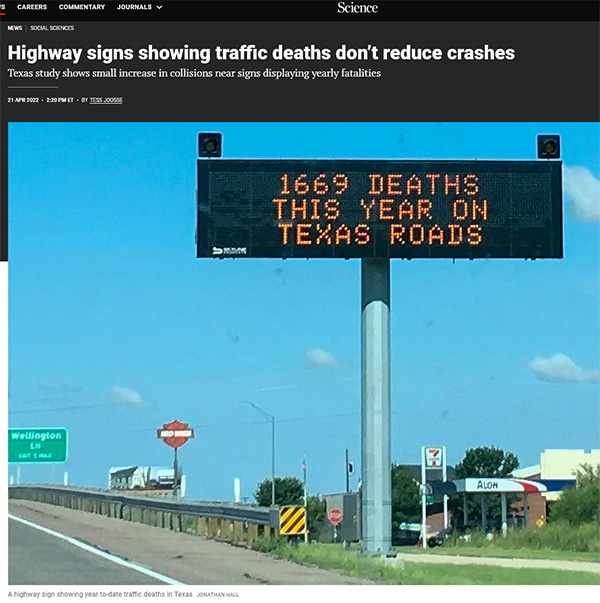
Some bright sparks in Texas put up glowing death toll score board message in neon lights near a highway in Texas. They were sure they’d save lives, but the study showed the giant death toll messages actually increased accidents by 1%.
Australia could make this kind of mistake on a national scale. Let’s not do that.
The Daily Telegraph has discovered a major Net Zero project has signed up several Chinese companies. The huge battery and solar scheme in Bundey South Australia has been given the red carpet treatment by the Albanese government. It will be fast tracked as a priority by the government and cash will rain down from the “Capital Investment Scheme (CIS)” .
The group running the project is Ganaspi Energy. Supposedly it is based in Sydney, except that when the Daily Telegraph visited the office there, it was empty. No one was responding to emails or text messages, and the phone number didn’t connect. If this company was a ghost corporation, or a front for Chinese interests, they don’t seem to be trying hard to disguise it?
Ganaspi Energy has brought in several Chinese firms, and held a party with some them in Suzhou to celebrate. Supposedly, the Bundey BESS and Solar project will be the largest battery storage power station in the Southern Hemisphere.
Taxpayers are underwriting the project for the first 15 years.
National security expert Michael Shoebridge, a director at Strategic Analysis Australia, said it appeared the Chinese Government had successfully completed a “backdoor Belt and Road Initiative” with an Australian company.
“The Chinese Government can by law direct its companies to hand over all its data and even interrupt the operation of its systems,” Mr Shoebridge said.
Two of the suppliers are the China Energy Engineering Corporation, and CEEC Energy Storage Technology, both of which are owned by the Chinese Communist Party. Indeed, the CEEC is listed as a stakeholder of the BRI (Belt and Road Initiative).
The danger with battery projects is that unlike coal or gas plants, they are digitally connected, full of sensors, and often linked by remote management systems. If a state-owned Chinese firm or its subsidiaries help design or integrate these systems, Beijing potentially gains a lot of real time data:
Telemetry data (power flows, grid vulnerabilities, frequency control info).
Firmware access (e.g., backdoors in battery-management systems).
A future sabotage vector, should relations deteriorate.
Access like this to the national grid not only gives China oversight over our energy flows, it gives it a foot in the door, and a precedent to bring in other Chinese projects. How can we object when there is already a large piece of critical infrastructure approved. If and when the Australian government ever wanted to criticize the CCP, it would only take a small nudge from a friend of the CCP to silence the PM. Nice grid you have there…
We know China wants to bring Australia into the Belt and Road program. In 2021 Dan Andrews tried to sign up Victoria to the Belt and Road program but it was rejected by the Coalition government as “inconsistent with Australia’s foreign policy…”
Keeping the renewable dream alive in Australia is good for China. It helps sabotage our reliable coal power. A few more Australian factories will close and move to Shanghai. We’ll buy even more Chinese made windmills, more EVs, battery packs and solar panels. It embeds Chinese standards in electronics and battery control software, a form of “technological colonisation” that increases the odds and advantages of future Chinese projects.
Indeed, we can almost imagine a Chinese representative siding up to Anthony Albanese in his darkest Net Zero days, and generously offering to help rescue him from the mess it has become. Who knows? Anthony Albanese and Chris Bowen might have been very amenable to offers of rapid big batteries, with the guarantee it will profit from taxpayer schemes, as long as they look the other way on the foreign investment risk.
When asked, Mr Bowen told The Daily Telegraph that “Labor was delivering “the maximum value to the taxpayer.” But all the details are hidden from the public because they are ‘commercial in confidence’. It could just as easily mean the Albanese government sold our national security for a sweet deal to rescue their own reputations. How would we know this wasn’t the case?
The Opposition has fittingly demanded there be an inquiry into the $2.6 billion dollar project. However government sources told the Daily Telegraph that Ganaspi is an Australian owned company and usually the sub-contracting arrangements of Australian companies don’t trigger investigations under the foreign investment framework.
All around the world, politicians are stepping back from Net Zero
The Net Zero debacle has become such a deadweight for the UK Labour Party, that Tony Blair, Former Labour Prime Minister has dropped a second bombshell on the Environment Minister, blaming renewables for high electricity prices and telling him to abandon Net Zero targets and green levies.
This is good news, but before anyone think he has seen the light, be aware the light his team are watching is mostly the rising star of Reform UK. What he’s really afraid of, apparently, is that the horrid “Right-wing populists” might win more elections. It’s a thought so awful, even a Labour stalwart is willing to give up the Net Zero incantation. Imagine how much damage Nigel Farage might do to the Blob if Reform UK romped home?
This then, is damage control to stop an electoral wipe-out:
Sir Tony Blair has urged Ed Miliband to abandon his clean power targets and slash expensive green levies.
The Tony Blair Institute (TBI), the former prime minister’s think tank, warned that a pledge to decarbonise UK electricity by 2030 was destroying industry and damaging households.
The target to ditch fossil fuels puts Labour at risk by pushing voters towards Reform UK before next year’s crucial Scottish, Welsh and English regional elections.
Ryan Wain from the TBI urged the Energy Secretary to instead focus on making electricity much cheaper to stop “Right-wing populists” undermining support for net zero.
One wonders if Tony Blair would have said a single word about the poor suffering victims of Net Zero, if Reform wasn’t streaking far ahead in the polls, and the Conservatives were still cheering on the plan too. Where was Blair in last year’s elections?
This is a do or die point for Sussan Lee and the Liberals
If Lee was brave enough to hold a torch against the trillion dollar bullies and their quest to control the weather, she would already know half the nation is skeptical. And after she shone the light on the storm-stopping witchcraft, many more would see the light. It would be a whole new national conversation.
As long as the Liberals pander to Net Zero, they’ll never know the passion and strength of the millions of skeptics who are fed up with bullying, namecalling, secret costs and hidden taxes on pagan quests.
Tony Blair is just mapping out the escape path for the Labour Party — how they sell their retreat:
They’ll never say they were wrong, they’ll just rebrand the mission. Tony’s Blair’s personal thinktank (TBI) has put out a report called “Cheaper Power 2030 … Resetting the UK’s Electricity Strategy for The Future”. Like a true Blob production he still wants to electrify everything so all the minions can be tracked. He still wants to pander to the hobgoblins and waste money on Carbon Capture and Storage, and decarbonisation, but the TBI is pro-nuclear, at least and talks about energy security as a strategic concern.
The Labour Party, he thinks, should still fight climate change, but they can turn off the tap to more wind and solar power, and cut out the subsidies, and ahem, even call it a day on any more emissions reduction:
At the same time, the global context is changing. Addressing climate change is an increasingly pressing imperative, as extreme weather is felt more and more around the world. The efforts of the global community to curb emissions have been substantial but insufficient. Technological progress offers hope of easing this transition, but we are reaching a stage where further reduction of emissions carries a higher and higher economic and political cost.
NetZeroWatch says this is good news but the TBI still doesn’t get the physics of affordable high density energy:
Where it falls short is in its prescription. It treats electrification as the route to abundance rather than the outcome of it, focusing on technical market tweaks and “flexibility” while ignoring the physical foundations of any affordable system – density and reliability.
The first and second laws of thermodynamics are not policy choices. Replacing dense, controllable sources like gas, coal and nuclear with diffuse, intermittent ones such as wind and solar increases entropy across the system — more infrastructure, more storage, more loss. The result of the renewables-based grid the TBI assumes is a structurally higher-cost, lower-efficiency system. Since 2005, when Britain’s generation peaked, firm power has fallen from 95 per cent to less than half. In two decades, we have de-densified our grid and made the supply of electricity more volatile.
The consequences are clear: soaring policy and systems costs (which total £17 billion today), collapsing industrial competitiveness, and stagnant productivity. No amount of flexibility or subsidy can offset low energy density. Neither cheaper finance nor higher gas prices will alter that physical reality.
… The TBI’s calls for a delay will reduce this burden, but will not reduce bills.
For the record, there is a new party in Australia called Reform. Check them out…
The State of Climate Action for 2025 is out, looking like a kindergarten report with red and orange stickers for all the areas the world is failing in, which is everything. Show this report to any MPs who tell you Australia is in danger of being left behind.
Ten years after the Paris Agreement even The Guardian notices that despite the bonanza in new wind and solar power, coal use hit a record high last year.
It’s a bizarre report, surely a product of an industry oozing too much spare cash. It has finger-wagging lectures, chumpy predictions, and cutsie stamps. But who is supposed to be impressed by this (apart from The Guardian) — political staffers in the third world? No one is going to look at forty graphs of failure and think “we have to double our efforts”.
Progress is marked with school teacher lingo like “Well off Track” or “U Turn needed”. As if the world is waiting to hear, and can just, ‘bing’, make planes fly on pumpkin seeds.
The graph of zero-carbon sources in electricity generation rather sums it all up — the outstanding hell-for-leather uptake of renewables is almost a flat line, but in their dreams renewable power is about to launch into space. (“S-Curve likely” they say, which is code for a slow start but with great news just around the corner.)
These kindy-totalitarians have big plans. Wow.
For some inexplicable reason the share of wind and solar power is a key outcome in and of itself, as if the world needs windmills and photovoltaic panels to be whole, or fix holes in its Chakra.
This graph is the wet-dream of the renewables industry…
Heat pump sales in the EU are not headed in the right direction:
It’s almost like hundreds of thousands of people tried a heat pump and didn’t like it.
Meanwhile direct carbon capture is… a wasteland:
The acceleration required in direct carbon capture is “greater than tenfold”, they say, on a graph that shows a that what they really want is a 400-fold increase.
It was brave of the team to include global aviation. Especially given that the lifespan of an electric battery in a plane is about three weeks. But look at the fantasy…
Who knew, Climate Action means we’re not supposed to drive our passenger cars as far (even if it’s an EV charged by a nuclear plant?) They are still dreaming of 15 minute cities, saying — “planners and developers must redesign cities to being foods and services closer to where people live and avoid the need for motorized passenger travel…”
…
And this is the current progress on Green hydrogen production, as written by renewables fans:
They don’t say it, but production needs to ramp up by a factor of 662 by 2030.
If anything, the report proves that the world has no chance of meeting its Net Zero target and that the government boondoggles, NGOs and tech giants (like Bezos Earth Fund) have far too much money to waste.
Even the US Democrats have realized that times have changed and talking about “climate change” has become toxic to voters, but the Australian conservatives can’t figure it out.
Even as Sussan Ley, the Opposition Leader, contemplates taking a baby step away from “Net Zero” targets (pushing it back to 2060), the latest advice for Democrats is “Don’t say Climate Change”.
The Democrat leaders say they’ve seen the light because of a recent Searchlight poll, but polling numbers have been the same for the last ten years. Voters have always said climate change is a catastrophe, because it was social-death to say anything else, but they also rank climate change near the bottom of their ToDo lists. They never cared, and it didn’t matter — not until their electricity bills caught fire, and the smelters started closing. Then it mattered, but in a bad way.
The field is ripe for a real opposition to pick up this dissatisfaction, instead the Australian Liberals tinker with a different shade of pagan fantasy, while the world moves on, and the left gear up for a flanking manouver.
Don’t expect to hear a nano-quark of a mea culpa, or any lessons learned — the people at the front of this political wagon are not admitting they were wrong, they’re just agreeing to hide their obsession with weather-changery, and then lie about how the Republicans are making electricity expensive.
They’re still patting themselves on the back, and telling themselves they’re smarter than the voters. Listen to Rep Sean Casten (D) as he softens the bad news for the genius Democrats:
“There’s no obvious electoral upside in being really smart on energy and climate policy.”
Nearly a year after the 2024 election, Democrats are still trying to figure out what went wrong. In the midst of this soul-searching, a new piece of advice has appeared: “Don’t say climate change.”
Having hammered us with righteous Climate Fear for twenty years, the Democrats are just starting to realize that the voters know the party cares more about the climate than it does about the voters…
That’s the takeaway from a recent poll by the Searchlight Institute, a new Democratic think tank. Americans said they see climate change as a problem, but it’s rarely one of their top issues — voters in battleground states are more concerned with affordability and health care. But when asked which issue they think the Democratic Party prioritizes, climate change was number one.
The Searchlight poll shows that half the population will still call climate change a serious sort of crisis, but only a pitiful 1 to 6% actually think it’s the top issue.
If only US Democrats had been reading skeptical blogs they would have known this years ago.
SearchLight
So this is a win for skeptics, but gird your loins, the battle is just shifting to a new front — “cheap” energy:
Advocacy groups are on board, too, with the League of Conservation Voters, Climate Power, and others running an ad blitz this summer blaming Republicans for increasing energy costs.
Australian conservatives still think they need a “Net Zero” policy to impress the voters, but as Barnaby Joyce says, it’s the liability that cost them the last two elections.
We use cookies to ensure that we give you the best experience on our website. If you continue to use this site we will assume that you are happy with it.












.jpg)
Recent Comments