|
|
||||
|
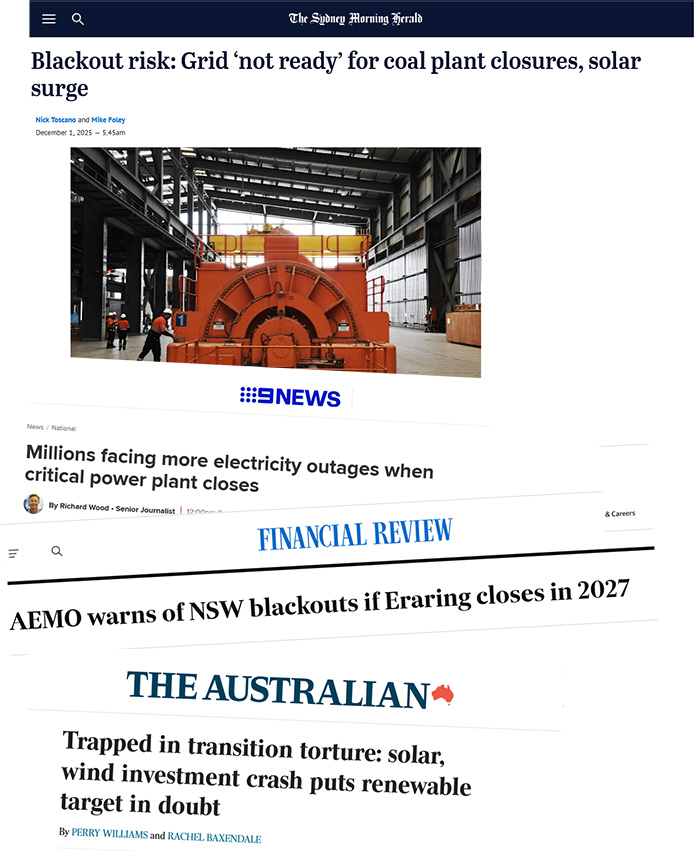
By Jo Nova It’s hard to keep up with the bad newsIs Australia finally waking up to the ugly truth about unreliable electricity? Last week, the Australian Bureau of Statistics dropped the bomb that electricity costs were up 37%, foiling hopes of an interest rate cut. They tempered it by saying it was due to the government stopping the rebates, as if that made it understandable instead of being a national disaster. The government promptly promised to make electricity cheaper by giving up plans to change the the polar vortex with our power plants. No, wait, — of course, they promised to think about paying rebates again… The coal is dead, long live the coalAnd so we reach the point of where headlines fill our main newspapers this week with warnings that blackouts are coming if one particular coal plant closes and prices are destroying businesses just like we said they would years ago. The old coal plant that was supposed to close in August now looks unlikely to close in 2027, because of blackout fears. Eraring supplies about 20% of the energy to our largest state grid. Suddenly newspapers are explaining what system inertia means and talking about frequency stability. It’s like were training up a nation of electrical engineers. They’re also explaining SynCons, the big spinning machines called synchronous condensers which cost $150 million dollars each, and don’t generate any energy at all. They just provide the stability we get for free with every coal turbine, except for only for a tenth of a second or even less.
Meanwhile, investments in large scale solar and wind power crashed by 80% in the last yearNot one single wind project reached a final approval in Australia this year. We’ve slid all the way back to 2016 levels of spending: Trapped in transition torture: solar, wind investment crash puts renewable target in doubtBy Perry Williams, and Rachel Baxendale,– The Australian Australia faces its worst year of investment in large-scale solar and wind in a decade, heightening concern the nation will fail to meet its 2030 renewable energy target. Large-scale investment in solar and wind generation totalled 1.05 gigawatts at the end of October compared with 4.5GW for the 2024 calendar year, Clean Energy Regulator data shows. Origin Energy chief executive Frank Calabria last week said Australia’s shift away from coal was increasingly being held back by a stubborn gap in onshore wind development. No onshore wind project in Australia has reached a final investment decision this year – a striking absence that has cast doubt over Anthony Albanese’s climate ambitions. As the illusion wears off, and the subsidy farming gets tough, investor interest disappears. Soberingly, most of this collapse occurred before the Australian Opposition finally came out with a No Net Zero policy. Imagine how bad things will be next year, if the Liberals start to actually fight the Net Zero fight? Then we found out our grid Managers weren’t even planning for the worst wind droughtsThe Australian caught the AEMO preparing for a worst case scenario where our wind turbines fell to only 14% capacity for a few days in a row. Embarrassingly for them, the same month they released the 2024 Integrated System Plan, our wind turbines fell to half that. In response to that news last week, they have quietly tweaked their assessment and preparations for wind droughts or dunkelflutes. In May 2024 for seven days in a row, the entire fleet of Australian NEM wind turbines was running almost entirely below 14%, apart from two brief periods. Our grid managers are so inept that even mainstream journalists are correcting their errors in system planning. It’s that bad. I mean, “yay for the free press”, but really, our Blob-o-crat web must be so one-sided that all the other government funded agencies, the ABC, AER, AEMC, CER, CEFC, ARENA, ECA, ESB, CCA, CSIRO and all our universities, didn’t notice that the AEMO modelling was wrong? 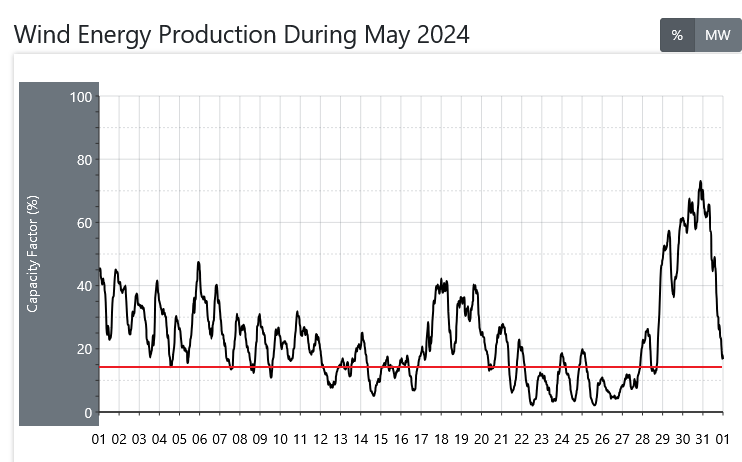 The red line marks 14% below which wind turbines were not supposed to stay for long. Graph by Anero.id All these agencies are just cheer-squads for Blob Renewables. Not one of them is paid to serve the public. Shut them all down…
 Image by Vilius Kukanauskas from Pixabay By Jo Nova The phase change in the Climate Apocalypse Trade rolls on, and the US leads the wayAlready some US ‘grassroots’ organizations are having an existential crisis. Actually, the Sierra Club has been struggling for three years, but no one wanted to mention that. Francis Menton at the Manhattan Contrarian points out the extraordinary collapse of the largest US environmental group, the Sierra Club: The Sierra Club is in the middle of what might well be called an implosion. The New York Times reported the story on November 7. Excerpt: The Sierra Club calls itself the “largest and most influential grass roots environmental organization in the country.” But it is in the middle of an implosion — left weakened, distracted and divided just as environmental protections are under assault by the Trump administration. The group has lost 60 percent of the four million members and supporters it counted in 2019. It has held three rounds of employee layoffs since 2022, trying to climb out of a $40 million projected budget deficit. . . . [T]his year, as the Trump administration returned better organized and better prepared than in its first term, the Sierra Club was the opposite. While Mr. Trump boosted coal power, canceled wind farms and rolled back pollution limits, the club was consumed by internal chaos, culminating when the board fired its executive director, Ben Jealous, a former president of the N.A.A.C.P. No doubt some of the pain is due to Donald Trump, and the DOGE effect, but a lot of this was an inside job with help from the cheer-squad-media. The Sierra Club forgot it was supposed to care about the environment and jumped into all the crazy lefty bandwagons they could find. As they ran off the road, the media cheered them on, and censored anyone who tried to tell them how the real world works. Thus and verily, they went double or nothing over Lemming cliff. Proving even the Green left can “Go Woke, Get Broke”: The Sierra Club Embraced Social Justice. Then It Tore Itself Apart.By David A. Fahrenthold and Claire Brown, The New York Times During Mr. Trump’s first term, when the Sierra Club was flush with donations, its leaders sought to expand far beyond environmentalism, embracing other progressive causes. Those included racial justice, labor rights, gay rights, immigrant rights and more. They stand by that shift today. By 2022, the club had exhausted its finances and splintered its coalition. It drove away longtime volunteers who loved the club’s single-minded defense of the environment, by asking them to fully embrace its pivot to the left. Some even felt they were investigated by the club for failing to go along. Many hard-core supporters felt the Sierra Club was casting aside the key to its success: It was an eclectic group of activists who had one, and sometimes only one, cause in common. The club hired Mr. Jealous, its first Black executive director, that year to stop that slide, but his tenure accelerated it as accusations of sexual harassment, bullying, and overspending piled up. Another casualty is 350.org which has lost revenue and suspended operationsAnd then there is 350.org. This organization is the baby of uber-climate-activist Bill McKibben, with the “350” supposedly designating some limit of ppm of CO2 in the atmosphere that must never be exceeded, or else . . . something may happen that they think is really, really scary. (The current level of CO2 in the atmosphere is approximately 424 ppm.). On November 13, even as COP 30 was going on, 350.org “suspended operations.” From Politico, November 13: Environmental group 350.org, which spearheaded the movement to block the Keystone XL oil pipeline, will “temporarily suspend programming” in the U.S. and other countries amid funding woes, according to a letter obtained on Thursday by POLITICO. . . . The letter to outside organizations from Executive Director Anne Jellema said 350.org had suffered a 25 percent drop in income for its 2025 and 2026 fiscal years, compelling it to halt operations. The group will keep three U.S. staff members in hopes of reviving operations in the future. In the US, the giant UN climate event in Brazil wasn’t even on the news. “…were you even aware that this year’s COP 30 happened? In a piece today for the Civitas Institute, Steven Hayward notes that not one of the American television networks sent reporters to this year’s event. Coverage in the American print and online media was also dramatically reduced. Hayward writes, “A few reporters at the conference filed stories wondering whether this would be the last COP meeting.” It appears that since Donald Trump didn’t go, the US TV networks didn’t bother sending camera teams. I can’t remember a COP meeting ever, where anyone discussed how it might be the last…
Memorial Service for Viv Forbes NEXT Friday at 9am EST time. (Apologies for getting the Fridays mixed up!) Address: at Centenary Memorial Gardens, 353 Wacol Station Road, Sumner, Qld 4074. There will be a live stream of this event at that time. PIN for access is 5918. Live steam link in case it does not come through: https://cmgcc.com.au/live-streaming/client?nid=08556218-2e27-45e2-9f85-6b8a128def77 Behind the scenes in the world of skeptics and libertarians, Viv was a source of wisdom, and tenaciously productive. He will be missed. — Thank you Viv! From his family: Viv lived a remarkable life — born in Warwick in 1939, he became a geologist, economist, farmer, writer, and above all, a man of principle. He was devoted to his family, passionate about learning, and unwavering in his commitment to libertarian ideals. He also dedicated much of his later life to climate science, challenging conventional wisdom with rigorous study and advocating for honest debate grounded in evidence. Viv was a Dux, Geologist, Economist, Intellectual, Libertarian, Writer, Poet, Political Commentator, Coal Miner, Sheep Farmer, Grandfather, Carbon Sense Coalition Founder and tireless campaigner for freedom. He will be remembered not only for his achievements but for the values he instilled in us and the legacy he leaves behind. Memorial details will follow in due course.
 Image by gugacurado from Pixabay By Jo Nova We now know that when AI is trained on AI generated content, its output degrades. The more artificial the training material is, the more it hallucinates and becomes delusional. But humans are a sort of large-language-model and we are running that same experiment on us. We are gradually raising children on more and more artificial content and less real experience. There are adult children who have never grown and harvested a single piece of food, who live online, watch anime, and know that electricity comes from wall sockets, and food comes from Coles. We thought they were just detached from reality, but what it it’s something much deeper? What if AI shows us a universal truth of a neurological network? This is the thesis of The Copernican:Urban Bugmen and AI Model Collapse: A Unified TheoryModel collapse is a serious limit to AI systems; a failure mode that occurs when AI is trained on AI-generated data… In reviewing model collapse, the symptoms bear a striking resemblance to certain non-digital cultural failings. Neural networks collapse, hallucinate, and become delusional when trained only on data produced by other neural networks of the same class. …and when you tell your retarded tech-bro boss that you’re “training a neural network to do data-entry,” upon hiring an intern, are you not technically telling the truth? It may be that, by happenstance in AI development, we have stumbled upon an underlying natural law, a fundamental principle. When applied to trained neural network systems, information-fidelity loss and collapse may be universal, not specific to digital systems. This line of reasoning has serious sociological implications: decadence may be more than just a moral failing; it may be universally applicable. Model collapse is visible in this study published in Nature last year  The more artificial the training content (the poison) the faster the output degrades. In any normal human society a three year old can guess who is a man and who is a woman, but there are adults now, raised on pure academic artificial material who seem to have lost this ability. Afterthought from Jo: During our earliest years the human brain appears incredibly well adapted to learning languages and music. For example, teaching children music at a young age increases the size of the corpus callosum which doesn’t happen in the late starters. (See: “Why musical genius comes easier to early starters”.) Similarly, “Neural and behavioral research studies show that exposure to language in the first year of life influences the brain’s neural circuitry even before infants speak their first words. ” Up to the age of 7 children appear able to learn a second language with grammatical proficiency that is increasingly difficult to gain afterwards. (see Fig 2) https://pmc.ncbi.nlm.nih.gov/articles/PMC2947444/ “People who grew up outside cities, or in more spatially complex cities (think Prague rather than Chicago), also appear to be better able to navigate as adults. This is related to the distances travelled and the variety of areas traversed.” What if there is a critical window of development of our neural network that needs to feel the pull of gravity, and get the bumps and bruises, or grow the pumpkin, or get lost in the bush? A retraining program in adulthood might recover some, but not all of the connections that should have formed in childhood. Copernicus pulls no punches: When it comes to navigating the real world, urban bug-people often behave as if they’re retarded. Socially (they’ve never been punched in the face), Geospatially (they have no idea how to navigate by the sun or shadows), Culturally (without some pop-fiction touchstone, culture doesn’t exist), etc. They’re entirely bound to a world of artificial ideas: human-produced data, and unable to accurately model from first principles anything outside their extremely limited sphere of artificial experience. The bugman’s neurological model of reality is divorced from reality. They hallucinate truths that make no sense, and they delude themselves into provably false ideas, and violently attack anyone with a model of reality more accurate than their own. They don’t understand violence, hunger, or (real) social organization because they’ve never encountered those things. And by the time they’re adults, their models of reality are too set to be easily changed. Those who don’t have a lived experience of physics or biology perhaps grow up to be the feminists who want biological males to win boxing medals in women’s division. They are the gays protesting to help a culture that would kill them if they visited. He points out there are programs growing to build purely non-AI-generated databases so they can train more useful AI models. Perhaps we need to grow these programs for our own children? Perhaps they need time on real farms and forests instead of just watching videos about someone else’s experience? A Thesis: Unified Model Collapse TheoryThe proposed thesis is that neural-network systems, which include AI models, human minds, larger human cultures, and our individual furry little friends, all train on available data. When a child stubs his wee little toe on an errant stone and starts screaming as if he’d caught himself on fire, that’s data he just received and which will be added to his model of reality. The same goes for climbing a tree, playing a video game, watching a YouTube video, sitting in a chair, eating that yucky green salad, etc. The child’s mind (or rather, subsections of his brain) are neural networks that behave similarly to AI neural networks12. People use new data as training data to model the outside world, particularly when we are children. In the same way that AI models become delusional and hallucinate when too much AI-generated data is in the training dataset, humans also become delusional when too much human-generated data is in their training dataset.
When a person watches the Olympics, they’re seeing real people interacting with real-world physics. When a person watches a cartoon, they’re seeing artificial people interacting with unrealistic and inaccurate physics. When a human climbs a tree, they’re absorbing real information about gravity, human fragility, and physical strength. When a human plays a high-realism video game, they’re absorbing information artificially produced by other humans to simulate some aspects of the real physical world. When a human watches a cute anime girl driving tanks around, that human is absorbing wholly artificial information created by other humans. Are we living in a Mouse Utopia?Copernicus talks about experiments from the 1960s where 8 mice were placed into a rich habitat with all the things a city of 6000 mice could need. In mouse utopia soon 8 mice became 16. They doubled every 55 days, reaching 2,200 mice after 19 months. But even though they could have doubled another time before the food ran out, they never did. Things went very wrong in the colony, some mice dubbed “the beautiful ones” guarded a prime spot and then did nothing with it. The lower ranked males just gave up trying to get a girl. The girls lost the ability, or the interest, in raising the pups, even forgetting them. And apparently fertility fell to nothing. A month after the population peaked very few baby mice survived more than a few days. “The mice were trained on datasets where there was little or no real-world intrusion. As a result, their training reached a state of catastrophic failure after roughly 13 generations. At that point, the fertility dropped to zero in the youngest populations, and the entire mouse society collapsed into nihilistic extinction.” People are still debating exactly why everything fell apart, but Copernicus offers it as an example of a model collapse in a social animal that had little contact with the real world of hunger, physics and surprises. He notes ruefully in capitals, that We Need Replication of the experiment. But Mouse Utopia must have ended up looking like a horror show, because, he says, ethics boards won’t allow a repeat experiment. Synthetic data is not all bad, but we don’t know what the limits are and we are running the experiment live:Clearly, humans have a tolerance for synthetic data. We’re surrounded by it, but we can manage ourselves as long as we have real first-principles and real interactions with the world around us. Combative martial arts. Shooting. Hiking. Hunting. Even cooking and realistic meal preparation can dramatically improve the quality of input data that a child receives. Without real data, the human mind ceases to function, and its disparate parts begin hallucinating information that doesn’t exist, and which will often be confidently and violently defended. The modern political Left is a product of delusional psychology… It’s a long piece. Read it all at Always The Horizon. There are many reasons humans adopt seemingly self-destructive behaviours, and this is just one, but the parallels with AI failure are uncanny. H/t David E
November 27th, 2025 | Tags: Cognition, Mental Health, Psychology | Category: Global Warming, Health, Social Media |  Print This Post | | Print This Post | | Sadly, last week we lost the extraordinary Viv Forbes, of the Carbon Sense Coalition. A very smart and politically savvy man who will be sorely missed. There will be a service tomorrow morning. “A fearless Champion of Liberty”. There’s no one quite like him. Memorial Service for Viv Forbes. FRIDAY 5 DECEMBER 2025, 9AM (AEST – Australian Eastern Standard Time) In addition, there will be a live stream of this event at that time. For access, use the PIN 5918. Live steam link in case it does not come through: https://cmgcc.com.au/live-streaming/client?nid=08556218-2e27-45e2-9f85-6b8a128def77
 Photo Steve Nowakowski By Jo Nova Just another day trapped in the impossibility paradox — trying to change the troposphere on the cheap…Asbestos has been found in GoldWind turbines, and now in Vestas turbines too. Both were using brake pads supplied by 3S Industry, a company based in China. The brake-pads are small, and contained within the lifts inside the towers, so at the moment, not likely to be spraying asbestos fibres across forests and farms. But no one will be sending unprotected workers up any of those wind turbines until those pads are replaced. However as Rachel Williamson says at Renew Economy, it’s likely this is just the “tips of the iceberg”: “Several sources confirmed to Renew Economy that 3S supplies the brake pads to almost every turbine OEM [Original Equipment Manufacturer] supplying Australia. “ The opposition has called for a halt on new turbines as the asbestos scare spreads. Both companies are quarantining an undisclosed number of turbines. So at best, even if the health risk is small, it’s just another nasty surprise, another delay, and another cost for the Renewable Crash Test Dummy. Who would have thought that building thousands of square kilometers of industrial infrastructure to catch the sun and breezes would be so complicated? Federal opposition demands halt to new wind turbines as asbestos scare spreadsBy Christine Middap, The Australian It comes as opposition industrial relations and employment spokesman Tim Wilson urged Climate Change and Energy Minister Chris Bowen to order a national safety review and temporary moratorium on new turbine installations, warning of the operational and reputational risks the issue posed to the country’s clean energy transition. “The importation of asbestos-containing goods into Australia has been banned since 2003, yet this incident suggests that components containing asbestos may have been distributed widely within the renewable energy sector,’’ he said. We might not want to be 100% dependent on China to make us all the widgets we want: Australian Workers Union national secretary Paul Farrow said the asbestos cases highlighted the risk of relying entirely on overseas supply chains for Australia’s renewables transition. “Right now we are building these massive infrastructure projects with nearly zero per cent Australian content. That is unacceptable and unsafe,’’ he said. We’d love to revive Australian manufacturing, but we’re buying it all from China because it’s all we can afford. If we make the brakepads and widgets ourselves, it’ll make renewable energy even more expensive than it already is. Let’s not forget — things cost less in China because they’re burning our coal, they treat their workers badly, the quality assurance is poor, and the environmental standards are terrible. That is not a race that we want to win. How many people should we kill today to save one spotted quoll in 2095? Where are those sums? Still, it could have been worse. At least we didn’t put the Chinese-made brake pads in preschools across the country and then have to close 70 schools while we clean the carpet in hazmat suits.
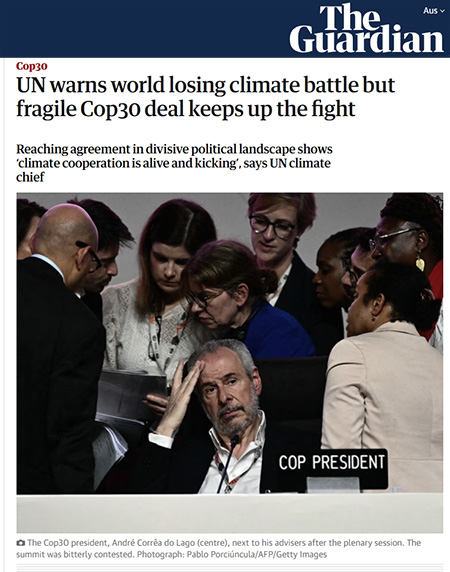
By JoNova Unlike nearly every UN gathering, COP30 in Brazil got no last minute ‘landmark deal’They didn’t even get something mildly positive that they could call spin into success. Even friends of The Blob are using words like “unhappy“, “losing” and “disappointing”. Only two years ago at COP28 everyone was quivering with the thrill of a ‘historic’ deal to phase out fossil fuels. Nearly 200 countries had agreed ‘for the first time ever’ to ” transition away from fossil fuels and towards renewables and energy efficiency. ” It was the first time the UN deal had specifically mentioned “fossil fuels”. And thus it was beginning of the end of coal, gas and oil, they told us. Then Donald Trump won, and two years later even the UN admits they are losing the climate battle. This time, instead of 200 countries endorsing the end of fossil fuels, according to Bloomberg, only about 80 “had united behind the push — a significant number, but short of the supermajority that forced the landmark pledge to transition away from fossil fuels in Dubai two years ago.” The ABC spun this crushing loss (from 200 down to 80) as just a “sidestep” around fossil fuels . They cover up for the UN-Blob with every edit. It’s not like it’s a sign that the world is backing away from renewables and self-immolating Net Zero targets, is it? “The talks did not actually collapse”The Guardian (of The Blob) puts the best spin on the situation that it can, which was that the talks did not disintegrate entirely. “Multilateralism held”. The big success in Brazil was that everyone held hands and agreed to promise nothing — but they did it together. The world is not winning the fight against the climate crisis but it is still in that fight, the UN climate chief has said in Belém, Brazil, after a bitterly contested Cop30 reached a deal. Countries at Cop30 failed to bring the curtain down on the fossil fuel age amid opposition from some countries led by Saudi Arabia, and they underdelivered on a flagship hope – at a conference held in the Amazon – to chart an end to deforestation. But in a fractious era of nationalism, war and distrust, the talks did not collapse as was feared. Multilateralism held – just. Expectations are so incredibly low now. They used to pretend to save the world, now they just want to save the COP junket: A Decade After Paris, Climate Diplomacy Is About Saving ItselfBloomberg COP30 President André Corrêa do Lago laid out the stakes before delegates traveled to Belém, telling a Bloomberg Green event: “We have to convince people it’s worthwhile to continue to negotiate.” In the end, the holdouts found enough reason to back a deal — if largely to send a signal that countries can still unite behind the climate cause. “There was a will to make sure this agreement didn’t fall,” said Ed Miliband, the UK’s energy secretary. “Nobody in that room really wanted to be the people who brought the thing down.” Instead, he added, “there was actually a will to keep the show on the road.” Perhaps the UN shouldn’t have picked Brazil for the cute forestry photos — because there were bigger forces at work: … a large faction of countries, egged on by Brazil President Luiz Inácio Lula da Silva in his role as host, had made a renewed push against fossil fuels, turning it into the proving ground for both climate cooperation and the very idea of multilateralism in a rapidly fracturing world. But Brazilian diplomats leading the summit, under pressure from Arab states and Russia, didn’t embrace the proposal. The whole point of holding it in far flung Belem, Brazil was to help get a historic forest-protection slush fund started. They wanted $125 billion dollar pot of influence called the Tropical Forests Forever Facility, but in the end, they didn’t even get the words “deforestation” in the final deal. “A lot of parties were quite surprised,” Wyns told SBS News, adding that references to deforestation were also removed.
A roadmap to the halting of deforestation was dropped from the final deal, a bitter disappointment for nature advocates at this “rainforest Cop” held in Belém, near the mouth of the Amazon River.
Remember when the historic COP28 meeting was the beginning of the end of fossil fuels?The Hail Mary line they managed to weave into the ‘COP 30 deal’ is pure fantasy wish list. Presumably a few people will quote this line smugly at pubs to skeptics as if it proves something:
“The global transition towards low greenhouse gas emissions and climate-resilient development is irreversible and the trend of the future.” He argued: “This is a political and market signal that cannot be ignored.” The political and market signal that can’t be ignored is the one where skeptics are winning elections, or dominating the polls, and sustainable investors are fleeing from references of climate change.
By Jo Nova Just when you think they can’t possibly squander money more extravagantly… We were told it was $4 million but the truth is that the BoM spent $96 million dollars of our money to make their workable website truly awful. They just forgot to mention the private consultation by Accenture Australia for seventy eight million dollars. It could have happened to anyone, right? Wrong. The staggering TRUTH about the weather bureau’s disastrous website redesign – as boss finally admits the eye-watering real costPaul Shapiro, The Daily Mail Now, the federal government’s weather agency is again on the back foot after it was revealed the loathed app cost taxpayers $96million to redesign and launch. New bureau chief Dr Stuart Minchin has admitted that the total cost of the redesign, completed under his predecessor Dr Andrew Johnson, was much higher. ‘I’ve looked into it. The total cost, when you add the Accenture work, the security testing and everything else, it’s about $96million,’ he told the Sydney Morning Herald. The new website changed the way the rain radars measured rainfall, and was dropped on Australians facing serious storms. The backlash was so bad, the BOM promised to bring back the old rain radar system. David Littleproud tore strips of the BoM: ‘It is unbelievable a private consultancy was paid $78million to redesign the website, but then security and system testing meant that Australian taxpayers actually paid $96 million,’ Mr Littleproud said. ‘The seriousness of this cannot be understated. This isn’t just about a clunky website, the changes actually put lives and safety at risk. It’s hard to believe they did a 15 month beta trial and the community “loved it”. Presumably they tested it on their own kids, and their friends at the ABC, but not on the people who’s lives depend upon the weather reports — the farmers, firefighters and fishermen? In the spirit of the best Soviet production, the new site reeks of condescension, panders to woke ideology, treats everyone like they are in primary school and destroyed 10 million hours of productivity across the country by forcing millions of people who already knew the site to have to learn an entirely new architecture. All the knowledge Australians had built up on how to navigate the BOM data was tossed to the wind. The BoM treats Australians as though their time is worthless and their money is infinite. The only good thing about the new site is that the old site is still there. See reg.bom.gov.au. 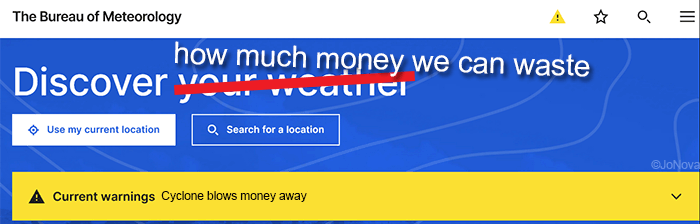 … Commenters at the Daily Mail were aghast that the BOM could spend so much on software. FlowerPower says: $100 million just thrown away into some greedy corporation’s pockets. This was taxpayers money. Who approach fee? Even more so when the original budget was only $4 million. I bet this has the Labor Party behind it somewhere? Ready to steal the glory…. The New Zealand upgrade to their Metservice cost $1.7 million dollars. Perhaps it wasn’t as awful? Kiwis may like to comment. As I said then, bring back the old site…. ht Jon Rattin, David E., and apologies to another commenter who left the first tip about the cost blowout. I can’t find that comment! UN climate conference drops “fossil fuels” from the draft deal. Activists say “We have nothing left”
By Jo Nova It is as if Satan disappeared from the BibleThe sacred fabric of the climate religion is unravelling by the day. The COP30 deal is being hammered out in Brazil — but in the draft any mention of “fossil fuels” has been dropped. Apparently the rich oil nations have formed a block that objects to a sentence committing countries to stronger, faster, action to reduce their use of fossil fuels. The UK, France and a few other nations have rejected this but the same small island nations that are frightened of drowning have joined the oil block. Apparently they were offered more money to adapt to climate change. UN climate summit drops mention of fossil fuels from draft dealBy Georgina Rannard, BBC All mention of fossil fuels, by far the largest contributor to climate change, has been dropped from the draft deal under negotiation as the COP30 UN climate talks in Belém, Brazil enter their final stretch. Brazil’s President Luiz Inácio Lula da Silva and some countries including the UK want the summit to commit countries to stronger, faster action to reduce their use of fossil fuels. An earlier text included three possible routes to achieve this, but that language has now been dropped after opposition from oil-producing nations. French Environment Minister Monique Barbut said the deal is being blocked by “oil-producing countries – Russia, India, Saudi Arabia, but joined by many emerging countries.” She suggested that small island nations may agree to a weaker deal on fossil fuels if they secured more finance to adapt to the changes in their countries caused by rising temperatures. It was always about the moneyThe big question here (if this sticks) is why the oil block didn’t do this years ago? The even bigger question is whether the oil block have found a way to circumvent The UN Blob? If they are paying the small countries off directly behind the scenes, the UN will miss out on collecting its share of the cash flow. The travesty! The irony is that if “man-made climate change” was really a crisis, it makes more sense for the oil giants to pay the islands to build sea-walls — instead of rearranging the global economy to try to control the clouds and the ocean. But this unthinkable sacrilege cuts out the middlemen Blob-o-crats and stops the whole totalitarian power game. The UN will not give up its aim to be the One World Government so easily. The French Environment Minister was not happy: On France’s position she said:”At this point, even if we don’t have the roadmap, but at least a mention of the fossil fuels, I think we would accept it. But as it stands now, we have nothing left.” Expect The Blob to fight this all the way. There will be wrangling and then possibly “euphoric joy” about a “historic agreement” ready for cameras on the nine o’clock news. Image by Vilius Kukanauskas from Pixabay
November 22nd, 2025 | Tags: Fossil Fuel, UNFCCC, United Nations (UN) | Category: Global Warming | Print This Post | |
By Jo Nova A new day dawns DownunderFor the first time in years, the Opposition doesn’t sound like a school girl (well, not all the time). And, suddenly the government has realized they shouldn’t go burning $2 billion on a COP31 UN-love-fest while voters can’t afford electricity — their political opponents could turn it into a stinging election campaign. Instead, as a consolation prize, they will fly Chris Bowen, the Minister for Weather Fiddling, to Turkey to preside over the COP meeting there and star in the bureaucratic beauty contest. Giving up on the COP Cabaret will save billions, not just in hotel rooms in Adelaide, but in all the tokenistic daft climate projects the government might have started to impress the UN powerlords. As it is, the PM radically increased our Net Zero target in September — was that to earn favor with the UN to cinch the deal — if it was, the UN won. The fantasy target certainly wasn’t done to impress voters, because the Labor Party hid it from them during the election. Who was ‘Albo’ trying to impress? Freed from the shackles of the Net Zero straight-jacket, the Opposition’s Energy spokesman can finally talk with some conviction about the awful costs, the poverty, the national productivity loss, the decline in standards of living, and the smelters that are closing. In a rare moment of functional governance, the Opposition promises to force the grid manager (the AEMO) to put cheap electricity ahead of weather voodoo. So, lucky Australians can still have hope, that one day our power stations might even be directed to make cheap reliable power rather than change the jet streams over Antarctica. But the Opposition are camouflaging themselves in the talisman of climate virtue, as if chanting the spells of the Paris Agreement will protect them from the Global Bullies. To ward off the bad spirits, and BlackRock bankers, they still say they’re committed to the Paris agreement, while promising to consider building coal plants, which sounds a lot like the Chinese “net-zero plan”. Smile and say ‘Yes‘ while doing whatever you were going to do anyway. Apart from burning the token Parisian incense, its heartening to hear some of the messages we’ve been saying for years, even if we feel like beating our head on the wall: Australians desperately need reset on energy for more affordable powerBy Dan Tehan, Opposition Spokesman for Energy in The Australian Australia is in the midst of a cost-of-living crisis. This is undeniable. We have suffered the steepest declines in living standards of the developed world. Real disposable income has fallen by 8.5 per cent since 2022. More than a million Australians now work multiple jobs simply to get by. Under Labor, poverty has risen from 12.4 per cent (one in eight) to 14.2 per cent (one in seven). That is 3.7 million Australians, including 757,000 children, are living below the poverty line. Our industries are collapsing under this strain. Closures in Whyalla, Port Pirie and Mount Isa are costing thousands of jobs. These are real livelihoods of real people that are being lost. Rio Tinto, who owns the Tomago Aluminium Smelter, directly attributes its imminent closure to soaring electricity prices. ASIC data shows 14,722 companies entered external administration in the 12 months to June 2025. Under the Coalition in 2021, that number was just 4,235. And the clincher: All of this pain has achieved nothing. When the Coalition left office, emissions were 28 per cent below 2005 levels. Today they are just 28.7 per cent below 2005 levels. Labor talks tough on climate but has delivered virtually no emissions reductions and higher costs. This is abject policy failure. Here comes the incantation: We remain committed to the Paris Agreement and to responding to climate change responsibly and affordably. We will reduce emissions on average year-on-year, and in line with comparable countries, moving as fast as technology allows rather than pursuing arbitrary, unachievable targets. To that end, we will use the Clean Energy Finance Corporation and ARENA to support scalable, breakthrough low-emissions technologies, including carbon capture and storage and advanced nuclear technologies that enable whole-of-economy decarbonisation. The Blob rewards the Blob players?Did anyone think any Australians would feel warm and gooey inside just because “an aussie” starred in a field of UN Blob-o-crats? Chris Bowen to serve as COP31 president after Australia cedes hosting rights to TurkeyChris Bowen will become Australia’s “part-time” Energy Minister as he takes on “all the powers” to lead global climate negotiations for the next 12 months, after the Albanese government ceded the right to host next year’s UN climate change summit to Turkey. Many are wondering if Chris Bowen can be a part time Minister when our electricity grid and gas supply are in a crisis. Sussan Ley challenged the decision, saying “Australians simply cannot afford to have a part-time minister in charge of energy policy”. “Families deserve an Energy Minister who is focused on their bills, not on chasing headlines overseas,” the Opposition Leader told The Australian. But I say, if Turkey wants him, they should keep him. The further he is from the Australian electricity grid, the better.
November 21st, 2025 | Tags: Australian Politics, Labor Party, Net Zero | Category: Global Warming | Print This Post | | By Jo Nova Just after the Coalition announced they would put cheaper energy ahead of global weather control, Anthony Albanese has been struck with cold feet about hosting the Climate COP31 giant junket in Adelaide. After campaigning for this for three years like it was the Olympics, Anthony Albanese is now suddenly worried about Germany. If Australia and Turkey don’t sort this out between them, the climate circus will default to the poor Germans who will have to host COP31 — something they’ve said they don’t want to do. Albanese puts COP31 truce on the table after blast from TurkeyBy Ben Packham, The Australian Anthony Albanese has signalled his government is prepared to cede the hosting of next year’s UN climate conference to Turkey but says he wants to salvage some benefits for Pacific Island countries. The Prime Minister was yet to withdraw Australia’s bid but said on Tuesday that if Turkey was preferred by delegates at this year’s COP (Conference of the Parties) then Australia would not challenge the decision. He said there was “considerable concern” in the international community that the impasse between Canberra and Ankara would see the 2026 COP default to the German city of Bonn, as required by UN rules. Amazing how fast political certainty can flip, isn’t it? One moment Anthony Albanese was hoping to stand beside Antonio Guterres on the glorious world stage and brag about how many solar panels Australia has, but now he probably wants a quiet exit. It doesn’t help that the current COP30 is a flop where Russia, China, India and the US didn’t turn up and most countries didn’t update their plan. If the Australian opposition find their feet and wage a climate war, COP31 in Adelaide will be a sitting duck, radiating upper-class green out-of-touch vibes while voters struggle to pay their electricity bills. It would be a gift to political opponents. Two thousand million dollars is a lot to burn on a lame UN event. The Opposition may have just saved Australia $2 billion dollars. Or maybe COP30 did.
|
Jo appreciates your support to help her keep doing what she does. This blog is funded by donations. Thanks!
 Follow Jo's Tweets
   
 
|
|||
|
Copyright © 2026 JoNova - All Rights Reserved |
||||










.jpg)
Recent Comments