|
|
By Jo Nova
That was a hellfire price spike yesterday. It’s not so much the height, but the width of the spike is shocking. Prices lifted off in NSW at 4:45pm and didn’t come back down til 9pm. That’s a four hour nightmare at around $10,000 per MWh. I rarely, if ever, have seen so much area under the red line — so many dollars flowing under the bridge.

“We could have bought a whole new gas plant instead”
Hypothetically, there was around 11,000 megawatts of demand at $10,000 a megawatt hour for over 4 long hours which is a $450 million “price signal” (and that’s just NSW). In Victoria a similar spike consumed another $200 million*. The market — sick, injured and rigged, it seems, is beating us over the head. The average price for the whole 24 hour period in NSW, Victoria and South Australia was a red hot $2,000 per MWh. (A 24 hour average!)
This is not a free market, it’s a fixed market — designed to change the global climate and maybe also keep the lights on. A free market would fix itself, but the government banned the good options, so all we’re left with is outbreaks of electromania.
Even with all the subsidies and the rigging, the Renewables-Wonderland of South Australia was also hit by the exact same price smash as NSW and Victoria. All that wind, solar, synchronous condensers, batteries and renewable smuggery can’t save the state from the 6 o’clock bonfire. This is a message from the future to Victoria and NSW. If South Australia can’t save itself now, how will the big states manage when they turn themselves into South Australia?
All the savings of renewables are illusory.
 AEMO The wind stopped across the whole continent
The problem was a normal wintery cold blast from Antarctica combined with the collapse of wind generation across the entire east coast “national grid” — reduced to about 400MW out of 13 gigawatts of generators. The whole wind industry in Australia was working at a capacity factor of 3%. Or, as a cruel commentator might say, 97% useless.
Obviously, on a day like this, it doesn’t matter how many twenty billion dollar interstate transmission lines we build, the solution is reliable power plants. That, or stopping those damn high pressure cells.
Over to you Mr Bowen:
 https://anero.id/energy/2025/june/26 Retailers will have hedging contracts to (sort of) cover these price spikes. However the price of future contracts will rise over the coming months. The people who cover the other side of those hedging contracts got burnt today and they will want to recover their costs. Thus events like this flow through to retail prices sooner or later.
Ironically, Paul McArdle of WattClarity notes that wind powered generation set a new record all time high on Monday this week, reaching 9,491 MW. It proves only that any money saved by wind power one day can be vaporized in an instant a few days later.
Batteries are starting to work so hard on the Victorian grid we can even see them on the daily chart (above in spiky pink). If people only knew how pathetically small their contribution is compared to fossil fuels.
And the forecast is looking similar for tomorrow:
 https://aemo.com.au/en/energy-systems/electricity/national-electricity-market-nem/data-nem/data-dashboard-nem Unless something changes, the bonfire begins again 5pm.
____________________
*In Victoria the spike averaged about 7,800W at a price of $9,000 MWh, for a bit over 3 hours — $210 million.
10 out of 10 based on 99 ratings
8.6 out of 10 based on 13 ratings
 …. By Jo Nova
So much for banks saving the Planet…
Elections do have consequences. (Thank goodness). After 19 Republican States hounded the banker cartels to behave, and Donald Trump won, the bankers quietly fled from the Net Zero banker clubs. They had been using our pension funds to bully companies and countries. They were playing Kingmakers — punishing law abiding companies, and thus forcing their own weather-changing energy policies on democracies (despite what the voters chose). In a triple whammy, they were forcing electricity bills up, sending industries and jobs to China, and also screwing the would-be-pensioners by not investing their money in the best investments. But the bankers were earning favors from China, and profiting from renewables investments, ESG funds, and their ability to push markets around.
Getting the bankers out of GFANZ was not just symbolic victory for The People over The Blob. The numbers show sixty five of the world’s largest banks put $869 billion in funding to gas, oil and coal companies last year. It was an increase of 23% from the year before. This ship is turning.
So Australia will tie itself in knots to close a few coal plants, but the rest of the world are pouring billions into fossil fuels.
by Elena Vardon, Wall Street Journal
Global banks significantly increased their financing for coal, oil and gas projects last year, according to a new report by climate advocacy groups, marking a reversal at a time when lenders are backtracking on climate pledges.
The world’s largest lenders committed $869.4 billion to companies conducting business in fossil fuels in 2024, according to the “Banking on Climate Chaos” report published on Tuesday.
The report, which tracks $7.9 trillion in fossil-fuel financing since 2016, notes that last year’s increase was partly due to a retreat from climate action by banks, with many watering down existing exclusion policies and delaying decarbonization targets.
The banker-blob wants to rule the world, and for a while they acted like a quasi Global-government bossing companies and nations around.
When asked to comment on their new lack of enthusiasm for saving the world most of the bankers said “no comment”. They knew there was nothing they could say.
But if the US elected representatives hadn’t stopped them, who would have?
10 out of 10 based on 102 ratings
A video going viral at the moment caught the moment a road buckles.
Best comment: “And that son, is how a speed bump is born”:
The backstory is at the Byte. Temperatures at Cape Girardeau, Missouri reached 91.9F or a not-so-scorching 33 C.
This is, I hear, a thing that happens in concrete roads designed to cope with the cold, rather than soft, flexible asphalt used in Arizona or Australia.
h/t David E
9.5 out of 10 based on 26 ratings
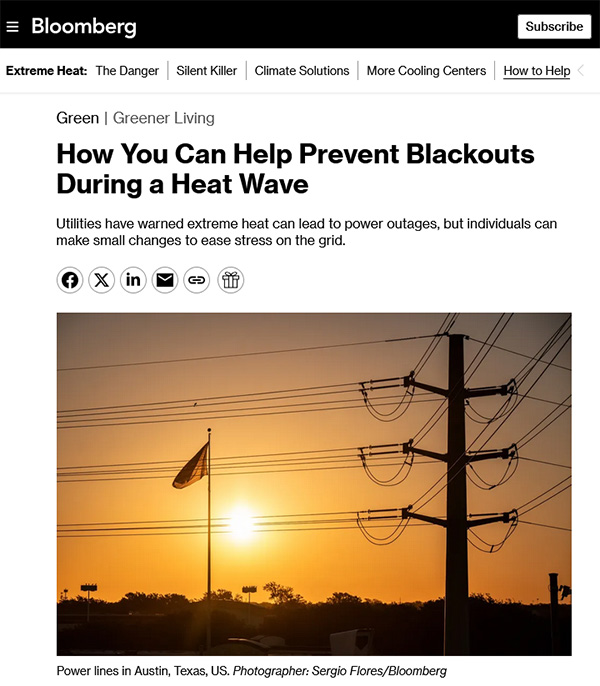
By Jo Nova
Bloomberg is softening everyone up for the blackouts
The latest Bloomberg puff-piece is straight out of Renewables-Marketing-Inc. It’s a plea for people to get used to rearranging their lives to accommodate the failing grid, but mostly it is pure Psy-Op to train the minions to blame grid failures and expensive electricity on hot weather. That way, if climate change causes the grid to blackout, the answer is “add more wind and solar power”, right?!
Firstly, get used to less power and more suffering
Girls and Boys, you can’t keep using that air conditioner, or charging your car at peak times. Put down your lifestyle Susie!
“Extreme weather events of all kinds – heat waves, hurricanes, flooding events – are putting immense stress on the grid and on people’s lives,” says Kit Kennedy, who leads the power division at non-profit Natural Resources Defense Council [NRDC]. Simple actions by consumers, such as avoiding charging your electric car during peak hours and raising air conditioning’s temperature, can ease grid stress, Kennedy says. “Flexibility is going to be the key.”
Bloomberg makes sure readers know Kit Kennedy works for a “non-profit” agency but forgets to mention that the same NRDC, has $462 million dollars in assets to spend, and their Chinese branch is sponsored by Chinese national agencies, the staff in the Beijing office used to work for the CCP, and the NRDC thinks China is doing a great job. If Kit were linked to Exxon instead, they’d make sure we all knew that.
Perhaps that explains why the Bloomberg team write like communist kindergarten teachers:
Here’s what you need to know about how extreme heat affects grids and how you can help prevent blackouts.
Remember, if you can prevent blackouts, that means when they happen, it’s your fault! Don’t blame us, children. You turned on the oven…
Extreme heat is distorting the Grid
Apparently hot weather now causes nameless “generators” to be less efficient, and transformers to heat up, and it “distorts the normal flow of electricity”, too. If only the world wasn’t heating by 0.1°C every decade!
Get ready for some of the worst science writing you’ve ever seen, almost like someone is trying to torture metaphors:
How Extreme Heat Hurts Power Grids
In a way, the grid functions like a seesaw: it stays stable if the power supply and demand are equal. But periods of high heat can throttle the efficiency of power generation and transmission, impairing the supply. Meanwhile, more homes, offices, shops and factories will turn on electric fans or ACs, sucking more juice out of the grid. When the demand and supply fall out of balance, a power outage can occur, says Timothy Wang, a managing director at consulting firm Filsinger Energy Partners.
Strangely, no one worried that hot days would “throttle the efficiency of generators” during all the decades that we relied on coal and gas plants? Since old coal plants operate at 540 degrees Celsius (1,000F) it’s “not likely” they give a toss about a 2 degree rise in global temperatures. The generators the Bloomberg team don’t want to name are the ones starting in S and W. Solar panels lose nearly half a percent for every degree above 25°C. If they reach 60C in the blazing sun they lose 10-17% of their generation. Wind turbines, might work in the heat, but often hot days are windless.
They could have just said new unreliable generators don’t cope in the heat.
The transformers needed to keep electricity flowing can also heat up, limiting their ability to handle rising power needs. Elevated overnight temperatures means equipment can’t cool when the sun sets. If the power load on the grid goes up too high, an aging transformer could blow up, likely causing a power outrage or worse, a fire, Wang says.
Lord help us all. Old things break at high temperatures. So, they probably break at freezing temperatures too?
Next your electricity bill will be attacked by spooky wave patterns:
Extreme heat also distorts the normal flow of electricity on transmission lines, causing the electronic appliances in your home to use more power, Marshall says. That’s because electricity travels across high-voltage lines in waves, and when those wave patterns deviate from what’s considered ideal, it distorts the power that flows into homes.That can add as much as 20% more on consumers’ electricity bills, according to an estimate by Whisker Labs.
What Whisker Labs is probably trying not to tell you is that solar panels can cause voltage surges at lunchtime, and that will increase some electricity bills. In Australia solar gluts have pushed up power to the 253V limit. The high voltage will make heaters, toasters, hair-dryers and old air conditioners draw more power than they normally use, hence one more cost imposition thanks to renewables.
Blame Climate Change for high electricity prices too!
Extreme weather causes higher electricity price spikes, it’s such bad luck…
The consumers who are lucky enough to keep the lights on may end up paying more for their electricity. Wholesale electricity costs can spike in extreme weather. These prices are passed on to consumers on their monthly bills, but by how much and how quickly will vary.
Lower those expectations people — you will be lucky if the lights stay on.
10 out of 10 based on 93 ratings
9.1 out of 10 based on 10 ratings
By Jo Nova
That didn’t take long?
It feels like Net Zero is undergoing a rapid unscheduled disassembly.
Two months ago the UK Prime Minster was going gangbusters. He told the world Britain would go “all out”to accelerate Net Zero, to bolster energy security and weather control, because “it’s in the DNA of my government”. This week, the same Prime Minister says he will save factories by cutting power bills for more than 7,000 of the most energy-intensive businesses “by up to 25%” by slashing net zero charges. So the companies that produce the most CO2 will be excused, because they will go out of business, but the rest of the UK can pay even more, because they aren’t going broke yet.
Speaking of which, industry groups warned a few weeks ago that high electricity costs threatened UK Manufacturing. And five days ago the largest fibreglass factory in the UK announced it would close because of the high electricity prices.
It makes no sense to pretend that a Net Zero economy is a goal to aim for while exempting the highest emitters. Does CO2 matter or doesn’t it? Obviously Net Zero is just the moveable excuse to make the taxes as high as “whatever the market will bear”. Tax ’em til they scream?
The Telegraph team report that UK business pay an eye-watering £258 per MWh in 2023, “compared to £218 in Italy, £178 in France and £177 in Germany”. Companies in the US paid just £65. Wow. But Australian brown coal still bids and wins wholesale electricity auctions in Australia for £5 or £10 a MWh. If the UK invaded Australia (it wouldn’t be hard, just avoid the Virgin flight paths) they could set up a factory next to Loy Yang, and could get the cheapest electricity in the developed world.
I’m old enough to remember April 2025:

The Guardian, April 25, 2025
Britain will go “all out” for a low-carbon future and accelerate the push to net zero instead of slowing down as some have demanded, the prime minister said on Thursday. In his strongest declaration yet of support for the net zero agenda, Sir Keir Starmer told a conference in London of more than 60 countries that tackling the climate crisis and bolstering energy security were “in the DNA of my government”.
Now in a heroic moment that is a “turning point for the economy”, and “a break, from short-termism” he will slash NetZero taxes:
The marketing word salami is becoming unreal:
 Just to correct the Telegraph subheader, the PM is not “cutting power bills” by even one cent. He has not made electricity cheaper, nor increased efficiency, productivity, or competition. He is just cutting his own weather-bending taxes (somewhat). Just to correct the Telegraph subheader, the PM is not “cutting power bills” by even one cent. He has not made electricity cheaper, nor increased efficiency, productivity, or competition. He is just cutting his own weather-bending taxes (somewhat).
Some British companies that survive as long as 2027, won’t have pay the net zero levies, like the renewables obligation and the feed-in tariff:
The Telegraph: June 22nd, 2025
Net zero taxes will be slashed for thousands of manufacturers as Sir Keir Starmer scrambles to save British industry from crippling electricity costs.
As part of the Government’s long-awaited Industrial Strategy, the Prime Minister is to cut power bills by up to 25pc for some 7,000 “electricity intensive” manufacturers, including car makers, aircraft factories and chemical plants.
It comes after repeated warnings that British manufacturers are labouring under the highest industrial electricity prices of any developed country, with output down by a third since 2021.
The Prime Minister said: “This Industrial Strategy marks a turning point for Britain’s economy and a clear break from the short-termism and sticking plasters of the past.
Only six months ago at COP29, the UK set a “Shining Example” of 2035 targets — committing to an 81% reduction in emissions by 2035. Back then, just days after Trump was elected, Net Zero was goal for “growth” and a race to “get ahead”:
“Our goal of 1.5°C is aligned with our goals for growth,” Starmer told the global climate conference.
“Because make no mistake, the race is on for the clean energy jobs of the future; the economy of tomorrow. And I don’t want to be in middle of the pack. I want to get ahead of the game.”
What game did he want to be ahead in? Winning at UN Bingo?
A generation from now, we must repeat all these emphatic slippery words in schools so that children grow up learning that politicians can speak 100% fantasies, right up until it all falls over, and even then they won’t stop.
10 out of 10 based on 96 ratings
8.8 out of 10 based on 11 ratings
8.9 out of 10 based on 18 ratings
8.3 out of 10 based on 15 ratings
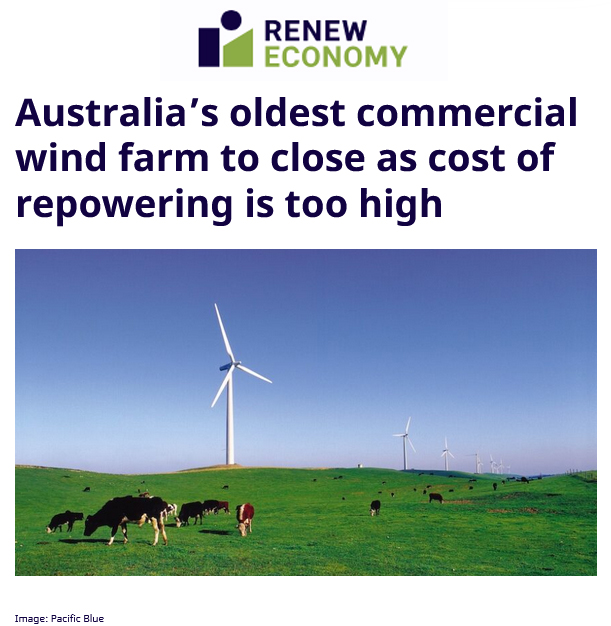
By Jo Nova
Repowering with intent to deceive…
When the subsidies run out, and an old industrial wind plant is due to be demolished and rebuilt, there are perfectly good English words the industry could use like demolish, rebuild or replace, but instead they call it “repowering” — as if we could just plug a bigger extension cord in and let those turbines grow.
In the headline above, Reneweconomy could have just as easily have said the cost of “rebuilding” the old wind farm was too high, and most of the country would know exactly what that means. Instead “repowering” sounds like a minor low cost maintenance job. Nothing to see here!
Think of the difference between someone saying they want to repower your house compared with saying they’re going to demolish and rebuild it…
You might agree to a little repowering without thinking about it. And that’s the point isn’t it? To sneak in a giant civil works operation and a set of 200 meter towers with blades bigger than the wingspan of a Jumbo Jet. Those new foundations will need 3,000 tons of concrete each. Just call it repowering!
Old industrial wind turbines are only 1MW or so, but the new ones are 6 to 8 MW. That’s six times more powerful, and nearly three times as tall. Obviously, none of the old bearings, gears, blades or footings will be reused in the new towers. Ironically, the only thing about repowering that doesn’t change is the power-cord.
It also hides the short, pathetically non-renewable, life of the old wind turbines
Old wind towers don’t die, of course, it is unmentionable, they just get repowered. (Don’t think about the cost, the waste, the disposal. Don’t think about how coal plants run for 50 years.) Shh!
The term is an official industry term now, o-so-conveniently, and even the commentators admit in the details that it means a complete rebuild.
Repowering a wind farm involves completely decommissioning the existing site – nothing can be reused except perhaps the connection to the grid. — Reneweconomy
So the underlings of the industry just absorb the term and use it in their press releases. But someone in a deep-marketing-bunker had to come up with the deceitful PR term in the first place, and they were not hoping you would understand it. It was never meant to inform — only to reframe.
Out with the old, in with the subsidy:
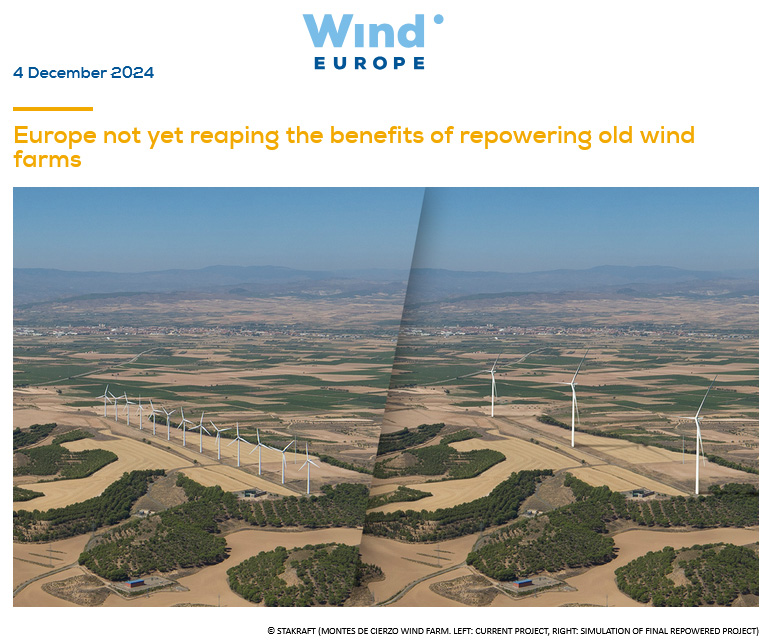
Think of “Repowering” as a shield to deflect attention
Before long, the absurdly meaningless marketing word fills headlines, legal documents and precious seconds of our day. And harried, heavily-taxed voter’s eyes glaze over. Less of them notice that renewables are not renewable, or that the cost of all this demolition and construction must be pushing up electricity bills. The local community-group leader might not pay attention until too late, when the trucks arrive with the supersize 747 wings and 18,000 tons of Repowering Concrete.
Every abused word is a win for the parasites unless we name and shame them for the deceit. The Collectivist Left wordsmiths abuse language all the time (and the foolish Right let them get away with it). Climate change used to mean the climate changed, but now it means your car causes cyclones. Liberal used to mean free. The word-thieves steal perfectly good words and distort their meaning. They destroy our common language one word at a time.
Our language is our heritage. It is our power to understand. Tell the children we must protect it.
9.9 out of 10 based on 128 ratings
The solar arc reaches it most Northerly point on the Earth.
9 out of 10 based on 28 ratings
 Bogong moths resting in caves in the Snowy Mountains. Photo by Eric Warrant. The Conversation. By Jo Nova
First insects to use the stars to navigate?
Each year thousands of Bogong moths hatch all over Eastern Australia. Somehow they fly 1,000 kilometers to caves in the Snowy Mountains that they have never seen. Once inside, they hang around and do an insect form of hibernation in the cool Alpine caves through the heat of summer. When autumn comes, they fly 1,000 kilometers back to where they came from so they can breed, and keel over. Next year their children make the exact same trip.
Researchers managed to catch some moths and put them in flight simulators (for real) where Earths magnetic field was neutralized, so they could figure out if the moths could navigate without it. Somehow they “tethered” the moths, and showed them night sky and lo’, behold, the moths still tried to fly in the right direction. When the sky was flipped, the moths reversed course, and when the stars were randomized, the moths were confused.
Ponder that the stars revolve through the night, the moon comes and goes, and the constellations change with the seasons. Somehow an insect with a brain a tenth of the size of a-grain-of-rice was able to fly straight through the night as the night stars revolved around them. They were not fooled by the moon. And, they weren’t following other moths that knew the way. Months later they could reverse that path and fly back through different seasonal star patterns to get to where they started. Freaky weird stuff.
Somehow they were born knowing how to find caves 1,000 kilometers away. The trip was, apparently, hard-coded in their genes. It’s pretty wild…
Which raises tricky questions about what other complex behaviours might be hard-coded in our own genes that we don’t know about?
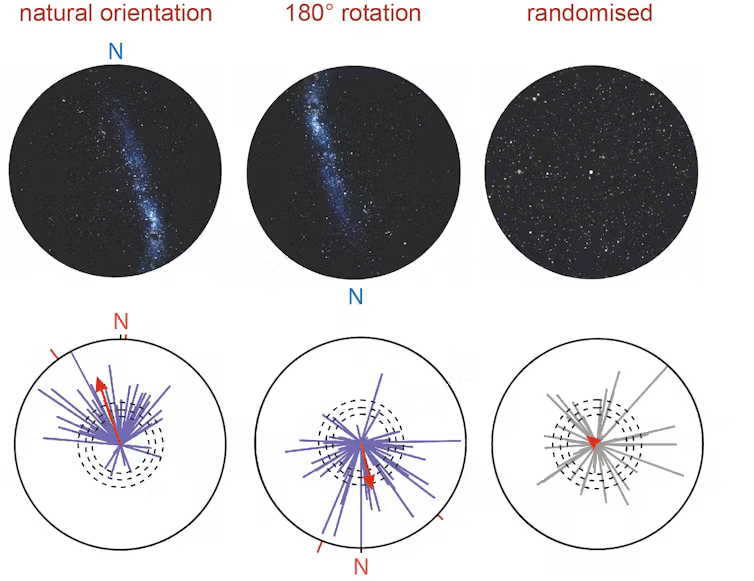 Eric Warrant. The Conversation. https://theconversation.com/ Eric Warrant, The Conversation
First we light-trapped bogong moths that were either migrating towards the Alps in spring or away again in autumn. We next placed them in a special flight arena inside the lab, and finely controlled Earth’s magnetic field (with magnetic coils around the arena) and the starry night sky (by projecting a highly realistic starry night sky on the roof of the arena).
Because we already knew bogong moths have a magnetic sense, we used the coils to completely remove, or null, the magnetic field in the arena.
What we found next astounded us. Using only the local Australian starry night sky projected above them, bogong moths flying in our arena were able to discern and follow their inherited migratory direction – both in spring and in autumn.
If we turned this projected sky by 180°, the moths turned and flew in exactly the opposite direction. If we then took all of the stars in this projected natural sky and randomly distributed them across the roof of the arena, the moths became completely confused and lost their ability to migrate in their inherited migratory direction.
The moths can also use the Earth’s magnetic field, so when nights are cloudy they can still navigate. The thinking is that moths have to escape the heat of summer in the outback, so they must find those caves. Presumably, they started, eons ago, living in the mountains near the caves and then gradually expanded their territory to the north and west until they were flying 1,000 kilometers away to breed.
It goes without saying that having survived five or ten million years of ice-ages, droughts, and asteroids, the Bogong Moth is now *threatened* by man-made CO2 (of course). Like all good university research projects are.
h/t Willie Soon.
REFERENCE
Dreyer, D., Adden, A., Chen, H. et al. Bogong moths use a stellar compass for long-distance navigation at night. Nature (2025). https://doi.org/10.1038/s41586-025-09135-3
9.7 out of 10 based on 76 ratings
8.4 out of 10 based on 13 ratings
By Jo Nova
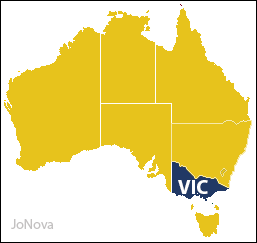
The Victorian state electricity grid is running close to the wire
They’ve run their largest coal plants into the ground — to the point of neglect where an air duct “detached from the boiler end and fell to the floor”. So one 380MW unit will be out of action at Yallourn for two weeks. And it’s just the latest in an ongoing series of failures.
We are the Renewable Crash Test Dummy — this is what the unfree, fixed, forced market produces when the best assets in a system are treated like planet-wrecking trolls.
A Hi-Tech transition, my foot…
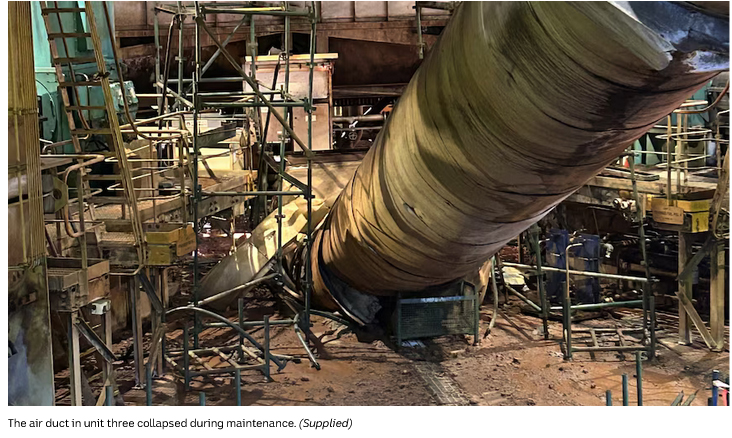 An Air duct collapses at Yallourn Power plant. ABC News https://www.abc.net.au/news/2025-06-09/yallourn-power-station-outage-air-duct-collapse/105394406 The Net Zero forced transition is just vandalism of a perfectly good electricity grid.
The whole 1,450 MW plant at Yallourn makes 20% of the state’s electricity, but has been described as “limping” along into retirement –– (a lot like Victorian manufacturing.)
One report on the power station found that at least one of its four generators was out of action for a third of the time last year. Yallourn was supposed to close in 2032, but under siege from heavily subsidized unreliable generators, and a rigged market, that’s been brought forward to 2028.
It doesn’t help that it is owned by EnergyAustralia which is a wholly owned subsidiary of China Light and Power (CLP) Group. Presumably the CCP won’t mind at all if Victoria burns less coal, loses more smelters and can’t compete with it in the race to build data centres?
Things got so hairy last week, Paul McArdle of WattClarity has written nine articles about “June 12th”, when the wind power (marked in green) produced virtually nothing of the state’s electricity. (Graph from Anero.id)
The state used 13% of their annual gas supply to keep the lights on for three days.

Saner heads are pointing out the obvious risks:
The Queensland government told the Victorian government off, saying it couldn’t keep “bailing out Victoria’s bad decisions”.
And CEO’s are calling for more coal and gas to give the system a buffer and warning that it could fall over any time:
By Perry Williams, The Australian
The transmission giant delivering the roll-out of renewables infrastructure has advocated for authorities to accelerate the development of gas plants and retain a buffer of coal after warning the power grid has been “stripped thin” of supply.
Transgrid chief executive Brett Redman, a former boss of AGL Energy, said it was time to prioritise putting “more buffer” back into the system.
“We’ve really stripped the system very, very thin. And so the events a couple of years ago where we nearly saw widespread outages and even what’s happening in Victoria in the last couple of weeks, we are in this world now where you cannot predict exactly when it will happen.
Meanwhile China Light and Power (who own EnergyAustralia) effectively said they are committed to “Net Zero” (in other countries):
 EnergyAustralia told The Australian it had made a pledge for net-zero emissions by 2050 and “closing Yallourn by 2028 is part of that commitment”. EnergyAustralia told The Australian it had made a pledge for net-zero emissions by 2050 and “closing Yallourn by 2028 is part of that commitment”.
Why aren’t EnergyAustralia committed to keeping the lights on, keeping electricity prices low, and serving Australians? Hmm?
Does anyone really believe energy companies care about fixing the planetary weather a hundred years from now, or that it is appropriate for them to pursue their storm-stopping-witchcraft with essential public infrastructure?
What kind of lunacy is this? Not that they say it, but that we accept these ridiculous lines?
10 out of 10 based on 104 ratings
7.8 out of 10 based on 12 ratings
8.3 out of 10 based on 18 ratings
By Jo Nova
Seismic backflip — NetZero unravelling in real time around us
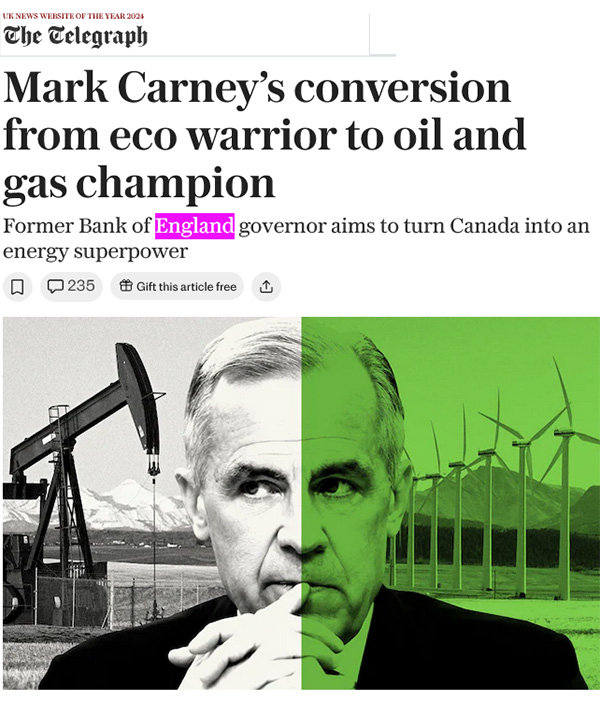
Mark Carney, recently elected the new PM of Canada, was Mr Net Zero Banker-man himself. Once upon a time, he was Governor of The Bank of England, and was so passionate about saving the planet, he set up a cartel of bankers called The Glasgow Financial Alliance for Net Zero (GFANZ). Since 2021 this was the black hole sucking in national energy policies. At one point, all the bankers in GFANZ cumulatively managed $130 trillion dollars worth of assets — that’s trillion with a T — meaning it was so large it was five times bigger than the US economy. As if that wasn’t bad enough, they were in cahoots with the UN and were essentially acting like a quasi world government, setting targets and rules and bossing democracies around by boycotting loans to legal oil and gas companies. GFANZ were eventually neutered by 19 Republican States in the US who fired off legal anti-trust and fiduciary duty salvos.
The new Mark Carney seems to find Donald Trump more frightening than Climate Change
Never mind about the sixth mass extinction, Mark Carney now wants Canada to dig up more oil and gas so they don’t have to buy it from the US. What matters is not whether his great grandchildren will bake in a catastrophe — but whether he can win a trade war with Donald Trump and stop him stealing Alberta:
Thanks to @NetZeroWatch
By Johnathon Leake, The Telegraph (UK)
Once considered the Bank of England’s greenest-ever governor, Mark Carney has seemingly undergone a Damascene conversion.
During his time at Threadneedle Street, he called on the world to leave 80pc of oil and gas in the ground.
But now, as Canada’s new prime minister, he wants to pump as much as he can to protect the country’s economy from Donald Trump’s trade war.
Canada is going to become an energy powerhouse, Carney told reporters last week…
Mark Carney was dropped in as Prime Minister in mid-March, but facing an election, the first bill he signed was to kill off the carbon tax — something the opposition leader, Pierre Poilievre, was campaigning heavily on.
Meanwhile, Alberta, the energy rich “engine” of Canada, was talking about seceding if he won, fed up with all the carbon rules and “Liberal neglect”. But suddenly Carney went on to promise to build oil and gas pipelines, set up LNG export terminals and undo the restrictions on carbon dioxide emissions. All the Trump talk of Canada becoming the 51st State and the imposition of tariffs may have slayed their carbon tax, and triggered new gas pipes and ports for Canada.
UPDATE: This is not a case of Trump Derangement Syndrome. Trump is a real threat (to Canada’s poncy green delusion). Carney is a smart guy (he’s selfish, serving the UN-banker-blob, but he’s not stupid). Trump has dropped the tariff bomb on Canada’s economy — he sees the weakness in the Canadian position and has upped the ante. Trump holds the cards. Carney knows he has to make Canada more self-sufficient. So paradoxically, Carney has to act like Trump, and not like a Greenie Banker, or Trump will be able to blow up Canada’s economy and even split the country in half. If Alberta leaves, there goes massive resources, and possibly British Columbia, Saskatchewan and Manitoba too.
Anthony Albanese is not that smart. But if he was, he’d be paying close attention to the Canadian situation. Trump is about to point out how utterly dependent Australia is on the USA.
Amazing what Donald Trump can achieve:
By Nadine Yousif, BBC News
Canadian Prime Minister Mark Carney said his government will start pushing legislation that would fast-track ambitious national projects to boost Canada’s economy, now faced with Donald Trump’s tariffs.
Carney said his plan is to narrow down a list of so-called “nation building” projects – like pipelines, nuclear reactors and trade corridors – and create a framework in which the projects would be approved in under two years’ time.
Apparently large gas pipelines are all OK now, just say the magic words: “carbon capture”.
UPDATE: Obviously the futile and useless “carbon capture” is just the marketing cover to hide that Mark Carney has just flipped 180 degrees. Carney doesn’t now, and probably never did give a damn about CO2 (he would have promoted nuclear power if he did). Right now he is playing poker against Trump but needs some fakery to pretend this is not complete capitulation and the end of the green fantasy. Carney is just putting out breadcrumbs for the green serfs, so they don’t revolt.
Bloomberg, June 3, 2025
Mark Carney said he sees opportunity for Canada to build a new pipeline to ship more oil to foreign markets, if it’s tied to billions in green investments to reduce the industry’s environmental footprint.
Carney said Canada still aims to ease trade tensions with US President Donald Trump, but in the meantime it must scrap internal trade barriers and build national-scale projects in order to take matters “very much into our own hands.”
“We will be a superpower when it comes to energy of all forms,” Ontario Premier Doug Ford said in his own remarks. “That’s our goal today, to make sure that we have large, national infrastructure projects that will benefit every Canadian from coast to coast to coast.”
Though the Bloomberg team that wrote carbon capture in the headline did not mention it in the story. Shh! The Blob-Media is helping Mark Carney pretend that oil and gas pipes can be green.
The US is the worlds top producer of oil at the moment, with 44 billion barrels of oil in reserve. Amazingly Canada has four times as much — or 171 billion barrels of oil in recoverable reserves, says the Telegraph. It’s amazing how stupid rich countries can be — to leave, as Alberta’s premier says, “$9 trillion worth of oil wealth we have in the ground”?
Speaking of stupid, perhaps the greatest and saddest irony is that Mark Carney once was the green-extreme Governor of the Bank of England. And while there, he helped tie the UK down in carbon markets and energy transitions that still cripple their economy. Can Trump save the UK too?
10 out of 10 based on 102 ratings
8 out of 10 based on 17 ratings
7.4 out of 10 based on 23 ratings
|
JoNova A science presenter, writer, speaker & former TV host; author of The Skeptic's Handbook (over 200,000 copies distributed & available in 15 languages).

Jo appreciates your support to help her keep doing what she does. This blog is funded by donations. Thanks!


 Follow Jo's Tweets
 To report "lost" comments or defamatory and offensive remarks, email the moderators at: support.jonova AT proton.me
Statistics
The nerds have the numbers on precious metals investments on the ASX
|






Recent Comments