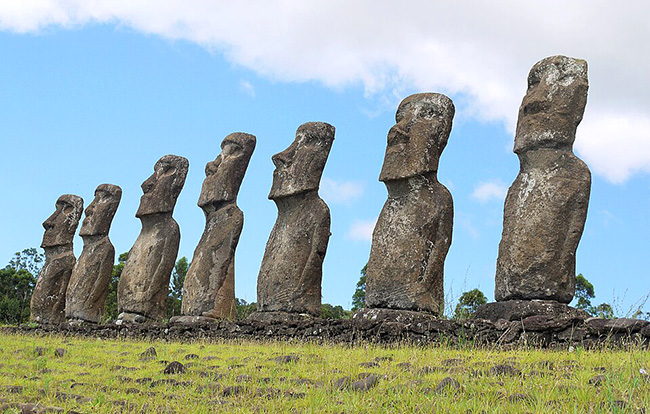
By Jo Nova
Yet more proof that mother nature is far worse than man-made climate change.
The extinction of tall trees and land birds on Easter Island became the apocryphal story of a man-made ecological disaster, but a new technique for estimating rainfall shows that there was a terrible drought starting in 1550AD that lasted for 100 years. This would have been a bit dire on a small island that doesn’t even have a river and relied on a crater lakes.
In recent times, catastrophic climate change has apparently reduced rainfall by 370mm. But starting around 1550AD rainfall declined by a shocking 600 to 800 mm per year. Despite the severe drought the population wasn’t wiped out — their population doesn’t seem to have collapsed. The rainfall shift coincided with many cultural changes and even the development of rock gardens called lithic mulching – where farmers get desperate enough to use rocks as ground cover and a soil improver to keep the evaporation rates down.

https://www.nature.com/articles/s43247-025-02801-4/figures/3
At the same time as the rain declined, the people changed the way they live...
Notable cultural shifts also took place during this time. Fewer ceremonial ‘ahu’ platforms were built, and Rano Kao became an important ritual site. A new social system called Tangata Manu emerged, in which leaders were chosen through athletic contests rather than through family ties to the moai statues.
The new rainfall estimate comes from Stein et al, who found a way to estimate rainfall using hydrogen isotopes in leaf wax.
“We think leaf waxes on Rapa Nui are only recording information about local rainfall and aridity,” lead author Redmond Stein explained. By measuring the ratio of “heavy” to “light” hydrogen preserved in those waxes, the researchers reconstructed 800 years of rainfall history. The data shows that rainfall declined sharply in the mid-1500s and remained low for more than a hundred years.
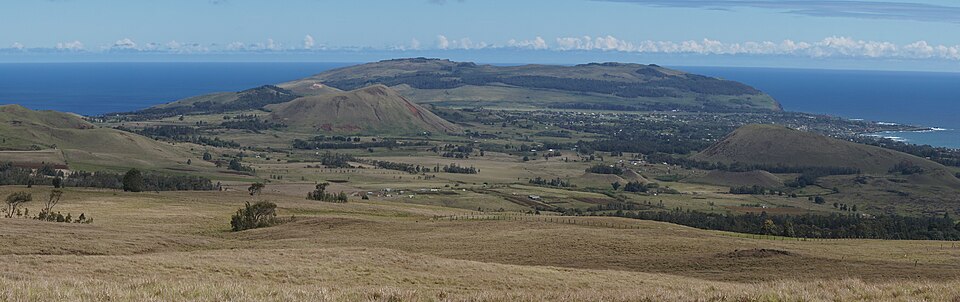
Easter Island has no permant rivers. | Photo by kallerna
So rather than being the foolish people who built stone statues and chopped down every last tree, the people of Rapa Nui are a remarkable survival story.
I’ve written about Easter Island at length in “What if Easter Island was a sustainable success story instead of an ecocidal disaster?”
Benny Peiser (of NetZeroWatch fame) published a research paper detailing how the real disaster was when slave traders, whalers and others came in the 1800s.
This tiny patch of land was discovered by European explorers more than three hundred years ago amidst the vast space that is the South Pacific Ocean. Its civilisation attained a level of social complexity that gave rise to one of the most advanced cultures and technological feats of Neolithic societies anywhere in the world. Easter Island’s stone-working skills and proficiency were far superior to any other Polynesian culture, as was its unique writing system. This most extraordinary society developed, flourished and persisted for perhaps more than one thousand years – before it collapsed and became all but extinct.
Naturally the media doesn’t mention any of this, instead the headlines talk about how the “enigmatic” the collapse was and how it was more “complex” than anyone thought. These are just weasel ways to not-admit they were wrong.
UPDATE: The drought on Easter Island coincides with the Little Ice Age
A cooler world is usually a drier world, because there is less evaporation. Why would anyone want a cooler world? — Thanks to TdeF, El Gordo and Mike Jonas for the reminder.
REFERENCE
Stein, R., Curtin, L., Balascio, N.L. et al. Prolonged drought on Rapa Nui during the decline of megalithic monument construction. Commun Earth Environ 6, 865 (2025). https://doi.org/10.1038/s43247-025-02801-4






.jpg)

Warmists think the world is static and never changes (as did Aristotle), despite the changes, even in historic times, of the climate optima of the Minoan, Egyptian, Roman and Medieval warm periods. Some warmists like Michael Mann have even erased the Medieval Warm Period from their data to conform to the Official Narrative. Australia’s BoM doesn’t use data before 1910 in the official record etc.. It’s only a matter of time before they deny this natural Easter Island “climate change”, and maybe even Greenland’s as well, the more favourable climate of which, back in the day, led Eric the Red to settle there.
310
So why isn’t Greenland called Redland in honour of Eric – or was he really more orange than red… hence Donald’s claim on it to rename it Orange-Land.
181
Is it true the Greenland might agree to become part of “The Green States of America” – but only if it is split into at least four states?
Four states, means 8 Senators.
And perhaps the Greenlanders won’t vote for Trump’s Republicans; so – bang goes Trump’s Senate majority …
Auto
31
It was advertising. Nobody would sign up to move to a place called Iceland.
00
That name was already taken and people, including Eric the Red himself, did move from Norway to Iceland.
00
There have been periods of anomalously wet weather experienced by early European settlers in the United States or Australia which led them to settle or apply inappropriate farming techniques, only realising later that the weather they experienced was not typical.
Examples include the American Great Plains, 1870s–1920s and colonial Australia 1790s–1830s.
It’s not a good idea to have a static earth world view.
Dorothea Mackellar recognised this in her famous 1904 poem, My Country.
320
Yes, hence the Goyder line in SA.
But wasn’t MacKellar’s poem at least a little of the sentiment of yes it’s a crappy place but it’s my crappy place so stick your green and pleasant land where the sun doesn’t shine?
150
Was it Mitchell that reported plains of grass as high as a horses belly in Western Victoria and South Australia, only to be called a liar when the graziers turned up to find a barren landscape? He had gone through in a “good” year, the pastoralists had turned up in a “bad” year. First example of the droughts and flooding rains analogy?
220
A number of historians have noted that the arid zone in Australia expanded east and south in the 1880s, the same time that the intervals between El Ninos decreased by several years.
60
Easter Island sits just to the west of the evaporation zone of the eastern Pacific. The air in circulation with the South Pacific current gets de-humidified as it transits the Southern Ocean and gains moisture as it comes up the west coast of South America.
https://earth.nullschool.net/#current/wind/surface/level/overlay=total_precipitable_water/orthographic=-107.88,-28.60,284/loc=-109.811,-29.136
If Easter Island was further west, it would see even less rain.
Antafagasta is a little further north than Easter Island but on the west coast of South America. It has an annual average rainfall of 48mm. Nothing grows there unless it is watered. In 1991. Antafagasta experienced 42mm of rainfall in one night that washed most of the place into the Pacific Ocean because there was no vegetation to prevent or slow mud flows.
https://en.wikipedia.org/wiki/1991_Antofagasta_mudflows
270
What a pile of facts! Facts are completely irrelevant to established UN consensus science since 1988 that CO2 controls all the weather across the planet by warming the air everywhere. That extra degree warms the oceans rapidly and causes universal evaporation and storms. Sooner or later a terrible storm will hit the Easter Island. And it will be our fault for failing to buy enough Chinese electric cars. At least Australia’s Teals are blameless. They all have electric cars.
400
I can’t wait until the usual suspects step up to the plate and say “97% of scientists…” blah, blah, blah…
230
97%? I heard a former children’s TV presenter had updated it to 99.99%
But of course Dr Karl isn’t and never has been a scientist by training or practice.
[As it happens, Karl has a BSc in Physics, a MS in Biomed Eng, and a Medical degree. Which makes it all the more baffling that he argues with fallacies. But this is headed off topic, so let’s take it to the unthreaded. – Jo]
150
I would like to think that my doctor dealt in observed facts rather than consensus “science”. I suppose he believes the propaganda on the pharmaceuticals he flogs as cures.
30
Although Easter Island, one of the most isolated tiny spots on the planet, is in the news. Nothing much has happened since the Bounty mutineers arrived. Now it is being hit by a topical storm.
80
The Bounty mutineers went to Pitcairn Is.
250
Then were transferred to Norfolk Island. I was there recently talking to some of the descendants. Fascinating Australian history which no children would be taught in today’s State schools.
160
Probably too dry, even then. 1000km West of Pitcairn.
60
And Pitcairn is truly tiny at 1mile x 2miles. Owner occupied. Mountain and beach views.
50
Norfolk Island is only one third the size of Phillip Island in Victoria. 1700 km. by air from Sydney. It’s a wonderful place every Aussie should visit.
50
So a very slow near linear increase in CO2 now amounting to 50% over 250 years has caused Global Warming and that has caused a drought in the middle of the Pacific Ocean? With science like this who needs Voodoo?
Also droughts are a lack of rain, not an indication of warming but of cooling. A lack of evaporation and that to lower ocean surface temperatures as all rain comes from the ocean. Lower rainfall indicates a substantial cooling ocean surface in the South Pacific, which is very significant given that the Pacific covers half the planet. So how does that fit with a single Global Temperature?
This single Global World Temperature just doesn’t work.
It’s like the family of 2.5 which doesn’t exist either. It has always been a question whether air temperatures in such different areas, the South Pacific, The North Atlantic, Antarctica and the Arctic ocean, Africa, Asia have any connection at all and a golf ball model of the planet is even useful, given 75% is covered in water which reacts to temperature changes and controls temperature changes.
As for CO2 changing air temperature which changes water temperature, it’s like trying to heat a swimming pool with a hair dryer. But it was a very convenient lie for Al Gore in his first tilt at the US Presidency. And like L.Ron Hubbard, he cannot believe how successful it has been.
291
It is all very interesting.
The one great mystery, to me at least, is what triggers el nino and la nina events. That would explain a great deal.
91
Ocean oscillations. Sloshing. Unlike in air, heat travels in rivers in the ocean
120
Actually, I think heat flow in air (advection) is similar to water. Rivers in the ocean equals ocean currents.
Like wise there are atmospheric currents but they are much shorter lived and not constrained by land boundaries. North winds bring hot days to Melbourne whereas Southerly winds bring cooler air.
01
‘ … what triggers el nino and la nina events.’
Its fairly clear that a marine heatwave in the south east Pacific is in the frame for triggering a strong El Nino. It connects with the Peru Current and heads towards the equator, but as you can see on this occasion its been stifled.
https://classic.nullschool.net/#current/ocean/surface/currents/overlay=sea_surface_temp_anomaly/orthographic=-106.11,-11.91,265
So we should expect a Modoki El Nino later this year.
To answer your question, the cold water tap is always on unless that marine heatwave turns it off. Its also worth noting that during the Holocene Climate Optimum the ENSO phenomenon did not exist.
51
Forrest Gardener: “The one great mystery, to me at least, is what triggers el nino and la nina events.”
Not just for you Forrest. This is the single biggest climate and weather phenomenon on the planet currently and the IPCC and 4000 Experts cannot predict El Nino or La Nina more than a few months in advance and often not even then. Obviously they have no idea what drives the oscillations of the largest ocean on Earth.
It is the reason they can’t tell farmers in most of the world whether they will have a BBQ summer or a wet one.
130
I compare it to waiting for a specific item of clothing to rise to the top in a clothes washer. The amount of heat stored in water is incredible. Oceans never freeze. The very deep dense oceans cannot cool down except at the surface which is tiny. They are too cold to radiate. Evaporation is the result and so all rain. It rains heavily most afternoons in the tropics, like the near equatorial island of Singapore, regardless of CO2. And they are always moving on this rotating planet.
A difference of 1C at a certain depth corresponds to vast energy climatically. Consider the Gulf stream, the body of water which changes the climates of Western Europe. It is the fastest ocean surface river in the world at 9km/hr. One mile deep and 100 miles wide it travels for 12,000 miles in a giant gyre. A free ride home for the tens of thousands of little boats which went to Cape Cod and created the mass migration to America before the gold rush of 1849.
Driven by centrifugal force, not thermal expansion like air, the Gulf Stream pumps vast Carribean solar heat to Norway along a great circle. Now consider that the ocean is on average alone 3.5km deep, 2 miles and most of it is in the Pacific which takes half the heat input from the sun. The presumption that it is a giant oscillator with a single frequency is unrealistic. Sloshing would be my explanation. And like the old expression, the Pacific still waters run deep. Fourier time analysis of temperature data may produce strong cycles. But to postulate that the 3D motion of the greatest store of surface heat on the planet is irrelevant compared to CO2 is pure folly. Any thinking person would guess that ocean and sun cycles control all climates. And the ocean cycles vary with the path of great oceans as different bodies of warmer or cooler water rise to the surface, not human activity or tiny monotonic very slow changing CO2.
I would not be surprised if the change in CO2 is ultimately caused by the 98% of CO2 in oceans, but the change is so small and so slow it would be very difficult to prove. However to argue that CO2 is critically important would have to be proven. The one great credible temperature analysis I have seen shows CO2 is irrelevant over the last 250 years in Europe with real thermometer data.
90
I was amused decades ago in Las Vegas with the sight of some bikini clad women in a small pool at the back of an Americcan mobile aircraft carrier or land yacht or stretch limo, whatever. In traffic.
But I also wondered how they stopped for a traffic light without dumping a few tons of water and occupied bikinis on the driver. A mobile swimming pool with acceleration and brakes and goes around corners? Like the oceans.
We look at the oceans as generally immobile, but they are spinning and the total heat they contain is immense and trapped. +1C change in water temperAture corresponds to +1600C in air for the same volume. Which is why air does not heat oceans but oceans control the air. Plus evaporation which carries both CO2 and H2O into the air all the time, non stop.
Our absurdly focused model of air temperatures critically dependent on Al Gore’s CO2 level alone is laughable. But if we had complete maps of the energy travelling in the world’s oceans, we could built a model of El Nino and predict climates around the Pacific rim which are so obviously coupled, like Peru/California and Australian droughts. But think of the Carbon Taxes you do not collect. And the fees going to China. Nothing gives like fantasy science disgracefully enshrined in Australian law.
80
The Gulf Stream is a good example of advection, but in the south east Pacific we see a marine heatwave which they claim is caused by blocking high pressure.
This is based on flimsy evidence, whereas your suggestion that centrifugal force is the most likely driver has a lot of merit.
https://en.wikipedia.org/wiki/South_Pacific_Gyre#/media/File:South_Pacific_Gyre.png
10
Many thanks Tdef.
My follow up question is whether the overall heat content in the oceans is steady or increasing.
In my mind increasing would explain the el nino/la nina being a bit like heat being released from the surface in a sort of belching action or as you say like a warm or cool item of clothing coming to the top in a washing machine.
And of course it is entirely possible to me that the overall heat content is sometimes steady, sometimes increasing and sometimes decreasing.
00
Actually the Incas had a method of predicting El Niňos a few months in advance that was better than nothing. They observed the brightness and apparent size of the Pleiades, or Seven Sister, constellation in June. If the constellation appeared hazy due to increased moisture from a warming Pacific then an El Niňo event was more likely.
20
Were they the guys who pulled human hearts out to study the weather?
Probably a bit drastic, but no more inaccurate than modern government forecasters.
00
There are a couple of studies on the cause of El Niño / La Nina. Both point to sea floor eruptions in the tropical mid Pacific Ocean. Dr Plimer sees it as possible but short on evidence presently.
John
40
If we focus on the Aleutian Island arc there are at least 100 hydrothermal vents.
‘The maximum measured temperature of the hydrothermal fluids was 133 °C, although the actual temperature may have reached 250 °C. Both the Kurile and Aleutian Arcs have the potential to host major submarine hydrothermal systems.’ (Glasby et al 2006)
10
Thanks very much Jo for trying to educate us about historic NATURAL CC and yet left wing loonies still prefer their AIT BS and Gore made millions of $ from his silly movie.
But there are many proxy studies that tell us about terrible droughts all over the world.
BTW Jo Nova’s SW WA area suffered terrible droughts for hundreds of years and was recently highlighted by the O’Donnell study a few years ago.
200
Even their ABC referred to the Alison O’Donnell study of the WA wheat belt.
The period since 1900 was the wettest period since 1350 and many terrible droughts over those centuries.
Recently this area has suffered from reduced rainfall while overall WA rainfall has increased. See the BOM data I’ve linked to many times.
Here’s their ABC link and many bad droughts from the first fleet onwards during our short settlement history.
https://www.abc.net.au/news/2021-05-26/australias-hidden-history-of-megadroughts/100160174
90
Cooling leads to less rain leads to warming leads to more rain leads to cooling. Climate is full of negative feedbacks. CO2, though, has positive feedbacks that treble its effect? It’s distressing that the lie has lasted so many decades. It seems like all of the organisations set up to work for us work against us. Is that a kind of mega negative feedback? Will our civilisation last as long as Easter Island’s did?
191
BTW here’s the WA rainfall since 1900 and much more rainfall since 1970 or last 55 years.
https://www.bom.gov.au/cgi-bin/climate/change/timeseries.cgi?graph=rranom&area=wa&season=0112&ave_yr=7&ave_period=6190
60
Again, here’s SW WA rainfall and it’s reduced since the 1970s.
Tricky stuff co2 because it can have the opposite effect over the same state.
And if you BELIEVE that you’ll BELIEVE anything.
https://www.bom.gov.au/cgi-bin/climate/change/timeseries.cgi?graph=rranom&area=swaus&season=0112&ave_yr=7&ave_period=6190
50
Perth faces drought.
Well it is obvious that the early settlers were wrong to settle Perth at the present site.
Inhabitants who believe the BOM should start demanding that the State Government moves Perth to a better watered site.
How about Broome?
30
Again, just to make things clear for our true believers, SW WA average rainfall is about 651 mm and overall WA average rainfall is about 342 mm.
Yet the high rainfall SW corner has been falling for decades and the rest of WA has increased rainfall since the 1970s.
And if you really, truly believe it’s the tricky co2 driver you should swallow a bex and have a good rest.
70
Yet overall wheat production in the WA wheat belt has increased over the last 25 years.
WA wheat yields graph is in RED, see the state graphs links since 2000. IOW our farmers in Australia are very efficient.
https://www.bing.com/images/search?view=detailV2&ccid=MC%2FCEVKy&id=4A35AD1A3955BBB3B0F006FFB3272AA18E443D05&thid=OIP.MC_CEVKyuSKHO6dU8O-V3gHaFa&mediaurl=https%3A%2F%2Fmecardo.com.au%2Fwp-content%2Fuploads%2F2025%2F06%2F10-06-2025-Figure-2.-Australian-wheat-yields-1.png&exph=1265&expw=1730&q=western+australian+wheat+yields+since+the+1970s%2C+graphs&FORM=IRPRST&ck=E1FA3D6EED362C2F8C7BFB1AF65BBF0A&selectedIndex=0&itb=0&cw=778&ch=361&ajaxhist=0&ajaxserp=0
10
Farmers are very efficient and that increase in yield is nearly all attributed to judicious application of technology. So the WA farmers have adapted. Which is a small example of the innate flexibility of human nature. As did the inhabitants of Easter Island. Which is why it is dumb to ever think mankind can control climate change. Better to say it’s all natural, nothing we can do about it and just get on with it. Build technologies that can withstand the weather extremes that have always been present anyway.
40
Mother nature? I’m over this mother nature stuff! It’s not a scientific concept. More anthroplogical and mythical like Gaia.
10
Rapa Nui / Easter Island / Te pito o te henua “navel of the world” is the 3rd point of the Polynesian triangle – along with Hawai’i and New Zealand – yet it’s the odd-man-out as Hawaii’s Mauna Kea volcano has snow on its summit (-1.2*C overnight with a -9 windchill) and NZ had a dusting of snow yesterday with more on the way tonight (plus the glaciers are still here despite rumours of their early demise).
Tangata Manu / people bird, or the Birdman Cult, inspired von Daniken (?) to popularise the flying space alien theory, as rock carvings depict winged-men with halos – as do practically every other early civilisation / religion / belief / cult – yet all they were saying was, “I’m off to get eggs for breakfast”.
And as for kumara / sweet potato, which originated in South America, being widely dispersed (and an essential food crop) across the many islands of Polynesia, adds even more intrigue to the travels of the greatest seafarers ever known – apart from Eric the Red and his Vi-kings and their women. Ahoy!
70
The Birdman Cult came about in the depths of the LIA, reflecting ideological stress from natural disaster. The cult was reinvigorated in the early 1800s because of European contact.
Off the top of my head, a third died from Western diseases and later a third was taken away by slavers.
11
Hey, old Eric did not bring his women with him. The Vikings raped and pillaged and had a particular liking for mutton.
Hence the current Scottish race.
00
It’s no wonder those stone-faced Easter Islanders look so thirsty.
20
Little known historical fact.
Easter island once had vibrant successful culture that built highly artistic monuments to celebrate their good fortune.
Unfortunately, an elite leadership class of moralistic micro-mangers arose in their population that exerted control over every thought and activity of their fellow islanders.
This group was known as the United Island and the Island Economic Forum.
This resulted in them all drowning themselves to escape their misery.
120
Two different sites support the hypothesis that when the earth cools Easter Island becomes droughty.
‘ … an almost continuous record for the last 2700 years that provided evidence for two drought phases, between ~AD 880 and 1170 and ~AD 1570 and 1720.
The peats of the Rano Aroi swamp, in the interior uplands provided a continuous record of a similar time period showing three phases of landscape opening (i.e. forest retraction) associated to drier climates at 300 BC to AD 50, AD 600 to 1100, and AD 1520 to 1700’ (Rull et al 2016)
The RWP on Easter Island goes against the grain.
41
Australia overall has had more rainfall since 1970.
And nobody would want to return to the lower rainfall of the first 50 years or since 1900.
Of course Australia is the driest continent on earth and any extra rainfall is a welcome bonus.
https://www.bom.gov.au/cgi-bin/climate/change/timeseries.cgi?graph=rranom&area=aus&season=0112&ave_yr=7&ave_period=6190
30
NSW had much lower rainfall from 1900 to 1948 and the moving average was below the line for nearly 50 years.
https://www.bom.gov.au/cgi-bin/climate/change/timeseries.cgi?graph=rranom&area=nsw&season=0112&ave_yr=7&ave_period=6190
00
As a small child of kindergarten and then primary school ages I remember visiting relatives in a village close to the QLD Border and Mount Warning and hot days, afternoon thunder storms and high humidity evenings and into the early hours.
10
Qld has had more even rainfall over the last 75 years and higher peaks every few decades since 1950.
https://www.bom.gov.au/cgi-bin/climate/change/timeseries.cgi?graph=rranom&area=qld&season=0112&ave_yr=7&ave_period=6190
00
The NT had much lower rainfall from 1900 to 1970 and much more rainfall over the last 55 years.
IOW like chalk and cheese.
https://www.bom.gov.au/cgi-bin/climate/change/timeseries.cgi?graph=rranom&area=nt&season=0112&ave_yr=7&ave_period=6190
10
SA has had more rainfall over the last 75 years and the period of 17 straight years of below average rainfall from about 1921 to 1938 is the worst recent drought in Aussie history.
https://www.bom.gov.au/cgi-bin/climate/change/timeseries.cgi?graph=rranom&area=sa&season=0112&ave_yr=7&ave_period=6190
10
Consider what I have posted before as discovered researching Trove newspaper articles, new settlers in the Hunter Valley 1800s when the then Port of Newcastle town of Maitland was being established and farms in the district, wharves on the Hunter River at the suburb or then village of Morpeth, the local indigenous people warned the settlers that the worst flood in their living memory and lore was up to the highest hilltop nearby. Put into prospective the worst since 1950s flooded the Maitland Main Street and business district up to shop awnings and first level floors, far lower than the hill.
The indigenous people also mentioned a very long period of drought when the tidal Hunter River above high tide reach was dry and the people had to move into the Great Dividing Range nearby where spring water was still flowing.
30
My Great Grandmother immigrated to Australia and her immediate and extended family members, many, on three sailing ships mid-1800s, and my Great Grandfather immigrated separately before they met and married in Morpeth. One of the ships my Great Grandmother and family sailed on was named “Maitland”.
Arrival time: 1838
30
Give it another few years and another “groundbreaking study” will be done on Easter Island, but this time, it’ll be correct, just like all the others.
In fact, I wonder if the themes of Easter Island research papers are not in themselves a way of tracking the zeitgeist.
Yes, perhaps I am too cynical…
I would like to visit the island though.
00
I may be behind the times, but I understood that the Easter Islanders invented Rongo Rongo, their writing system, in response to contact with Europeans. They had concluded that writing was the source of Eurpean power and advancement. They invented their own. And, again, so far as I know, the only text written in Rongo Rongo is a creation story.
00