By Jo Nova
The Command Economy Fails Again…
Only 6% of government backed wind farms have made it to a committed financial sign off. The “Capacity Investment Scheme” (CIS) was supposed to deliver 40 gigawatts by 2030. Less than a single gigawatt has been finalized. There’s another nearly 13 gigawatts sitting there on the sidelines “in the pipeline” waiting for a cash downpour or a physics miracle.
Anthony Albanese has played whack-a-mole with the free market, but nothing can make this hydra work. Every time he drops a sugar bomb on one part of the market another part gets diabetic. His genius plan to gift rich people with expensive batteries seemed like a great success — smoothing out some of the nightly wild price spikes (and for just $8 billion dollars!). But who could have guessed that the industrial wind plants were counting on making money from those price spikes themselves, and now are struggling to see how to make a profit? (Say, weren’t they the cheapest energy on Earth, and now they can’t compete..?)
Apparently the teams that bid to build wind parks for the CIS didn’t realize wars would drive up the cost of fossil fuels (which they need to build renewables) and they didn’t know inflation would ramp up (even though it was no secret that governments printed billions during covid.) And they didn’t realize that the AI wave would suck the spare electrical hardware out of the room, and leave everyone else scrambling for the last gas turbine on Earth.
Thus and verily, the price of building onshore wind has doubled since they put their bids in, and now no can afford to fulfill those bids.
If only Australia had 1000 years of cheap coal, and its own steel and electronics industry…?!
Renewable energy investment plunges to decade low as major projects stall
By Perry Williams, The Australian
The CIS has the lowest financial close success rate of any major renewable underwriting mechanism in Australia at just 17 per cent, according to Rystad. “Many of the early winners were bid on yesterday’s economics and may never reach financial close without greater flexibility,” said Gero Farruggio, Rystad’s head of Australia.
The combination of high capital spending and subdued spot wholesale electricity prices has also kept the volume of overall power purchase agreements low, on par with two of the worst years on record in the early 2010s.
“Once the backbone of Australia’s energy transition, onshore wind is now being squeezed from every direction,” Mr Farruggio said. “Batteries have eroded the price premium that once underpinned wind economics, while construction costs have more than doubled and power purchase agreements have dried up.”
Nexa Advisory chief executive Stephanie Bashir, a former AGL Energy executive, said the CIS was designed primarily to reduce merchant revenue risk. However, it was not structured to solve the practical barriers stopping projects from reaching final investment decisions.
These include “transmission delays, access to renewable energy zone capacity, network connection processes, planning and environmental approvals, construction cost escalation, community benefit obligations, and the lack of long-term PPAs,” Ms Bashir said.
It’s a multifunctional fail. Somehow, the profits are not there for developers, the power is not there for industry, the cheap electricity is not there for families, and the certainty is not there for investors — unless they get a guaranteed government handout. There’s no winner here except the Chinese Communist Party for selling us solar panels, batteries and turbines, and stealing our factories, and for the Chief Bureaucrat Sponges who fly to beachside resorts on UN holiday plans, (not mentioning any names, Chris Bowen!)
Worst of all, there’s no productivity bounce coming, not even in 80 years time. There’s no payoff to the nation if we reduce our sacred CO2 emissions. No tourism win when we become 0.0001°C degrees cooler. No steel factories waiting to move back here and make the Green Steel no one wants to buy.
Mr Bowen’s *big hope* now is that AI data centres will still want to build something in Australia with our high electricity prices, while being forced to build wind and solar projects as a penance for the “right to do business here”.
If only wind and solar power were cheap, like they told us every day for the last 7,000 days, it might have worked.
h/t Bally
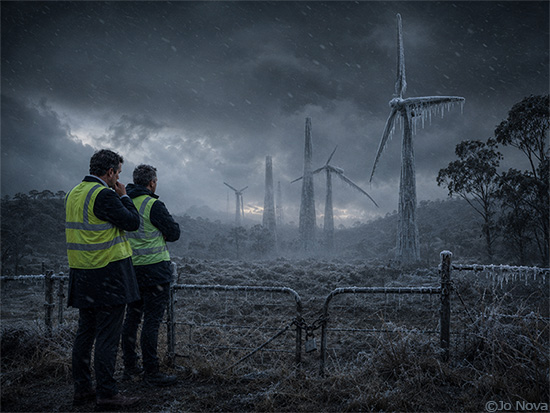
Image: Ai generated. ©JoNova