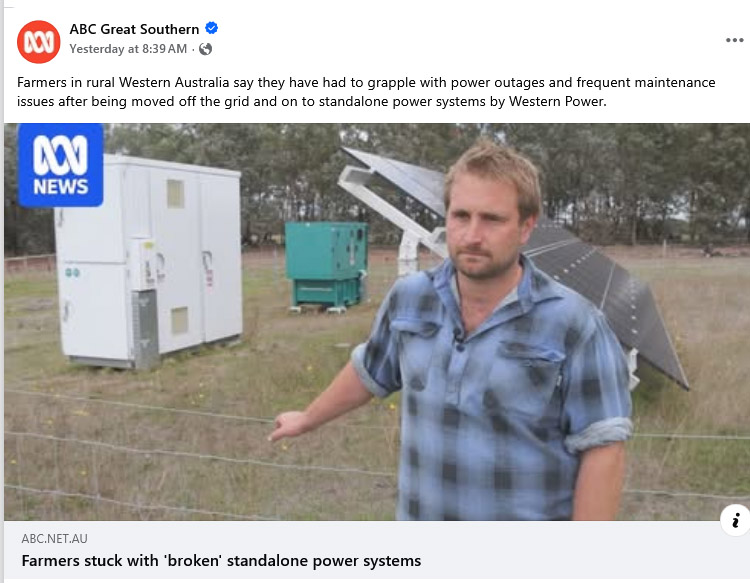
By Jo Nova
It was supposed to be so ambitious, clean and green but turned out to be unreliable, noisy and hard to live with
Things are so bad, some farmers just want the old grid back, but the government won’t let them.
Back in 2022, Western Power was excited about their big plan to get rid of 23,000 kilometers of wire in regional Western Australia by forcing about 4,000 farmers off-grid and supplying them with solar panels and batteries. As of 2026, they have installed about 500 systems. Those farmers are the guinea pigs for the forced transition, whether they like it or not.
If renewable microgrids were going to work anywhere, it is surely in sunny vast first-world Western Australia, where renewable installations are only competing with a high-cost sparse long distance network.
But it hasn’t worked out as well as they hoped:
Maintenance issues, outages plague WA standalone power systems
By Mark Bennett and Rosemary Murphy, ABC News Stateline, WA
“We probably used to get three or four power outages a year and we thought it’s going to be great, we’ll have power all year round,” Mr [Ben] Parsons said. “Since it’s been installed, we’ve had untold power outages, probably getting up towards 70 power outages.“
He has asked Western Power to switch him back on to the main grid, but the utility rejected his request. “We’ve had kids in the bath, and the power’s dropped out, 7 o’clock at night middle of winter pitch black, you’ve got kids screaming in the bathroom,” he said. “It sounds like the generator is right outside the kids’ bedroom. My seven-year-old said to me the other day, ‘Oh Dad what’s that noise I can’t get to sleep’ … and it was the generator running.”
Big-Government isn’t giving people any choices. They turned up at one 85 year old’s house and told her they were cutting off her power and installing a standalone system. She had no warning. And apparently under the legislation, this is all fine, they don’t need to ask permission, and if you refuse them access to your land, they’ll just get a warrant.
According to Western Power 96% of customers are getting more reliable power now. The noise might be driving them nuts, but at least it’s reliable.
Here’s what the ABC was saying just 4 years ago –” It’s just a simple piece of technology, right?”
Farmers are getting renewable Standalone Power Systems as Western Australia’s regional power grid is dismantled
— By James Purtill, for The ABC, 2 Oct, 2022
Each “Standalone Power System” (SPS) is a fairly simple piece of technology, but the cumulative effect of the planned rollout will be enormous: 23,000km of wire will be taken down, or enough to string a power line around mainland Australia.
According to Western Power, no other network operator has embraced off-grid power on this scale, anywhere in the world.
[At Craig Poultney’s farm…] a fenced area contains about 60 ground-mounted solar panels providing nearly 20kW of energy, of about four-times the amount of a standard rooftop solar array. Western Power plans to install 4,000 SPS in the next decade, and up to 6,000 within 20-30 years. So far, it’s managed about 100.
But even back in 2022, there were signs of trouble. Farmers at the end of the line used to get blackouts which the solar panels and batteries were meant to improve, but if a storm knocked out the new generator or the solar panels, farmers were not allowed to switch it back on. They had to wait for an official to drive out and flick the switch, which sometimes took 12 hours.
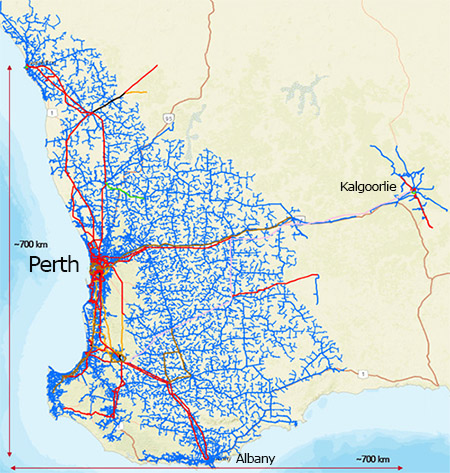
The map of the South West Interconnected System (SWIS) of Western Australia covers more than half a million square kilometers. — most of which is farmland.
The Cost, The Cost…
The key question, of course, is “what does it cost”, and “who pays” and the answer is — “unknown” and “we all do”.
The farmers are charged at the same rate for electricity as city folk and everything is subsidized, though Western Power was not saying how much in 2022:
Western Power declined to say how much a standard-size SPS cost to install, but other sources have estimated they’re about $150,000 each.
Installing an SPS became economical when a single customer had at least 4km of lines, Western Power’s Ben Bristow said. “Our modelling shows that over their 50-year life, installing standalone power systems is actually more cost efficient than poles and wires for certain parts of our network,” he said.
Horizon Power, the state-owned corporation which manages the network for the parts of Western Australia outside of the SWIS, is also using SPS to supply remote farms and properties. It’s so far received $6 million to deliver 150 systems across regional Western Australia.
They modeled a 50 year life?
Parts of South West WA has some of the lowest population density in the inhabited world, so renewables only have to compete against a sparse grid that’s expensive to run. And yet, here we are, just four years later, and even the ABC can’t find that many nice things to say about it.
REFERENCE
Map of SouthWest Grid: A Fereidouni et al Online Security Assessment of Low-Inertia Power Systems: A Real-Time Frequency Stability Tool for the Australian South-West Interconnected System DOI:10.48550/arXiv.2010.14016
h/t Bally, TonyfromOz, ABC News.