By Jo Nova
The big solar storms of 1201-1204 might be oldest historical records of extreme space weather.
It turns out the Sun was far more active than we thought during the warm late Medieval era — which is jolly awkward for the climate modelers who need to believe the sun is just a irrelevant ball of light that has no effect on Earth’s weather. If high solar activity correlates with warming on Earth (which it seems to) the modelers can’t keep ignoring the sun.
The crux of the matter, is if they add in more solar factors, the models might accidentally actually work without needing CO2. That would be a disaster (for the modelers).
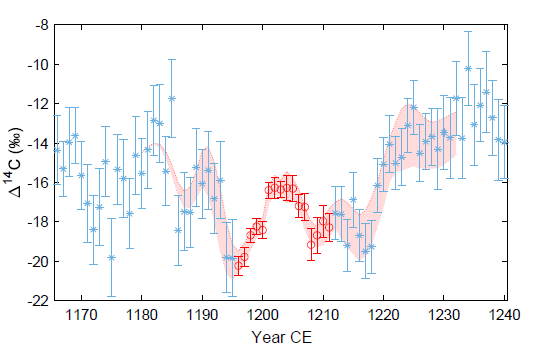
On February 21 and 23 of 1201 AD, a Japanese poet wrote of seeing striking red auroras near Kyoto Japan. Someone nearby described the same thing on Feb 22, which makes it an intense three day solar storm. So researchers started looking for carbon 14 in buried wood in Northern Japan, and, voila, they found a huge spike in carbon 14 that suggest a “sub extreme solar proton event”. They rate this is “about 20% of the Miyake event in 774/775, a legendary solar storm.
The carbon 14 data was so detailed they were able to piece together three solar cycles from 1190 – 12:20. Which means the solar cycles then were only 7 – 8 years long, and were extremely active. In modern times we know that longer cycles are slower quieter ones. During the Little Ice Age the cycles were as long as 16 years and there were long periods with no sunspots at all.

Variation of the solar modulation parameter for the past millennium obtained based on carbon-14 data (Brehm et al., 2021).1)
The team found a whole new solar cycle peaking in 1204 that we didn’t know about.
https://www.jstage.jst.go.jp/article/pjab/102/4/102_pjab.102.011/_html/-char/en
From the paper come the descriptions of many solar observations recorded from 800 years ago:
For example, in Meigetsuki, the diary of Fujiwara no Sadaie, a Japanese courtier famous for his poetry, there are descriptions indicating the occurrence of low-latitude red aurorae in Kyoto on February 21 and 23, 1204.6) The sighting of a red aurora is also recorded for February 22 in another historical document, Omuro Soshoki, which remains in Kyoto, suggesting that the intense magnetic storm continued for three consecutive days, making it one of the oldest extreme space weather events documented in historical records. During these three days, red and white stripes were observed toward the north and northeast. This event may be associated with the appearance of a large sunspot with the size of a date palm, as recorded in a Chinese document on February 21, 1204.3) There are also recordings of the sighting of aurorae in the following month in Meigetsuki as well as in a Chinese document2) and a French document.8) In Meigetsuki, there is a description that aurorae were seen over three nights,7) although it was hearsay within the imperial court.
This suggests that solar activity was higher for longer than we thought during the Medieval Warm Period (MWP). It’s more evidence that solar activity correlates with the global temperatures.
It’s remarkable to see how many space weather events are recorded:
| Date | Location | Reference | |||
|---|---|---|---|---|---|
| 1193 | Jan 22 | red aurora | China | Beijing Astronomical Observatory, 19882) | |
| 1193 | (Apr 4–May 2) | red aurora | China | Beijing Astronomical Observatory, 19882) | |
| 1193 | Dec 3–12 | sunspot | China | Abbott and Juhl, 20163) | |
| 1194 | Oct 23 | red aurora | China | Beijing Astronomical Observatory, 19882) | |
| 1200 | Aug 11 | red aurora | Italy | Fritz, 18734) | |
| 1200 | Sep 19 | sunspot | Korea | Abbott and Juhl, 20163) | |
| 1200 | Sep 21–26 | sunspot | China | Abbott and Juhl, 20163) | |
| * | 1200 | (Nov 9–Dec 7) | red aurora | China | Beijing Astronomical Observatory, 19882) |
| * | 1201 | Jan 9–29 | sunspot | China | Abbott and Juhl, 20163) |
| * | 1201 | Apr 6 | sunspot | Korea | Abbott and Juhl, 20163) |
| 1202 | Aug 23 | sunspot | Korea | Abbott and Juhl, 20163) | |
| 1202 | Dec 19–31 | sunspot | China | Abbott and Juhl, 20163) | |
| 1202 | Dec 19 | red aurora | Japan (Kyoto) | Centr. Met. Obs. and Mar. Met. Obs. of Japan, 19395) | |
| 1203 | Apr 1–3 | red aurora | Germany | Fritz, 18734) | |
| 1204 | Feb 3–5 | sunspot | Korea | Abbott and Juhl, 20163) | |
| 1204 | Feb 21 | sunspot | China | Abbott and Juhl, 20163) | |
| 1204 | Feb 21–23 | red aurora | Japan (Kyoto) | Meigetsuki and Omuro Soshoki (see Kataoka et al., 20176)) | |
| 1204 | Mar 29 | red aurora | China | Beijing Astronomical Observatory, 19882); Kataoka et al., 20176) | |
| 1204 | Mar 28–30‡ | red aurora | Japan (Kyoto) | Meigetsuki (see Inamura, 20027) and Kataoka et al., 20176)) | |
| 1204 | (Mar 8–Apr 7) | red aurora | France | Kataoka et al., 20176); Brial, 18228) | |
| 1204 | (Apr 2–May 1) | red aurora | China | Beijing Astronomical Observatory, 19882) | |
| 1204 | (Apr–Jun) | red aurora | Germany | Fritz, 18734) | |
| 1205 | Jan 20 | red aurora | Japan (Kyoto) | Meigetsuki (see Inamura, 20027)) | |
| 1205 | May 4 | sunspot | China | Abbott and Juhl, 20163) | |
| 1205 | Oct 8 | red aurora | China | Beijing Astronomical Observatory, 19882) | |
| 1206 | Oct 10 | red aurora | China | Beijing Astronomical Observatory, 19882) | |
| 1207 | Jan 25 | red aurora | China | Abbott and Juhl, 20163) | |
| 1209 | (March 8–Apr 5) | red aurora | China | Beijing Astronomical Observatory, 19882) | |
| 1210 | (Feb 26–Mar 26) | red aurora | China | Beijing Astronomical Observatory, 19882) | |
| 1211 | Apr 23 | white aurora | China | Beijing Astronomical Observatory, 19882) | |
| 1226 | Apr 13 | pale yellow aurora | China | Beijing Astronomical Observatory, 19882) | |
| 1238 | Dec 5 | sunspot | China | Abbott and Juhl, 20163) | |
‡Heresay within the imperial court.
REFERENCE
Hiroko MIYAHARA, Ryuho KATAOKA, Kazuaki YAMAMOTO, Fuyuki TOKANAI, Toru MORIYA, Mirei TAKEYAMA, Hirohisa SAKURAI, Motonari OHYAMA, Kazuho HORIUCHI, Hideyuki HOTTA. Extremely active Sun from 1190 to 1220 in the Medieval Period: Intercomparison of historical records and tree-ring carbon-14. Proceedings of the Japan Academy, Series B, 2026; 102 (4): 156 DOI: 10.2183/pjab.102.011