By Jo Nova
Two trendlines and the climate distraction converged
Just before Easter, the Page Research Centre put out a policy paper that ought to rivet Australians.
We have so casually sleepwalked (sprinted) blindfolded to the edge of cliff. Twenty years ago we were self-sufficient in liquid fuels, then we got distracted trying to change the rain and clouds in 2100 AD. Meanwhile in 2013, the area of South East Asia under the potential control of China was starting to grow rapidly. It is only now, after we have closed 6 of 8 refineries, banned oil exploration and shale use in some states in an Ode to Gaia, but we find that at a moment’s notice, China could potentially put three quarters of our liquid fuel supply under threat.
“In an Asian war scenario, 76% of our liquid fuel requirements would be in immediate jeopardy.”
The situation in 2013 regarding China’s ability to control supply lines:
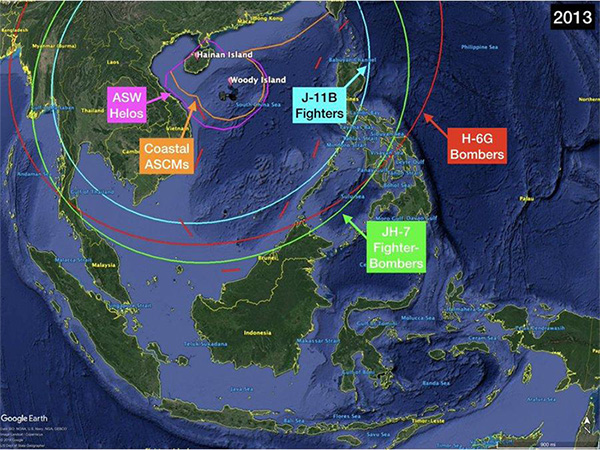
China’s area of denial capacity 2013
But the world is a different place in 2026:
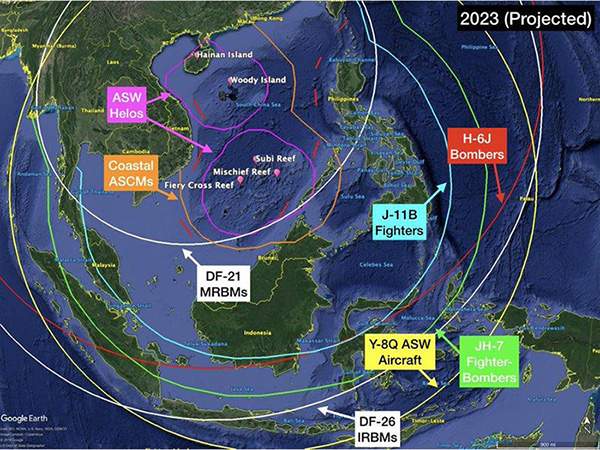
China’s area of denial capacity 2025
How rapidly we ran towards the pit, closing refineries, assuming it didn’t matter even after China had been dishonest about and leaked a bioweapon, revealing a hostile intent, or at best a callous indifference to our health and welfare.
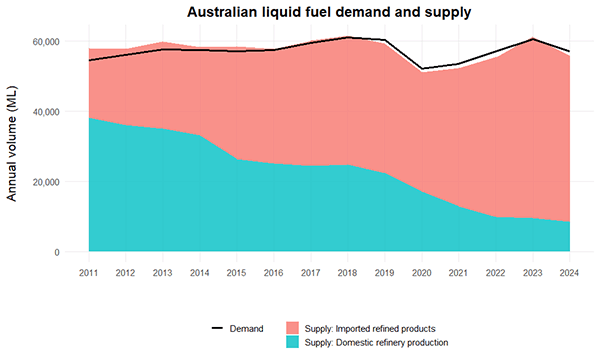
Figure 10 – Australian domestic liquid fuel demand and supply
Remarkably, we don’t use much more petrol than we did 50 years ago. But staggeringly we use nearly five times as much diesel.
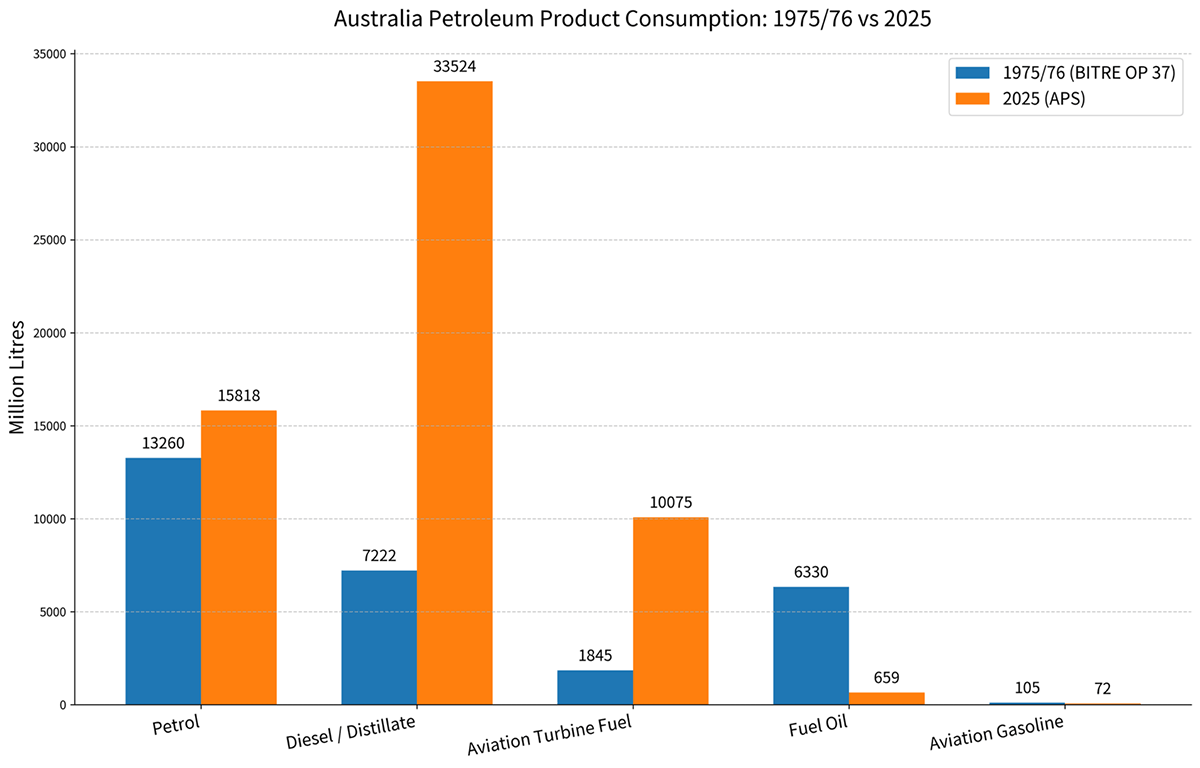
Figure 13 – Comparison of Australian Consumption of major petroleum products in 1975 and 2025 | Page Research Centre
We are a diesel nation that would grind to a halt in days if the ships stopped arriving.
The two authors of the Page Research Report, Gerard Holland and Jude Blik, lay bare the four options we have, three of which aren’t much use:
1. Diversify our sources — (Good for peace-time, but likely to fall in a whole once a war breaks out).
When war breaks out everything changes. Right now, 800 ships are stuck in the Persian Gulf which is about 10% of the official global cargo fleet, not delivering anything to anyone. When 20% of the world is short of oil, no one wants to give it up, so most countries are suddenly competing in the same diversity game.
A disruption anywhere in the global oil chain can change the direction of every ship that we don’t control, and we control none, not a single ship. The Australian merchant fleet is zero. With an acerbic wit, they ask the core question that both sides of government forgot to ask:
“Given the current reserve requirement is 30 days, do we intend to maintain sovereignty and economic function for longer than a month?”
ie. Would you like to still be a country in 30 days?
And as they point out, our fuel stocks are public information, and any malign actor could easily use this vulnerability to extort our submission. Indeed, we are encouraging them to do exactly that:
…an adversary can tailor a naval capability around cutting off our seaborne supplies, knowing that at some certain future point (determined by our reserves, which are publicly known) Australia would be economically crippled. This allows considerable leverage to intimidate us short of conflict breaking out, since their ability to impose catastrophic pain is so clear. This further encourages an opponent to develop such a capability, since the pay-off is clear. With only 30 days of reserves, and near-total dependence on imports, successfully sinking a single convoy would bring us to our knees. Honing the ability to do this has clear returns for an adversary.
2. Increasing our 30 day fuel reserves is a band-aid:
Australia’s pitiful reserves are embarrassing, but we must not be distracted thinking that making them 60 days or 90 days is “the answer”.
Increasing our reserves just makes the bridge-to-nowhere a bit longer if we have no destination — that is, no way to restore our ongoing supply. We are still in danger of falling off the cliff. No matter how long our reserves are, the question that matters is how we ensure our fuel supply in a crisis? Security only comes from self sufficiency.
3. Demand Reduction: “Pretend we don’t need oil”
Painless demand reduction is an illusion. There are no easy efficiency gains left. We use barely any more petrol now than we did in 1976 (See figure 13), even though the national car fleet has increased from 6 million to 20 million vehicles. As the Page Research team note, even during the pandemic lockdowns, with all the pain that brought, we only saw a 20% reduction in total fuel use.
Even if we all caught the bus to school, work, shopping and soccer, (if that were even possible) passenger vehicles only consume 30% of the total liquid fuel demand. And miners and farmers don’t take their 130 ton Haul Trucks, or Combine Harvesters on frivolous trips to the corner store that they can easily do on a bike.
4. Produce oil ourselves
If a real war breaks out, the only protection comes from domestic production. We can drill, baby drill for oil and shale, perhaps even approve some fields in less than seven years, but there’s no time to waste.
We can also store large reserves of crude oil like the US does in salt caverns. Crude oil needs refining, so we’d need to build-back a refinery or two, but it has a long expiry date. And then there’s the biggie — we can convert our coal into liquid fuel. Something that China is doing at the astonishing rate of 380 million tons a year.
Maybe, if we can tame the Maritime Workers Union, the island continent could even afford to own a merchant ship?
There is so much more to say…
Thanks to Aidan Morrison for pointing me at this report, and Vic in Perth.
REFERENCE
Gerard Holland and Jude Blik (2026) All at Sea: Fuel, War, and Australia’s Achilles’ Heel, Page Research Centre. PDF.