
Image by Zdenek Vadura from Pixabay
By Jo Nova
This study kills a few sacred cows at once: it pokes a hole in the idea that less red meat is always better, and that one diet is “the best” for everyone.
Researchers in Sweden followed 2000 people for 15 years, and expected to find that the people with the high risk ApoE4 gene, ate more red meat they would suffer from an increase in dementia. Instead the study showed the opposite. People with the ApoE4 gene who had lower intakes of red meat, had “more than twice” the risk of Alzheimers. But the ApoE4 people with the highest consumption of meat had the same risk as people without the risky gene.
There’s a dark possibility that all those years of Vegan Wokery pushing people to eat less red meat to “save the planet” may have come at the price of an increase in Alzheimers.
ApoE4 is a very unusual variant, it’s both common and yet important — about 30% of the Swedish population have one or two copies of ApoE4, which puts them at significantly greater risk of Alzheimers. Even one copy of the variant increases the risk two or three fold and two copies increases the risk by 10 fold which is really rather bad. Among people with Alzheimers, about 70% have the ApoE4 gene.
To be clear, eating more meat didn’t change the risks of people with the ApoE3 or E2 variants. And processed meat didn’t help anyone. This study suggests that people with the ApoE4 gene need more meat than others. It may be just that red meat is higher in B12, zinc, iron, B6, creatine, carnitine, choline, and taurine and it solves a nutrient deficiency?
But the good news in this study is that people with ApoE4 might be able to reduce their risk with a nice steak or ten.
High meat consumption linked to lower dementia risk in genetic risk group
News from the Karolinska Institutet
Older people with a genetic risk of Alzheimer’s disease did not experience the expected increase in cognitive decline and dementia risk if they consumed relatively large amounts of meat.
At lower meat intake, the group with APOE 3/4 and 4/4 had more than twice the risk of dementia than people without these gene variants. However, the increased risk of cognitive decline and dementia in the risk groups was not seen in the fifth of participants who consumed the most meat. Their median consumption is estimated at approximately 870 grams of meat per week, standardised to a daily energy intake of 2,000 calories.
‘Those who ate more meat overall had significantly slower cognitive decline and a lower risk of dementia, but only if they had the APOE 3/4 or 4/4 gene variants,’ says Jakob Norgren. He continues: ‘There is a lack of dietary research into brain health, and our findings suggest that conventional dietary advice may be unfavourable to a genetically defined subgroup of the population. For those who are aware that they belong to this genetic risk group, the findings offer hope; the risk may be modifiable through lifestyle changes. ‘
Wow — Decreased mortality too?
You might wonder if more red meat decreased dementia in high risk people but then increased heart attacks and cancer. But ApoE4 people eating the highest levels of meat were also more likely to live longer. That suggests there is something very real going on.
The findings also extend beyond brain health. In a follow-up analysis, the researchers observed a significant reduction in all-cause-mortality in carriers of APOE 3/4 and 4/4 with higher consumption of unprocessed meat.
What will the green zealots do when a third of the population argue that putting carbon taxes on cows, or making meat more expensive could increase their risk of dementia?
Who wants to tell the vegans with ApoE4 what the future holds?
This was an observational study, and the people obviously chose their own level of meat consumption. So we don’t necessarily know cause and effect, but there is a dose dependent curve in Figure B which strengthens the idea that the results are not just random noise. And in three graphs below we see a convergence of the lines as meat intake increases. The ApoE4 scores came to resemble the people in the ApoE3 and E2 camp. That looks for all the world like people in the ApoE4 group need something that high levels of meat provides to bring them up to normal.
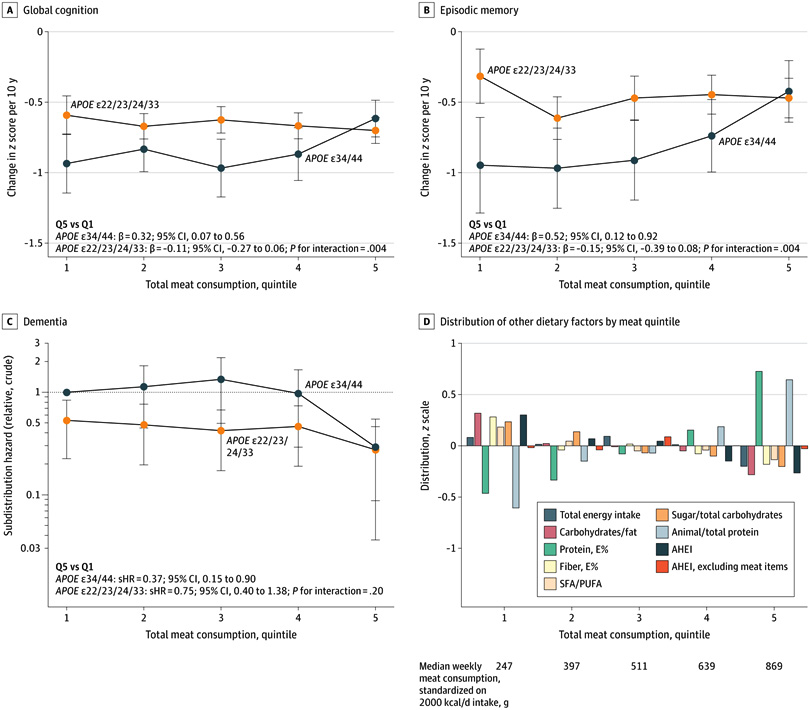
The figure displays 3 cognitive outcomes: global cognition (A), episodic memory (B), and dementia incidence (C), analyzed in the same subsample (1680 participants with ≥1 cognitive follow-up) by quintile (Q) of total meat consumption. Q assignment is based on weight per total energy intake. Linear regression (A and B) was adjusted for age, sex, education, APOE status, living arrangements, occupation type, physical activity level, smoking status, alcohol intake, total energy intake, Alternative Healthy Eating Index (AHEI; calculated without meat items when used as a covariate) score, baseline cognition, and number of chronic diseases. Similar adjustments, except for baseline cognition, were applied to subdistribution hazard ratios (sHRs) in panel C, whereas plotted values are crude to enhance scaling. D, Distributions of other dietary factors by meat quintile are illustrated among all 2157 participants. No factors changed results substantially when added as covariates (eFigure 8 in Supplement 1). As a reference, the shown consumption levels in Q3 to Q5 clearly exceed the Nordic Nutrition Recommendations,33 2023. P values are given for the interaction between exposure (Q5 vs Q1) and APOE genotype. E% indicates energy percentage; SFA/PUFA, saturated/polyunsaturated fatty acids.
This may be the beginning (finally) of customized diets
One day doctors and nutritionists may be able to recommend several different kinds of diets for different people. But at the moment, we will just have to rely on half a billion years of evolution that fine-tuned our taste buds in concert with that dopamine reward system. Those instincts get screwed up by factory food, and additives, but at least it seems to work with unprocessed food.
ApoE4 is the ancient genetic variant
ApoE4 is the original variant in the human population that dates back millions of years. The ApoE3 variant arose about 300,000 years ago, and then the ApoE2 and rarer one only appears after that. The latter two types both carry lower risk of dementia.
‘This study tested the hypothesis that people with APOE 3/4 and 4/4 would have a reduced risk of cognitive decline and dementia with higher meat intake, based on the fact that APOE4 is the evolutionarily oldest variant of the APOE gene and may have arisen during a period when our evolutionary ancestors ate a more animal-based diet,’ says first author Jakob Norgren, researcher at the Department of Neurobiology, Care Sciences and Society, Karolinska Institutet.
The study followed more than 2,100 participants in the Swedish National Study on Aging and Care, Kungsholmen (SNAC-K) for up to 15 years. All were aged 60 or older and had no diagnosis of dementia at the start of the study. The association between self-reported diet and cognitive health measures was analysed, adjusting for age, sex, education and lifestyle factors.
It appears that the ApoE4 variant might help people with better fat absorption and a stronger immune system, but it evolved in a era when hominids ate more meat. (Maybe).
REFERENCE
”Meat Consumption and Cognitive Health by APOE Genotype”, Jakob Norgren, Adrián Carballo-Casla, Giulia Grande, Anne Börjesson-Hanson, Hong Xu, Maria Eriksdotter, Erika J Laukka, Sara Garcia-Ptacek, JAMA Network Open, online March 19, 2026, doi:10.1001/ jamanetworkopen.2026.6489