By Jo Nova
There goes that Big Back-Up Battery plan
It looks like consumers won’t save the Australian grid by spending thousands to buy the batteries the government can’t afford.
Unfortunately, the government has screwed it up again. They’re (we’re) subsiding solar panels and home batteries, and hoping customers will pay thousands to put a battery in their garage so that the grid managers can use it at dinner time to stop wild price spikes and blackouts.
Dean Spaccavento is the co-founder and CEO of Reposit Power –– which sells a controller that connects batteries to solar panels. He says almost no homeowners are signing up for the Virtual Power Plans (VPP) where they share their battery to help balance the grid. People don’t trust the agencies, and even if they did, most of the batteries on the market couldn’t be used in a VPP anyway. They’re not fit for purpose. The government, he said, assumed you could just plug in a battery, but it isn’t like that. “The government’s definition of what qualifies as “VPP ready” is meaningless.” he says, so all the manufacturers can say their battery is “VPP ready” when they’re not.
Only 4 or 5%!
‘A colossal wasted opportunity’: Reposit CEO slams federal cheaper home batteries scheme
Reneweconomy
“No more than 4% or 5% of those batteries will ever participate in a VPP [virtual power plant] based upon data we’ve seen,” he says in the latest episode of Renew Economy’s weekly SwitchedOn Australia podcast.
“That’s just a wasted opportunity. Probably 1.2 maybe 1.3 gigawatt hours of home batteries [have been] installed in the last three months, and 4% — 40 or 50 megawatt hours of that — will actually contribute to the transition of our grid from a coal-fired, gas-fired one to one based upon solar and battery.”
Firstly, he explains, people just don’t trust the VPP idea (Virtual Power Plant).
The first hurdle, he says, is trust.
“People don’t like the VPP thing because they say, I bought this battery. This is my battery, and I don’t want to share it with somebody who’s going to make a bunch of money out of it.”
Maybe if electricity retailers and the government hadn’t told everyone lies about how renewable-energy would be cheap, and how we were saving the world, customers might believe the agencies gave a toss about the people they are supposed to serve?
He is scathing of the poor planning involved:
“They [the government] don’t understand the nature of distributed energy assets and the way they get installed, how they work, the pieces that must work together,” he says. “And I think they assume things that are not true.”
“[They assume] you slap a battery down, you pull some wiring through and bing, bang, boom, hey, look at all those megawatts we could get under control. And it’s absolutely not like that.”
The key question:
“I think there’s an obligation where 17 or $18,000 of public money is being spent, that these devices actually do remain able to participate in a VPP.”
And on top of all that, even batteries that are VPP ready can lose that if something breaks, and no one is checking the batteries. He recommends a quarterly automated performance check. Just another little complexity and another cost to add to the pile.
So this first wave of home batteries are just the poor subsidizing the rich to install batteries. One day they might fix the standards, and the new batteries will be VPP compliant, but the issue of “trust” is only getting worse, not better.
Related Posts:
- Australia becomes a Top Five Battery Nation just as we find out how expensive batteries are — $478/MWh!
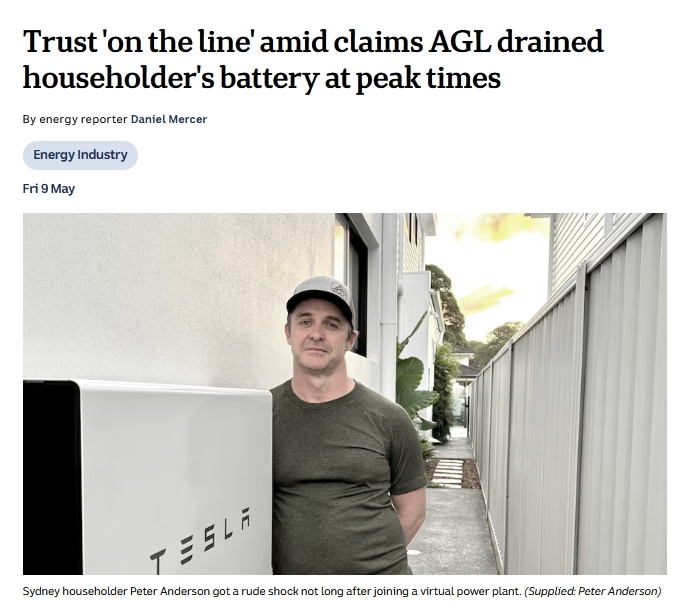
- Buy a battery, join a virtual power plant, and let AGL eat 80% of your battery for dinner
- Secret comms devices, radios, hidden in solar inverters from China. Would you like a Blackout with that?
- Labor wants the working class to help rich people buy batteries